
Market Overview:
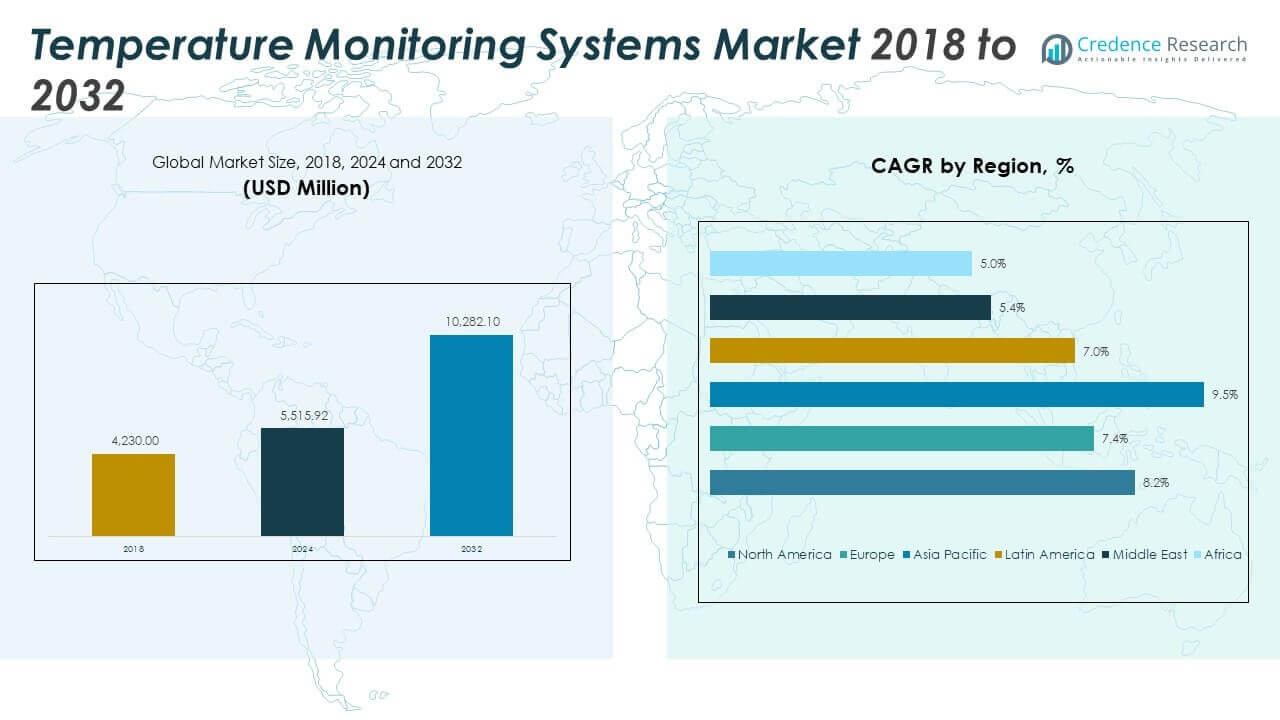
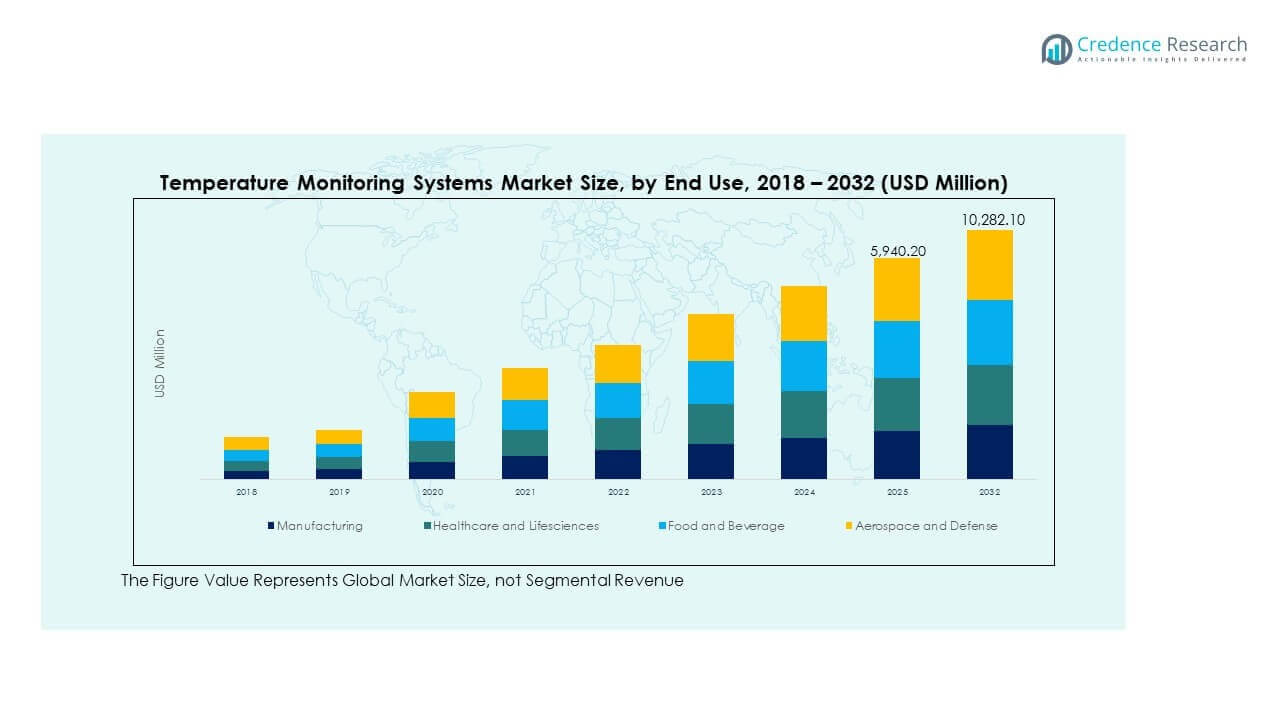
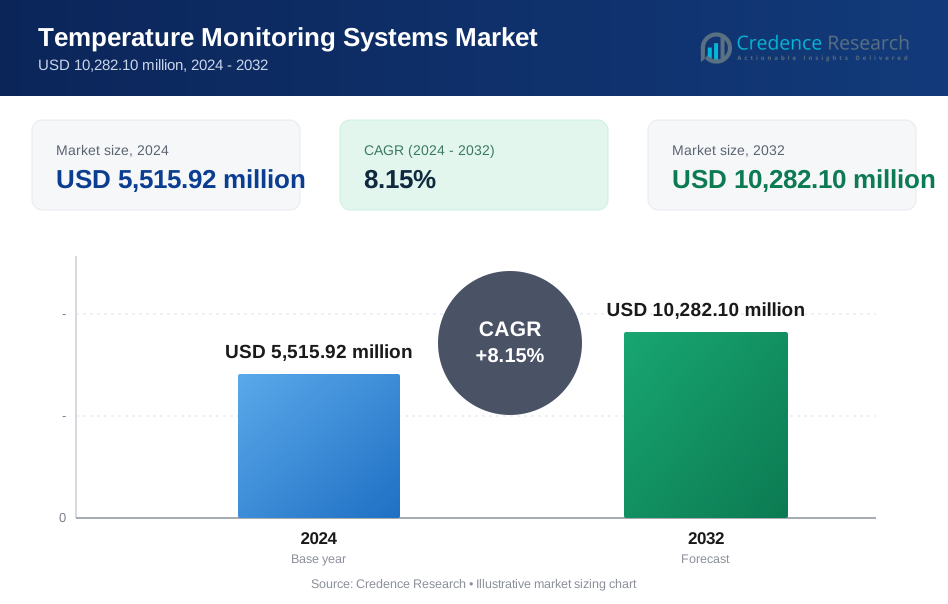
The Global Temperature Monitoring Systems Market size was valued at USD 4,230.00 million in 2018 to USD 5,515.92 million in 2024 and is anticipated to reach USD 10,282.10 million by 2032, at a CAGR of 8.15% during the forecast period.
| REPORT ATTRIBUTE | DETAILS |
|---|---|
| Historical Period | 2020-2023 |
| Base Year | 2024 |
| Forecast Period | 2025-2032 |
| Temperature Monitoring Systems Market Size 2024 | USD 5,515.92 million |
| Temperature Monitoring Systems Market, CAGR | 8.15% |
| Temperature Monitoring Systems Market Size 2032 | USD 10,282.10 million |
Rising demand for real-time monitoring drives strong market growth worldwide. Healthcare providers rely on precise temperature control for vaccines and biologics. Food processors use continuous monitoring to meet safety rules. Data centers deploy advanced sensors to prevent equipment failure. Industrial plants adopt automated systems to support process stability. Smart manufacturing increases the need for connected monitoring platforms. Wireless sensors reduce installation effort and operating cost. Cloud analytics improves alert accuracy and response speed. Regulatory pressure strengthens adoption across regulated industries. Technology upgrades support long-term system reliability.
North America leads due to strict compliance standards and early technology adoption. The United States shows strong demand across healthcare and data centers. Europe follows with focus on food safety and cold chain control. Germany and France invest in industrial monitoring upgrades. Asia Pacific emerges as a high-growth region. China and India expand manufacturing and healthcare infrastructure rapidly. Southeast Asia adopts monitoring systems for food exports. Latin America grows steadily with logistics modernization. Middle East demand rises from energy and infrastructure projects.
Market Insights:
- The market reached USD 4,230.00 million in 2018, grew to USD 5,515.92 million in 2024, and will hit USD 10,282.10 million by 2032, expanding at an 8.15% CAGR.
- North America leads with about 40.8% share, followed by Asia Pacific at 28.0% and Europe at 22.9%, driven by regulation, infrastructure maturity, and strong industrial demand.
- Asia Pacific is the fastest-growing region, holding nearly 28.0% share, supported by manufacturing expansion, healthcare upgrades, and cold chain growth.
- By end use, manufacturing and healthcare & lifesciences together account for about 65% share, reflecting process control needs and strict storage compliance.
- Food and beverage holds roughly 25% share, while aerospace and defense contributes about 10%, supported by safety standards and precision requirements.
Market Drivers:
Strict Regulatory Compliance Across Healthcare, Food, And Industrial Operations
Regulatory frameworks strongly influence technology adoption across regulated industries. Healthcare providers require continuous monitoring to protect vaccines and biologics. Food processors depend on accurate systems to meet safety audits. Pharmaceutical manufacturers enforce temperature logs for quality assurance. The Global Temperature Monitoring Systems Market responds to these compliance-driven needs. Auditors demand traceable data with minimal error margins. Automated alerts support faster corrective action. Manual methods fail to meet modern audit standards. Compliance pressure sustains steady system demand.
- For instance, Sensitech supports pharmaceutical and food logistics with monitoring systems used in more than 170 countries.
Rising Dependence On Real-Time Monitoring For Asset Protection
Industries prioritize asset protection through precise thermal control. Data centers deploy monitoring tools to avoid equipment downtime. Cold storage operators protect high-value inventory through continuous tracking. Manufacturing plants rely on stable temperatures for process consistency. The Global Temperature Monitoring Systems Market benefits from this operational focus. Real-time data reduces loss risk across sectors. Automated alarms prevent delayed responses. System accuracy supports preventive maintenance strategies. Operational reliability drives long-term adoption.
- For instance, Schneider Electric deploys EcoStruxure monitoring across millions of connected devices to protect critical infrastructure.
Expansion Of Cold Chain Infrastructure In Global Logistics Networks
Global trade increases demand for reliable cold chain systems. Logistics providers monitor temperature during transport and storage. Biopharma distribution requires strict thermal control across routes. Food exporters depend on monitoring to maintain product integrity. The Global Temperature Monitoring Systems Market aligns with logistics modernization goals. Wireless sensors support mobile asset tracking. Central dashboards improve shipment visibility. Reduced spoilage improves profit margins. Logistics expansion supports sustained market growth.
Industrial Automation And Digital Transformation Across Manufacturing Sites
Manufacturers invest in automation to improve output consistency. Temperature control plays a central role in automated processes. Smart factories rely on integrated monitoring platforms. Predictive maintenance uses thermal data to detect faults early. The Global Temperature Monitoring Systems Market gains traction from digital upgrades. Sensors integrate with control systems seamlessly. Software analytics improve process optimization. Reduced human intervention improves accuracy. Automation adoption strengthens long-term demand.
Market Trends:
Integration Of Cloud-Based Platforms For Centralized Temperature Analytics
Cloud platforms reshape how monitoring data is managed. Enterprises prefer centralized dashboards for multi-site visibility. Remote access improves response speed during deviations. Data storage supports long-term compliance records. The Global Temperature Monitoring Systems Market adapts to cloud-based architectures. Scalable platforms reduce infrastructure burden. Analytics tools improve decision accuracy. Cloud models support subscription-based deployment. Digital access reshapes user expectations.
- For instance, Emerson offers cloud-enabled temperature analytics supporting multi-site pharmaceutical operations worldwide.
Shift Toward Wireless And Battery-Efficient Sensor Technologies
Wireless sensors gain preference across industrial and commercial sites. Installation becomes faster without extensive cabling. Battery efficiency extends operational life significantly. Portable sensors support flexible deployment needs. The Global Temperature Monitoring Systems Market reflects this hardware shift. Wireless networks reduce maintenance complexity. Signal reliability improves with new protocols. Compact designs fit constrained environments. Mobility drives wider adoption.
Growing Use Of Data Analytics For Predictive And Preventive Control
Advanced analytics enhance the value of monitoring systems. Historical data supports trend analysis and forecasting. Predictive insights reduce unplanned downtime risks. Maintenance teams rely on early warnings for intervention. The Global Temperature Monitoring Systems Market incorporates analytics-driven features. Pattern recognition improves system intelligence. Automated reports support management decisions. Insight-driven operations improve efficiency. Analytics elevate system relevance.
Rising Preference For Integrated Multi-Parameter Monitoring Solutions
Users seek platforms that monitor more than temperature alone. Combined humidity and pressure tracking improves control accuracy. Integrated systems reduce the need for separate devices. Unified interfaces simplify training and operation. The Global Temperature Monitoring Systems Market evolves toward integrated solutions. Consolidation lowers total ownership cost. Single platforms improve data consistency. Cross-parameter insights support better decisions. Integration defines modern system demand.
Market Challenges Analysis:
High Initial Investment And Integration Complexity Across Legacy Systems
Cost remains a major barrier for small operators. Advanced systems require upfront hardware and software investment. Integration with legacy infrastructure creates technical hurdles. Skilled personnel are needed for deployment and calibration. The Global Temperature Monitoring Systems Market faces adoption delays from cost concerns. Budget limits slow upgrades in emerging regions. Custom integration raises project timelines. Complexity increases risk perception among buyers. Cost sensitivity restricts penetration.
Data Security Concerns And Reliability Risks In Connected Environments
Connected systems introduce data security challenges. Unauthorized access threatens sensitive operational information. Network instability affects real-time data accuracy. Users demand strong encryption and system reliability. The Global Temperature Monitoring Systems Market must address trust issues. Cyber risks raise compliance concerns. System downtime impacts critical operations. Reliability assurance becomes a key purchase factor. Security gaps slow adoption decisions.
Market Opportunities:
Rapid Adoption Of Smart Infrastructure In Emerging Economies
Emerging economies invest in smart infrastructure development. Healthcare expansion increases monitoring requirements. Food export growth demands reliable temperature control. Manufacturing hubs modernize operational systems. The Global Temperature Monitoring Systems Market gains new growth avenues. Government digitization supports technology adoption. Local production lowers system costs. Infrastructure upgrades expand addressable markets. Emerging regions offer long-term potential.
Product Innovation Focused On Automation And User-Friendly Design
Manufacturers invest in user-centric product design. Automated calibration reduces manual intervention. Intuitive interfaces shorten training time. Compact devices suit space-limited facilities. The Global Temperature Monitoring Systems Market benefits from innovation focus. Plug-and-play systems speed deployment. Enhanced accuracy improves user trust. Innovation supports differentiation strategies. Product evolution unlocks new applications.
Market Segmentation Analysis:
By Component Type
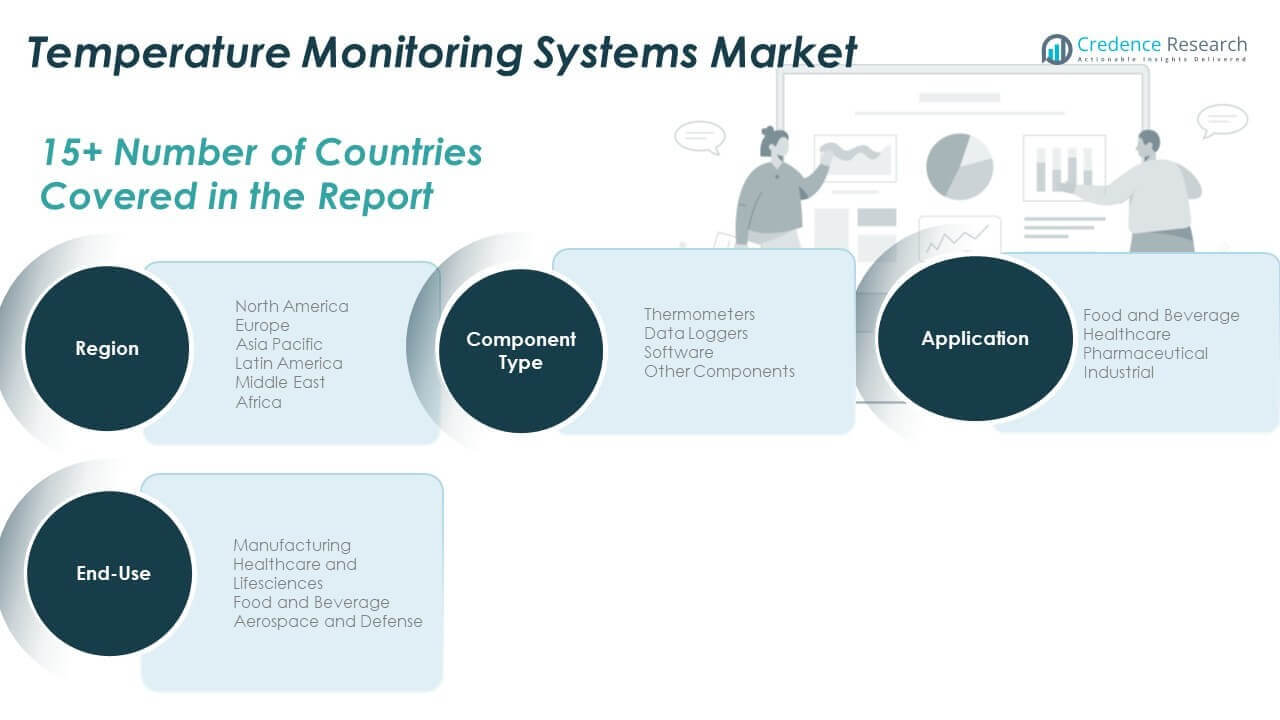
Thermometers serve as core tools for point-based temperature checks across sectors. Data loggers support continuous monitoring and record storage for audits. Software platforms enable centralized control, alerts, and reporting across facilities. Other components include sensors and connectors that support system accuracy. The Global Temperature Monitoring Systems Market relies on this mix for flexible deployment. Hardware ensures measurement reliability while software drives system intelligence. Integrated solutions improve operational control. Component diversity supports varied industry needs.
- For instance, Honeywell integrates sensors, loggers, and software across regulated facilities globally.
By Application
Food and beverage applications depend on strict temperature control for safety compliance. Healthcare settings require precise monitoring for patient care and storage. Pharmaceutical operations use systems to protect sensitive drugs and biologics. Industrial use supports process stability and equipment protection. The Global Temperature Monitoring Systems Market addresses these varied requirements effectively. Each application demands accuracy and reliability. Monitoring systems reduce quality risks. Application breadth sustains steady demand.
- For instance, Siemens supplies monitoring systems across hospitals and manufacturing plants worldwide.
By End-use
Manufacturing facilities use monitoring to maintain process consistency. Healthcare and lifesciences focus on storage and treatment safety. Food and beverage end users rely on systems to prevent spoilage. Aerospace and defense require high-precision control for critical equipment. The Global Temperature Monitoring Systems Market supports these end users with scalable solutions. End-use diversity reduces sector risk. Industry standards shape system design. End-user demand drives continuous innovation.
Segmentation:
By Component Type- Thermometers
- Data Loggers
- Software
- Other Components
- Food and Beverage
- Healthcare
- Pharmaceutical
- Industrial
- Manufacturing
- Healthcare and Lifesciences
- Food and Beverage
- Aerospace and Defense
- North America
- U.S.
- Canada
- Mexico
- Europe
- Germany
- France
- U.K.
- Italy
- Spain
- Rest of Europe
- Asia Pacific
- China
- Japan
- India
- South Korea
- South-east Asia
- Rest of Asia Pacific
- Latin America
- Brazil
- Argentina
- Rest of Latin America
- Middle East & Africa
- GCC Countries
- South Africa
- Rest of the Middle East and Africa
Regional Analysis:
North America
The North America Global Temperature Monitoring Systems Market size was valued at USD 1,746.14 million in 2018 to USD 2,252.67 million in 2024 and is anticipated to reach USD 4,194.09 million by 2032, at a CAGR of 8.2% during the forecast period. North America shows strong technology adoption across industries. Healthcare drives demand through strict storage rules. Data centers deploy systems for uptime protection. Food safety laws strengthen monitoring needs. Manufacturing favors automation-ready solutions. The Global Temperature Monitoring Systems Market benefits from early upgrades. It gains support from digital infrastructure maturity. North America holds about 40.8% market share.
Europe
The Europe Global Temperature Monitoring Systems Market size was valued at USD 1,071.04 million in 2018 to USD 1,340.22 million in 2024 and is anticipated to reach USD 2,354.11 million by 2032, at a CAGR of 7.4% during the forecast period. Europe emphasizes compliance and quality assurance. Food and beverage monitoring remains critical. Pharmaceutical cold storage drives steady adoption. Industrial automation supports system deployment. The Global Temperature Monitoring Systems Market aligns with EU standards. It benefits from sustainability-focused operations. Western Europe leads regional demand. Europe accounts for about 22.9% share.
Asia Pacific
The Asia Pacific Global Temperature Monitoring Systems Market size was valued at USD 1,024.93 million in 2018 to USD 1,396.33 million in 2024 and is anticipated to reach USD 2,874.88 million by 2032, at a CAGR of 9.5% during the forecast period. Asia Pacific records the fastest growth pace. Manufacturing expansion increases monitoring adoption. Healthcare infrastructure upgrades support demand. Food exports require reliable cold chains. The Global Temperature Monitoring Systems Market gains scale here. It benefits from cost-efficient deployments. China and India lead adoption. Asia Pacific holds nearly 28.0% share.
Latin America
The Latin America Global Temperature Monitoring Systems Market size was valued at USD 232.65 million in 2018 to USD 300.01 million in 2024 and is anticipated to reach USD 512.77 million by 2032, at a CAGR of 7.0% during the forecast period. Latin America shows gradual technology penetration. Food processing remains a key driver. Healthcare logistics support system demand. Industrial safety standards improve adoption rates. The Global Temperature Monitoring Systems Market grows steadily here. It benefits from export-driven compliance needs. Brazil leads regional consumption. Latin America holds about 5.0% share.
Middle East
The Middle East Global Temperature Monitoring Systems Market size was valued at USD 88.83 million in 2018 to USD 102.56 million in 2024 and is anticipated to reach USD 155.32 million by 2032, at a CAGR of 5.4% during the forecast period. Middle East demand links to infrastructure growth. Energy and logistics projects drive usage. Healthcare investments support monitoring needs. Food imports require storage control systems. The Global Temperature Monitoring Systems Market expands gradually. It benefits from smart city initiatives. GCC countries lead adoption. Middle East holds nearly 1.5% share.
Africa
The Africa Global Temperature Monitoring Systems Market size was valued at USD 66.41 million in 2018 to USD 124.13 million in 2024 and is anticipated to reach USD 190.93 million by 2032, at a CAGR of 5.0% during the forecast period. Africa shows emerging adoption across sectors. Healthcare cold storage drives key demand. Food distribution needs support system growth. Industrial monitoring remains at early stages. The Global Temperature Monitoring Systems Market develops steadily. It benefits from donor-funded infrastructure projects. South Africa leads regional usage. Africa accounts for about 1.9% share.
Key Player Analysis:
- 3M
- Emerson Electric Co.
- Siemens AG
- Honeywell International Inc.
- TE Connectivity
- Datalogic S.p.A.
- Omron Corporation
- Omega Engineering
- Schneider Electric
- Fluke Corporation
- Danaher Corporation
- Texas Instruments
- Sensirion AG
- Yokogawa Electric Corporation
Competitive Analysis:
The Global Temperature Monitoring Systems Market shows moderate consolidation with strong global and regional players. Companies compete through product accuracy, system reliability, and software capability. Leading players focus on integrated hardware and analytics platforms. Portfolio depth helps firms serve healthcare, food, and industrial users. Strategic partnerships expand geographic reach and customer base. Product differentiation centers on wireless capability and data security. Pricing pressure remains visible in cost-sensitive regions. It benefits from long-term contracts in regulated industries. Competitive intensity stays stable due to high switching costs.
Recent Developments:
- On September 29, 2025, Schneider Electric unveiled a new liquid cooling portfolio with Motivair, featuring CDUs, ChilledDoor Rear Door Heat Exchangers, and direct-to-chip solutions tailored for AI and HPC workloads involving advanced temperature control.
- In March 2025, Emerson Electric Co. completed the acquisition of the remaining outstanding shares of AspenTech, strengthening its end-to-end automation solutions relevant to temperature monitoring systems in industrial applications.
- Danaher Cryogenics, part of Danaher Corporation, acquired the Adiabatic Demagnetization Refrigerator (ADR) Cryostat product line from High Precision Devices on January 7, 2025, expanding sub-Kelvin temperature monitoring capabilities for quantum computing and advanced research applications.
Report Coverage:
The research report offers an in-depth analysis based on Component Type and Application segments. It details leading market players, providing an overview of their business, product offerings, investments, revenue streams, and key applications. Additionally, the report includes insights into the competitive environment, SWOT analysis, current market trends, as well as the primary drivers and constraints. Furthermore, it discusses various factors that have driven market expansion in recent years. The report also explores market dynamics, regulatory scenarios, and technological advancements that are shaping the industry. It assesses the impact of external factors and global economic changes on market growth. Lastly, it provides strategic recommendations for new entrants and established companies to navigate the complexities of the market.
Future Outlook:
- The market will see wider adoption of wireless temperature monitoring systems across regulated industries.
- Software-driven platforms will play a larger role in compliance management and reporting accuracy.
- Healthcare and pharmaceutical cold storage will remain a major source of long-term demand.
- Food safety regulations will continue to support consistent system deployment worldwide.
- Cloud-based monitoring solutions will gain preference for multi-site visibility and control.
- Integration with industrial automation systems will enhance operational efficiency and reliability.
- Emerging economies will attract new investments through infrastructure and healthcare expansion.
- Data security and system reliability will influence purchasing decisions more strongly.
- Compact and portable monitoring devices will expand usage in mobile applications.
- Strategic partnerships will support product innovation and global market expansion.
Request a Free Sample
Fill in your details and we'll send you a free sample report.
- Sample data tables & charts
- Research methodology
Need a Custom Version of This Report?
Tailor the scope, geography, or segments to your exact requirements.
- Custom geography or segment scope
- Direct access to our analyst team
Frequently Asked Questions
What is the current market size for Global Temperature Monitoring Systems Market, and what is its projected size in 2032?
At what Compound Annual Growth Rate is the Global Temperature Monitoring Systems Market projected to grow between 2025 and 2032?
Which Global Temperature Monitoring Systems Market segment held the largest share in 2024?
What are the primary factors fueling the growth of the Global Temperature Monitoring Systems Market?
Who are the leading companies in the Global Temperature Monitoring Systems Market?
Which region commanded the largest share of the Global Temperature Monitoring Systems Market in 2024?
Table of Content
Chapter 1. Report Introduction
- 1.1 Report Description & Purpose
- 1.1.1 Report Title & Market Definition
- 1.1.2 Unique Selling Propositions (USP) & Key Differentiators
- 1.1.3 Value Proposition for Stakeholders
- 1.2 Research Objectives
- 1.2.1 Market Sizing Objectives (Volume & Revenue)
- 1.2.2 Segmentation Objectives
- 1.2.3 Competitive Intelligence Objectives
- 1.2.4 Forecast & Scenario Objectives
- 1.3 Report Scope
- 1.3.1 Temperature Monitoring Systems Scope – Types & Subtypes Covered
- 1.3.2 Geographic Scope – Regions & Countries Covered
- 1.3.3 Historical Period, Base Year & Forecast Period (2024; forecast to 2032)
- 1.3.4 Inclusions & Exclusions
- 1.4 HS Code & Classification Framework
- 1.5 Currency, Units & Pricing Basis
- 1.6 Target Stakeholders
- 1.7 Limitations & Assumptions
Chapter 2. Executive Summary
- 2.1 Global Temperature Monitoring Systems Market Snapshot
- 2.1.1 Market Size – Historical (2024) & Forecast (2024-2032) (2024: USD 5,515.92 million → 2032: USD 10,282.10 million)
- 2.1.2 Volume & Revenue – Global Totals
- 2.1.3 Key Market Highlights – Top Five Facts
- 2.2 Temperature Monitoring Systems Market Segmentation Snapshot
- 2.2.1 Market Split by Region – 2024 vs. 2032
- 2.3 Competitive Snapshot
- 2.3.1 Top 10 Players by Revenue Share – 2024
- 2.3.2 Top 10 Players by Volume Share – 2024
- 2.3.3 Recent Strategic Developments (18-Month Summary)
- 2.4 Key Investment Highlights & Strategic Conclusions
Chapter 3. Temperature Monitoring Systems Market Dynamics & Industry Analysis
- 3.1 Market Overview & Context
- 3.1.1 Temperature Monitoring Systems Market Position in the Broader Automotive Value Chain
- 3.1.2 OEM vs. Replacement Market Dynamics
- 3.1.3 Market Maturity & Development Stage by Region
- 3.2 Temperature Monitoring Systems Market Drivers
- 3.3 Temperature Monitoring Systems Market Restraints & Challenges
- 3.4 Temperature Monitoring Systems Market Opportunities
- 3.5 Porter's Five Forces Analysis
- 3.5.1 Threat of New Entrants
- 3.5.2 Bargaining Power of Suppliers
- 3.5.3 Bargaining Power of Buyers
- 3.5.4 Threat of Substitutes
- 3.5.5 Competitive Rivalry – Intensity Assessment
- 3.6 Temperature Monitoring Systems Value Chain Analysis
- 3.6.1 Upstream – Raw Material/Input Suppliers
- 3.6.1.1 Raw Material/Input 1
- 3.6.1.2 Raw Material/Input 2
- 3.6.1.3 Raw Material/Input 3
- 3.6.2 Midstream – Production/Manufacturing/Service Delivery
- 3.6.2.1 Production/Process Overview
- 3.6.2.2 Key Facility Locations & Capacity by Manufacturer
- 3.6.3 Downstream – Distribution & End Consumer
- 3.6.3.1 Primary Channel – B2B/OEM
- 3.6.3.2 Secondary Channels – Dealer, Retail, Online, Direct
- 3.6.4 Value Chain Profitability Analysis
- 3.6.1 Upstream – Raw Material/Input Suppliers
- 3.7 PESTEL Analysis
- 3.7.1 Political Factors
- 3.7.2 Economic Factors
- 3.7.3 Social Factors
- 3.7.4 Technological Factors
- 3.7.5 Environmental Factors
- 3.7.6 Legal Factors
- 3.8 Temperature Monitoring Systems Supply Chain Analysis
- 3.8.1 Raw Material/Input Supply Risk Assessment
- 3.8.2 Manufacturing Concentration Risk (Geographic Exposure)
- 3.8.3 Trade Disruption Impact Analysis
- 3.9 Regulatory & Policy Landscape
Note: The regulatory and policy landscape section covers regulations based on their applicability to the market, Temperature Monitoring Systems category, geography, and scope of the study. Only regulatory frameworks with a material impact on operations, compliance, trade, sustainability, or market access are analyzed in detail.
Chapter 4. Key Investment Pockets & Opportunity Analysis
- 4.1 Temperature Monitoring Systems Market Attractiveness Analysis
- 4.1.1 By Region – Investment Attractiveness Matrix (Volume × CAGR)
- 4.2 Absolute Revenue Growth Opportunity
- 4.2.1 By Region – Absolute USD Growth Through 2032
- 4.3 Incremental Volume Opportunity
- 4.3.1 By Region – Incremental Volume Through 2032
- 4.3.2 Segment – Incremental Volume
- 4.4 Emerging Submarket Opportunity Deep Dive (Subject to Applicability)
- 4.5 Emerging Market Opportunity Scorecards
- 4.5.1 United States
- 4.5.2 Europe
- 4.5.3 Asia
- 4.5.4 Middle East & Africa
Note: Emerging Market Opportunity Scorecards will be included based on relevance and strategic importance. Regions listed are indicative and may vary depending on data availability and market dynamics.
Chapter 5. Temperature Monitoring Systems Import-Export Analysis & Trade Flows
- 5.1 Global Trade Overview
- 5.1.1 Global Export Value by Country (2024)
- 5.1.2 Global Export Volume by Country (2024)
- 5.1.3 Global Import Value by Country (2024)
- 5.1.4 Global Import Volume by Country (2024)
- 5.1.5 Net Trade Balance by Country (2024)
- 5.2 Export Analysis – Segment
- 5.2.1 Type 1 (HS Code)
- 5.2.2 Type 2 (HS Code)
- 5.2.3 Type 3 (HS Code)
- 5.2.4 Type 4 (HS Code)
- 5.2.5 Type 5 (HS Code)
- 5.3 Import Analysis – Segment
- 5.3.1 Type 1 (HS Code)
- 5.3.2 Type 2 (HS Code)
- 5.3.3 Type 3 (HS Code)
- 5.3.4 Type 4 (HS Code)
- 5.3.5 Type 5 (HS Code)
- 5.4 Average Unit Trade Prices
- 5.4.1 Average Export Price – Segment & Country
- 5.4.2 Average Import Price – Segment & Source Country
- 5.4.3 Price Trends (2024)
- 5.5 Key Trade Route Analysis
- 5.5.1 Trade Route 1
- 5.5.2 Trade Route 2
- 5.5.3 Trade Route 3
- 5.5.4 Trade Route 4
- 5.5.5 Trade Route 5
- 5.6 Trade Policy Impact Assessment
- 5.6.1 US Anti-Dumping & Section 301 Tariffs
- 5.6.2 EU Customs Union Impact
- 5.6.3 Major Free Trade Agreements
- 5.6.4 USMCA Rules of Origin
Note: Trade policy analysis will be included only where relevant to the Temperature Monitoring Systems market.
Chapter 6. Competitive Landscape & Company Benchmarking
- 6.1 Temperature Monitoring Systems Market Concentration & Structure
- 6.1.1 Herfindahl-Hirschman Index (HHI) – vs. 2024
- 6.1.2 Tier 1, Tier 2 & Tier 3 Market Structure
- 6.1.3 Global, Regional & Local Player Dynamics
- 6.2 Temperature Monitoring Systems Market Share Analysis – 2024
- 6.2.1 Global Revenue Share by Company
- 6.2.2 Global Volume Share by Company
- 6.2.3 Regional Revenue Share
- 6.2.4 Market Share Evolution ( vs. 2024)
- 6.2.5 OEM Segment Share by Company
- 6.2.6 Replacement Segment Share by Company
- 6.3 Production/Delivery Capacity & Facility Analysis
- 6.3.1 Global Installed Capacity
- 6.3.2 Capacity Utilization Rates
- 6.3.3 Production/Output Volume
- 6.3.4 Facility Locations & Capacity Map
- 6.3.5 Planned Capacity Additions
- 6.4 Temperature Monitoring Systems Competitive Benchmarking Matrix
- 6.4.1 Revenue, Volume, CAGR & Profitability Comparison
- 6.4.2 Channel Revenue Mix
- 6.4.3 Geographic Revenue Exposure
- 6.4.4 R&D Intensity
- 6.4.5 Sustainability Maturity
- 6.5 Strategic Developments in Temperature Monitoring Systems (Last 24 Months)
- 6.5.1 Mergers, Acquisitions & Divestments
- 6.5.2 New Temperature Monitoring Systems Launches
- 6.5.3 Facility Expansions
- 6.5.4 Strategic Alliances, Joint Ventures & Partnerships
- 6.5.5 Distribution Expansion & Market Entry
- 6.5.6 Sustainability & ESG Initiatives
- 6.6 Competitive Strategy Mapping
- 6.6.1 Leader, Challenger, Follower & Niche Classification
- 6.6.2 Pricing Strategy Comparison
- 6.6.3 Channel Strategy Matrix
Note: Strategic developments are included based on their materiality and the availability of reliable information.
Chapter 7. Global Temperature Monitoring Systems Market – By Distribution Channel
- 7.1 Segment Overview
- 7.1.1 Volume & Revenue Split by Channel (2024 & 2032)
- 7.1.2 Channel Mix Evolution (2024-2032)
Chapter 8. Regional Market Analysis – Global Overview
- 8.1 Global Regional Overview
- 8.1.1 Regional Volume Share
- 8.1.2 Regional Revenue Share
- 8.1.3 Regional Volume by Region
- 8.1.4 Regional Revenue by Region
- 8.1.5 Regional Forecast Through 2032
- 8.2 Cross-Regional Segment Analysis
- 8.2.1 By Distribution Channel
- 8.2.2 By Brand/Price Tier
Chapter 9. North America Temperature Monitoring Systems Market
- 9.1 United States
- 9.2 Canada
- 9.3 Mexico
Chapter 10. Europe Temperature Monitoring Systems Market
- 10.1 Germany
- 10.2 France
- 10.3 Italy
- 10.4 United Kingdom
- 10.5 Spain
- 10.6 Poland
- 10.7 Russia
- 10.8 Netherlands
- 10.9 Belgium
- 10.10 Sweden
- 10.11 Denmark
- 10.12 Norway
- 10.13 Rest of Europe
Chapter 11. Asia Pacific Temperature Monitoring Systems Market
- 11.1 China
- 11.2 India
- 11.3 Japan
- 11.4 South Korea
- 11.5 Thailand
- 11.6 Indonesia
- 11.7 Vietnam
- 11.8 Malaysia
- 11.9 Australia
- 11.10 Rest of Asia Pacific
Chapter 12. Latin America Temperature Monitoring Systems Market
- 12.1 Brazil
- 12.2 Argentina
- 12.3 Colombia
- 12.4 Chile
- 12.5 Rest of Latin America
Chapter 13. Middle East Temperature Monitoring Systems Market
- 13.1 Saudi Arabia
- 13.2 United Arab Emirates
- 13.3 Turkey
- 13.4 Israel
- 13.5 Iran
- 13.6 Rest of the Middle East
Chapter 14. Africa Temperature Monitoring Systems Market
- 14.1 South Africa
- 14.2 Egypt
- 14.3 Nigeria
- 14.4 Morocco
- 14.5 Rest of Africa
Chapter 15. Temperature Monitoring Systems Company Profiles
- 15.1 [Company 01]
- 15.1.1 Company Overview
- 15.1.2 Key Management Personnel
- 15.1.3 Products & Services Portfolio
- 15.1.4 Financial Performance
- 15.1.5 Key Market Focus & Geographic Presence
- 15.1.6 Recent Developments & Strategic Initiatives
Note: The company profile list is preliminary and may change based on research findings, market developments, data availability, and client requirements.
Chapter 16. Appendices
- Appendix A – List of Abbreviations & Acronyms
- Appendix B – Industry Classification Code Reference – Full Series
- Appendix C – Production & Capacity Data Tables
- Appendix D – End-Use & Demand Base Tables
- Appendix E – Consumption & Replacement Rate Assumptions
- Appendix F – ASP Reference Tables
- Appendix G – Manufacturing & Facility Database
- Appendix H – Import-Export Data Tables
- Appendix I – Regulatory Summary Tables
- Appendix J – Primary Research Participant List (Anonymized)
- Appendix K – Primary Research Questionnaire Framework
- Appendix L – Data Sources & Bibliography
- Appendix M – Market Size Divergence & Source Comparison
Chapter 17. Research Methodology
- 17.1 Research Framework & Philosophy
- 17.2 Secondary Research – Sources, Hierarchy & Data Extraction
- 17.3 Data Modeling – Bottom-Up & Top-Down Market Sizing
- 17.4 Primary Research – Stakeholder Framework, LOI & Sample Sizes
- 17.5 Forecast Methodology – Regression, Scenario & Sensitivity Analysis
- 17.6 Quality Control – Four-Layer Validation Framework
- 17.7 Limitations & Standard Assumptions
- 17.8 Disclaimer
