
Market Overview:
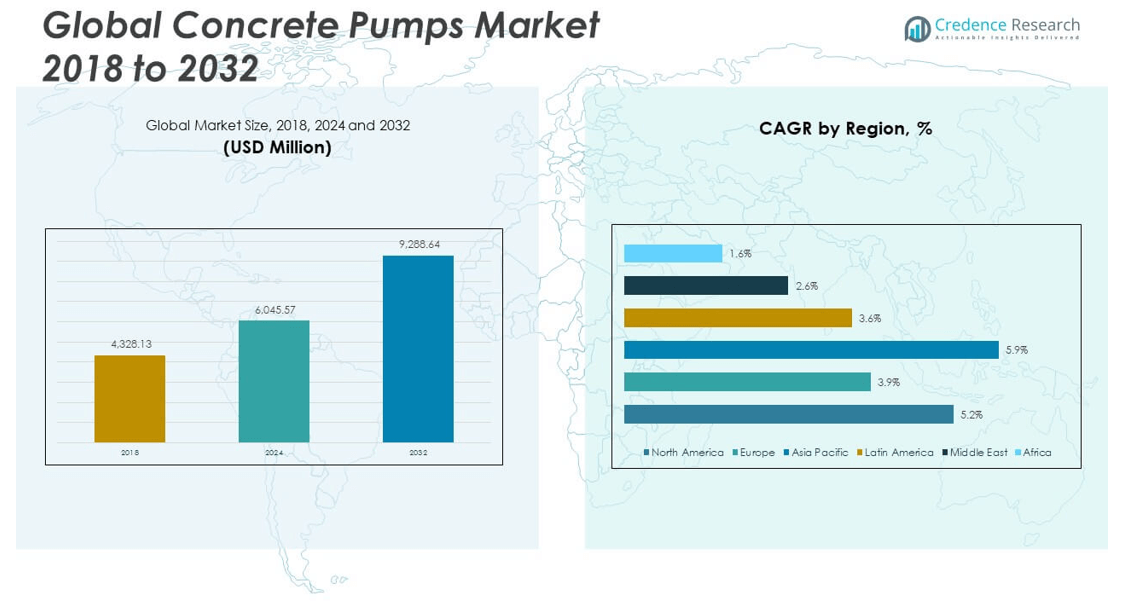
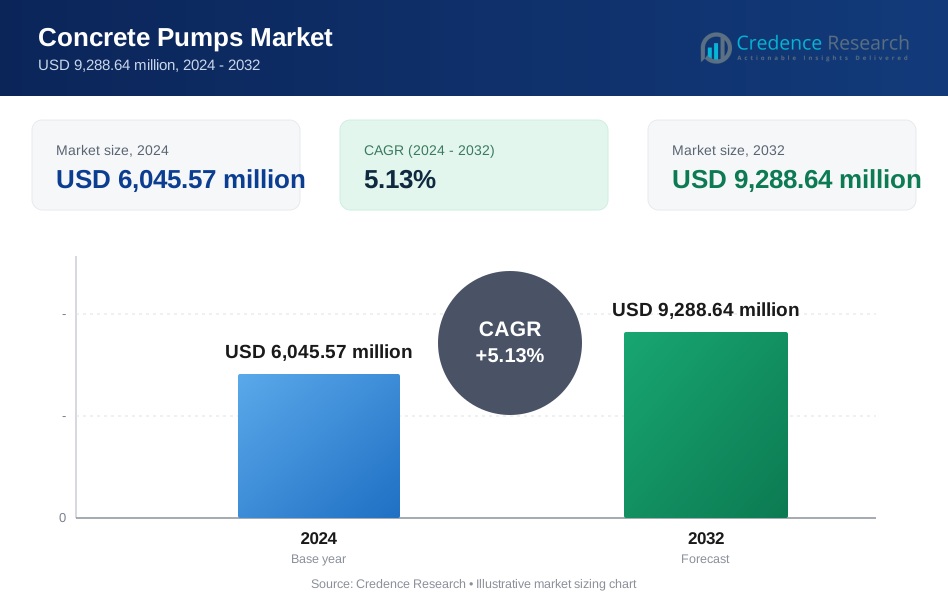
The Global Concrete Pumps Market size was valued at USD 4,328.13 million in 2018 to USD 6,045.57 million in 2024 and is anticipated to reach USD 9,288.64 million by 2032, at a CAGR of 5.13% during the forecast period.
| REPORT ATTRIBUTE | DETAILS |
|---|---|
| Historical Period | 2020-2023 |
| Base Year | 2024 |
| Forecast Period | 2025-2032 |
| Concrete Pumps Market Size 2024 | USD 6,045.57 million |
| Concrete Pumps Market, CAGR | 5.13% |
| Concrete Pumps Market Size 2032 | USD 9,288.64 million |
The market is witnessing strong demand due to the rapid expansion of infrastructure projects, rising urbanization, and growing investments in commercial and residential construction. Increasing adoption of advanced pumping technologies improves efficiency and reduces labor costs, making them essential for modern construction needs. Additionally, government initiatives to develop smart cities, coupled with rising demand for high-rise structures, are fueling the integration of concrete pumps into large-scale projects. Manufacturers are also innovating with energy-efficient and environmentally friendly designs to align with sustainability goals.
Asia-Pacific dominates the market, driven by large-scale urban infrastructure development in China, India, and Southeast Asia. North America holds a substantial share, supported by ongoing infrastructure rehabilitation and advanced construction practices. Europe remains a mature market, with demand supported by modernization projects and strict environmental standards. Emerging markets in Africa and the Middle East are experiencing growing adoption, fueled by rising construction activities and government-led infrastructure investments.
Market Insights:
- The Global Concrete Pumps Market size was valued at USD 4,328.13 million in 2018, reached USD 6,045.57 million in 2024, and is projected to attain USD 9,288.64 million by 2032, registering a CAGR of 5.13% during the forecast period.
- Rising urbanization and large-scale infrastructure projects are driving demand, supported by increased adoption of advanced pumping technologies for high-rise and complex construction works.
- Government initiatives promoting sustainable construction practices are boosting the integration of energy-efficient and environmentally friendly concrete pump designs.
- High capital costs, ongoing maintenance expenses, and the shortage of skilled operators are restraining adoption in cost-sensitive and emerging markets.
- Asia-Pacific leads the market due to rapid infrastructure expansion in China, India, and Southeast Asia, with North America holding a significant share from modernization and rehabilitation projects.
- Europe remains a mature market focused on compliance with environmental regulations and modernization of aging infrastructure, while emerging economies in Africa and the Middle East are witnessing accelerated growth.
- Increasing demand for specialized pumps in offshore, marine, and large-scale industrial projects presents lucrative opportunities for manufacturers and service providers.
Market Drivers:
Rapid Urbanization and Expanding Infrastructure Projects Across Emerging Economies:
The Global Concrete Pumps Market is benefiting from a surge in infrastructure development projects across rapidly urbanizing economies. Governments are prioritizing investments in transportation networks, bridges, and smart city projects to support economic growth. High-rise residential and commercial buildings are increasing in number, requiring efficient concrete placement solutions. Concrete pumps enable faster construction timelines, improved precision, and reduced manpower dependency. Their ability to transport concrete to challenging heights and distances makes them indispensable in urban megaprojects. Emerging economies such as India, China, and Indonesia are driving demand with large-scale public and private construction initiatives. It is also gaining momentum from the rehabilitation of aging infrastructure in developed regions. The combination of urban growth and modernization is creating sustained market momentum.
- For instance, Sany Heavy Industry Co. Ltd. has developed concrete pumps with output capacities exceeding 150 m³/h and boom reaches up to 63 meters, enabling efficient concrete delivery to high-rise buildings in dense urban environments in China and India. Their advanced hydraulic systems support continuous pumping operations, reducing project cycle times significantly.
Increasing Preference for Mechanized Concrete Placement in High-Density Projects:
Construction companies are shifting toward mechanized methods for concrete placement to improve productivity and reduce labor costs. The Global Concrete Pumps Market is seeing adoption from builders seeking greater efficiency in congested urban sites. Concrete pumps allow continuous pouring with minimal delays, supporting large-scale structural work. Their use reduces manual handling risks and ensures uniform concrete distribution. High-density areas benefit from the mobility and reach of boom and line pumps, which can navigate space constraints effectively. Regulatory standards for construction quality and safety are reinforcing this transition. Advanced pump technologies are enabling better output control and improved material handling. Contractors recognize the role of mechanization in meeting project deadlines and quality benchmarks.
- For instance, Concord Concrete Pumps is recognized for line pumps delivering up to around 70 cubic meters per hour with integrated real-time monitoring for uniform concrete flow and safety assurance in urban sites.
Technological Advancements Enhancing Performance and Operational Efficiency:
The integration of advanced hydraulic systems, automated controls, and telematics is transforming the performance of modern concrete pumps. The Global Concrete Pumps Market is adopting solutions that optimize pumping pressure, reduce energy consumption, and enhance precision. GPS-enabled monitoring allows operators to track pump usage, maintenance schedules, and performance metrics in real time. Intelligent control systems are improving concrete flow consistency while minimizing material waste. Manufacturers are also introducing designs with reduced emissions to comply with environmental regulations. Remote diagnostics and predictive maintenance capabilities are reducing downtime for construction firms. These innovations are making concrete pumps more reliable, user-friendly, and cost-effective. The industry’s technology-driven evolution is reinforcing its role in high-performance construction.
Government Policies and Investments in Sustainable Construction Practices:
Government initiatives promoting sustainable and energy-efficient construction methods are influencing equipment choices. The Global Concrete Pumps Market is aligning with policies that encourage reduced waste, lower emissions, and improved site safety. Public infrastructure projects often mandate the use of advanced machinery to meet environmental and efficiency standards. Subsidies, tax incentives, and financing options for modern construction equipment are increasing adoption rates. Green building certifications and compliance frameworks are pushing contractors to upgrade to more efficient pumping solutions. It is also benefiting from international development programs funding large-scale housing and infrastructure schemes. Collaborative projects between governments and private enterprises are creating new demand streams. The shift toward sustainability is not only regulatory but also market-driven, as clients seek eco-conscious solutions.
Market Trends:
Rising Adoption of High-Capacity and Long-Reach Boom Pumps for Mega Projects:
Large-scale infrastructure and commercial projects are driving demand for high-capacity boom pumps capable of delivering concrete over extended heights and distances. The Global Concrete Pumps Market is witnessing significant upgrades in boom length, stability, and pumping capacity. These pumps enable continuous concrete delivery for skyscrapers, bridges, and dams without frequent repositioning. Their enhanced flexibility improves efficiency on complex construction sites. Manufacturers are investing in lightweight yet robust materials to increase mobility without compromising performance. Contractors prefer these advanced pumps to manage tight deadlines and challenging project requirements. The trend is particularly evident in regions executing multi-billion-dollar infrastructure programs. The focus on versatility and reach is shaping product innovation strategies across the industry.
- For instance, Liebherr’s THS 140 crawler concrete pump, showcased in 2025, supports boom reaches of approximately 42 meters and can sustain pumping pressures up to 85 bar (8.5 MPa).
Integration of Digital Monitoring and Automation for Precision Operations:
Digitalization is becoming a defining trend, with concrete pumps increasingly equipped with IoT-enabled sensors and automation features. The Global Concrete Pumps Market is leveraging data-driven solutions to optimize operations and reduce operational risks. Real-time monitoring of pump performance allows proactive maintenance, avoiding costly breakdowns. Automated controls enhance pumping precision, ensuring consistent concrete quality. Smart diagnostics streamline troubleshooting processes, improving uptime for contractors. Data analytics help construction managers assess equipment productivity and plan future operations. Automated safety features are reducing workplace incidents and improving compliance with regulations. The adoption of digital tools is setting new standards for operational excellence in the sector.
- For instance, The smart diagnostic system enhances uptime and ensures pumping precision, particularly in European and overseas markets, reflecting a trend toward automation and data utilization in the concrete.
Emergence of Electric and Hybrid Concrete Pumps for Environmental Compliance:
With stricter environmental regulations, there is growing interest in electric and hybrid concrete pump models. The Global Concrete Pumps Market is responding with equipment that reduces emissions, noise, and energy consumption. Electric pumps are particularly suitable for urban and indoor projects where low noise levels are essential. Hybrid models offer flexibility, switching between fuel and battery power depending on site requirements. These innovations help contractors meet green building standards while reducing operational costs. Governments are supporting the adoption of cleaner machinery through incentives and funding programs. Manufacturers are expanding their electric product portfolios to cater to sustainability-conscious buyers. The move toward eco-friendly pumps is expected to intensify over the next decade.
Expansion of Rental Services to Support Cost-Efficient Project Execution:
The rising cost of purchasing advanced concrete pumps is boosting the rental market. The Global Concrete Pumps Market is seeing strong growth in rental service providers offering flexible leasing options. Contractors prefer rentals for short-term projects or when testing new equipment types. This approach reduces capital expenditure and allows access to the latest technology without ownership burdens. Rental companies are expanding their fleets with advanced models to attract high-value contracts. On-demand availability of specialized pumps supports rapid project mobilization. The trend benefits small and medium-sized construction firms that prioritize cost control. Strategic partnerships between equipment manufacturers and rental firms are also gaining traction.
Market Challenges Analysis:
High Capital Costs and Maintenance Expenses Limiting Widespread Adoption:
The acquisition of advanced concrete pumping equipment requires significant upfront investment, which can deter small and medium-sized contractors. The Global Concrete Pumps Market faces adoption barriers in price-sensitive regions where project budgets are tight. High-capacity boom pumps, in particular, involve substantial procurement and operational costs. Regular maintenance, spare parts, and skilled operators further add to the expense. Fluctuating raw material prices can increase manufacturing costs, impacting affordability for buyers. Financing options may not always be accessible to smaller firms, limiting their ability to upgrade equipment. It is also impacted by the challenge of balancing advanced technology integration with cost competitiveness. Addressing the cost barrier remains critical for market penetration in developing economies.
Shortage of Skilled Operators and Complex Equipment Handling Requirements:
Concrete pumps require trained operators capable of managing complex machinery under varying site conditions. The Global Concrete Pumps Market is hindered by a shortage of skilled labor in many construction markets. Modern pumps with advanced control systems demand technical expertise to ensure optimal performance. Inadequate training can lead to inefficiencies, equipment damage, and safety risks. Contractors in remote or emerging markets often struggle to find qualified personnel. The learning curve for new digital and automated features adds to the challenge. Industry stakeholders are emphasizing operator training programs to improve equipment handling capabilities. Bridging the skills gap is essential to fully leverage advanced pumping technologies.
Market Opportunities:
Growing Demand for Specialized Pumps in Large-Scale Infrastructure and Offshore Projects:
Mega infrastructure projects, including highways, bridges, ports, and offshore developments, are creating opportunities for specialized concrete pumps. The Global Concrete Pumps Market is positioned to supply high-performance equipment capable of handling complex and large-scale applications. Pumps with enhanced reach, stability, and efficiency are in demand for projects requiring continuous and precise concrete delivery. Offshore wind farms and marine construction present niche opportunities where robust pumping solutions are essential. It is also benefiting from government-led initiatives to modernize transportation networks and public facilities. Contractors are increasingly seeking equipment tailored to specific project environments. This specialization opens new avenues for product diversification and market expansion.
Expansion Potential in Emerging Economies with Rapid Urban Growth:
Emerging economies with expanding urban populations are witnessing accelerated construction activity. The Global Concrete Pumps Market can capitalize on this momentum by targeting infrastructure and residential development in Asia-Pacific, Africa, and the Middle East. Urban renewal projects, affordable housing schemes, and industrial expansion are driving consistent demand. Equipment financing solutions and rental services can help penetrate cost-sensitive markets. Local partnerships with distributors and construction firms can strengthen market presence. It is also poised to gain from increased foreign investment in infrastructure across these regions. Tailored marketing and after-sales support will enhance adoption rates in these high-growth territories.
Market Segmentation Analysis:
By Pump Type
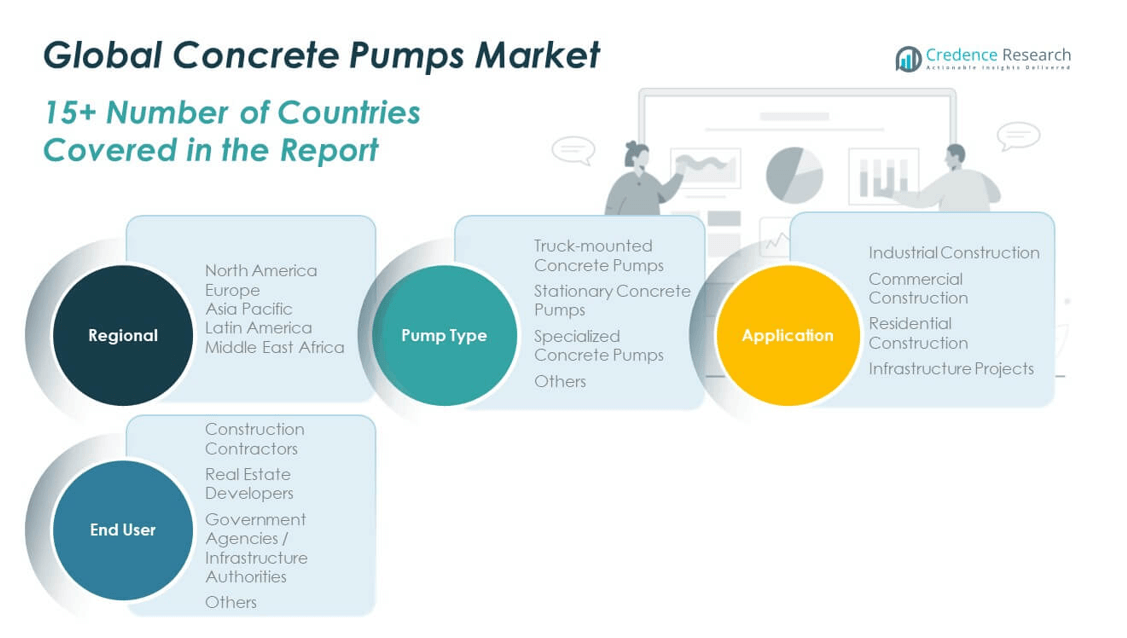
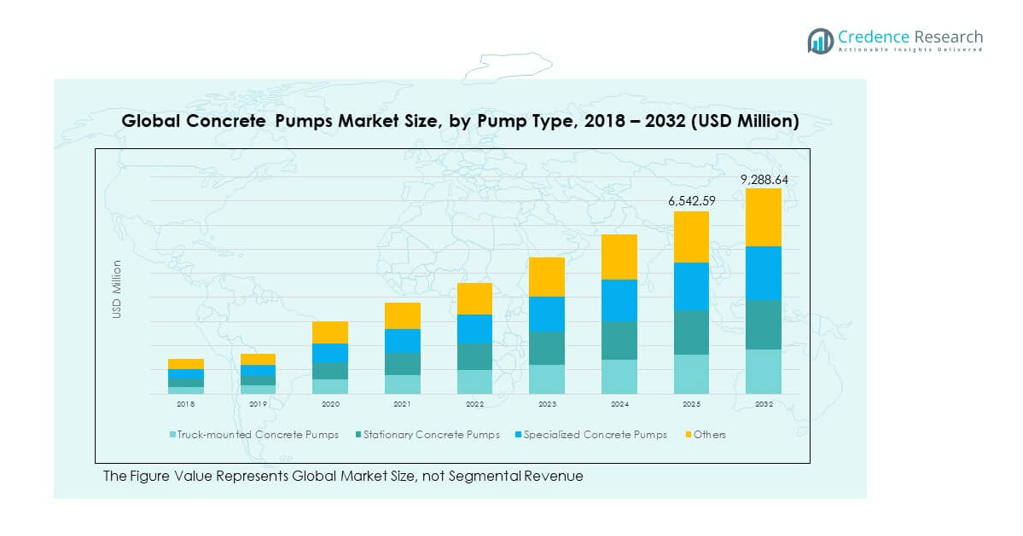
Truck-mounted concrete pumps dominate the segment due to their mobility, extended reach, and suitability for large-scale projects such as high-rise buildings and bridges. Stationary concrete pumps are preferred for long-term and precision-driven projects, particularly in infrastructure development. Specialized concrete pumps cater to niche applications like tunneling and marine works, where tailored performance is required. The “Others” category covers portable and smaller-scale models ideal for limited-access sites or short-duration projects.
- For instance, XCMG Group’s latest truck-mounted concrete pump models can deliver output volumes exceeding 100 cubic meters per hour with boom lengths reaching up to 60 meters.
By Application
Industrial construction projects, including factories, warehouses, and power plants, require high-volume and continuous concrete delivery, driving demand for advanced pumping systems. Commercial construction, encompassing office complexes, shopping centers, and mixed-use developments, supports steady adoption of high-performance solutions. Residential construction benefits from compact, adaptable pumps suitable for high-density urban projects. Infrastructure projects, such as highways, airports, and ports, remain a critical growth driver due to their large-scale requirements.
- For instance, SCHWING Stetter India’s municipal line pumps achieve consistent delivery rates above 50 cubic meters per hour in urban redevelopment projects requiring compact equipment fitting confined construction sites.
By End User
Construction contractors form the largest end-user segment, deploying concrete pumps across diverse project sizes and complexities. Real estate developers rely on efficient pumping systems to accelerate delivery schedules while maintaining quality. Government agencies and infrastructure authorities invest in high-capacity equipment for public works and strategic development projects. The “Others” category includes rental service providers and specialized private operators, highlighting the adaptability of the Global Concrete Pumps Market to varied operational demands.
Segmentation:
By Pump Type
- Truck-mounted Concrete Pumps
- Stationary Concrete Pumps
- Specialized Concrete Pumps
- Others
By Application
- Industrial Construction
- Commercial Construction
- Residential Construction
- Infrastructure Projects
By End User
- Construction Contractors
- Real Estate Developers
- Government Agencies / Infrastructure Authorities
- Others
By Region
- North America
- U.S.
- Canada
- Mexico
- Europe
- UK
- France
- Germany
- Italy
- Spain
- Russia
- Belgium
- Netherlands
- Austria
- Sweden
- Poland
- Denmark
- Switzerland
- Rest of Europe
- Asia Pacific
- China
- Japan
- South Korea
- India
- Australia
- Thailand
- Indonesia
- Vietnam
- Malaysia
- Philippines
- Taiwan
- Rest of Asia Pacific
- Latin America
- Brazil
- Argentina
- Peru
- Chile
- Colombia
- Rest of Latin America
- Middle East
- UAE
- KSA
- Israel
- Turkey
- Iran
- Rest of Middle East
- Africa
- Egypt
- Nigeria
- Algeria
- Morocco
- Rest of Africa
Regional Analysis:
North America
The North America Global Concrete Pumps Market size was valued at USD 1,230.18 million in 2018 to USD 1,690.92 million in 2024 and is anticipated to reach USD 2,609.13 million by 2032, at a CAGR of 5.2% during the forecast period. North America accounts for approximately 28% of the global market share. It is driven by significant investments in infrastructure rehabilitation, highway expansion, and modernization of urban facilities. Large-scale commercial and residential developments are reinforcing the demand for advanced concrete pumping solutions. Contractors in the region prefer high-capacity boom pumps for skyscraper and bridge projects. Strict construction safety and environmental regulations encourage the use of modern, efficient machinery. The market benefits from advanced technology adoption, with telematics and automation becoming standard in equipment. Public-private partnerships and government funding for smart city projects further support growth. The region’s well-developed rental equipment market ensures accessibility for both large and small contractors.
Europe
The Europe Global Concrete Pumps Market size was valued at USD 810.85 million in 2018 to USD 1,070.78 million in 2024 and is anticipated to reach USD 1,496.56 million by 2032, at a CAGR of 3.9% during the forecast period. Europe holds about 18% of the global market share. It is influenced by a mature construction sector focused on renovation, modernization, and energy-efficient upgrades. Stringent EU environmental regulations drive the adoption of low-emission and electric concrete pumps. Demand is strong for projects involving transportation infrastructure, public facilities, and urban redevelopment. Key countries such as Germany, France, and the UK lead in integrating automation and safety features into construction equipment. The market benefits from a high level of skilled labor and established rental service networks. Government-backed green building initiatives are influencing equipment preferences. The emphasis on sustainability is expected to sustain moderate growth.
Asia Pacific
The Asia Pacific Global Concrete Pumps Market size was valued at USD 1,909.70 million in 2018 to USD 2,765.03 million in 2024 and is anticipated to reach USD 4,505.04 million by 2032, at a CAGR of 5.9% during the forecast period. Asia Pacific commands approximately 46% of the global market share, making it the largest regional contributor. It is fueled by rapid urbanization, industrial growth, and massive infrastructure investment, particularly in China, India, and Southeast Asia. Governments are prioritizing high-speed rail, metro networks, highways, and urban housing projects. The construction of high-rise towers and mega-infrastructure requires high-capacity and long-reach pumps. The region benefits from low labor costs but increasingly demands mechanized solutions for efficiency. Foreign direct investments and public-private partnerships are expanding the scope for modern equipment adoption. Local manufacturers are also entering the market, increasing competition and affordability.
Latin America
The Latin America Global Concrete Pumps Market size was valued at USD 212.61 million in 2018 to USD 293.43 million in 2024 and is anticipated to reach USD 401.04 million by 2032, at a CAGR of 3.6% during the forecast period. Latin America accounts for about 5% of the global market share. It is shaped by infrastructure modernization efforts, urban housing demand, and public works projects. Brazil and Mexico lead in adopting advanced pumping solutions for both residential and commercial developments. Political and economic fluctuations influence project funding and equipment procurement. The demand for rental pumps is increasing as contractors seek cost-effective solutions. Growing focus on reducing construction timelines is encouraging the adoption of mechanized concrete placement. Regional government initiatives to improve transportation and energy infrastructure support steady growth. Environmental considerations are also prompting interest in energy-efficient machinery.
Middle East
The Middle East Global Concrete Pumps Market size was valued at USD 108.74 million in 2018 to USD 137.33 million in 2024 and is anticipated to reach USD 173.85 million by 2032, at a CAGR of 2.6% during the forecast period. The Middle East contributes nearly 3% of the global market share. It is characterized by mega construction projects, including airports, stadiums, and luxury residential complexes, particularly in the Gulf Cooperation Council countries. Governments are investing heavily in infrastructure to diversify economies beyond oil dependency. The market demands high-performance equipment capable of operating in extreme climatic conditions. Large-scale events and tourism infrastructure projects fuel equipment rentals and purchases. Contractors value concrete pumps with durability and low maintenance requirements. Sustainability goals are gradually influencing equipment specifications. The pace of growth is moderate due to fluctuating oil revenues impacting project timelines.
Africa
The Africa Global Concrete Pumps Market size was valued at USD 56.04 million in 2018 to USD 88.08 million in 2024 and is anticipated to reach USD 103.01 million by 2032, at a CAGR of 1.6% during the forecast period. Africa holds roughly 1% of the global market share. It is driven by ongoing urban development and infrastructure projects in countries such as South Africa, Nigeria, and Kenya. Demand is concentrated in transportation networks, housing projects, and energy facilities. Limited access to financing and high equipment costs remain key challenges. The rental market plays a crucial role in enabling small and medium contractors to access modern pumping technology. International aid and foreign investments are contributing to infrastructure expansion. Harsh environmental conditions in certain areas require durable and adaptable equipment. The overall market growth remains gradual but consistent with regional development priorities.
Key Player Analysis:
- AJAX Engineering Pvt. Ltd.
- Alliance Concrete Pumps Inc.
- Concord Concrete Pumps Inc.
- DY Concrete Pumps Inc.
- Junjin Concrete Pump Services
- Liebherr
- Sany Heavy Industry Co. Ltd.
- SCHWING Stetter India
- Sebhsa
- XCMG Group
Competitive Analysis:
The Global Concrete Pumps Market features intense competition with a mix of global manufacturers and regional players striving to expand market share. It is shaped by technological advancements, product differentiation, and cost competitiveness. Leading companies focus on developing high-capacity, energy-efficient, and digitally integrated pumping solutions to meet evolving construction demands. Strategic initiatives include mergers, acquisitions, and partnerships to enhance geographic reach and product portfolios. Regional manufacturers leverage localized distribution networks and cost-effective models to compete with multinational brands. Brand reputation, service quality, and after-sales support remain key competitive differentiators. The market rewards innovation and operational efficiency, pushing players to continuously upgrade capabilities.
Recent Developments:
- In April 2025, SCHWING Stetter India announced a strategic partnership with MAX-Truder GmbH, a renowned German machinery firm. This partnership aims to support India’s booming infrastructure sector through innovative, cost-effective precast concrete production technology—facilitating faster, high-quality construction solutions and tapping into the growing demand for premium precast products.
- In April 2025, Liebherr delivered its latest model, the THS 140 crawler concrete pump, to TWF International GmbH at Bauma 2025. The THS 140 is designed for optimal integration with piling and drilling operations, featuring seamless coordination and advanced data analysis for enhanced efficiency and workforce reduction in demanding jobsite environments.
- In August 2024, Alliance Concrete Pumps Inc. expanded its operations by opening a new branch in Fort Worth, Texas. This new full-service facility strengthens their presence in the Southern U.S., allowing quicker delivery of parts, enhanced service support, and local pump refurbishing—representing a strategic expansion to meet growing demand for concrete pumps in the region.
- In January 2024, DY Concrete Pumps Inc. introduced the new HP-3250 Line Pump at World of Concrete in Las Vegas. The HP-3250 features a dual-pressure system for versatile applications and represents an increased focus on the line pump segment. DY Concrete Pumps also announced upcoming launches of the TP-50 and TP-70 trailer pumps and plans to launch a new e-commerce platform for parts in early 2025, which is poised to be a game-changer for client convenience.
Market Concentration & Characteristics:
The Global Concrete Pumps Market is moderately concentrated, with a few major players dominating global sales alongside numerous regional competitors. It is characterized by continuous product innovation, growing demand for high-capacity and specialized pumps, and increasing adoption of digital control systems. The market serves diverse end users, from large construction contractors to government infrastructure agencies, with rental services playing a significant role. Competitive advantage relies on technology, distribution efficiency, and strong after-sales support. Environmental compliance and operational cost efficiency are becoming critical factors shaping purchasing decisions.
Report Coverage:
The research report offers an in-depth analysis based on Pump Type and Application. It details leading market players, providing an overview of their business, product offerings, investments, revenue streams, and key applications. Additionally, the report includes insights into the competitive environment, SWOT analysis, current market trends, as well as the primary drivers and constraints. Furthermore, it discusses various factors that have driven market expansion in recent years. The report also explores market dynamics, regulatory scenarios, and technological advancements that are shaping the industry. It assesses the impact of external factors and global economic changes on market growth. Lastly, it provides strategic recommendations for new entrants and established companies to navigate the complexities of the market.
Future Outlook:
- Rising infrastructure spending will create sustained demand for advanced pumping solutions.
- Adoption of electric and hybrid pumps will expand with stricter environmental regulations.
- Digital monitoring and automation will become standard for high-performance operations.
- Rental services will grow, enabling cost-effective access to advanced equipment.
- Emerging economies will drive demand through urbanization and industrial expansion.
- Specialized pumps for marine and tunneling projects will capture niche opportunities.
- Manufacturers will focus on lightweight, durable designs for operational efficiency.
- Strategic partnerships will strengthen distribution and after-sales networks.
- Green building initiatives will influence equipment selection and specifications.
- Continuous R&D investment will differentiate leaders from competitors.
Request a Free Sample
Fill in your details and we'll send you a free sample report.
- Sample data tables & charts
- Research methodology
Need a Custom Version of This Report?
Tailor the scope, geography, or segments to your exact requirements.
- Custom geography or segment scope
- Direct access to our analyst team
Frequently Asked Questions
What is the current market size for Global Concrete Pumps Market, and what is its projected size in 2032?
Which Global Concrete Pumps Market segment held the largest share in 2024?
What are the primary factors fueling the growth of the Global Concrete Pumps Market?
Who are the leading companies in the Global Concrete Pumps Market?
Table of Content
Chapter 1. Report Introduction
- 1.1 Report Description & Purpose
- 1.1.1 Report Title & Market Definition
- 1.1.2 Unique Selling Propositions (USP) & Key Differentiators
- 1.1.3 Value Proposition for Stakeholders
- 1.2 Research Objectives
- 1.2.1 Market Sizing Objectives (Volume & Revenue)
- 1.2.2 Segmentation Objectives
- 1.2.3 Competitive Intelligence Objectives
- 1.2.4 Forecast & Scenario Objectives
- 1.3 Report Scope
- 1.3.1 Concrete Pumps Scope – Types & Subtypes Covered
- 1.3.2 Geographic Scope – Regions & Countries Covered
- 1.3.3 Historical Period, Base Year & Forecast Period (2024; forecast to 2032)
- 1.3.4 Inclusions & Exclusions
- 1.4 HS Code & Classification Framework
- 1.5 Currency, Units & Pricing Basis
- 1.6 Target Stakeholders
- 1.7 Limitations & Assumptions
Chapter 2. Executive Summary
- 2.1 Global Concrete Pumps Market Snapshot
- 2.1.1 Market Size – Historical (2024) & Forecast (2024-2032) (2024: USD 6,045.57 million → 2032: USD 9,288.64 million)
- 2.1.2 Volume & Revenue – Global Totals
- 2.1.3 Key Market Highlights – Top Five Facts
- 2.2 Concrete Pumps Market Segmentation Snapshot
- 2.2.1 Market Split by Region – 2024 vs. 2032
- 2.3 Competitive Snapshot
- 2.3.1 Top 10 Players by Revenue Share – 2024
- 2.3.2 Top 10 Players by Volume Share – 2024
- 2.3.3 Recent Strategic Developments (18-Month Summary)
- 2.4 Key Investment Highlights & Strategic Conclusions
Chapter 3. Concrete Pumps Market Dynamics & Industry Analysis
- 3.1 Market Overview & Context
- 3.1.1 Concrete Pumps Market Position in the Broader Automotive Value Chain
- 3.1.2 OEM vs. Replacement Market Dynamics
- 3.1.3 Market Maturity & Development Stage by Region
- 3.2 Concrete Pumps Market Drivers
- 3.3 Concrete Pumps Market Restraints & Challenges
- 3.4 Concrete Pumps Market Opportunities
- 3.5 Porter's Five Forces Analysis
- 3.5.1 Threat of New Entrants
- 3.5.2 Bargaining Power of Suppliers
- 3.5.3 Bargaining Power of Buyers
- 3.5.4 Threat of Substitutes
- 3.5.5 Competitive Rivalry – Intensity Assessment
- 3.6 Concrete Pumps Value Chain Analysis
- 3.6.1 Upstream – Raw Material/Input Suppliers
- 3.6.1.1 Raw Material/Input 1
- 3.6.1.2 Raw Material/Input 2
- 3.6.1.3 Raw Material/Input 3
- 3.6.2 Midstream – Production/Manufacturing/Service Delivery
- 3.6.2.1 Production/Process Overview
- 3.6.2.2 Key Facility Locations & Capacity by Manufacturer
- 3.6.3 Downstream – Distribution & End Consumer
- 3.6.3.1 Primary Channel – B2B/OEM
- 3.6.3.2 Secondary Channels – Dealer, Retail, Online, Direct
- 3.6.4 Value Chain Profitability Analysis
- 3.6.1 Upstream – Raw Material/Input Suppliers
- 3.7 PESTEL Analysis
- 3.7.1 Political Factors
- 3.7.2 Economic Factors
- 3.7.3 Social Factors
- 3.7.4 Technological Factors
- 3.7.5 Environmental Factors
- 3.7.6 Legal Factors
- 3.8 Concrete Pumps Supply Chain Analysis
- 3.8.1 Raw Material/Input Supply Risk Assessment
- 3.8.2 Manufacturing Concentration Risk (Geographic Exposure)
- 3.8.3 Trade Disruption Impact Analysis
- 3.9 Regulatory & Policy Landscape
Note: The regulatory and policy landscape section covers regulations based on their applicability to the market, Concrete Pumps category, geography, and scope of the study. Only regulatory frameworks with a material impact on operations, compliance, trade, sustainability, or market access are analyzed in detail.
Chapter 4. Key Investment Pockets & Opportunity Analysis
- 4.1 Concrete Pumps Market Attractiveness Analysis
- 4.1.1 By Region – Investment Attractiveness Matrix (Volume × CAGR)
- 4.2 Absolute Revenue Growth Opportunity
- 4.2.1 By Region – Absolute USD Growth Through 2032
- 4.3 Incremental Volume Opportunity
- 4.3.1 By Region – Incremental Volume Through 2032
- 4.3.2 Segment – Incremental Volume
- 4.4 Emerging Submarket Opportunity Deep Dive (Subject to Applicability)
- 4.5 Emerging Market Opportunity Scorecards
- 4.5.1 United States
- 4.5.2 Europe
- 4.5.3 Asia
- 4.5.4 Middle East & Africa
Note: Emerging Market Opportunity Scorecards will be included based on relevance and strategic importance. Regions listed are indicative and may vary depending on data availability and market dynamics.
Chapter 5. Concrete Pumps Import-Export Analysis & Trade Flows
- 5.1 Global Trade Overview
- 5.1.1 Global Export Value by Country (2024)
- 5.1.2 Global Export Volume by Country (2024)
- 5.1.3 Global Import Value by Country (2024)
- 5.1.4 Global Import Volume by Country (2024)
- 5.1.5 Net Trade Balance by Country (2024)
- 5.2 Export Analysis – Segment
- 5.2.1 Type 1 (HS Code)
- 5.2.2 Type 2 (HS Code)
- 5.2.3 Type 3 (HS Code)
- 5.2.4 Type 4 (HS Code)
- 5.2.5 Type 5 (HS Code)
- 5.3 Import Analysis – Segment
- 5.3.1 Type 1 (HS Code)
- 5.3.2 Type 2 (HS Code)
- 5.3.3 Type 3 (HS Code)
- 5.3.4 Type 4 (HS Code)
- 5.3.5 Type 5 (HS Code)
- 5.4 Average Unit Trade Prices
- 5.4.1 Average Export Price – Segment & Country
- 5.4.2 Average Import Price – Segment & Source Country
- 5.4.3 Price Trends (2024)
- 5.5 Key Trade Route Analysis
- 5.5.1 Trade Route 1
- 5.5.2 Trade Route 2
- 5.5.3 Trade Route 3
- 5.5.4 Trade Route 4
- 5.5.5 Trade Route 5
- 5.6 Trade Policy Impact Assessment
- 5.6.1 US Anti-Dumping & Section 301 Tariffs
- 5.6.2 EU Customs Union Impact
- 5.6.3 Major Free Trade Agreements
- 5.6.4 USMCA Rules of Origin
Note: Trade policy analysis will be included only where relevant to the Concrete Pumps market.
Chapter 6. Competitive Landscape & Company Benchmarking
- 6.1 Concrete Pumps Market Concentration & Structure
- 6.1.1 Herfindahl-Hirschman Index (HHI) – vs. 2024
- 6.1.2 Tier 1, Tier 2 & Tier 3 Market Structure
- 6.1.3 Global, Regional & Local Player Dynamics
- 6.2 Concrete Pumps Market Share Analysis – 2024
- 6.2.1 Global Revenue Share by Company
- 6.2.2 Global Volume Share by Company
- 6.2.3 Regional Revenue Share
- 6.2.4 Market Share Evolution ( vs. 2024)
- 6.2.5 OEM Segment Share by Company
- 6.2.6 Replacement Segment Share by Company
- 6.3 Production/Delivery Capacity & Facility Analysis
- 6.3.1 Global Installed Capacity
- 6.3.2 Capacity Utilization Rates
- 6.3.3 Production/Output Volume
- 6.3.4 Facility Locations & Capacity Map
- 6.3.5 Planned Capacity Additions
- 6.4 Concrete Pumps Competitive Benchmarking Matrix
- 6.4.1 Revenue, Volume, CAGR & Profitability Comparison
- 6.4.2 Channel Revenue Mix
- 6.4.3 Geographic Revenue Exposure
- 6.4.4 R&D Intensity
- 6.4.5 Sustainability Maturity
- 6.5 Strategic Developments in Concrete Pumps (Last 24 Months)
- 6.5.1 Mergers, Acquisitions & Divestments
- 6.5.2 New Concrete Pumps Launches
- 6.5.3 Facility Expansions
- 6.5.4 Strategic Alliances, Joint Ventures & Partnerships
- 6.5.5 Distribution Expansion & Market Entry
- 6.5.6 Sustainability & ESG Initiatives
- 6.6 Competitive Strategy Mapping
- 6.6.1 Leader, Challenger, Follower & Niche Classification
- 6.6.2 Pricing Strategy Comparison
- 6.6.3 Channel Strategy Matrix
Note: Strategic developments are included based on their materiality and the availability of reliable information.
Chapter 7. Global Concrete Pumps Market – By Distribution Channel
- 7.1 Segment Overview
- 7.1.1 Volume & Revenue Split by Channel (2024 & 2032)
- 7.1.2 Channel Mix Evolution (2024-2032)
Chapter 8. Regional Market Analysis – Global Overview
- 8.1 Global Regional Overview
- 8.1.1 Regional Volume Share
- 8.1.2 Regional Revenue Share
- 8.1.3 Regional Volume by Region
- 8.1.4 Regional Revenue by Region
- 8.1.5 Regional Forecast Through 2032
- 8.2 Cross-Regional Segment Analysis
- 8.2.1 By Distribution Channel
- 8.2.2 By Brand/Price Tier
Chapter 9. North America Concrete Pumps Market
- 9.1 United States
- 9.2 Canada
- 9.3 Mexico
Chapter 10. Europe Concrete Pumps Market
- 10.1 Germany
- 10.2 France
- 10.3 Italy
- 10.4 United Kingdom
- 10.5 Spain
- 10.6 Poland
- 10.7 Russia
- 10.8 Netherlands
- 10.9 Belgium
- 10.10 Sweden
- 10.11 Denmark
- 10.12 Norway
- 10.13 Rest of Europe
Chapter 11. Asia Pacific Concrete Pumps Market
- 11.1 China
- 11.2 India
- 11.3 Japan
- 11.4 South Korea
- 11.5 Thailand
- 11.6 Indonesia
- 11.7 Vietnam
- 11.8 Malaysia
- 11.9 Australia
- 11.10 Rest of Asia Pacific
Chapter 12. Latin America Concrete Pumps Market
- 12.1 Brazil
- 12.2 Argentina
- 12.3 Colombia
- 12.4 Chile
- 12.5 Rest of Latin America
Chapter 13. Middle East Concrete Pumps Market
- 13.1 Saudi Arabia
- 13.2 United Arab Emirates
- 13.3 Turkey
- 13.4 Israel
- 13.5 Iran
- 13.6 Rest of the Middle East
Chapter 14. Africa Concrete Pumps Market
- 14.1 South Africa
- 14.2 Egypt
- 14.3 Nigeria
- 14.4 Morocco
- 14.5 Rest of Africa
Chapter 15. Concrete Pumps Company Profiles
- 15.1 [Company 01]
- 15.1.1 Company Overview
- 15.1.2 Key Management Personnel
- 15.1.3 Products & Services Portfolio
- 15.1.4 Financial Performance
- 15.1.5 Key Market Focus & Geographic Presence
- 15.1.6 Recent Developments & Strategic Initiatives
Note: The company profile list is preliminary and may change based on research findings, market developments, data availability, and client requirements.
Chapter 16. Appendices
- Appendix A – List of Abbreviations & Acronyms
- Appendix B – Industry Classification Code Reference – Full Series
- Appendix C – Production & Capacity Data Tables
- Appendix D – End-Use & Demand Base Tables
- Appendix E – Consumption & Replacement Rate Assumptions
- Appendix F – ASP Reference Tables
- Appendix G – Manufacturing & Facility Database
- Appendix H – Import-Export Data Tables
- Appendix I – Regulatory Summary Tables
- Appendix J – Primary Research Participant List (Anonymized)
- Appendix K – Primary Research Questionnaire Framework
- Appendix L – Data Sources & Bibliography
- Appendix M – Market Size Divergence & Source Comparison
Chapter 17. Research Methodology
- 17.1 Research Framework & Philosophy
- 17.2 Secondary Research – Sources, Hierarchy & Data Extraction
- 17.3 Data Modeling – Bottom-Up & Top-Down Market Sizing
- 17.4 Primary Research – Stakeholder Framework, LOI & Sample Sizes
- 17.5 Forecast Methodology – Regression, Scenario & Sensitivity Analysis
- 17.6 Quality Control – Four-Layer Validation Framework
- 17.7 Limitations & Standard Assumptions
- 17.8 Disclaimer
