
Market Overview
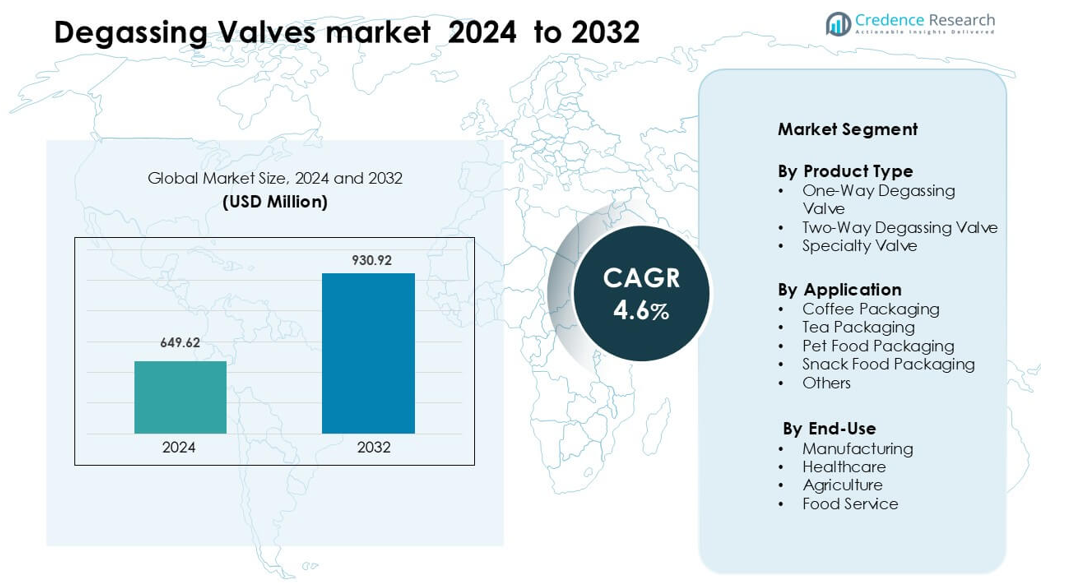
Degassing Valves market was valued at USD 649.62 million in 2024 and is anticipated to reach USD 930.92 million by 2032, growing at a CAGR of 4.6 % during the forecast period.
| REPORT ATTRIBUTE | DETAILS |
|---|---|
| Historical Period | 2020-2023 |
| Base Year | 2024 |
| Forecast Period | 2025-2032 |
| Degassing Valves Market Size 2024 | USD 649.62 million |
| Degassing Valves Market, CAGR | 4.6% |
| Degassing Valves Market Size 2032 | USD 930.92 million |
North America leads the Degassing Valves market with 34% share in 2024, supported by strong consumption of roasted coffee, premium snacks, and high-barrier flexible packaging. Key players such as Packaging Concepts & Designs, Syntegon Technology GmbH, Goglio S.p.A., Valco Melton, Wipf AG, Fres-co System USA, Inc., ICA S.p.A., Plitek LLC, TricorBraun, and CCL Industries Inc. strengthen market growth through advanced valve engineering, high-speed application systems, and sustainability-focused designs. These companies focus on improving freshness preservation, increasing compatibility with recyclable materials, and enhancing production efficiency, allowing them to maintain strong competitive positioning in this rapidly evolving packaging segment.
Market Insights
- Degassing Valves market was valued at USD 649.62 million in 2024 and is anticipated to reach USD 930.92 million by 2032, growing at a CAGR of 4.6 % during the forecast period.
- Strong market growth stems from increasing adoption of flexible pouches, expanding specialty coffee consumption, and rising investments in automated packaging lines that require reliable one-way venting systems; the one-way valve segment leads with about 72% share.
- Key trends include the shift toward compostable and recyclable valve materials, growing use of high-barrier films, and rapid adoption of premium aroma-protection technologies across specialty food categories.
- Competition intensifies as top players enhance precision molding, integrate sustainable materials, and expand high-speed valve-application systems to support food and beverage manufacturers across global supply chains.
- North America leads with 34% share, followed by Europe at 29%; coffee packaging remains dominant with nearly 61% share, supported by long-shelf-life and freshness-focused consumer demand.
Market Segmentation Analysis:
By Product Type
One-way degassing valves hold the dominant position with about 72% share in 2024, supported by wide adoption in coffee and dry food packaging that requires steady gas release without oxygen backflow. Brands favor this design because the valve maintains flavor, prevents pouch swelling, and supports longer shelf life in single-way venting systems. Two-way valves gain slow traction in sensitive blends that need controlled dual-direction flow, while specialty valves grow in niche use cases such as premium tea and fermented snacks. Rising demand for aroma protection strengthens one-way valve use across major packaging lines.
- For instance, Goglio is widely recognized as the inventor and a major supplier of the one-way degassing valve for coffee packaging, which allows CO₂ to escape while preventing oxygen from entering the bag.
By Application
Coffee packaging leads this segment with nearly 61% share in 2024, driven by the need to vent carbon dioxide released during roasting while preventing oxygen exposure that harms flavor. Coffee producers rely on degassing valves to maintain freshness, reduce spoilage, and support airtight packaging formats across retail channels. Tea packaging expands with rising demand for premium loose-leaf products, while pet food and snack brands adopt valves to avoid pouch deformation. Growth rises in specialty foods as consumers shift toward long-shelf-life and aroma-preserving packs.
- For instance, PLANET® has supplied its PLI-VALVE® one-way degassing valves to over 1,000 coffee roasting facilities globally, with its applicator systems capable of applying between 50 to 300 valves per minute, enabling roasters to package freshly roasted beans immediately and reduce oxygen levels inside bags to as low as 0.5–3.0% depending on their process.
By End-Use
Food service dominates this segment with around 54% share in 2024, fueled by strong demand for fresh-roast coffee dispensing packs, high-turnover snack formats, and ready-brew systems that rely on controlled gas venting. Restaurants, cafés, and vending operators prefer degassing valves because the feature helps preserve flavor quality and extend usable life. Manufacturing records stable growth as producers integrate valves into automated filling lines, while healthcare and agriculture segments adopt them for sensitive powders and supplements. Rising focus on product stability supports wider food service adoption.
Key Growth Drivers
Rising Demand for Freshness Preservation in Coffee and Specialty Foods
Growing consumption of roasted coffee and premium specialty foods drives strong adoption of degassing valves in global packaging lines. Roasted coffee releases significant carbon dioxide for several days after roasting, and this gas buildup can cause pouch expansion or rupture without a controlled venting system. Degassing valves allow carbon dioxide to escape while blocking oxygen entry, helping producers maintain aroma, flavor stability, and product integrity. This function supports longer shelf life and reduces spoilage across retail environments. Expanding café culture, rising packaged coffee sales, and booming specialty snack categories strengthen the need for valves that preserve freshness and meet consumer expectations for high-quality sealed products.
- For instance, Wipf’s WICOVALVE® technology, whose W606 valve opens at 2–7 mbar over-pressure and recloses when pressure drops to ≥ 0.1 mbar, delivering consistent functionality and gas-tight integrity over a guaranteed lifespan of three years.
Shift Toward High-Barrier Flexible Packaging Solutions
The rapid transition from rigid packaging to flexible pouches supports wider integration of degassing valves across food, pet food, and nutraceutical categories. Flexible packs require venting components to manage internal pressure after filling, especially for products that continue releasing gases during storage. Degassing valves ensure pack durability, smooth distribution handling, and better presentation on store shelves. Manufacturers adopt these valves to enhance product attractiveness and reduce leakage or deformation incidents that damage brand reputation. The rising preference for lightweight packaging and sustainability-aligned pack formats further increases the need for venting technology that improves material efficiency and extends product usability.
- For instance, Wipf AG’s WICOVALVE® W059 high-flow valve is tailored for large-volume flexible packs, opening at pressures of 3.0–9.0 mbar, which helps prevent pouch bursting during pallet stacking while preserving airtight integrity.
Increasing Automation in Food and Beverage Manufacturing
Growing automation across packaging facilities fuels demand for reliable degassing valves that align with high-speed filling, sealing, and inspection systems. Automated lines require venting components that maintain consistent performance under rapid processing conditions while supporting uniform sealing quality across large production batches. Degassing valves enable smoother machine operation by preventing pouch swelling and minimizing stoppages caused by pressure buildup. Manufacturers adopt advanced valve designs that integrate easily into automated lines and reduce manual interventions. Rising investments in smart factories, robotics, and digital quality control systems further accelerate the need for precision-engineered valves that enhance operational efficiency and reduce waste.
Key Trend & Opportunity
Expansion of Sustainable and Compostable Valve Designs
The growth of eco-friendly packaging encourages development of compostable and recyclable degassing valves that pair with sustainable pouches. Brands seek renewable materials to meet tightening environmental regulations and rising consumer expectations for greener packaging. Valve producers explore bio-based plastics, low-impact adhesives, and simplified one-piece structures that reduce environmental footprint. This shift opens opportunities for manufacturers offering solutions compatible with paper-based packs, biodegradable films, and mono-material laminates. Adoption accelerates as major coffee roasters and natural food brands commit to long-term sustainability targets, creating strong market potential for compliant venting components.
- For instance, Wipf AG has developed its WICOVALVE® W606E and W616E bio-compostable valves made of Ecovio®, certified under EN 13432, with opening pressures of 2.0–7.0 mbar
Adoption of Smart and Precision-Controlled Venting Technologies
Advancements in smart packaging support next-generation degassing valves that offer precise gas-release control, improved barrier performance, and better compatibility with modified-atmosphere packs. Producers explore valves with enhanced flow-rate stability, tamper-resistant structures, and micro-engineered materials designed to maintain flavor across longer distribution cycles. Integration with digital sensors or track-and-trace systems presents future opportunities for high-value applications such as specialty coffee, nutraceutical powders, and fermentation-based foods. These innovations help brands differentiate premium product lines and meet rising expectations for consistent quality, longer shelf life, and reduced spoilage in global supply chains.
- For instance, The Wipf AG WICOVALVE® W606 is indeed a one-way pressure relief valve primarily used for coffee packaging.
Key Challenge
Limited Compatibility with Certain Sustainable Packaging Formats
Despite growing interest in eco-friendly packaging, many degassing valves still rely on multi-material structures that complicate recyclability. Paper-based or mono-material pouches often struggle to integrate conventional plastic valves without compromising circularity goals. Brands face challenges designing packs that balance sustainability, gas management, and barrier performance. The absence of widely scalable compostable valve options restricts adoption among companies pursuing strict environmental targets. Innovation requirements increase production costs and delay large-scale deployment, making it difficult for manufacturers to meet regulatory expectations while maintaining functional venting and long-term product protection.
Cost Pressures and Price Sensitivity in Mass-Market Applications
Price sensitivity across coffee, snack, and pet food markets poses a challenge for widespread adoption of advanced degassing valves. Many small and mid-size producers struggle to absorb additional component costs within thin profit margins. High-quality valves require specialized materials and precision molding, raising procurement expenses in cost-driven sectors. Volatility in raw material pricing and global supply chain disruptions further increase production costs. These financial pressures limit adoption in markets where low-cost alternatives or basic packaging formats dominate, forcing manufacturers to balance performance needs with affordability and competitive positioning.
Regional Analysis
North America
North America leads the Degassing Valves market with about 34% share in 2024, driven by strong demand from premium coffee roasters, specialty food brands, and high-barrier flexible packaging users. The region benefits from mature automation in manufacturing and early adoption of aroma-preserving technologies across retail coffee formats. Growing preference for sustainable packs also encourages brands to integrate precision valves that extend shelf life. Expanding specialty cafés, rising single-serve coffee consumption, and a shift toward lightweight pouch formats continue to boost market growth across the United States and Canada.
Europe
Europe holds nearly 29% share in 2024, supported by high consumption of roasted coffee, strong sustainability regulations, and rapid adoption of recyclable and compostable packaging formats. Manufacturers focus on eco-aligned venting technologies to meet EU circular-economy targets, driving steady uptake of advanced degassing valves across food and beverage applications. Specialty tea, organic foods, and premium pet food categories further strengthen demand. Germany, Italy, France, and the Nordic countries show strong penetration due to well-established roasting industries and rising retail preference for aroma-protected packs.
Asia-Pacific
Asia-Pacific accounts for about 27% share in 2024, fueled by expanding coffee culture, rapid growth in flexible packaging, and rising production of snacks and pet food. China, Japan, South Korea, and Australia emerge as key markets as brands adopt valves to improve product stability and prevent pouch swelling in hot and humid climates. Increasing investments in advanced food processing, higher acceptance of premium coffee, and the growing popularity of ready-to-drink formats strengthen market penetration. The region’s strong manufacturing base also supports large-scale valve production and competitive pricing.
Latin America
Latin America captures around 6% share in 2024, driven by strong coffee production activity and growing interest in value-added packaged coffee for domestic and export markets. Brazil, Colombia, and Mexico integrate degassing valves in retail coffee packs to maintain freshness during long shipping cycles. Adoption grows in emerging snack and pet food categories as flexible packaging expands. Limited automation and price sensitivity restrict penetration in smaller markets, but increasing exports of roasted and specialty coffee support steady demand for reliable venting components.
Middle East & Africa
The Middle East & Africa region holds approximately 4% share in 2024, with growth led by rising café culture, premium food imports, and increasing retail coffee consumption in Gulf countries. Brands adopt degassing valves to maintain flavor stability in hot climates where temperature-driven pressure buildup is common. Africa’s emerging roasting sector shows gradual uptake, especially in Ethiopia, Kenya, and South Africa. Limited packaging infrastructure slows growth in some markets, but expanding supermarket chains and premium food demand continue to create opportunities for valve-enhanced flexible packaging.
Market Segmentations:
By Product Type
- One-Way Degassing Valve
- Two-Way Degassing Valve
- Specialty Valve
By Application
- Coffee Packaging
- Tea Packaging
- Pet Food Packaging
- Snack Food Packaging
- Others
By End-Use
- Manufacturing
- Healthcare
- Agriculture
- Food Service
By Geography
- North America
- U.S.
- Canada
- Mexico
- Europe
- Germany
- France
- U.K.
- Italy
- Spain
- Rest of Europe
- Asia Pacific
- China
- Japan
- India
- South Korea
- South-east Asia
- Rest of Asia Pacific
- Latin America
- Brazil
- Argentina
- Rest of Latin America
- Middle East & Africa
- GCC Countries
- South Africa
- Rest of the Middle East and Africa
Competitive Landscape
The competitive landscape of the Degassing Valves market features active participation from leading manufacturers such as Packaging Concepts & Designs, Syntegon Technology GmbH, Goglio S.p.A., Valco Melton, Wipf AG, Fres-co System USA, Inc., ICA S.p.A., Plitek LLC, TricorBraun, and CCL Industries Inc. Competition centers on engineering precision, product reliability, and strong compatibility with high-barrier flexible packaging formats. Companies focus on developing valves that support freshness preservation, controlled gas release, and longer shelf life for coffee, snacks, and specialty foods. Many players invest in sustainable materials, mono-material integration, and compostable valve technologies to meet rising environmental expectations. Partnerships with roasting facilities, food processors, and packaging converters enhance market presence. Expansion of automated packaging lines further drives innovation in high-speed application systems. Global supply capabilities, broad product portfolios, and strong technical support programs continue to shape competitive positioning across major regions.
Key Player Analysis
- Packaging Concepts & Designs
- Syntegon Technology GmbH
- Goglio S.p.A.
- Valco Melton
- Wipf AG
- Fres-co System USA, Inc.
- ICA S.p.A.
- Plitek LLC
- TricorBraun
- CCL Industries Inc.
Recent Developments
- In October 2025, Goglio S.p.A. was highlighted as a leading player in the Degassing Valves Market, building on its long history with one-way coffee valves and its strong integration of high-barrier laminates, coffee pouches, and degassing valves in aroma-preserving coffee packaging systems.
- In March 2025, Syntegon Technology GmbH reported that Portuguese roaster NewCoffee had installed its PMX coffee packaging machine, which automatically applies degassing valves, forms block-bottom bags, and fills up to 65 bags per minute in single-tube and 100 bags per minute in double-tube mode, supporting recyclable packaging with an extensive degassing-valve portfolio.
- In May 2024,Wipf AG presented recyclable WICOVALVE aroma-protection valves at the World of Private Label 2024 in Amsterdam, promoting mono-material PE and PP pouches with integrated degassing valves that provide robust CO₂ release and guaranteed valve functionality for three years for coffee and other CO₂-releasing goods.
Report Coverage
The research report offers an in-depth analysis based on Product Type, Application, End-Use and Geography. It details leading market players, providing an overview of their business, product offerings, investments, revenue streams, and key applications. Additionally, the report includes insights into the competitive environment, SWOT analysis, current market trends, as well as the primary drivers and constraints. Furthermore, it discusses various factors that have driven market expansion in recent years. The report also explores market dynamics, regulatory scenarios, and technological advancements that are shaping the industry. It assesses the impact of external factors and global economic changes on market growth. Lastly, it provides strategic recommendations for new entrants and established companies to navigate the complexities of the market.
Future Outlook
- Demand for degassing valves will rise as global coffee consumption continues to expand.
- Adoption of compostable and recyclable valves will accelerate due to sustainability targets.
- Flexible packaging formats will drive higher integration of precision venting components.
- Automation in food processing will increase the need for high-speed valve application systems.
- Premium snack and pet food categories will adopt more valves to protect aroma and freshness.
- Valve manufacturers will invest in advanced materials that enhance barrier and venting stability.
- Partnerships between packaging converters and coffee roasters will strengthen market presence.
- Growth in specialty tea and fermented foods will expand new application opportunities.
- Smart and micro-engineered valve technologies will emerge for premium and long-shelf-life products.
- Emerging markets in Asia and Latin America will boost demand with rising packaged food consumption.

Request a Free Sample
Fill in your details and we'll send you a free sample report.
- Sample data tables & charts
- Research methodology
Market Dynamics
Freshness Preservation in Coffee and Specialty Foods
Degassing valves are essential for maintaining aroma and flavor stability in roasted coffee and specialty foods by allowing CO₂ to escape while preventing oxygen ingress, which extends shelf life and reduces spoilage. This is especially critical as global coffee consumption and demand for premium, long-shelf-life foods continue to rise.
Shift Toward High-Barrier Flexible Packaging
The transition from rigid to flexible packaging formats in food, pet food, and nutraceuticals increases the need for degassing valves to manage internal gas pressure, prevent pouch deformation, and ensure product integrity during storage and distribution.
Growth in Automated Packaging Lines
Rising automation in food and beverage manufacturing drives demand for reliable, high-speed degassing valves that integrate seamlessly with automated filling and sealing systems, supporting consistent quality and operational efficiency at scale.
Sustainability and Compostable Valve Innovation
Increasing regulatory and consumer pressure for eco-friendly packaging is accelerating the development and adoption of recyclable and compostable degassing valves, enabling brands to meet environmental targets while maintaining product protection.
Expansion of Premium Snack and Pet Food Segments
As consumer preferences shift toward premium snacks and pet foods that require aroma and freshness protection, manufacturers are integrating degassing valves to enhance product appeal and shelf stability, further expanding the market’s application base.
Need a Custom Version of This Report?
Tailor the scope, geography, or segments to your exact requirements.
- Custom geography or segment scope
- Direct access to our analyst team
Frequently Asked Questions
What is the current market size for the Degassing Valves market, and what is its projected size in 2032?
At what Compound Annual Growth Rate is the Degassing Valves market projected to grow between 2025 and 2032?
Who are the major players in the global degassing valves market?
What are the major market drivers of the degassing valves industry?
What are the major market restraints of the degassing valves industry?
What are the major market opportunities of the degassing valves industry?
Who are the leading companies in the Degassing Valves market?
Table of Content
Chapter 1 Market Segmentation
- 1.1 Segmentation Framework
- 1.1.1 Product and Service Classification
- 1.1.2 Application and End-Use Classification
- 1.1.3 Technology and Solution Classification
- 1.1.4 Customer and Distribution Channel Classification
- 1.1.5 Geographic Segmentation
- 1.1.6 Market Segment Definitions and Boundaries
- 1.2 By End-Use
- 1.2.1 Manufacturing
- 1.2.2 Healthcare
- 1.2.3 Agriculture
- 1.2.4 Food Service
- 1.3 By Application
- 1.3.1 Coffee Packaging
- 1.3.2 Tea Packaging
- 1.3.3 Pet Food Packaging
- 1.3.4 Snack Food Packaging
- 1.3.5 Others
- 1.4 By Product Type
- 1.4.1 One-Way Degassing Valve
- 1.4.2 Two-Way Degassing Valve
- 1.4.3 Specialty Valve
Chapter 2 Introduction
- 2.1 Report Objectives and Scope
- 2.2 Product Definition and Industry Terminology
- 2.3 Market Inclusions and Exclusions
- 2.4 Research Process
- 2.4.1 Primary Research and Expert Interviews
- 2.4.2 Secondary Research and Source Review
- 2.4.3 Top-Down and Bottom-Up Estimation
- 2.4.4 Data Triangulation and Verification
- 2.5 Market Size Measurement Basis
- 2.5.1 2024: USD 649.62 million → 2032: USD 930.92million
- 2.6 Historical and Forecast Reference Periods
- 2.6.1 Base Year: 2024
- 2.6.2 Forecast Period: 2024-2032
- 2.7 Research Assumptions and Limitations
Chapter 3 Executive Summary
- 3.1 Market Snapshot and Key Findings
- 3.2 Base-Year Market Size, 2024
- 3.3 Forecast Market Size, 2032
- 3.4 Revenue and Volume Growth Outlook
- 3.5 Key Demand and Supply Indicators
- 3.6 Leading Market Segments
- 3.7 Fastest-Growing Market Opportunities
- 3.8 Regional Performance Highlights
- 3.9 Technology and Industry Transformation
- 3.10 Competitive Landscape Summary
- 3.11 Analyst View and Strategic Implications
Chapter 4 Global Degassing Valves Market Trends and Developments
- 4.1 Historical Industry Development
- 4.2 Recent Market Trends and Developments
- 4.3 Demand and Customer Behavior Trends
- 4.4 Technology and Product Innovation
- 4.5 Artificial Intelligence, Automation and Digitalization
- 4.6 Local Manufacturing and Supply Chain Realignment
- 4.7 Industry Partnerships, Mergers and Acquisitions
- 4.8 Sustainability and Circular Economy Developments
- 4.9 Government and Private Sector Investment Trends
- 4.10 Emerging Business Models and Commercialization
- 4.11 Industry Developments and Announcements
Chapter 5 Global Degassing Valves Market Production, Supply and Demand Analysis
- 5.1 Demand Trend and Consumption Analysis
- 5.2 Demand Forecast, 2024-2032
- 5.3 Production and Output Trend
- 5.4 Production and Output Forecast, 2024-2032
- 5.5 Installed Capacity and Capacity Utilization
- 5.6 Company-Wise Production Plants and Statistics
- 5.6.1 Installed Production Capacity
- 5.6.2 Actual Production
- 5.6.3 Planned Capacity and Expansion Targets
- 5.7 Supply Chain Structure and Procurement Trends
- 5.8 Supply-Demand Gap and Bottlenecks
- 5.9 Import Dependence and Sourcing Structure
- 5.10 Contract Manufacturing and Outsourcing
- 5.11 Regional Supply and Demand Concentration
Chapter 6 Global Degassing Valves Market Pricing Analysis
- 6.1 Pricing Structure and Measurement
- 6.2 Historical Pricing Trends
- 6.3 Pricing Outlook, 2024-2032
- 6.4 Average Selling Price and Unit Economics
- 6.5 Pricing by Product and Market Segment
- 6.6 Geographic Pricing Differences
- 6.7 Key Input, Energy, Labor and Logistics Costs
- 6.8 Contract Pricing and Purchasing Models
- 6.9 Pricing Sensitivity and Competitive Positioning
- 6.10 Price, Margin and Profitability Implications
Chapter 7 Global Degassing Valves Market Dynamics
- 7.1 Market Growth Drivers
- 7.1.1 Demand-Side Drivers
- 7.1.2 Technology and Innovation Drivers
- 7.1.3 Infrastructure and Investment Drivers
- 7.1.4 Regulatory and Policy Drivers
- 7.2 Market Restraints
- 7.2.1 Cost and Affordability Constraints
- 7.2.2 Technology and Adoption Barriers
- 7.2.3 Supply Chain and Operational Constraints
- 7.3 Market Challenges
- 7.3.1 Competitive Pressure and Margin Erosion
- 7.3.2 Skills, Infrastructure and Implementation Gaps
- 7.4 Emerging Market Opportunities
- 7.5 Market Dynamics Impact and Time-Horizon Assessment
Chapter 8 Global Degassing Valves Value Chain Analysis
- 8.1 Industry Value Chain Overview
- 8.2 Upstream Suppliers and Critical Inputs
- 8.3 Technology and Component Providers
- 8.4 Manufacturing or Service Delivery
- 8.5 Distribution, Channel Partners and Integrators
- 8.6 Downstream Applications and End Users
- 8.7 Value Addition and Profit Pools
- 8.8 Vertical Integration and Outsourcing
- 8.9 Supplier Concentration and Risk
- 8.10 Supply Chain Localization and Resilience
Chapter 9 Global Degassing Valves Market Regulations and Policies
- 9.1 Relevant Laws, Standards and Compliance Frameworks
- 9.2 Product, Service, Safety and Quality Requirements
- 9.3 Government Policies, Incentives and Subsidies
- 9.4 Imports, Exports and Trade Barriers
- 9.5 Public Procurement and Local Content Requirements
- 9.6 Environmental and Sustainability Compliance
- 9.7 Upcoming Policy Changes and Market Implications
Chapter 10 Global Degassing Valves Market Hotspots and Opportunities
- 10.1 Market Opportunity Mapping and Growth Hotspots
- 10.2 High-Growth Applications and Customer Groups
- 10.3 Underserved Markets and White-Space Opportunities
- 10.4 Emerging Technology and Product Opportunities
- 10.5 New Capacity and Investment Hotspots
- 10.6 Market Entry and Expansion Opportunities
- 10.7 Distribution and Partnership Opportunities
- 10.8 Near-Term and Long-Term Commercial Potential
- 10.9 Opportunity Attractiveness and Execution Risks
Chapter 11 Global Degassing Valves Market Outlook, 2024-2032
- 11.1 Market Size and Analysis
- 11.1.1 Revenue (Market Measurement: 2024: USD 649.62 million → 2032: USD 930.92million)
- 11.1.2 Market Volume and Quantity Sold
- 11.1.3 Historical Market Size
- 11.1.4 Base-Year Market Size, 2024
- 11.2 Market Forecast, 2024-2032
- 11.2.1 Revenue Forecast to 2032
- 11.2.2 Volume Forecast to 2032
- 11.2.3 CAGR and Year-on-Year Growth
- 11.2.4 Incremental Revenue Opportunity
- 11.3 Forecast Assumptions and Scenario Analysis
- 11.3.1 Base-Case Forecast
- 11.3.2 Optimistic and Conservative Scenarios
- 11.3.3 Technology, Pricing and Policy Sensitivities
- 11.4 Market Attractiveness and Growth Outlook
Chapter 12 Global Degassing Valves Market Segmentation and Outlook
- 12.1 Segmentation Summary and Market Shares, 2024
- 12.2 Largest and Fastest-Growing Segments
- 12.3 By End-Use - Market Size and Forecast, 2024-2032
- 12.3.1 Segment Definition and Scope
- 12.3.2 Historical Market Size
- 12.3.3 Revenue Forecast, 2024-2032
- 12.3.4 Volume Forecast, 2024-2032
- 12.3.5 Base-Year Market Share, 2024
- 12.3.6 Segment CAGR and Growth Drivers
- 12.3.7 Subsegment Market Size and Forecast
- 12.3.7.1 Manufacturing
- 12.3.7.2 Healthcare
- 12.3.7.3 Agriculture
- 12.3.7.4 Food Service
- 12.3.8 Subsegment Pricing and Adoption Trends
- 12.3.9 Leading Suppliers and Competition
- 12.3.10 Regional Demand and Opportunities
- 12.4 By Application - Market Size and Forecast, 2024-2032
- 12.4.1 Segment Definition and Scope
- 12.4.2 Historical Market Size
- 12.4.3 Revenue Forecast, 2024-2032
- 12.4.4 Volume Forecast, 2024-2032
- 12.4.5 Base-Year Market Share, 2024
- 12.4.6 Segment CAGR and Growth Drivers
- 12.4.7 Subsegment Market Size and Forecast
- 12.4.7.1 Coffee Packaging
- 12.4.7.2 Tea Packaging
- 12.4.7.3 Pet Food Packaging
- 12.4.7.4 Snack Food Packaging
- 12.4.7.5 Others
- 12.4.8 Subsegment Pricing and Adoption Trends
- 12.4.9 Leading Suppliers and Competition
- 12.4.10 Regional Demand and Opportunities
- 12.5 By Product Type - Market Size and Forecast, 2024-2032
- 12.5.1 Segment Definition and Scope
- 12.5.2 Historical Market Size
- 12.5.3 Revenue Forecast, 2024-2032
- 12.5.4 Volume Forecast, 2024-2032
- 12.5.5 Base-Year Market Share, 2024
- 12.5.6 Segment CAGR and Growth Drivers
- 12.5.7 Subsegment Market Size and Forecast
- 12.5.7.1 One-Way Degassing Valve
- 12.5.7.2 Two-Way Degassing Valve
- 12.5.7.3 Specialty Valve
- 12.5.8 Subsegment Pricing and Adoption Trends
- 12.5.9 Leading Suppliers and Competition
- 12.5.10 Regional Demand and Opportunities
- 12.6 Segment Growth Comparison
- 12.7 Segment Attractiveness and Priority Matrix
Chapter 13 Global Degassing Valves End-Use and Application Market Outlook
- 13.1 End-Use Industry and Customer Demand Structure
- 13.2 Leading Applications and Customer Groups
- 13.3 End-Use Market Size, Share and Forecast
- 13.4 Major End-Use Industry Deep Dives
- 13.4.1 Customer Requirements and Use Cases
- 13.4.2 Demand and Replacement Cycles
- 13.4.3 Technical and Regulatory Considerations
- 13.4.4 Purchasing and Procurement Models
- 13.4.5 Leading Vendors and Distribution Channels
- 13.4.6 Forecast and Commercial Opportunities
- 13.5 Emerging Applications and Cross-Segment Demand
- 13.6 End-Use Industry Investment Priorities
Chapter 14 Global Degassing Valves Geographic Market Outlook, 2024-2032
- 14.1 Regional Market Size and Share, 2024
- 14.2 Regional Market Forecast, 2024-2032
- 14.3 Regional Pricing, Production and Demand Differences
- 14.4 North America
- 14.4.1 United States
- 14.4.2 Canada
- 14.4.3 Mexico
- 14.5 Europe
- 14.5.1 Germany
- 14.5.2 France
- 14.5.3 Italy
- 14.5.4 United Kingdom
- 14.5.5 Spain
- 14.5.6 Poland
- 14.5.7 Russia
- 14.5.8 Netherlands
- 14.5.9 Belgium
- 14.5.10 Sweden
- 14.5.11 Denmark
- 14.5.12 Norway
- 14.5.13 Rest of Europe
- 14.6 Asia Pacific
- 14.6.1 China
- 14.6.2 India
- 14.6.3 Japan
- 14.6.4 South Korea
- 14.6.5 Thailand
- 14.6.6 Indonesia
- 14.6.7 Vietnam
- 14.6.8 Malaysia
- 14.6.9 Australia
- 14.6.10 Rest of Asia Pacific
- 14.7 Latin America
- 14.7.1 Brazil
- 14.7.2 Argentina
- 14.7.3 Colombia
- 14.7.4 Chile
- 14.7.5 Rest of Latin America
- 14.8 Middle East
- 14.8.1 Saudi Arabia
- 14.8.2 United Arab Emirates
- 14.8.3 Turkey
- 14.8.4 Israel
- 14.8.5 Iran
- 14.8.6 Rest of the Middle East
- 14.9 Africa
- 14.9.1 South Africa
- 14.9.2 Egypt
- 14.9.3 Nigeria
- 14.9.4 Morocco
- 14.9.5 Rest of Africa
- 14.10 Regional Investment, Policy and Supply Chain Differences
- 14.11 Regional Competitive Landscape
- 14.12 Geographic Growth Hotspots
Chapter 15 Global Degassing Valves Technology, Innovation and Sustainability Outlook
- 15.1 Technology Landscape and Maturity
- 15.2 Product, Process and Service Innovation
- 15.3 AI, Automation and Digital Tools in the Industry
- 15.4 Technology Adoption and Performance Benchmarking
- 15.5 Innovation Pipeline and R&D Investment
- 15.6 Patent and Intellectual Property Trends
- 15.7 Energy Efficiency and Resource Management
- 15.8 Sustainability, Recycling and Circularity
- 15.9 Technology Roadmap, 2024-2032
- 15.10 Risks of Obsolescence and Technology Substitution
Chapter 16 Global Degassing Valves Market Key Strategic Imperatives
- 16.1 Growth and Market Entry Priorities
- 16.2 High-Return Products and Segments
- 16.3 Pricing, Profitability and Cost Optimization
- 16.4 Technology Investment and Product Differentiation
- 16.5 Supply Chain Localization and Resilience
- 16.6 Distribution and Customer Acquisition
- 16.7 Partnership, Acquisition and Capacity Strategy
- 16.8 Regional Expansion Priorities
- 16.9 Short-, Medium- and Long-Term Actions
Chapter 17 Competition Outlook
- 17.1 Industry Competition Characteristics
- 17.2 Market Structure and Concentration
- 17.3 Market Share and Competitive Positioning, 2024
- 17.4 Company-Wise Revenue and Product Benchmarking
- 17.5 Production and Service Capacity Benchmarking
- 17.6 Technology, Pricing and Differentiation
- 17.7 Regional Footprint and Distribution Strength
- 17.8 Mergers, Acquisitions and Strategic Alliances
- 17.9 New Entrants and Competitive Threats
- 17.10 Porter's Five Forces and Industry Attractiveness
- 17.11 Competitive Outlook, 2024-2032
Chapter 18 Company Profiles
- 18.1 Company Coverage and Selection Criteria
- 18.2 Packaging Concepts & Designs
- 18.2.1 Business Description
- 18.2.2 Company Ownership and Geographic Presence
- 18.2.3 Product and Service Portfolio
- 18.2.4 Manufacturing and Operating Footprint
- 18.2.5 Production Capacity and Expansion Plans
- 18.2.6 Financial Performance and Investment
- 18.2.7 Market Share and Competitive Position
- 18.2.8 Technology and Innovation Capabilities
- 18.2.9 Strategic Alliances or Partnerships
- 18.2.10 Recent Developments
- 18.2.11 Growth Strategy and Outlook
- 18.3 Syntegon Technology GmbH
- 18.4 Goglio S.p.A.
- 18.5 Valco Melton
- 18.6 Wipf AG
- 18.7 Fres-co System USA, Inc.
- 18.8 ICA S.p.A.
- 18.9 Plitek LLC
- 18.10 TricorBraun
- 18.11 CCL Industries Inc.
- 18.12 Other Relevant Market Participants
Note: Every listed company is profiled on the structure shown under the first company. The company list is preliminary and may change based on research findings, market developments, data availability and client requirements.
Chapter 19 Disclaimer
- 19.1 Research and Forecast Disclaimer
- 19.2 Data Source and Estimation Limitations
Note: The depth of individual sections depends on data availability for this market. Volume, capacity, trade and other unit-based metrics are included where applicable.

