Market Overview:
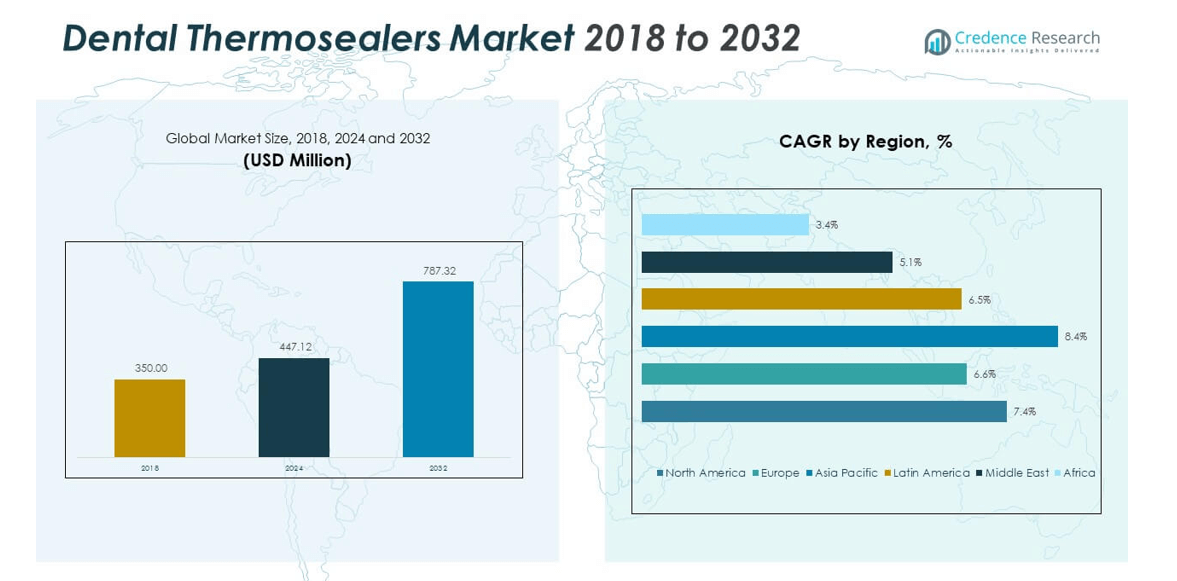
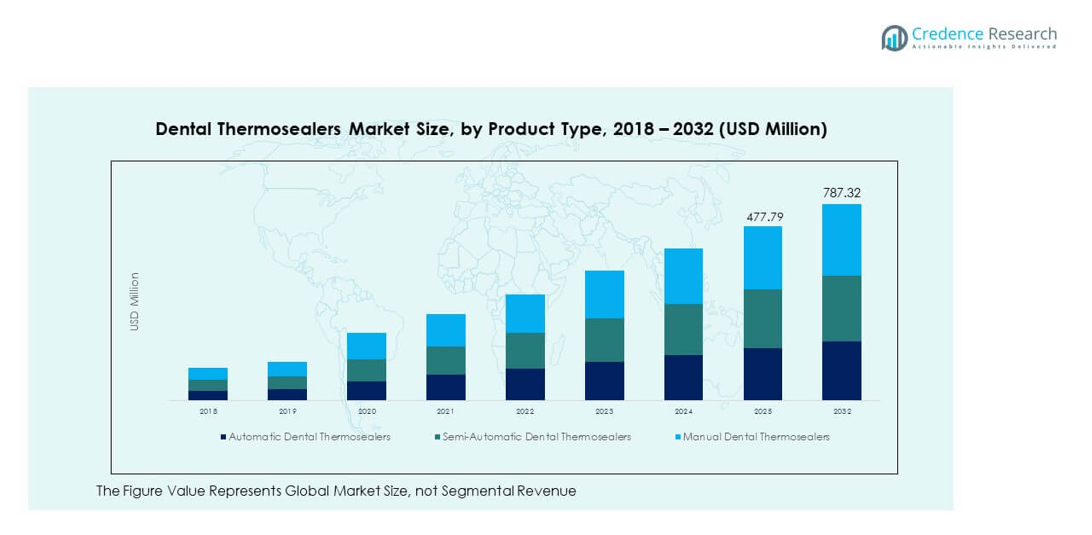
The Dental Thermosealers Market size was valued at USD 350.00 million in 2018 to USD 447.12 million in 2024 and is anticipated to reach USD 787.32 million by 2032, at a CAGR of 7.40% during the forecast period.
| REPORT ATTRIBUTE | DETAILS |
|---|---|
| Historical Period | 2020-2023 |
| Base Year | 2024 |
| Forecast Period | 2025-2032 |
| Dental Thermosealers Market Size 2024 | USD 447.12 million |
| Dental Thermosealers Market, CAGR | 7.40% |
| Dental Thermosealers Market Size 2032 | USD 787.32 million |
Growing focus on infection prevention, increasing dental procedures, and stricter sterilization regulations are driving market expansion. Dental clinics and hospitals are adopting advanced thermosealers to maintain consistent sealing quality, reduce human error, and meet international hygiene standards. Manufacturers are developing compact and energy-efficient devices equipped with digital controls to enhance workflow efficiency and reliability, supporting wider clinical adoption globally.
North America dominates the market due to its advanced dental infrastructure, strong regulatory framework, and early adoption of automated sterilization systems. Europe follows, driven by technological innovation and emphasis on patient safety across dental practices. Asia Pacific is emerging rapidly as expanding healthcare infrastructure, dental tourism, and rising hygiene awareness promote steady demand for dental thermosealers.
Market Insights:
- The Dental Thermosealers Market was valued at USD 350.00 million in 2018, rising to USD 447.12 million in 2024 and projected to reach USD 787.32 million by 2032, expanding at a CAGR of 7.40%.
- North America leads with 33.2% share, supported by advanced dental infrastructure, strict sterilization regulations, and early digital adoption.
- Europe follows with 23.6% share, driven by strong infection control policies, high equipment quality standards, and modernization of clinics.
- Asia Pacific holds 29.8% share and remains the fastest-growing region, fueled by expanding dental infrastructure, growing hygiene awareness, and local manufacturing growth.
- By product type, automatic thermosealers hold 42% of the market, semi-automatic 36%, and manual 22%, reflecting steady preference for precision and automation in dental sterilization processes.
Market Drivers
Rising Awareness of Sterilization Standards Across Dental Practices
The growing focus on infection prevention is strengthening demand for advanced thermosealers in dental settings. Clinics seek reliable sealing systems to ensure the sterility of dental instruments before patient use. The Dental Thermosealers Market benefits from regulatory pressure mandating compliance with sterilization protocols. Increased adoption in hospitals and dental chains supports strong sales momentum. Hygienic sealing processes enhance patient safety and operational efficiency. Many dental professionals prefer compact, automated sealing units for consistent performance. Demand continues to grow with the rise in dental procedures worldwide. Manufacturers are integrating automation and digital monitoring to maintain quality assurance in clinical operations.
Technological Advancements Improving Sealing Precision and Efficiency
Innovation in thermosealing devices enhances precision, energy efficiency, and ease of operation. Manufacturers focus on digital temperature control and automatic pressure regulation to ensure uniform sealing results. It drives the replacement of manual sealers with programmable systems in dental clinics. The Dental Thermosealers Market experiences growth through integration of touch-screen displays and data recording for traceability. These advancements support compliance with ISO sterilization standards and reduce human error. High-speed sealers minimize downtime, improving workflow in busy dental facilities. Compact units with lower power consumption appeal to smaller practices. Continuous product innovation sustains competitiveness among key manufacturers globally.
Expansion of Dental Infrastructure and Growth in Preventive Dentistry
Expanding dental care infrastructure fuels steady product adoption across emerging economies. Governments support dental hygiene programs and preventive care campaigns, increasing clinic numbers. The Dental Thermosealers Market gains from higher patient visits for cosmetic and restorative procedures. Hospitals and private clinics invest in modern sterilization equipment to align with updated infection-control protocols. Increasing awareness about cross-contamination risks encourages standardized sterilization workflows. The preference for integrated dental solutions boosts demand for user-friendly thermosealers. Strong distribution networks enable global accessibility for advanced models. Rising patient awareness strengthens purchasing decisions among dental professionals worldwide.
- For instance, DÜRR DENTAL introduced the Hygopac View in 2024, featuring a color touchscreen and a compact design for integration into newly established dental clinics worldwide; this device validates and digitally logs every seal in accordance with DIN EN ISO 11607-2, with installations reported in multi-site dental organizations across Europe and Asia, enhancing standardized infection control.
Regulatory Mandates Driving Sterilization Compliance Across Dental Ecosystems
Government regulations emphasizing hygiene and infection control drive equipment upgrades in dental practices. Regulatory agencies enforce strict sterilization monitoring across dental care facilities. The Dental Thermosealers Market expands due to compliance requirements for seal validation and performance tracking. Dental professionals adopt automated sealers to generate digital records of every sterilization cycle. It promotes transparency and reduces compliance risks during inspections. Standardization across health systems enhances product demand in both public and private sectors. Growing institutional investments improve sterilization infrastructure in dental hospitals. The emphasis on traceability and patient safety strengthens the market’s long-term sustainability.
- For instance, the Getinge Proseal rotary sealer, widely deployed in hospital and dental settings in 2024, logs sealing parameters and connects directly to the Getinge T-DOC traceability system, meeting ISO 11607-2 standards and facilitating regulatory audits; built-in validation ensures documentation of all sealed pouches, supporting compliance in over 200 clinics across EMEA.
Market Trends
Integration of Smart Connectivity and Data Traceability Features
Smart thermosealers with digital connectivity gain traction across modern dental facilities. Integrated software allows real-time tracking of sterilization data and automatic documentation. The Dental Thermosealers Market witnesses increased adoption of Wi-Fi and USB-enabled models supporting compliance management. Clinics use digital records to monitor performance, sealing temperatures, and validation cycles. It simplifies audit trails and ensures alignment with dental sterilization protocols. The trend supports the digital transformation of clinical workflows. Demand for traceable and networked devices continues to grow among large practices. Connected systems enhance accountability, consistency, and quality assurance in sterilization processes.
Shift Toward Compact and Ergonomically Designed Sealers
Compact thermosealers designed for limited-space clinics attract strong interest from practitioners. Portable models enable efficient placement near dental chairs for quick sterilization. The Dental Thermosealers Market experiences growing preference for lightweight, energy-efficient devices. Ergonomic designs improve user comfort and operational convenience during repetitive sealing tasks. It enhances productivity and reduces fatigue in high-volume practices. User-friendly interfaces, quiet operation, and minimal maintenance make these models ideal for smaller setups. Manufacturers emphasize modularity to simplify repairs and upgrades. The shift aligns with the broader adoption of streamlined equipment in modern dental environments.
- For instance, Mocom Millseal+ Evo is verified as a compact thermosealer weighing 6.5 kg, equipped with a continuous constant-temperature cycle at 180°C, and offering a 12 mm wide sealing band and ergonomic, user-friendly design for space-constrained dental clinics. The automatic preparation control allows batch sealing with minimal manual effort, and its compact footprint (474 x 374 x 200 mm) fits easily beside dental chairs in small practices.
Sustainability and Energy Efficiency in Product Manufacturing
Manufacturers prioritize sustainability by developing energy-efficient and recyclable thermosealers. The Dental Thermosealers Market responds to growing environmental awareness among healthcare providers. Energy-efficient sealing cycles minimize power consumption without compromising speed. It helps dental clinics reduce operational costs while meeting green certification standards. Eco-friendly materials and packaging enhance brand credibility. Manufacturers also explore recyclable components to meet environmental regulations. The shift toward sustainable equipment design promotes long-term adoption. This trend reflects the broader move toward responsible and resource-efficient healthcare technologies.
- For instance, Euronda’s E9 Recorder autoclave, as of 2024, features a modular structure with integrated traceability systems and received ISO 14001 Environmental Management System Certification in 2023 for its sustainable production processes. The device utilizes inspectionable tanks and promotes the use of eco-friendly sterilization rolls (Eurosteril) with recyclable ruler design, directly reflecting the manufacturer’s commitment to energy efficiency and environmentally responsible device manufacturing.
Automation and Integration With Sterilization Chains in Clinics
Automation becomes a defining trend, enabling full integration of thermosealers with sterilization units. The Dental Thermosealers Market evolves toward synchronized sterilization workflows in clinics and hospitals. Automated sealing devices communicate with sterilizers and tracking software to manage workflow steps. It reduces manual intervention and ensures precise timing of sealing and sterilization cycles. Automation improves throughput and reduces risk of contamination from handling. Dental institutions deploy integrated systems for large-scale operations. Advanced automation features appeal to high-end clinics focused on efficiency. The growing reliance on connected automation drives further digital adoption across dental sterilization departments.
Market Challenges Analysis
High Equipment Costs and Limited Adoption Among Small Clinics
High initial investment limits adoption among smaller dental practices and clinics in cost-sensitive regions. The Dental Thermosealers Market faces barriers in developing economies where manual sealing remains common. Limited awareness of long-term benefits reduces upgrade intent among practitioners. It slows penetration of automated systems in low-volume dental facilities. Maintenance and calibration costs add to ownership challenges for small operators. Import taxes and distribution expenses further inflate retail prices. Financial constraints hinder replacement of outdated equipment. Vendors are pressured to introduce low-cost variants to reach wider audiences and maintain growth.
Regulatory Complexity and Lack of Standardized Compliance Frameworks
Frequent updates in sterilization standards create confusion among end users and manufacturers. The Dental Thermosealers Market experiences compliance challenges due to regional variations in certification requirements. It increases documentation efforts and delays new product approvals. Inconsistent technical standards complicate international product launches. Limited regulatory clarity discourages smaller manufacturers from expanding globally. End users often struggle to interpret seal validation data, affecting proper device utilization. Insufficient training resources in developing countries reduce operational efficiency. The fragmented regulatory environment continues to challenge the market’s uniform growth across regions.
Market Opportunities
Expanding Digitalization and Automation in Dental Care Workflows
Digital transformation of dental practices opens new growth opportunities for connected thermosealers. The Dental Thermosealers Market benefits from integration with software that manages complete sterilization chains. It enables dental professionals to automate documentation, trace results, and improve compliance. Increased preference for data-driven operations drives demand for smart sealing devices. Hospitals and multi-chair clinics invest in systems that ensure operational transparency. Compact, intelligent devices fit well into cloud-based record-keeping systems. The opportunity lies in combining efficiency with digital accountability. Advancements in connectivity expand product adoption among technologically progressive facilities.
Rising Demand From Emerging Economies With Expanding Dental Infrastructure
Emerging economies show rising adoption of advanced sterilization equipment across urban clinics. The Dental Thermosealers Market finds untapped potential in Asia-Pacific and Latin America. It aligns with expanding healthcare infrastructure and improved patient awareness of hygiene. Government investments support modern dental facility development in these regions. Global manufacturers target local partnerships to enhance distribution reach. Growing medical tourism further increases demand for standardized sterilization systems. Affordable and durable thermosealers can attract cost-conscious practitioners. The long-term opportunity lies in building market presence through localized production and after-sales support.
Market Segmentation Analysis:
By product type, automatic thermosealers dominate due to their precision, speed, and compliance with sterilization standards. These models are preferred in high-volume dental clinics for consistent sealing performance and reduced human error. Semi-automatic thermosealers hold a solid position, balancing cost and functionality for mid-sized practices. Manual thermosealers continue to serve smaller clinics requiring basic sealing functions without automation, supported by their low maintenance and affordability. The Dental Thermosealers Market benefits from diverse product availability that caters to varying clinic capacities and operational needs.
- For instance, Euronda’s E9 Recorder features rapid cycle selection and complete management of sterilization data through SD card and Ethernet connectivity, supporting up to 24 liters chamber capacity and optimized B, N, and S cycles in full compliance with EN 13060, as verified in official Euronda documentation as of May 2025.
By application, dental clinics lead due to their high patient turnover and stringent hygiene requirements. Laboratories adopt thermosealers to maintain instrument sterility during fabrication processes. Hospitals use advanced devices integrated with centralized sterilization systems. The others category includes academic institutions and mobile dental units expanding access to preventive care. It drives adoption across both urban and rural healthcare settings, strengthening overall equipment demand.
- For exampale, the MELAG Medizintechnik MELAseal Pro is a validated rotary heat sealer featuring a 14 mm seal seam and an adjustable temperature range between 100 °C and 199 °C. It ensures continuous sealing with automatic control and complies with EN 868-5 and DIN 58953-7 standards, making it suitable for hospital and dental sterilization workflows.
By distribution channel, dental equipment stores remain the primary source for professional-grade devices supported by technical assistance. Online stores gain traction through convenience, transparent pricing, and easy access to global brands. Specialty stores cater to institutional buyers seeking bulk purchases and tailored product portfolios. The others segment includes direct manufacturer sales and authorized distributors that provide after-sales service, ensuring operational reliability and long-term customer retention across regions.
Segmentation:
By Product Type
- Automatic Dental Thermosealers
- Semi-Automatic Dental Thermosealers
- Manual Dental Thermosealers
By Application
- Dental Clinics
- Dental Laboratories
- Hospitals
- Others
By Distribution Channel
- Online Stores
- Dental Equipment Stores
- Specialty Stores
- Others
By Region
- North America
- U.S.
- Canada
- Mexico
- Europe
- Germany
- France
- U.K.
- Italy
- Spain
- Rest of Europe
- Asia Pacific
- China
- Japan
- India
- South Korea
- South-east Asia
- Rest of Asia Pacific
- Latin America
- Brazil
- Argentina
- Rest of Latin America
- Middle East & Africa
- GCC Countries
- South Africa
- Rest of the Middle East and Africa
Regional Analysis:
North America
The North America Dental Thermosealers Market size was valued at USD 117.95 million in 2018 to USD 148.71 million in 2024 and is anticipated to reach USD 261.47 million by 2032, at a CAGR of 7.4% during the forecast period. North America holds a market share of 33.2% in the global industry. The region leads due to strong dental infrastructure, high awareness of infection control, and advanced healthcare standards. The U.S. drives most of the demand with a dense network of dental clinics and hospitals. Canada follows, supported by growing dental tourism and public investment in oral health. It benefits from regulatory frameworks mandating sterilization compliance across healthcare sectors. Manufacturers in the region focus on automation and smart connectivity to support workflow efficiency. Increasing integration of sterilization tracking systems enhances product reliability. Strong distribution networks and presence of leading global brands strengthen regional dominance.
Europe
The Europe Dental Thermosealers Market size was valued at USD 86.10 million in 2018 to USD 105.42 million in 2024 and is anticipated to reach USD 174.59 million by 2032, at a CAGR of 6.6% during the forecast period. Europe accounts for 23.6% of the global share. The region benefits from early adoption of high-quality sterilization equipment driven by strict infection prevention regulations. Countries such as Germany, France, and the UK lead in technological innovation and equipment certification. It gains momentum through modernization of dental clinics and replacement of manual sealers with digital devices. Increasing focus on patient safety and adherence to EN standards support steady demand. Western Europe dominates sales, while Eastern Europe shows potential through healthcare reforms. Manufacturers emphasize product traceability and eco-friendly designs aligned with EU sustainability goals. Growing collaboration with dental associations enhances market visibility across the continent.
Asia Pacific
The Asia Pacific Dental Thermosealers Market size was valued at USD 109.90 million in 2018 to USD 145.25 million in 2024 and is anticipated to reach USD 276.59 million by 2032, at a CAGR of 8.4% during the forecast period. The region contributes 29.8% of the total global market share. Rapid expansion of dental infrastructure and increasing disposable income drive adoption across clinics and hospitals. China, Japan, and India represent key growth territories with strong public investment in oral healthcare. It benefits from rising demand for automated sterilization systems in dental laboratories. Emerging economies focus on affordable thermosealers that meet safety standards without compromising quality. Local manufacturing expansion supports price competitiveness against imported brands. Growing awareness of cross-contamination prevention boosts product penetration. The region’s dental equipment exports continue to expand due to cost-effective production and innovation capabilities.
Latin America
The Latin America Dental Thermosealers Market size was valued at USD 23.80 million in 2018 to USD 30.13 million in 2024 and is anticipated to reach USD 49.50 million by 2032, at a CAGR of 6.5% during the forecast period. Latin America holds a market share of 5.3% globally. Demand growth is driven by increasing adoption of sterilization protocols in dental care facilities. Brazil leads the region with a strong network of public and private clinics upgrading sterilization systems. Mexico and Argentina also show steady progress with healthcare modernization initiatives. It benefits from international partnerships between dental equipment suppliers and local distributors. Manufacturers focus on cost-effective thermosealers to match regional price sensitivity. Training programs by dental associations improve awareness of infection control practices. Government incentives for medical equipment imports support greater accessibility and product adoption.
Middle East
The Middle East Dental Thermosealers Market size was valued at USD 8.40 million in 2018 to USD 9.65 million in 2024 and is anticipated to reach USD 14.25 million by 2032, at a CAGR of 5.1% during the forecast period. The region accounts for 3.2% of the global market share. Growing investment in healthcare infrastructure supports the use of sterilization technologies in modern dental centers. GCC countries dominate due to high expenditure on premium dental equipment. It experiences increasing adoption of thermosealers across private clinics and multi-specialty hospitals. Demand rises as international dental chains expand in the UAE and Saudi Arabia. Local distributors collaborate with European and North American brands to enhance availability. Healthcare reforms encourage compliance with global sterilization standards. Ongoing infrastructure development and focus on patient safety continue to drive regional growth.
Africa
The Africa Dental Thermosealers Market size was valued at USD 3.85 million in 2018 to USD 7.96 million in 2024 and is anticipated to reach USD 10.92 million by 2032, at a CAGR of 3.4% during the forecast period. Africa represents 2.9% of the global share. Market growth is supported by gradual improvements in healthcare infrastructure and rising awareness of infection control. South Africa leads adoption with modern clinics emphasizing sterilization quality. Egypt and Nigeria display growing demand supported by public oral health initiatives. It faces challenges due to limited access to advanced equipment and high import dependency. Manufacturers focus on low-cost, durable models suited for developing healthcare environments. Partnerships with non-governmental organizations enhance product reach in underserved areas. Continued expansion of dental education and public hygiene campaigns sustains steady long-term demand.
Key Player Analysis:
- Dentsply Sirona
- Mocom Srl
- MELAG Medizintechnik GmbH & Co. KG
- Tuttnauer
- Midmark Corporation
- SciCan Ltd.
- Runyes Medical Instrument Co., Ltd.
- Gnatus
- FONA Dental, s.r.o.
- Prestige Medical Limited
- Euronda SpA
- Ningbo Runyes Medical Instrument Co., Ltd.
- Getinge AB
- 3M ESPE
- Systec GmbH
- Antonio Matachana S.A.
- Steris Corporation
Competitive Analysis:
The Dental Thermosealers Market features strong competition among global and regional manufacturers focusing on innovation, automation, and compliance with sterilization standards. Leading players such as Dentsply Sirona, MELAG Medizintechnik GmbH & Co. KG, and Tuttnauer emphasize precision engineering and digital integration in their product lines. It is driven by continuous R&D investment to enhance sealing performance, user safety, and traceability. Companies strengthen their market presence through strategic mergers, regional partnerships, and product diversification. Compact and energy-efficient models appeal to both large institutions and smaller clinics. Firms such as Midmark Corporation and Euronda SpA focus on expanding distribution networks to improve global accessibility. The competitive landscape reflects an increasing shift toward connected thermosealers with smart monitoring features. Continuous technological advancement and adherence to international sterilization protocols define leadership in this evolving market.
Recent Developments:
- In November 2023, Kerr Dental announced the launch of ZenSeal, a bioceramic endodontic sealer designed to minimize waste and improve workflow efficiency for clinicians performing root canal procedures. ZenSeal’s innovative syringe delivery system enables over 60% less product waste per application compared to leading alternatives and offers high flowability, radiopacity, and easy application, making it a notable advancement for infection control and procedural outcomes in dental practice.
Report Coverage:
The research report offers an in-depth analysis based on Product Type, Application and Distribution Channel. It details leading market players, providing an overview of their business, product offerings, investments, revenue streams, and key applications. Additionally, the report includes insights into the competitive environment, SWOT analysis, current market trends, as well as the primary drivers and constraints. Furthermore, it discusses various factors that have driven market expansion in recent years. The report also explores market dynamics, regulatory scenarios, and technological advancements that are shaping the industry. It assesses the impact of external factors and global economic changes on market growth. Lastly, it provides strategic recommendations for new entrants and established companies to navigate the complexities of the market.
Future Outlook:
- Demand for automated thermosealers will expand as dental clinics upgrade sterilization workflows.
- Integration of digital tracking and smart connectivity will strengthen compliance and quality assurance.
- Manufacturers will focus on energy-efficient designs to align with sustainability and green healthcare goals.
- Compact and ergonomic devices will gain adoption among small and mid-sized dental practices.
- Cloud-based monitoring systems will enable real-time data sharing for sterilization validation.
- Partnerships between global manufacturers and regional distributors will enhance product accessibility.
- The shift toward preventive dentistry will increase equipment investments across developing economies.
- Growth in dental tourism will accelerate adoption of advanced thermosealers in high-traffic clinics.
- Stringent hygiene regulations will continue to drive replacement of manual and semi-automated models.
- Continued R&D in sealing materials and sensor technology will enhance precision and operational reliability.

Request a Free Sample
Fill in your details and we'll send you a free sample report.
- Sample data tables & charts
- Research methodology
Market Dynamics
Rising Awareness of Sterilization Standards Across Dental Practices
Increasing focus on infection prevention and regulatory mandates for sterilization compliance are driving dental clinics and hospitals to adopt advanced thermosealers, ensuring instrument sterility and patient safety.
Technological Advancements Improving Sealing Precision and Efficiency
Innovation in thermosealing devices, such as digital temperature control, automation, and data traceability, is replacing manual systems and enabling clinics to achieve consistent, high-quality sealing with reduced human error.
Expansion of Dental Infrastructure and Growth in Preventive Dentistry
The global expansion of dental care infrastructure, especially in emerging economies, and the rise in preventive and cosmetic dental procedures are fueling demand for modern thermosealers in both new and upgraded clinics.
Regulatory Mandates Driving Sterilization Compliance
Stricter government regulations and international standards for infection control are compelling dental facilities to upgrade to validated, automated thermosealers that provide digital records and traceability for compliance audits.
Integration of Smart Connectivity and Data Traceability Features
The adoption of smart thermosealers with Wi-Fi, USB, and cloud-based monitoring capabilities is enabling clinics to automate documentation, improve workflow efficiency, and ensure compliance with evolving hygiene protocols.
Need a Custom Version of This Report?
Tailor the scope, geography, or segments to your exact requirements.
- Custom geography or segment scope
- Direct access to our analyst team
Frequently Asked Questions
What is the current market size for Dental Thermosealers Market, and what is its projected size in 2032?
At what Compound Annual Growth Rate is the Dental Thermosealers Market projected to grow between 2024 and 2032?
Which Dental Thermosealers Market segment held the largest share in 2024?
What is the major growth driving factors for global Dental Thermosealers market?
Who are the leading companies in the Dental Thermosealers Market?
Table of Content
Chapter 1 Market Segmentation
- 1.1 Segmentation Framework
- 1.1.1 Product and Service Classification
- 1.1.2 Application and End-Use Classification
- 1.1.3 Technology and Solution Classification
- 1.1.4 Customer and Distribution Channel Classification
- 1.1.5 Geographic Segmentation
- 1.1.6 Market Segment Definitions and Boundaries
- 1.2 By Application
- 1.2.1 Dental Clinics
- 1.2.2 Dental Laboratories
- 1.2.3 Hospitals
- 1.2.4 Others
- 1.3 By Product Type
- 1.3.1 Automatic Dental Thermosealers
- 1.3.2 Semi-Automatic Dental Thermosealers
- 1.3.3 Manual Dental Thermosealers
Chapter 2 Introduction
- 2.1 Report Objectives and Scope
- 2.2 Product Definition and Industry Terminology
- 2.3 Market Inclusions and Exclusions
- 2.4 Research Process
- 2.4.1 Primary Research and Expert Interviews
- 2.4.2 Secondary Research and Source Review
- 2.4.3 Top-Down and Bottom-Up Estimation
- 2.4.4 Data Triangulation and Verification
- 2.5 Market Size Measurement Basis
- 2.5.1 2024: USD 447.12 million → 2032: USD 787.32 million
- 2.6 Historical and Forecast Reference Periods
- 2.6.1 Base Year: 2024
- 2.6.2 Forecast Period: 2024-2032
- 2.7 Research Assumptions and Limitations
Chapter 3 Executive Summary
- 3.1 Market Snapshot and Key Findings
- 3.2 Base-Year Market Size, 2024
- 3.3 Forecast Market Size, 2032
- 3.4 Revenue and Volume Growth Outlook
- 3.5 Key Demand and Supply Indicators
- 3.6 Leading Market Segments
- 3.7 Fastest-Growing Market Opportunities
- 3.8 Regional Performance Highlights
- 3.9 Technology and Industry Transformation
- 3.10 Competitive Landscape Summary
- 3.11 Analyst View and Strategic Implications
Chapter 4 Global Dental Thermosealers Market Trends and Developments
- 4.1 Historical Industry Development
- 4.2 Recent Market Trends and Developments
- 4.3 Demand and Customer Behavior Trends
- 4.4 Technology and Product Innovation
- 4.5 Artificial Intelligence, Automation and Digitalization
- 4.6 Local Manufacturing and Supply Chain Realignment
- 4.7 Industry Partnerships, Mergers and Acquisitions
- 4.8 Sustainability and Circular Economy Developments
- 4.9 Government and Private Sector Investment Trends
- 4.10 Emerging Business Models and Commercialization
- 4.11 Industry Developments and Announcements
Chapter 5 Global Dental Thermosealers Market Production, Supply and Demand Analysis
- 5.1 Demand Trend and Consumption Analysis
- 5.2 Demand Forecast, 2024-2032
- 5.3 Production and Output Trend
- 5.4 Production and Output Forecast, 2024-2032
- 5.5 Installed Capacity and Capacity Utilization
- 5.6 Company-Wise Production Plants and Statistics
- 5.6.1 Installed Production Capacity
- 5.6.2 Actual Production
- 5.6.3 Planned Capacity and Expansion Targets
- 5.7 Supply Chain Structure and Procurement Trends
- 5.8 Supply-Demand Gap and Bottlenecks
- 5.9 Import Dependence and Sourcing Structure
- 5.10 Contract Manufacturing and Outsourcing
- 5.11 Regional Supply and Demand Concentration
Chapter 6 Global Dental Thermosealers Market Pricing Analysis
- 6.1 Pricing Structure and Measurement
- 6.2 Historical Pricing Trends
- 6.3 Pricing Outlook, 2024-2032
- 6.4 Average Selling Price and Unit Economics
- 6.5 Pricing by Product and Market Segment
- 6.6 Geographic Pricing Differences
- 6.7 Key Input, Energy, Labor and Logistics Costs
- 6.8 Contract Pricing and Purchasing Models
- 6.9 Pricing Sensitivity and Competitive Positioning
- 6.10 Price, Margin and Profitability Implications
Chapter 7 Global Dental Thermosealers Market Dynamics
- 7.1 Market Growth Drivers
- 7.1.1 Demand-Side Drivers
- 7.1.2 Technology and Innovation Drivers
- 7.1.3 Infrastructure and Investment Drivers
- 7.1.4 Regulatory and Policy Drivers
- 7.2 Market Restraints
- 7.2.1 Cost and Affordability Constraints
- 7.2.2 Technology and Adoption Barriers
- 7.2.3 Supply Chain and Operational Constraints
- 7.3 Market Challenges
- 7.3.1 Competitive Pressure and Margin Erosion
- 7.3.2 Skills, Infrastructure and Implementation Gaps
- 7.4 Emerging Market Opportunities
- 7.5 Market Dynamics Impact and Time-Horizon Assessment
Chapter 8 Global Dental Thermosealers Value Chain Analysis
- 8.1 Industry Value Chain Overview
- 8.2 Upstream Suppliers and Critical Inputs
- 8.3 Technology and Component Providers
- 8.4 Manufacturing or Service Delivery
- 8.5 Distribution, Channel Partners and Integrators
- 8.6 Downstream Applications and End Users
- 8.7 Value Addition and Profit Pools
- 8.8 Vertical Integration and Outsourcing
- 8.9 Supplier Concentration and Risk
- 8.10 Supply Chain Localization and Resilience
Chapter 9 Global Dental Thermosealers Market Regulations and Policies
- 9.1 Relevant Laws, Standards and Compliance Frameworks
- 9.2 Product, Service, Safety and Quality Requirements
- 9.3 Government Policies, Incentives and Subsidies
- 9.4 Imports, Exports and Trade Barriers
- 9.5 Public Procurement and Local Content Requirements
- 9.6 Environmental and Sustainability Compliance
- 9.7 Upcoming Policy Changes and Market Implications
Chapter 10 Global Dental Thermosealers Market Hotspots and Opportunities
- 10.1 Market Opportunity Mapping and Growth Hotspots
- 10.2 High-Growth Applications and Customer Groups
- 10.3 Underserved Markets and White-Space Opportunities
- 10.4 Emerging Technology and Product Opportunities
- 10.5 New Capacity and Investment Hotspots
- 10.6 Market Entry and Expansion Opportunities
- 10.7 Distribution and Partnership Opportunities
- 10.8 Near-Term and Long-Term Commercial Potential
- 10.9 Opportunity Attractiveness and Execution Risks
Chapter 11 Global Dental Thermosealers Market Outlook, 2024-2032
- 11.1 Market Size and Analysis
- 11.1.1 Revenue (Market Measurement: 2024: USD 447.12 million → 2032: USD 787.32 million)
- 11.1.2 Market Volume and Quantity Sold
- 11.1.3 Historical Market Size
- 11.1.4 Base-Year Market Size, 2024
- 11.2 Market Forecast, 2024-2032
- 11.2.1 Revenue Forecast to 2032
- 11.2.2 Volume Forecast to 2032
- 11.2.3 CAGR and Year-on-Year Growth
- 11.2.4 Incremental Revenue Opportunity
- 11.3 Forecast Assumptions and Scenario Analysis
- 11.3.1 Base-Case Forecast
- 11.3.2 Optimistic and Conservative Scenarios
- 11.3.3 Technology, Pricing and Policy Sensitivities
- 11.4 Market Attractiveness and Growth Outlook
Chapter 12 Global Dental Thermosealers Market Segmentation and Outlook
- 12.1 Segmentation Summary and Market Shares, 2024
- 12.2 Largest and Fastest-Growing Segments
- 12.3 By Application - Market Size and Forecast, 2024-2032
- 12.3.1 Segment Definition and Scope
- 12.3.2 Historical Market Size
- 12.3.3 Revenue Forecast, 2024-2032
- 12.3.4 Volume Forecast, 2024-2032
- 12.3.5 Base-Year Market Share, 2024
- 12.3.6 Segment CAGR and Growth Drivers
- 12.3.7 Subsegment Market Size and Forecast
- 12.3.7.1 Dental Clinics
- 12.3.7.2 Dental Laboratories
- 12.3.7.3 Hospitals
- 12.3.7.4 Others
- 12.3.8 Subsegment Pricing and Adoption Trends
- 12.3.9 Leading Suppliers and Competition
- 12.3.10 Regional Demand and Opportunities
- 12.4 By Product Type - Market Size and Forecast, 2024-2032
- 12.4.1 Segment Definition and Scope
- 12.4.2 Historical Market Size
- 12.4.3 Revenue Forecast, 2024-2032
- 12.4.4 Volume Forecast, 2024-2032
- 12.4.5 Base-Year Market Share, 2024
- 12.4.6 Segment CAGR and Growth Drivers
- 12.4.7 Subsegment Market Size and Forecast
- 12.4.7.1 Automatic Dental Thermosealers
- 12.4.7.2 Semi-Automatic Dental Thermosealers
- 12.4.7.3 Manual Dental Thermosealers
- 12.4.8 Subsegment Pricing and Adoption Trends
- 12.4.9 Leading Suppliers and Competition
- 12.4.10 Regional Demand and Opportunities
- 12.5 Segment Growth Comparison
- 12.6 Segment Attractiveness and Priority Matrix
Chapter 13 Global Dental Thermosealers End-Use and Application Market Outlook
- 13.1 End-Use Industry and Customer Demand Structure
- 13.2 Leading Applications and Customer Groups
- 13.3 End-Use Market Size, Share and Forecast
- 13.4 Major End-Use Industry Deep Dives
- 13.4.1 Customer Requirements and Use Cases
- 13.4.2 Demand and Replacement Cycles
- 13.4.3 Technical and Regulatory Considerations
- 13.4.4 Purchasing and Procurement Models
- 13.4.5 Leading Vendors and Distribution Channels
- 13.4.6 Forecast and Commercial Opportunities
- 13.5 Emerging Applications and Cross-Segment Demand
- 13.6 End-Use Industry Investment Priorities
Chapter 14 Global Dental Thermosealers Geographic Market Outlook, 2024-2032
- 14.1 Regional Market Size and Share, 2024
- 14.2 Regional Market Forecast, 2024-2032
- 14.3 Regional Pricing, Production and Demand Differences
- 14.4 North America
- 14.4.1 United States
- 14.4.2 Canada
- 14.4.3 Mexico
- 14.5 Europe
- 14.5.1 Germany
- 14.5.2 France
- 14.5.3 Italy
- 14.5.4 United Kingdom
- 14.5.5 Spain
- 14.5.6 Poland
- 14.5.7 Russia
- 14.5.8 Netherlands
- 14.5.9 Belgium
- 14.5.10 Sweden
- 14.5.11 Denmark
- 14.5.12 Norway
- 14.5.13 Rest of Europe
- 14.6 Asia Pacific
- 14.6.1 China
- 14.6.2 India
- 14.6.3 Japan
- 14.6.4 South Korea
- 14.6.5 Thailand
- 14.6.6 Indonesia
- 14.6.7 Vietnam
- 14.6.8 Malaysia
- 14.6.9 Australia
- 14.6.10 Rest of Asia Pacific
- 14.7 Latin America
- 14.7.1 Brazil
- 14.7.2 Argentina
- 14.7.3 Colombia
- 14.7.4 Chile
- 14.7.5 Rest of Latin America
- 14.8 Middle East
- 14.8.1 Saudi Arabia
- 14.8.2 United Arab Emirates
- 14.8.3 Turkey
- 14.8.4 Israel
- 14.8.5 Iran
- 14.8.6 Rest of the Middle East
- 14.9 Africa
- 14.9.1 South Africa
- 14.9.2 Egypt
- 14.9.3 Nigeria
- 14.9.4 Morocco
- 14.9.5 Rest of Africa
- 14.10 Regional Investment, Policy and Supply Chain Differences
- 14.11 Regional Competitive Landscape
- 14.12 Geographic Growth Hotspots
Chapter 15 Global Dental Thermosealers Technology, Innovation and Sustainability Outlook
- 15.1 Technology Landscape and Maturity
- 15.2 Product, Process and Service Innovation
- 15.3 AI, Automation and Digital Tools in the Industry
- 15.4 Technology Adoption and Performance Benchmarking
- 15.5 Innovation Pipeline and R&D Investment
- 15.6 Patent and Intellectual Property Trends
- 15.7 Energy Efficiency and Resource Management
- 15.8 Sustainability, Recycling and Circularity
- 15.9 Technology Roadmap, 2024-2032
- 15.10 Risks of Obsolescence and Technology Substitution
Chapter 16 Global Dental Thermosealers Market Key Strategic Imperatives
- 16.1 Growth and Market Entry Priorities
- 16.2 High-Return Products and Segments
- 16.3 Pricing, Profitability and Cost Optimization
- 16.4 Technology Investment and Product Differentiation
- 16.5 Supply Chain Localization and Resilience
- 16.6 Distribution and Customer Acquisition
- 16.7 Partnership, Acquisition and Capacity Strategy
- 16.8 Regional Expansion Priorities
- 16.9 Short-, Medium- and Long-Term Actions
Chapter 17 Competition Outlook
- 17.1 Industry Competition Characteristics
- 17.2 Market Structure and Concentration
- 17.3 Market Share and Competitive Positioning, 2024
- 17.4 Company-Wise Revenue and Product Benchmarking
- 17.5 Production and Service Capacity Benchmarking
- 17.6 Technology, Pricing and Differentiation
- 17.7 Regional Footprint and Distribution Strength
- 17.8 Mergers, Acquisitions and Strategic Alliances
- 17.9 New Entrants and Competitive Threats
- 17.10 Porter's Five Forces and Industry Attractiveness
- 17.11 Competitive Outlook, 2024-2032
Chapter 18 Company Profiles
- 18.1 Company Coverage and Selection Criteria
- 18.2 Dentsply Sirona
- 18.2.1 Business Description
- 18.2.2 Company Ownership and Geographic Presence
- 18.2.3 Product and Service Portfolio
- 18.2.4 Manufacturing and Operating Footprint
- 18.2.5 Production Capacity and Expansion Plans
- 18.2.6 Financial Performance and Investment
- 18.2.7 Market Share and Competitive Position
- 18.2.8 Technology and Innovation Capabilities
- 18.2.9 Strategic Alliances or Partnerships
- 18.2.10 Recent Developments
- 18.2.11 Growth Strategy and Outlook
- 18.3 Mocom Srl
- 18.4 MELAG Medizintechnik GmbH & Co. KG
- 18.5 Tuttnauer
- 18.6 Midmark Corporation
- 18.7 SciCan Ltd.
- 18.8 Euronda SpA
- 18.9 Getinge AB
- 18.10 Steris Corporation
- 18.11 Prestige Medical Limited
- 18.12 Other Relevant Market Participants
Note: Every listed company is profiled on the structure shown under the first company. The company list is preliminary and may change based on research findings, market developments, data availability and client requirements.
Chapter 19 Disclaimer
- 19.1 Research and Forecast Disclaimer
- 19.2 Data Source and Estimation Limitations
Note: The depth of individual sections depends on data availability for this market. Volume, capacity, trade and other unit-based metrics are included where applicable.