
| REPORT ATTRIBUTE | DETAILS |
|---|---|
| Historical Period | 2019-2022 |
| Base Year | 2023 |
| Forecast Period | 2024-2032 |
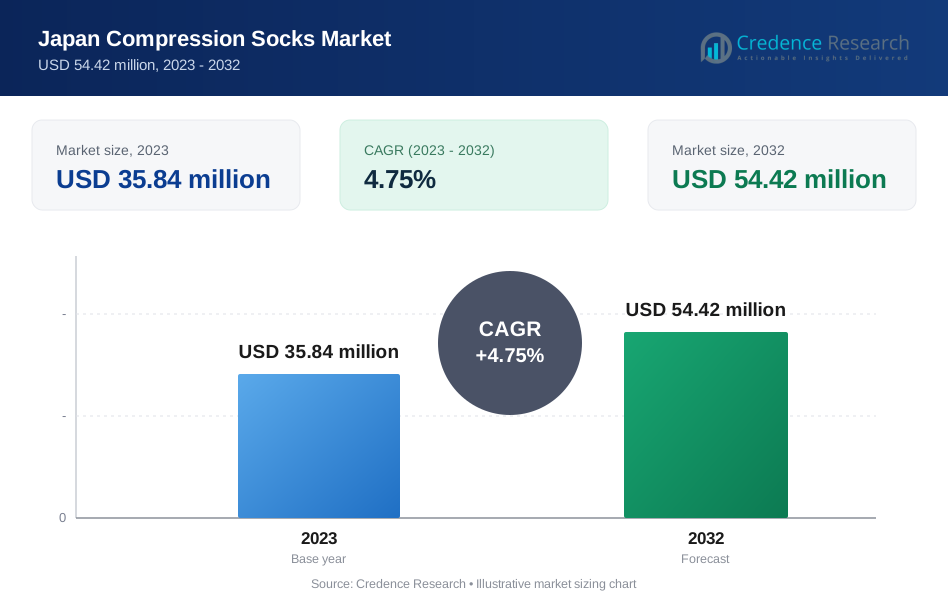
| Japan Compression Socks Market Size 2023 | USD 35.84 million |
| Japan Compression Socks Market, CAGR | 4.75% |
| Japan Compression Socks Market Size 2032 | USD 54.42 million |
Market Overview
The compression socks market in Japan is a segment of the broader medical textiles industry, focusing on products designed to improve blood circulation, support vein health, and alleviate conditions such as varicose veins, edema, and deep vein thrombosis (DVT). Over recent years, this market has seen significant growth, propelled by Japan's aging population, increasing health awareness, and advancements in textile technology. The Japan Compression Socks Market is projected to grow from USD 35.84 million in 2023 to USD 54.42 million by 2032, at a CAGR of 4.75%.
Japan's demographic trends, with a substantial portion of its population being elderly, have been a crucial factor driving the demand for compression socks. These products are not only sought after by the older demographic but also by athletes, travelers, and individuals engaged in professions requiring prolonged periods of standing or sitting. The market offers a range of products, varying in compression levels, materials, styles, and purposes, catering to a wide array of consumer needs.
The integration of innovative technologies in fabric manufacturing and design has led to the development of compression socks that are not only functional but also comfortable and fashionable. This has helped in expanding the consumer base to include younger individuals who are conscious about health and style. The market is supported by a well-established healthcare system in Japan, which often recommends the use of compression socks for both preventive and therapeutic purposes.
Moreover, the market dynamics are influenced by Japan's robust retail infrastructure, including online platforms, which has made compression socks readily accessible to consumers across the country. The availability of detailed product information and reviews online has also aided in informed decision-making among potential buyers.
Key market drivers
Technological advancements and product innovation
One of the primary drivers of the compression socks market in Japan is the continuous innovation and technological advancements in textile materials and manufacturing processes. Manufacturers are increasingly focusing on creating products that offer superior comfort, better compression, and aesthetic appeal. The development of microfiber technology, moisture-wicking fabrics, and anti-microbial properties has significantly enhanced the functionality and attractiveness of compression socks. These innovations have not only improved the effectiveness of compression therapy but have also increased consumer acceptance and usage, particularly among younger demographics and athletes.
Furthermore, the integration of smart technologies, such as wearable sensors in compression socks, to monitor circulation and leg health in real-time represents a frontier in product development. These advancements are expected to cater to a growing demand for personalized healthcare solutions, making compression socks an integral part of preventive health regimes.
Growing health awareness and an aging population
The increasing health consciousness among the Japanese population, coupled with the country’s aging demographic, serves as a major driver for the compression socks market. Japan has one of the highest life expectancy rates globally, resulting in a larger elderly population prone to circulatory issues and diseases that can be mitigated by the use of compression socks. For instance, more than a quarter of Japanese were 65 years of age or older in 2022. Awareness regarding the benefits of compression therapy in preventing venous disorders, reducing swelling, and enhancing blood circulation has significantly contributed to the market’s growth.
Active Lifestyles in an Aging Population
Contrary to the challenges posed by an aging demographic, Japan is witnessing a notable trend of individuals maintaining active lifestyles into their advanced years. Compression socks serve as a crucial aid in this regard, enhancing circulation and alleviating discomfort during physical exertion, thus supporting the populace in pursuing healthier, more active lives.
The Impact of an Aging Population
With one of the fastest-aging populations globally, Japan faces unique health challenges, including an increased prevalence of circulatory issues like varicose veins and lymphedema among the elderly. Compression socks are recognized for their ability to improve blood circulation and minimize leg swelling, making them an essential tool for aging individuals to maintain mobility and quality of life. For example, almost a third of Japan’s population is over 65-an estimated 36.23 million.
Key market restraints
Despite the promising growth, the market faces challenges that restrain its potential. One significant barrier is the widespread lack of awareness and misconceptions about compression socks among the general public. Many people still perceive these products as solely for the elderly or those with severe circulatory problems, not realizing the preventive and performance-enhancing benefits they offer to a broader audience. This perception has limited market penetration among younger individuals and those in the early stages of circulatory issues, who could significantly benefit from early adoption.
Moreover, the high cost of premium and technologically advanced compression socks can be prohibitive for a segment of the population. While there is a range of products available at different price points, the higher-end, more effective products with advanced features may not be accessible to all. This cost factor, coupled with the perception issue, poses a challenge to the market's growth, necessitating targeted educational campaigns and potential price adjustments or financing options to make these health-benefiting products more accessible.
Market Opportunities
- Expansion into Sports and Fitness: Targeting athletes and fitness enthusiasts with products designed for performance enhancement and faster recovery could open new growth avenues. Marketing these benefits alongside health improvements could significantly widen the market base.
- Collaboration with Healthcare Providers: Partnering with doctors, physiotherapists, and hospitals to recommend or prescribe compression socks for preventive care and treatment of various conditions can boost market penetration.
- Innovative Product Offerings: The development of compression socks with enhanced features such as temperature regulation, customized compression levels, and smart technology integration for health monitoring could attract a tech-savvy consumer base.
- Educational Marketing Campaigns: Implementing comprehensive marketing strategies to educate the public on the benefits of compression socks for all age groups and lifestyles could help dispel misconceptions and stimulate demand.
- Online Retail Expansion: Strengthening online sales channels through e-commerce platforms and social media marketing can reach a broader audience, including younger consumers who are more comfortable with online shopping.
- International Market Expansion: Exploring export opportunities and expanding into other markets with similar demographic trends and health awareness levels could provide additional revenue streams.
- Sustainability Initiatives: Offering eco-friendly and sustainably produced compression socks could appeal to environmentally conscious consumers, aligning with global trends towards sustainable products.
Segmentations:
By Material Segment
- Nylon
- Spandex
- Cotton
- Polyester
- Others
By end-user segment
- Medical
- Athletic
- Travel
- Maternity
- Fashion
By Compression Level
- Mild
- Moderate
- Firm
- Extra-Firm
- Medical-Grade
By Distribution Channel
- Retail Pharmacies
- Online Retailers
- Medical Supply Stores
Interesting Facts About the Market
- Diverse Consumer Base: Initially targeted at older adults, the market now sees growing demand from younger demographics, including office workers, travelers, and athletes.
- Technological Integration: The market is witnessing the introduction of smart compression socks equipped with sensors for health monitoring, appealing to the tech-savvy generation.
- Cultural Influence: Japan's cultural emphasis on health and wellness significantly contributes to the market's growth, with compression socks being recommended by healthcare professionals as part of regular health maintenance.
- Fashion Forward: Japanese manufacturers are producing stylish and fashionable compression socks, breaking the stereotype of medical-grade wear being unattractive.
- Customization Trend: There's a rising trend towards personalized compression socks, catering to individual needs and preferences in terms of compression level, material, and design.
- Research and Development: Japan is at the forefront of research in textile technology, with significant investments in developing materials that offer better compression, comfort, and durability.
- Export Potential: Japanese compression socks are gaining popularity in international markets, known for their quality and innovation.
- Preventive Healthcare: Increasingly, compression socks are being recognized for their preventive health benefits, leading to wider adoption among those without explicit medical needs.
- Regulatory Support: The Japanese government's regulations and support for medical devices, including compression socks, ensure high standards of quality and safety.
- Online Sales Growth: The market has experienced significant growth in online sales, driven by the convenience of e-commerce and the COVID-19 pandemic's impact on shopping behaviors.
Top Leading Players
The Japanese compression socks market is characterized by the presence of both international and domestic players. Leading companies in this space are known for their innovation, quality, and comprehensive product offerings. Some of the top players include:
- Venosan
- Sigvaris
- Medi
- BSN Medical
- Juzo
- Souermei
- Truform
- GUNZE LIMITED
- ASICS
These companies are at the forefront of product innovation, marketing strategies, and customer engagement, setting the pace for the industry's growth and evolution.
Competitive Landscape
The competitive landscape of the Japanese compression socks market is marked by intense competition among both international and domestic players. Companies compete on various fronts, including product innovation, quality, pricing, marketing strategies, and distribution channels. The market has seen a trend towards mergification and partnerships, with companies looking to leverage each other's strengths in technology, distribution, and brand recognition to expand their market share.
Product differentiation has become a key strategy, with companies offering a wide range of products catering to specific needs and preferences, such as sports compression socks, fashionable options, and medical-grade compression for different conditions. The emphasis on research and development has led to significant advancements in material technology, compression techniques, and product features, enhancing the value proposition to consumers.
Online sales channels and digital marketing have emerged as critical components of the competitive strategy, especially in reaching younger demographics and expanding market penetration. Companies that successfully integrate innovative products with strong online presence and customer engagement practices are likely to gain a competitive edge in the market.
Regional Analysis
The demand for compression socks in Japan varies across different regions, influenced by demographics, lifestyle, and access to healthcare services. Urban areas such as Tokyo, Osaka, and Nagoya, with their large populations, high concentration of office workers, and active lifestyles, represent significant markets for compression socks. These regions are characterized by higher health awareness and accessibility to advanced healthcare and wellness products.
Rural areas, on the other hand, have a higher proportion of elderly residents who require compression therapy for medical reasons. However, market penetration in these areas may be limited by lower health awareness and access to specialized retail outlets.
The western region of Japan, known for its active sporting community, presents opportunities for sports-oriented compression socks, while the northern regions, with colder climates, may have higher demand for products offering thermal properties in addition to compression.
Overall, the regional analysis indicates a diverse market with varying needs and opportunities, necessitating targeted strategies for different segments.
Recent Developments:
- GUNZE LIMITED published the “Gunze Integrated Report 2023” in September 2023, which includes their corporate and business strategies, corporate governance, and environmental and social initiatives.
- Juzo has introduced a new line of men’s socks, Juzo Power Comfort, in February 2020. They also have a range of products with X-Static silver thread for its antibacterial effect.
- Sigvaris emphasizes the importance of quality in compression socks and explains why their products, made with state-of-the-art circular knitting machines, are worth the price. They also debunked popular misconceptions about compression socks. (No specific month or year is provided in the source.)
Future Outlook
- Increased Health Awareness: Continued growth in health awareness and preventive healthcare will drive broader adoption of compression socks among all age groups.
- Technological Innovations: Advances in textile technology and wearable devices will lead to more sophisticated products with enhanced features and functionalities.
- Expansion into New Markets: Companies will increasingly look to international markets for growth, leveraging Japan's reputation for quality and innovation.
- Sustainability Focus: Eco-friendly and sustainable products will become more prominent, aligning with global environmental concerns and consumer preferences.
- Personalization and Customization: The trend towards personalized healthcare will extend to compression socks, with more customized solutions based on individual health needs and preferences.
- Integration with Digital Health Platforms: Smart compression socks will integrate with digital health platforms for real-time monitoring and data-driven health management.
- Collaborations with Healthcare Providers: Stronger collaborations with healthcare professionals will enhance the market's credibility and drive adoption.
- Innovative Distribution Channels: The expansion of online and direct-to-consumer sales channels will make compression socks more accessible and convenient to purchase.
- Fashion and Functionality: The blending of fashion and functionality will continue, making compression socks a lifestyle product beyond a medical necessity.
- Regulatory Evolution: Regulatory advancements will ensure product safety and efficacy, supporting market growth and innovation.
Request a Free Sample
Fill in your details and we'll send you a free sample report.
- Sample data tables & charts
- Research methodology
Need a Custom Version of This Report?
Tailor the scope, geography, or segments to your exact requirements.
- Custom geography or segment scope
- Direct access to our analyst team
Frequently Asked Questions
What is driving the growth of the compression socks market in Japan?
Who are the primary users of compression socks in Japan?
How have advancements in textile technology impacted the compression socks market?
How does Japan's retail infrastructure affect the compression socks market?
Table of Content
Chapter 1. Report Introduction
- 1.1 Report Description & Purpose
- 1.1.1 Report Title & Market Definition
- 1.1.2 Unique Selling Propositions (USP) & Key Differentiators
- 1.1.3 Value Proposition for Stakeholders
- 1.2 Research Objectives
- 1.2.1 Market Sizing Objectives (Volume & Revenue)
- 1.2.2 Segmentation Objectives
- 1.2.3 Competitive Intelligence Objectives
- 1.2.4 Forecast & Scenario Objectives
- 1.3 Report Scope
- 1.3.1 Japan Compression Socks Scope – Types & Subtypes Covered
- 1.3.2 Geographic Scope – Regions & Countries Covered
- 1.3.3 Historical Period, Base Year & Forecast Period (2023; forecast to 2032)
- 1.3.4 Inclusions & Exclusions
- 1.4 HS Code & Classification Framework
- 1.5 Currency, Units & Pricing Basis
- 1.6 Target Stakeholders
- 1.7 Limitations & Assumptions
Chapter 2. Executive Summary
- 2.1 Global Japan Compression Socks Market Snapshot
- 2.1.1 Market Size – Historical (2023) & Forecast (2023-2032) (2023: USD 35.84 million → 2032: USD 54.42 million)
- 2.1.2 Volume & Revenue – Global Totals
- 2.1.3 Key Market Highlights – Top Five Facts
- 2.2 Japan Compression Socks Market Segmentation Snapshot
- 2.2.1 Market Split by Region – 2023 vs. 2032
- 2.3 Competitive Snapshot
- 2.3.1 Top 10 Players by Revenue Share – 2023
- 2.3.2 Top 10 Players by Volume Share – 2023
- 2.3.3 Recent Strategic Developments (18-Month Summary)
- 2.4 Key Investment Highlights & Strategic Conclusions
Chapter 3. Japan Compression Socks Market Dynamics & Industry Analysis
- 3.1 Market Overview & Context
- 3.1.1 Japan Compression Socks Market Position in the Broader Automotive Value Chain
- 3.1.2 OEM vs. Replacement Market Dynamics
- 3.1.3 Market Maturity & Development Stage by Region
- 3.2 Japan Compression Socks Market Drivers
- 3.3 Japan Compression Socks Market Restraints & Challenges
- 3.4 Japan Compression Socks Market Opportunities
- 3.5 Porter's Five Forces Analysis
- 3.5.1 Threat of New Entrants
- 3.5.2 Bargaining Power of Suppliers
- 3.5.3 Bargaining Power of Buyers
- 3.5.4 Threat of Substitutes
- 3.5.5 Competitive Rivalry – Intensity Assessment
- 3.6 Japan Compression Socks Value Chain Analysis
- 3.6.1 Upstream – Raw Material/Input Suppliers
- 3.6.1.1 Raw Material/Input 1
- 3.6.1.2 Raw Material/Input 2
- 3.6.1.3 Raw Material/Input 3
- 3.6.2 Midstream – Production/Manufacturing/Service Delivery
- 3.6.2.1 Production/Process Overview
- 3.6.2.2 Key Facility Locations & Capacity by Manufacturer
- 3.6.3 Downstream – Distribution & End Consumer
- 3.6.3.1 Primary Channel – B2B/OEM
- 3.6.3.2 Secondary Channels – Dealer, Retail, Online, Direct
- 3.6.4 Value Chain Profitability Analysis
- 3.6.1 Upstream – Raw Material/Input Suppliers
- 3.7 PESTEL Analysis
- 3.7.1 Political Factors
- 3.7.2 Economic Factors
- 3.7.3 Social Factors
- 3.7.4 Technological Factors
- 3.7.5 Environmental Factors
- 3.7.6 Legal Factors
- 3.8 Japan Compression Socks Supply Chain Analysis
- 3.8.1 Raw Material/Input Supply Risk Assessment
- 3.8.2 Manufacturing Concentration Risk (Geographic Exposure)
- 3.8.3 Trade Disruption Impact Analysis
- 3.9 Regulatory & Policy Landscape
Note: The regulatory and policy landscape section covers regulations based on their applicability to the market, Japan Compression Socks category, geography, and scope of the study. Only regulatory frameworks with a material impact on operations, compliance, trade, sustainability, or market access are analyzed in detail.
Chapter 4. Key Investment Pockets & Opportunity Analysis
- 4.1 Japan Compression Socks Market Attractiveness Analysis
- 4.1.1 By Region – Investment Attractiveness Matrix (Volume × CAGR)
- 4.2 Absolute Revenue Growth Opportunity
- 4.2.1 By Region – Absolute USD Growth Through 2032
- 4.3 Incremental Volume Opportunity
- 4.3.1 By Region – Incremental Volume Through 2032
- 4.3.2 Segment – Incremental Volume
- 4.4 Emerging Submarket Opportunity Deep Dive (Subject to Applicability)
- 4.5 Emerging Market Opportunity Scorecards
- 4.5.1 United States
- 4.5.2 Europe
- 4.5.3 Asia
- 4.5.4 Middle East & Africa
Note: Emerging Market Opportunity Scorecards will be included based on relevance and strategic importance. Regions listed are indicative and may vary depending on data availability and market dynamics.
Chapter 5. Japan Compression Socks Import-Export Analysis & Trade Flows
- 5.1 Global Trade Overview
- 5.1.1 Global Export Value by Country (2023)
- 5.1.2 Global Export Volume by Country (2023)
- 5.1.3 Global Import Value by Country (2023)
- 5.1.4 Global Import Volume by Country (2023)
- 5.1.5 Net Trade Balance by Country (2023)
- 5.2 Export Analysis – Segment
- 5.2.1 Type 1 (HS Code)
- 5.2.2 Type 2 (HS Code)
- 5.2.3 Type 3 (HS Code)
- 5.2.4 Type 4 (HS Code)
- 5.2.5 Type 5 (HS Code)
- 5.3 Import Analysis – Segment
- 5.3.1 Type 1 (HS Code)
- 5.3.2 Type 2 (HS Code)
- 5.3.3 Type 3 (HS Code)
- 5.3.4 Type 4 (HS Code)
- 5.3.5 Type 5 (HS Code)
- 5.4 Average Unit Trade Prices
- 5.4.1 Average Export Price – Segment & Country
- 5.4.2 Average Import Price – Segment & Source Country
- 5.4.3 Price Trends (2023)
- 5.5 Key Trade Route Analysis
- 5.5.1 Trade Route 1
- 5.5.2 Trade Route 2
- 5.5.3 Trade Route 3
- 5.5.4 Trade Route 4
- 5.5.5 Trade Route 5
- 5.6 Trade Policy Impact Assessment
- 5.6.1 US Anti-Dumping & Section 301 Tariffs
- 5.6.2 EU Customs Union Impact
- 5.6.3 Major Free Trade Agreements
- 5.6.4 USMCA Rules of Origin
Note: Trade policy analysis will be included only where relevant to the Japan Compression Socks market.
Chapter 6. Competitive Landscape & Company Benchmarking
- 6.1 Japan Compression Socks Market Concentration & Structure
- 6.1.1 Herfindahl-Hirschman Index (HHI) – vs. 2023
- 6.1.2 Tier 1, Tier 2 & Tier 3 Market Structure
- 6.1.3 Global, Regional & Local Player Dynamics
- 6.2 Japan Compression Socks Market Share Analysis – 2023
- 6.2.1 Global Revenue Share by Company
- 6.2.2 Global Volume Share by Company
- 6.2.3 Regional Revenue Share
- 6.2.4 Market Share Evolution ( vs. 2023)
- 6.2.5 OEM Segment Share by Company
- 6.2.6 Replacement Segment Share by Company
- 6.3 Production/Delivery Capacity & Facility Analysis
- 6.3.1 Global Installed Capacity
- 6.3.2 Capacity Utilization Rates
- 6.3.3 Production/Output Volume
- 6.3.4 Facility Locations & Capacity Map
- 6.3.5 Planned Capacity Additions
- 6.4 Japan Compression Socks Competitive Benchmarking Matrix
- 6.4.1 Revenue, Volume, CAGR & Profitability Comparison
- 6.4.2 Channel Revenue Mix
- 6.4.3 Geographic Revenue Exposure
- 6.4.4 R&D Intensity
- 6.4.5 Sustainability Maturity
- 6.5 Strategic Developments in Japan Compression Socks (Last 24 Months)
- 6.5.1 Mergers, Acquisitions & Divestments
- 6.5.2 New Japan Compression Socks Launches
- 6.5.3 Facility Expansions
- 6.5.4 Strategic Alliances, Joint Ventures & Partnerships
- 6.5.5 Distribution Expansion & Market Entry
- 6.5.6 Sustainability & ESG Initiatives
- 6.6 Competitive Strategy Mapping
- 6.6.1 Leader, Challenger, Follower & Niche Classification
- 6.6.2 Pricing Strategy Comparison
- 6.6.3 Channel Strategy Matrix
Note: Strategic developments are included based on their materiality and the availability of reliable information.
Chapter 7. Global Japan Compression Socks Market – By Distribution Channel
- 7.1 Segment Overview
- 7.1.1 Volume & Revenue Split by Channel (2023 & 2032)
- 7.1.2 Channel Mix Evolution (2023-2032)
Chapter 8. Regional Market Analysis – Global Overview
- 8.1 Global Regional Overview
- 8.1.1 Regional Volume Share
- 8.1.2 Regional Revenue Share
- 8.1.3 Regional Volume by Region
- 8.1.4 Regional Revenue by Region
- 8.1.5 Regional Forecast Through 2032
- 8.2 Cross-Regional Segment Analysis
- 8.2.1 By Distribution Channel
- 8.2.2 By Brand/Price Tier
Chapter 9. North America Japan Compression Socks Market
- 9.1 United States
- 9.2 Canada
- 9.3 Mexico
Chapter 10. Europe Japan Compression Socks Market
- 10.1 Germany
- 10.2 France
- 10.3 Italy
- 10.4 United Kingdom
- 10.5 Spain
- 10.6 Poland
- 10.7 Russia
- 10.8 Netherlands
- 10.9 Belgium
- 10.10 Sweden
- 10.11 Denmark
- 10.12 Norway
- 10.13 Rest of Europe
Chapter 11. Asia Pacific Japan Compression Socks Market
- 11.1 China
- 11.2 India
- 11.3 Japan
- 11.4 South Korea
- 11.5 Thailand
- 11.6 Indonesia
- 11.7 Vietnam
- 11.8 Malaysia
- 11.9 Australia
- 11.10 Rest of Asia Pacific
Chapter 12. Latin America Japan Compression Socks Market
- 12.1 Brazil
- 12.2 Argentina
- 12.3 Colombia
- 12.4 Chile
- 12.5 Rest of Latin America
Chapter 13. Middle East Japan Compression Socks Market
- 13.1 Saudi Arabia
- 13.2 United Arab Emirates
- 13.3 Turkey
- 13.4 Israel
- 13.5 Iran
- 13.6 Rest of the Middle East
Chapter 14. Africa Japan Compression Socks Market
- 14.1 South Africa
- 14.2 Egypt
- 14.3 Nigeria
- 14.4 Morocco
- 14.5 Rest of Africa
Chapter 15. Japan Compression Socks Company Profiles
- 15.1 [Company 01]
- 15.1.1 Company Overview
- 15.1.2 Key Management Personnel
- 15.1.3 Products & Services Portfolio
- 15.1.4 Financial Performance
- 15.1.5 Key Market Focus & Geographic Presence
- 15.1.6 Recent Developments & Strategic Initiatives
Note: The company profile list is preliminary and may change based on research findings, market developments, data availability, and client requirements.
Chapter 16. Appendices
- Appendix A – List of Abbreviations & Acronyms
- Appendix B – Industry Classification Code Reference – Full Series
- Appendix C – Production & Capacity Data Tables
- Appendix D – End-Use & Demand Base Tables
- Appendix E – Consumption & Replacement Rate Assumptions
- Appendix F – ASP Reference Tables
- Appendix G – Manufacturing & Facility Database
- Appendix H – Import-Export Data Tables
- Appendix I – Regulatory Summary Tables
- Appendix J – Primary Research Participant List (Anonymized)
- Appendix K – Primary Research Questionnaire Framework
- Appendix L – Data Sources & Bibliography
- Appendix M – Market Size Divergence & Source Comparison
Chapter 17. Research Methodology
- 17.1 Research Framework & Philosophy
- 17.2 Secondary Research – Sources, Hierarchy & Data Extraction
- 17.3 Data Modeling – Bottom-Up & Top-Down Market Sizing
- 17.4 Primary Research – Stakeholder Framework, LOI & Sample Sizes
- 17.5 Forecast Methodology – Regression, Scenario & Sensitivity Analysis
- 17.6 Quality Control – Four-Layer Validation Framework
- 17.7 Limitations & Standard Assumptions
- 17.8 Disclaimer
