Market Overview:
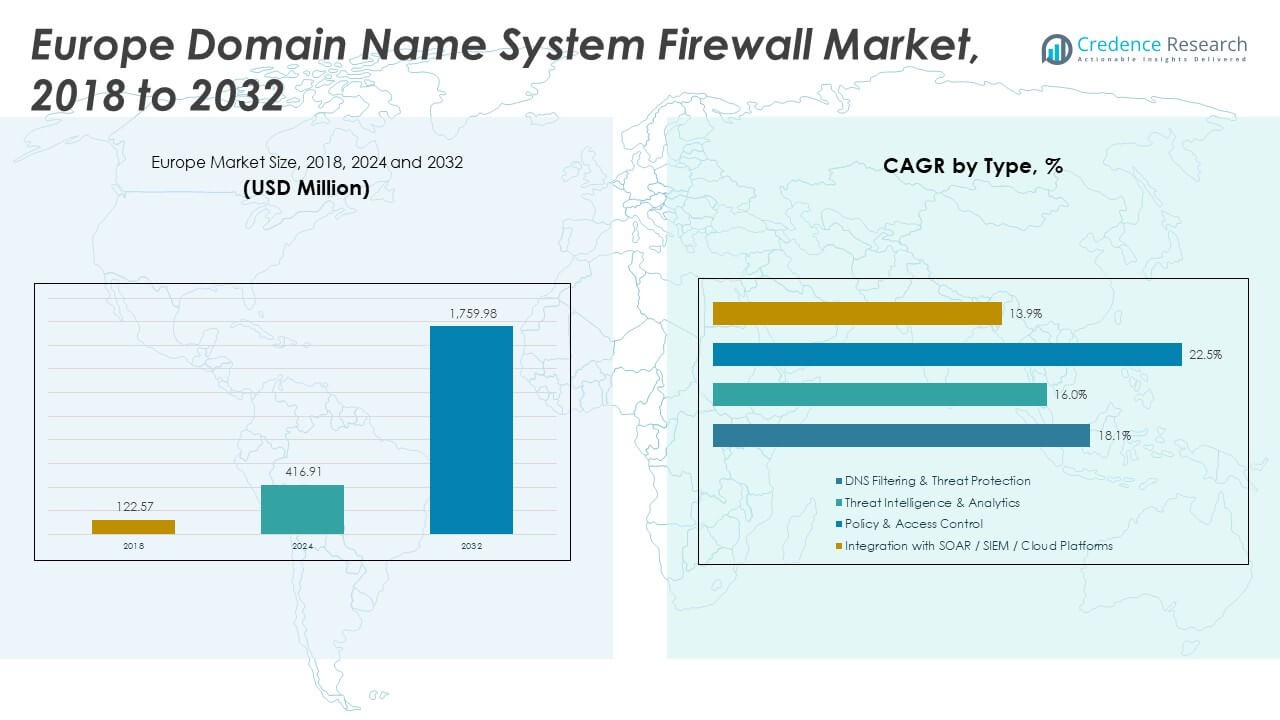
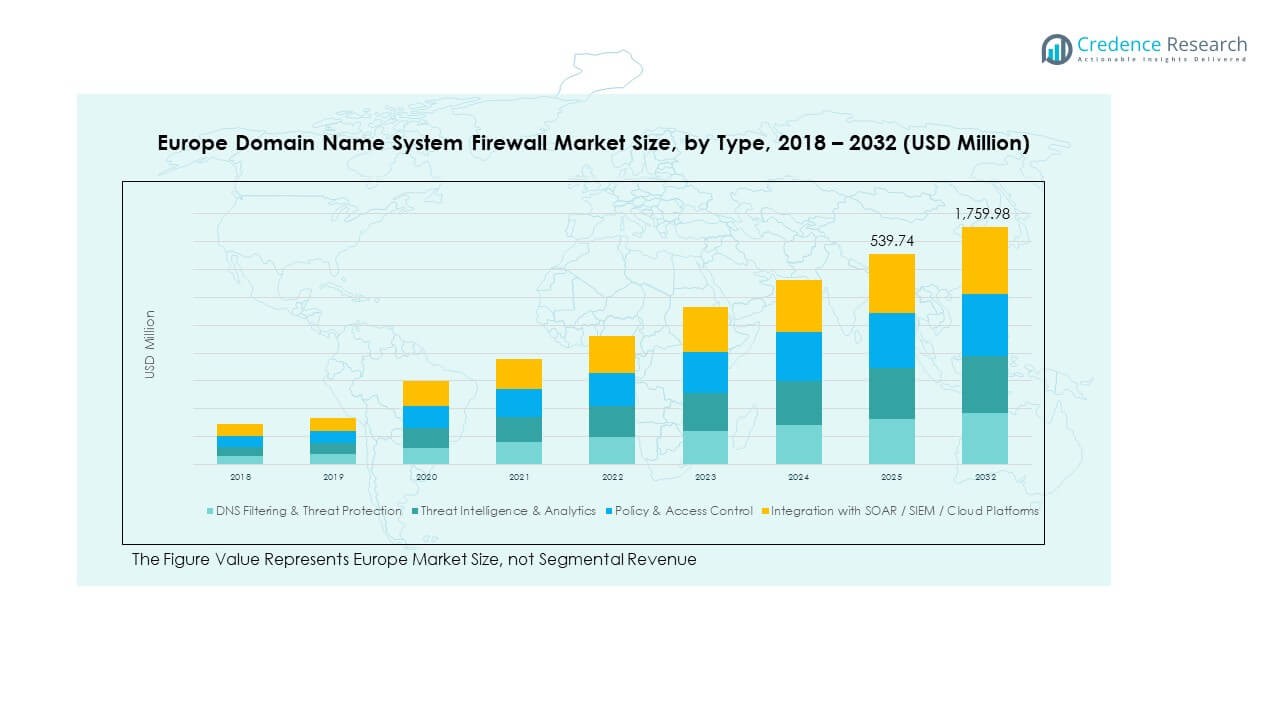
The Europe Domain Name System Firewall Market size was valued at USD 122.57 million in 2018 to USD 416.91 million in 2024 and is anticipated to reach USD 1,759.98 million by 2032, at a CAGR of 18.39% during the forecast period.
| REPORT ATTRIBUTE | DETAILS |
|---|---|
| Historical Period | 2020-2023 |
| Base Year | 2024 |
| Forecast Period | 2025-2032 |
| Europe Domain Name System Firewall Market Size 2024 | USD 416.91 Million |
| Europe Domain Name System Firewall Market, CAGR | 18.39% |
| Europe Domain Name System Firewall Market Size 2032 | USD 1,759.98 Million |
Market growth is being driven by escalating cyber‑threats across enterprises, with organisations actively investing in DNS‑level protection to defend against phishing, DNS hijacking and malicious domain‑based attacks. Strict data protection and regulatory compliance regimes across Europe amplify demand as firms incorporate advanced DNS firewall solutions to safeguard distributed infrastructure and cloud environments. Continuous digital transformation and cloud migration within sectors such as BFSI and telecom further fuel this surge in adoption.
Regionally, the leading markets in Europe include Germany, the United Kingdom and France, where strong regulation, high digitalisation and large enterprise footprints dominate the DNS firewall landscape. Emerging markets include parts of Eastern Europe and the Nordics, where increasing cyber‑risk awareness and growing SME investment signal expansion opportunity. Collectively, Western Europe remains the core revenue base, while growth momentum is shifting into newer sub‑regions as infrastructure upgrades accelerate.
Market Insights:
- The Europe Domain Name System Firewall Market was valued at USD 122.57 million in 2018 and is projected to reach USD 1,759.98 million by 2032, growing at a CAGR of 18.39% during the forecast period.
- Western Europe leads the regional market with around 40% share due to its advanced cybersecurity infrastructure, followed by Northern and Southern Europe at 30%, driven by cloud adoption and increasing cyber threats. Eastern Europe accounts for 30%, with rapid growth fueled by digital infrastructure upgrades.
- The fastest-growing region is Eastern Europe, showing the highest growth rate, driven by digital transformation, increasing cybersecurity awareness, and regulatory alignment.
- In 2024, the "Cloud-based DNS Firewall / DNS Security Services" segment is expected to hold the largest market share, followed by DNS Filtering & Threat Protection at around 25%.
- Integration with SOAR / SIEM / Cloud Platforms accounts for the smallest share but is anticipated to experience significant growth, particularly in large enterprises adopting hybrid and advanced security solutions.
Market Drivers:
Increasing Cybersecurity Threats
Rising cyber threats across various sectors are driving demand for advanced security solutions. The Europe Domain Name System Firewall Market benefits from escalating concerns over cyber-attacks, such as DNS spoofing and DDoS attacks. These threats target critical infrastructure, heightening the need for robust DNS-level protection. Enterprises across Europe are focusing on mitigating these risks, investing in DNS firewall solutions to defend against data breaches and system disruptions. Enhanced threat awareness across industries further fuels adoption.
- For instance, Infoblox's DNS security solutions, such as its Advanced DNS Protection, which protects against DNS threats including DDoS attacks and cache poisoning (a form of DNS spoofing), have been deployed by major enterprises like a confidential large internet service provider and a global financial services company to safeguard against sophisticated cyber-attacks.
Stringent Regulatory Compliance and Data Privacy
Governments in Europe enforce strict data privacy laws, such as GDPR, which drive the market for DNS firewalls. Organizations must adhere to these regulations to protect customer information and avoid hefty fines. The Europe Domain Name System Firewall Market sees rising demand from firms striving to comply with regulatory requirements. DNS firewalls help these firms protect sensitive data while maintaining privacy standards. Increasing pressure on organizations to maintain compliance amplifies the adoption of these security measures. Data protection continues to be a critical factor in the market's growth.
- For instance, EfficientIP provides a suite of DDI and security solutions, including products such as DNS Guardian and DNS Firewall, designed to align with regulatory requirements like GDPR by offering advanced threat detection, logging, and data protection against exfiltration. Users such as General Motors and HSBC leverage EfficientIP's solutions to secure their networks and ensure compliance standards are met.
Growing Cloud Adoption and Digital Transformation
The rapid shift to cloud environments accelerates the need for DNS firewall solutions. With enterprises migrating to multi-cloud and hybrid infrastructures, securing DNS services becomes a priority. The Europe Domain Name System Firewall Market sees substantial demand from organizations seeking to safeguard distributed cloud platforms. As businesses scale their digital operations, they require enhanced security to defend against cloud-based attacks. DNS firewalls offer a proactive approach to securing cloud networks.
Rise of IoT Devices and Network Expansion
The widespread adoption of IoT devices and the expansion of connected networks contribute to increased DNS vulnerabilities. In the Europe Domain Name System Firewall Market, this creates a growing need for secure DNS solutions. With more devices connected to the network, the surface area for potential attacks expands, necessitating DNS-level protection. The demand for DNS firewalls rises as enterprises seek to secure IoT-driven infrastructures. These firewalls help mitigate risks associated with unsecured connected devices and prevent unauthorized access.
Market Trends:
Cloud-Based DNS Firewall Solutions
The trend toward cloud-based solutions is transforming the Europe Domain Name System Firewall Market. Cloud DNS firewalls offer scalability, flexibility, and cost efficiency, appealing to businesses of all sizes. These solutions allow organizations to offload their DNS security functions to the cloud, reducing the burden on in-house IT teams. As more companies embrace cloud-first strategies, demand for cloud-native DNS firewalls is expected to rise. These solutions also integrate seamlessly with existing cloud environments, providing a comprehensive security layer.
- For instance, Companies like Zscaler have pioneered cloud-native DNS firewall systems, with customers such as Siemens leveraging the Zscaler Cloud Security platform to offload DNS security functions to the cloud.
AI and Machine Learning Integration
Artificial Intelligence (AI) and machine learning (ML) are revolutionizing DNS firewall technology in the Europe Domain Name System Firewall Market. These technologies enable DNS firewalls to identify and block sophisticated threats in real time. Machine learning algorithms continuously learn from attack patterns, improving the firewall’s ability to detect new threats. AI-driven DNS firewalls offer advanced predictive capabilities, helping organizations stay ahead of evolving cyber threats. These innovations enhance the overall efficiency and reliability of DNS security systems.
- For instance, Palo Alto Networks' DNS Security solution uses AI to predict and block threats, helping organizations secure their networks. Through machine learning algorithms, the solution offers leading threat coverage and can detect malicious domains faster than traditional DNS security systems.
Adoption of Hybrid Security Models
The adoption of hybrid security models is gaining traction in the Europe Domain Name System Firewall Market. Companies are combining on-premise and cloud-based solutions to ensure comprehensive DNS protection. Hybrid models offer the flexibility of managing DNS security both on-site and in the cloud. This approach allows businesses to secure critical infrastructure while also benefiting from the scalability of cloud solutions. Hybrid DNS firewall solutions are becoming increasingly popular among enterprises with complex and diverse IT environments.
Integration with Zero-Trust Architectures
Zero-trust security models are reshaping the Europe Domain Name System Firewall Market. The integration of DNS firewalls with zero-trust architectures enables enterprises to implement stricter security measures. Zero-trust models assume no entity, inside or outside the network, is trusted, and require verification before granting access. Combining DNS firewalls with zero-trust frameworks enhances the ability to detect unauthorized access attempts and prevent security breaches. This trend is expected to continue as zero-trust security practices become more prevalent across industries.
Market Challenges Analysis:
Complexity of Implementation and Maintenance
One of the primary challenges in the Europe Domain Name System Firewall Market is the complexity involved in implementing and maintaining DNS firewall solutions. For organizations with complex IT infrastructures, integrating a new security system can be a lengthy and resource-intensive process. Additionally, ongoing management of DNS firewall solutions requires skilled personnel and continuous monitoring to ensure optimal performance. Many small and medium-sized businesses face difficulties in allocating resources to effectively deploy and manage DNS firewalls. These challenges can hinder adoption, particularly among firms with limited IT resources.
Integration with Existing Security Infrastructure
Integrating DNS firewalls with existing security infrastructure can be another challenge in the market. Organizations often rely on a range of security systems to protect their networks, and integrating DNS firewall solutions seamlessly can prove difficult. Compatibility issues, data silos, and the need for specialized configurations can slow down the integration process. The complexity of merging DNS firewalls with other security tools like intrusion detection systems and firewalls can discourage potential adopters. Firms may also face concerns over the performance impact of adding another layer of security to their networks.
Market Opportunities:
Growing Demand for DNS Security in SMEs
Small and medium-sized enterprises (SMEs) represent a growing opportunity in the Europe Domain Name System Firewall Market. As cyber threats become more prevalent, SMEs are increasingly seeking affordable and efficient DNS firewall solutions. This segment is largely underserved, creating an opportunity for providers to offer tailored solutions that meet the specific needs of smaller businesses. With rising awareness of cybersecurity risks, SMEs are likely to adopt DNS firewalls to enhance their network security. This trend will drive market growth in the coming years.
Expansion of Security Solutions in Emerging Regions
The emergence of new markets in Eastern Europe and the Nordic regions presents significant opportunities for DNS firewall adoption. As digital transformation accelerates in these regions, businesses are investing in robust security measures, including DNS firewalls. The growth of internet-connected devices and the increasing frequency of cyberattacks create a high demand for secure DNS solutions. Providers can tap into these expanding markets by offering scalable and cost-effective DNS firewall solutions that cater to regional needs.
Market Segmentation Analysis:
By Type Segment:
DNS Filtering & Threat Protection
This segment holds a significant share in the Europe Domain Name System Firewall Market, driven by the increasing demand for robust threat prevention measures. DNS filtering and threat protection solutions offer real-time defense against cyber-attacks such as phishing and malware, enabling businesses to maintain secure networks.
- For example, Cisco’s Umbrella DNS security solution is widely adopted for its ability to block malicious traffic in real-time. Cisco reports that Umbrella blocked over 19 billion threats in 2023 alone, providing strong defense against phishing and malware attacks for organizations like Coca-Cola, which saw a 50% reduction in phishing-related incidents after implementation.
Threat Intelligence & Analytics
Threat intelligence and analytics solutions are gaining traction as they provide actionable insights into potential threats. These solutions use data analytics to detect patterns and anomalies in network traffic, empowering organizations to proactively address DNS-based vulnerabilities.
Policy & Access Control
Policy and access control solutions enable enterprises to regulate access to sensitive data and resources through DNS firewalls. By enforcing policies, businesses can ensure that only authorized users and devices access their network, enhancing security across various infrastructure layers.
Integration with SOAR / SIEM / Cloud Platforms
The integration of DNS firewalls with SOAR (Security Orchestration, Automation, and Response), SIEM (Security Information and Event Management), and cloud platforms is driving growth in this segment. These integrations streamline security operations and provide comprehensive protection, enabling businesses to manage DNS security across distributed environments.
By Deployment Mode Segment:
On-premises DNS Firewall
On-premises deployment remains a preferred choice for large organizations that require more control over their security infrastructure. It provides enterprises with the ability to customize their DNS security according to their specific requirements.
Cloud-based DNS Firewall / DNS Security Services
Cloud-based DNS firewall solutions are increasingly popular due to their scalability, cost-effectiveness, and ease of implementation. These solutions cater to businesses of all sizes and offer flexibility, particularly for those migrating to cloud environments.
By Organization Size Segment:
Large Enterprises
Large enterprises continue to dominate the Europe Domain Name System Firewall Market, as they have the resources to invest in advanced DNS security systems. Their vast network infrastructures require comprehensive DNS protection to mitigate risks.
SMBs / Mid-Market
Small and medium-sized businesses are gradually adopting DNS firewalls as part of their cybersecurity strategies. With the increasing frequency of cyber-attacks, these organizations recognize the need to protect their digital assets without a significant increase in operational costs.
By End-User Segment:
IT & Telecom
The IT and telecom sectors lead the market, given their reliance on DNS systems for service delivery. These sectors are prime targets for cyber-attacks, making them key adopters of DNS firewall solutions.
Healthcare
Healthcare organizations prioritize DNS firewall solutions to protect sensitive patient data and ensure compliance with regulatory standards. As cyber threats targeting healthcare networks increase, DNS security becomes essential.
Government
Government agencies are key consumers of DNS firewalls, focusing on safeguarding national security, public services, and sensitive information. These organizations require robust DNS protection to maintain the confidentiality of their operations.
Retail
The retail sector also shows strong demand for DNS security, driven by the need to protect customer data and payment information. DNS firewalls are essential in defending against threats like fraud and data breaches.
Others
Other sectors, such as education, finance, and manufacturing, are also contributing to market growth as they increasingly adopt DNS firewall solutions to safeguard their digital infrastructure.
Segmentation:
By Type Segment:- DNS Filtering & Threat Protection
- Threat Intelligence & Analytics
- Policy & Access Control
- Integration with SOAR / SIEM / Cloud Platforms
- On-premises DNS Firewall
- Cloud-based DNS Firewall / DNS Security Services
- Large Enterprises
- SMBs / Mid-Market
- IT & Telecom
- Healthcare
- Government
- Retail
- Others
Regional Analysis:
Western Europe Dominance and Market Share
Western Europe leads the Europe Domain Name System Firewall Market with around 40 % share of regional revenue in 2024. Germany, the United Kingdom and France drive this dominance thanks to their advanced digital ecosystems and strict regulatory frameworks. Large enterprises in these countries invest heavily in DNS firewall solutions to protect critical infrastructure and comply with GDPR. High cyber‑threat exposure and mature service provider markets further support strong uptake. Vendors continue to prioritise Western Europe for product launches and partnerships.
Emerging Northern and Southern European Markets
Northern and Southern European countries account for approximately 30 % of the market. The Nordics and Benelux region show accelerating growth thanks to strong cloud adoption and populated IoT deployments. In Southern Europe, Italy, Spain and Portugal display rising cyber‑security spending despite budget constraints. Local public‑sector initiatives and rising SME adoption boost market momentum in these areas. Although these markets remain less mature than Western Europe, they offer significant upside potential.
Eastern Europe and Rest of Europe Growth Trajectory
Eastern Europe and the “Rest of Europe” region represent about 30 % of the total regional share and display the highest growth rate. Countries such as Poland, Czech Republic and Romania increasingly adopt DNS firewalls due to rising awareness of cyber‑threats and regulatory alignment. These markets benefit from digital‑infrastructure upgrades and multinational enterprise expansion into lower‑cost locations. Though overall spend remains lower, the steep growth trajectory positions this region as a key focus for vendors seeking new revenue streams.
Key Player Analysis:
- Infoblox
- Cisco
- Palo Alto Networks
- Fortinet
- Check Point Software Technologies
- BlueCat Networks
- EfficientIP
Competitive Analysis:
The Europe Domain Name System Firewall Market is highly competitive, with several global players offering advanced security solutions. Companies like Infoblox, Cisco, Palo Alto Networks, and Fortinet dominate the market with robust DNS security offerings. These companies focus on innovation, product diversification, and strategic partnerships to strengthen their market position. With an increasing demand for cloud-based security services and AI-driven threat intelligence, these players are investing heavily in technology upgrades and acquisitions. Smaller players and emerging start-ups also pose competition, especially in niche segments. The market remains fragmented with a high level of competition, requiring established players to continuously evolve to meet the dynamic needs of businesses across Europe.
Recent Developments:
- In September 2025, Cisco announced the launch of its Sovereign Critical Infrastructure portfolio, available in Europe from September 2025. This strategic offering addresses European customers' specific requirements by providing configurable, air-gapped portfolio capabilities for on-premises deployment. The portfolio spans Cisco's core product lines, including routing, switching, wireless, collaboration, and select endpoint devices, enhanced by Cisco and Splunk security and observability solutions. In 2025, Cisco Systems strengthened its DNS security portfolio by enhancing its Umbrella platform with AI-driven detection capabilities, empowering organizations to stay ahead of sophisticated, AI-driven cyber threats at the DNS layer.
- In May 2025, Check Point announced a definitive agreement to acquire Veriti Cybersecurity, an AI-driven exposure assessment and remediation platform, estimated at over $100 million. This acquisition strengthens the Infinity Platform's open-garden approach by enabling seamless, multi-vendor remediation across the entire security stack. In September 2025, Check Point entered the next level of its strategic partnership with Wiz, unveiling a unified Cloud Security Solution with real-time visibility and AI-powered prevention. The integrated Check Point–Wiz solution brings together Check Point's prevention-first cloud network security with Wiz's Cloud-Native Application Protection Platform, helping enterprises gain real-time insights to understand cloud risks and achieve faster remediation.
Report Coverage:
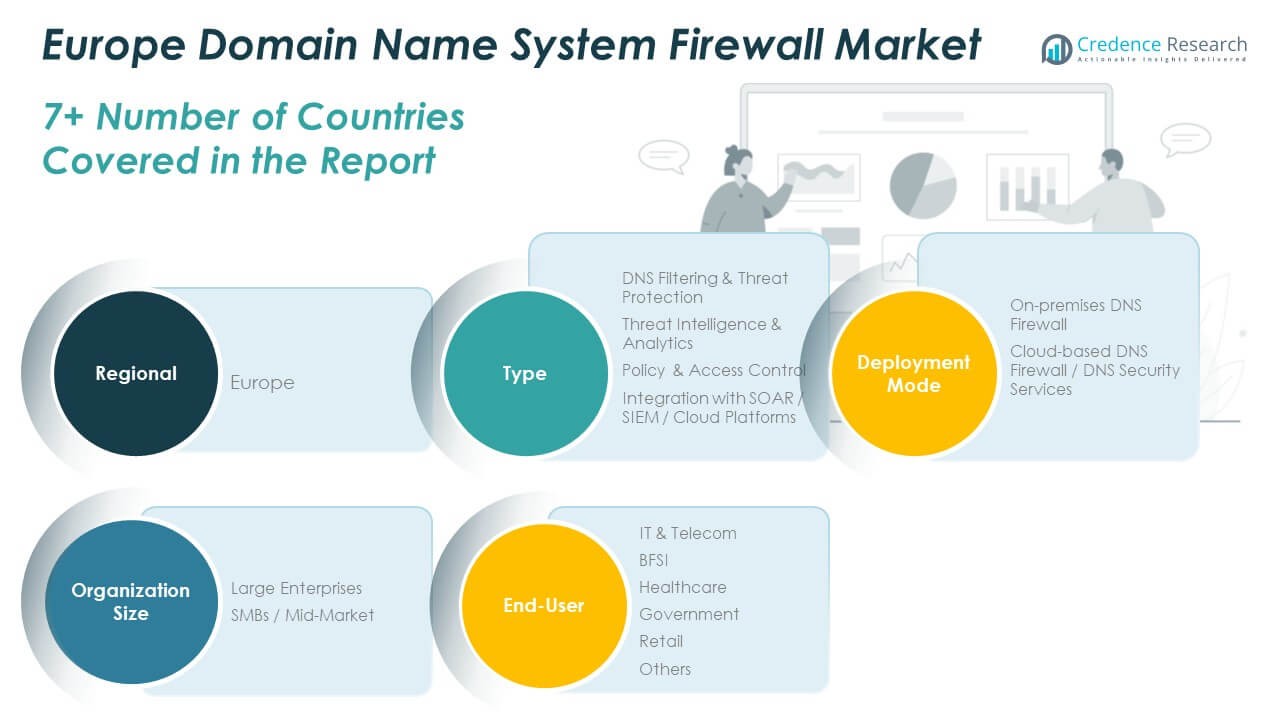
The research report offers an in-depth analysis based on type, deployment mode, organization size, and end-users. It details leading market players, providing an overview of their business, product offerings, investments, revenue streams, and key applications. Additionally, the report includes insights into the competitive environment, SWOT analysis, current market trends, as well as the primary drivers and constraints. Furthermore, it discusses various factors that have driven market expansion in recent years. The report also explores market dynamics, regulatory scenarios, and technological advancements that are shaping the industry. It assesses the impact of external factors and global economic changes on market growth. Lastly, it provides strategic recommendations for new entrants and established companies to navigate the complexities of the market.
Future Outlook:
- Increased demand for cloud-based DNS firewall solutions will drive market expansion.
- Strong regulatory frameworks across Europe will continue to propel DNS firewall adoption.
- The integration of AI and machine learning into DNS security solutions will enhance threat detection capabilities.
- Small and medium-sized enterprises (SMEs) will become significant consumers of DNS firewalls.
- Rising cyber threats in healthcare and government sectors will increase security spending.
- The growth of IoT and connected devices will expand the market's customer base.
- High competition will lead to consolidation, with strategic mergers and acquisitions.
- As digital transformation continues, hybrid deployment models will gain traction.
- The market will see greater regional diversification, with emerging Eastern European markets driving growth.
- Vendors will continue to focus on product innovation and advanced threat intelligence features.

Request a Free Sample
Fill in your details and we'll send you a free sample report.
- Sample data tables & charts
- Research methodology
Need a Custom Version of This Report?
Tailor the scope, geography, or segments to your exact requirements.
- Custom geography or segment scope
- Direct access to our analyst team
Frequently Asked Questions
What is the current market size for the Europe Domain Name System Firewall Market, and what is its projected size in 2032?
At what Compound Annual Growth Rate is the Europe Domain Name System Firewall Market projected to grow between 2024 and 2032?
Which Europe Domain Name System Firewall Market segment held the largest share in 2024?
What are the primary factors fueling the growth of the Europe Domain Name System Firewall Market?
Who are the leading companies in the Europe Domain Name System Firewall Market?
Which region commanded the largest share of the Europe Domain Name System Firewall Market in 2024?
Table of Content
Chapter 1. Report Introduction
- 1.1 Report Description & Purpose
- 1.1.1 Report Title & Market Definition
- 1.1.2 Unique Selling Propositions (USP) & Key Differentiators
- 1.1.3 Value Proposition for Stakeholders
- 1.2 Research Objectives
- 1.2.1 Market Sizing Objectives (Volume & Revenue)
- 1.2.2 Segmentation Objectives
- 1.2.3 Competitive Intelligence Objectives
- 1.2.4 Forecast & Scenario Objectives
- 1.3 Report Scope
- 1.3.1 Europe Domain Name System Firewall Scope – Types & Subtypes Covered
- 1.3.2 Geographic Scope – Regions & Countries Covered
- 1.3.3 Historical Period, Base Year & Forecast Period (2024; forecast to 2032)
- 1.3.4 Inclusions & Exclusions
- 1.4 HS Code & Classification Framework
- 1.5 Currency, Units & Pricing Basis
- 1.6 Target Stakeholders
- 1.7 Limitations & Assumptions
Chapter 2. Executive Summary
- 2.1 Global Europe Domain Name System Firewall Market Snapshot
- 2.1.1 Market Size – Historical (2024) & Forecast (2024-2032) (2024: USD 416.91 million → 2032: USD 1,759.98 million)
- 2.1.2 Volume & Revenue – Global Totals
- 2.1.3 Key Market Highlights – Top Five Facts
- 2.2 Europe Domain Name System Firewall Market Segmentation Snapshot
- 2.2.1 Market Split by Region – 2024 vs. 2032
- 2.3 Competitive Snapshot
- 2.3.1 Top 10 Players by Revenue Share – 2024
- 2.3.2 Top 10 Players by Volume Share – 2024
- 2.3.3 Recent Strategic Developments (18-Month Summary)
- 2.4 Key Investment Highlights & Strategic Conclusions
Chapter 3. Europe Domain Name System Firewall Market Dynamics & Industry Analysis
- 3.1 Market Overview & Context
- 3.1.1 Europe Domain Name System Firewall Market Position in the Broader Automotive Value Chain
- 3.1.2 OEM vs. Replacement Market Dynamics
- 3.1.3 Market Maturity & Development Stage by Region
- 3.2 Europe Domain Name System Firewall Market Drivers
- 3.3 Europe Domain Name System Firewall Market Restraints & Challenges
- 3.4 Europe Domain Name System Firewall Market Opportunities
- 3.5 Porter's Five Forces Analysis
- 3.5.1 Threat of New Entrants
- 3.5.2 Bargaining Power of Suppliers
- 3.5.3 Bargaining Power of Buyers
- 3.5.4 Threat of Substitutes
- 3.5.5 Competitive Rivalry – Intensity Assessment
- 3.6 Europe Domain Name System Firewall Value Chain Analysis
- 3.6.1 Upstream – Raw Material/Input Suppliers
- 3.6.1.1 Raw Material/Input 1
- 3.6.1.2 Raw Material/Input 2
- 3.6.1.3 Raw Material/Input 3
- 3.6.2 Midstream – Production/Manufacturing/Service Delivery
- 3.6.2.1 Production/Process Overview
- 3.6.2.2 Key Facility Locations & Capacity by Manufacturer
- 3.6.3 Downstream – Distribution & End Consumer
- 3.6.3.1 Primary Channel – B2B/OEM
- 3.6.3.2 Secondary Channels – Dealer, Retail, Online, Direct
- 3.6.4 Value Chain Profitability Analysis
- 3.6.1 Upstream – Raw Material/Input Suppliers
- 3.7 PESTEL Analysis
- 3.7.1 Political Factors
- 3.7.2 Economic Factors
- 3.7.3 Social Factors
- 3.7.4 Technological Factors
- 3.7.5 Environmental Factors
- 3.7.6 Legal Factors
- 3.8 Europe Domain Name System Firewall Supply Chain Analysis
- 3.8.1 Raw Material/Input Supply Risk Assessment
- 3.8.2 Manufacturing Concentration Risk (Geographic Exposure)
- 3.8.3 Trade Disruption Impact Analysis
- 3.9 Regulatory & Policy Landscape
Note: The regulatory and policy landscape section covers regulations based on their applicability to the market, Europe Domain Name System Firewall category, geography, and scope of the study. Only regulatory frameworks with a material impact on operations, compliance, trade, sustainability, or market access are analyzed in detail.
Chapter 4. Key Investment Pockets & Opportunity Analysis
- 4.1 Europe Domain Name System Firewall Market Attractiveness Analysis
- 4.1.1 By Region – Investment Attractiveness Matrix (Volume × CAGR)
- 4.2 Absolute Revenue Growth Opportunity
- 4.2.1 By Region – Absolute USD Growth Through 2032
- 4.3 Incremental Volume Opportunity
- 4.3.1 By Region – Incremental Volume Through 2032
- 4.3.2 Segment – Incremental Volume
- 4.4 Emerging Submarket Opportunity Deep Dive (Subject to Applicability)
- 4.5 Emerging Market Opportunity Scorecards
- 4.5.1 United States
- 4.5.2 Europe
- 4.5.3 Asia
- 4.5.4 Middle East & Africa
Note: Emerging Market Opportunity Scorecards will be included based on relevance and strategic importance. Regions listed are indicative and may vary depending on data availability and market dynamics.
Chapter 5. Europe Domain Name System Firewall Import-Export Analysis & Trade Flows
- 5.1 Global Trade Overview
- 5.1.1 Global Export Value by Country (2024)
- 5.1.2 Global Export Volume by Country (2024)
- 5.1.3 Global Import Value by Country (2024)
- 5.1.4 Global Import Volume by Country (2024)
- 5.1.5 Net Trade Balance by Country (2024)
- 5.2 Export Analysis – Segment
- 5.2.1 Type 1 (HS Code)
- 5.2.2 Type 2 (HS Code)
- 5.2.3 Type 3 (HS Code)
- 5.2.4 Type 4 (HS Code)
- 5.2.5 Type 5 (HS Code)
- 5.3 Import Analysis – Segment
- 5.3.1 Type 1 (HS Code)
- 5.3.2 Type 2 (HS Code)
- 5.3.3 Type 3 (HS Code)
- 5.3.4 Type 4 (HS Code)
- 5.3.5 Type 5 (HS Code)
- 5.4 Average Unit Trade Prices
- 5.4.1 Average Export Price – Segment & Country
- 5.4.2 Average Import Price – Segment & Source Country
- 5.4.3 Price Trends (2024)
- 5.5 Key Trade Route Analysis
- 5.5.1 Trade Route 1
- 5.5.2 Trade Route 2
- 5.5.3 Trade Route 3
- 5.5.4 Trade Route 4
- 5.5.5 Trade Route 5
- 5.6 Trade Policy Impact Assessment
- 5.6.1 US Anti-Dumping & Section 301 Tariffs
- 5.6.2 EU Customs Union Impact
- 5.6.3 Major Free Trade Agreements
- 5.6.4 USMCA Rules of Origin
Note: Trade policy analysis will be included only where relevant to the Europe Domain Name System Firewall market.
Chapter 6. Competitive Landscape & Company Benchmarking
- 6.1 Europe Domain Name System Firewall Market Concentration & Structure
- 6.1.1 Herfindahl-Hirschman Index (HHI) – vs. 2024
- 6.1.2 Tier 1, Tier 2 & Tier 3 Market Structure
- 6.1.3 Global, Regional & Local Player Dynamics
- 6.2 Europe Domain Name System Firewall Market Share Analysis – 2024
- 6.2.1 Global Revenue Share by Company
- 6.2.2 Global Volume Share by Company
- 6.2.3 Regional Revenue Share
- 6.2.4 Market Share Evolution ( vs. 2024)
- 6.2.5 OEM Segment Share by Company
- 6.2.6 Replacement Segment Share by Company
- 6.3 Production/Delivery Capacity & Facility Analysis
- 6.3.1 Global Installed Capacity
- 6.3.2 Capacity Utilization Rates
- 6.3.3 Production/Output Volume
- 6.3.4 Facility Locations & Capacity Map
- 6.3.5 Planned Capacity Additions
- 6.4 Europe Domain Name System Firewall Competitive Benchmarking Matrix
- 6.4.1 Revenue, Volume, CAGR & Profitability Comparison
- 6.4.2 Channel Revenue Mix
- 6.4.3 Geographic Revenue Exposure
- 6.4.4 R&D Intensity
- 6.4.5 Sustainability Maturity
- 6.5 Strategic Developments in Europe Domain Name System Firewall (Last 24 Months)
- 6.5.1 Mergers, Acquisitions & Divestments
- 6.5.2 New Europe Domain Name System Firewall Launches
- 6.5.3 Facility Expansions
- 6.5.4 Strategic Alliances, Joint Ventures & Partnerships
- 6.5.5 Distribution Expansion & Market Entry
- 6.5.6 Sustainability & ESG Initiatives
- 6.6 Competitive Strategy Mapping
- 6.6.1 Leader, Challenger, Follower & Niche Classification
- 6.6.2 Pricing Strategy Comparison
- 6.6.3 Channel Strategy Matrix
Note: Strategic developments are included based on their materiality and the availability of reliable information.
Chapter 7. Global Europe Domain Name System Firewall Market – By Distribution Channel
- 7.1 Segment Overview
- 7.1.1 Volume & Revenue Split by Channel (2024 & 2032)
- 7.1.2 Channel Mix Evolution (2024-2032)
Chapter 8. Regional Market Analysis – Global Overview
- 8.1 Global Regional Overview
- 8.1.1 Regional Volume Share
- 8.1.2 Regional Revenue Share
- 8.1.3 Regional Volume by Region
- 8.1.4 Regional Revenue by Region
- 8.1.5 Regional Forecast Through 2032
- 8.2 Cross-Regional Segment Analysis
- 8.2.1 By Distribution Channel
- 8.2.2 By Brand/Price Tier
Chapter 9. North America Europe Domain Name System Firewall Market
- 9.1 United States
- 9.2 Canada
- 9.3 Mexico
Chapter 10. Europe Europe Domain Name System Firewall Market
- 10.1 Germany
- 10.2 France
- 10.3 Italy
- 10.4 United Kingdom
- 10.5 Spain
- 10.6 Poland
- 10.7 Russia
- 10.8 Netherlands
- 10.9 Belgium
- 10.10 Sweden
- 10.11 Denmark
- 10.12 Norway
- 10.13 Rest of Europe
Chapter 11. Asia Pacific Europe Domain Name System Firewall Market
- 11.1 China
- 11.2 India
- 11.3 Japan
- 11.4 South Korea
- 11.5 Thailand
- 11.6 Indonesia
- 11.7 Vietnam
- 11.8 Malaysia
- 11.9 Australia
- 11.10 Rest of Asia Pacific
Chapter 12. Latin America Europe Domain Name System Firewall Market
- 12.1 Brazil
- 12.2 Argentina
- 12.3 Colombia
- 12.4 Chile
- 12.5 Rest of Latin America
Chapter 13. Middle East Europe Domain Name System Firewall Market
- 13.1 Saudi Arabia
- 13.2 United Arab Emirates
- 13.3 Turkey
- 13.4 Israel
- 13.5 Iran
- 13.6 Rest of the Middle East
Chapter 14. Africa Europe Domain Name System Firewall Market
- 14.1 South Africa
- 14.2 Egypt
- 14.3 Nigeria
- 14.4 Morocco
- 14.5 Rest of Africa
Chapter 15. Europe Domain Name System Firewall Company Profiles
- 15.1 [Company 01]
- 15.1.1 Company Overview
- 15.1.2 Key Management Personnel
- 15.1.3 Products & Services Portfolio
- 15.1.4 Financial Performance
- 15.1.5 Key Market Focus & Geographic Presence
- 15.1.6 Recent Developments & Strategic Initiatives
Note: The company profile list is preliminary and may change based on research findings, market developments, data availability, and client requirements.
Chapter 16. Appendices
- Appendix A – List of Abbreviations & Acronyms
- Appendix B – Industry Classification Code Reference – Full Series
- Appendix C – Production & Capacity Data Tables
- Appendix D – End-Use & Demand Base Tables
- Appendix E – Consumption & Replacement Rate Assumptions
- Appendix F – ASP Reference Tables
- Appendix G – Manufacturing & Facility Database
- Appendix H – Import-Export Data Tables
- Appendix I – Regulatory Summary Tables
- Appendix J – Primary Research Participant List (Anonymized)
- Appendix K – Primary Research Questionnaire Framework
- Appendix L – Data Sources & Bibliography
- Appendix M – Market Size Divergence & Source Comparison
Chapter 17. Research Methodology
- 17.1 Research Framework & Philosophy
- 17.2 Secondary Research – Sources, Hierarchy & Data Extraction
- 17.3 Data Modeling – Bottom-Up & Top-Down Market Sizing
- 17.4 Primary Research – Stakeholder Framework, LOI & Sample Sizes
- 17.5 Forecast Methodology – Regression, Scenario & Sensitivity Analysis
- 17.6 Quality Control – Four-Layer Validation Framework
- 17.7 Limitations & Standard Assumptions
- 17.8 Disclaimer