
Market Overview:
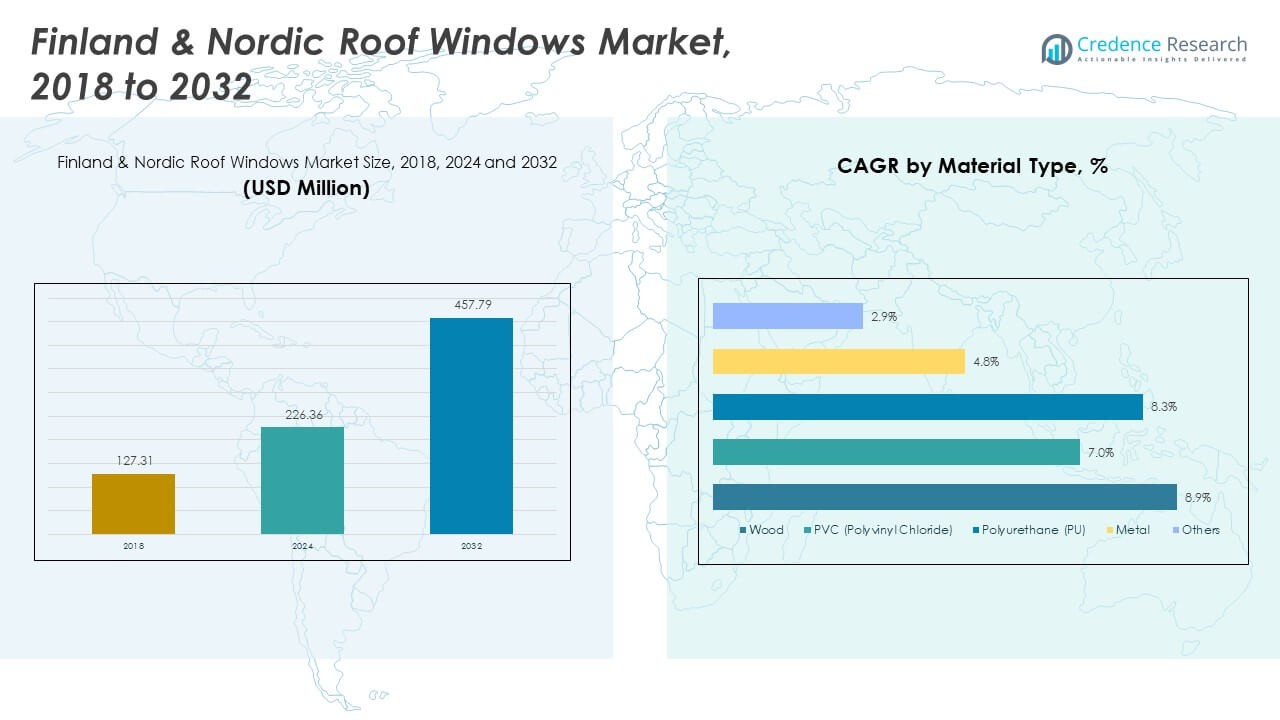
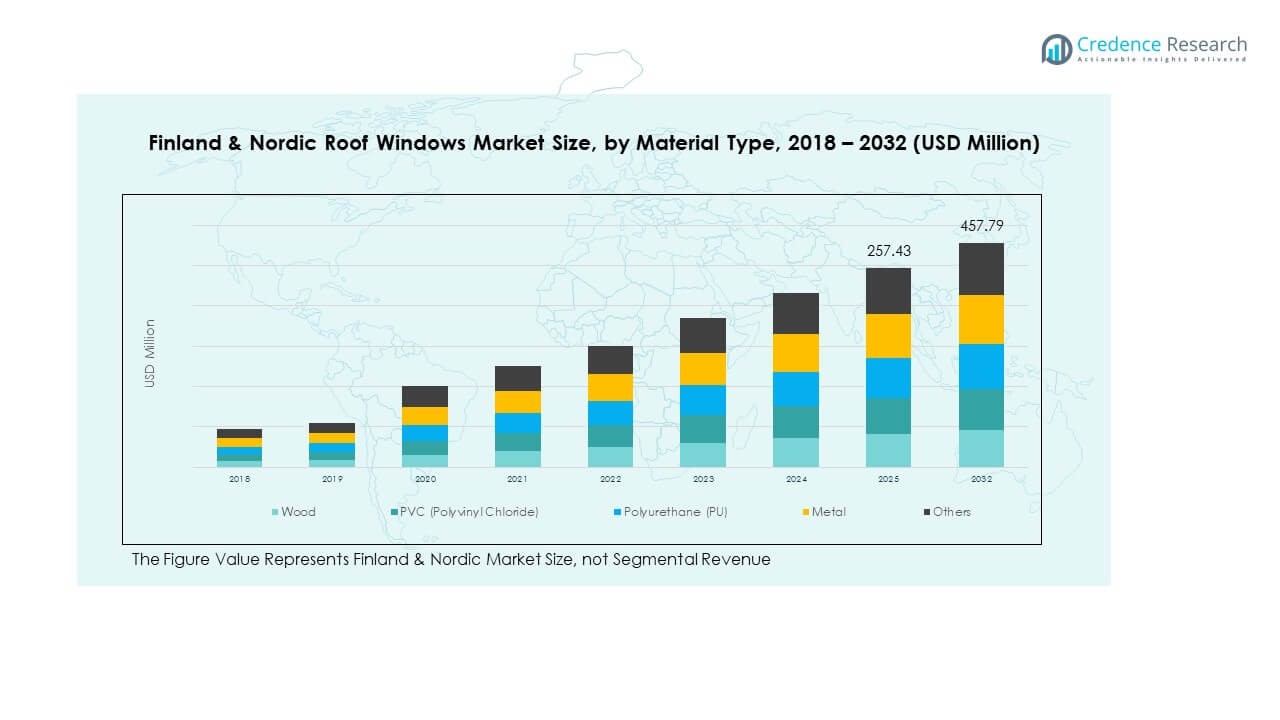
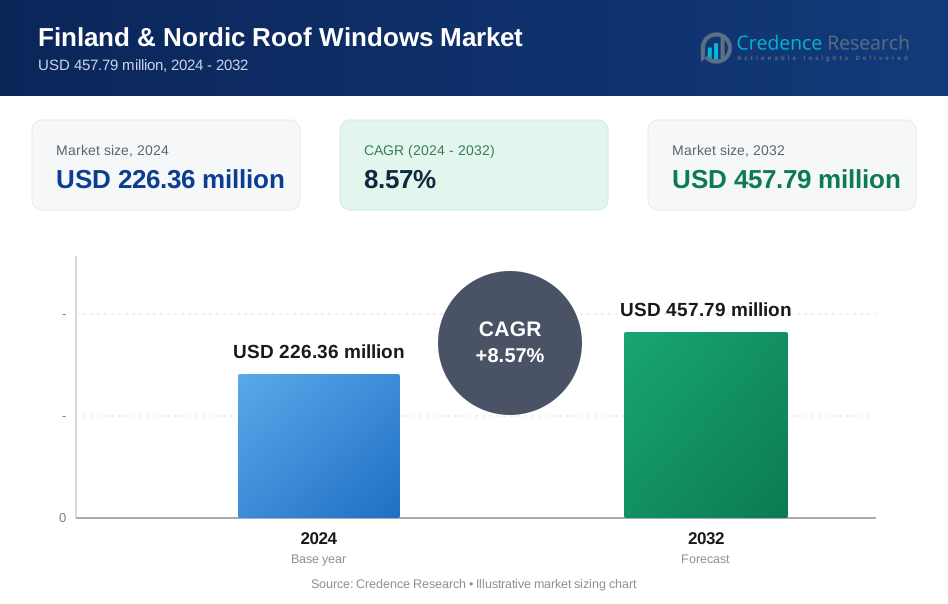
The Finland & Nordic Roof Windows Market size was valued at USD 127.31 million in 2018 to USD 226.36 million in 2024 and is anticipated to reach USD 457.79 million by 2032, at a CAGR of 8.57 % during the forecast period.
| REPORT ATTRIBUTE | DETAILS |
|---|---|
| Historical Period | 2020-2023 |
| Base Year | 2024 |
| Forecast Period | 2025-2032 |
| Finland & Nordic Roof Windows Market Size 2024 | USD 226.36 Million |
| Finland & Nordic Roof Windows Market, CAGR | 8.57 % |
| Finland & Nordic Roof Windows Market Size 2032 | USD 457.79 Million |
Strong emphasis on energy efficiency and natural daylight integration drives the market expansion. Government policies promoting sustainable construction and low-energy housing boost product adoption. Consumers increasingly choose automated roof windows that regulate light and ventilation to improve comfort. The growing trend of attic conversions and home renovations also supports steady sales. Manufacturers continue to introduce smart, insulated, and eco-friendly solutions tailored for harsh Nordic climates.
Regionally, Sweden and Denmark lead the market due to modern housing infrastructure and strong energy efficiency codes. Finland and Norway follow with rising renovation activity and adoption of advanced window technologies. Iceland and smaller Nordic territories remain emerging markets with gradual installation growth. Cold weather conditions, environmental regulations, and increasing consumer preference for daylight optimization influence regional product demand.
Market Insights
- The Finland & Nordic Roof Windows Market was valued at USD 127.31 million in 2018, reached USD 226.36 million in 2024, and is projected to touch USD 457.79 million by 2032, growing at a CAGR of 8.57 %.
- Sweden and Denmark together hold around 45 % of the market, driven by modern housing developments and strict building energy codes encouraging roof window installations.
- Finland and Norway collectively capture 35 % share, emerging as the fastest-growing region due to high renovation rates and government-backed energy-efficient housing programs.
- PVC accounts for roughly 38 % of material-type demand, favored for its affordability, moisture resistance, and low maintenance requirements.
- Wood contributes nearly 28 % share, maintaining demand in premium residential construction where insulation and aesthetic value remain top priorities.
Market Drivers
Rising Energy Efficiency Regulations and Sustainable Building Practices
Growing emphasis on energy-efficient architecture is boosting adoption of roof windows across Nordic countries. Governments are enforcing stricter insulation and daylight access standards in new residential and commercial buildings. The Finland & Nordic Roof Windows Market benefits from eco-conscious construction policies that prioritize low-carbon materials and renewable energy usage. Roof windows help reduce artificial lighting costs and maintain thermal efficiency in colder climates. Developers increasingly choose triple-glazed models to meet compliance requirements. Leading brands focus on recyclable frames and smart ventilation systems that enhance indoor air quality. Public awareness about sustainable housing drives household replacements. Rising renovation rates amplify the market’s momentum in urban regions.
- For instance, the VELUX Group achieved a 60% reduction in its Scope 1 & 2 CO₂ emissions between 2020 and 2024, and in 2024 alone cut emissions by 11% from the previous year.
Increased Focus on Natural Lighting and Home Aesthetic Improvements
Urban residents value natural lighting for comfort and energy savings, stimulating installation of skylights and roof windows. Consumers are replacing traditional windows with modern, automated roof units that adjust based on sunlight intensity. The trend supports wellness-focused designs in homes and workplaces. The Finland & Nordic Roof Windows Market gains from architectural shifts emphasizing open, bright spaces. Architects integrate roof glazing systems to optimize space utilization in small apartments. Smart sensor integration allows automated control of light and air circulation. Product aesthetics such as frameless designs and aluminum finishes attract modern homeowners. Expanding remodeling projects in dense housing markets sustain demand.
- For instance, Fakro’s FTP‑V roof window model lists a U-value of 1.3 W/m²K and includes an automatic air-inlet system, supporting enhanced natural-light and ventilation features.
Growing Renovation Activities in Residential and Commercial Buildings
The region’s aging housing infrastructure fuels replacement demand for advanced fenestration systems. Governments provide renovation incentives that support energy-efficient window upgrades. Rising home improvement spending across Sweden, Norway, and Finland enhances the sales of premium roof windows. The Finland & Nordic Roof Windows Market sees consistent upgrades driven by design trends and eco-efficiency targets. Retailers expand digital channels, offering easy configuration and delivery for consumers. Commercial spaces adopt modular skylight systems to improve energy management. Contractors prefer prefabricated and easy-install models that reduce project timelines. Urban redevelopment and sustainable retrofit programs continue to stimulate steady growth.
Technological Innovations and Smart Control Integration in Fenestration
Smart home adoption supports demand for intelligent roof windows that regulate temperature and humidity. Manufacturers integrate IoT-enabled controls for automated ventilation, shading, and rain sensors. The Finland & Nordic Roof Windows Market experiences rising interest in remote-control functionality and AI-based maintenance alerts. Brands like Velux and Fakro invest in digitalized product lines compatible with smart ecosystems. These features enhance indoor comfort while lowering energy waste. Enhanced sealing and noise reduction technologies suit Nordic weather conditions. Digital monitoring improves performance tracking in commercial applications. The innovation-led environment encourages partnerships between tech firms and window manufacturers.
Market Trends
Expansion of Smart Roof Window Systems and Automation Capabilities
Smart automation continues to redefine window functionality in modern construction. Developers and homeowners adopt connected systems that adjust automatically to light, temperature, and rain conditions. The Finland & Nordic Roof Windows Market reflects a growing fusion of building automation with energy-saving goals. Bluetooth and Wi-Fi integration enhance convenience and control. Consumers appreciate the compatibility of roof windows with leading smart home platforms. Automation also improves air quality by enabling responsive ventilation cycles. Product innovation supports integration with renewable power systems. The adoption of smart control windows positions the region as a digital building leader.
Shift Toward Triple-Glazed and High-Performance Insulated Windows
Energy efficiency remains a priority in regions facing long winters and limited daylight. Builders demand triple-glazed roof windows with superior insulation and condensation resistance. The Finland & Nordic Roof Windows Market embraces advanced glazing that maintains interior comfort while minimizing heating costs. Manufacturers employ low-emission coatings and argon-filled panes to enhance performance. Consumers prefer durable products with minimal maintenance needs. Technological improvements reduce energy leakage and improve indoor brightness. Developers use these solutions to comply with near-zero energy building codes. Expanding product diversity supports customized installations for homes and offices.
- For instance, the Norrsken triple-glazed windows achieve whole-window U-values as low as 0.64 W/m²K, significantly improving insulation in cold-climate construction.
Rising Use of Sustainable and Recyclable Construction Materials
Sustainability trends influence material sourcing and product design across the fenestration industry. Aluminum and wood-aluminum hybrid frames gain popularity for their balance between aesthetics and durability. The Finland & Nordic Roof Windows Market aligns with EU environmental goals emphasizing recyclability and circular production. Manufacturers implement closed-loop recycling for glass and polymer components. Green certification requirements push brands to adopt eco-labels and verified production standards. Consumers prioritize long-lasting, repairable window systems that reduce waste. Building contractors integrate roof windows as part of sustainable housing projects. The push toward eco-design continues shaping product development cycles.
- For instance, the Nordic Swan Ecolabelling criteria for windows and roof windows under EN 14351-1 include recyclability, closed-loop material use and low-impact manufacturing, guiding manufacturers across the region.
Integration of Modular Roof Window Systems in Prefabricated Housing
Prefabricated and modular construction techniques create demand for flexible, ready-to-install roof windows. Factories integrate window modules into prefabricated panels for efficient assembly on-site. The Finland & Nordic Roof Windows Market benefits from this shift toward off-site construction methods. Prefab housing projects value lightweight and easily installed units that lower labor costs. Modular systems enhance scalability for large housing developments. Manufacturers design adjustable frame kits that suit varied roof slopes. The trend supports shorter construction times while maintaining aesthetic standards. Growth in prefabrication projects across the region expands window demand further.
Market Challenges Analysis
High Installation and Maintenance Costs Limiting Wider Adoption
The upfront expense of roof window installation deters adoption in cost-sensitive households. Skilled labor shortages elevate service charges, especially in remote Nordic regions. The Finland & Nordic Roof Windows Market faces cost barriers from customized design needs and advanced glazing materials. Maintenance becomes challenging in steep-roof designs exposed to snow and rain. Replacement costs remain high due to complex sealing systems. Builders seek simplified installation solutions that reduce dependency on specialized labor. Homeowners in older structures often hesitate due to structural retrofitting needs. Managing post-installation condensation and leakage also adds to operational concerns.
Climatic Extremes and Technical Limitations Impacting Product Longevity
Nordic climates expose roof windows to freezing, moisture, and ultraviolet degradation. These conditions accelerate wear on seals and glass coatings. The Finland & Nordic Roof Windows Market must contend with durability issues under extended cold and wet cycles. Improper installation or ventilation can cause condensation and mold formation. Snow accumulation creates mechanical stress on frames and glazing layers. Manufacturers invest in weather-resistant materials and anti-fog technologies to counter these challenges. Builders emphasize better flashing systems to prevent water intrusion. Meeting longevity expectations while maintaining visual appeal remains a complex engineering task.
Market Opportunities
Growing Demand for Eco-Friendly Construction and Green Retrofitting Solutions
Sustainability initiatives open new revenue streams across the regional construction sector. Consumers and developers favor eco-certified roof windows for low energy usage. The Finland & Nordic Roof Windows Market gains traction from government incentives promoting energy renovations. Manufacturers introducing recyclable components and smart ventilation systems attract broader customer bases. Commercial properties invest in daylight-optimized skylights to meet workplace wellness goals. Renovation grants further support replacement of old frames with efficient alternatives. Retailers offering online customization tools capture digital consumers. Rising environmental standards ensure steady demand for next-generation solutions.
Expansion of Smart Infrastructure and Integration with Renewable Energy Systems
Smart infrastructure investments across Nordic nations support connected window installations. Roof windows integrated with solar panels and energy-monitoring systems create new business models. The Finland & Nordic Roof Windows Market benefits from ongoing digital transformation across real estate and construction. Builders combine roof glazing with photovoltaic cells for better energy management. Automated systems adjust for seasonal daylight variations to enhance efficiency. Firms offering modular smart kits gain competitive advantage in large-scale housing. Energy-efficient public buildings drive institutional demand for integrated solutions. Growing collaboration between tech and construction sectors strengthens future adoption.
Market Segmentation Analysis
By material type segment of the Finland & Nordic Roof Windows Market is defined by the performance and sustainability of available materials. PVC frames dominate due to their low cost, moisture resistance, and compliance with energy standards. Wood maintains a premium niche because of its aesthetics and insulation value, supported by eco-certified sourcing. Polyurethane finds applications in humid interiors, offering strong insulation without warping. Metal frames serve high-end commercial or architectural projects requiring strength and slim profiles. Emerging materials like composites and fiberglass are gaining traction in custom designs and high-performance housing.
- For instance, the VELUX GGU roof window features a white wood‐polyurethane finish and invisible motor, highlighting the premium polyurethane frame option for roof windows.
By application segment is led by residential installations, driven by the strong renovation culture and growing preference for daylight optimization in homes. Loft conversions and attic upgrades increase the use of skylights in urban and suburban regions. Builders and homeowners focus on energy efficiency, modern design, and indoor comfort, favoring automated or triple-glazed roof windows. The commercial segment, including offices, educational buildings, and hospitality projects, is smaller but rising. It emphasizes large spans, integrated automation, and compliance with green building certifications across Nordic economies.
- For example, Lamilux’s metal frame skylight systems target offices, educational facilities and high-end commercial buildings, supporting large spans and architectural integration.
By sales channel segment reflects an evolving balance between direct sales and distributors. Direct sales are prominent in large commercial projects and government-funded renovation programs requiring tailored specifications. They strengthen brand presence and allow technical customization. Distributor networks, however, hold the major share by serving small builders, local contractors, and retail customers through multi-brand outlets. They provide wider geographic access and faster delivery times. Together, these channels ensure consistent product availability across both urban and remote Nordic markets.
Segmentation
By Material Type:
- Wood
- PVC (Polyvinyl Chloride)
- Polyurethane (PU)
- Metal
- Others
By Application:
- Residential
- Commercial
By Sales Channel:
- Direct Sales
- Distributors
By Geography:
- Finland
- Nordic
Regional Analysis
Nordic Core Region – Sweden and Denmark (≈ 45 %)
In the Sweden-Denmark subregion the Finland & Nordic Roof Windows Market commands about 45 % share. These countries host modern construction activity and strict energy-efficiency codes. Many projects use high-performance roof windows to meet daylight and thermal regulations. Renovation rates remain high and homeowner investment in premium materials is strong. Manufacturers maintain extensive distribution networks here, enabling rapid product launches. Competitive intensity is stiff but brand presence is well-established. The region sets the benchmark for product design and technical standards across the Nordic area.
Emerging Region – Finland and Norway (≈ 35 %)
The Finland and Norway market accounts for approximately 35 % of the total. These countries show rising demand driven by retrofit programmes and aging building stock. Cold-climate performance and insulation are key selling points, helping roof windows gain traction. Local players and global brands both invest in service and installation capability in this region. Expansion of multi-unit housing and attic conversions supports steady growth. The region offers mid-tier growth relative to Sweden-Denmark but still leads innovation adoption. It plays a pivotal role in shaping product specification for extreme conditions.
Peripheral Region – Rest of Nordic Countries (≈ 20 %)
The remaining Nordic countries including smaller markets in Iceland, the Faroe Islands and remote parts of the region contribute about 20 % share of the overall market. Growth here arises from niche renovation projects, smaller residential developments, and specialist installations. Accessibility and logistics present challenges but local distributors fill gaps effectively. Manufacturers target these markets with modular, easy-to-install roof window solutions tailored for remote and rural settings. While volume remains lower, premium unit prices make these areas important contributors. These regions also act as testing ground for new business models and installation technologies.
Key Player Analysis
Competitive Analysis
The market exhibits moderate concentration with several established global roof-window manufacturers holding dominant positions. Key players such as VELUX Group and Fakro lead through broad product portfolios, strong dealer networks and high brand recognition across Nordic countries. The market entry barriers are elevated by regulatory standards for energy efficiency and sealing performance in cold climates, so new entrants face substantial compliance-cost burdens before competing effectively. Leading firms differentiate through innovation, offering triple-glazing, smart ventilation and automated roof-window systems designed for extreme Nordic weather. Licensing and certification for sustainable wood sourcing and thermal insulation set high quality thresholds. The competitive dynamic forces mid-tier manufacturers to either specialize in niche segments - e.g., low-cost retrofit or hybrid-frame designs - or form alliances with larger brands for distribution leverage. The companies that manage service and installation networks in remote regions gain a distinct edge given the logistical challenges in Nordic markets. Price competition remains limited among the top tier because value is increasingly driven by performance and certification rather than cost alone. Firms focus on premium positioning and long-term lifecycle benefits to end users.
Recent Developments
- In June 2025, VELUX Group announced a strategic partnership with Novelis to supply low-carbon aluminium for roof windows and accessories. The collaboration focuses on manufacturing components from over 70 % recycled content to reduce CO₂ emissions in product lines.
- In April 2025, Velux launched the VELUX Skylight System, featuring a solar-powered, pre-installed room-darkening shade as a standard. This innovation aims to enhance energy efficiency and user comfort in roof window applications across Nordic markets.
Report Coverage
The research report offers an in-depth analysis based on Material Type, Application and Sales Channel. It details leading market players, providing an overview of their business, product offerings, investments, revenue streams, and key applications. Additionally, the report includes insights into the competitive environment, SWOT analysis, current market trends, as well as the primary drivers and constraints. Furthermore, it discusses various factors that have driven market expansion in recent years. The report also explores market dynamics, regulatory scenarios, and technological advancements that are shaping the industry. It assesses the impact of external factors and global economic changes on market growth. Lastly, it provides strategic recommendations for new entrants and established companies to navigate the complexities of the market.
Future Outlook
- Rising government incentives for energy-efficient housing will sustain strong installation rates across residential renovations.
- Growing smart home adoption will drive demand for automated and sensor-controlled roof windows in Nordic urban centers.
- Increasing architectural preference for daylight optimization will encourage use of roof windows in compact and multi-storey buildings.
- Manufacturers will invest in triple-glazed and hybrid frame technologies to enhance insulation and durability.
- Expansion of e-commerce and direct-to-consumer channels will simplify product selection and customization for homeowners.
- Demand from commercial spaces, including offices and schools, will grow with the trend toward green and ventilated interiors.
- The PVC segment will continue to dominate due to its low maintenance and suitability for harsh climates.
- Partnerships between local builders and multinational brands will strengthen regional supply and after-sales support.
- R&D efforts toward recyclable materials and eco-certified wood will improve sustainability credentials.
- Market competition will shift toward product differentiation, service reliability, and digital installation support tools.
Request a Free Sample
Fill in your details and we'll send you a free sample report.
- Sample data tables & charts
- Research methodology
Need a Custom Version of This Report?
Tailor the scope, geography, or segments to your exact requirements.
- Custom geography or segment scope
- Direct access to our analyst team
Frequently Asked Questions
What is the current market size for Finland & Nordic Roof Windows Market, and what is its projected size in 2032?
At what Compound Annual Growth Rate is the Finland & Nordic Roof Windows Market projected to grow between 2024 and 2032?
Which Finland & Nordic Roof Windows Market segment held the largest share in 2024?
What are the primary factors fueling the growth of the Finland & Nordic Roof Windows Market?
Who are the leading companies in the Finland & Nordic Roof Windows Market?
Which region commanded the largest share of the Finland & Nordic Roof Windows Market in 2024?
Table of Content
Chapter 1. Report Introduction
- 1.1 Report Description & Purpose
- 1.1.1 Report Title & Market Definition
- 1.1.2 Unique Selling Propositions (USP) & Key Differentiators
- 1.1.3 Value Proposition for Stakeholders
- 1.2 Research Objectives
- 1.2.1 Market Sizing Objectives (Volume & Revenue)
- 1.2.2 Segmentation Objectives
- 1.2.3 Competitive Intelligence Objectives
- 1.2.4 Forecast & Scenario Objectives
- 1.3 Report Scope
- 1.3.1 Finland & Nordic Roof Windows Scope – Types & Subtypes Covered
- 1.3.2 Geographic Scope – Regions & Countries Covered
- 1.3.3 Historical Period, Base Year & Forecast Period (2024; forecast to 2032)
- 1.3.4 Inclusions & Exclusions
- 1.4 HS Code & Classification Framework
- 1.5 Currency, Units & Pricing Basis
- 1.6 Target Stakeholders
- 1.7 Limitations & Assumptions
Chapter 2. Executive Summary
- 2.1 Global Finland & Nordic Roof Windows Market Snapshot
- 2.1.1 Market Size – Historical (2024) & Forecast (2024-2032) (2024: USD 226.36 million → 2032: USD 457.79 million)
- 2.1.2 Volume & Revenue – Global Totals
- 2.1.3 Key Market Highlights – Top Five Facts
- 2.2 Finland & Nordic Roof Windows Market Segmentation Snapshot
- 2.2.1 Market Split by Region – 2024 vs. 2032
- 2.3 Competitive Snapshot
- 2.3.1 Top 10 Players by Revenue Share – 2024
- 2.3.2 Top 10 Players by Volume Share – 2024
- 2.3.3 Recent Strategic Developments (18-Month Summary)
- 2.4 Key Investment Highlights & Strategic Conclusions
Chapter 3. Finland & Nordic Roof Windows Market Dynamics & Industry Analysis
- 3.1 Market Overview & Context
- 3.1.1 Finland & Nordic Roof Windows Market Position in the Broader Automotive Value Chain
- 3.1.2 OEM vs. Replacement Market Dynamics
- 3.1.3 Market Maturity & Development Stage by Region
- 3.2 Finland & Nordic Roof Windows Market Drivers
- 3.3 Finland & Nordic Roof Windows Market Restraints & Challenges
- 3.4 Finland & Nordic Roof Windows Market Opportunities
- 3.5 Porter's Five Forces Analysis
- 3.5.1 Threat of New Entrants
- 3.5.2 Bargaining Power of Suppliers
- 3.5.3 Bargaining Power of Buyers
- 3.5.4 Threat of Substitutes
- 3.5.5 Competitive Rivalry – Intensity Assessment
- 3.6 Finland & Nordic Roof Windows Value Chain Analysis
- 3.6.1 Upstream – Raw Material/Input Suppliers
- 3.6.1.1 Raw Material/Input 1
- 3.6.1.2 Raw Material/Input 2
- 3.6.1.3 Raw Material/Input 3
- 3.6.2 Midstream – Production/Manufacturing/Service Delivery
- 3.6.2.1 Production/Process Overview
- 3.6.2.2 Key Facility Locations & Capacity by Manufacturer
- 3.6.3 Downstream – Distribution & End Consumer
- 3.6.3.1 Primary Channel – B2B/OEM
- 3.6.3.2 Secondary Channels – Dealer, Retail, Online, Direct
- 3.6.4 Value Chain Profitability Analysis
- 3.6.1 Upstream – Raw Material/Input Suppliers
- 3.7 PESTEL Analysis
- 3.7.1 Political Factors
- 3.7.2 Economic Factors
- 3.7.3 Social Factors
- 3.7.4 Technological Factors
- 3.7.5 Environmental Factors
- 3.7.6 Legal Factors
- 3.8 Finland & Nordic Roof Windows Supply Chain Analysis
- 3.8.1 Raw Material/Input Supply Risk Assessment
- 3.8.2 Manufacturing Concentration Risk (Geographic Exposure)
- 3.8.3 Trade Disruption Impact Analysis
- 3.9 Regulatory & Policy Landscape
Note: The regulatory and policy landscape section covers regulations based on their applicability to the market, Finland & Nordic Roof Windows category, geography, and scope of the study. Only regulatory frameworks with a material impact on operations, compliance, trade, sustainability, or market access are analyzed in detail.
Chapter 4. Key Investment Pockets & Opportunity Analysis
- 4.1 Finland & Nordic Roof Windows Market Attractiveness Analysis
- 4.1.1 By Region – Investment Attractiveness Matrix (Volume × CAGR)
- 4.2 Absolute Revenue Growth Opportunity
- 4.2.1 By Region – Absolute USD Growth Through 2032
- 4.3 Incremental Volume Opportunity
- 4.3.1 By Region – Incremental Volume Through 2032
- 4.3.2 Segment – Incremental Volume
- 4.4 Emerging Submarket Opportunity Deep Dive (Subject to Applicability)
- 4.5 Emerging Market Opportunity Scorecards
- 4.5.1 United States
- 4.5.2 Europe
- 4.5.3 Asia
- 4.5.4 Middle East & Africa
Note: Emerging Market Opportunity Scorecards will be included based on relevance and strategic importance. Regions listed are indicative and may vary depending on data availability and market dynamics.
Chapter 5. Finland & Nordic Roof Windows Import-Export Analysis & Trade Flows
- 5.1 Global Trade Overview
- 5.1.1 Global Export Value by Country (2024)
- 5.1.2 Global Export Volume by Country (2024)
- 5.1.3 Global Import Value by Country (2024)
- 5.1.4 Global Import Volume by Country (2024)
- 5.1.5 Net Trade Balance by Country (2024)
- 5.2 Export Analysis – Segment
- 5.2.1 Type 1 (HS Code)
- 5.2.2 Type 2 (HS Code)
- 5.2.3 Type 3 (HS Code)
- 5.2.4 Type 4 (HS Code)
- 5.2.5 Type 5 (HS Code)
- 5.3 Import Analysis – Segment
- 5.3.1 Type 1 (HS Code)
- 5.3.2 Type 2 (HS Code)
- 5.3.3 Type 3 (HS Code)
- 5.3.4 Type 4 (HS Code)
- 5.3.5 Type 5 (HS Code)
- 5.4 Average Unit Trade Prices
- 5.4.1 Average Export Price – Segment & Country
- 5.4.2 Average Import Price – Segment & Source Country
- 5.4.3 Price Trends (2024)
- 5.5 Key Trade Route Analysis
- 5.5.1 Trade Route 1
- 5.5.2 Trade Route 2
- 5.5.3 Trade Route 3
- 5.5.4 Trade Route 4
- 5.5.5 Trade Route 5
- 5.6 Trade Policy Impact Assessment
- 5.6.1 US Anti-Dumping & Section 301 Tariffs
- 5.6.2 EU Customs Union Impact
- 5.6.3 Major Free Trade Agreements
- 5.6.4 USMCA Rules of Origin
Note: Trade policy analysis will be included only where relevant to the Finland & Nordic Roof Windows market.
Chapter 6. Competitive Landscape & Company Benchmarking
- 6.1 Finland & Nordic Roof Windows Market Concentration & Structure
- 6.1.1 Herfindahl-Hirschman Index (HHI) – vs. 2024
- 6.1.2 Tier 1, Tier 2 & Tier 3 Market Structure
- 6.1.3 Global, Regional & Local Player Dynamics
- 6.2 Finland & Nordic Roof Windows Market Share Analysis – 2024
- 6.2.1 Global Revenue Share by Company
- 6.2.2 Global Volume Share by Company
- 6.2.3 Regional Revenue Share
- 6.2.4 Market Share Evolution ( vs. 2024)
- 6.2.5 OEM Segment Share by Company
- 6.2.6 Replacement Segment Share by Company
- 6.3 Production/Delivery Capacity & Facility Analysis
- 6.3.1 Global Installed Capacity
- 6.3.2 Capacity Utilization Rates
- 6.3.3 Production/Output Volume
- 6.3.4 Facility Locations & Capacity Map
- 6.3.5 Planned Capacity Additions
- 6.4 Finland & Nordic Roof Windows Competitive Benchmarking Matrix
- 6.4.1 Revenue, Volume, CAGR & Profitability Comparison
- 6.4.2 Channel Revenue Mix
- 6.4.3 Geographic Revenue Exposure
- 6.4.4 R&D Intensity
- 6.4.5 Sustainability Maturity
- 6.5 Strategic Developments in Finland & Nordic Roof Windows (Last 24 Months)
- 6.5.1 Mergers, Acquisitions & Divestments
- 6.5.2 New Finland & Nordic Roof Windows Launches
- 6.5.3 Facility Expansions
- 6.5.4 Strategic Alliances, Joint Ventures & Partnerships
- 6.5.5 Distribution Expansion & Market Entry
- 6.5.6 Sustainability & ESG Initiatives
- 6.6 Competitive Strategy Mapping
- 6.6.1 Leader, Challenger, Follower & Niche Classification
- 6.6.2 Pricing Strategy Comparison
- 6.6.3 Channel Strategy Matrix
Note: Strategic developments are included based on their materiality and the availability of reliable information.
Chapter 7. Global Finland & Nordic Roof Windows Market – By Distribution Channel
- 7.1 Segment Overview
- 7.1.1 Volume & Revenue Split by Channel (2024 & 2032)
- 7.1.2 Channel Mix Evolution (2024-2032)
Chapter 8. Regional Market Analysis – Global Overview
- 8.1 Global Regional Overview
- 8.1.1 Regional Volume Share
- 8.1.2 Regional Revenue Share
- 8.1.3 Regional Volume by Region
- 8.1.4 Regional Revenue by Region
- 8.1.5 Regional Forecast Through 2032
- 8.2 Cross-Regional Segment Analysis
- 8.2.1 By Distribution Channel
- 8.2.2 By Brand/Price Tier
Chapter 9. North America Finland & Nordic Roof Windows Market
- 9.1 United States
- 9.2 Canada
- 9.3 Mexico
Chapter 10. Europe Finland & Nordic Roof Windows Market
- 10.1 Germany
- 10.2 France
- 10.3 Italy
- 10.4 United Kingdom
- 10.5 Spain
- 10.6 Poland
- 10.7 Russia
- 10.8 Netherlands
- 10.9 Belgium
- 10.10 Sweden
- 10.11 Denmark
- 10.12 Norway
- 10.13 Rest of Europe
Chapter 11. Asia Pacific Finland & Nordic Roof Windows Market
- 11.1 China
- 11.2 India
- 11.3 Japan
- 11.4 South Korea
- 11.5 Thailand
- 11.6 Indonesia
- 11.7 Vietnam
- 11.8 Malaysia
- 11.9 Australia
- 11.10 Rest of Asia Pacific
Chapter 12. Latin America Finland & Nordic Roof Windows Market
- 12.1 Brazil
- 12.2 Argentina
- 12.3 Colombia
- 12.4 Chile
- 12.5 Rest of Latin America
Chapter 13. Middle East Finland & Nordic Roof Windows Market
- 13.1 Saudi Arabia
- 13.2 United Arab Emirates
- 13.3 Turkey
- 13.4 Israel
- 13.5 Iran
- 13.6 Rest of the Middle East
Chapter 14. Africa Finland & Nordic Roof Windows Market
- 14.1 South Africa
- 14.2 Egypt
- 14.3 Nigeria
- 14.4 Morocco
- 14.5 Rest of Africa
Chapter 15. Finland & Nordic Roof Windows Company Profiles
- 15.1 [Company 01]
- 15.1.1 Company Overview
- 15.1.2 Key Management Personnel
- 15.1.3 Products & Services Portfolio
- 15.1.4 Financial Performance
- 15.1.5 Key Market Focus & Geographic Presence
- 15.1.6 Recent Developments & Strategic Initiatives
Note: The company profile list is preliminary and may change based on research findings, market developments, data availability, and client requirements.
Chapter 16. Appendices
- Appendix A – List of Abbreviations & Acronyms
- Appendix B – Industry Classification Code Reference – Full Series
- Appendix C – Production & Capacity Data Tables
- Appendix D – End-Use & Demand Base Tables
- Appendix E – Consumption & Replacement Rate Assumptions
- Appendix F – ASP Reference Tables
- Appendix G – Manufacturing & Facility Database
- Appendix H – Import-Export Data Tables
- Appendix I – Regulatory Summary Tables
- Appendix J – Primary Research Participant List (Anonymized)
- Appendix K – Primary Research Questionnaire Framework
- Appendix L – Data Sources & Bibliography
- Appendix M – Market Size Divergence & Source Comparison
Chapter 17. Research Methodology
- 17.1 Research Framework & Philosophy
- 17.2 Secondary Research – Sources, Hierarchy & Data Extraction
- 17.3 Data Modeling – Bottom-Up & Top-Down Market Sizing
- 17.4 Primary Research – Stakeholder Framework, LOI & Sample Sizes
- 17.5 Forecast Methodology – Regression, Scenario & Sensitivity Analysis
- 17.6 Quality Control – Four-Layer Validation Framework
- 17.7 Limitations & Standard Assumptions
- 17.8 Disclaimer
