Market Overview:
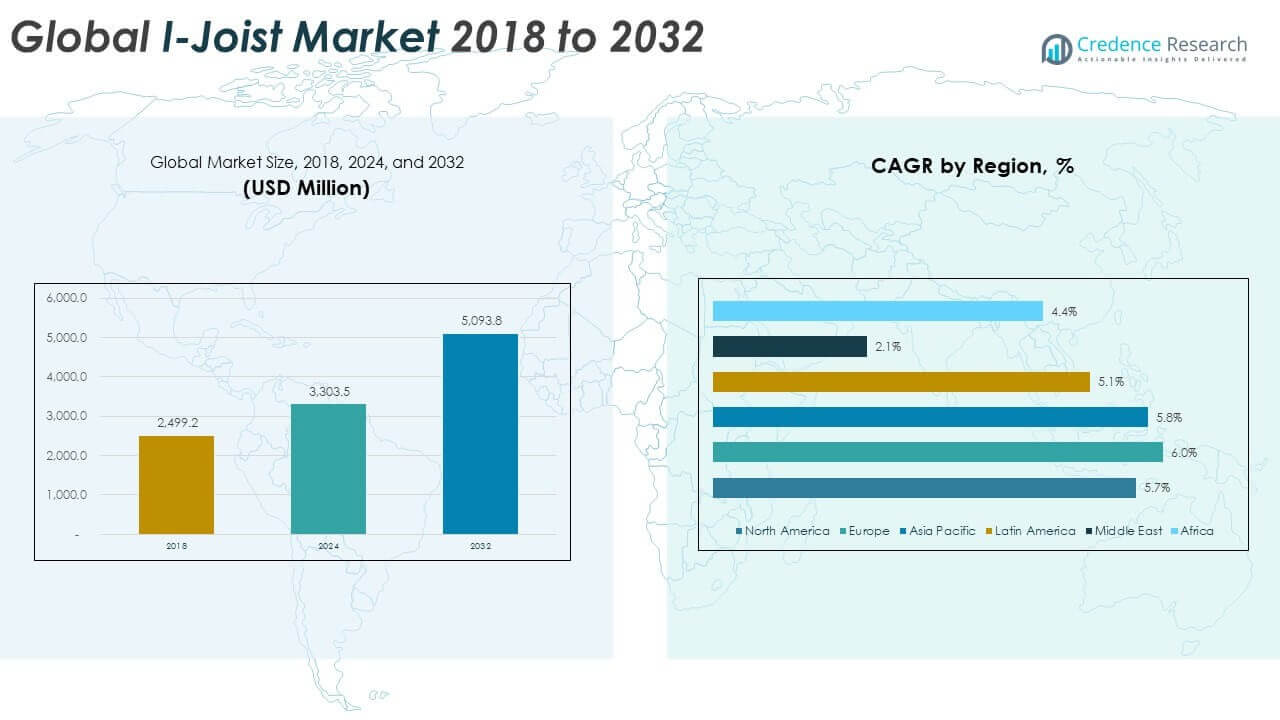
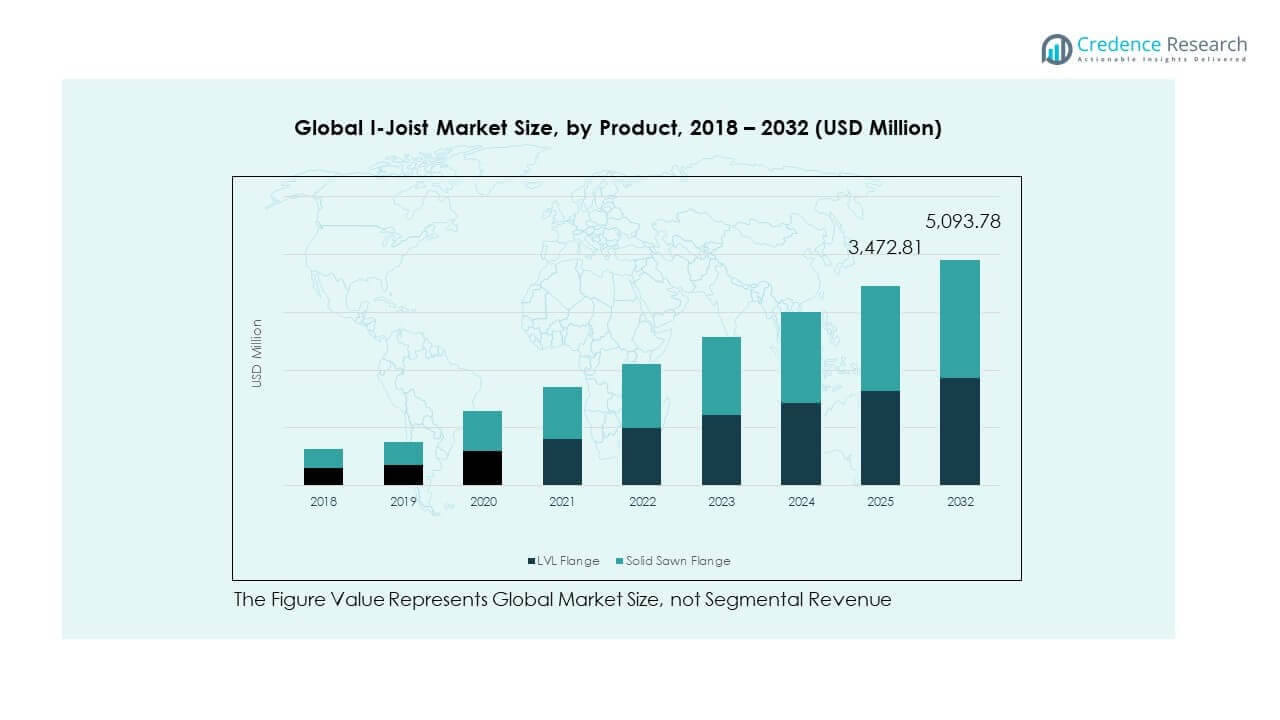
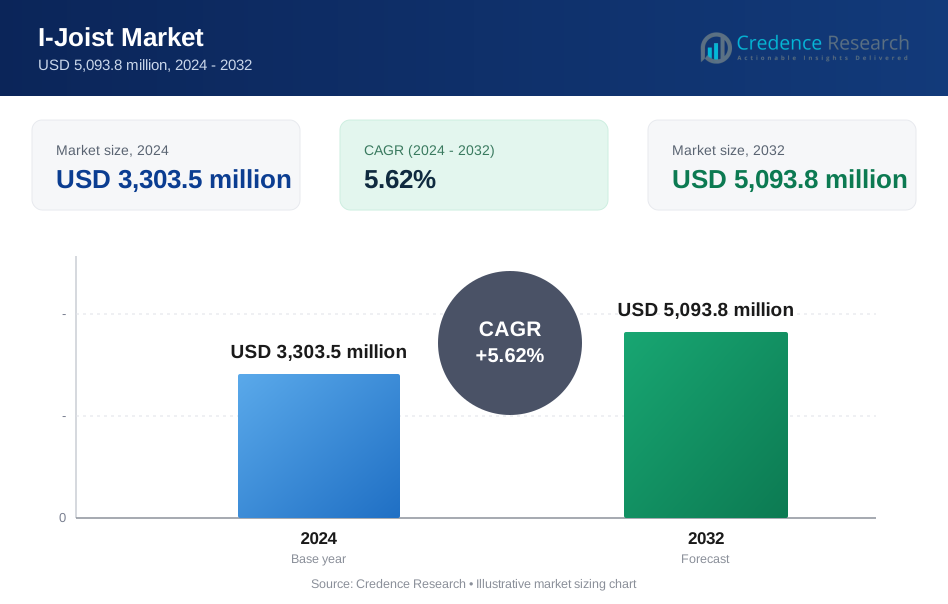
The Global I-Joist Market size was valued at USD 2,499.2 million in 2018 to USD 3,303.5 million in 2024 and is anticipated to reach USD 5,093.8 million by 2032, at a CAGR of 5.62% during the forecast period.
| REPORT ATTRIBUTE | DETAILS |
|---|---|
| Historical Period | 2020-2023 |
| Base Year | 2024 |
| Forecast Period | 2025-2032 |
| I-Joist Market Size 2024 | USD 3,303.5 million |
| I-Joist Market, CAGR | 5.62% |
| I-Joist Market Size 2032 | USD 5,093.8 million |
Growth in the Global I-Joist Market is driven by rising demand for energy-efficient and sustainable building materials. Builders increasingly adopt I-joists due to their superior strength-to-weight ratio, design flexibility, and reduced material waste. These products support longer spans and quicker installation, which improves construction timelines and cost efficiency. Green building standards and regulatory push for low-carbon materials further encourage engineered wood adoption. Technological advances and prefabrication trends also promote usage in both residential and commercial settings. Market players focus on innovation and regional expansion to meet evolving construction demands.
North America leads the market due to strong residential construction activity and widespread use of wood-framed housing. Europe follows closely, with growth supported by sustainable construction practices and government incentives. Asia Pacific is the fastest-growing region, driven by urban expansion, housing development, and rising awareness of engineered wood. Emerging markets in Latin America and Africa show gradual adoption due to affordability and material efficiency needs. Distribution and training infrastructure remain key factors influencing adoption in developing economies.
Market Insights:
- The Global I-Joist Market was valued at USD 2,499.2 million in 2018, reached USD 3,303.5 million in 2024, and is projected to hit USD 5,093.8 million by 2032, expanding at a CAGR of 5.62% due to steady construction demand and engineered wood adoption.
- Asia Pacific leads with about 5% share, followed by Europe at 27.1% and North America at 23.8%, supported by urban housing growth, green building policies, and strong wood-frame construction practices.
- Europe is the fastest-growing region with a CAGR of 0% and a 27.1% share, driven by sustainability mandates, energy-efficient building standards, and rising engineered timber use.
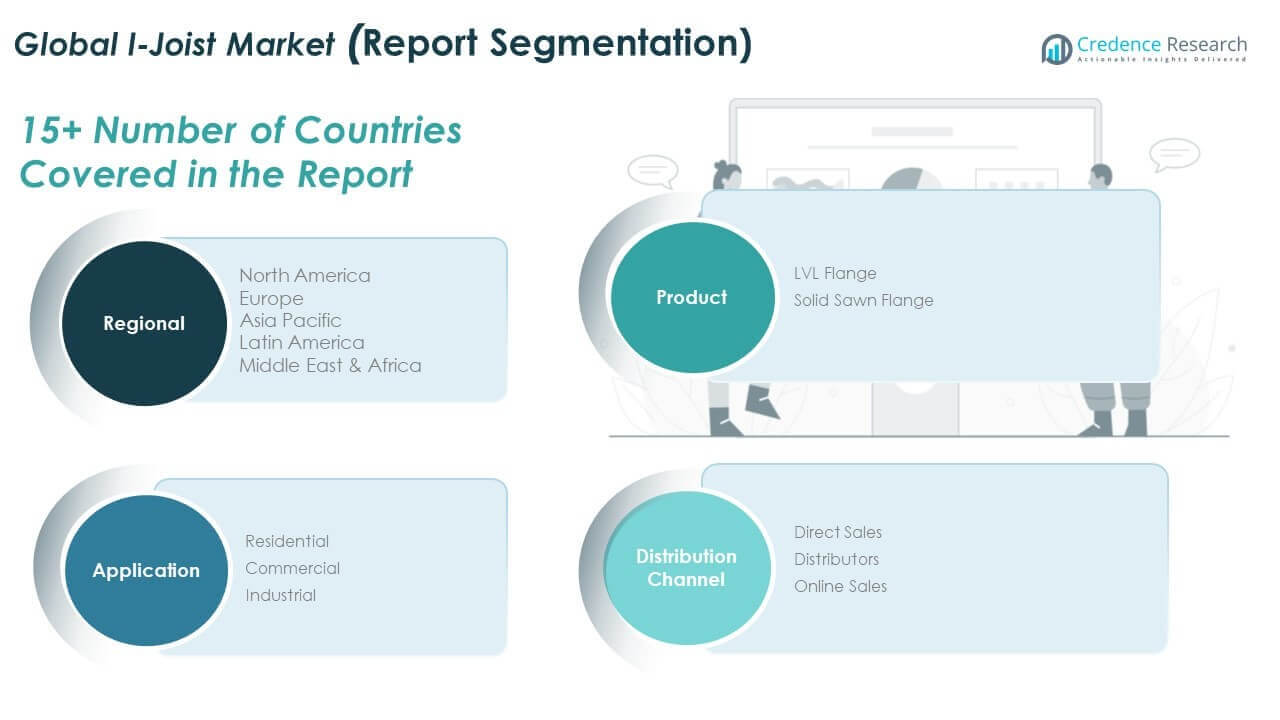
- By product, Solid Sawn Flange accounts for roughly 60% of total volume, reflecting its cost suitability for residential flooring and traditional construction applications.
- LVL Flange represents about 40% share, supported by demand for higher strength, longer spans, and consistent performance in commercial and multi-story projects.
Market Drivers
Surging Demand for Lightweight and High-Performance Engineered Wood in Residential Housing
Homebuilders increasingly prefer engineered wood like I-joists due to superior load-bearing properties. These joists weigh less, span longer distances, and reduce the need for intermediate support. The framing process becomes faster, more efficient, and less labor-intensive with them. Rising residential construction, especially in the U.S., Canada, and Australia, drives their adoption. The Global I-Joist Market benefits from the shift toward pre-fabricated structural components. Builders use I-joists for their consistent performance and dimensional stability. Wood scarcity and rising lumber prices also encourage the use of engineered alternatives. It gains momentum as builders seek reliable, sustainable structural materials.
- For instance, Weyerhaeuser’s Trus Joist® TJI® products are rated #1 by builders for performance and ease of install in long‑span floors, helping reduce callbacks and improve structural consistency.
Growing Emphasis on Green Buildings and Resource-Efficient Construction Practices
Sustainability targets push developers toward eco-friendly construction methods and materials. I-joists use less raw wood than solid lumber, which reduces deforestation pressure. Their manufacturing process often relies on fast-growing species and optimized waste use. These factors align with LEED and green certification programs globally. The Global I-Joist Market benefits from policy incentives supporting low-carbon and energy-efficient buildings. Builders also favor products that support thermal and acoustic insulation. Engineered wood systems reduce emissions through lower embodied energy. It aligns with climate goals and supports greener construction supply chains.
Expanding Infrastructure Investments and Housing Projects in Emerging Markets
Emerging economies are ramping up housing and public infrastructure investments. Governments in Asia Pacific, Latin America, and Eastern Europe allocate funds to housing affordability and urban development. I-joists enable faster, scalable, and durable construction in these projects. The Global I-Joist Market grows as cost-efficient framing gains interest in volume housing developments. Local builders adopt prefabricated wood systems to meet tight deadlines. The flexibility and easy transport of I-joists help address logistics in remote or high-density areas. It appeals to both government and private-sector developers. Market access improves as distribution networks strengthen in these regions.
- For instance, Boise Cascade is one of North America’s largest engineered wood producers with integrated facilities that supply robust I‑joist products and LVL beams suited for large housing projects.
Rising Demand for Multi-Family, Modular, and Mixed-Use Construction Projects
Urban real estate development increasingly adopts modular and mixed-use formats. These structures require precise, consistent framing solutions to meet design complexity and safety standards. The Global I-Joist Market gains traction in such formats due to compatibility with factory-built elements. Prefabricated systems using I-joists speed up floor assembly and reduce construction time. Builders prefer their low shrinkage and resistance to warping. This supports quality assurance in large-scale housing and commercial sites. It also helps developers meet rising demand for rapid urban housing supply. Long-term cost savings and performance consistency strengthen adoption in vertical and horizontal mixed-use projects.
Market Trends
Adoption of Hybrid Construction Combining Wood, Steel, and Concrete Elements
Builders are adopting hybrid structural systems that blend wood with steel and concrete. I-joists integrate efficiently into these systems, offering design flexibility. The trend supports complex floor spans and lightweight solutions in multi-story buildings. The Global I-Joist Market adapts to hybrid construction by supplying products compatible with steel connectors and modular floors. It allows builders to meet fire resistance and acoustic requirements more easily. Project owners use hybrids to balance cost, speed, and structural performance. I-joists also reduce the carbon footprint of traditional steel-heavy designs. The mix of materials opens new applications beyond wood-centric buildings.
Integration of Digital Design and Prefabrication in Engineered Wood Framing
The shift toward Building Information Modeling (BIM) supports engineered wood adoption. I-joists work well with software-led design systems for floor layout optimization. Builders use digital tools to reduce waste, improve precision, and streamline onsite labor. The Global I-Joist Market benefits from the standardization of specifications and performance metrics. Digital integration allows faster procurement and efficient load calculations. Suppliers align products with digital libraries used by architects and structural engineers. It helps prefabricators build assemblies in factory settings with minimal margin of error. This digital trend expands use cases for engineered wood in industrialized construction formats.
- For instance, Weyerhaeuser’s Javelin® design software integrates directly with major BIM workflows and provides engineered wood component libraries that support efficient specification of I‑joists and other structural members, improving design precision and reducing rework.
Innovation in Fire-Resistant and Moisture-Resistant Coatings for Safety Compliance
Regulatory agencies are tightening fire safety standards across regions. Manufacturers now offer I-joists with protective coatings or design enhancements. These include fire-rated flanges and web treatments tested for residential and commercial codes. The Global I-Joist Market responds by innovating flame-retardant, water-resistant, and mold-inhibiting designs. It ensures performance stability in varied environments like basements or multi-family units. Builders select rated products to meet code without additional treatments. Fire and moisture upgrades open markets in high-risk zones and urban infill projects. It strengthens trust in engineered wood in safety-critical applications.
- For instance, Hexion’s PRF (phenol‑resorcinol formaldehyde) adhesives meet ANSI A190.1 standards for structural wood products and achieve ASTM D2559 water‑resistance classification, enhancing moisture performance in engineered wood applications.
Customization of Joist Geometry for Project-Specific Load and Span Requirements
Architects and engineers demand framing components tailored to project specifications. Manufacturers now offer I-joists in custom lengths, depths, and flange configurations. This trend supports unique floor plans and structural loads in commercial builds. The Global I-Joist Market evolves to deliver specialized variants that reduce field modifications. It improves installation speed and minimizes waste at construction sites. Builders achieve higher performance in energy-efficient and load-sensitive buildings. Joist customization supports design freedom while maintaining structural integrity. The trend also drives innovations in end-plate connectors and span charts for optimized usage.
Market Challenges Analysis
Limited Awareness and Skill Gap in Engineered Wood Construction Across Some Regions
In several developing countries, traditional solid lumber still dominates due to builder familiarity. I-joists require training in handling, cutting, and installation practices. Without proper training, builders risk improper placement or structural failures. The Global I-Joist Market faces slower uptake in regions with weak technical education in engineered wood. Distributors and manufacturers often invest in workshops to bridge the skill gap. It must compete with more accessible or established materials in new markets. The need for certified installers also limits scalability in rural or informal housing projects. This challenge requires industry-wide collaboration in upskilling labor forces.
High Material Costs and Price Volatility Impacting Large-Scale Adoption
Engineered wood products depend on stable wood supply chains and resin-based components. I-joist prices often fluctuate with global lumber costs and resin availability. The Global I-Joist Market struggles to maintain pricing stability amid global raw material shifts. Builders on tight budgets hesitate to adopt higher-cost materials despite long-term savings. Supply chain disruptions due to weather, trade policy, or transportation issues affect delivery timelines. Market growth slows when competing materials offer lower upfront costs. Price-sensitive regions delay switching to engineered options. Manufacturers must improve sourcing strategies and promote life-cycle cost advantages to ease this barrier.
Market Opportunities
Expansion into Mid-Rise Commercial and Educational Buildings Supported by Code Advancements
Mid-rise commercial and institutional buildings increasingly allow wood-based structural systems under new building codes. The Global I-Joist Market can enter these segments with products that meet performance and safety thresholds. Educational campuses, retail complexes, and office spaces now use engineered wood to reduce carbon impact. It creates new demand beyond traditional homebuilding. Builders choose I-joists for fast installation and floor plan flexibility.
Rising Demand for Disaster-Resilient and Climate-Adaptive Construction in Vulnerable Areas
Climate-related disasters increase demand for structures that balance strength and material flexibility. I-joists offer seismic and wind resistance when correctly installed. The Global I-Joist Market has room to grow in regions adopting resilient construction norms. Builders adopt such framing to meet government resilience targets. It supports future-ready housing and commercial solutions.
Market Segmentation Analysis:
By product, LVL flange dominates due to its high strength, uniformity, and ability to support longer spans. It is preferred in engineered flooring systems where structural integrity is critical. Solid sawn flange remains relevant for cost-sensitive residential projects, offering adequate performance with simpler fabrication needs. The Global I-Joist Market benefits from the growing preference for LVL flanges in multi-story and mixed-use construction.
By application, residential construction holds the largest share due to widespread use of wood-framed buildings in North America and parts of Europe. I-joists are favored for floor and roof framing in new housing developments and remodeling activities. The commercial segment gains traction as builders adopt wood for mid-rise offices, schools, and retail buildings. Industrial use remains limited but growing, driven by light industrial facilities using pre-engineered structural systems.
- For instance, Weyerhaeuser’s Microllam® LVL is engineered with allowable bending stress values typically ranging from 2,600 psi to 2,900 psi, depending on grade, which is significantly higher than most solid‑sawn lumber. This higher and more uniform strength enables designers to specify longer, uninterrupted spans with fewer structural members.
By distribution channel, direct sales dominate in large-scale projects where contractors procure in bulk through long-term supplier agreements. Distributors serve regional builders and contractors, offering inventory flexibility and localized support. Online sales grow steadily, supported by e-commerce platforms targeting small and mid-sized builders. It enables easier access to technical specifications and price comparisons. The Global I-Joist Market continues to align distribution models with evolving procurement trends across residential and commercial sectors.
- For instance, BlueLinx Holdings operates a network of distribution centers that stock standardized I‑joist and engineered wood inventories, enabling quick fulfillment for project schedules.
Segmentation:
By Product Segment
- LVL Flange
- Solid Sawn Flange
By Application Segment
- Residential
- Commercial
- Industrial
By Distribution Channel Segment
- Direct Sales
- Distributors
- Online Sales
By Geography
- North America
- U.S.
- Canada
- Mexico
- Europe
- Germany
- France
- U.K.
- Italy
- Spain
- Rest of Europe
- Asia Pacific
- China
- Japan
- India
- South Korea
- South-east Asia
- Rest of Asia Pacific
- Latin America
- Brazil
- Argentina
- Rest of Latin America
- Middle East & Africa
- GCC Countries
- South Africa
- Rest of the Middle East and Africa
Regional Analysis:
North America
The North America Global I-Joist Market size was valued at USD 591.56 million in 2018 to USD 785.06 million in 2024 and is anticipated to reach USD 1,216.90 million by 2032, at a CAGR of 5.7% during the forecast period. North America accounts for nearly 23.8% of the global market share in 2024. The region leads due to strong demand in single-family housing, modular construction, and home renovations. Widespread wood-frame construction practices support high adoption of I-joists across the U.S. and Canada. Builders prioritize speed, cost-efficiency, and code-compliant engineered wood systems. It benefits from favorable building codes, availability of trained labor, and established distribution networks. Government support for housing and infrastructure also contributes to consistent demand. Direct sales dominate the distribution landscape, particularly in large residential developments. The U.S. remains the core contributor to regional growth.
Europe
The Europe Global I-Joist Market size was valued at USD 661.04 million in 2018 to USD 895.72 million in 2024 and is anticipated to reach USD 1,426.26 million by 2032, at a CAGR of 6.0% during the forecast period. Europe holds approximately 27.1% of the global market share in 2024. Countries such as Germany, the UK, and France lead demand, driven by green building standards and energy efficiency mandates. Builders adopt I-joists for their thermal insulation benefits, strength-to-weight ratio, and dimensional consistency. It gains traction in both new construction and retrofitting projects. Rising costs of traditional lumber support a gradual shift toward engineered alternatives. Timber-framed apartment buildings and mixed-use projects fuel uptake. Distributors play a key role in local supply. Western Europe dominates the regional share, while Eastern Europe offers emerging potential.
Asia Pacific
The Asia Pacific Global I-Joist Market size was valued at USD 802.74 million in 2018 to USD 1,074.82 million in 2024 and is anticipated to reach USD 1,685.53 million by 2032, at a CAGR of 5.8% during the forecast period. Asia Pacific captures about 32.5% of the global market share in 2024, making it the largest regional contributor. China, Japan, Australia, and India lead demand due to urbanization, industrialization, and growth in mid-rise housing. I-joists gain ground in factory-built housing, light commercial construction, and sustainable projects. Japan adopts them in timber apartment blocks and energy-efficient buildings. It benefits from growing awareness of engineered wood's structural advantages. Governments support wood innovation for faster housing delivery. Domestic manufacturing and imports cater to expanding demand. Southeast Asia offers long-term opportunity as construction scales up.
Latin America
The Latin America Global I-Joist Market size was valued at USD 269.41 million in 2018 to USD 345.50 million in 2024 and is anticipated to reach USD 510.91 million by 2032, at a CAGR of 5.1% during the forecast period. Latin America accounts for roughly 10.5% of the global market share in 2024. Brazil and Mexico lead adoption due to rising middle-class housing demand and growing infrastructure projects. I-joists help reduce labor requirements and support modular construction in constrained urban areas. Local builders adopt them for floor and roof systems in multi-unit buildings. It benefits from increased imports and expanding distributor networks. Rising lumber prices encourage the use of engineered alternatives in select regions. Public housing programs and foreign investment fuel construction activity. Limited awareness and technical training present near-term hurdles.
Middle East
The Middle East Global I-Joist Market size was valued at USD 119.46 million in 2018 to USD 134.12 million in 2024 and is anticipated to reach USD 157.91 million by 2032, at a CAGR of 2.1% during the forecast period. Middle East contributes about 4.1% to the global market share in 2024. Engineered wood adoption remains limited but grows steadily in UAE, Saudi Arabia, and Turkey. Builders use I-joists in villa construction, modular developments, and eco-friendly pilot projects. It gains attention in offsite manufacturing for smart cities and tourism infrastructure. Harsh climate and fire safety requirements drive interest in treated and certified joists. Imports dominate supply, with few domestic manufacturers. Building codes increasingly support engineered systems. Awareness and acceptance grow in government-backed housing programs.
Africa
The Africa Global I-Joist Market size was valued at USD 54.98 million in 2018 to USD 68.29 million in 2024 and is anticipated to reach USD 96.27 million by 2032, at a CAGR of 4.4% during the forecast period. Africa holds around 2.1% of the global market share in 2024. South Africa leads in adoption, with growing interest in light timber construction across Egypt, Kenya, and Nigeria. The Global I-Joist Market finds early-stage opportunity in modular schools, clinics, and mid-income housing. Builders seek cost-effective, lightweight materials for rapid construction. It helps address skills shortages and improve build quality in low-infrastructure zones. Regional growth depends on trade access and government-led building initiatives. Awareness of engineered wood solutions remains limited but improves through partnerships and pilot projects. Import reliance and fragmented distribution pose near-term challenges.
Key Player Analysis:
- Weyerhaeuser Company
- Georgia-Pacific LLC
- Boise Cascade Company
- Katerra Inc.
- Trimjoist Corporation
- Roseburg Forest Products Co.
- Hexion Inc.
- Canfor Corporation
- West Fraser Timber Co. Ltd.
- Structurlam Mass Timber Corporation
- Other Key Players
Competitive Analysis:
The Global I-Joist Market features a mix of established timber producers, engineered wood specialists, and integrated forest product companies competing on product quality, price, and distribution reach. Major players like Weyerhaeuser Company and Georgia-Pacific LLC lead with broad product portfolios and deep dealer networks. Boise Cascade Company and West Fraser Timber Co. Ltd. compete by offering performance-certified I-joists that meet regional building codes. Smaller firms such as Trimjoist Corporation and Structurlam Mass Timber Corporation differentiate through niche product variants and custom solutions. It pushes innovation in fire-resistant and moisture-resistant designs to attract commercial projects. Competitors invest in regional expansions to meet rising demand in Asia Pacific and Europe. Strategic partnerships with distributors and direct sales agreements strengthen market penetration. Price competition remains intense due to raw material cost volatility. Brand reputation and after-sales technical support also shape buyer preference. The market favors firms with efficient supply chains and quality assurance processes.
Recent Developments:
- In November 2025, Boise Cascade reached an agreement to acquire Holden Humphrey, a building materials distributor in Massachusetts and completed the deal on December 14, 2025. The acquisition strengthens Boise Cascade's distribution network in the northeast U.S., potentially supporting I-joist product reach.
- In November 2024, Weyerhaeuser Company announced plans to invest approximately $500 million in a new state-of-the-art TimberStrand® facility, expanding its engineered wood products portfolio with enhanced capacity for related structural components like I-joists.
Report Coverage:
The research report offers an in-depth analysis based on Product Segment, Application Segment, and Distribution Channel Segment. It details leading market players, providing an overview of their business, product offerings, investments, revenue streams, and key applications. Additionally, the report includes insights into the competitive environment, SWOT analysis, current market trends, as well as the primary drivers and constraints. Furthermore, it discusses various factors that have driven market expansion in recent years. The report also explores market dynamics, regulatory scenarios, and technological advancements that are shaping the industry. It assesses the impact of external factors and global economic changes on market growth. Lastly, it provides strategic recommendations for new entrants and established companies to navigate the complexities of the market.
Future Outlook:
- The Global I-Joist Market will benefit from sustained residential construction and steady housing replacement cycles.
- Adoption of engineered wood will rise as builders prioritize material efficiency and structural consistency.
- Prefabricated and modular construction methods will expand demand for standardized I-joist solutions.
- Sustainability goals will strengthen the preference for resource-efficient wood products over solid lumber.
- Commercial and institutional buildings will create new use cases beyond traditional housing projects.
- Fire-rated and moisture-resistant I-joists will gain traction due to stricter building regulations.
- Digital design tools will improve specification accuracy and reduce onsite material waste.
- Asia Pacific will remain a key growth engine due to urban expansion and housing programs.
- Distribution strategies will evolve with stronger online and hybrid procurement models.
- Competitive intensity will push manufacturers to improve supply reliability and technical support services.
Request a Free Sample
Fill in your details and we'll send you a free sample report.
- Sample data tables & charts
- Research methodology
Need a Custom Version of This Report?
Tailor the scope, geography, or segments to your exact requirements.
- Custom geography or segment scope
- Direct access to our analyst team
Frequently Asked Questions
What is the current market size for Global I-Joist Market, and what is its projected size in 2032?
At what Compound Annual Growth Rate is the Global I-Joist Market projected to grow between 2024 and 2032?
Which Global I-Joist Market segment held the largest share in 2024?
What are the primary factors fueling the growth of the Global I-Joist Market?
Who are the leading companies in the Global I-Joist Market?
Which region commanded the largest share of the Global I-Joist Market in 2024?
Table of Content
Chapter 1 Market Segmentation
- 1.1 Segmentation Framework
- 1.1.1 Product and Service Classification
- 1.1.2 Application and End-Use Classification
- 1.1.3 Technology and Solution Classification
- 1.1.4 Customer and Distribution Channel Classification
- 1.1.5 Geographic Segmentation
- 1.1.6 Market Segment Definitions and Boundaries
Chapter 2 Introduction
- 2.1 Report Objectives and Scope
- 2.2 Product Definition and Industry Terminology
- 2.3 Market Inclusions and Exclusions
- 2.4 Research Process
- 2.4.1 Primary Research and Expert Interviews
- 2.4.2 Secondary Research and Source Review
- 2.4.3 Top-Down and Bottom-Up Estimation
- 2.4.4 Data Triangulation and Verification
- 2.5 Market Size Measurement Basis
- 2.5.1 2024: USD 3,303.5 million → 2032: USD 5,093.8 million
- 2.6 Historical and Forecast Reference Periods
- 2.6.1 Base Year: 2024
- 2.6.2 Forecast Period: 2024-2032
- 2.7 Research Assumptions and Limitations
Chapter 3 Executive Summary
- 3.1 Market Snapshot and Key Findings
- 3.2 Base-Year Market Size, 2024
- 3.3 Forecast Market Size, 2032
- 3.4 Revenue and Volume Growth Outlook
- 3.5 Key Demand and Supply Indicators
- 3.6 Leading Market Segments
- 3.7 Fastest-Growing Market Opportunities
- 3.8 Regional Performance Highlights
- 3.9 Technology and Industry Transformation
- 3.10 Competitive Landscape Summary
- 3.11 Analyst View and Strategic Implications
Chapter 4 Global I-Joist Market Trends and Developments
- 4.1 Historical Industry Development
- 4.2 Recent Market Trends and Developments
- 4.3 Demand and Customer Behavior Trends
- 4.4 Technology and Product Innovation
- 4.5 Artificial Intelligence, Automation and Digitalization
- 4.6 Local Manufacturing and Supply Chain Realignment
- 4.7 Industry Partnerships, Mergers and Acquisitions
- 4.8 Sustainability and Circular Economy Developments
- 4.9 Government and Private Sector Investment Trends
- 4.10 Emerging Business Models and Commercialization
- 4.11 Industry Developments and Announcements
Chapter 5 Global I-Joist Market Production, Supply and Demand Analysis
- 5.1 Demand Trend and Consumption Analysis
- 5.2 Demand Forecast, 2024-2032
- 5.3 Production and Output Trend
- 5.4 Production and Output Forecast, 2024-2032
- 5.5 Installed Capacity and Capacity Utilization
- 5.6 Company-Wise Production Plants and Statistics
- 5.6.1 Installed Production Capacity
- 5.6.2 Actual Production
- 5.6.3 Planned Capacity and Expansion Targets
- 5.7 Supply Chain Structure and Procurement Trends
- 5.8 Supply-Demand Gap and Bottlenecks
- 5.9 Import Dependence and Sourcing Structure
- 5.10 Contract Manufacturing and Outsourcing
- 5.11 Regional Supply and Demand Concentration
Chapter 6 Global I-Joist Market Pricing Analysis
- 6.1 Pricing Structure and Measurement
- 6.2 Historical Pricing Trends
- 6.3 Pricing Outlook, 2024-2032
- 6.4 Average Selling Price and Unit Economics
- 6.5 Pricing by Product and Market Segment
- 6.6 Geographic Pricing Differences
- 6.7 Key Input, Energy, Labor and Logistics Costs
- 6.8 Contract Pricing and Purchasing Models
- 6.9 Pricing Sensitivity and Competitive Positioning
- 6.10 Price, Margin and Profitability Implications
Chapter 7 Global I-Joist Market Dynamics
- 7.1 Market Growth Drivers
- 7.1.1 Demand-Side Drivers
- 7.1.2 Technology and Innovation Drivers
- 7.1.3 Infrastructure and Investment Drivers
- 7.1.4 Regulatory and Policy Drivers
- 7.2 Market Restraints
- 7.2.1 Cost and Affordability Constraints
- 7.2.2 Technology and Adoption Barriers
- 7.2.3 Supply Chain and Operational Constraints
- 7.3 Market Challenges
- 7.3.1 Competitive Pressure and Margin Erosion
- 7.3.2 Skills, Infrastructure and Implementation Gaps
- 7.4 Emerging Market Opportunities
- 7.5 Market Dynamics Impact and Time-Horizon Assessment
Chapter 8 Global I-Joist Value Chain Analysis
- 8.1 Industry Value Chain Overview
- 8.2 Upstream Suppliers and Critical Inputs
- 8.3 Technology and Component Providers
- 8.4 Manufacturing or Service Delivery
- 8.5 Distribution, Channel Partners and Integrators
- 8.6 Downstream Applications and End Users
- 8.7 Value Addition and Profit Pools
- 8.8 Vertical Integration and Outsourcing
- 8.9 Supplier Concentration and Risk
- 8.10 Supply Chain Localization and Resilience
Chapter 9 Global I-Joist Market Regulations and Policies
- 9.1 Relevant Laws, Standards and Compliance Frameworks
- 9.2 Product, Service, Safety and Quality Requirements
- 9.3 Government Policies, Incentives and Subsidies
- 9.4 Imports, Exports and Trade Barriers
- 9.5 Public Procurement and Local Content Requirements
- 9.6 Environmental and Sustainability Compliance
- 9.7 Upcoming Policy Changes and Market Implications
Chapter 10 Global I-Joist Market Hotspots and Opportunities
- 10.1 Market Opportunity Mapping and Growth Hotspots
- 10.2 High-Growth Applications and Customer Groups
- 10.3 Underserved Markets and White-Space Opportunities
- 10.4 Emerging Technology and Product Opportunities
- 10.5 New Capacity and Investment Hotspots
- 10.6 Market Entry and Expansion Opportunities
- 10.7 Distribution and Partnership Opportunities
- 10.8 Near-Term and Long-Term Commercial Potential
- 10.9 Opportunity Attractiveness and Execution Risks
Chapter 11 Global I-Joist Market Outlook, 2024-2032
- 11.1 Market Size and Analysis
- 11.1.1 Revenue (Market Measurement: 2024: USD 3,303.5 million → 2032: USD 5,093.8 million)
- 11.1.2 Market Volume and Quantity Sold
- 11.1.3 Historical Market Size
- 11.1.4 Base-Year Market Size, 2024
- 11.2 Market Forecast, 2024-2032
- 11.2.1 Revenue Forecast to 2032
- 11.2.2 Volume Forecast to 2032
- 11.2.3 CAGR and Year-on-Year Growth
- 11.2.4 Incremental Revenue Opportunity
- 11.3 Forecast Assumptions and Scenario Analysis
- 11.3.1 Base-Case Forecast
- 11.3.2 Optimistic and Conservative Scenarios
- 11.3.3 Technology, Pricing and Policy Sensitivities
- 11.4 Market Attractiveness and Growth Outlook
Chapter 12 Global I-Joist Market Segmentation and Outlook
- 12.1 Segmentation Summary and Market Shares, 2024
- 12.2 Largest and Fastest-Growing Segments
- 12.3 Segment Growth Comparison
- 12.4 Segment Attractiveness and Priority Matrix
Chapter 13 Global I-Joist Geographic Market Outlook, 2024-2032
- 13.1 Regional Market Size and Share, 2024
- 13.2 Regional Market Forecast, 2024-2032
- 13.3 Regional Pricing, Production and Demand Differences
- 13.4 North America
- 13.4.1 United States
- 13.4.2 Canada
- 13.4.3 Mexico
- 13.5 Europe
- 13.5.1 Germany
- 13.5.2 France
- 13.5.3 Italy
- 13.5.4 United Kingdom
- 13.5.5 Spain
- 13.5.6 Poland
- 13.5.7 Russia
- 13.5.8 Netherlands
- 13.5.9 Belgium
- 13.5.10 Sweden
- 13.5.11 Denmark
- 13.5.12 Norway
- 13.5.13 Rest of Europe
- 13.6 Asia Pacific
- 13.6.1 China
- 13.6.2 India
- 13.6.3 Japan
- 13.6.4 South Korea
- 13.6.5 Thailand
- 13.6.6 Indonesia
- 13.6.7 Vietnam
- 13.6.8 Malaysia
- 13.6.9 Australia
- 13.6.10 Rest of Asia Pacific
- 13.7 Latin America
- 13.7.1 Brazil
- 13.7.2 Argentina
- 13.7.3 Colombia
- 13.7.4 Chile
- 13.7.5 Rest of Latin America
- 13.8 Middle East
- 13.8.1 Saudi Arabia
- 13.8.2 United Arab Emirates
- 13.8.3 Turkey
- 13.8.4 Israel
- 13.8.5 Iran
- 13.8.6 Rest of the Middle East
- 13.9 Africa
- 13.9.1 South Africa
- 13.9.2 Egypt
- 13.9.3 Nigeria
- 13.9.4 Morocco
- 13.9.5 Rest of Africa
- 13.10 Regional Investment, Policy and Supply Chain Differences
- 13.11 Regional Competitive Landscape
- 13.12 Geographic Growth Hotspots
Chapter 14 Global I-Joist Technology, Innovation and Sustainability Outlook
- 14.1 Technology Landscape and Maturity
- 14.2 Product, Process and Service Innovation
- 14.3 AI, Automation and Digital Tools in the Industry
- 14.4 Technology Adoption and Performance Benchmarking
- 14.5 Innovation Pipeline and R&D Investment
- 14.6 Patent and Intellectual Property Trends
- 14.7 Energy Efficiency and Resource Management
- 14.8 Sustainability, Recycling and Circularity
- 14.9 Technology Roadmap, 2024-2032
- 14.10 Risks of Obsolescence and Technology Substitution
Chapter 15 Global I-Joist Market Key Strategic Imperatives
- 15.1 Growth and Market Entry Priorities
- 15.2 High-Return Products and Segments
- 15.3 Pricing, Profitability and Cost Optimization
- 15.4 Technology Investment and Product Differentiation
- 15.5 Supply Chain Localization and Resilience
- 15.6 Distribution and Customer Acquisition
- 15.7 Partnership, Acquisition and Capacity Strategy
- 15.8 Regional Expansion Priorities
- 15.9 Short-, Medium- and Long-Term Actions
Chapter 16 Competition Outlook
- 16.1 Industry Competition Characteristics
- 16.2 Market Structure and Concentration
- 16.3 Market Share and Competitive Positioning, 2024
- 16.4 Company-Wise Revenue and Product Benchmarking
- 16.5 Production and Service Capacity Benchmarking
- 16.6 Technology, Pricing and Differentiation
- 16.7 Regional Footprint and Distribution Strength
- 16.8 Mergers, Acquisitions and Strategic Alliances
- 16.9 New Entrants and Competitive Threats
- 16.10 Porter's Five Forces and Industry Attractiveness
- 16.11 Competitive Outlook, 2024-2032
Chapter 17 Company Profiles
- 17.1 Company Coverage and Selection Criteria
- 17.2 Leading Market Participants – Standard Profile Structure
- 17.2.1 Business Description
- 17.2.2 Company Ownership and Geographic Presence
- 17.2.3 Product and Service Portfolio
- 17.2.4 Manufacturing and Operating Footprint
- 17.2.5 Production Capacity and Expansion Plans
- 17.2.6 Financial Performance and Investment
- 17.2.7 Market Share and Competitive Position
- 17.2.8 Technology and Innovation Capabilities
- 17.2.9 Strategic Alliances or Partnerships
- 17.2.10 Recent Developments
- 17.2.11 Growth Strategy and Outlook
- 17.3 Other Relevant Market Participants
Note: Every listed company is profiled on the structure shown under the first company. The company list is preliminary and may change based on research findings, market developments, data availability and client requirements.
Chapter 18 Disclaimer
- 18.1 Research and Forecast Disclaimer
- 18.2 Data Source and Estimation Limitations
Note: The depth of individual sections depends on data availability for this market. Volume, capacity, trade and other unit-based metrics are included where applicable.