Market Overview:
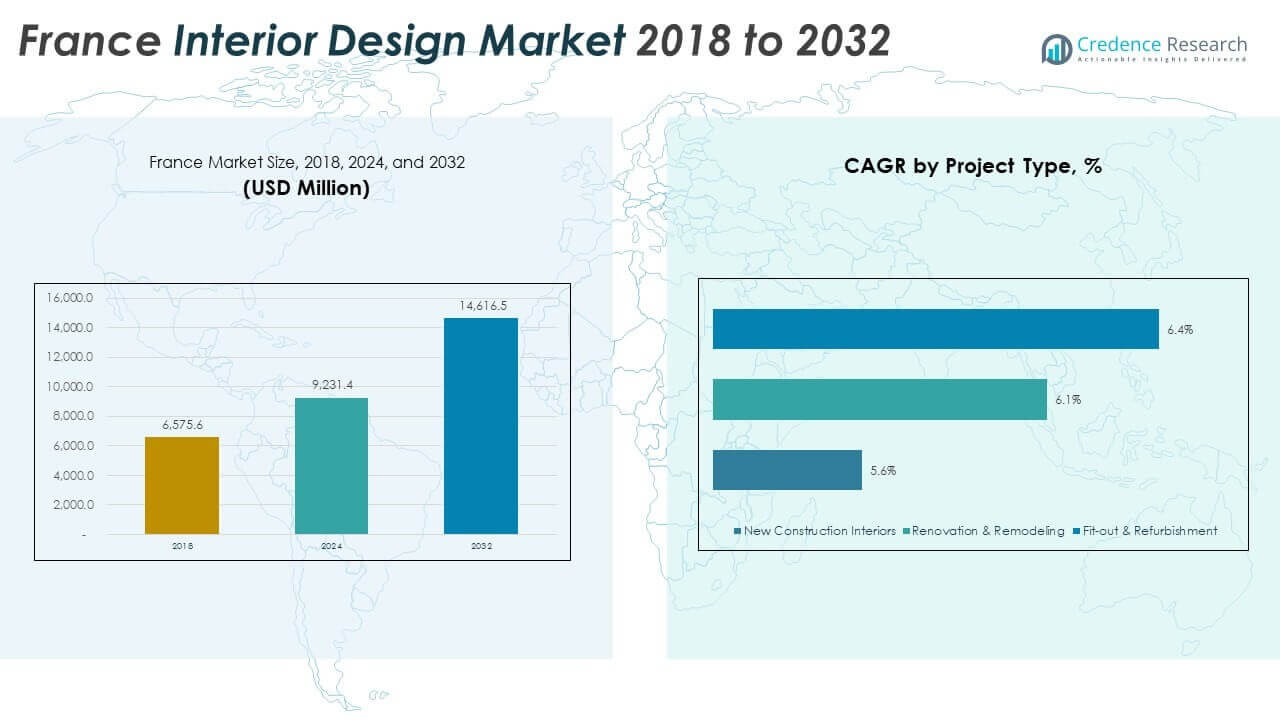
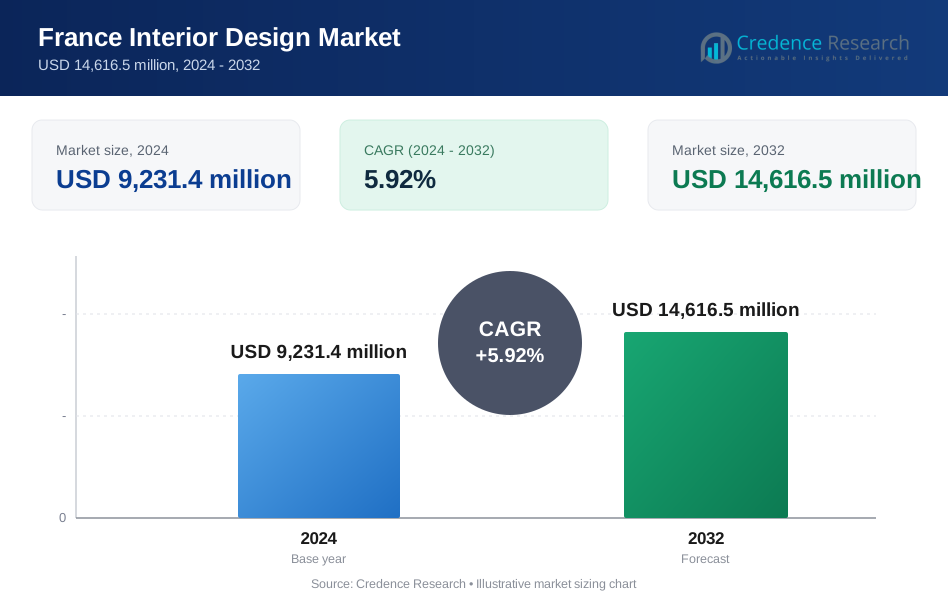
The France Interior Design Market size was valued at USD 6,575.6 million in 2018 to USD 9,231.4 million in 2024 and is anticipated to reach USD 14,616.5 million by 2032, at a CAGR of 5.92% during the forecast period.
| REPORT ATTRIBUTE | DETAILS |
|---|---|
| Historical Period | 2020-2023 |
| Base Year | 2024 |
| Forecast Period | 2025-2032 |
| Solid Bleached Board Market Size 2024 | USD 9,231.4 million |
| Solid Bleached Board Market, CAGR | 5.92% |
| Solid Bleached Board Market Size 2032 | USD 14,616.5 million |
Growing urban housing developments and rising disposable incomes are driving demand for interior design services across France. Consumers increasingly seek personalized home and office spaces that reflect modern aesthetics and sustainability. Renovation trends and a surge in smart, energy‑efficient solutions are encouraging spending. Commercial projects in hospitality and retail also boost market growth, as brands strive for unique customer environments. Innovation in design technology and materials further fuels industry expansion through enhanced client experiences and efficient project delivery.
Paris and Île‑de‑France remain the leading regions in France’s interior design market due to high population density and strong corporate activity. Southern regions like Provence also see notable growth driven by luxury residential demand and tourism‑linked hospitality projects. Emerging interest appears in cities such as Lyon and Bordeaux, where tech and business sectors expand. Rural areas gradually adopt design services as remote work and home upgrades rise, reflecting broader national preferences for quality living spaces.
Market Insights:
- The France Interior Design Market was valued at USD 6,575.6 million in 2018, reached USD 9,231.4 million in 2024, and is projected to hit USD 14,616.5 million by 2032, growing at a CAGR of 5.92%.
- Île-de-France dominates with over 35% share due to dense urban development, high-income households, and luxury real estate. Provence-Alpes-Côte d’Azur and Auvergne-Rhône-Alpes hold 17% and 13% shares respectively, driven by tourism and commercial growth.
- Occitanie and Nouvelle-Aquitaine are the fastest-growing regions, contributing a combined 20% share, with rising public projects and suburban housing driving interior service demand.
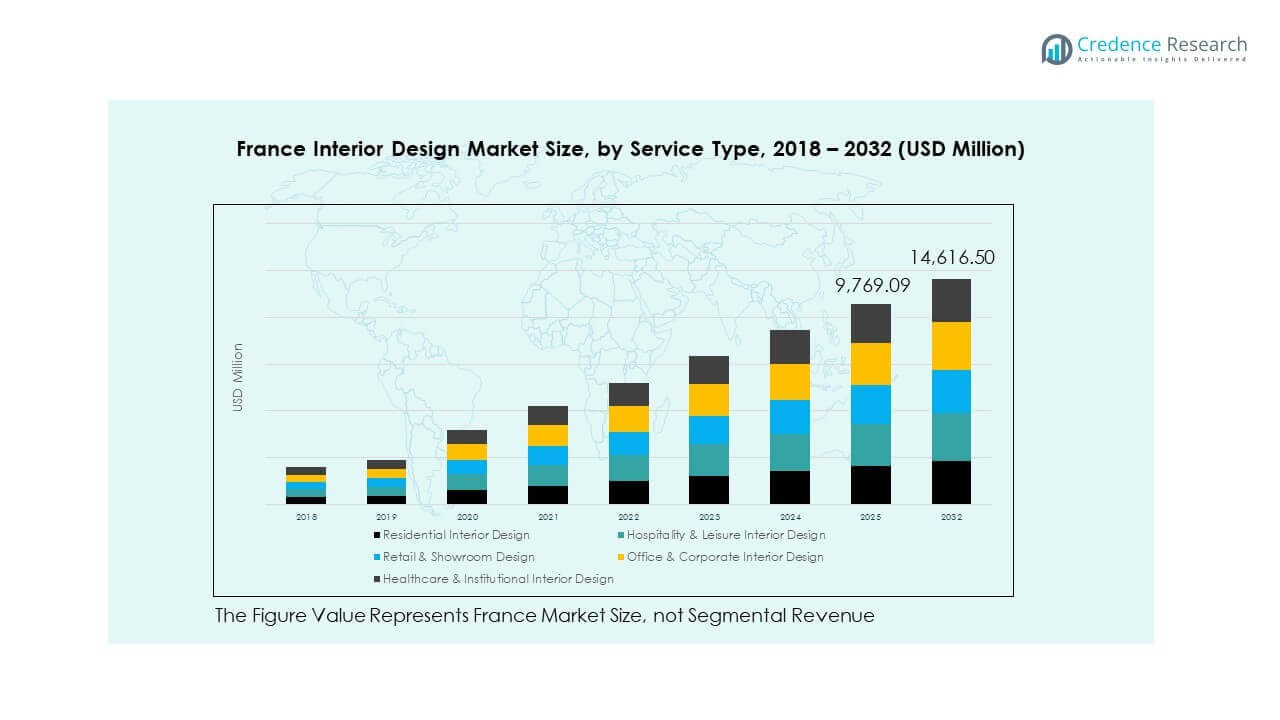
- Residential Interior Design leads the service segment mix, contributing the highest visual share in every year from 2018 to 2032, followed by Office & Corporate Interior Design.
- Retail & Showroom Design and Healthcare & Institutional Interior Design represent smaller yet consistent shares, with growing demand tied to modernized retail formats and hospital refurbishments.
Market Drivers:
Rising Home Renovation and Remodeling Activities Across Urban and Suburban Households
France sees a steady rise in home renovation demand, especially in urban zones like Paris and Lyon. Aging residential stock encourages investments in modern layouts, sustainable materials, and smart lighting. Homeowners prioritize personal comfort, energy efficiency, and modern aesthetics. Government incentives supporting eco-friendly refurbishments accelerate this shift. Younger professionals drive demand for functional, minimalist interiors. The France Interior Design Market benefits from this widespread trend across metro and suburban spaces. It gains traction through design studios offering turnkey home upgrade solutions. Customization preferences further increase design service consumption.
- For instance, Studio MHNA has completed over 25 personalised interior projects globally, blending bespoke furniture and adaptive layouts tailored to homeowner lifestyles. Homeowners prioritise personal comfort, energy efficiency, and modern aesthetics. Government incentives supporting eco‑friendly refurbishments accelerate this shift.
Expanding Real Estate and Luxury Residential Construction Across Prime Regions
Real estate development projects across Île-de-France and southern coastal areas fuel interior design demand. High-end residential spaces require bespoke interiors with advanced finishes. International buyers seek luxurious second homes with tailored design services. Design firms collaborate with real estate developers to offer premium packages. The France Interior Design Market gains value from such bundled offerings. It supports branded residences, serviced apartments, and penthouses. Wealthy clientele demand exclusive furnishings and cultural themes. Increased permits for residential units strengthen business pipelines.
- For instance, Saguez & Partners designed the 18,000‑square‑metre Pernod Ricard headquarters interior to support collaboration across 900 employees, showing complex spatial planning capabilities. International buyers seek luxurious second homes with tailored design services. Design firms collaborate with real estate developers to offer premium packages.
Growing Commercial Refurbishments in Retail, Hospitality, and Corporate Workspaces
Businesses in retail and hospitality invest in visual branding through curated interiors. Hotels adopt thematic design concepts to elevate guest experience. Corporate offices integrate ergonomic layouts, breakout zones, and eco-friendly lighting. These commercial shifts strengthen demand for professional design services. The France Interior Design Market sees steady commercial inflows across Paris, Marseille, and Bordeaux. It supports coworking firms, boutique hotels, and flagship stores. Interior designers create experiential environments aligned with business identity. Higher footfall and employee retention objectives drive commercial upgrades.
Government Energy Efficiency Mandates for Green Building and Interior Spaces
France enforces building codes and environmental regulations encouraging sustainable interiors. National mandates promote use of low-emission materials, energy-saving systems, and renewable components. Interior designers align with these standards by integrating eco-label products. Commercial and residential projects seek LEED or HQE certification, boosting eco-centric design. The France Interior Design Market benefits from these compliance needs. It facilitates project approvals and long-term cost savings. Clients increasingly choose design firms with certified green portfolios. Public awareness around climate goals strengthens green interior adoption.
Market Trends:
Integration of Smart Home Technologies with Interior Design Themes and Layouts
Smart home systems reshape layout planning and furniture placement. Designers adapt to client preferences for voice control, lighting automation, and smart appliances. These features demand hidden wiring, space optimization, and material compatibility. The France Interior Design Market incorporates connected technologies into residential and commercial spaces. It enhances convenience and energy control. Smart mirrors, climate systems, and remote security drive functional interiors. Design firms partner with tech providers to deliver integrated outcomes. User experience drives high-value design contracts.
- For instance, Saguez & Partners’ graphic team crafted vinyl decals and design cues covering 1,400 square feet for AXA’s Paris office to enhance wayfinding and engagement, blending aesthetics with technology‑inspired spatial cues.
Influence of Biophilic Design and Natural Elements in Indoor Aesthetics
Indoor spaces increasingly feature biophilic elements to promote wellness. Designers use natural light, indoor plants, and organic materials to boost occupant comfort. Wood, stone, and linen surfaces gain preference across homes and offices. The France Interior Design Market evolves with this nature-inspired movement. It blends sustainability with aesthetics. Open-plan layouts support natural airflow and daylight use. Clients demand calming, earthy tones and textures. Wellness-driven design gains traction across urban apartments and boutique hotels.
Growing Popularity of Minimalist, Multi-Functional Furniture in Compact Living Spaces
Urban housing constraints shift consumer interest toward minimalist, space-saving furniture. Designers respond with modular solutions and convertible designs. Built-in storage, sliding panels, and foldable fixtures meet modern needs. The France Interior Design Market supports furniture innovation that aligns with this trend. It targets studio apartments and shared accommodations. Functional aesthetics gain priority over ornate design. Younger demographics lead this shift. Interior professionals emphasize practicality in concept development.
Customization Trends Driven by Digital Visualization and AR-Enabled Planning Tools
Virtual reality and AR tools enhance client-designer collaboration. Homeowners preview designs in 3D before execution. This speeds decision-making and improves satisfaction rates. The France Interior Design Market adopts digital platforms for project planning. It improves accuracy, reduces rework, and shortens timelines. Customization becomes more accessible through interactive interfaces. Design firms gain competitive edge by offering tech-enabled experiences. Digital workflows redefine client engagement.
- For instance, French design teams implementing Archicad BIM and 3D modelling for a 1,200 sqm residential project illustrate how digital workflows enhance layout accuracy and client collaboration.
Market Challenges Analysis:
High Cost of Premium Design Services Limits Mass Market Accessibility and Adoption
Interior design remains a discretionary service for many French households. Premium services cost more due to skilled labor, imported materials, and personalized planning. Smaller budgets limit access to full-service design studios. The France Interior Design Market faces difficulty scaling across mid-income segments. Independent designers and online platforms offer limited alternatives. High-value clients sustain demand but restrict overall volume expansion. Material inflation and rising labor costs increase project budgets. Affordability remains a key adoption barrier outside affluent zones.
Fragmented Industry Structure with Informal Operators Impacting Standardization and Scalability
France hosts a large number of freelance designers and small agencies. Many operate informally, limiting quality assurance and legal compliance. Standardization of practices, pricing, and project management remains low. The France Interior Design Market lacks uniform benchmarks across service tiers. Clients face variable experiences and inconsistent delivery. This fragmentation reduces investor interest and limits industry consolidation. Professional certification uptake remains low, especially outside urban centers. It affects brand visibility and formal sector competitiveness.
Market Opportunities:
Rise of E-Commerce and Online Interior Design Platforms Offering Remote Design Services
Online design platforms grow rapidly by offering affordable packages and digital consultations. Clients choose styles, upload room photos, and receive layout plans. The France Interior Design Market leverages this shift to expand reach. It lowers entry barriers for mid-income customers. E-commerce platforms bundle furnishings and décor with virtual planning. Remote consultations help rural customers access professional services. Standard packages enhance scale and delivery speed.
Tourism-Focused Refurbishments in Boutique Hotels, Heritage Villas, and Short-Term Rentals
Tourism drives demand for unique and inviting interiors across holiday properties. Boutique hotels and rental villas focus on differentiated aesthetics. The France Interior Design Market supports custom refurbishments for guest appeal. Designers blend regional heritage with modern themes. This trend grows across Provence, Riviera, and Loire Valley. Airbnb and luxury stay operators invest in interior upgrades. Seasonal demand cycles offer repeat business for design firms.
Market Segmentation Analysis:
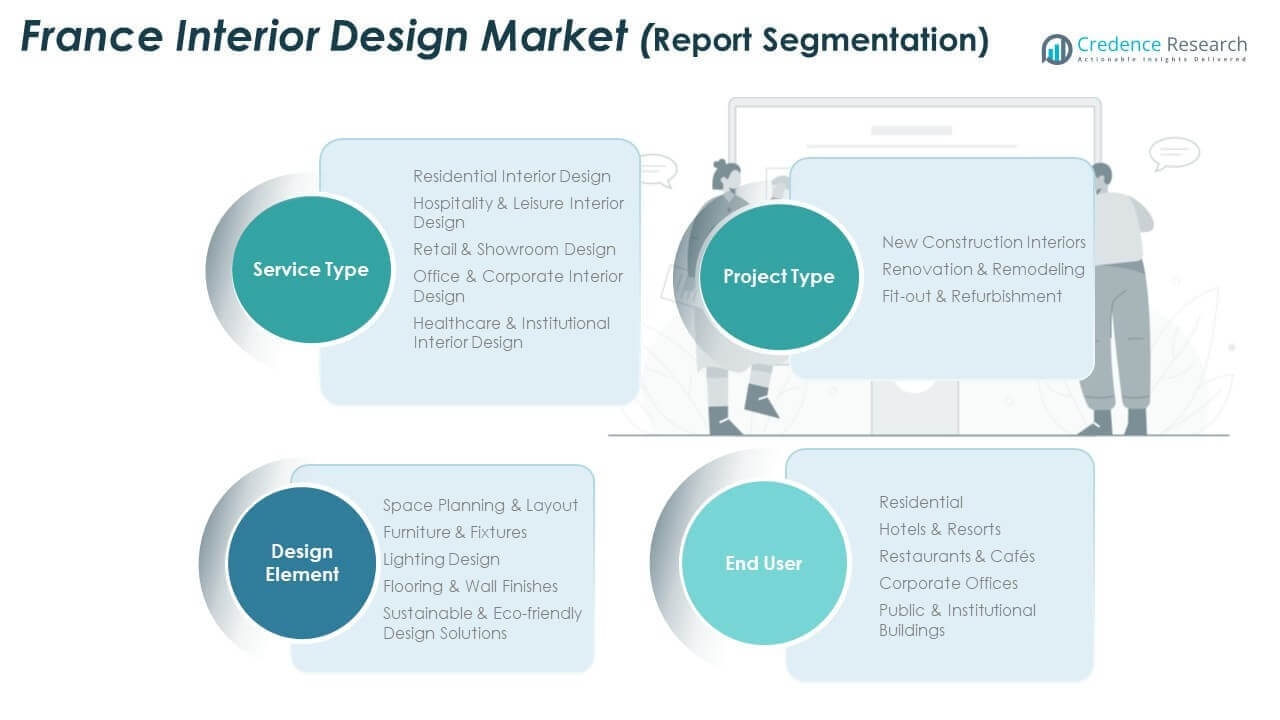
Project Type Segments
New construction interiors drive demand through residential and mixed‑use developments. Renovation and remodeling hold strong share due to aging housing stock and lifestyle upgrades. Fit‑out and refurbishment projects support offices, retail units, and hospitality assets. These segments benefit from faster project cycles and design standardization. Client focus remains on efficiency, durability, and visual appeal. Professional designers support turnkey delivery across project types.
- For instance, AREP Designlab delivered large‑scale fit‑out interiors for SNCF railway hubs, coordinating design across stations handling millions of passengers annually. Professional designers support turnkey delivery across project types.
Services Segments
Residential interior design leads demand from homeowners seeking comfort and personalization. Hospitality and leisure interior design supports hotels, resorts, and serviced apartments. Retail and showroom design emphasizes brand identity and customer experience. Office and corporate interior design focuses on flexible layouts and employee well‑being. Healthcare and institutional interior design prioritizes safety, compliance, and functional planning. The France Interior Design Market gains balanced revenue across these service categories.
- For instance, Design Studio Liaigre has delivered bespoke interiors for luxury residences and hotels worldwide, producing handcrafted furniture collections with limited annual output to maintain quality standards.
Design Element Segments
Space planning and layout form the foundation of most projects. Furniture and fixtures reflect quality, function, and style preferences. Lighting design enhances ambiance, productivity, and energy control. Flooring and wall finishes support durability and visual consistency. Sustainable and eco‑friendly design solutions gain traction through regulatory and client demand. Designers integrate these elements into cohesive concepts.
End User Segments
Residential users account for consistent project volumes across urban areas. Hotels and resorts invest in differentiated interiors to attract guests. Restaurants and cafés focus on atmosphere and efficient layouts. Corporate offices demand adaptable and collaborative spaces. Public and institutional buildings require compliant and long‑life designs. Each end user shapes service scope and design priorities.
Segmentation:
By Project Type Segments
- New Construction Interiors
- Renovation & Remodeling
- Fit-out & Refurbishment
By Services Segments
- Residential Interior Design
- Hospitality & Leisure Interior Design
- Retail & Showroom Design
- Office & Corporate Interior Design
- Healthcare & Institutional Interior Design
By Design Element Segments
- Space Planning & Layout
- Furniture & Fixtures
- Lighting Design
- Flooring & Wall Finishes
- Sustainable & Eco-friendly Design Solutions
By End User Segments
- Residential
- Hotels & Resorts
- Restaurants & Cafés
- Corporate Offices
- Public & Institutional Buildings
Regional Analysis:
Île-de-France Dominates with Over 35% Market Share Driven by Urban Projects and Affluent Clientele
Île-de-France holds the highest share in the France Interior Design Market, accounting for over 35%. The region benefits from Paris’s dense population, high disposable income, and luxury property demand. Commercial design services grow steadily with new retail, office, and hospitality developments. Design firms cater to affluent consumers seeking premium interiors with sustainable and tech-driven solutions. Government projects in public infrastructure add to institutional design demand. It remains the core business hub, drawing continuous investment in high-value spaces.
Provence-Alpes-Côte d’Azur and Auvergne-Rhône-Alpes Together Capture 30% Market Share
Provence-Alpes-Côte d’Azur holds strong demand from hospitality and vacation rental segments. High tourist influx drives interior design for boutique hotels, resorts, and heritage homes. The region accounts for nearly 17% of the market. Auvergne-Rhône-Alpes follows closely with 13%, led by cities like Lyon and Grenoble. It benefits from urban regeneration projects and corporate office refurbishments. Both regions see a rise in residential remodeling and green-certified buildings. It supports growing design preferences for Mediterranean and alpine-inspired interiors.
Emerging Growth in Nouvelle-Aquitaine, Occitanie, and Grand Est with Combined 20% Share
Nouvelle-Aquitaine, Occitanie, and Grand Est collectively contribute around 20% to the France Interior Design Market. These regions benefit from improved real estate activity and regional development policies. Occitanie shows rising demand in cities like Toulouse, driven by education and public-sector projects. Nouvelle-Aquitaine sees growth in suburban housing and retail refurbishments. Grand Est focuses on cultural space renovations and institutional interiors. It reflects broader adoption of interior design beyond traditional metro centers. These areas present strong upside potential for mid-scale firms.
Key Player Analysis:
- Studio MHNA
- Hometon
- Saguez & Partners
- AREP Designlab
- Design Studio Liaigre
- The Oblist
- Toulon Provence Méditerranée
- Other Key Players
Competitive Analysis:
The France Interior Design Market features a fragmented yet competitive landscape with a mix of boutique studios and established design firms. Leading players compete through design specialization, project scale, and sector focus. Firms emphasize residential luxury, hospitality themes, and corporate workspace expertise. Strategic positioning depends on design innovation, client relationships, and regional presence. It benefits from strong creative talent and architectural heritage. Smaller studios gain traction through niche concepts and bespoke services. Larger firms secure contracts through integrated design and project management capabilities. Competition remains service‑driven rather than price‑led.
Recent Developments:
- In January 2025, the Paris-based design agency Saguez & Partners officially acquired New York-based Dash Design to form Saguez & Dash. This strategic move merged American innovation with French design expertise after three years of informal collaboration. The new entity operates globally, focusing on sustainable and luxury solutions in the hospitality and retail sectors.
Report Coverage:
The research report offers an in-depth analysis based on project type, services, design elements, and end user segments. It details leading market players, providing an overview of their business, product offerings, investments, revenue streams, and key applications. Additionally, the report includes insights into the competitive environment, SWOT analysis, current market trends, as well as the primary drivers and constraints. Furthermore, it discusses various factors that have driven market expansion in recent years. The report also explores market dynamics, regulatory scenarios, and technological advancements that are shaping the industry. It assesses the impact of external factors and global economic changes on market growth. Lastly, it provides strategic recommendations for new entrants and established companies to navigate the complexities of the market.
Future Outlook:
- Homeowners will increasingly seek personalized interiors driven by lifestyle upgrades and aesthetic preferences.
- Demand for renovation and remodeling will rise across suburban and Tier-II cities with aging infrastructure.
- Design services will integrate more circular materials and low-emission solutions due to EU-wide sustainability mandates.
- Hospitality and retail interiors will focus on immersive guest experiences and modular spatial planning.
- Smart lighting, sensor-integrated fixtures, and connected home layouts will shape future residential designs.
- Office spaces will transition to hybrid-friendly environments with movable furniture and flexible layout zones.
- Public sector and institutional buildings will adopt inclusive design principles for accessibility and compliance.
- Digital visualization tools such as AR/VR and AI-based layout assistants will streamline client-decision cycles.
- Mid-sized studios will expand through franchising and collaborations to reach emerging growth regions.
- Government initiatives and tax incentives will promote green-certified interiors across private and public projects.
Request a Free Sample
Fill in your details and we'll send you a free sample report.
- Sample data tables & charts
- Research methodology
Market Dynamics
Rising Home Renovation and Remodeling Activities
Aging housing stock and evolving lifestyle preferences in urban and suburban France are driving significant investment in home renovations, with homeowners seeking modern layouts, energy efficiency, and personalized aesthetics. Government incentives for eco-friendly refurbishments further accelerate this trend, expanding the market for interior design services.
Expanding Real Estate and Luxury Residential Construction
Prime regions such as Île-de-France and Provence-Alpes-Côte d’Azur are experiencing a surge in luxury residential and real estate development, fueling demand for bespoke interior design services. International buyers and high-net-worth individuals seek tailored, high-end interiors, boosting collaboration between design firms and property developers.
Growing Commercial Refurbishments in Retail, Hospitality, and Corporate Workspaces
Businesses in retail, hospitality, and corporate sectors are investing in interior upgrades to enhance brand identity, guest experience, and employee well-being. This trend is particularly strong in major cities like Paris, Marseille, and Bordeaux, where commercial refurbishments drive steady demand for professional design services.
Government Energy Efficiency Mandates and Green Building Regulations
France’s strict building codes and environmental regulations are pushing both residential and commercial clients to adopt sustainable, low-emission materials and energy-saving systems. Interior designers are increasingly integrating eco-friendly solutions to meet certification standards, which boosts demand for specialized design expertise.
Integration of Smart Home Technologies and Digital Visualization Tools
The adoption of smart home systems and digital planning tools such as AR/VR is transforming the interior design process, enabling greater customization and client engagement. These technologies streamline project delivery, improve satisfaction, and create new opportunities for design firms to differentiate their offerings.
Need a Custom Version of This Report?
Tailor the scope, geography, or segments to your exact requirements.
- Custom geography or segment scope
- Direct access to our analyst team
Frequently Asked Questions
What is the current market size for France Interior Design Market, and what is its projected size in 2032?
At what Compound Annual Growth Rate is the France Interior Design Market projected to grow between 2024 and 2032?
Which France Interior Design Market segment held the largest share in 2024?
What are the primary factors fueling the growth of the France Interior Design Market?
Who are the leading companies in the France Interior Design Market?
Which region commanded the largest share of the France Interior Design Market in 2024?
Table of Content
Chapter 1 Market Segmentation
- 1.1 Segmentation Framework
- 1.1.1 Product and Service Classification
- 1.1.2 Application and End-Use Classification
- 1.1.3 Technology and Solution Classification
- 1.1.4 Customer and Distribution Channel Classification
- 1.1.5 Geographic Segmentation
- 1.1.6 Market Segment Definitions and Boundaries
- 1.2 By End User
- 1.2.1 Residential
- 1.2.2 Hotels & Resorts
- 1.2.3 Restaurants & Cafés
- 1.2.4 Corporate Offices
- 1.2.5 Public & Institutional Buildings
- 1.3 By Services
- 1.3.1 Residential Interior Design
- 1.3.2 Hospitality & Leisure Interior Design
- 1.3.3 Retail & Showroom Design
- 1.3.4 Office & Corporate Interior Design
- 1.3.5 Healthcare & Institutional Interior Design
- 1.4 By Project Type
- 1.4.1 New Construction Interiors
- 1.4.2 Renovation & Remodeling
- 1.4.3 Fit-out & Refurbishment
- 1.5 By Design Element
- 1.5.1 Space Planning & Layout
- 1.5.2 Furniture & Fixtures
- 1.5.3 Lighting Design
- 1.5.4 Flooring & Wall Finishes
- 1.5.5 Sustainable & Eco-friendly Design Solutions
Chapter 2 Introduction
- 2.1 Report Objectives and Scope
- 2.2 Product Definition and Industry Terminology
- 2.3 Market Inclusions and Exclusions
- 2.4 Research Process
- 2.4.1 Primary Research and Expert Interviews
- 2.4.2 Secondary Research and Source Review
- 2.4.3 Top-Down and Bottom-Up Estimation
- 2.4.4 Data Triangulation and Verification
- 2.5 Market Size Measurement Basis
- 2.5.1 2024: USD 9,231.4 million → 2032: USD 14,616.5 million
- 2.6 Historical and Forecast Reference Periods
- 2.6.1 Base Year: 2024
- 2.6.2 Forecast Period: 2024-2032
- 2.7 Research Assumptions and Limitations
Chapter 3 Executive Summary
- 3.1 Market Snapshot and Key Findings
- 3.2 Base-Year Market Size, 2024
- 3.3 Forecast Market Size, 2032
- 3.4 Revenue and Volume Growth Outlook
- 3.5 Key Demand and Supply Indicators
- 3.6 Leading Market Segments
- 3.7 Fastest-Growing Market Opportunities
- 3.8 Regional Performance Highlights
- 3.9 Technology and Industry Transformation
- 3.10 Competitive Landscape Summary
- 3.11 Analyst View and Strategic Implications
Chapter 4 France Interior Design Market Trends and Developments
- 4.1 Historical Industry Development
- 4.2 Recent Market Trends and Developments
- 4.3 Demand and Customer Behavior Trends
- 4.4 Technology and Product Innovation
- 4.5 Artificial Intelligence, Automation and Digitalization
- 4.6 Local Manufacturing and Supply Chain Realignment
- 4.7 Industry Partnerships, Mergers and Acquisitions
- 4.8 Sustainability and Circular Economy Developments
- 4.9 Government and Private Sector Investment Trends
- 4.10 Emerging Business Models and Commercialization
- 4.11 Industry Developments and Announcements
Chapter 5 France Interior Design Market Production, Supply and Demand Analysis
- 5.1 Demand Trend and Consumption Analysis
- 5.2 Demand Forecast, 2024-2032
- 5.3 Production and Output Trend
- 5.4 Production and Output Forecast, 2024-2032
- 5.5 Installed Capacity and Capacity Utilization
- 5.6 Company-Wise Production Plants and Statistics
- 5.6.1 Installed Production Capacity
- 5.6.2 Actual Production
- 5.6.3 Planned Capacity and Expansion Targets
- 5.7 Supply Chain Structure and Procurement Trends
- 5.8 Supply-Demand Gap and Bottlenecks
- 5.9 Import Dependence and Sourcing Structure
- 5.10 Contract Manufacturing and Outsourcing
- 5.11 Regional Supply and Demand Concentration
Chapter 6 France Interior Design Market Pricing Analysis
- 6.1 Pricing Structure and Measurement
- 6.2 Historical Pricing Trends
- 6.3 Pricing Outlook, 2024-2032
- 6.4 Average Selling Price and Unit Economics
- 6.5 Pricing by Product and Market Segment
- 6.6 Geographic Pricing Differences
- 6.7 Key Input, Energy, Labor and Logistics Costs
- 6.8 Contract Pricing and Purchasing Models
- 6.9 Pricing Sensitivity and Competitive Positioning
- 6.10 Price, Margin and Profitability Implications
Chapter 7 France Interior Design Market Dynamics
- 7.1 Market Growth Drivers
- 7.1.1 Demand-Side Drivers
- 7.1.2 Technology and Innovation Drivers
- 7.1.3 Infrastructure and Investment Drivers
- 7.1.4 Regulatory and Policy Drivers
- 7.2 Market Restraints
- 7.2.1 Cost and Affordability Constraints
- 7.2.2 Technology and Adoption Barriers
- 7.2.3 Supply Chain and Operational Constraints
- 7.3 Market Challenges
- 7.3.1 Competitive Pressure and Margin Erosion
- 7.3.2 Skills, Infrastructure and Implementation Gaps
- 7.4 Emerging Market Opportunities
- 7.5 Market Dynamics Impact and Time-Horizon Assessment
Chapter 8 France Interior Design Value Chain Analysis
- 8.1 Industry Value Chain Overview
- 8.2 Upstream Suppliers and Critical Inputs
- 8.3 Technology and Component Providers
- 8.4 Manufacturing or Service Delivery
- 8.5 Distribution, Channel Partners and Integrators
- 8.6 Downstream Applications and End Users
- 8.7 Value Addition and Profit Pools
- 8.8 Vertical Integration and Outsourcing
- 8.9 Supplier Concentration and Risk
- 8.10 Supply Chain Localization and Resilience
Chapter 9 France Interior Design Market Regulations and Policies
- 9.1 Relevant Laws, Standards and Compliance Frameworks
- 9.2 Product, Service, Safety and Quality Requirements
- 9.3 Government Policies, Incentives and Subsidies
- 9.4 Imports, Exports and Trade Barriers
- 9.5 Public Procurement and Local Content Requirements
- 9.6 Environmental and Sustainability Compliance
- 9.7 Upcoming Policy Changes and Market Implications
Chapter 10 France Interior Design Market Hotspots and Opportunities
- 10.1 Market Opportunity Mapping and Growth Hotspots
- 10.2 High-Growth Applications and Customer Groups
- 10.3 Underserved Markets and White-Space Opportunities
- 10.4 Emerging Technology and Product Opportunities
- 10.5 New Capacity and Investment Hotspots
- 10.6 Market Entry and Expansion Opportunities
- 10.7 Distribution and Partnership Opportunities
- 10.8 Near-Term and Long-Term Commercial Potential
- 10.9 Opportunity Attractiveness and Execution Risks
Chapter 11 France Interior Design Market Outlook, 2024-2032
- 11.1 Market Size and Analysis
- 11.1.1 Revenue (Market Measurement: 2024: USD 9,231.4 million → 2032: USD 14,616.5 million)
- 11.1.2 Market Volume and Quantity Sold
- 11.1.3 Historical Market Size
- 11.1.4 Base-Year Market Size, 2024
- 11.2 Market Forecast, 2024-2032
- 11.2.1 Revenue Forecast to 2032
- 11.2.2 Volume Forecast to 2032
- 11.2.3 CAGR and Year-on-Year Growth
- 11.2.4 Incremental Revenue Opportunity
- 11.3 Forecast Assumptions and Scenario Analysis
- 11.3.1 Base-Case Forecast
- 11.3.2 Optimistic and Conservative Scenarios
- 11.3.3 Technology, Pricing and Policy Sensitivities
- 11.4 Market Attractiveness and Growth Outlook
Chapter 12 France Interior Design Market Segmentation and Outlook
- 12.1 Segmentation Summary and Market Shares, 2024
- 12.2 Largest and Fastest-Growing Segments
- 12.3 By End User - Market Size and Forecast, 2024-2032
- 12.3.1 Segment Definition and Scope
- 12.3.2 Historical Market Size
- 12.3.3 Revenue Forecast, 2024-2032
- 12.3.4 Volume Forecast, 2024-2032
- 12.3.5 Base-Year Market Share, 2024
- 12.3.6 Segment CAGR and Growth Drivers
- 12.3.7 Subsegment Market Size and Forecast
- 12.3.7.1 Residential
- 12.3.7.2 Hotels & Resorts
- 12.3.7.3 Restaurants & Cafés
- 12.3.7.4 Corporate Offices
- 12.3.7.5 Public & Institutional Buildings
- 12.3.8 Subsegment Pricing and Adoption Trends
- 12.3.9 Leading Suppliers and Competition
- 12.3.10 Regional Demand and Opportunities
- 12.4 By Services - Market Size and Forecast, 2024-2032
- 12.4.1 Segment Definition and Scope
- 12.4.2 Historical Market Size
- 12.4.3 Revenue Forecast, 2024-2032
- 12.4.4 Volume Forecast, 2024-2032
- 12.4.5 Base-Year Market Share, 2024
- 12.4.6 Segment CAGR and Growth Drivers
- 12.4.7 Subsegment Market Size and Forecast
- 12.4.7.1 Residential Interior Design
- 12.4.7.2 Hospitality & Leisure Interior Design
- 12.4.7.3 Retail & Showroom Design
- 12.4.7.4 Office & Corporate Interior Design
- 12.4.7.5 Healthcare & Institutional Interior Design
- 12.4.8 Subsegment Pricing and Adoption Trends
- 12.4.9 Leading Suppliers and Competition
- 12.4.10 Regional Demand and Opportunities
- 12.5 By Project Type - Market Size and Forecast, 2024-2032
- 12.5.1 Segment Definition and Scope
- 12.5.2 Historical Market Size
- 12.5.3 Revenue Forecast, 2024-2032
- 12.5.4 Volume Forecast, 2024-2032
- 12.5.5 Base-Year Market Share, 2024
- 12.5.6 Segment CAGR and Growth Drivers
- 12.5.7 Subsegment Market Size and Forecast
- 12.5.7.1 New Construction Interiors
- 12.5.7.2 Renovation & Remodeling
- 12.5.7.3 Fit-out & Refurbishment
- 12.5.8 Subsegment Pricing and Adoption Trends
- 12.5.9 Leading Suppliers and Competition
- 12.5.10 Regional Demand and Opportunities
- 12.6 By Design Element - Market Size and Forecast, 2024-2032
- 12.6.1 Segment Definition and Scope
- 12.6.2 Historical Market Size
- 12.6.3 Revenue Forecast, 2024-2032
- 12.6.4 Volume Forecast, 2024-2032
- 12.6.5 Base-Year Market Share, 2024
- 12.6.6 Segment CAGR and Growth Drivers
- 12.6.7 Subsegment Market Size and Forecast
- 12.6.7.1 Space Planning & Layout
- 12.6.7.2 Furniture & Fixtures
- 12.6.7.3 Lighting Design
- 12.6.7.4 Flooring & Wall Finishes
- 12.6.7.5 Sustainable & Eco-friendly Design Solutions
- 12.6.8 Subsegment Pricing and Adoption Trends
- 12.6.9 Leading Suppliers and Competition
- 12.6.10 Regional Demand and Opportunities
- 12.7 Segment Growth Comparison
- 12.8 Segment Attractiveness and Priority Matrix
Chapter 13 France Interior Design End-Use and Application Market Outlook
- 13.1 End-Use Industry and Customer Demand Structure
- 13.2 Leading Applications and Customer Groups
- 13.3 End-Use Market Size, Share and Forecast
- 13.4 Major End-Use Industry Deep Dives
- 13.4.1 Customer Requirements and Use Cases
- 13.4.2 Demand and Replacement Cycles
- 13.4.3 Technical and Regulatory Considerations
- 13.4.4 Purchasing and Procurement Models
- 13.4.5 Leading Vendors and Distribution Channels
- 13.4.6 Forecast and Commercial Opportunities
- 13.5 Emerging Applications and Cross-Segment Demand
- 13.6 End-Use Industry Investment Priorities
Chapter 14 France Interior Design Geographic Market Outlook, 2024-2032
- 14.1 Domestic Market Distribution and Demand Clusters
- 14.2 State- or Province-Wise Market Size and Forecast, 2024-2032
- 14.3 City and Metropolitan Market Outlook
- 14.4 Industrial, Manufacturing and Commercial Clusters
- 14.5 Geographic Concentration of Key End Users
- 14.6 Local Pricing and Purchasing Differences
- 14.7 Domestic Production Facilities and Capacity Map
- 14.8 Local Infrastructure and Project Pipeline
- 14.9 State-Level Policy and Incentive Differences
- 14.10 Subnational Investment Hotspots and Opportunities
- 14.11 Distribution and Logistics Networks
- 14.12 Domestic Competitive Footprint
Chapter 15 France Interior Design Technology, Innovation and Sustainability Outlook
- 15.1 Technology Landscape and Maturity
- 15.2 Product, Process and Service Innovation
- 15.3 AI, Automation and Digital Tools in the Industry
- 15.4 Technology Adoption and Performance Benchmarking
- 15.5 Innovation Pipeline and R&D Investment
- 15.6 Patent and Intellectual Property Trends
- 15.7 Energy Efficiency and Resource Management
- 15.8 Sustainability, Recycling and Circularity
- 15.9 Technology Roadmap, 2024-2032
- 15.10 Risks of Obsolescence and Technology Substitution
Chapter 16 France Interior Design Market Key Strategic Imperatives
- 16.1 Growth and Market Entry Priorities
- 16.2 High-Return Products and Segments
- 16.3 Pricing, Profitability and Cost Optimization
- 16.4 Technology Investment and Product Differentiation
- 16.5 Supply Chain Localization and Resilience
- 16.6 Distribution and Customer Acquisition
- 16.7 Partnership, Acquisition and Capacity Strategy
- 16.8 Regional Expansion Priorities
- 16.9 Short-, Medium- and Long-Term Actions
Chapter 17 Competition Outlook
- 17.1 Industry Competition Characteristics
- 17.2 Market Structure and Concentration
- 17.3 Market Share and Competitive Positioning, 2024
- 17.4 Company-Wise Revenue and Product Benchmarking
- 17.5 Production and Service Capacity Benchmarking
- 17.6 Technology, Pricing and Differentiation
- 17.7 Regional Footprint and Distribution Strength
- 17.8 Mergers, Acquisitions and Strategic Alliances
- 17.9 New Entrants and Competitive Threats
- 17.10 Porter's Five Forces and Industry Attractiveness
- 17.11 Competitive Outlook, 2024-2032
Chapter 18 Company Profiles
- 18.1 Company Coverage and Selection Criteria
- 18.2 Studio MHNA
- 18.2.1 Business Description
- 18.2.2 Company Ownership and Geographic Presence
- 18.2.3 Product and Service Portfolio
- 18.2.4 Manufacturing and Operating Footprint
- 18.2.5 Production Capacity and Expansion Plans
- 18.2.6 Financial Performance and Investment
- 18.2.7 Market Share and Competitive Position
- 18.2.8 Technology and Innovation Capabilities
- 18.2.9 Strategic Alliances or Partnerships
- 18.2.10 Recent Developments
- 18.2.11 Growth Strategy and Outlook
- 18.3 Hometon
- 18.4 Saguez & Partners
- 18.5 AREP Designlab
- 18.6 Design Studio Liaigre
- 18.7 The Oblist
- 18.8 Toulon Provence Méditerranée
- 18.9 Maison Sarah Lavoine
- 18.10 Philippe Starck
- 18.11 Jean-Louis Deniot
- 18.12 Other Relevant Market Participants
Note: Every listed company is profiled on the structure shown under the first company. The company list is preliminary and may change based on research findings, market developments, data availability and client requirements.
Chapter 19 Disclaimer
- 19.1 Research and Forecast Disclaimer
- 19.2 Data Source and Estimation Limitations
Note: The depth of individual sections depends on data availability for this market. Volume, capacity, trade and other unit-based metrics are included where applicable.