
| REPORT ATTRIBUTE | DETAILS |
|---|---|
| Historical Period | 2019-2022 |
| Base Year | 2023 |
| Forecast Period | 2024-2032 |
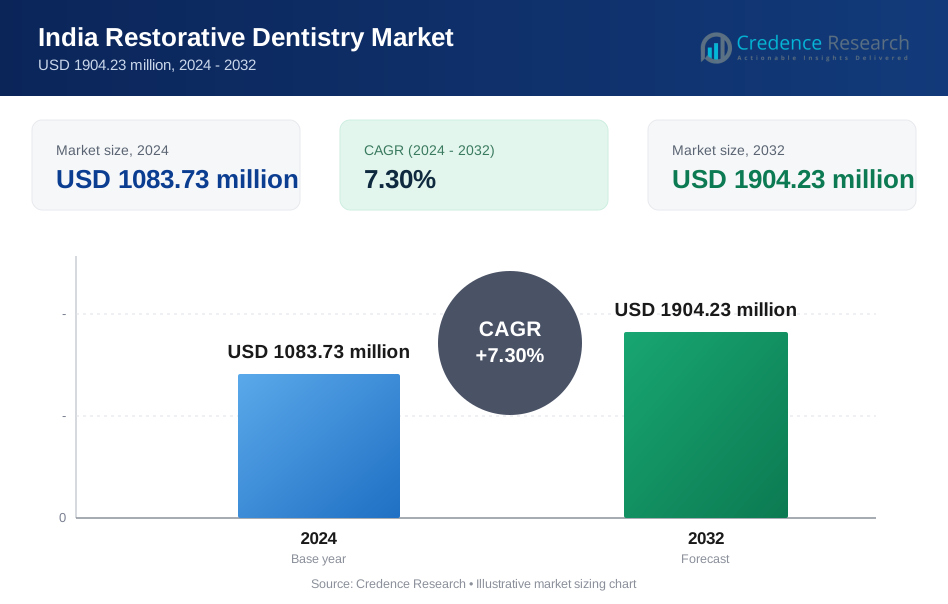
| India Restorative Dentistry Market Size 2024 | USD 1083.73 Million |
| India Restorative Dentistry Market, CAGR | 7.30% |
| India Restorative Dentistry Market Size 2032 | USD 1904.23 Million |
Market Overview
The India Restorative Dentistry Market is projected to grow from USD 1083.73 million in 2024 to USD 1904.23 million by 2032, with a compound annual growth rate (CAGR) of 7.30%.
Market drivers and trends in the India Restorative Dentistry Market include rising dental awareness and hygiene practices among the population, increasing incidences of dental disorders such as cavities and tooth decay, advancements in restorative dentistry technologies and materials, growing disposable income enabling more individuals to opt for restorative dental procedures, and expanding dental tourism industry in India attracting patients from abroad seeking cost-effective treatment options. These factors collectively contribute to the market's growth trajectory, fostering innovation and investment opportunities for stakeholders across the restorative dentistry sector in India.
In the geographical analysis of the India Restorative Dentistry Market, major regions such as North India, South India, East India, and West India exhibit varying levels of demand and adoption for restorative dental procedures. Metropolitan areas like Mumbai, Delhi, Bangalore, and Chennai serve as key hubs for advanced dental care services, attracting both domestic and international patients. Key players in the market include prominent dental clinics and hospitals such as Apollo Hospitals, Manipal Hospitals, and Clove Dental, as well as dental product manufacturers like Dentsply Sirona, 3M Company, and GC Corporation, driving innovation and competitiveness within the industry.
Market Drivers
Rising Prevalence of Dental Diseases
India indeed faces a significant challenge with a high prevalence of dental issues. For instance, about 85% to 90% of adults in India have dental cavities, and approximately 60% to 80% of children are affected by them. This prevalence stems from multiple factors, including limited access to preventive dental care services, dietary habits rich in sugars, and insufficient awareness about oral hygiene practices. As a consequence, there is a pressing demand for restorative dentistry services to address the extensive dental disease burden prevalent across various demographic segments of the population.
Increasing Disposable Income
The burgeoning economy in India is accompanied by a notable rise in disposable incomes, especially among the burgeoning middle class. For instance, the average disposable income of Indian households has seen a significant increase, with a growth rate of approximately 6.5% annually over the past five years. This economic empowerment enables individuals to allocate a portion of their discretionary income towards essential healthcare needs, including previously unaffordable dental procedures. As individuals prioritize their health and well-being, there is a growing propensity to invest in restorative dental treatments.
Growing Awareness of Oral Health
In recent years, there has been a noticeable increase in public awareness regarding oral health in India. For instance, the National Oral Health Programme (NOHP) has been instrumental in enhancing public awareness, with the government of India initiating various measures to provide integrated, comprehensive oral health care. This surge in awareness is attributed to various factors including media campaigns, educational initiatives, and a heightened emphasis on dental aesthetics. For example, a report by the Voluntary Health Association of India in 2022 stated that India has the highest number of oral cancer patients worldwide, with 75,000 to 80,000 new cases annually. With a greater understanding of the importance of maintaining oral health for overall well-being, individuals are becoming increasingly proactive in seeking preventive and restorative dental care services.
Expanding Dental Infrastructure and Government Initiatives
India is witnessing a rapid expansion of its dental infrastructure, characterized by the establishment of numerous dental colleges, hospitals, and clinics across both urban and rural areas. This expansion aims to improve accessibility to dental care services for a broader spectrum of the population. Moreover, government initiatives aimed at enhancing oral healthcare accessibility, such as promoting dental insurance coverage, subsidizing dental treatments for specific demographics, and incentivizing the establishment of dental clinics in underserved rural areas, are further bolstering the growth trajectory of the restorative dentistry market in India.
Market Trends
Focus on Minimally Invasive Procedures and Cost-Effective Solutions
There's a growing preference for minimally invasive restorative procedures in India, driven by a desire to preserve healthy tooth structure. Techniques such as tooth bonding, inlays, and onlays are gaining popularity due to their effectiveness in restoration with minimal tooth removal. For example, ceramic inlays and onlays have become popular not only because of patient demand for esthetic, durable restorative materials but also because of recent improvements in materials, fabrication techniques, and bonding systems. Simultaneously, affordability remains a significant concern, prompting the market to witness a surge in cost-effective restorative options like tooth-colored fillings and locally manufactured dental implants. This trend caters to the price-sensitive population while still addressing dental needs, reflecting a dual focus on both effectiveness and accessibility in the restorative dentistry landscape. In fact, the cost-effectiveness of dental treatment in India becomes evident when considering the average dental implant cost, which is approximately ₹25,000. This range is significantly more affordable than the costs in many Western countries, where the price for the same procedure can be substantially higher. This affordability allows patients to access high-quality dental care at a fraction of the cost, ensuring that financial constraints don’t prevent anyone from getting dental treatment in India.
Digital Dentistry and Expansion into Tier-2 and Tier-3 Cities
The adoption of digital dentistry is rapidly accelerating across India. For instance, as of June 2023, approximately 40.9% of dental professionals in India have been using CAD/CAM technology for 0 to 5 years in their practice. Technologies like CAD/CAM for creating customized restorations and digital X-rays for enhanced diagnostics are increasingly being implemented in dental clinics, paving the way for more precise and efficient treatments.
Moreover, the market is expanding beyond metropolitan cities, with tier-2 and tier-3 cities witnessing a surge in demand for restorative dentistry services. For example, the ongoing tech revolution in these cities is fueling economic growth and driving socioeconomic transformation, which includes the healthcare sector. As disposable incomes rise and dental awareness increases in these areas, there’s a growing need for accessible care, leading to the establishment of more dental clinics and improved accessibility of services, thereby democratizing quality dental care across regions.
Market Challenges Analysis
Shortage of Qualified Dentists and Limited Dental Insurance Coverage
India grapples with a significant shortage of qualified dentists, particularly in rural areas, which poses a substantial challenge in meeting the growing demand for restorative dentistry services. This scarcity of dental professionals creates bottlenecks and impedes access to timely and quality dental care for a large segment of the population. Compounding this issue is the low penetration of dental insurance coverage in the country, leaving many patients vulnerable to high out-of-pocket expenses for restorative procedures. This financial barrier, especially prevalent among individuals from lower-income backgrounds, further exacerbates the challenge of accessing essential dental care services.
Uneven Distribution of Dental Care Facilities and Counterfeit Dental Materials
The distribution of dental care facilities in India is heavily skewed towards major urban centers, leaving rural areas underserved and devoid of adequate dental infrastructure. This imbalance in access to dental services restricts the availability of restorative dentistry options for a significant portion of the population residing in remote regions. Additionally, the presence of counterfeit dental materials poses a grave concern, as inferior-quality materials can compromise treatment outcomes and jeopardize patient safety. Addressing these challenges necessitates the implementation of stricter quality control measures to ensure the authenticity and safety of dental materials used in restorative procedures.
Market Segmentation Analysis:
By Type:
The India Restorative Dentistry Market can be segmented by type into anterior and posterior restorations. Anterior restorations primarily involve dental work on the front teeth, focusing on aesthetic improvements and functionality. These procedures are commonly sought after for cosmetic enhancements and to restore damaged or decayed front teeth. In contrast, posterior restorations target the molars and premolars, addressing functional issues such as chewing and biting. Posterior restorations often require more durable materials due to the higher pressure and wear they endure during chewing.
By Restoration Type:
The market can be categorized based on restoration type into direct and indirect restorations. Direct restorations involve the immediate placement of filling materials directly into the prepared cavity, typically completed in a single dental visit. This approach is commonly used for minor tooth repairs and cavity fillings. On the other hand, indirect restorations involve the fabrication of restorations outside of the mouth, such as crowns and bridges, which are then bonded to the teeth. Indirect restorations are often preferred for more extensive repairs or when aesthetics are a primary concern, requiring multiple dental visits for completion.
Segments:
Based on Type
- Anterior
- Posterior
Based on Restoration Type
- Direct
- Indirect
Based on Product
- Restorative Materials
- Implants
- Prosthetics
- Restorative Equipment
- Others
Based on End-User
- Hospitals & Clinics
- Dental Laboratories
- Others
Based on the Geography
- Northern Region
- Delhi
- Uttar Pradesh
- Punjab
- Western Region
- Maharashtra
- Gujarat
- Rajasthan
- Remaining Regions
- Karnataka
- Tamil Nadu
- Andhra Pradesh
- West Bengal
- Odisha
- Bihar
- Madhya Pradesh
- Chhattisgarh
Regional Analysis
Northern region
The northern region, comprising states like Delhi, Uttar Pradesh, and Punjab, holds the largest market share of approximately 30% in India's restorative dentistry market. This region is home to several metropolitan cities with a significant concentration of dental clinics and hospitals offering advanced restorative dentistry services. The presence of well-established dental institutions, the increasing awareness of oral health, and the growing disposable incomes of the urban population have fueled the demand for restorative dental treatments in the northern region.
Western region
The western region, including Maharashtra, Gujarat, and Rajasthan, accounts for around 25% of the restorative dentistry market share. This region has witnessed a surge in the adoption of cutting-edge dental technologies, driven by the increasing prevalence of dental problems and the availability of well-equipped dental facilities. The western region's focus on attracting medical tourism and providing advanced dental services has further contributed to the demand for restorative dentistry solutions.
Key Player Analysis
- 3M India Limited
- Septodont Healthcare India Pvt. Ltd.
- GC India Dental
- Dentsply India Private Limited
- Zimmer India Pvt. Ltd.
- Straumann Dental India LLP
- Ivoclar Vivadent Marketing (India) Private Limited
Competitive Analysis
In the competitive landscape of the India Restorative Dentistry Market, several leading players vie for market dominance. 3M India Limited stands out with its comprehensive range of dental products, including restorative materials and equipment, coupled with a strong brand reputation for innovation and quality. Dentsply India Private Limited commands a significant share with its diverse portfolio of restorative solutions, leveraging its global expertise in dental technology. Septodont Healthcare India Pvt. Ltd. distinguishes itself through its focus on specialized dental pharmaceuticals and innovative restorative materials. GC India Dental is a key player known for its advanced dental materials and commitment to research and development. Additionally, Zimmer India Pvt. Ltd. and Straumann Dental India LLP contribute to the competitive landscape with their specialized offerings in dental implants and prosthetics. Ivoclar Vivadent Marketing (India) Private Limited further enriches the market with its premium range of restorative and aesthetic dentistry solutions, intensifying competition and driving innovation within the sector.
Recent Developments
In September 2023, J Morita launched its new Vera view X800 3D CBCT imaging system. This system is designed to provide dentists with high-quality 3D images of patients' teeth and jaws.
In May 2022, Dentsply Sirona introduced the initial version of a new line of Dentsply Sirona devices that will revolutionize digital dentistry, as well as Prime print Solution for dental offices and labs. This innovative 3D printing method makes it simple to build patient-specific and biocompatible appliances through an automated and simplified manufacturing procedure.
In March 2022, Envisat Holdings Corporation announced Envisat’s KaVo imagining business to be re-branded as DEXIS. The DEXIS brand represents a portfolio of award-winning imaging and digital solutions, including cone-beam computed tomography (CBCT), intraoral scanners, handheld X-rays, and sensors.
Market Concentration & Characteristics
The India Restorative Dentistry Market exhibits characteristics of moderate market concentration, with several key players competing for market share. Despite the presence of numerous dental clinics and hospitals offering restorative dental services across the country, a handful of leading companies dominate the market. These companies differentiate themselves through a combination of factors including product quality, innovation, brand reputation, and distribution networks. Market concentration is driven by the demand for advanced restorative solutions, coupled with increasing consumer preferences for trusted and established brands. Additionally, the market's characteristics include a growing emphasis on technological advancements such as digital dentistry and minimally invasive procedures, reflecting the evolving nature of restorative dentistry practices in India. As competition intensifies, companies are expected to invest further in research and development to maintain their competitive edge and cater to the evolving needs of both dental professionals and patients in the Indian market.
Report Coverage
The research report offers an in-depth analysis based on Type, Restoration Type, Product, End-User and Geography. It details leading market players, providing an overview of their business, product offerings, investments, revenue streams, and key applications. Additionally, the report includes insights into the competitive environment, SWOT analysis, current market trends, as well as the primary drivers and constraints. Furthermore, it discusses various factors that have driven market expansion in recent years. The report also explores market dynamics, regulatory scenarios, and technological advancements that are shaping the industry. It assesses the impact of external factors and global economic changes on market growth. Lastly, it provides strategic recommendations for new entrants and established companies to navigate the complexities of the market.
Future Outlook
- Continued Growth: The India Restorative Dentistry Market is projected to experience sustained growth driven by increasing demand for advanced dental treatments and rising awareness of oral health.
- Technological Advancements: Future developments in digital dentistry and minimally invasive procedures are expected to revolutionize restorative dental practices, enhancing treatment outcomes and patient experiences.
- Expansion of Dental Infrastructure: The ongoing expansion of dental clinics and hospitals, particularly in tier-2 and tier-3 cities, will improve accessibility to restorative dentistry services across the country.
- Focus on Preventive Care: There will be a greater emphasis on preventive dental care to address oral health issues at early stages, potentially reducing the need for extensive restorative treatments.
- Adoption of Cost-Effective Solutions: The market will witness increased adoption of cost-effective restorative options to cater to the diverse needs of price-sensitive consumers.
- Rising Dental Tourism: India's growing reputation as a destination for medical tourism, including dental tourism, will attract more international patients seeking affordable and high-quality restorative dental procedures.
- Government Initiatives: Continued government initiatives to improve oral healthcare accessibility and promote dental insurance coverage will further stimulate market growth.
- Collaboration and Partnerships: Increased collaborations between dental professionals, research institutions, and industry stakeholders will drive innovation and introduce new restorative dentistry solutions to the market.
- Focus on Aesthetic Dentistry: There will be a growing demand for cosmetic dentistry procedures alongside restorative treatments, driven by a heightened emphasis on dental aesthetics.
- Enhanced Patient Education: Efforts to enhance patient awareness about oral health and the importance of regular dental check-ups will play a crucial role in shaping the future of the restorative dentistry market in India.
Request a Free Sample
Fill in your details and we'll send you a free sample report.
- Sample data tables & charts
- Research methodology
Need a Custom Version of This Report?
Tailor the scope, geography, or segments to your exact requirements.
- Custom geography or segment scope
- Direct access to our analyst team
Frequently Asked Questions
What is the current size of the India Restorative Dentistry Market?
What factors are driving the growth of the India Restorative Dentistry Market?
What are the key segments within the India Restorative Dentistry Market?
What are some challenges faced by the India Restorative Dentistry Market?
Who are the major players in the India Restorative Dentistry Market?
Table of Content
Chapter 1. Report Introduction
- 1.1 Report Description & Purpose
- 1.1.1 Report Title & Market Definition
- 1.1.2 Unique Selling Propositions (USP) & Key Differentiators
- 1.1.3 Value Proposition for Stakeholders
- 1.2 Research Objectives
- 1.2.1 Market Sizing Objectives (Volume & Revenue)
- 1.2.2 Segmentation Objectives
- 1.2.3 Competitive Intelligence Objectives
- 1.2.4 Forecast & Scenario Objectives
- 1.3 Report Scope
- 1.3.1 India Restorative Dentistry Scope – Types & Subtypes Covered
- 1.3.2 Geographic Scope – Regions & Countries Covered
- 1.3.3 Historical Period, Base Year & Forecast Period (2024; forecast to 2032)
- 1.3.4 Inclusions & Exclusions
- 1.4 HS Code & Classification Framework
- 1.5 Currency, Units & Pricing Basis
- 1.6 Target Stakeholders
- 1.7 Limitations & Assumptions
Chapter 2. Executive Summary
- 2.1 Global India Restorative Dentistry Market Snapshot
- 2.1.1 Market Size – Historical (2024) & Forecast (2024-2032) (2024: USD 1083.73 million → 2032: USD 1904.23 million)
- 2.1.2 Volume & Revenue – Global Totals
- 2.1.3 Key Market Highlights – Top Five Facts
- 2.2 India Restorative Dentistry Market Segmentation Snapshot
- 2.2.1 Market Split by Region – 2024 vs. 2032
- 2.3 Competitive Snapshot
- 2.3.1 Top 10 Players by Revenue Share – 2024
- 2.3.2 Top 10 Players by Volume Share – 2024
- 2.3.3 Recent Strategic Developments (18-Month Summary)
- 2.4 Key Investment Highlights & Strategic Conclusions
Chapter 3. India Restorative Dentistry Market Dynamics & Industry Analysis
- 3.1 Market Overview & Context
- 3.1.1 India Restorative Dentistry Market Position in the Broader Automotive Value Chain
- 3.1.2 OEM vs. Replacement Market Dynamics
- 3.1.3 Market Maturity & Development Stage by Region
- 3.2 India Restorative Dentistry Market Drivers
- 3.3 India Restorative Dentistry Market Restraints & Challenges
- 3.4 India Restorative Dentistry Market Opportunities
- 3.5 Porter's Five Forces Analysis
- 3.5.1 Threat of New Entrants
- 3.5.2 Bargaining Power of Suppliers
- 3.5.3 Bargaining Power of Buyers
- 3.5.4 Threat of Substitutes
- 3.5.5 Competitive Rivalry – Intensity Assessment
- 3.6 India Restorative Dentistry Value Chain Analysis
- 3.6.1 Upstream – Raw Material/Input Suppliers
- 3.6.1.1 Raw Material/Input 1
- 3.6.1.2 Raw Material/Input 2
- 3.6.1.3 Raw Material/Input 3
- 3.6.2 Midstream – Production/Manufacturing/Service Delivery
- 3.6.2.1 Production/Process Overview
- 3.6.2.2 Key Facility Locations & Capacity by Manufacturer
- 3.6.3 Downstream – Distribution & End Consumer
- 3.6.3.1 Primary Channel – B2B/OEM
- 3.6.3.2 Secondary Channels – Dealer, Retail, Online, Direct
- 3.6.4 Value Chain Profitability Analysis
- 3.6.1 Upstream – Raw Material/Input Suppliers
- 3.7 PESTEL Analysis
- 3.7.1 Political Factors
- 3.7.2 Economic Factors
- 3.7.3 Social Factors
- 3.7.4 Technological Factors
- 3.7.5 Environmental Factors
- 3.7.6 Legal Factors
- 3.8 India Restorative Dentistry Supply Chain Analysis
- 3.8.1 Raw Material/Input Supply Risk Assessment
- 3.8.2 Manufacturing Concentration Risk (Geographic Exposure)
- 3.8.3 Trade Disruption Impact Analysis
- 3.9 Regulatory & Policy Landscape
Note: The regulatory and policy landscape section covers regulations based on their applicability to the market, India Restorative Dentistry category, geography, and scope of the study. Only regulatory frameworks with a material impact on operations, compliance, trade, sustainability, or market access are analyzed in detail.
Chapter 4. Key Investment Pockets & Opportunity Analysis
- 4.1 India Restorative Dentistry Market Attractiveness Analysis
- 4.1.1 By Region – Investment Attractiveness Matrix (Volume × CAGR)
- 4.2 Absolute Revenue Growth Opportunity
- 4.2.1 By Region – Absolute USD Growth Through 2032
- 4.3 Incremental Volume Opportunity
- 4.3.1 By Region – Incremental Volume Through 2032
- 4.3.2 Segment – Incremental Volume
- 4.4 Emerging Submarket Opportunity Deep Dive (Subject to Applicability)
- 4.5 Emerging Market Opportunity Scorecards
- 4.5.1 United States
- 4.5.2 Europe
- 4.5.3 Asia
- 4.5.4 Middle East & Africa
Note: Emerging Market Opportunity Scorecards will be included based on relevance and strategic importance. Regions listed are indicative and may vary depending on data availability and market dynamics.
Chapter 5. India Restorative Dentistry Import-Export Analysis & Trade Flows
- 5.1 Global Trade Overview
- 5.1.1 Global Export Value by Country (2024)
- 5.1.2 Global Export Volume by Country (2024)
- 5.1.3 Global Import Value by Country (2024)
- 5.1.4 Global Import Volume by Country (2024)
- 5.1.5 Net Trade Balance by Country (2024)
- 5.2 Export Analysis – Segment
- 5.2.1 Type 1 (HS Code)
- 5.2.2 Type 2 (HS Code)
- 5.2.3 Type 3 (HS Code)
- 5.2.4 Type 4 (HS Code)
- 5.2.5 Type 5 (HS Code)
- 5.3 Import Analysis – Segment
- 5.3.1 Type 1 (HS Code)
- 5.3.2 Type 2 (HS Code)
- 5.3.3 Type 3 (HS Code)
- 5.3.4 Type 4 (HS Code)
- 5.3.5 Type 5 (HS Code)
- 5.4 Average Unit Trade Prices
- 5.4.1 Average Export Price – Segment & Country
- 5.4.2 Average Import Price – Segment & Source Country
- 5.4.3 Price Trends (2024)
- 5.5 Key Trade Route Analysis
- 5.5.1 Trade Route 1
- 5.5.2 Trade Route 2
- 5.5.3 Trade Route 3
- 5.5.4 Trade Route 4
- 5.5.5 Trade Route 5
- 5.6 Trade Policy Impact Assessment
- 5.6.1 US Anti-Dumping & Section 301 Tariffs
- 5.6.2 EU Customs Union Impact
- 5.6.3 Major Free Trade Agreements
- 5.6.4 USMCA Rules of Origin
Note: Trade policy analysis will be included only where relevant to the India Restorative Dentistry market.
Chapter 6. Competitive Landscape & Company Benchmarking
- 6.1 India Restorative Dentistry Market Concentration & Structure
- 6.1.1 Herfindahl-Hirschman Index (HHI) – vs. 2024
- 6.1.2 Tier 1, Tier 2 & Tier 3 Market Structure
- 6.1.3 Global, Regional & Local Player Dynamics
- 6.2 India Restorative Dentistry Market Share Analysis – 2024
- 6.2.1 Global Revenue Share by Company
- 6.2.2 Global Volume Share by Company
- 6.2.3 Regional Revenue Share
- 6.2.4 Market Share Evolution ( vs. 2024)
- 6.2.5 OEM Segment Share by Company
- 6.2.6 Replacement Segment Share by Company
- 6.3 Production/Delivery Capacity & Facility Analysis
- 6.3.1 Global Installed Capacity
- 6.3.2 Capacity Utilization Rates
- 6.3.3 Production/Output Volume
- 6.3.4 Facility Locations & Capacity Map
- 6.3.5 Planned Capacity Additions
- 6.4 India Restorative Dentistry Competitive Benchmarking Matrix
- 6.4.1 Revenue, Volume, CAGR & Profitability Comparison
- 6.4.2 Channel Revenue Mix
- 6.4.3 Geographic Revenue Exposure
- 6.4.4 R&D Intensity
- 6.4.5 Sustainability Maturity
- 6.5 Strategic Developments in India Restorative Dentistry (Last 24 Months)
- 6.5.1 Mergers, Acquisitions & Divestments
- 6.5.2 New India Restorative Dentistry Launches
- 6.5.3 Facility Expansions
- 6.5.4 Strategic Alliances, Joint Ventures & Partnerships
- 6.5.5 Distribution Expansion & Market Entry
- 6.5.6 Sustainability & ESG Initiatives
- 6.6 Competitive Strategy Mapping
- 6.6.1 Leader, Challenger, Follower & Niche Classification
- 6.6.2 Pricing Strategy Comparison
- 6.6.3 Channel Strategy Matrix
Note: Strategic developments are included based on their materiality and the availability of reliable information.
Chapter 7. Global India Restorative Dentistry Market – By Distribution Channel
- 7.1 Segment Overview
- 7.1.1 Volume & Revenue Split by Channel (2024 & 2032)
- 7.1.2 Channel Mix Evolution (2024-2032)
Chapter 8. Regional Market Analysis – Global Overview
- 8.1 Global Regional Overview
- 8.1.1 Regional Volume Share
- 8.1.2 Regional Revenue Share
- 8.1.3 Regional Volume by Region
- 8.1.4 Regional Revenue by Region
- 8.1.5 Regional Forecast Through 2032
- 8.2 Cross-Regional Segment Analysis
- 8.2.1 By Distribution Channel
- 8.2.2 By Brand/Price Tier
Chapter 9. North America India Restorative Dentistry Market
- 9.1 United States
- 9.2 Canada
- 9.3 Mexico
Chapter 10. Europe India Restorative Dentistry Market
- 10.1 Germany
- 10.2 France
- 10.3 Italy
- 10.4 United Kingdom
- 10.5 Spain
- 10.6 Poland
- 10.7 Russia
- 10.8 Netherlands
- 10.9 Belgium
- 10.10 Sweden
- 10.11 Denmark
- 10.12 Norway
- 10.13 Rest of Europe
Chapter 11. Asia Pacific India Restorative Dentistry Market
- 11.1 China
- 11.2 India
- 11.3 Japan
- 11.4 South Korea
- 11.5 Thailand
- 11.6 Indonesia
- 11.7 Vietnam
- 11.8 Malaysia
- 11.9 Australia
- 11.10 Rest of Asia Pacific
Chapter 12. Latin America India Restorative Dentistry Market
- 12.1 Brazil
- 12.2 Argentina
- 12.3 Colombia
- 12.4 Chile
- 12.5 Rest of Latin America
Chapter 13. Middle East India Restorative Dentistry Market
- 13.1 Saudi Arabia
- 13.2 United Arab Emirates
- 13.3 Turkey
- 13.4 Israel
- 13.5 Iran
- 13.6 Rest of the Middle East
Chapter 14. Africa India Restorative Dentistry Market
- 14.1 South Africa
- 14.2 Egypt
- 14.3 Nigeria
- 14.4 Morocco
- 14.5 Rest of Africa
Chapter 15. India Restorative Dentistry Company Profiles
- 15.1 [Company 01]
- 15.1.1 Company Overview
- 15.1.2 Key Management Personnel
- 15.1.3 Products & Services Portfolio
- 15.1.4 Financial Performance
- 15.1.5 Key Market Focus & Geographic Presence
- 15.1.6 Recent Developments & Strategic Initiatives
Note: The company profile list is preliminary and may change based on research findings, market developments, data availability, and client requirements.
Chapter 16. Appendices
- Appendix A – List of Abbreviations & Acronyms
- Appendix B – Industry Classification Code Reference – Full Series
- Appendix C – Production & Capacity Data Tables
- Appendix D – End-Use & Demand Base Tables
- Appendix E – Consumption & Replacement Rate Assumptions
- Appendix F – ASP Reference Tables
- Appendix G – Manufacturing & Facility Database
- Appendix H – Import-Export Data Tables
- Appendix I – Regulatory Summary Tables
- Appendix J – Primary Research Participant List (Anonymized)
- Appendix K – Primary Research Questionnaire Framework
- Appendix L – Data Sources & Bibliography
- Appendix M – Market Size Divergence & Source Comparison
Chapter 17. Research Methodology
- 17.1 Research Framework & Philosophy
- 17.2 Secondary Research – Sources, Hierarchy & Data Extraction
- 17.3 Data Modeling – Bottom-Up & Top-Down Market Sizing
- 17.4 Primary Research – Stakeholder Framework, LOI & Sample Sizes
- 17.5 Forecast Methodology – Regression, Scenario & Sensitivity Analysis
- 17.6 Quality Control – Four-Layer Validation Framework
- 17.7 Limitations & Standard Assumptions
- 17.8 Disclaimer
