
Market Overview
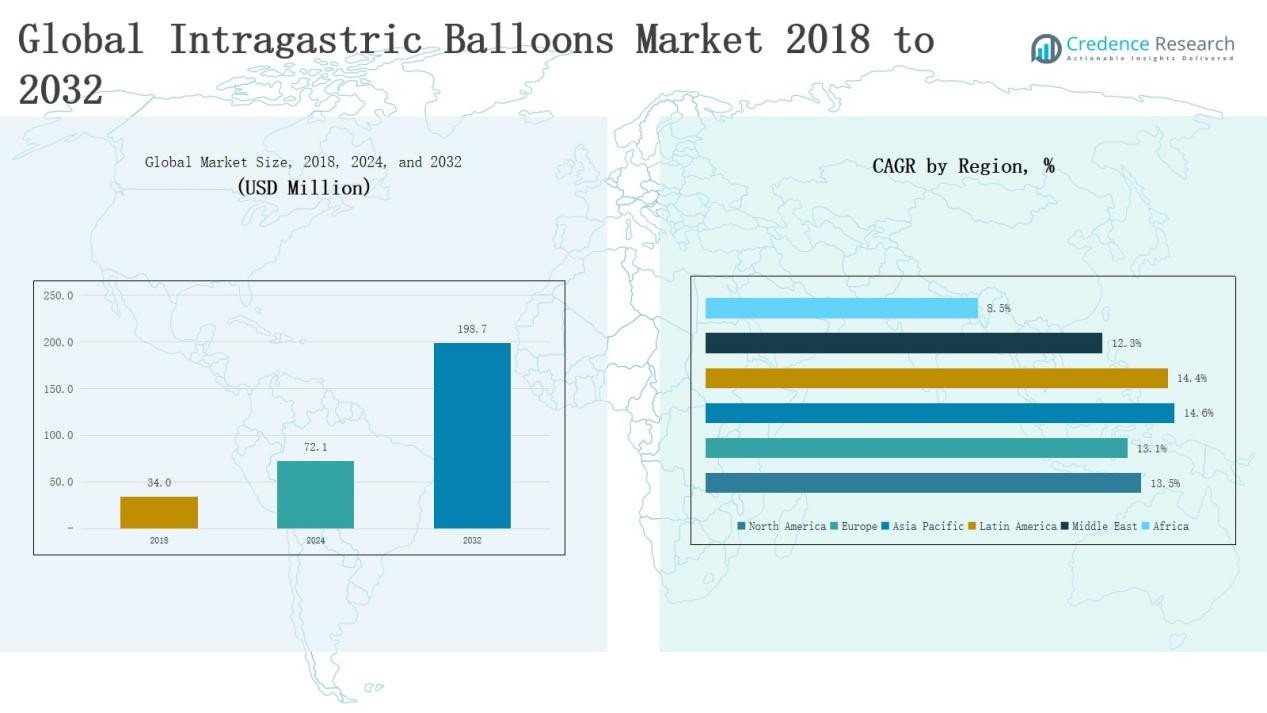
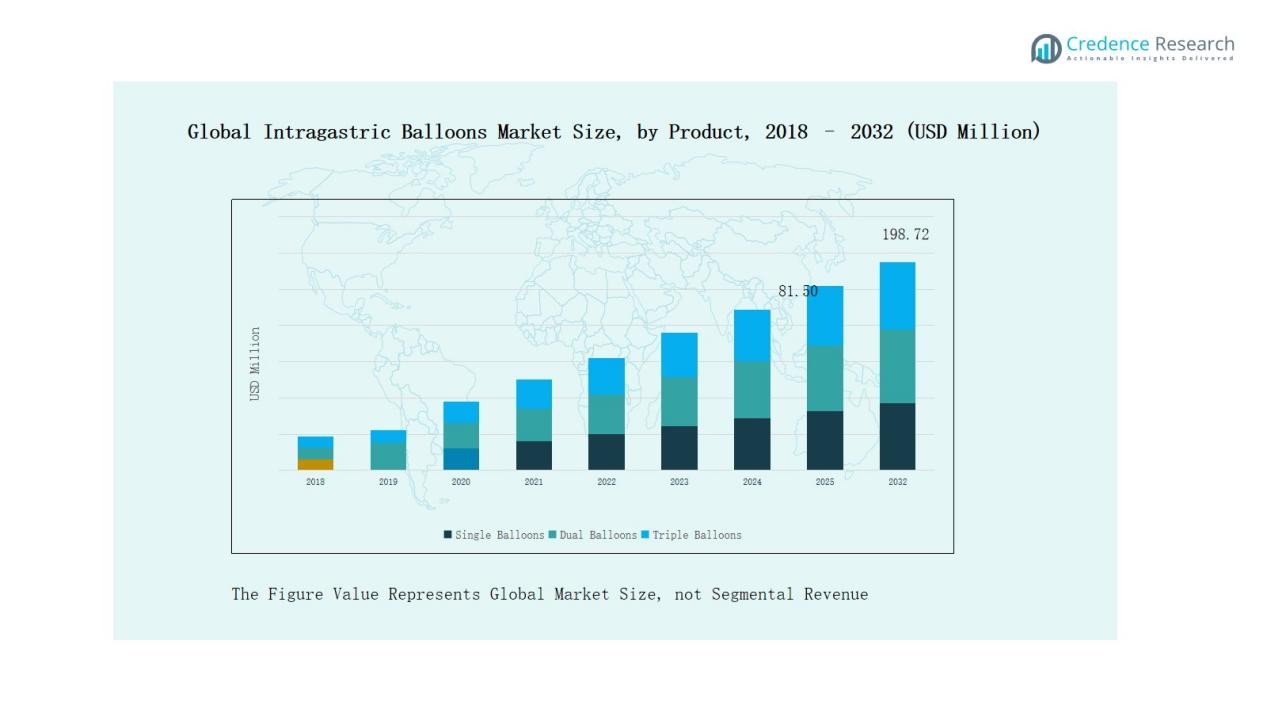
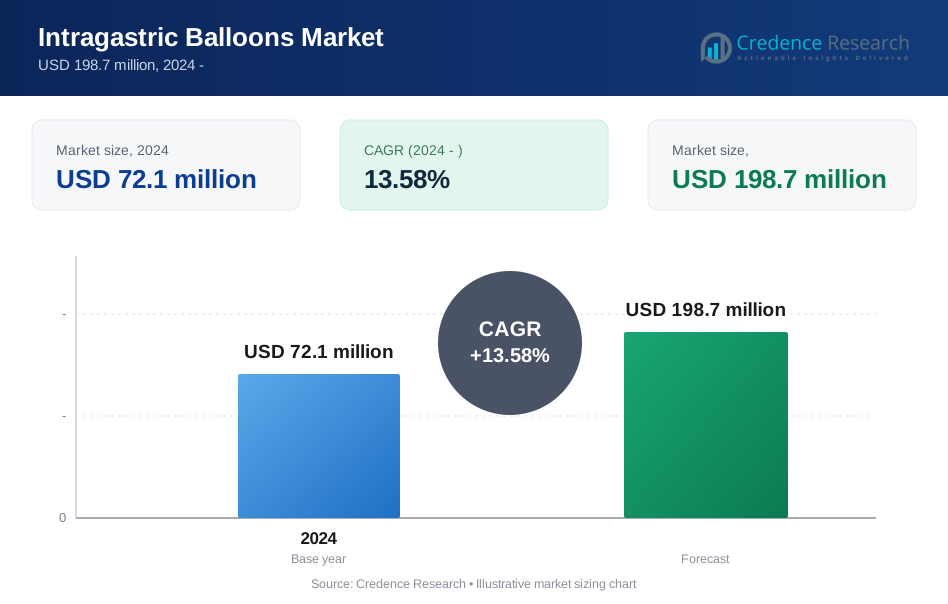
Global Intragastric Balloons Market size was valued at USD 34.0 million in 2018 to USD 72.1 million in 2024 and is anticipated to reach USD 198.7 million by 2032, at a CAGR of 13.58% during the forecast period.
| REPORT ATTRIBUTE | DETAILS |
|---|---|
| Historical Period | 2020-2023 |
| Base Year | 2024 |
| Forecast Period | 2025-2032 |
| Intragastric Balloons Market Size 2024 | USD 72.1 Million |
| Intragastric Balloons Market, CAGR | 13.58% |
| Intragastric Balloons Market Size 2032 | USD 198.7 Million |
The Global Intragastric Balloons Market is shaped by leading players such as Allurion, Boston Scientific Corporation, Medicone, ReShape Lifesciences, Helioscopie, MEDSIL, and Lexel Medical, alongside several regional participants. These companies compete through innovation in capsule-based technologies, product safety enhancements, and strategic collaborations with healthcare providers to expand adoption. Allurion and ReShape Lifesciences emphasize swallowable balloon systems to strengthen patient compliance, while Boston Scientific leverages its diversified portfolio and global network. European players like Helioscopie and MEDSIL focus on region-specific innovation, while emerging firms improve local supply chains. Regionally, North America dominated the market in 2024 with a 36.3% share, supported by high obesity prevalence, advanced healthcare infrastructure, and strong procedural adoption across hospitals and clinics.
Market Insights
- The Global Intragastric Balloons Market grew from USD 34.0 million in 2018 to USD 72.1 million in 2024 and is projected to reach USD 198.7 million by 2032.
- Saline-filled balloons led the filled material segment with 68% share in 2024, while gas-filled options gained traction due to lighter weight and improved patient comfort.
- Single-balloon systems dominated the product segment with 57% share in 2024, whereas dual and triple-balloon systems advanced through higher efficacy and reduced migration risk.
- Endoscopy-based procedures held 72% market share in 2024, while pill-form capsules accounted for 28% and are expanding rapidly due to non-invasive benefits.
- North America led the regional market with 36.3% share in 2024, followed by Europe at 33% and Asia Pacific at 23.5%, reflecting strong global adoption patterns.
Market Segment Insights
By Filled Material
Saline-filled intragastric balloons dominate the market with nearly 68% share in 2024. Their leadership is supported by established safety profiles, wide clinical acceptance, and relatively lower costs compared to gas-filled options. Gas-filled balloons, while lighter and offering greater patient comfort, account for the remaining share and are gaining traction due to improved tolerance rates and reduced post-procedure discomfort.
- For instance, Allurion Technologies reported that more than 150,000 patients worldwide had been treated with its swallowable, gas-filled intragastric balloon system, highlighting growing preference for non-invasive options.
By Product
Single-balloon systems lead the segment with around 57% market share in 2024, driven by ease of insertion, lower procedure complexity, and broad physician adoption. Dual and triple-balloon systems, together holding about 43%, are increasingly utilized in cases requiring higher volume restriction and better weight loss outcomes. Their adoption is growing as clinical studies highlight enhanced efficacy and reduced balloon migration risk.
- For instance, Spatz Medical received expanded CE Mark approval for its Spatz3 Adjustable Balloon System, allowing longer implantation duration and improved patient-adjustability for enhanced weight loss performance.
By Administration
Endoscopy-based administration holds a strong 72% share in 2024, reflecting its long-standing use, reliability, and physician preference for controlled placement and removal. Pill form administration, accounting for about 28%, is witnessing rapid adoption due to its non-invasive approach, reduced procedural costs, and higher patient convenience. Its growth is expected to accelerate as capsule-based technologies continue to gain regulatory approvals and wider clinical trust.
Key Growth Drivers
Rising Obesity Prevalence
The increasing global prevalence of obesity and overweight conditions is a primary driver for the intragastric balloons market. Rising sedentary lifestyles, poor dietary habits, and urbanization have amplified obesity-related health issues, such as diabetes and cardiovascular diseases. Intragastric balloons are gaining preference as a minimally invasive weight-loss intervention compared to bariatric surgery. Healthcare providers are recommending these devices for patients not eligible for invasive procedures, further fueling adoption. This rising demand is directly translating into higher procedure volumes worldwide.
- For instance, Orbera intragastric balloon showed an average weight loss of 12.9 kg within the first three months of therapy, highlighting early effectiveness.
Minimally Invasive Preference
Growing patient preference for minimally invasive treatments is propelling the adoption of intragastric balloons. Compared to surgical interventions, these balloons offer reduced risk, quicker recovery, and improved patient compliance. The increasing burden of healthcare costs has also encouraged payers and hospitals to promote less invasive solutions. The shorter procedure time and outpatient nature of balloon placement add further value for both patients and providers. As awareness spreads, this trend is accelerating adoption in both developed and emerging markets.
- For instance, Allurion Technologies announced that over 100,000 of its swallowable intragastric balloons had been placed worldwide, highlighting increasing global adoption of non-surgical weight-loss solutions.
Expanding Clinical Evidence
Clinical studies supporting the safety and efficacy of intragastric balloons are strengthening market acceptance. Evidence showing significant short-term weight reduction and improved metabolic parameters has influenced physician recommendations. The availability of published data highlighting reduced comorbidities, such as hypertension and type 2 diabetes, is enhancing trust among patients and healthcare systems. These outcomes are also driving greater regulatory support, reimbursement consideration, and expansion of product approvals across multiple regions, creating a strong foundation for future market growth.
Key Trends & Opportunities
Capsule-Based Balloons
The emergence of swallowable, pill-form balloons is a key trend transforming the market. These capsules allow non-endoscopic placement, reducing procedure costs and patient discomfort. Their non-invasive nature is appealing to patients hesitant about traditional endoscopy-based solutions. With regulatory approvals expanding in multiple regions, capsule-based systems are creating strong growth opportunities. Manufacturers focusing on enhancing safety and retrievability of such devices are likely to capture significant market share in the coming years.
- For instance, Allurion Technologies announced that more than 100,000 of its swallowable intragastric balloons had been placed globally, highlighting increasing adoption as a non-invasive weight-loss alternative.
Expanding Emerging Markets
Developing economies represent untapped opportunities due to rising obesity rates and growing healthcare spending. Countries across Asia Pacific, Latin America, and the Middle East are witnessing increasing demand for affordable and less invasive weight management solutions. Healthcare reforms, expanding insurance coverage, and the entry of global players are accelerating accessibility. Local distribution partnerships and awareness programs are helping penetrate these regions, positioning them as lucrative markets. This trend is expected to drive future revenue diversification for key players.
- For instance, Novo Nordisk launched its weight-loss drug Wegovy in June 2025. The company priced it between ₹17,345 and ₹26,015 depending on dose, aiming for affordability.
Key Challenges
Limited Long-Term Efficacy
One of the major challenges is the limited long-term efficacy of intragastric balloons. While effective for short-term weight loss, many patients experience weight regain after balloon removal. This limitation reduces confidence among both patients and healthcare providers. Sustained lifestyle modifications are required to maintain outcomes, which can be difficult to achieve. Addressing this challenge demands greater integration of behavioral therapy and follow-up programs to improve long-term patient success rates.
Adverse Effects and Tolerability Issues
Complications such as nausea, vomiting, abdominal pain, and balloon intolerance remain barriers to widespread adoption. Although generally safe, these side effects often lead to premature balloon removal, impacting patient satisfaction and overall market credibility. Efforts to improve balloon design, use lighter materials, and enhance placement techniques are ongoing. However, unless tolerability issues are significantly reduced, adoption rates may face limitations in both new and existing patient groups.
Reimbursement Limitations
Reimbursement challenges continue to hinder broader market penetration. In many countries, intragastric balloon procedures are classified as elective or cosmetic, restricting insurance coverage. Out-of-pocket expenses limit accessibility for patients, particularly in price-sensitive markets. The lack of uniform reimbursement policies also discourages hospitals and clinics from investing heavily in these procedures. Market growth depends on securing stronger payer support and generating cost-effectiveness data to justify insurance inclusion across key healthcare systems.
Regional Analysis
North America
North America generated USD 11.61 million in 2018, rising to USD 24.53 million in 2024, with an expected USD 67.37 million by 2032. The region held 36.3% share in 2024 and is projected to sustain leadership with a CAGR of 13.5%. Growth is driven by high obesity rates, advanced healthcare facilities, and strong adoption of minimally invasive weight-loss procedures. The U.S. dominates regional demand, while Canada and Mexico contribute with growing awareness programs and accessibility to innovative balloon technologies.
Europe
Europe recorded USD 10.81 million in 2018, increasing to USD 22.36 million in 2024, and is forecasted at USD 59.62 million by 2032. With 33.0% share in 2024, Europe ranks as the second-largest market, growing at a CAGR of 13.1%. Key contributors include Germany, the UK, France, and Italy, where bariatric programs and clinical adoption are well-established. Supportive reimbursement policies and ongoing product approvals for balloon systems enhance regional acceptance, further consolidating Europe’s strong position.
Asia Pacific
Asia Pacific was valued at USD 7.11 million in 2018, expanding to USD 15.92 million in 2024, and projected to reach USD 47.04 million by 2032. The region captured 23.5% share in 2024, advancing at the fastest CAGR of 14.6%. Rising obesity prevalence, rapid lifestyle changes, and improved healthcare access are fueling adoption. China, Japan, and India lead market growth, while Southeast Asia is witnessing increased penetration through cost-effective solutions and expanding distributor networks.
Latin America
Latin America generated USD 2.54 million in 2018, growing to USD 5.61 million in 2024, and forecasted at USD 16.31 million by 2032. Holding 8.3% share in 2024, the region is expanding at a CAGR of 14.4%. Brazil is the largest contributor, with Argentina and other nations gradually adopting minimally invasive treatments. Market expansion is supported by obesity prevalence, affordability programs, and partnerships between global players and local distributors.
Middle East
The Middle East accounted for USD 1.10 million in 2018, rising to USD 2.19 million in 2024, and expected to reach USD 5.52 million by 2032. It held 3.3% share in 2024 with a CAGR of 12.3%. Demand is primarily concentrated in GCC countries, driven by high obesity prevalence, supportive healthcare investments, and premium treatment adoption. Israel and Turkey also contribute significantly due to advanced medical infrastructure and increasing uptake of minimally invasive solutions.
Africa
Africa registered USD 0.86 million in 2018, increasing to USD 1.49 million in 2024, and projected at USD 2.86 million by 2032. With the smallest 2.2% share in 2024, the region grows at the lowest CAGR of 8.5%. Limited healthcare infrastructure, low awareness, and affordability barriers constrain adoption. However, South Africa and Egypt are emerging hubs due to obesity growth trends and gradual infrastructure improvements, while international players are eyeing Africa as a long-term expansion opportunity.
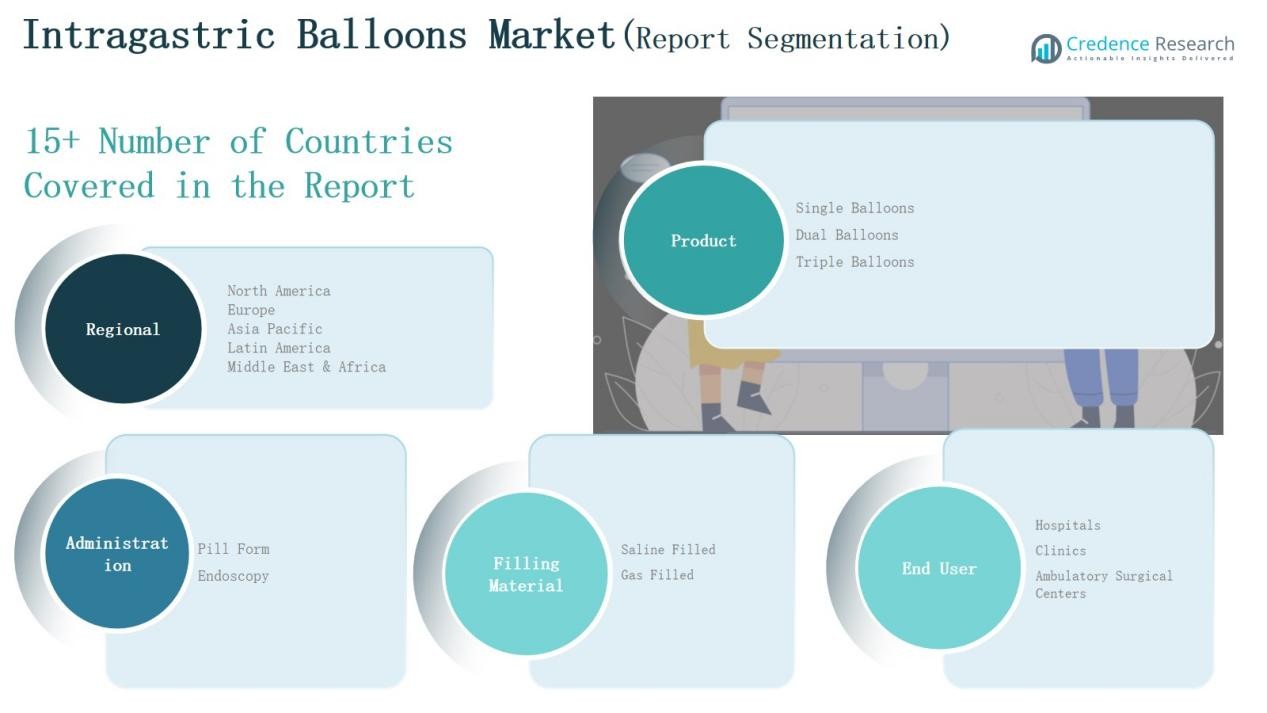
Market Segmentations:
By Filled Material
- Saline Filled
- Gas Filled
By Product
- Single Balloons
- Dual Balloons
- Triple Balloons
By Administration
- Pill Form
- Endoscopy
By End User
- Hospitals
- Clinics
- Ambulatory Surgical Centers
By Region
- North America
- U.S.
- Canada
- Mexico
- Europe
- Germany
- France
- U.K.
- Italy
- Spain
- Rest of Europe
- Asia Pacific
- China
- Japan
- India
- South Korea
- South-east Asia
- Rest of Asia Pacific
- Latin America
- Brazil
- Argentina
- Rest of Latin America
- Middle East & Africa
- GCC Countries
- South Africa
- Rest of the Middle East and Africa
Competitive Landscape
The Global Intragastric Balloons Market is characterized by moderate concentration, with a mix of established multinational corporations and specialized medical device manufacturers. Key players include Allurion, Boston Scientific Corporation, Medicone, ReShape Lifesciences, Helioscopie, MEDSIL, and Lexel Medical, alongside several regional participants. These companies compete on product innovation, safety profiles, pricing strategies, and distribution networks. Allurion and ReShape Lifesciences emphasize capsule-based and advanced balloon designs to enhance patient tolerability and expand adoption. Boston Scientific leverages its strong global presence and diversified product portfolio to maintain market reach. European players like Helioscopie and MEDSIL focus on innovation tailored to regional regulatory requirements, while emerging firms strengthen local supply chains. Strategic collaborations, clinical trial investments, and geographic expansion remain central to sustaining competitiveness. The market is also witnessing increased product launches, regulatory approvals, and partnerships with healthcare providers, positioning leading firms to capture growing demand for minimally invasive weight-loss solutions worldwide.
Key Players
- Allurion
- Boston Scientific Corporation
- Medicone
- ReShape Lifesciences
- Helioscopie
- MEDSIL
- Lexel Medical
- Other Key Players
Recent Developments
- In April 2025, RadNet, Inc. began the acquisition process of iCAD, Inc., a global leader in AI-powered breast health solutions, aiming to accelerate AI-driven early detection and diagnosis of breast cancer, with integration expected by Q3 2025.
- In March 2025, iCAD partnered with RamSoft to integrate the ProFound AI® Breast Health Suite into RamSoft’s RIS/PACS platforms across North America.
- In January 2025, Dolbey and Ikonopedia formed a strategic partnership to offer a hands-free mammography reporting solution with speech recognition and structured reporting.
- In April 2025, SimonMed Imaging collaborated with Lunit and Volpara Analytics to deploy Lunit INSIGHT DBT and Volpara tools for AI-powered breast cancer detection.
Report Coverage
The research report offers an in-depth analysis based on Filled Material, Product, Administration, End User and Region. It details leading market players, providing an overview of their business, product offerings, investments, revenue streams, and key applications. Additionally, the report includes insights into the competitive environment, SWOT analysis, current market trends, as well as the primary drivers and constraints. Furthermore, it discusses various factors that have driven market expansion in recent years. The report also explores market dynamics, regulatory scenarios, and technological advancements that are shaping the industry. It assesses the impact of external factors and global economic changes on market growth. Lastly, it provides strategic recommendations for new entrants and established companies to navigate the complexities of the market.
Future Outlook
- Adoption of capsule-based intragastric balloons will expand due to non-invasive placement.
- Rising obesity prevalence worldwide will continue to drive demand for weight-loss interventions.
- Hospitals and clinics will strengthen adoption with supportive patient management programs.
- Technological advancements will improve balloon durability, comfort, and safety.
- Strategic collaborations between manufacturers and healthcare providers will widen market reach.
- Emerging markets in Asia Pacific and Latin America will witness faster adoption.
- Growing clinical evidence will enhance physician trust and patient acceptance.
- Companies will focus on affordability to penetrate price-sensitive regions.
- Regulatory approvals for innovative products will accelerate global commercialization.
- Integration of digital health monitoring with balloon therapies will improve patient outcomes.
Request a Free Sample
Fill in your details and we'll send you a free sample report.
- Sample data tables & charts
- Research methodology
Need a Custom Version of This Report?
Tailor the scope, geography, or segments to your exact requirements.
- Custom geography or segment scope
- Direct access to our analyst team
Frequently Asked Questions
What is the current market size for Global Intragastric Balloons Market, and what is its projected size in 2032?
At what Compound Annual Growth Rate is the Global Intragastric Balloons Market projected to grow between 2025 and 2032?
Which Global Intragastric Balloons Market segment held the largest share in 2024?
What are the primary factors fueling the growth of the Global Intragastric Balloons Market?
Who are the leading companies in the Global Intragastric Balloons Market?
Which region commanded the largest share of the Global Intragastric Balloons Market in 2024?
Table of Content
Chapter 1. Report Introduction
- 1.1 Report Description & Purpose
- 1.1.1 Report Title & Market Definition
- 1.1.2 Unique Selling Propositions (USP) & Key Differentiators
- 1.1.3 Value Proposition for Stakeholders
- 1.2 Research Objectives
- 1.2.1 Market Sizing Objectives (Volume & Revenue)
- 1.2.2 Segmentation Objectives
- 1.2.3 Competitive Intelligence Objectives
- 1.2.4 Forecast & Scenario Objectives
- 1.3 Report Scope
- 1.3.1 Intragastric Balloons Scope – Types & Subtypes Covered
- 1.3.2 Geographic Scope – Regions & Countries Covered
- 1.3.3 Historical Period, Base Year & Forecast Period (2024; forecast to the forecast period)
- 1.3.4 Inclusions & Exclusions
- 1.4 HS Code & Classification Framework
- 1.5 Currency, Units & Pricing Basis
- 1.6 Target Stakeholders
- 1.7 Limitations & Assumptions
Chapter 2. Executive Summary
- 2.1 Global Intragastric Balloons Market Snapshot
- 2.1.1 Market Size – Historical (2024) & Forecast (the forecast period) (2024: USD 72.1 million → forecast year: USD 198.7 million)
- 2.1.2 Volume & Revenue – Global Totals
- 2.1.3 Key Market Highlights – Top Five Facts
- 2.2 Intragastric Balloons Market Segmentation Snapshot
- 2.2.1 Market Split by Region – 2024 vs.
- 2.3 Competitive Snapshot
- 2.3.1 Top 10 Players by Revenue Share – 2024
- 2.3.2 Top 10 Players by Volume Share – 2024
- 2.3.3 Recent Strategic Developments (18-Month Summary)
- 2.4 Key Investment Highlights & Strategic Conclusions
Chapter 3. Intragastric Balloons Market Dynamics & Industry Analysis
- 3.1 Market Overview & Context
- 3.1.1 Intragastric Balloons Market Position in the Broader Automotive Value Chain
- 3.1.2 OEM vs. Replacement Market Dynamics
- 3.1.3 Market Maturity & Development Stage by Region
- 3.2 Intragastric Balloons Market Drivers
- 3.3 Intragastric Balloons Market Restraints & Challenges
- 3.4 Intragastric Balloons Market Opportunities
- 3.5 Porter's Five Forces Analysis
- 3.5.1 Threat of New Entrants
- 3.5.2 Bargaining Power of Suppliers
- 3.5.3 Bargaining Power of Buyers
- 3.5.4 Threat of Substitutes
- 3.5.5 Competitive Rivalry – Intensity Assessment
- 3.6 Intragastric Balloons Value Chain Analysis
- 3.6.1 Upstream – Raw Material/Input Suppliers
- 3.6.1.1 Raw Material/Input 1
- 3.6.1.2 Raw Material/Input 2
- 3.6.1.3 Raw Material/Input 3
- 3.6.2 Midstream – Production/Manufacturing/Service Delivery
- 3.6.2.1 Production/Process Overview
- 3.6.2.2 Key Facility Locations & Capacity by Manufacturer
- 3.6.3 Downstream – Distribution & End Consumer
- 3.6.3.1 Primary Channel – B2B/OEM
- 3.6.3.2 Secondary Channels – Dealer, Retail, Online, Direct
- 3.6.4 Value Chain Profitability Analysis
- 3.6.1 Upstream – Raw Material/Input Suppliers
- 3.7 PESTEL Analysis
- 3.7.1 Political Factors
- 3.7.2 Economic Factors
- 3.7.3 Social Factors
- 3.7.4 Technological Factors
- 3.7.5 Environmental Factors
- 3.7.6 Legal Factors
- 3.8 Intragastric Balloons Supply Chain Analysis
- 3.8.1 Raw Material/Input Supply Risk Assessment
- 3.8.2 Manufacturing Concentration Risk (Geographic Exposure)
- 3.8.3 Trade Disruption Impact Analysis
- 3.9 Regulatory & Policy Landscape
Note: The regulatory and policy landscape section covers regulations based on their applicability to the market, Intragastric Balloons category, geography, and scope of the study. Only regulatory frameworks with a material impact on operations, compliance, trade, sustainability, or market access are analyzed in detail.
Chapter 4. Key Investment Pockets & Opportunity Analysis
- 4.1 Intragastric Balloons Market Attractiveness Analysis
- 4.1.1 By Region – Investment Attractiveness Matrix (Volume × CAGR)
- 4.2 Absolute Revenue Growth Opportunity
- 4.2.1 By Region – Absolute USD Growth Through the forecast period
- 4.3 Incremental Volume Opportunity
- 4.3.1 By Region – Incremental Volume Through the forecast period
- 4.3.2 Segment – Incremental Volume
- 4.4 Emerging Submarket Opportunity Deep Dive (Subject to Applicability)
- 4.5 Emerging Market Opportunity Scorecards
- 4.5.1 United States
- 4.5.2 Europe
- 4.5.3 Asia
- 4.5.4 Middle East & Africa
Note: Emerging Market Opportunity Scorecards will be included based on relevance and strategic importance. Regions listed are indicative and may vary depending on data availability and market dynamics.
Chapter 5. Intragastric Balloons Import-Export Analysis & Trade Flows
- 5.1 Global Trade Overview
- 5.1.1 Global Export Value by Country (2024)
- 5.1.2 Global Export Volume by Country (2024)
- 5.1.3 Global Import Value by Country (2024)
- 5.1.4 Global Import Volume by Country (2024)
- 5.1.5 Net Trade Balance by Country (2024)
- 5.2 Export Analysis – Segment
- 5.2.1 Type 1 (HS Code)
- 5.2.2 Type 2 (HS Code)
- 5.2.3 Type 3 (HS Code)
- 5.2.4 Type 4 (HS Code)
- 5.2.5 Type 5 (HS Code)
- 5.3 Import Analysis – Segment
- 5.3.1 Type 1 (HS Code)
- 5.3.2 Type 2 (HS Code)
- 5.3.3 Type 3 (HS Code)
- 5.3.4 Type 4 (HS Code)
- 5.3.5 Type 5 (HS Code)
- 5.4 Average Unit Trade Prices
- 5.4.1 Average Export Price – Segment & Country
- 5.4.2 Average Import Price – Segment & Source Country
- 5.4.3 Price Trends (2024)
- 5.5 Key Trade Route Analysis
- 5.5.1 Trade Route 1
- 5.5.2 Trade Route 2
- 5.5.3 Trade Route 3
- 5.5.4 Trade Route 4
- 5.5.5 Trade Route 5
- 5.6 Trade Policy Impact Assessment
- 5.6.1 US Anti-Dumping & Section 301 Tariffs
- 5.6.2 EU Customs Union Impact
- 5.6.3 Major Free Trade Agreements
- 5.6.4 USMCA Rules of Origin
Note: Trade policy analysis will be included only where relevant to the Intragastric Balloons market.
Chapter 6. Competitive Landscape & Company Benchmarking
- 6.1 Intragastric Balloons Market Concentration & Structure
- 6.1.1 Herfindahl-Hirschman Index (HHI) – vs. 2024
- 6.1.2 Tier 1, Tier 2 & Tier 3 Market Structure
- 6.1.3 Global, Regional & Local Player Dynamics
- 6.2 Intragastric Balloons Market Share Analysis – 2024
- 6.2.1 Global Revenue Share by Company
- 6.2.2 Global Volume Share by Company
- 6.2.3 Regional Revenue Share
- 6.2.4 Market Share Evolution ( vs. 2024)
- 6.2.5 OEM Segment Share by Company
- 6.2.6 Replacement Segment Share by Company
- 6.3 Production/Delivery Capacity & Facility Analysis
- 6.3.1 Global Installed Capacity
- 6.3.2 Capacity Utilization Rates
- 6.3.3 Production/Output Volume
- 6.3.4 Facility Locations & Capacity Map
- 6.3.5 Planned Capacity Additions
- 6.4 Intragastric Balloons Competitive Benchmarking Matrix
- 6.4.1 Revenue, Volume, CAGR & Profitability Comparison
- 6.4.2 Channel Revenue Mix
- 6.4.3 Geographic Revenue Exposure
- 6.4.4 R&D Intensity
- 6.4.5 Sustainability Maturity
- 6.5 Strategic Developments in Intragastric Balloons (Last 24 Months)
- 6.5.1 Mergers, Acquisitions & Divestments
- 6.5.2 New Intragastric Balloons Launches
- 6.5.3 Facility Expansions
- 6.5.4 Strategic Alliances, Joint Ventures & Partnerships
- 6.5.5 Distribution Expansion & Market Entry
- 6.5.6 Sustainability & ESG Initiatives
- 6.6 Competitive Strategy Mapping
- 6.6.1 Leader, Challenger, Follower & Niche Classification
- 6.6.2 Pricing Strategy Comparison
- 6.6.3 Channel Strategy Matrix
Note: Strategic developments are included based on their materiality and the availability of reliable information.
Chapter 7. Global Intragastric Balloons Market – By Distribution Channel
- 7.1 Segment Overview
- 7.1.1 Volume & Revenue Split by Channel (2024 & )
- 7.1.2 Channel Mix Evolution (the forecast period)
Chapter 8. Regional Market Analysis – Global Overview
- 8.1 Global Regional Overview
- 8.1.1 Regional Volume Share
- 8.1.2 Regional Revenue Share
- 8.1.3 Regional Volume by Region
- 8.1.4 Regional Revenue by Region
- 8.1.5 Regional Forecast Through the forecast period
- 8.2 Cross-Regional Segment Analysis
- 8.2.1 By Distribution Channel
- 8.2.2 By Brand/Price Tier
Chapter 9. North America Intragastric Balloons Market
- 9.1 United States
- 9.2 Canada
- 9.3 Mexico
Chapter 10. Europe Intragastric Balloons Market
- 10.1 Germany
- 10.2 France
- 10.3 Italy
- 10.4 United Kingdom
- 10.5 Spain
- 10.6 Poland
- 10.7 Russia
- 10.8 Netherlands
- 10.9 Belgium
- 10.10 Sweden
- 10.11 Denmark
- 10.12 Norway
- 10.13 Rest of Europe
Chapter 11. Asia Pacific Intragastric Balloons Market
- 11.1 China
- 11.2 India
- 11.3 Japan
- 11.4 South Korea
- 11.5 Thailand
- 11.6 Indonesia
- 11.7 Vietnam
- 11.8 Malaysia
- 11.9 Australia
- 11.10 Rest of Asia Pacific
Chapter 12. Latin America Intragastric Balloons Market
- 12.1 Brazil
- 12.2 Argentina
- 12.3 Colombia
- 12.4 Chile
- 12.5 Rest of Latin America
Chapter 13. Middle East Intragastric Balloons Market
- 13.1 Saudi Arabia
- 13.2 United Arab Emirates
- 13.3 Turkey
- 13.4 Israel
- 13.5 Iran
- 13.6 Rest of the Middle East
Chapter 14. Africa Intragastric Balloons Market
- 14.1 South Africa
- 14.2 Egypt
- 14.3 Nigeria
- 14.4 Morocco
- 14.5 Rest of Africa
Chapter 15. Intragastric Balloons Company Profiles
- 15.1 [Company 01]
- 15.1.1 Company Overview
- 15.1.2 Key Management Personnel
- 15.1.3 Products & Services Portfolio
- 15.1.4 Financial Performance
- 15.1.5 Key Market Focus & Geographic Presence
- 15.1.6 Recent Developments & Strategic Initiatives
Note: The company profile list is preliminary and may change based on research findings, market developments, data availability, and client requirements.
Chapter 16. Appendices
- Appendix A – List of Abbreviations & Acronyms
- Appendix B – Industry Classification Code Reference – Full Series
- Appendix C – Production & Capacity Data Tables
- Appendix D – End-Use & Demand Base Tables
- Appendix E – Consumption & Replacement Rate Assumptions
- Appendix F – ASP Reference Tables
- Appendix G – Manufacturing & Facility Database
- Appendix H – Import-Export Data Tables
- Appendix I – Regulatory Summary Tables
- Appendix J – Primary Research Participant List (Anonymized)
- Appendix K – Primary Research Questionnaire Framework
- Appendix L – Data Sources & Bibliography
- Appendix M – Market Size Divergence & Source Comparison
Chapter 17. Research Methodology
- 17.1 Research Framework & Philosophy
- 17.2 Secondary Research – Sources, Hierarchy & Data Extraction
- 17.3 Data Modeling – Bottom-Up & Top-Down Market Sizing
- 17.4 Primary Research – Stakeholder Framework, LOI & Sample Sizes
- 17.5 Forecast Methodology – Regression, Scenario & Sensitivity Analysis
- 17.6 Quality Control – Four-Layer Validation Framework
- 17.7 Limitations & Standard Assumptions
- 17.8 Disclaimer
