| REPORT ATTRIBUTE | DETAILS |
|---|---|
| Historical Period | 2020-2023 |
| Base Year | 2024 |
| Forecast Period | 2025-2032 |
| Italy Industrial Fasteners Market Size 2024 | USD 2702.58 million |
| Italy Industrial Fasteners Market, CAGR | 4.81% |
| Italy Industrial Fasteners Market Size 2032 | USD 3934.96 million |
Market Overview:
The Italy Industrial Fasteners Market is projected to grow from USD 2702.58 million in 2024 to an estimated USD 3934.96 million by 2032, with a compound annual growth rate (CAGR) of 4.81% from 2024 to 2032.
Italy's industrial fasteners market is primarily driven by the strong demand from key sectors such as automotive, construction, and machinery manufacturing. The country's automotive sector, known for iconic brands like Fiat and Ferrari, relies heavily on high-quality, durable fasteners to meet the strict safety and performance standards required for modern vehicles. Additionally, Italy's ongoing infrastructure development and construction projects fuel the need for reliable fastening solutions to ensure the structural integrity of buildings and infrastructure. Moreover, Italy’s robust machinery manufacturing base, particularly in areas like packaging, textiles, and industrial automation, further propels the demand for precision-engineered fasteners to support operational efficiency and product quality. Technological advancements in automation and Industry 4.0 also play a significant role, with innovations in fastener designs, materials, and production methods improving both performance and cost-efficiency.
Italy, strategically located in Southern Europe, holds a critical position in the regional industrial fasteners market. It is a significant player in the European market, accounting for 1.6% of the global industrial fasteners market revenue in 2024. Italy's industrial fasteners market is well-integrated into the European supply chain, with a substantial portion of its exports directed to other European countries, followed by the Americas and Asia. The country benefits from its established manufacturing capabilities and strong export network, which continues to drive its market share. Moreover, Italy’s adherence to European Union standards and regulations ensures the production of high-quality, compliant fasteners that meet stringent safety requirements, supporting both domestic consumption and international trade within the EU and other global markets. This integration into the broader European and global markets positions Italy as a key contributor to the industrial fasteners industry.
Market Insights:
- The Italy Industrial Fasteners Market is projected to grow from USD 2.7 billion in 2024 to USD 3.9 billion by 2032, with a CAGR of 4.81%, driven by demand from the automotive, construction, and machinery sectors.
- The Global Industrial Fasteners Market is projected to grow from USD 98,826 million in 2024 to USD 158,987.23 million by 2032, registering a robust CAGR of 6.12%.
- The automotive industry, including brands like Fiat and Ferrari, is a key driver, with increasing demand for lightweight and corrosion-resistant fasteners due to the shift toward electric vehicles (EVs) and lightweight materials.
- Ongoing infrastructure and construction projects, including residential, commercial, and transportation development, are boosting the need for reliable fastening solutions to ensure structural integrity.
- Technological advancements in materials, designs, and manufacturing techniques, such as 3D printing and automation, are improving fastener performance and cost-efficiency while supporting Industry 4.0.
- Rising raw material costs, particularly for steel, aluminum, and titanium, are putting pressure on fastener manufacturers and impacting pricing and profitability.
- Italy's fasteners market is strongly integrated into the European supply chain, with over 56% of exports directed to other European countries, and significant exports to the Americas and Asia.
- Northern Italy, especially Lombardy and Emilia-Romagna, is a major manufacturing hub, while demand in Central and Southern Italy is growing due to increasing infrastructure projects.
Market Drivers:
Automotive Industry Demand
The automotive sector is one of the primary drivers of the Italy industrial fasteners market. Italy is home to prominent automotive manufacturers, such as Fiat, Ferrari, and Lamborghini, which require high-quality fasteners to meet the stringent safety and performance standards of the industry. The shift toward lightweight materials and the growing trend of electric vehicles (EVs) in Italy further escalate the need for specialized fasteners. These fasteners not only ensure the structural integrity and safety of vehicles but also contribute to improving fuel efficiency and reducing emissions. As the automotive industry continues to innovate and embrace new technologies, the demand for advanced fastening solutions, such as corrosion-resistant and lightweight materials, will continue to rise.
Construction and Infrastructure Development
The demand for industrial fasteners in Italy is also driven by the country’s ongoing construction and infrastructure development projects. As Italy invests in both residential and commercial real estate, along with major infrastructure undertakings such as transportation and energy, the need for durable and reliable fastening systems becomes critical. AB Steel, for example, offers fasteners in grades 4.6, 8.8, 10.9, and 12.9, with bolts ranging from M6 to M64 and nuts from M6 to M100, ensuring excellent load-bearing capacity and reliability for construction and infrastructure projects. Fasteners play an essential role in securing structural components, ensuring that buildings, bridges, roads, and other infrastructure projects maintain their integrity and safety over time. The growing focus on sustainability in construction and the increasing use of green building materials further enhances the demand for advanced fastening solutions that can withstand environmental pressures.
Machinery Manufacturing Sector
Italy has a well-established machinery manufacturing sector, which contributes significantly to the industrial fasteners market. Industries such as packaging, textiles, and industrial automation heavily rely on fasteners to ensure the operational efficiency of their machinery. For instance, companies like TR Italy, S.p.A. specialize in male threaded cold-forged products tailored to customer specifications, serving global brands across machinery, energy, and infrastructure sectors. As Italy continues to maintain a strong position in global machinery production, there is a steady demand for high-precision fasteners that meet the rigorous requirements of these industries. Furthermore, the continued integration of automation and smart manufacturing practices within the machinery sector is likely to drive demand for innovative fasteners that support higher levels of precision, reliability, and performance.
Technological Advancements in Fastening Solutions
Technological advancements in fastening solutions are another key driver for the growth of Italy's industrial fasteners market. The ongoing development of new materials, such as high-strength alloys, composite materials, and corrosion-resistant coatings, is enhancing the performance and longevity of fasteners. Additionally, the incorporation of advanced manufacturing techniques, such as 3D printing and automated assembly lines, has led to improvements in the production of fasteners, reducing costs and increasing efficiency. These innovations are enabling industries to meet higher standards of safety, durability, and sustainability while offering greater versatility in applications. As Italy continues to embrace Industry 4.0 technologies, the demand for technologically advanced fasteners will increase, further driving market growth.
Market Trends:
Technological Advancements in Fastener Materials
The Italy industrial fasteners market is witnessing a significant shift towards advanced materials aimed at enhancing performance and durability. While metal fasteners have traditionally dominated the market, plastic fasteners are emerging as a lucrative segment, registering the fastest growth during the forecast period. For instance, Bontempi Vibo S.p.A. produces over 25,000 tonnes of screws annually, offering a wide range of carbon and stainless steel fasteners in various classes and diameters, including tailored solutions for automotive and industrial applications. This trend is driven by the demand for lightweight, corrosion-resistant, and cost-effective fastening solutions across various applications. Plastic fasteners offer advantages such as reduced weight, resistance to environmental factors, and compatibility with modern manufacturing processes, making them increasingly popular in industries like automotive and electronics. The adoption of plastic fasteners reflects the industry's response to evolving material requirements and the pursuit of sustainable manufacturing practices.
Customization and Precision Engineering
There is a growing emphasis on customization and precision engineering in the production of industrial fasteners in Italy. Manufacturers are increasingly offering tailored solutions to meet the specific needs of various industries, including automotive, aerospace, and machinery manufacturing. For instance, Rusconi Bixio Srl specialize in producing fasteners-including rivets, screws, rods, and pins-customized to client specifications and designed to withstand extreme conditions like high temperatures, vibrations, and corrosive environments. This trend is driven by the demand for fasteners that can withstand extreme conditions, such as high temperatures, vibrations, and corrosive environments. Advanced manufacturing techniques, including computer-aided design (CAD) and computer numerical control (CNC) machining, enable the production of fasteners with precise dimensions and complex geometries. By focusing on customization and precision, Italian manufacturers aim to enhance the performance and reliability of their products, thereby strengthening their position in the competitive global market.
Integration of Automation and Industry 4.0
The integration of automation and Industry 4.0 technologies is transforming the industrial fasteners market in Italy. Manufacturers are adopting smart manufacturing processes, including robotics, artificial intelligence (AI), and the Internet of Things (IoT), to improve efficiency, reduce costs, and enhance product quality. These technologies enable real-time monitoring of production processes, predictive maintenance of machinery, and optimization of supply chains. The adoption of Industry 4.0 practices is facilitating the production of high-quality fasteners at scale, meeting the increasing demand from various industries. As Italy continues to embrace digital transformation, the industrial fasteners market is expected to benefit from increased innovation and competitiveness.
Sustainability and Environmental Considerations
Sustainability is becoming a central focus in the industrial fasteners market in Italy, driven by both regulatory pressures and consumer demand for environmentally friendly products. Manufacturers are increasingly adopting sustainable practices, such as using recyclable materials, reducing energy consumption in production processes, and minimizing waste generation. The development of eco-friendly fasteners, including biodegradable plastics and coatings with low environmental impact, is gaining traction. These initiatives align with broader global trends towards sustainability and are helping Italian manufacturers meet stringent environmental standards. By prioritizing sustainability, the Italian industrial fasteners market is positioning itself as a responsible and forward-thinking segment within the broader manufacturing industry.
Market Challenges Analysis:
High Raw Material Costs
One of the primary challenges facing the Italy industrial fasteners market is the rising cost of raw materials. Fasteners are typically made from metals like steel, aluminum, and titanium, and fluctuations in the prices of these materials can significantly impact manufacturing costs. The volatility of global commodity markets, influenced by factors such as supply chain disruptions and geopolitical tensions, has led to price hikes in raw materials. This increases the overall production cost for manufacturers, which, in turn, may result in higher prices for consumers. The inability to absorb these increased costs without passing them on to customers could affect the price competitiveness of Italian fastener manufacturers in the global market.
Intense Competition and Price Pressure
The Italian industrial fasteners market is highly competitive, with numerous domestic and international players vying for market share. For instance, European fastener manufacturers, including those in Italy, are under increasing pressure from low-cost producers in Asia, which has led to downward pressure on prices and profit margins. This competition, particularly from low-cost producers in Asia, places downward pressure on pricing and profit margins. Manufacturers in Italy are faced with the challenge of differentiating their products through quality and innovation while managing the pressure to offer competitive prices. As more players enter the market and international competitors continue to offer cost-effective solutions, maintaining profitability while sustaining market share becomes a key challenge for Italian fastener companies.
Stringent Regulatory Compliance
The Italian industrial fasteners market must adhere to strict regulations and industry standards, particularly in sectors such as automotive, aerospace, and construction, where safety and reliability are paramount. Compliance with these regulations requires continuous investments in quality control, testing, and certification processes. While necessary to ensure product safety and performance, these regulatory requirements can create additional costs for manufacturers. Moreover, the complexity of navigating these regulatory landscapes, particularly in a post-Brexit European market, could pose challenges for Italian companies that export fasteners to other regions, complicating operations and increasing operational costs.
Supply Chain Disruptions
The COVID-19 pandemic highlighted the vulnerability of global supply chains, and the industrial fasteners market in Italy is no exception. Disruptions in the supply of raw materials, transportation delays, and labor shortages have impacted production timelines and the ability to meet demand. As a result, manufacturers have faced difficulties in maintaining a consistent supply of fasteners, affecting both local and international sales. Additionally, geopolitical factors and ongoing global trade tensions further exacerbate these supply chain risks, creating uncertainty for businesses operating in the fastener sector.
Market Opportunities:
The Italy industrial fasteners market presents significant growth opportunities, particularly driven by the expanding demand from emerging industries such as electric vehicles (EVs) and renewable energy. As the automotive industry shifts towards EVs, the need for specialized fasteners that support lightweight construction and advanced materials is on the rise. This shift presents an opportunity for Italian fastener manufacturers to innovate and offer products that meet the unique requirements of EV manufacturing, including corrosion-resistant fasteners and those suitable for high-performance batteries and electrical systems. Additionally, the renewable energy sector, including wind and solar power, is increasingly reliant on durable fasteners for the installation and maintenance of infrastructure. These industries' rapid growth provides a valuable opportunity for Italian fastener manufacturers to diversify their product offerings and enter high-growth markets.
Another key opportunity lies in the adoption of technological innovations and automation within the Italian industrial fasteners market. The integration of Industry 4.0 technologies, including artificial intelligence, robotics, and the Internet of Things (IoT), is transforming manufacturing processes. Italian manufacturers who invest in smart production techniques can enhance operational efficiency, improve product quality, and reduce costs. Additionally, innovations in materials science, such as the development of lightweight, corrosion-resistant, and high-strength alloys, present opportunities for fastener companies to develop more advanced products that cater to the growing needs of industries like aerospace, automotive, and construction. By focusing on R&D and embracing new technologies, Italian fastener manufacturers can position themselves as leaders in the market, capturing increased demand from both domestic and international customers.
Market Segmentation Analysis:
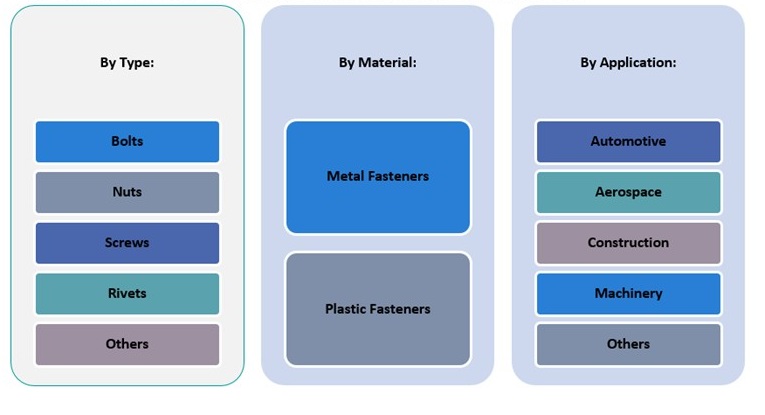
The Italy industrial fasteners market can be segmented across various dimensions, including type, application, and material, each contributing to its overall growth.
By Type Segment
In the Italy industrial fasteners market, bolts, nuts, screws, and rivets are the most commonly used fasteners. Bolts and nuts are integral in automotive and machinery applications due to their reliability and strength. Screws, known for their versatility, are widely used across several industries including construction and aerospace. Rivets, which provide strong, permanent fastening, are heavily utilized in the aerospace sector, where lightweight, secure fasteners are crucial. The "others" category includes specialized fasteners, such as washers and clips, which cater to niche applications requiring specific performance characteristics.
By Application Segment
The automotive sector is a significant contributor to the demand for industrial fasteners in Italy, driven by the ongoing advancements in automotive design, especially in electric vehicles (EVs). The aerospace industry also plays a critical role, requiring high-performance, lightweight fasteners for aircraft construction. The construction sector is another key driver, with fasteners being used extensively in both residential and commercial infrastructure projects. The machinery segment, particularly in packaging and industrial automation, accounts for a significant portion of fastener usage due to the precision and durability required in machinery assembly. The "others" category includes sectors like electronics and energy, where fasteners are used in specialized applications.
By Material Segment
Metal fasteners, especially those made from steel, aluminum, and titanium, dominate the market due to their strength, durability, and widespread use across various applications. Plastic fasteners, however, are gaining traction, particularly in automotive and electronics industries, due to their lightweight properties and corrosion resistance, offering new opportunities for manufacturers to innovate and meet evolving industry needs.
Segmentation:
By Type Segment:
- Bolts
- Nuts
- Screws
- Rivets
- Others
By Application Segment:
- Automotive
- Aerospace
- Construction
- Machinery
- Others
By Material Segment:
- Metal Fasteners
- Plastic Fasteners
Regional Analysis:
Italy's industrial fasteners market is strategically positioned within the broader European context, benefiting from its central location and robust manufacturing capabilities. The market is primarily driven by domestic demand from key sectors such as automotive, aerospace, construction, and machinery. Italy's industrial fasteners industry also enjoys a strong export presence, with a significant portion of production directed to other European countries, the Americas, and Asia.
Northern Italy: Key Manufacturing Hub
Northern Italy, particularly the regions of Lombardy, Emilia-Romagna, and Veneto, holds a dominant share in the industrial fasteners market. These regions are well-known for their manufacturing prowess, housing numerous automotive, aerospace, and machinery manufacturers. The automotive sector in the north is particularly influential, contributing significantly to the demand for high-performance fasteners, especially in vehicle assembly. Additionally, the presence of industrial automation and machinery manufacturers in these areas further fuels the demand for fasteners. Lombardy, in particular, is a key driver of industrial output in Italy and plays a central role in the fastener market.
Central and Southern Italy: Growing Infrastructure Demand
Central and Southern Italy, while not as dominant in manufacturing as the northern regions, are experiencing a growing demand for industrial fasteners due to infrastructure development projects. As Italy focuses on modernizing its infrastructure, particularly in transportation, energy, and residential construction, the need for reliable fastening solutions increases. These regions also benefit from increased investments in renewable energy projects, further driving the demand for durable fasteners. While the market share from these regions is smaller compared to the north, the continued focus on construction and infrastructure development is contributing to steady growth.
Export Market: Europe and Beyond
Italy's industrial fasteners market is heavily integrated into the European supply chain, with exports accounting for a significant portion of the country’s fastener production. Approximately 56.6% of Italy's fastener exports are directed towards other European countries, reflecting Italy’s strong presence in the regional market. Italy’s adherence to European Union standards and regulations helps ensure that its fasteners meet the quality requirements of other EU member states, facilitating trade. The Americas represent the second-largest market for Italian fasteners, accounting for around 20.2% of exports, while the Asian market, though growing, accounts for approximately 17%. These export destinations highlight Italy’s global reach and competitive positioning in the international fastener market.
Key Player Analysis:
- LISI Group
- The Würth Group
- Bulten AB
- Bossard Group
- EJOT Holding GmbH & Co. KG
- Fabory Group
- Bolt & Nut Industry Ltd
- Precision Castparts Corp.
- Bufab Group
- Fischer Holding GmbH & Co.
Competitive Analysis:
The Italy industrial fasteners market is highly competitive, with both domestic and international players vying for market share. Key Italian manufacturers, such as BULTEM and FASCOM, dominate the domestic market, leveraging their expertise in precision engineering and established relationships with key industries like automotive and aerospace. These companies are known for their commitment to product quality and innovation, catering to the high-performance demands of sectors that require durability and safety. International companies, especially those from Asia and Europe, also have a significant presence in the Italian market. They offer cost-effective solutions that challenge local manufacturers in terms of pricing, especially for standard fastener products. To maintain a competitive edge, Italian fastener producers focus on technological advancements, such as the development of corrosion-resistant and lightweight fasteners, as well as adhering to stringent EU quality standards. The ongoing drive for product innovation and efficiency remains crucial for sustaining competitiveness in this dynamic market.
Recent Developments:
- In September 2024, Italian fastener manufacturer Vimi Fasteners announced new growth projects in the United States, aiming to strengthen their ties with the American market and expand their global presence. Since its founding in 1967, Vimi Fasteners has built a reputation for highly engineered fasteners used in demanding applications across sectors such as automotive, supercar, industrial, marine, oil & gas, energy, and infrastructure.
- In December 2024, LISI AUTOMOTIVE, a subsidiary of LISI Group, entered exclusive negotiations to sell its French subsidiary LISI AUTOMOTIVE NOMEL SAS to ZeroBaseInvest GmbH. This subsidiary specializes in manufacturing nuts and washers for automotive and industrial markets. The transaction, part of LISI’s strategy to focus on high value-added fastening solutions, is expected to close by the end of February 2025.
- On December 5, 2024, Würth Italia announced a groundbreaking partnership with GaussML, an AI technology company. This alliance aims to transform Italian manufacturing by integrating GaussML’s Optimyzer AI solution for rapid process optimization, improved product quality, and increased manufacturing efficiency across Italy’s industrial sector.
Market Concentration & Characteristics:
The Italy industrial fasteners market exhibits moderate concentration, with a mix of established local players and a growing presence of international competitors. Domestically, a few key manufacturers dominate, particularly in the automotive, aerospace, and machinery sectors. These companies, such as BULTEM and FASCOM, focus on high-quality, specialized fasteners to meet stringent industry standards. However, the market also sees increasing competition from international brands, especially those offering cost-effective, mass-produced fasteners. This has intensified price competition, particularly for standard fastener products. The market is characterized by a focus on product innovation, with manufacturers investing in new materials and technologies, such as corrosion-resistant and lightweight fasteners. Additionally, there is a growing trend toward customization and precision engineering to meet the specific needs of various industries. As demand for high-performance fasteners continues to rise, companies are prioritizing quality and reliability to differentiate themselves in a competitive environment.
Report Coverage:
The research report offers an in-depth analysis based on Type, Application and Material. It details leading market players, providing an overview of their business, product offerings, investments, revenue streams, and key applications. Additionally, the report includes insights into the competitive environment, SWOT analysis, current market trends, as well as the primary drivers and constraints. Furthermore, it discusses various factors that have driven market expansion in recent years. The report also explores market dynamics, regulatory scenarios, and technological advancements that are shaping the industry. It assesses the impact of external factors and global economic changes on market growth. Lastly, it provides strategic recommendations for new entrants and established companies to navigate the complexities of the market.
Future Outlook:
- The Italy industrial fasteners market is expected to experience continued growth in the coming years.
- The automotive sector will drive demand for fasteners, particularly due to the rise of electric vehicle production.
- The aerospace industry will remain a key contributor, requiring advanced, high-performance fasteners for aircraft components.
- Infrastructure projects across Italy will increase the need for durable fastening solutions in construction.
- Advancements in material technology will lead to the creation of more efficient, lightweight, and corrosion-resistant fasteners.
- The growing integration of automation and Industry 4.0 will streamline production processes and enhance product quality.
- Renewable energy projects, such as wind and solar, will generate additional demand for specialized fastening solutions.
- The trend toward plastic fasteners will gain momentum, driven by industries seeking lightweight and environmentally friendly options.
- Manufacturers will focus on offering innovative, customized fasteners to meet the specific needs of various industries.
- Italy’s strong export market will continue to grow, with increasing demand for fasteners in emerging regions.

Request a Free Sample
Fill in your details and we'll send you a free sample report.
- Sample data tables & charts
- Research methodology
Need a Custom Version of This Report?
Tailor the scope, geography, or segments to your exact requirements.
- Custom geography or segment scope
- Direct access to our analyst team
Frequently Asked Questions
What is the current size of the Italy Industrial Fasteners Market?
What factors are driving the growth of the Italy Industrial Fasteners Market?
What are the key segments within the Italy Industrial Fasteners Market?
Who are the major players in the Italy Industrial Fasteners Market?
Table of Content
Chapter 1 Market Segmentation
- 1.1 Segmentation Framework
- 1.1.1 Product and Service Classification
- 1.1.2 Application and End-Use Classification
- 1.1.3 Technology and Solution Classification
- 1.1.4 Customer and Distribution Channel Classification
- 1.1.5 Geographic Segmentation
- 1.1.6 Market Segment Definitions and Boundaries
Chapter 2 Introduction
- 2.1 Report Objectives and Scope
- 2.2 Product Definition and Industry Terminology
- 2.3 Market Inclusions and Exclusions
- 2.4 Research Process
- 2.4.1 Primary Research and Expert Interviews
- 2.4.2 Secondary Research and Source Review
- 2.4.3 Top-Down and Bottom-Up Estimation
- 2.4.4 Data Triangulation and Verification
- 2.5 Market Size Measurement Basis
- 2.5.1 2024: USD 2702.58 million → 2032: USD 3934.96 million
- 2.6 Historical and Forecast Reference Periods
- 2.6.1 Base Year: 2024
- 2.6.2 Forecast Period: 2024-2032
- 2.7 Research Assumptions and Limitations
Chapter 3 Executive Summary
- 3.1 Market Snapshot and Key Findings
- 3.2 Base-Year Market Size, 2024
- 3.3 Forecast Market Size, 2032
- 3.4 Revenue and Volume Growth Outlook
- 3.5 Key Demand and Supply Indicators
- 3.6 Leading Market Segments
- 3.7 Fastest-Growing Market Opportunities
- 3.8 Regional Performance Highlights
- 3.9 Technology and Industry Transformation
- 3.10 Competitive Landscape Summary
- 3.11 Analyst View and Strategic Implications
Chapter 4 Italy Industrial Fasteners Market Trends and Developments
- 4.1 Historical Industry Development
- 4.2 Recent Market Trends and Developments
- 4.3 Demand and Customer Behavior Trends
- 4.4 Technology and Product Innovation
- 4.5 Artificial Intelligence, Automation and Digitalization
- 4.6 Local Manufacturing and Supply Chain Realignment
- 4.7 Industry Partnerships, Mergers and Acquisitions
- 4.8 Sustainability and Circular Economy Developments
- 4.9 Government and Private Sector Investment Trends
- 4.10 Emerging Business Models and Commercialization
- 4.11 Industry Developments and Announcements
Chapter 5 Italy Industrial Fasteners Market Production, Supply and Demand Analysis
- 5.1 Demand Trend and Consumption Analysis
- 5.2 Demand Forecast, 2024-2032
- 5.3 Production and Output Trend
- 5.4 Production and Output Forecast, 2024-2032
- 5.5 Installed Capacity and Capacity Utilization
- 5.6 Company-Wise Production Plants and Statistics
- 5.6.1 Installed Production Capacity
- 5.6.2 Actual Production
- 5.6.3 Planned Capacity and Expansion Targets
- 5.7 Supply Chain Structure and Procurement Trends
- 5.8 Supply-Demand Gap and Bottlenecks
- 5.9 Import Dependence and Sourcing Structure
- 5.10 Contract Manufacturing and Outsourcing
- 5.11 Regional Supply and Demand Concentration
Chapter 6 Italy Industrial Fasteners Market Pricing Analysis
- 6.1 Pricing Structure and Measurement
- 6.2 Historical Pricing Trends
- 6.3 Pricing Outlook, 2024-2032
- 6.4 Average Selling Price and Unit Economics
- 6.5 Pricing by Product and Market Segment
- 6.6 Geographic Pricing Differences
- 6.7 Key Input, Energy, Labor and Logistics Costs
- 6.8 Contract Pricing and Purchasing Models
- 6.9 Pricing Sensitivity and Competitive Positioning
- 6.10 Price, Margin and Profitability Implications
Chapter 7 Italy Industrial Fasteners Market Dynamics
- 7.1 Market Growth Drivers
- 7.1.1 Demand-Side Drivers
- 7.1.2 Technology and Innovation Drivers
- 7.1.3 Infrastructure and Investment Drivers
- 7.1.4 Regulatory and Policy Drivers
- 7.2 Market Restraints
- 7.2.1 Cost and Affordability Constraints
- 7.2.2 Technology and Adoption Barriers
- 7.2.3 Supply Chain and Operational Constraints
- 7.3 Market Challenges
- 7.3.1 Competitive Pressure and Margin Erosion
- 7.3.2 Skills, Infrastructure and Implementation Gaps
- 7.4 Emerging Market Opportunities
- 7.5 Market Dynamics Impact and Time-Horizon Assessment
Chapter 8 Italy Industrial Fasteners Value Chain Analysis
- 8.1 Industry Value Chain Overview
- 8.2 Upstream Suppliers and Critical Inputs
- 8.3 Technology and Component Providers
- 8.4 Manufacturing or Service Delivery
- 8.5 Distribution, Channel Partners and Integrators
- 8.6 Downstream Applications and End Users
- 8.7 Value Addition and Profit Pools
- 8.8 Vertical Integration and Outsourcing
- 8.9 Supplier Concentration and Risk
- 8.10 Supply Chain Localization and Resilience
Chapter 9 Italy Industrial Fasteners Market Regulations and Policies
- 9.1 Relevant Laws, Standards and Compliance Frameworks
- 9.2 Product, Service, Safety and Quality Requirements
- 9.3 Government Policies, Incentives and Subsidies
- 9.4 Imports, Exports and Trade Barriers
- 9.5 Public Procurement and Local Content Requirements
- 9.6 Environmental and Sustainability Compliance
- 9.7 Upcoming Policy Changes and Market Implications
Chapter 10 Italy Industrial Fasteners Market Hotspots and Opportunities
- 10.1 Market Opportunity Mapping and Growth Hotspots
- 10.2 High-Growth Applications and Customer Groups
- 10.3 Underserved Markets and White-Space Opportunities
- 10.4 Emerging Technology and Product Opportunities
- 10.5 New Capacity and Investment Hotspots
- 10.6 Market Entry and Expansion Opportunities
- 10.7 Distribution and Partnership Opportunities
- 10.8 Near-Term and Long-Term Commercial Potential
- 10.9 Opportunity Attractiveness and Execution Risks
Chapter 11 Italy Industrial Fasteners Market Outlook, 2024-2032
- 11.1 Market Size and Analysis
- 11.1.1 Revenue (Market Measurement: 2024: USD 2702.58 million → 2032: USD 3934.96 million)
- 11.1.2 Market Volume and Quantity Sold
- 11.1.3 Historical Market Size
- 11.1.4 Base-Year Market Size, 2024
- 11.2 Market Forecast, 2024-2032
- 11.2.1 Revenue Forecast to 2032
- 11.2.2 Volume Forecast to 2032
- 11.2.3 CAGR and Year-on-Year Growth
- 11.2.4 Incremental Revenue Opportunity
- 11.3 Forecast Assumptions and Scenario Analysis
- 11.3.1 Base-Case Forecast
- 11.3.2 Optimistic and Conservative Scenarios
- 11.3.3 Technology, Pricing and Policy Sensitivities
- 11.4 Market Attractiveness and Growth Outlook
Chapter 12 Italy Industrial Fasteners Market Segmentation and Outlook
- 12.1 Segmentation Summary and Market Shares, 2024
- 12.2 Largest and Fastest-Growing Segments
- 12.3 Segment Growth Comparison
- 12.4 Segment Attractiveness and Priority Matrix
Chapter 13 Italy Industrial Fasteners Geographic Market Outlook, 2024-2032
- 13.1 Domestic Market Distribution and Demand Clusters
- 13.2 State- or Province-Wise Market Size and Forecast, 2024-2032
- 13.3 City and Metropolitan Market Outlook
- 13.4 Industrial, Manufacturing and Commercial Clusters
- 13.5 Geographic Concentration of Key End Users
- 13.6 Local Pricing and Purchasing Differences
- 13.7 Domestic Production Facilities and Capacity Map
- 13.8 Local Infrastructure and Project Pipeline
- 13.9 State-Level Policy and Incentive Differences
- 13.10 Subnational Investment Hotspots and Opportunities
- 13.11 Distribution and Logistics Networks
- 13.12 Domestic Competitive Footprint
Chapter 14 Italy Industrial Fasteners Technology, Innovation and Sustainability Outlook
- 14.1 Technology Landscape and Maturity
- 14.2 Product, Process and Service Innovation
- 14.3 AI, Automation and Digital Tools in the Industry
- 14.4 Technology Adoption and Performance Benchmarking
- 14.5 Innovation Pipeline and R&D Investment
- 14.6 Patent and Intellectual Property Trends
- 14.7 Energy Efficiency and Resource Management
- 14.8 Sustainability, Recycling and Circularity
- 14.9 Technology Roadmap, 2024-2032
- 14.10 Risks of Obsolescence and Technology Substitution
Chapter 15 Italy Industrial Fasteners Market Key Strategic Imperatives
- 15.1 Growth and Market Entry Priorities
- 15.2 High-Return Products and Segments
- 15.3 Pricing, Profitability and Cost Optimization
- 15.4 Technology Investment and Product Differentiation
- 15.5 Supply Chain Localization and Resilience
- 15.6 Distribution and Customer Acquisition
- 15.7 Partnership, Acquisition and Capacity Strategy
- 15.8 Regional Expansion Priorities
- 15.9 Short-, Medium- and Long-Term Actions
Chapter 16 Competition Outlook
- 16.1 Industry Competition Characteristics
- 16.2 Market Structure and Concentration
- 16.3 Market Share and Competitive Positioning, 2024
- 16.4 Company-Wise Revenue and Product Benchmarking
- 16.5 Production and Service Capacity Benchmarking
- 16.6 Technology, Pricing and Differentiation
- 16.7 Regional Footprint and Distribution Strength
- 16.8 Mergers, Acquisitions and Strategic Alliances
- 16.9 New Entrants and Competitive Threats
- 16.10 Porter's Five Forces and Industry Attractiveness
- 16.11 Competitive Outlook, 2024-2032
Chapter 17 Company Profiles
- 17.1 Company Coverage and Selection Criteria
- 17.2 Leading Market Participants – Standard Profile Structure
- 17.2.1 Business Description
- 17.2.2 Company Ownership and Geographic Presence
- 17.2.3 Product and Service Portfolio
- 17.2.4 Manufacturing and Operating Footprint
- 17.2.5 Production Capacity and Expansion Plans
- 17.2.6 Financial Performance and Investment
- 17.2.7 Market Share and Competitive Position
- 17.2.8 Technology and Innovation Capabilities
- 17.2.9 Strategic Alliances or Partnerships
- 17.2.10 Recent Developments
- 17.2.11 Growth Strategy and Outlook
- 17.3 Other Relevant Market Participants
Note: Every listed company is profiled on the structure shown under the first company. The company list is preliminary and may change based on research findings, market developments, data availability and client requirements.
Chapter 18 Disclaimer
- 18.1 Research and Forecast Disclaimer
- 18.2 Data Source and Estimation Limitations
Note: The depth of individual sections depends on data availability for this market. Volume, capacity, trade and other unit-based metrics are included where applicable.