
| REPORT ATTRIBUTE | DETAILS |
|---|---|
| Historical Period | 2020-2023 |
| Base Year | 2024 |
| Forecast Period | 2025-2032 |
| On-Demand Laundry Service Market Size 2024 | USD 32,974.3 Million |
| On-Demand Laundry Service Market, CAGR | 12.8% |
| On-Demand Laundry Service Market Size 2032 | USD 86,426.78 Million |
Market Overview:
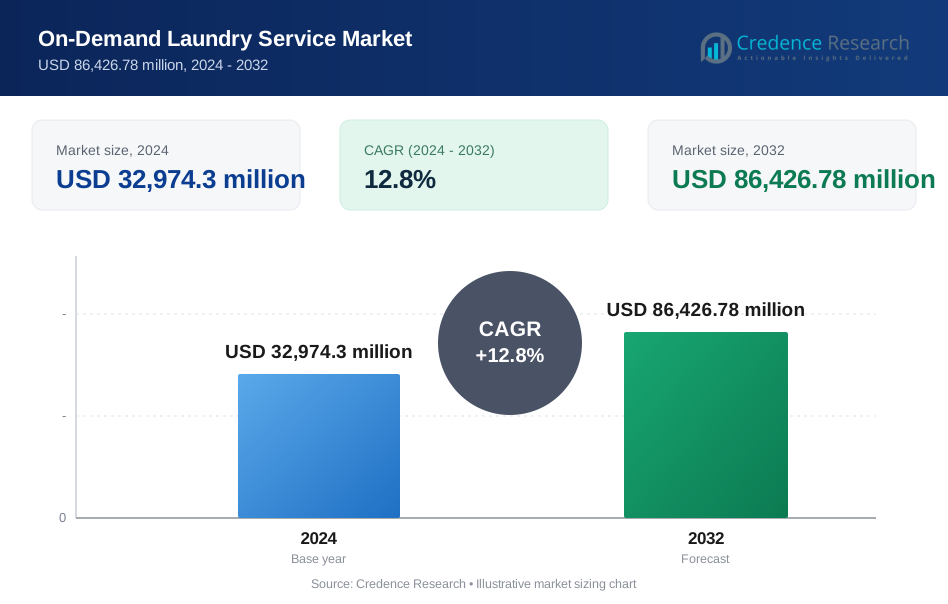
The On-Demand Laundry Service Market is projected to grow from USD 32,974.3 million in 2024 to USD 86,426.78 million by 2032, with a compound annual growth rate (CAGR) of 12.8%.
The On-Demand Laundry Service market is driven by increasing consumer demand for convenience, time-saving solutions, and a growing preference for outsourcing laundry tasks. Busy lifestyles, especially in urban areas, are prompting individuals to seek services that offer ease of access, quick turnaround times, and door-to-door delivery. The rise in smartphone adoption and the growth of online platforms further fuel the market's expansion, as customers increasingly turn to mobile apps to book services. Additionally, the growing awareness of sustainability is pushing businesses to offer eco-friendly laundry solutions, using energy-efficient machines and biodegradable detergents. Market trends also include innovations in service offerings, such as express laundry options and subscription models, enhancing customer satisfaction. As the market continues to mature, increased competition is driving companies to differentiate themselves with premium services, personalized offerings, and loyalty programs, contributing to the sector's rapid growth.
The On-Demand Laundry Service market exhibits strong growth across various regions, with North America leading the market, holding a 38% share in 2024, driven by high demand in the U.S. and Canada. The Asia Pacific region, with a market share of 25%, is rapidly expanding due to urbanization and rising disposable incomes, particularly in China and India. Europe follows with a 20% share, with countries like the UK, Germany, and France focusing on eco-friendly solutions. The Rest of the World, including Latin America, the Middle East, and Africa, accounts for 17% of the market, seeing steady growth. Key players such as CLEANLY, Hampr, Rinse, FlyCleaners, P&G, Mulberrys Garment Care, Edaixi, WASHMEN, Laundryheap, and Press Technologies are capitalizing on these regional opportunities, tailoring their services to meet local consumer demands and market trends.
Market Insights:
- The On-Demand Laundry Service market is projected to grow from USD 32,974.3 million in 2024 to USD 86,426.78 million by 2032, at a CAGR of 12.8%.
- Increasing consumer demand for convenience and time-saving solutions, particularly in urban areas, is driving market growth.
- The rise in smartphone adoption and the growth of online platforms enable easier access to on-demand laundry services, enhancing customer experience.
- Eco-friendly solutions such as energy-efficient machines and biodegradable detergents are becoming a major market trend.
- Subscription models and personalized services are gaining popularity, increasing customer loyalty and revenue streams for service providers.
- North America leads the market, holding 38% of the global share in 2024, driven by demand in the U.S. and Canada.
- The Asia Pacific region follows with 25% market share in 2024, driven by urbanization, rising disposable incomes, and tech-savvy consumers.
Market Drivers:
Growing Consumer Demand for Convenience:
One of the primary drivers of the On-Demand Laundry Service market is the increasing consumer demand for convenience. Busy lifestyles, particularly in urban areas, are leading individuals to seek services that save them time and effort. For instance, companies like Rinse and Laundrapp offer services that pick up, clean, and deliver laundry to consumers' doorsteps, allowing them to focus on other priorities, thereby increasing the demand for these services. With hectic work schedules, long commutes, and other commitments, consumers are turning to on-demand laundry services for a hassle-free laundry experience.
Technological Advancements and Mobile App Adoption:
Technological advancements have significantly contributed to the growth of the On-Demand Laundry Service market. The widespread adoption of smartphones and the development of user-friendly mobile apps have made it easier for consumers to access laundry services on-demand. For example, mobile apps developed by companies like WashClub and Cleanly provide convenience and accessibility for both service providers and users, becoming a key factor in the market's expansion. With a few taps, customers can schedule pick-ups, track orders, and make payments, enhancing the overall customer experience.
Increasing Focus on Sustainability:
Sustainability has become a growing concern for both consumers and businesses. On-Demand Laundry Service providers are responding to this demand by offering eco-friendly solutions, such as using energy-efficient machines, biodegradable detergents, and environmentally friendly packaging. For instance, companies like WashBox and The Eco Laundry Company are adopting sustainable practices that appeal to environmentally conscious consumers and help differentiate themselves in a competitive market. The shift towards sustainable laundry practices is driving the adoption of on-demand laundry services, especially among environmentally aware customers.
Subscription Models and Personalization:
The introduction of subscription-based models and personalized services is another key driver in the On-Demand Laundry Service market. Subscription models offer customers the convenience of fixed pricing for regular laundry services, which increases customer loyalty and ensures a steady revenue stream for service providers. For example, companies like SudShare and Tide Cleaners offer subscription plans that provide regular laundry services at fixed prices. Additionally, personalized offerings tailored to individual preferences, such as custom washing methods or specific delivery schedules, are enhancing customer satisfaction and encouraging long-term engagement with on-demand laundry services.
Market Trends:
Rise of Eco-Friendly Practices:
A significant trend in the On-Demand Laundry Service market is the growing emphasis on sustainability. Consumers are increasingly aware of the environmental impact of their choices, which has led to a demand for eco-friendly laundry services. Providers are responding by incorporating energy-efficient machines, biodegradable detergents, and environmentally conscious packaging. For instance, companies like WashBox and The Eco Laundry Company are adopting sustainable practices that appeal to environmentally aware customers. These sustainable practices not only cater to environmentally conscious consumers but also enhance the overall appeal of on-demand services, helping businesses stand out in a competitive market.
Integration of Subscription Models:
Subscription-based models have gained traction in the On-Demand Laundry Service market. Customers appreciate the convenience of fixed pricing for regular laundry services, which simplifies budgeting and offers a more predictable experience. This model fosters customer loyalty, as it ensures consistent revenue for service providers. For example, companies like SudShare and Tide Cleaners offer subscription plans that provide regular laundry services at fixed prices. The convenience of scheduling laundry pick-ups and deliveries through a subscription also appeals to busy individuals, allowing them to automate routine tasks and streamline their daily responsibilities.
Personalization of Services:
Personalization is a key trend shaping the On-Demand Laundry Service market. Service providers are increasingly offering tailored solutions to meet the unique preferences of their customers. These personalized offerings may include custom washing methods, specific delivery times, or individualized treatment for delicate garments. Companies like Rinse and Laundrapp offer tailored solutions to enhance customer satisfaction. The ability to customize laundry services enhances customer satisfaction and increases the likelihood of repeat business, positioning companies to build stronger relationships with their clientele.
Technology-Driven Customer Experience:
The integration of advanced technologies is transforming the On-Demand Laundry Service market. The use of mobile apps, real-time order tracking, and contactless payment options has revolutionized the customer experience. These technological advancements make it easier for users to book, track, and pay for services with ease. For example, mobile apps developed by companies like WashClub and Cleanly provide convenience and accessibility for both service providers and users. Additionally, machine learning and artificial intelligence are being used to optimize logistics, predict customer demand, and improve operational efficiency, further enhancing the overall service quality and customer experience.
Market Challenges Analysis:
Operational Costs and Efficiency:
One of the primary challenges faced by the On-Demand Laundry Service market is managing operational costs while ensuring service efficiency. Laundry service providers must invest in high-quality equipment, eco-friendly detergents, and well-maintained delivery fleets to meet customer expectations, which can result in significant upfront and ongoing costs. Additionally, maintaining a balance between service quality and cost-effectiveness is crucial, as high operational costs can impact profitability. Labor costs, for instance, often represent a significant portion of expenses, ranging between 25-40% of overall operating costs, as skilled personnel are required for tasks such as washing, folding, and delivery. Efficient management of logistics, such as route planning for pick-ups and deliveries, is also a challenge. Any inefficiencies in these areas can lead to delayed services, increased expenses, and ultimately dissatisfied customers. Providers must continuously seek ways to optimize their operations while controlling costs, which often involves integrating new technologies, adopting automation solutions, or streamlining their processes to maintain a competitive edge in the market. Furthermore, managing inventory and ensuring consistent service quality while scaling operations can be a significant challenge for growing businesses.
Market Competition and Customer Retention:
The On-Demand Laundry Service market is highly competitive, with numerous local and national players offering similar services. This saturation makes it difficult for companies to differentiate themselves and capture significant market share. Additionally, customer retention is a constant challenge as consumers have many options available and can easily switch providers based on pricing, service quality, or convenience. Building customer loyalty requires offering exceptional service, personalized experiences, and innovative features such as subscription models or premium services. With the rise of digital platforms and mobile apps, customers have become more empowered, expecting seamless and on-demand services. To stay competitive, businesses must constantly innovate and adapt to changing customer preferences while managing the pressure to provide cost-effective and efficient solutions. Failure to do so can result in high customer churn, reduced market positioning, and ultimately lower profitability. Businesses must invest in creating unique value propositions to secure customer loyalty in an increasingly crowded market.
Market Opportunities:
The On-Demand Laundry Service market presents significant opportunities for growth driven by evolving consumer preferences and technological advancements. With urbanization continuing to rise and busy lifestyles becoming more prevalent, there is an increasing demand for convenient, time-saving solutions. Consumers are increasingly willing to pay for services that simplify everyday tasks, such as laundry, making this market an attractive space for new entrants and existing companies to expand their offerings. The growing trend of subscription-based services further enhances this opportunity by providing companies with steady revenue streams and improving customer retention. Additionally, offering eco-friendly services appeals to the environmentally conscious consumer, allowing providers to capitalize on the rising demand for sustainability in everyday services.
Technological innovations also create opportunities within the On-Demand Laundry Service market. The integration of mobile apps, AI-driven logistics, and machine learning algorithms enables businesses to optimize operations, enhance customer experience, and reduce costs. Real-time order tracking, automated scheduling, and contactless payments have become essential features that improve convenience and customer satisfaction. Additionally, new business models, such as premium or express services, can attract a wide range of consumers who require faster or specialized care for their laundry needs. The market’s continuous evolution presents growth opportunities for companies that can leverage technology, offer differentiated services, and meet the growing demand for convenience, quality, and sustainability in laundry services.
Market Segmentation Analysis:
By Service Type
The On-Demand Laundry Service market is segmented by service type into wash and fold, dry cleaning, and ironing services. Wash and fold services dominate the market due to their affordability and convenience for everyday consumers. Dry cleaning and ironing services cater to customers with specific garment care needs, contributing to a broader market appeal.
By Customer
Customer segmentation in the On-Demand Laundry Service market includes individual consumers and businesses. Individual consumers, particularly those with busy lifestyles, form the largest customer group, driving demand for home pick-up and delivery services. Businesses, including hotels, restaurants, and gyms, require laundry services in bulk, representing a lucrative segment for B2B providers.
By Pricing Model
The market offers various pricing models, including pay-per-service, subscription-based, and package deals. Subscription-based pricing models have gained traction, offering customers fixed rates for regular services. Pay-per-service remains a popular choice for those with sporadic laundry needs, while package deals cater to high-volume customers seeking cost-effective solutions.
Segments:
Based on Service Type
- Wash and Fold
- Dry Cleaning
- Ironing Services
- Specialty Item Cleaning (e.g., wedding dresses, leather garments)
- Pickup and Delivery
Based on Customer
- Residential Customers
- Commercial Customers (e.g., businesses, hotels)
- Students
- Busy Professionals
- Families
Based on Pricing Model
- Pay-per-use
- Subscription Services
- Bundle Packages
- Loyalty Programs
- Promotional Offers
Based on Distribution Channel
- Mobile Apps
- Web Platforms
- Physical Stores
- Partnerships with Hotels and Spas
- Corporate Tie-ups
Based on Technology Integration
- Automated Order Management Systems
- Route Optimization for Pickup and Delivery
- Mobile Payment Solutions
- Customer Relationship Management (CRM) Tools
- Eco-friendly Technology Solutions
Based on the Geography:
- North America
- U.S.
- Canada
- Mexico
- Europe
- Germany
- France
- U.K.
- Italy
- Spain
- Rest of Europe
- Asia Pacific
- China
- Japan
- India
- South Korea
- South-east Asia
- Rest of Asia Pacific
- Latin America
- Brazil
- Argentina
- Rest of Latin America
- Middle East & Africa
- GCC Countries
- South Africa
- Rest of the Middle East and Africa
Regional Analysis
North America
North America holds the largest market share in the On-Demand Laundry Service market, accounting for 38% of the global market in 2024. The United States and Canada are the primary drivers of this growth due to the high demand for convenient services in urban areas. The increasing number of busy professionals, coupled with a preference for outsourcing time-consuming tasks, has led to the widespread adoption of on-demand laundry services. Additionally, the growth of technology-driven services, such as mobile app-based booking and real-time order tracking, has further fueled the market. The rise of subscription models, eco-friendly laundry options, and a high level of disposable income among consumers continue to support market expansion in the region.
Asia Pacific
The Asia Pacific region is experiencing rapid growth in the On-Demand Laundry Service market, with a market share of 25% in 2024. Countries such as China, India, Japan, and South Korea are seeing an increasing demand for these services, driven by urbanization, rising disposable incomes, and changing lifestyles. Consumers in densely populated cities are opting for convenience-based services, particularly due to long working hours and high urban living costs. The availability of cost-effective laundry services has also contributed to market growth. Additionally, the rise of smartphone penetration and the increasing number of tech-savvy consumers in this region are making on-demand laundry services more accessible, further accelerating market expansion.
Europe
Europe accounts for 20% of the global market share in 2024, with the United Kingdom, Germany, and France being key markets for on-demand laundry services. The demand for eco-friendly and sustainable laundry solutions is a significant factor driving market growth in Europe, as environmentally conscious consumers increasingly seek services that reduce their carbon footprint. Furthermore, the growing adoption of mobile platforms and digital technologies is enabling service providers to reach a broader customer base. Increasing disposable income and busy lifestyles in major European cities continue to bolster the demand for on-demand services, especially among professionals who prioritize convenience.
Rest of the World
The Rest of the World region, including Latin America, the Middle East, and Africa, accounts for 17% of the global market share in 2024. While this region is still emerging in terms of market penetration, the demand for on-demand laundry services is growing steadily. Urbanization and the shift toward convenience-based services are key factors contributing to market expansion. As disposable incomes rise and smartphones become more widely used, more consumers in these regions are adopting on-demand laundry solutions, creating opportunities for service providers to expand their presence.
Key Player Analysis:
- Laundryheap
- WASHMEN
- P&G
- Press Technologies
- Mulberrys Garment Care
- FlyCleaners
- Edaixi
- CLEANLY
- Hampr
- Rinse
Competitive Analysis:
The On-Demand Laundry Service market is highly competitive, with leading players such as CLEANLY, Hampr, Rinse, FlyCleaners, P&G, Mulberrys Garment Care, Edaixi, WASHMEN, Laundryheap, and Press Technologies establishing strong market positions. These companies differentiate themselves through various factors, including service quality, convenience, pricing models, and technological integration. CLEANLY and Rinse, for example, focus on mobile app-based solutions for seamless customer experiences, while Mulberrys Garment Care and P&G emphasize premium services and eco-friendly options. Companies like Laundryheap and WASHMEN are gaining traction by offering fast delivery and international coverage. Additionally, players such as Edaixi are tapping into emerging markets, while FlyCleaners and Hampr cater to niche customer segments with specialized services. For example, Press Technologies and Hampr are exploring new pricing models and personalized services to attract and retain customers. As the market continues to evolve, these companies must consistently innovate in service offerings, pricing structures, and operational efficiency to maintain a competitive edge.
Recent Developments:
- In February 2023, a franchise owner of the company revealed plans to open a new store, Lapels Cleaners of Indian Land, in South Carolina by April of the same year, aiming to expand its regional operations.
- In February 2023, Rinse, Inc. further expanded its business in Texas by launching services in Dallas and Austin. The company received a strong initial response and offered a USD 50 credit for new users who signed up.
- In January 2023, Rinse, Inc. acquired Room Service Laundry (RSL), a Brooklyn-based laundry delivery service. This acquisition enables Rinse, Inc. to tap into RSL's consumer base and continue its growth in New York.
- In January 2023, dobiQueen in Malaysia introduced a new six-hour laundry service, allowing customers to have their laundry picked up, cleaned, and delivered in just six hours.
Market Concentration & Characteristics:
The On-Demand Laundry Service market exhibits moderate to high market concentration, with several established players holding significant shares across various regions. Major companies such as CLEANLY, Hampr, Rinse, and FlyCleaners dominate key markets, particularly in North America and Europe, while emerging players focus on regional expansion in Asia Pacific and Rest of the World. The market is characterized by a high level of competition, with companies differentiating themselves through service offerings, pricing models, and technology-driven solutions. Additionally, the market is marked by innovation, as providers incorporate mobile apps, real-time tracking, and AI-driven logistics to enhance customer experience and operational efficiency. The growing focus on sustainability and eco-friendly practices further defines the market, as companies invest in energy-efficient machines and biodegradable detergents to attract environmentally conscious consumers. As the market matures, customer retention, service quality, and personalized experiences remain critical factors for maintaining a competitive edge.
Report Coverage:
The research report offers an in-depth analysis based on Service, Application and Geography. It details leading market players, providing an overview of their business, product offerings, investments, revenue streams, and key applications. Additionally, the report includes insights into the competitive environment, SWOT analysis, current market trends, as well as the primary drivers and constraints. Furthermore, it discusses various factors that have driven market expansion in recent years. The report also explores market dynamics, regulatory scenarios, and technological advancements that are shaping the industry. It assesses the impact of external factors and global economic changes on market growth. Lastly, it provides strategic recommendations for new entrants and established companies to navigate the complexities of the market.
Future Outlook:
- The On-Demand Laundry Service market is expected to continue its rapid growth, driven by increasing consumer demand for convenience and time-saving solutions.
- Mobile app-based platforms will see further innovation, offering customers enhanced user experiences with real-time tracking and seamless payments.
- Subscription-based models will become more widespread, providing service providers with stable, recurring revenue streams.
- Eco-friendly laundry services will gain more traction as consumers prioritize sustainability, encouraging businesses to adopt energy-efficient machines and biodegradable detergents.
- The integration of AI and machine learning technologies will optimize logistics, improving efficiency and reducing operational costs.
- The market will witness greater geographic expansion, with emerging regions such as Asia Pacific and the Middle East offering significant growth potential.
- On-demand laundry services will increasingly cater to both B2C and B2B sectors, expanding offerings to businesses such as hotels, gyms, and restaurants.
- Personalized laundry services tailored to individual preferences, including specific delivery times and custom washing methods, will become a key differentiator.
- The adoption of contactless and automated services will rise, improving safety and convenience for customers.
- Increased competition will push companies to innovate continuously, enhancing service quality and creating loyalty programs to retain customers.
Request a Free Sample
Fill in your details and we'll send you a free sample report.
- Sample data tables & charts
- Research methodology
Need a Custom Version of This Report?
Tailor the scope, geography, or segments to your exact requirements.
- Custom geography or segment scope
- Direct access to our analyst team
Frequently Asked Questions
What is the current size of the On-Demand Laundry Service market?
What factors are driving the growth of the On-Demand Laundry Service market?
What are the key segments within the On-Demand Laundry Service market?
What are some challenges faced by the On-Demand Laundry Service market?
Who are the major players in the On-Demand Laundry Service market?
Table of Content
Chapter 1. Report Introduction
- 1.1 Report Description & Purpose
- 1.1.1 Report Title & Market Definition
- 1.1.2 Unique Selling Propositions (USP) & Key Differentiators
- 1.1.3 Value Proposition for Stakeholders
- 1.2 Research Objectives
- 1.2.1 Market Sizing Objectives (Volume & Revenue)
- 1.2.2 Segmentation Objectives
- 1.2.3 Competitive Intelligence Objectives
- 1.2.4 Forecast & Scenario Objectives
- 1.3 Report Scope
- 1.3.1 On-Demand Laundry Service Scope – Types & Subtypes Covered
- 1.3.2 Geographic Scope – Regions & Countries Covered
- 1.3.3 Historical Period, Base Year & Forecast Period (2024; forecast to 2032)
- 1.3.4 Inclusions & Exclusions
- 1.4 HS Code & Classification Framework
- 1.5 Currency, Units & Pricing Basis
- 1.6 Target Stakeholders
- 1.7 Limitations & Assumptions
Chapter 2. Executive Summary
- 2.1 Global On-Demand Laundry Service Market Snapshot
- 2.1.1 Market Size – Historical (2024) & Forecast (2024-2032) (2024: USD 32,974.3 million → 2032: USD 86,426.78 million)
- 2.1.2 Volume & Revenue – Global Totals
- 2.1.3 Key Market Highlights – Top Five Facts
- 2.2 On-Demand Laundry Service Market Segmentation Snapshot
- 2.2.1 Market Split by Region – 2024 vs. 2032
- 2.3 Competitive Snapshot
- 2.3.1 Top 10 Players by Revenue Share – 2024
- 2.3.2 Top 10 Players by Volume Share – 2024
- 2.3.3 Recent Strategic Developments (18-Month Summary)
- 2.4 Key Investment Highlights & Strategic Conclusions
Chapter 3. On-Demand Laundry Service Market Dynamics & Industry Analysis
- 3.1 Market Overview & Context
- 3.1.1 On-Demand Laundry Service Market Position in the Broader Automotive Value Chain
- 3.1.2 OEM vs. Replacement Market Dynamics
- 3.1.3 Market Maturity & Development Stage by Region
- 3.2 On-Demand Laundry Service Market Drivers
- 3.3 On-Demand Laundry Service Market Restraints & Challenges
- 3.4 On-Demand Laundry Service Market Opportunities
- 3.5 Porter's Five Forces Analysis
- 3.5.1 Threat of New Entrants
- 3.5.2 Bargaining Power of Suppliers
- 3.5.3 Bargaining Power of Buyers
- 3.5.4 Threat of Substitutes
- 3.5.5 Competitive Rivalry – Intensity Assessment
- 3.6 On-Demand Laundry Service Value Chain Analysis
- 3.6.1 Upstream – Raw Material/Input Suppliers
- 3.6.1.1 Raw Material/Input 1
- 3.6.1.2 Raw Material/Input 2
- 3.6.1.3 Raw Material/Input 3
- 3.6.2 Midstream – Production/Manufacturing/Service Delivery
- 3.6.2.1 Production/Process Overview
- 3.6.2.2 Key Facility Locations & Capacity by Manufacturer
- 3.6.3 Downstream – Distribution & End Consumer
- 3.6.3.1 Primary Channel – B2B/OEM
- 3.6.3.2 Secondary Channels – Dealer, Retail, Online, Direct
- 3.6.4 Value Chain Profitability Analysis
- 3.6.1 Upstream – Raw Material/Input Suppliers
- 3.7 PESTEL Analysis
- 3.7.1 Political Factors
- 3.7.2 Economic Factors
- 3.7.3 Social Factors
- 3.7.4 Technological Factors
- 3.7.5 Environmental Factors
- 3.7.6 Legal Factors
- 3.8 On-Demand Laundry Service Supply Chain Analysis
- 3.8.1 Raw Material/Input Supply Risk Assessment
- 3.8.2 Manufacturing Concentration Risk (Geographic Exposure)
- 3.8.3 Trade Disruption Impact Analysis
- 3.9 Regulatory & Policy Landscape
Note: The regulatory and policy landscape section covers regulations based on their applicability to the market, On-Demand Laundry Service category, geography, and scope of the study. Only regulatory frameworks with a material impact on operations, compliance, trade, sustainability, or market access are analyzed in detail.
Chapter 4. Key Investment Pockets & Opportunity Analysis
- 4.1 On-Demand Laundry Service Market Attractiveness Analysis
- 4.1.1 By Region – Investment Attractiveness Matrix (Volume × CAGR)
- 4.2 Absolute Revenue Growth Opportunity
- 4.2.1 By Region – Absolute USD Growth Through 2032
- 4.3 Incremental Volume Opportunity
- 4.3.1 By Region – Incremental Volume Through 2032
- 4.3.2 Segment – Incremental Volume
- 4.4 Emerging Submarket Opportunity Deep Dive (Subject to Applicability)
- 4.5 Emerging Market Opportunity Scorecards
- 4.5.1 United States
- 4.5.2 Europe
- 4.5.3 Asia
- 4.5.4 Middle East & Africa
Note: Emerging Market Opportunity Scorecards will be included based on relevance and strategic importance. Regions listed are indicative and may vary depending on data availability and market dynamics.
Chapter 5. On-Demand Laundry Service Import-Export Analysis & Trade Flows
- 5.1 Global Trade Overview
- 5.1.1 Global Export Value by Country (2024)
- 5.1.2 Global Export Volume by Country (2024)
- 5.1.3 Global Import Value by Country (2024)
- 5.1.4 Global Import Volume by Country (2024)
- 5.1.5 Net Trade Balance by Country (2024)
- 5.2 Export Analysis – Segment
- 5.2.1 Type 1 (HS Code)
- 5.2.2 Type 2 (HS Code)
- 5.2.3 Type 3 (HS Code)
- 5.2.4 Type 4 (HS Code)
- 5.2.5 Type 5 (HS Code)
- 5.3 Import Analysis – Segment
- 5.3.1 Type 1 (HS Code)
- 5.3.2 Type 2 (HS Code)
- 5.3.3 Type 3 (HS Code)
- 5.3.4 Type 4 (HS Code)
- 5.3.5 Type 5 (HS Code)
- 5.4 Average Unit Trade Prices
- 5.4.1 Average Export Price – Segment & Country
- 5.4.2 Average Import Price – Segment & Source Country
- 5.4.3 Price Trends (2024)
- 5.5 Key Trade Route Analysis
- 5.5.1 Trade Route 1
- 5.5.2 Trade Route 2
- 5.5.3 Trade Route 3
- 5.5.4 Trade Route 4
- 5.5.5 Trade Route 5
- 5.6 Trade Policy Impact Assessment
- 5.6.1 US Anti-Dumping & Section 301 Tariffs
- 5.6.2 EU Customs Union Impact
- 5.6.3 Major Free Trade Agreements
- 5.6.4 USMCA Rules of Origin
Note: Trade policy analysis will be included only where relevant to the On-Demand Laundry Service market.
Chapter 6. Competitive Landscape & Company Benchmarking
- 6.1 On-Demand Laundry Service Market Concentration & Structure
- 6.1.1 Herfindahl-Hirschman Index (HHI) – vs. 2024
- 6.1.2 Tier 1, Tier 2 & Tier 3 Market Structure
- 6.1.3 Global, Regional & Local Player Dynamics
- 6.2 On-Demand Laundry Service Market Share Analysis – 2024
- 6.2.1 Global Revenue Share by Company
- 6.2.2 Global Volume Share by Company
- 6.2.3 Regional Revenue Share
- 6.2.4 Market Share Evolution ( vs. 2024)
- 6.2.5 OEM Segment Share by Company
- 6.2.6 Replacement Segment Share by Company
- 6.3 Production/Delivery Capacity & Facility Analysis
- 6.3.1 Global Installed Capacity
- 6.3.2 Capacity Utilization Rates
- 6.3.3 Production/Output Volume
- 6.3.4 Facility Locations & Capacity Map
- 6.3.5 Planned Capacity Additions
- 6.4 On-Demand Laundry Service Competitive Benchmarking Matrix
- 6.4.1 Revenue, Volume, CAGR & Profitability Comparison
- 6.4.2 Channel Revenue Mix
- 6.4.3 Geographic Revenue Exposure
- 6.4.4 R&D Intensity
- 6.4.5 Sustainability Maturity
- 6.5 Strategic Developments in On-Demand Laundry Service (Last 24 Months)
- 6.5.1 Mergers, Acquisitions & Divestments
- 6.5.2 New On-Demand Laundry Service Launches
- 6.5.3 Facility Expansions
- 6.5.4 Strategic Alliances, Joint Ventures & Partnerships
- 6.5.5 Distribution Expansion & Market Entry
- 6.5.6 Sustainability & ESG Initiatives
- 6.6 Competitive Strategy Mapping
- 6.6.1 Leader, Challenger, Follower & Niche Classification
- 6.6.2 Pricing Strategy Comparison
- 6.6.3 Channel Strategy Matrix
Note: Strategic developments are included based on their materiality and the availability of reliable information.
Chapter 7. Global On-Demand Laundry Service Market – By Distribution Channel
- 7.1 Segment Overview
- 7.1.1 Volume & Revenue Split by Channel (2024 & 2032)
- 7.1.2 Channel Mix Evolution (2024-2032)
Chapter 8. Regional Market Analysis – Global Overview
- 8.1 Global Regional Overview
- 8.1.1 Regional Volume Share
- 8.1.2 Regional Revenue Share
- 8.1.3 Regional Volume by Region
- 8.1.4 Regional Revenue by Region
- 8.1.5 Regional Forecast Through 2032
- 8.2 Cross-Regional Segment Analysis
- 8.2.1 By Distribution Channel
- 8.2.2 By Brand/Price Tier
Chapter 9. North America On-Demand Laundry Service Market
- 9.1 United States
- 9.2 Canada
- 9.3 Mexico
Chapter 10. Europe On-Demand Laundry Service Market
- 10.1 Germany
- 10.2 France
- 10.3 Italy
- 10.4 United Kingdom
- 10.5 Spain
- 10.6 Poland
- 10.7 Russia
- 10.8 Netherlands
- 10.9 Belgium
- 10.10 Sweden
- 10.11 Denmark
- 10.12 Norway
- 10.13 Rest of Europe
Chapter 11. Asia Pacific On-Demand Laundry Service Market
- 11.1 China
- 11.2 India
- 11.3 Japan
- 11.4 South Korea
- 11.5 Thailand
- 11.6 Indonesia
- 11.7 Vietnam
- 11.8 Malaysia
- 11.9 Australia
- 11.10 Rest of Asia Pacific
Chapter 12. Latin America On-Demand Laundry Service Market
- 12.1 Brazil
- 12.2 Argentina
- 12.3 Colombia
- 12.4 Chile
- 12.5 Rest of Latin America
Chapter 13. Middle East On-Demand Laundry Service Market
- 13.1 Saudi Arabia
- 13.2 United Arab Emirates
- 13.3 Turkey
- 13.4 Israel
- 13.5 Iran
- 13.6 Rest of the Middle East
Chapter 14. Africa On-Demand Laundry Service Market
- 14.1 South Africa
- 14.2 Egypt
- 14.3 Nigeria
- 14.4 Morocco
- 14.5 Rest of Africa
Chapter 15. On-Demand Laundry Service Company Profiles
- 15.1 [Company 01]
- 15.1.1 Company Overview
- 15.1.2 Key Management Personnel
- 15.1.3 Products & Services Portfolio
- 15.1.4 Financial Performance
- 15.1.5 Key Market Focus & Geographic Presence
- 15.1.6 Recent Developments & Strategic Initiatives
Note: The company profile list is preliminary and may change based on research findings, market developments, data availability, and client requirements.
Chapter 16. Appendices
- Appendix A – List of Abbreviations & Acronyms
- Appendix B – Industry Classification Code Reference – Full Series
- Appendix C – Production & Capacity Data Tables
- Appendix D – End-Use & Demand Base Tables
- Appendix E – Consumption & Replacement Rate Assumptions
- Appendix F – ASP Reference Tables
- Appendix G – Manufacturing & Facility Database
- Appendix H – Import-Export Data Tables
- Appendix I – Regulatory Summary Tables
- Appendix J – Primary Research Participant List (Anonymized)
- Appendix K – Primary Research Questionnaire Framework
- Appendix L – Data Sources & Bibliography
- Appendix M – Market Size Divergence & Source Comparison
Chapter 17. Research Methodology
- 17.1 Research Framework & Philosophy
- 17.2 Secondary Research – Sources, Hierarchy & Data Extraction
- 17.3 Data Modeling – Bottom-Up & Top-Down Market Sizing
- 17.4 Primary Research – Stakeholder Framework, LOI & Sample Sizes
- 17.5 Forecast Methodology – Regression, Scenario & Sensitivity Analysis
- 17.6 Quality Control – Four-Layer Validation Framework
- 17.7 Limitations & Standard Assumptions
- 17.8 Disclaimer
