
Market Overview
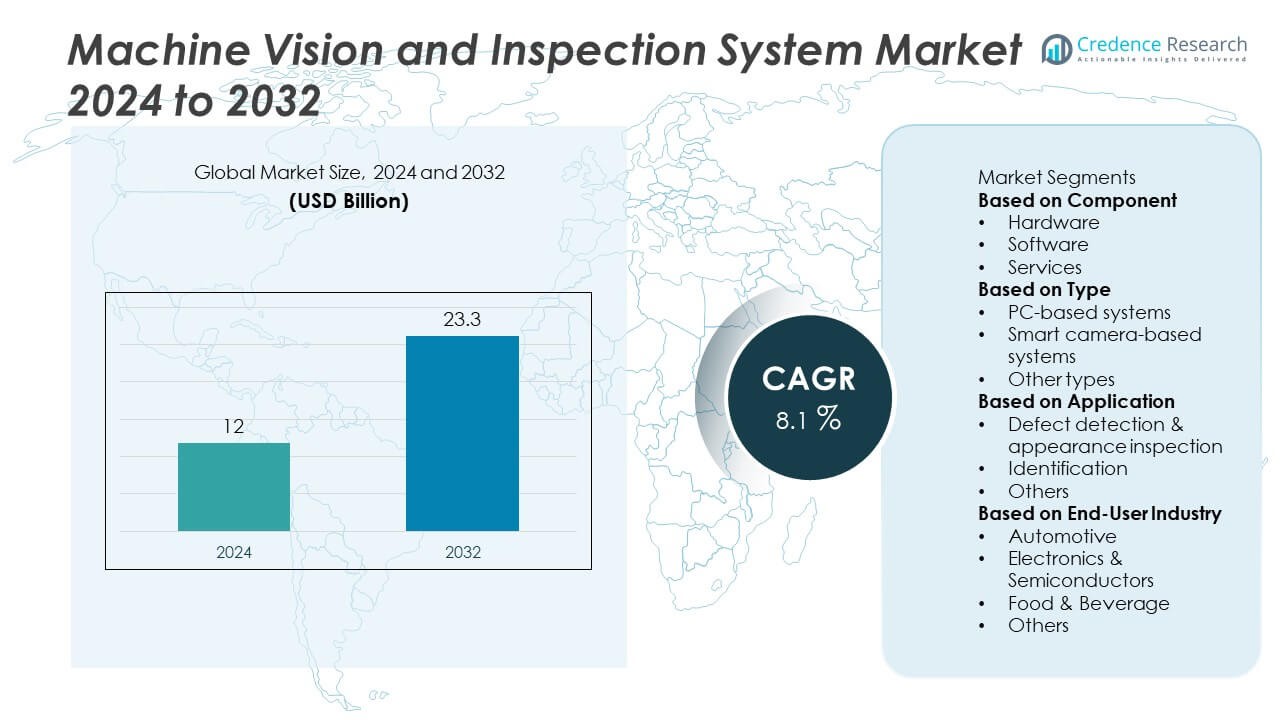
The Machine Vision and Inspection System market was valued at USD 12 billion in 2024 and is expected to reach USD 23.3 billion by 2032, growing at a CAGR of 8.1% during the forecast period.
| REPORT ATTRIBUTE | DETAILS |
|---|---|
| Historical Period | 2020-2023 |
| Base Year | 2024 |
| Forecast Period | 2025-2032 |
| Machine Vision and Inspection System Market Size 2024 | USD 12 Billion |
| Machine Vision and Inspection System Market, CAGR | 8.1% |
| Machine Vision and Inspection System Market Size 2032 | USD 23.3 Billion |
The top players in the machine vision and inspection system market-Cognex Corporation, KEYENCE Corporation, Teledyne Technologies Inc., Basler AG, and Omron Corporation-capitalize on advanced vision hardware, software integration and global distribution channels. Cognex leads its segment with a market share around 11.4 % in 2024. In regional terms, the Asia Pacific region dominates with a market share exceeding 43 % of the global market in 2024, driven by high manufacturing output and strong automation adoption. North America follows, bolstered by early integration of Industry 4.0 technologies and established firms. These companies leverage regional strengths, product breadth and technological innovation to strengthen their competitive positions in a dynamic market.
Market Insights
- The global machine vision and inspection system market reached USD 12 billion in 2024 and is expected to grow at a CAGR of 8.1 %.
- Rising automation in manufacturing, increasing quality requirements, and strong investment in sensors and imaging drive market growth.
- Smart camera‑based systems and AI‑enabled vision software are gaining traction as trends, while hardware still constitutes about 50 % of segment share.
- A competitive landscape is visible with major players consolidating market position; however high system integration costs and lack of skilled workforce limit faster uptake.
- Regionally, Asia‑Pacific leads with a share around 44 %, followed by North America at about 24 % and Europe at approximately 18 %, driven by large manufacturing bases and automation initiatives.
Market Segmentation Analysis:
By Component
In the Machine Vision and Inspection System market, the Hardware segment holds the largest share, accounting for approximately 50% of the market in 2024. This segment includes cameras, lighting systems, and processors essential for capturing and processing images. The Software segment follows closely with a 35% share, driven by the growing demand for advanced algorithms and deep learning solutions to improve inspection accuracy. Services, which account for 15% of the market, include system integration, maintenance, and consulting. The rise in automation and the need for high-precision inspections are the key drivers for hardware and software adoption.
- For instance, the Cognex In-Sight D900 series and In-Sight 3800 series use deep learning algorithms for automated defect detection in real-time, which has been adopted widely in automotive manufacturing. Services, which account for a notable portion of the market, include system integration, maintenance, and consulting.
By Type
The PC-based systems segment leads the market with a 45% share due to their high processing power and versatility, making them ideal for complex inspection tasks in manufacturing. Smart camera-based systems follow with a 35% share, offering compact, cost-effective solutions with integrated processing capabilities. The Other types segment, which includes compact and embedded systems, holds the remaining 20% share. The demand for smart, all-in-one solutions and the increased need for high-speed, real-time inspections in industries such as automotive and electronics are fueling the growth of these systems.
- For instance, Omron's FH-Series Smart Cameras integrate processing and vision in one unit, delivering a streamlined solution for quality control in the automotive industry.
By Application
Defect detection and appearance inspection dominate the market, accounting for nearly 50% of the share, as they are critical for quality control in industries such as automotive and electronics. Identification applications, including barcode reading and component tracking, follow with a 30% share, driven by the increasing demand for traceability and precision in logistics and supply chains. The Others segment, which includes applications like measurement and positioning, holds the remaining 20%. As industries strive for improved product quality and efficiency, the demand for defect detection and automated identification systems continues to rise.
Key Growth Drivers
Increasing Demand for Automation in Manufacturing
One of the key drivers for the Machine Vision and Inspection System market is the growing demand for automation in manufacturing processes. As industries seek to reduce labor costs, improve efficiency, and minimize human error, machine vision systems are being widely adopted for tasks such as quality control, defect detection, and process monitoring. Automation through vision and inspection systems enhances production speed and consistency, especially in high-volume manufacturing sectors like automotive, electronics, and pharmaceuticals. The ongoing trend of Industry 4.0, which integrates AI, IoT, and robotics, is further accelerating the adoption of these systems, contributing to market growth.
- For instance, FANUC's Robodrill machines can be integrated with the proprietary iRVision systems, which use 2D, 3D, and AI-based tools to detect anomalies and perform quality checks in high-speed production lines.
Technological Advancements in AI and Deep Learning
The integration of artificial intelligence (AI) and deep learning technologies into machine vision and inspection systems has significantly enhanced their capabilities. AI-powered systems can process vast amounts of data and adapt to complex inspection tasks, making them more accurate and efficient. Deep learning enables systems to perform intricate visual inspections with a higher level of precision, which was previously difficult or impossible with traditional methods. These advancements allow manufacturers to detect minute defects, perform advanced measurements, and automate decisions, thus expanding the scope of machine vision applications across various industries.
- For instance, Keyence’s CV-X series vision system uses deep learning to detect defects as small as 0.1 mm in real-time, enabling precise defect detection in the electronics industry.
Cost Reduction and Efficiency Improvements
Machine vision systems have become more cost-effective, making them accessible to smaller manufacturers and industries with tight budgets. As the technology advances, the cost of components like cameras, processors, and lighting systems has decreased, while their performance continues to improve. This has made machine vision systems a viable option for a broader range of applications, including small and medium-sized enterprises (SMEs). The ability to improve efficiency and reduce operational costs by automating inspection processes drives widespread adoption, resulting in the expansion of the machine vision market across different industries and regions.
Key Trends & Opportunities
Rise in Smart Manufacturing and Industry 4.0
The rise of smart manufacturing and Industry 4.0 presents significant opportunities for the machine vision and inspection systems market. As manufacturers increasingly incorporate IoT, AI, and robotics into their operations, the demand for advanced vision systems that can operate seamlessly in these environments is growing. Smart machines and interconnected production lines require machine vision systems that can provide real-time data analysis, facilitate predictive maintenance, and enhance overall operational efficiency. As more industries adopt digital transformation initiatives, the need for intelligent inspection systems will continue to rise, offering substantial growth opportunities for machine vision providers.
- For instance, Rockwell Automation's FactoryTalk InnovationSuite integrates machine vision with IIoT (Industrial Internet of Things) capabilities, enabling real-time data analysis and enhancing operational efficiency by consolidating information technology (IT) and operational technology (OT) data into a unified view.
Growing Adoption of 3D and 2D Vision Systems
Another key trend is the increasing adoption of 3D and 2D vision systems in applications that require detailed and precise inspections. 3D vision systems provide depth perception and are especially valuable in complex manufacturing processes, such as assembly, measurement, and part placement. These systems allow for more accurate spatial measurements and are becoming essential in industries like electronics, automotive, and pharmaceuticals. As product designs become more intricate and precision-driven, the demand for 3D and 2D machine vision systems will continue to rise, creating opportunities for innovation and growth in the market.
- For instance, Zivid's 3D color camera is integrated into robotic arms in automotive assembly lines to verify parts' exact positioning before processes like welding, with high-precision point clouds designed to enable reliable and consistent operations.
Key Challenges
High Initial Investment Costs
One of the significant challenges in the Machine Vision and Inspection System market is the high initial investment required for purchasing and implementing these systems. While the long-term benefits, such as improved efficiency, accuracy, and cost savings, are evident, the upfront capital expenditure remains a barrier, particularly for small and medium-sized enterprises (SMEs). The need for high-quality cameras, processors, software, and integration services can be expensive, and many businesses may be hesitant to invest in advanced systems without guaranteed returns. This challenge may slow the adoption of machine vision systems in certain industries, especially in emerging markets where budgets are constrained.
Lack of Skilled Workforce
Another challenge the market faces is the lack of skilled professionals capable of operating, maintaining, and troubleshooting advanced machine vision systems. These systems require expertise in areas such as computer vision, artificial intelligence, and software programming, which can be difficult to find in certain regions. The shortage of skilled personnel creates a knowledge gap, hindering the efficient implementation and use of machine vision technologies. To overcome this, companies must invest in training programs and educational initiatives to build a workforce capable of supporting the growing demand for advanced inspection systems.
Regional Analysis
Asia Pacific
The Asia Pacific region holds a market share of 41% in the machine vision and inspection system market, driven by heavy manufacturing activity in China, India, Japan and South Korea. Rapid industrialisation, the rise of electronics and semiconductor production, and strong investment in automation support growth in the region. Many manufacturers adopt vision systems to meet quality standards in mass production and high‑tech industries. These factors make Asia Pacific the dominant region and the primary growth engine in the market.
North America
North America accounts for 24% of the global market share in machine vision and inspection systems. The region’s maturity in automation, strong presence of high‑value manufacturing sectors like automotive and aerospace, and early adoption of Industry 4.0 technologies drive demand. The United States leads in spending on smart inspection solutions and vision‑guided robotics, helping firms improve productivity, reduce defects and meet stringent regulatory standards. These dynamics sustain North America’s significant role in the global market.
Europe
Europe holds an 18% market share in the machine vision and inspection system market. The region benefits from well‑established manufacturing hubs in Germany, France, Italy and the UK, strong regulatory pressure for quality assurance, and growing adoption of smart factory initiatives. European firms increasingly deploy machine vision for automated inspection, measurement and alignment tasks to enhance output and comply with environmental and safety standards. These trends maintain Europe’s steady contribution to global market revenues.
Latin America
Latin America contributes a 9% share of the global market for machine vision and inspection systems. Growth in the region is supported by expanding manufacturing in Brazil, Mexico and Chile, increased investment in automated production lines, and rising demand for quality control solutions in agricultural processing and consumer goods. While infrastructure and investment levels vary, emerging industries in this region are increasingly using machine vision to upgrade traditional manufacturing, driving gradual market expansion.
Middle East & Africa
The Middle East & Africa region captures 8% of the global machine vision and inspection system market share. Water‑scarce and resource‑driven industries such as oil & gas, mining and infrastructure are increasingly adopting automated vision inspection to enhance efficiency and reliability. Growth is supported by government investments in industrial automation and smart manufacturing within Gulf countries and South Africa. While adoption is uneven across countries, the push for digitalisation and quality assurance drives rising uptake in this region.
Market Segmentations:
By Component
- Hardware
- Software
- Services
By Type
- PC-based systems
- Smart camera-based systems
- Other types
By Application
- Defect detection & appearance inspection
- Identification
- Others
By End-User Industry
- Automotive
- Electronics & Semiconductors
- Food & Beverage
- Others
By Geography
- North America
- U.S.
- Canada
- Mexico
- Europe
- Germany
- France
- U.K.
- Italy
- Spain
- Rest of Europe
- Asia Pacific
- China
- Japan
- India
- South Korea
- South-east Asia
- Rest of Asia Pacific
- Latin America
- Brazil
- Argentina
- Rest of Latin America
- Middle East & Africa
- GCC Countries
- South Africa
- Rest of the Middle East and Africa
Competitive Landscape
The competitive landscape for the Machine Vision and Inspection System market is anchored by major key players such as Cognex Corporation, KEYENCE Corporation, Teledyne Technologies Inc., Basler AG, and Omron Corporation. These companies maintain strong global positions by leveraging extensive product portfolios, innovation in AI‑enabled vision software, and robust distribution networks across major manufacturing hubs. They regularly pursue strategic acquisitions and partnerships to expand capabilities in smart vision sensors, embedded systems, and cloud‑based analytics. Smaller regional players compete by focusing on niche applications, cost‑competitive offerings, and service models tailored to local markets. As the market evolves, differentiation increasingly relies on software platforms, recurring service revenue, and integration with Industry 4.0 ecosystems rather than purely hardware sales. This dynamic environment intensifies competition while pushing consolidation and partnerships across geographies and technology segments.
Key Player Analysis
- Cognex Corporation
- KEYENCE Corporation
- Teledyne Technologies Inc.
- Basler AG
- Omron Corporation
- SICK AG
- National Instruments Corporation
- Datalogic S.p.A.
- ISRA VISION GmbH
- Sony Corporation
Recent Developments
- In October 2025, OMRON Corporation enhanced its FH Vision System by adding new AI features that eliminate over‑detection and support up to eight camera inputs from a single controller.
- In June 2025, Cognex Corporation launched OneVision™, a cloud‑based platform designed for AI‑powered machine vision applications on its In‑Sight® 3800 and 8900 systems.
- In April 2024, Cognex introduced the In‑Sight® L38 3D Vision System, which integrates AI, 2D and 3D vision to enable new inspection and measurement tasks.
Report Coverage
The research report offers an in-depth analysis based on Component, Type, Application, End-User Industry and Geography. It details leading market players, providing an overview of their business, product offerings, investments, revenue streams, and key applications. Additionally, the report includes insights into the competitive environment, SWOT analysis, current market trends, as well as the primary drivers and constraints. Furthermore, it discusses various factors that have driven market expansion in recent years. The report also explores market dynamics, regulatory scenarios, and technological advancements that are shaping the industry. It assesses the impact of external factors and global economic changes on market growth. Lastly, it provides strategic recommendations for new entrants and established companies to navigate the complexities of the market.
Future Outlook
- Adoption of edge computing will expand, enabling machine vision systems to process data locally and reduce latency in industrial environments.
- Integration of generative AI and deep‑learning algorithms will enhance defect detection accuracy and adapt to complex inspection tasks with less manual configuration.
- Stand‑alone smart camera systems will gain wider use, offering flexible, plug‑and‑play inspection solutions ideal for small and medium‑sized operations.
- Collaboration between vision systems and robots will accelerate, enabling vision‑guided robots to perform pick‑and‑place, assembly, and inspection without human oversight.
- Growth in electric vehicles and semiconductors will escalate demand for high‑precision vision inspection across these industries, driving market expansion.
- Use of 3D vision technology will increase, supporting shape measurement and volumetric inspection essential for advanced manufacturing and packaging.
- Subscription‑based and “vision‑as‑a‑service” business models will emerge, reducing upfront investment barriers and broadening adoption among cost‑sensitive users.
- Sustainability and zero‑defect manufacturing goals will push firms to deploy machine vision systems to minimise waste and guarantee product quality.
- Expansion into emerging markets in Asia‑Pacific, Latin America and Middle East will offer new growth corridors as automation gains traction in these regions.
- Cyber‑security and data integrity requirements will elevate, prompting vision‑system providers to embed secure design and encrypted analytics capabilities in their solutions.

Request a Free Sample
Fill in your details and we'll send you a free sample report.
- Sample data tables & charts
- Research methodology
Market Dynamics
Increasing Demand for Automation in Manufacturing
Manufacturers are rapidly adopting machine vision and inspection systems to automate quality control, defect detection, and process monitoring, aiming to reduce labor costs and improve production efficiency. This trend is especially strong in high-volume sectors like automotive, electronics, and pharmaceuticals, where consistent quality and speed are critical.
Technological Advancements in AI and Deep Learning
The integration of AI and deep learning into machine vision systems has enabled more accurate and complex inspections, allowing detection of minute defects and advanced measurements that were previously challenging. These technologies expand the scope of machine vision applications and drive adoption across industries seeking higher precision.
Cost Reduction and Efficiency Improvements
Advancements in hardware and software have reduced the cost of machine vision systems, making them accessible to small and medium-sized enterprises. The ability to automate inspections and reduce operational costs encourages broader adoption, fueling market growth across diverse industry verticals.
Rise of Smart Manufacturing and Industry 4.0
The shift toward smart factories and Industry 4.0 is driving demand for machine vision systems that can seamlessly integrate with IoT, robotics, and real-time analytics. These systems enable predictive maintenance, real-time quality assurance, and operational efficiency, making them essential for digital transformation initiatives.
Growing Adoption of 3D and 2D Vision Systems
As manufacturing processes become more complex and product designs more intricate, the need for detailed and precise inspections is rising. The adoption of 3D and advanced 2D vision systems supports accurate spatial measurements and quality control, particularly in electronics, automotive, and pharmaceutical industries.
Need a Custom Version of This Report?
Tailor the scope, geography, or segments to your exact requirements.
- Custom geography or segment scope
- Direct access to our analyst team
Frequently Asked Questions
What is the current market size for Machine Vision and Inspection System market, and what is its projected size in 2032?
At what Compound Annual Growth Rate is the Machine Vision and Inspection System market projected to grow between 2025 and 2032?
Which Machine Vision and Inspection System market segment held the largest share in 2024?
What are the primary factors fueling the growth of the Machine Vision and Inspection System market?
Who are the leading companies in the Machine Vision and Inspection System market?
Which region commanded the largest share of the Machine Vision and Inspection System market in 2024?
Table of Content
Chapter 1 Market Segmentation
- 1.1 Segmentation Framework
- 1.1.1 Product and Service Classification
- 1.1.2 Application and End-Use Classification
- 1.1.3 Technology and Solution Classification
- 1.1.4 Customer and Distribution Channel Classification
- 1.1.5 Geographic Segmentation
- 1.1.6 Market Segment Definitions and Boundaries
- 1.2 By Type
- 1.2.1 PC-based systems
- 1.2.2 Smart camera-based systems
- 1.2.3 Other types
- 1.3 By Component
- 1.3.1 Hardware
- 1.3.2 Software
- 1.3.3 Services
- 1.4 By Application
- 1.4.1 Defect detection & appearance inspection
- 1.4.2 Identification
- 1.4.3 Others
- 1.5 By End-User Industry
- 1.5.1 Automotive
- 1.5.2 Electronics & Semiconductors
- 1.5.3 Food & Beverage
- 1.5.4 Others
Chapter 2 Introduction
- 2.1 Report Objectives and Scope
- 2.2 Product Definition and Industry Terminology
- 2.3 Market Inclusions and Exclusions
- 2.4 Research Process
- 2.4.1 Primary Research and Expert Interviews
- 2.4.2 Secondary Research and Source Review
- 2.4.3 Top-Down and Bottom-Up Estimation
- 2.4.4 Data Triangulation and Verification
- 2.5 Market Size Measurement Basis
- 2.5.1 2024: USD 12 billion → 2032: USD 23.3 billion
- 2.6 Historical and Forecast Reference Periods
- 2.6.1 Base Year: 2024
- 2.6.2 Forecast Period: 2024-2032
- 2.7 Research Assumptions and Limitations
Chapter 3 Executive Summary
- 3.1 Market Snapshot and Key Findings
- 3.2 Base-Year Market Size, 2024
- 3.3 Forecast Market Size, 2032
- 3.4 Revenue and Volume Growth Outlook
- 3.5 Key Demand and Supply Indicators
- 3.6 Leading Market Segments
- 3.7 Fastest-Growing Market Opportunities
- 3.8 Regional Performance Highlights
- 3.9 Technology and Industry Transformation
- 3.10 Competitive Landscape Summary
- 3.11 Analyst View and Strategic Implications
Chapter 4 Global Machine Vision And Inspection System Market Trends and Developments
- 4.1 Historical Industry Development
- 4.2 Recent Market Trends and Developments
- 4.3 Demand and Customer Behavior Trends
- 4.4 Technology and Product Innovation
- 4.5 Artificial Intelligence, Automation and Digitalization
- 4.6 Local Manufacturing and Supply Chain Realignment
- 4.7 Industry Partnerships, Mergers and Acquisitions
- 4.8 Sustainability and Circular Economy Developments
- 4.9 Government and Private Sector Investment Trends
- 4.10 Emerging Business Models and Commercialization
- 4.11 Industry Developments and Announcements
Chapter 5 Global Machine Vision And Inspection System Market Production, Supply and Demand Analysis
- 5.1 Demand Trend and Consumption Analysis
- 5.2 Demand Forecast, 2024-2032
- 5.3 Production and Output Trend
- 5.4 Production and Output Forecast, 2024-2032
- 5.5 Installed Capacity and Capacity Utilization
- 5.6 Company-Wise Production Plants and Statistics
- 5.6.1 Installed Production Capacity
- 5.6.2 Actual Production
- 5.6.3 Planned Capacity and Expansion Targets
- 5.7 Supply Chain Structure and Procurement Trends
- 5.8 Supply-Demand Gap and Bottlenecks
- 5.9 Import Dependence and Sourcing Structure
- 5.10 Contract Manufacturing and Outsourcing
- 5.11 Regional Supply and Demand Concentration
Chapter 6 Global Machine Vision And Inspection System Market Pricing Analysis
- 6.1 Pricing Structure and Measurement
- 6.2 Historical Pricing Trends
- 6.3 Pricing Outlook, 2024-2032
- 6.4 Average Selling Price and Unit Economics
- 6.5 Pricing by Product and Market Segment
- 6.6 Geographic Pricing Differences
- 6.7 Key Input, Energy, Labor and Logistics Costs
- 6.8 Contract Pricing and Purchasing Models
- 6.9 Pricing Sensitivity and Competitive Positioning
- 6.10 Price, Margin and Profitability Implications
Chapter 7 Global Machine Vision And Inspection System Market Dynamics
- 7.1 Market Growth Drivers
- 7.1.1 Demand-Side Drivers
- 7.1.2 Technology and Innovation Drivers
- 7.1.3 Infrastructure and Investment Drivers
- 7.1.4 Regulatory and Policy Drivers
- 7.2 Market Restraints
- 7.2.1 Cost and Affordability Constraints
- 7.2.2 Technology and Adoption Barriers
- 7.2.3 Supply Chain and Operational Constraints
- 7.3 Market Challenges
- 7.3.1 Competitive Pressure and Margin Erosion
- 7.3.2 Skills, Infrastructure and Implementation Gaps
- 7.4 Emerging Market Opportunities
- 7.5 Market Dynamics Impact and Time-Horizon Assessment
Chapter 8 Global Machine Vision And Inspection System Value Chain Analysis
- 8.1 Industry Value Chain Overview
- 8.2 Upstream Suppliers and Critical Inputs
- 8.3 Technology and Component Providers
- 8.4 Manufacturing or Service Delivery
- 8.5 Distribution, Channel Partners and Integrators
- 8.6 Downstream Applications and End Users
- 8.7 Value Addition and Profit Pools
- 8.8 Vertical Integration and Outsourcing
- 8.9 Supplier Concentration and Risk
- 8.10 Supply Chain Localization and Resilience
Chapter 9 Global Machine Vision And Inspection System Market Regulations and Policies
- 9.1 Relevant Laws, Standards and Compliance Frameworks
- 9.2 Product, Service, Safety and Quality Requirements
- 9.3 Government Policies, Incentives and Subsidies
- 9.4 Imports, Exports and Trade Barriers
- 9.5 Public Procurement and Local Content Requirements
- 9.6 Environmental and Sustainability Compliance
- 9.7 Data Protection, AI and Cybersecurity Compliance
- 9.8 Upcoming Policy Changes and Market Implications
Chapter 10 Global Machine Vision And Inspection System Market Hotspots and Opportunities
- 10.1 Market Opportunity Mapping and Growth Hotspots
- 10.2 High-Growth Applications and Customer Groups
- 10.3 Underserved Markets and White-Space Opportunities
- 10.4 Emerging Technology and Product Opportunities
- 10.5 New Capacity and Investment Hotspots
- 10.6 Market Entry and Expansion Opportunities
- 10.7 Distribution and Partnership Opportunities
- 10.8 Near-Term and Long-Term Commercial Potential
- 10.9 Opportunity Attractiveness and Execution Risks
Chapter 11 Global Machine Vision And Inspection System Market Outlook, 2024-2032
- 11.1 Market Size and Analysis
- 11.1.1 Revenue (Market Measurement: 2024: USD 12 billion → 2032: USD 23.3 billion)
- 11.1.2 Market Volume and Quantity Sold
- 11.1.3 Historical Market Size
- 11.1.4 Base-Year Market Size, 2024
- 11.2 Market Forecast, 2024-2032
- 11.2.1 Revenue Forecast to 2032
- 11.2.2 Volume Forecast to 2032
- 11.2.3 CAGR and Year-on-Year Growth
- 11.2.4 Incremental Revenue Opportunity
- 11.3 Forecast Assumptions and Scenario Analysis
- 11.3.1 Base-Case Forecast
- 11.3.2 Optimistic and Conservative Scenarios
- 11.3.3 Technology, Pricing and Policy Sensitivities
- 11.4 Market Attractiveness and Growth Outlook
Chapter 12 Global Machine Vision And Inspection System Market Segmentation and Outlook
- 12.1 Segmentation Summary and Market Shares, 2024
- 12.2 Largest and Fastest-Growing Segments
- 12.3 By Type - Market Size and Forecast, 2024-2032
- 12.3.1 Segment Definition and Scope
- 12.3.2 Historical Market Size
- 12.3.3 Revenue Forecast, 2024-2032
- 12.3.4 Volume Forecast, 2024-2032
- 12.3.5 Base-Year Market Share, 2024
- 12.3.6 Segment CAGR and Growth Drivers
- 12.3.7 Subsegment Market Size and Forecast
- 12.3.7.1 PC-based systems
- 12.3.7.2 Smart camera-based systems
- 12.3.7.3 Other types
- 12.3.8 Subsegment Pricing and Adoption Trends
- 12.3.9 Leading Suppliers and Competition
- 12.3.10 Regional Demand and Opportunities
- 12.4 By Component - Market Size and Forecast, 2024-2032
- 12.4.1 Segment Definition and Scope
- 12.4.2 Historical Market Size
- 12.4.3 Revenue Forecast, 2024-2032
- 12.4.4 Volume Forecast, 2024-2032
- 12.4.5 Base-Year Market Share, 2024
- 12.4.6 Segment CAGR and Growth Drivers
- 12.4.7 Subsegment Market Size and Forecast
- 12.4.7.1 Hardware
- 12.4.7.2 Software
- 12.4.7.3 Services
- 12.4.8 Subsegment Pricing and Adoption Trends
- 12.4.9 Leading Suppliers and Competition
- 12.4.10 Regional Demand and Opportunities
- 12.5 By Application - Market Size and Forecast, 2024-2032
- 12.5.1 Segment Definition and Scope
- 12.5.2 Historical Market Size
- 12.5.3 Revenue Forecast, 2024-2032
- 12.5.4 Volume Forecast, 2024-2032
- 12.5.5 Base-Year Market Share, 2024
- 12.5.6 Segment CAGR and Growth Drivers
- 12.5.7 Subsegment Market Size and Forecast
- 12.5.7.1 Defect detection & appearance inspection
- 12.5.7.2 Identification
- 12.5.7.3 Others
- 12.5.8 Subsegment Pricing and Adoption Trends
- 12.5.9 Leading Suppliers and Competition
- 12.5.10 Regional Demand and Opportunities
- 12.6 By End-User Industry - Market Size and Forecast, 2024-2032
- 12.6.1 Segment Definition and Scope
- 12.6.2 Historical Market Size
- 12.6.3 Revenue Forecast, 2024-2032
- 12.6.4 Volume Forecast, 2024-2032
- 12.6.5 Base-Year Market Share, 2024
- 12.6.6 Segment CAGR and Growth Drivers
- 12.6.7 Subsegment Market Size and Forecast
- 12.6.7.1 Automotive
- 12.6.7.2 Electronics & Semiconductors
- 12.6.7.3 Food & Beverage
- 12.6.7.4 Others
- 12.6.8 Subsegment Pricing and Adoption Trends
- 12.6.9 Leading Suppliers and Competition
- 12.6.10 Regional Demand and Opportunities
- 12.7 Segment Growth Comparison
- 12.8 Segment Attractiveness and Priority Matrix
Chapter 13 Global Machine Vision And Inspection System End-Use and Application Market Outlook
- 13.1 End-Use Industry and Customer Demand Structure
- 13.2 Leading Applications and Customer Groups
- 13.3 End-Use Market Size, Share and Forecast
- 13.4 Major End-Use Industry Deep Dives
- 13.4.1 Customer Requirements and Use Cases
- 13.4.2 Demand and Replacement Cycles
- 13.4.3 Technical and Regulatory Considerations
- 13.4.4 Purchasing and Procurement Models
- 13.4.5 Leading Vendors and Distribution Channels
- 13.4.6 Forecast and Commercial Opportunities
- 13.5 Emerging Applications and Cross-Segment Demand
- 13.6 End-Use Industry Investment Priorities
Chapter 14 Global Machine Vision And Inspection System Geographic Market Outlook, 2024-2032
- 14.1 Regional Market Size and Share, 2024
- 14.2 Regional Market Forecast, 2024-2032
- 14.3 Regional Pricing, Production and Demand Differences
- 14.4 North America
- 14.4.1 United States
- 14.4.2 Canada
- 14.4.3 Mexico
- 14.5 Europe
- 14.5.1 Germany
- 14.5.2 France
- 14.5.3 Italy
- 14.5.4 United Kingdom
- 14.5.5 Spain
- 14.5.6 Poland
- 14.5.7 Russia
- 14.5.8 Netherlands
- 14.5.9 Belgium
- 14.5.10 Sweden
- 14.5.11 Denmark
- 14.5.12 Norway
- 14.5.13 Rest of Europe
- 14.6 Asia Pacific
- 14.6.1 China
- 14.6.2 India
- 14.6.3 Japan
- 14.6.4 South Korea
- 14.6.5 Thailand
- 14.6.6 Indonesia
- 14.6.7 Vietnam
- 14.6.8 Malaysia
- 14.6.9 Australia
- 14.6.10 Rest of Asia Pacific
- 14.7 Latin America
- 14.7.1 Brazil
- 14.7.2 Argentina
- 14.7.3 Colombia
- 14.7.4 Chile
- 14.7.5 Rest of Latin America
- 14.8 Middle East
- 14.8.1 Saudi Arabia
- 14.8.2 United Arab Emirates
- 14.8.3 Turkey
- 14.8.4 Israel
- 14.8.5 Iran
- 14.8.6 Rest of the Middle East
- 14.9 Africa
- 14.9.1 South Africa
- 14.9.2 Egypt
- 14.9.3 Nigeria
- 14.9.4 Morocco
- 14.9.5 Rest of Africa
- 14.10 Regional Investment, Policy and Supply Chain Differences
- 14.11 Regional Competitive Landscape
- 14.12 Geographic Growth Hotspots
Chapter 15 Global Machine Vision And Inspection System Technology, Innovation and Sustainability Outlook
- 15.1 Technology Landscape and Maturity
- 15.2 Product, Process and Service Innovation
- 15.3 AI, Automation and Digital Tools in the Industry
- 15.4 Technology Adoption and Performance Benchmarking
- 15.5 Innovation Pipeline and R&D Investment
- 15.6 Patent and Intellectual Property Trends
- 15.7 Energy Efficiency and Resource Management
- 15.8 Sustainability, Recycling and Circularity
- 15.9 Technology Roadmap, 2024-2032
- 15.10 Risks of Obsolescence and Technology Substitution
Chapter 16 Global Machine Vision And Inspection System Market Key Strategic Imperatives
- 16.1 Growth and Market Entry Priorities
- 16.2 High-Return Products and Segments
- 16.3 Pricing, Profitability and Cost Optimization
- 16.4 Technology Investment and Product Differentiation
- 16.5 Supply Chain Localization and Resilience
- 16.6 Distribution and Customer Acquisition
- 16.7 Partnership, Acquisition and Capacity Strategy
- 16.8 Regional Expansion Priorities
- 16.9 Short-, Medium- and Long-Term Actions
Chapter 17 Competition Outlook
- 17.1 Industry Competition Characteristics
- 17.2 Market Structure and Concentration
- 17.3 Market Share and Competitive Positioning, 2024
- 17.4 Company-Wise Revenue and Product Benchmarking
- 17.5 Production and Service Capacity Benchmarking
- 17.6 Technology, Pricing and Differentiation
- 17.7 Regional Footprint and Distribution Strength
- 17.8 Mergers, Acquisitions and Strategic Alliances
- 17.9 New Entrants and Competitive Threats
- 17.10 Porter's Five Forces and Industry Attractiveness
- 17.11 Competitive Outlook, 2024-2032
Chapter 18 Company Profiles
- 18.1 Company Coverage and Selection Criteria
- 18.2 Cognex Corporation
- 18.2.1 Business Description
- 18.2.2 Company Ownership and Geographic Presence
- 18.2.3 Product and Service Portfolio
- 18.2.4 Manufacturing and Operating Footprint
- 18.2.5 Production Capacity and Expansion Plans
- 18.2.6 Financial Performance and Investment
- 18.2.7 Market Share and Competitive Position
- 18.2.8 Technology and Innovation Capabilities
- 18.2.9 Strategic Alliances or Partnerships
- 18.2.10 Recent Developments
- 18.2.11 Growth Strategy and Outlook
- 18.3 KEYENCE Corporation
- 18.4 Teledyne Technologies Inc.
- 18.5 Basler AG
- 18.6 Omron Corporation
- 18.7 SICK AG
- 18.8 National Instruments Corporation
- 18.9 Datalogic S.p.A.
- 18.10 ISRA VISION GmbH
- 18.11 Sony Corporation
- 18.12 Other Relevant Market Participants
Note: Every listed company is profiled on the structure shown under the first company. The company list is preliminary and may change based on research findings, market developments, data availability and client requirements.
Chapter 19 Disclaimer
- 19.1 Research and Forecast Disclaimer
- 19.2 Data Source and Estimation Limitations
Note: The depth of individual sections depends on data availability for this market. Volume, capacity, trade and other unit-based metrics are included where applicable.

