Market Overview:
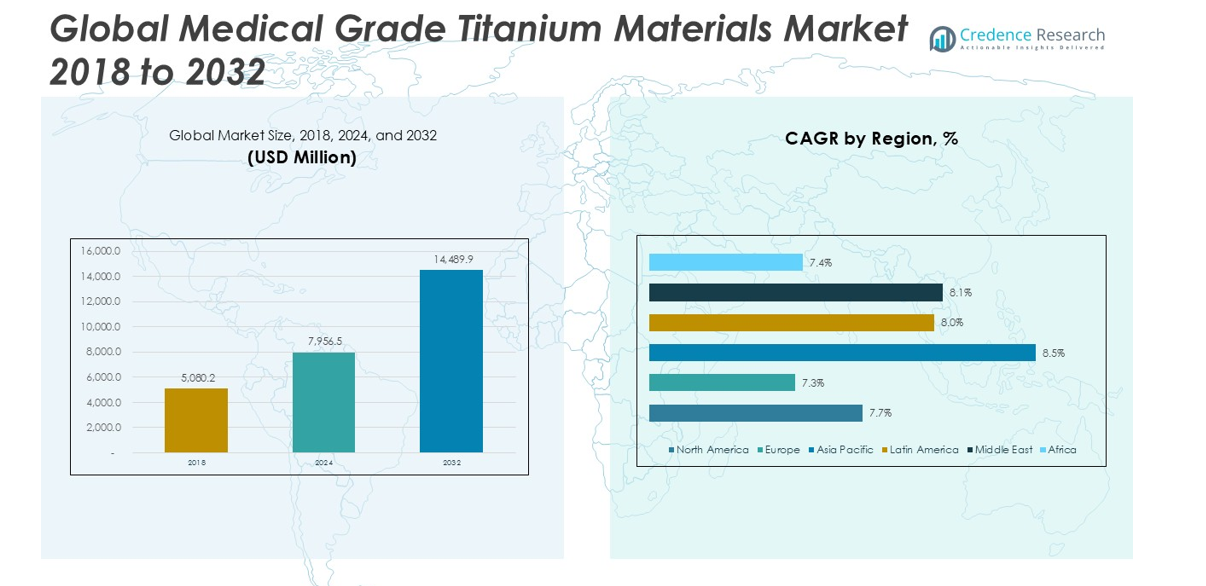
Global Medical Grade Titanium Materials market size was valued at USD 5,080.2 million in 2018 and reached USD 7,956.5 million in 2024. It is anticipated to reach USD 14,489.9 million by 2032, growing at a CAGR of 7.81% during the forecast period.
| REPORT ATTRIBUTE | DETAILS |
|---|---|
| Historical Period | 2020-2023 |
| Base Year | 2024 |
| Forecast Period | 2025-2032 |
| Medical Grade Titanium Materials Market Size 2024 | USD 7,956.5 million |
| Medical Grade Titanium Materials Market, CAGR | 7.81% |
| Medical Grade Titanium Materials Market Size 2032 | USD 14,489.9 billion |
The global medical grade titanium materials market is led by key players including Alcoa Inc., ATI Metals, AMETEK Inc., Daido Steel, Kyocera Medical Corporation, Puris LLC, Hermit GmbH, Western Superconducting Technologies Co., Ltd., and Xi'an Saite Metal Materials Development Co. Ltd. These companies maintain competitiveness through advanced alloy development, strategic partnerships, and expansion into additive manufacturing for customized implants. North America emerged as the leading region in 2024, holding 33.3% of the global market share, driven by strong healthcare infrastructure, high surgical volumes, and early adoption of advanced titanium implants. Europe followed with 27.3% share, supported by established medical device manufacturers and favorable reimbursement policies, while Asia Pacific accounted for 23.7%, reflecting rapid healthcare investments and rising implant demand.
Market Insights
- The global medical grade titanium materials market was valued at USD 7,956.5 million in 2024 and is projected to reach USD 14,489.9 million by 2032, growing at a CAGR of 7.81%.
- Rising demand for orthopedic and dental implants, supported by an aging population and increasing trauma cases, is driving adoption of titanium alloys such as 6AL4V due to their strength, biocompatibility, and durability.
- Key trends include the growing use of 3D printing and additive manufacturing for customized implants and advanced surface modifications that improve osseointegration and implant longevity.
- The competitive landscape is moderately consolidated, with major players like Alcoa Inc., ATI Metals, AMETEK Inc., and Kyocera Medical Corporation investing in R&D, capacity expansion, and strategic partnerships to maintain market leadership.
- Regionally, North America led with 33.3% share in 2024, followed by Europe at 27.3% and Asia Pacific at 23.7%, while titanium 6AL4V dominated materials with over 55% share.
Market Segmentation Analysis:
By Material
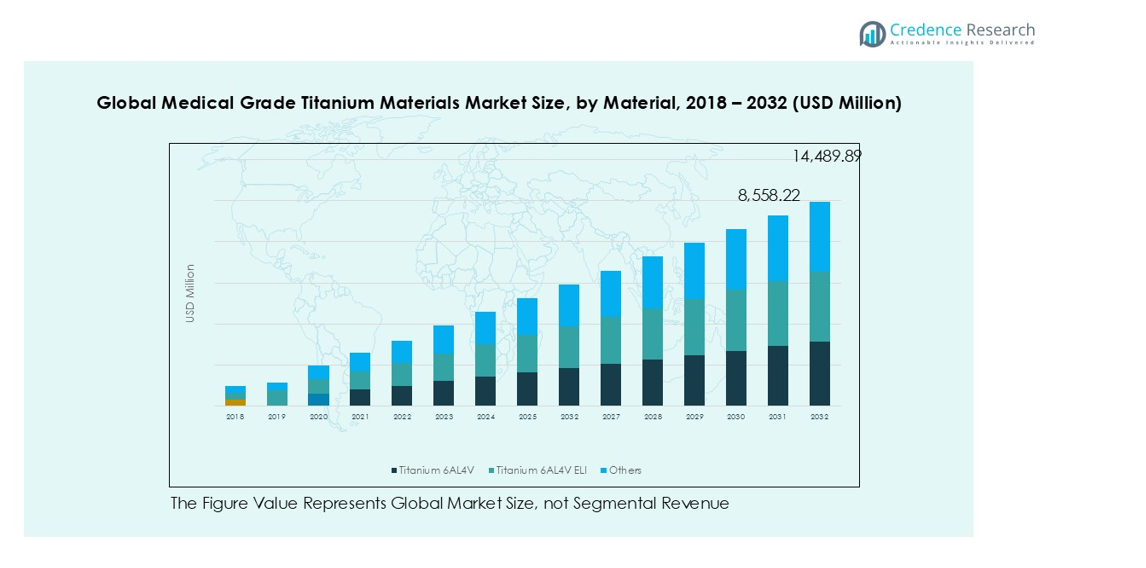
The titanium 6AL4V segment held the dominant share of the medical grade titanium materials market in 2024, accounting for over 55% of the total demand. Its strength-to-weight ratio, corrosion resistance, and biocompatibility make it the preferred choice for surgical implants and prosthetics. The growing use of titanium 6AL4V in critical orthopedic and dental applications continues to support its leadership. Titanium 6AL4V ELI, with enhanced fracture toughness and purity, is gaining adoption in specialized implants, while the "Others" category, including pure titanium, serves niche surgical tools and low-load applications.
- For instance, Carpenter Technology is a major producer of advanced medical materials, including the high-performance alloy titanium 6AL4V, which is widely used in orthopedic implants. The company confirms its strong presence and ongoing supply of specialty alloys to the medical and other critical markets.
By Application
The medical device segment represented a significant share of the market, capturing nearly 40% in 2024. Rising adoption of titanium in cardiovascular devices, surgical instruments, and diagnostic equipment has fueled this dominance. Titanium’s lightweight properties and compatibility with advanced coatings enhance durability and patient safety, driving its acceptance in high-precision devices. Orthopedic implants emerged as the largest sub-segment, holding more than 45% share in 2024, followed by dental implants. The increasing prevalence of joint disorders, trauma cases, and an aging population has driven the use of titanium in hip, knee, and spinal implants. Titanium’s osseointegration ability ensures long-term stability and faster recovery, making it the material of choice for orthopedic reconstruction. Dental implants also show strong growth as cosmetic and restorative dentistry demand rises. Both areas benefit from improved surface modification technologies, which enhance bone integration and extend implant life cycles.
- For instance, Zimmer Biomet is a major manufacturer of orthopedic implants, including hip and knee systems, and utilizes the titanium alloy Ti-6Al-4V ELI in its products for its high strength, biocompatibility, and durability.
Market Overview
Rising Demand for Orthopedic and Dental Implants
The growing prevalence of musculoskeletal disorders and dental conditions is a major driver for medical grade titanium materials. Titanium’s superior biocompatibility, resistance to corrosion, and ability to integrate with bone make it a preferred choice in joint replacements, spinal surgeries, and dental restorations. With the global aging population increasing, particularly in North America, Europe, and Asia-Pacific, the need for hip and knee replacements continues to rise. Additionally, cosmetic and restorative dentistry adoption is expanding rapidly, driven by higher disposable incomes and awareness of oral health. These factors are propelling demand for titanium-based implants worldwide, establishing a strong and sustained growth path.
- For instance, Zimmer Biomet, a global leader in musculoskeletal healthcare, manufactured and marketed a wide range of orthopedic products in 2023, which include hip, knee, and spinal systems that utilize various materials, including titanium and titanium alloys. For the full year 2023, the company reported total net sales of $7.394 billion.
Advancements in Medical Technology and Surface Engineering
Continuous innovation in medical device manufacturing has reinforced the use of titanium materials in critical applications. Advanced surface treatments, including plasma spraying, nanostructuring, and coating technologies, improve osseointegration and reduce implant rejection risks. These improvements extend implant life cycles and reduce revision surgeries, creating strong value for healthcare providers and patients. Moreover, precision manufacturing technologies such as 3D printing and additive manufacturing are increasingly using titanium powders for customized implant production. This ability to produce patient-specific devices enhances treatment outcomes and aligns with the growing trend of personalized medicine. Together, these technological developments ensure titanium materials remain central to next-generation medical devices.
- For instance, Medtronic, a manufacturer of spinal implants, utilizes various technologies, including titanium plasma spray coatings, to enhance the surface of its devices. Surface treatments are intended to promote osseointegration—the integration of the implant with the bone—potentially improving the strength of bone fusion over uncoated implants.
Supportive Regulatory Framework and Healthcare Investments
Regulatory support and global investments in healthcare infrastructure further drive the adoption of medical grade titanium. Stringent guidelines from agencies such as the U.S. FDA and European Medicines Agency have reinforced the safety and reliability of titanium-based implants and devices. Rising government spending on healthcare in developing economies, coupled with private investments in advanced hospitals, accelerates market penetration. Policies that encourage the use of biocompatible and durable materials in surgical applications also strengthen titanium’s competitive edge. In addition, collaborations between hospitals, research institutes, and manufacturers are fostering product innovation, ensuring titanium maintains its position as the material of choice for life-critical applications.
Key Trends & Opportunities
Growth of Additive Manufacturing in Implant Production
Additive manufacturing, particularly 3D printing, is transforming the medical implants market by enabling customized solutions. Titanium powders are extensively used in these processes due to their high strength, light weight, and compatibility with patient-specific geometries. The ability to create porous structures enhances osseointegration and reduces healing times. As healthcare providers focus on patient-centric solutions, the demand for 3D-printed titanium implants is expanding rapidly. This trend presents a strong growth opportunity for titanium suppliers and implant manufacturers, fostering innovation in orthopedic, dental, and craniofacial applications.
- For instance, Stryker uses additive manufacturing to produce thousands of 3D-printed titanium orthopedic implants annually at its facility in Ireland, including devices for hip and spinal applications.
Rising Adoption in Emerging Economies
Emerging markets in Asia-Pacific, Latin America, and the Middle East are witnessing increasing demand for titanium implants and devices. Growing medical tourism, rising healthcare expenditure, and expanding hospital networks are fueling adoption. In countries like India, China, and Brazil, a surge in orthopedic and dental surgeries has created new opportunities for titanium suppliers. Additionally, government programs promoting advanced medical technologies are accelerating access to titanium-based solutions. These regions represent untapped potential, with rising patient volumes and growing awareness of the benefits of titanium materials driving market expansion.
Key Challenges
High Cost of Titanium Materials and Processing
One of the primary challenges for the medical grade titanium materials market is the high cost associated with extraction, processing, and fabrication. Titanium requires advanced manufacturing techniques such as forging, machining, and powder metallurgy, which significantly increase production expenses. For many developing countries, these costs limit widespread adoption, especially in low-income patient groups. While titanium’s durability reduces long-term treatment expenses, the upfront investment remains a barrier for hospitals and patients. Addressing cost challenges through recycling, more efficient processing, and alternative alloys is essential to broaden market access.
Competition from Alternative Biomaterials
The increasing use of alternative biomaterials such as bioceramics, polymers, and advanced composites poses a growing challenge. These materials are being developed to match or exceed titanium’s performance in specific applications while reducing costs and improving flexibility. For example, zirconia is gaining traction in dental implants due to its aesthetic appeal, while PEEK (polyether ether ketone) composites are increasingly used in spinal implants. Although titanium remains the gold standard for many applications, the steady rise of competitive biomaterials could limit its market share if innovation and cost reduction measures are not prioritized by manufacturers.
Regional Analysis
North America
North America dominated the global medical grade titanium materials market in 2024, holding 33.3% share with a value of USD 2,647.36 million, up from USD 1,704.92 million in 2018. The region is projected to reach USD 4,765.72 million by 2032 at a CAGR of 7.7%. Growth is supported by high adoption of titanium in orthopedic and dental implants, advanced healthcare infrastructure, and strong regulatory support. The U.S. leads the market due to extensive surgical volumes and rapid adoption of additive manufacturing technologies, reinforcing the region’s leadership position throughout the forecast period.
Europe
Europe accounted for 27.3% share of the market in 2024, valued at USD 2,172.69 million, rising from USD 1,424.49 million in 2018. It is expected to reach USD 3,815.19 million by 2032, expanding at a CAGR of 7.3%. The region benefits from established medical device manufacturers, high healthcare expenditure, and rising geriatric populations. Demand for titanium-based orthopedic and dental implants continues to expand in Germany, France, and the U.K., where strong reimbursement frameworks exist. The growing presence of research collaborations and advancements in implant surface modifications further strengthen Europe’s steady growth outlook.
Asia Pacific
Asia Pacific emerged as the fastest-growing region, holding 23.7% market share in 2024, with revenues of USD 1,888.19 million, compared to USD 1,157.27 million in 2018. The market is projected to reach USD 3,622.47 million by 2032 at a CAGR of 8.5%. Rising healthcare investments, expanding hospital infrastructure, and growing adoption of dental and orthopedic procedures are driving growth. Countries like China, Japan, and India are at the forefront, fueled by increasing medical tourism and favorable government initiatives. The adoption of 3D printing for customized titanium implants further accelerates the region’s rapid expansion.
Latin America
Latin America represented 7.9% share of the market in 2024, reaching USD 634.93 million from USD 400.83 million in 2018. The market is anticipated to attain USD 1,173.68 million by 2032, growing at a CAGR of 8.0%. Brazil and Mexico lead adoption due to a growing middle-class population, rising healthcare expenditure, and expanding private hospital networks. The demand for titanium implants in trauma and dental care is increasing as awareness of advanced surgical solutions improves. Government support for modernizing healthcare facilities also contributes to expanding titanium material applications in the region.
Middle East
The Middle East accounted for 4.4% share in 2024, with revenues of USD 350.09 million, increasing from USD 220.48 million in 2018. The market is projected to reach USD 649.15 million by 2032, registering a CAGR of 8.1%. Demand is driven by increasing investments in hospital infrastructure, medical tourism hubs such as the UAE, and the adoption of advanced orthopedic and dental implants. Rising lifestyle-related diseases and accident-related trauma cases are creating demand for titanium-based implants. The region’s strategic focus on healthcare modernization continues to create new opportunities for titanium suppliers.
Africa
Africa held the smallest share, accounting for 3.3% of the global market in 2024, with revenues of USD 263.25 million, up from USD 172.22 million in 2018. The market is forecast to reach USD 463.68 million by 2032, growing at a CAGR of 7.4%. Demand is supported by increasing urbanization, improving access to healthcare, and rising government investments in medical infrastructure. South Africa and Nigeria remain key markets, with expanding orthopedic and dental surgery demand. However, limited affordability and reliance on imported medical devices constrain wider adoption, though growth prospects remain strong in the long term.
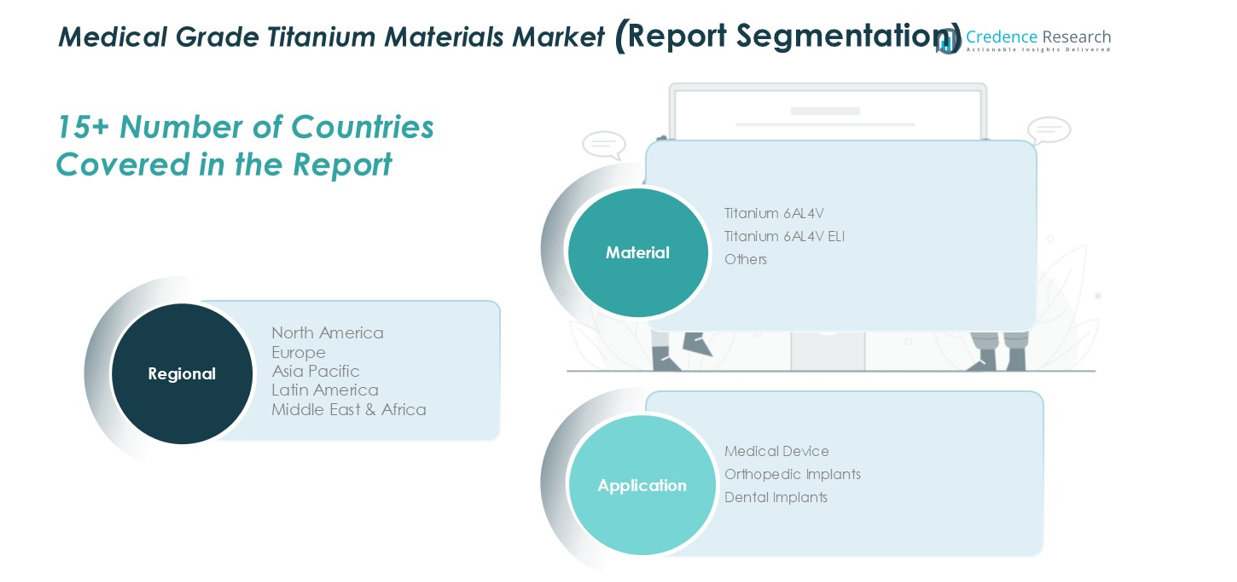
Market Segmentations:
By Material
- Titanium 6AL4V
- Titanium 6AL4V ELI
- Others
By Application
- Medical Device
- Orthopedic Implants
- Dental Implants
By Geography
- North America
- U.S.
- Canada
- Mexico
- Europe
- UK
- France
- Germany
- Italy
- Spain
- Russia
- Belgium
- Netherlands
- Austria
- Sweden
- Poland
- Denmark
- Switzerland
- Rest of Europe
- Asia Pacific
- China
- Japan
- South Korea
- India
- Australia
- Thailand
- Indonesia
- Vietnam
- Malaysia
- Philippines
- Taiwan
- Rest of Asia Pacific
- Latin America
- Brazil
- Argentina
- Peru
- Chile
- Colombia
- Rest of Latin America
- Middle East
- UAE
- KSA
- Israel
- Turkey
- Iran
- Rest of Middle East
- Africa
- Egypt
- Nigeria
- Algeria
- Morocco
- Rest of Africa
Competitive Landscape
The global medical grade titanium materials market is moderately consolidated, with competition driven by product innovation, technological expertise, and strong supply chains. Leading companies such as Alcoa Inc., ATI Metals, AMETEK Inc., Daido Steel, Kyocera Medical Corporation, Puris LLC, Hermit GmbH, Western Superconducting Technologies, and Xi'an Saite Metal Materials dominate the market through broad product portfolios and global reach. These players focus on developing high-performance titanium alloys, advancing additive manufacturing capabilities, and securing long-term contracts with medical device manufacturers. Financial strength and strategic collaborations with hospitals and research institutions provide a competitive edge, while regional players in Asia-Pacific contribute to localized supply and cost advantages. Recent developments highlight increasing investments in R&D, capacity expansion, and vertical integration to strengthen market positions. The competitive environment is further shaped by rising demand for customized implants, driving companies to innovate in titanium processing technologies and establish sustainable growth strategies in emerging markets.
Key Player Analysis
- Alcoa Inc.
- ATI Metals
- AMETEK Inc.
- Daido Steel
- Kyocera Medical Corporation
- Puris LLC
- Hermit GmbH
- Western Superconducting Technologies Co., Ltd.
- Xi'an Saite Metal Materials Development Co. Ltd
- Other Key Players
Recent Developments
- In June 2025, ATI Inc. started titanium alloy sheet production in Pageland, South Carolina. The expansion strengthens titanium supply for critical applications.
- In March 2025, Kyocera Medical Technologies won FDA 510(k) clearance for Tesera-k PL/XL cages. The implants use Ti-6Al-4V ELI per ASTM F3001/F136.
- In March 2025, AMETEK SMP added Coining to its group of businesses. The move expands precision components capacity for med-device customers.
- In February 2024, Daido Steel introduced Ti-15Mo (ASTM F2066) for medical use. The alloy targets flexible, low-modulus implants.
Report Coverage
The research report offers an in-depth analysis based on Material, Application and Geography. It details leading market players, providing an overview of their business, product offerings, investments, revenue streams, and key applications. Additionally, the report includes insights into the competitive environment, SWOT analysis, current market trends, as well as the primary drivers and constraints. Furthermore, it discusses various factors that have driven market expansion in recent years. The report also explores market dynamics, regulatory scenarios, and technological advancements that are shaping the industry. It assesses the impact of external factors and global economic changes on market growth. Lastly, it provides strategic recommendations for new entrants and established companies to navigate the complexities of the market.
Future Outlook
- Demand for titanium implants will rise with the growing global aging population.
- Orthopedic implants will continue to dominate due to increasing joint replacement surgeries.
- Dental implant adoption will expand with higher focus on cosmetic and restorative dentistry.
- 3D printing of titanium implants will gain momentum for patient-specific solutions.
- Surface modification technologies will enhance implant performance and longevity.
- Emerging economies will drive growth through rising healthcare investments and medical tourism.
- Regulatory support will strengthen adoption of titanium in medical applications worldwide.
- Competition will intensify as players expand capacity and invest in R&D.
- Alternative biomaterials will challenge titanium, but its biocompatibility ensures sustained demand.
- Asia Pacific will register the fastest growth, supported by large patient pools and infrastructure expansion.

Request a Free Sample
Fill in your details and we'll send you a free sample report.
- Sample data tables & charts
- Research methodology
Need a Custom Version of This Report?
Tailor the scope, geography, or segments to your exact requirements.
- Custom geography or segment scope
- Direct access to our analyst team
Frequently Asked Questions
What is the current market size for Global Medical Grade Titanium Materials market, and what is its projected size in 2032?
At what Compound Annual Growth Rate is the Global Medical Grade Titanium Materials market projected to grow between 2025 and 2032?
Which Global Medical Grade Titanium Materials market segment held the largest share in 2024?
What are the primary factors fueling the growth of the Global Medical Grade Titanium Materials market?
Who are the major players in this market?
Table of Content
Chapter 1. Report Introduction
- 1.1 Report Description & Purpose
- 1.1.1 Report Title & Market Definition
- 1.1.2 Unique Selling Propositions (USP) & Key Differentiators
- 1.1.3 Value Proposition for Stakeholders
- 1.2 Research Objectives
- 1.2.1 Market Sizing Objectives (Volume & Revenue)
- 1.2.2 Segmentation Objectives
- 1.2.3 Competitive Intelligence Objectives
- 1.2.4 Forecast & Scenario Objectives
- 1.3 Report Scope
- 1.3.1 Medical Grade Titanium Materials Scope – Types & Subtypes Covered
- 1.3.2 Geographic Scope – Regions & Countries Covered
- 1.3.3 Historical Period, Base Year & Forecast Period (2024; forecast to 2032)
- 1.3.4 Inclusions & Exclusions
- 1.4 HS Code & Classification Framework
- 1.5 Currency, Units & Pricing Basis
- 1.6 Target Stakeholders
- 1.7 Limitations & Assumptions
Chapter 2. Executive Summary
- 2.1 Global Medical Grade Titanium Materials Market Snapshot
- 2.1.1 Market Size – Historical (2024) & Forecast (2024-2032) (2024: USD 7,956.5 million → 2032: USD 14,489.9 million)
- 2.1.2 Volume & Revenue – Global Totals
- 2.1.3 Key Market Highlights – Top Five Facts
- 2.2 Medical Grade Titanium Materials Market Segmentation Snapshot
- 2.2.1 Market Split by Region – 2024 vs. 2032
- 2.3 Competitive Snapshot
- 2.3.1 Top 10 Players by Revenue Share – 2024
- 2.3.2 Top 10 Players by Volume Share – 2024
- 2.3.3 Recent Strategic Developments (18-Month Summary)
- 2.4 Key Investment Highlights & Strategic Conclusions
Chapter 3. Medical Grade Titanium Materials Market Dynamics & Industry Analysis
- 3.1 Market Overview & Context
- 3.1.1 Medical Grade Titanium Materials Market Position in the Broader Automotive Value Chain
- 3.1.2 OEM vs. Replacement Market Dynamics
- 3.1.3 Market Maturity & Development Stage by Region
- 3.2 Medical Grade Titanium Materials Market Drivers
- 3.3 Medical Grade Titanium Materials Market Restraints & Challenges
- 3.4 Medical Grade Titanium Materials Market Opportunities
- 3.5 Porter's Five Forces Analysis
- 3.5.1 Threat of New Entrants
- 3.5.2 Bargaining Power of Suppliers
- 3.5.3 Bargaining Power of Buyers
- 3.5.4 Threat of Substitutes
- 3.5.5 Competitive Rivalry – Intensity Assessment
- 3.6 Medical Grade Titanium Materials Value Chain Analysis
- 3.6.1 Upstream – Raw Material/Input Suppliers
- 3.6.1.1 Raw Material/Input 1
- 3.6.1.2 Raw Material/Input 2
- 3.6.1.3 Raw Material/Input 3
- 3.6.2 Midstream – Production/Manufacturing/Service Delivery
- 3.6.2.1 Production/Process Overview
- 3.6.2.2 Key Facility Locations & Capacity by Manufacturer
- 3.6.3 Downstream – Distribution & End Consumer
- 3.6.3.1 Primary Channel – B2B/OEM
- 3.6.3.2 Secondary Channels – Dealer, Retail, Online, Direct
- 3.6.4 Value Chain Profitability Analysis
- 3.6.1 Upstream – Raw Material/Input Suppliers
- 3.7 PESTEL Analysis
- 3.7.1 Political Factors
- 3.7.2 Economic Factors
- 3.7.3 Social Factors
- 3.7.4 Technological Factors
- 3.7.5 Environmental Factors
- 3.7.6 Legal Factors
- 3.8 Medical Grade Titanium Materials Supply Chain Analysis
- 3.8.1 Raw Material/Input Supply Risk Assessment
- 3.8.2 Manufacturing Concentration Risk (Geographic Exposure)
- 3.8.3 Trade Disruption Impact Analysis
- 3.9 Regulatory & Policy Landscape
Note: The regulatory and policy landscape section covers regulations based on their applicability to the market, Medical Grade Titanium Materials category, geography, and scope of the study. Only regulatory frameworks with a material impact on operations, compliance, trade, sustainability, or market access are analyzed in detail.
Chapter 4. Key Investment Pockets & Opportunity Analysis
- 4.1 Medical Grade Titanium Materials Market Attractiveness Analysis
- 4.1.1 By Region – Investment Attractiveness Matrix (Volume × CAGR)
- 4.2 Absolute Revenue Growth Opportunity
- 4.2.1 By Region – Absolute USD Growth Through 2032
- 4.3 Incremental Volume Opportunity
- 4.3.1 By Region – Incremental Volume Through 2032
- 4.3.2 Segment – Incremental Volume
- 4.4 Emerging Submarket Opportunity Deep Dive (Subject to Applicability)
- 4.5 Emerging Market Opportunity Scorecards
- 4.5.1 United States
- 4.5.2 Europe
- 4.5.3 Asia
- 4.5.4 Middle East & Africa
Note: Emerging Market Opportunity Scorecards will be included based on relevance and strategic importance. Regions listed are indicative and may vary depending on data availability and market dynamics.
Chapter 5. Medical Grade Titanium Materials Import-Export Analysis & Trade Flows
- 5.1 Global Trade Overview
- 5.1.1 Global Export Value by Country (2024)
- 5.1.2 Global Export Volume by Country (2024)
- 5.1.3 Global Import Value by Country (2024)
- 5.1.4 Global Import Volume by Country (2024)
- 5.1.5 Net Trade Balance by Country (2024)
- 5.2 Export Analysis – Segment
- 5.2.1 Type 1 (HS Code)
- 5.2.2 Type 2 (HS Code)
- 5.2.3 Type 3 (HS Code)
- 5.2.4 Type 4 (HS Code)
- 5.2.5 Type 5 (HS Code)
- 5.3 Import Analysis – Segment
- 5.3.1 Type 1 (HS Code)
- 5.3.2 Type 2 (HS Code)
- 5.3.3 Type 3 (HS Code)
- 5.3.4 Type 4 (HS Code)
- 5.3.5 Type 5 (HS Code)
- 5.4 Average Unit Trade Prices
- 5.4.1 Average Export Price – Segment & Country
- 5.4.2 Average Import Price – Segment & Source Country
- 5.4.3 Price Trends (2024)
- 5.5 Key Trade Route Analysis
- 5.5.1 Trade Route 1
- 5.5.2 Trade Route 2
- 5.5.3 Trade Route 3
- 5.5.4 Trade Route 4
- 5.5.5 Trade Route 5
- 5.6 Trade Policy Impact Assessment
- 5.6.1 US Anti-Dumping & Section 301 Tariffs
- 5.6.2 EU Customs Union Impact
- 5.6.3 Major Free Trade Agreements
- 5.6.4 USMCA Rules of Origin
Note: Trade policy analysis will be included only where relevant to the Medical Grade Titanium Materials market.
Chapter 6. Competitive Landscape & Company Benchmarking
- 6.1 Medical Grade Titanium Materials Market Concentration & Structure
- 6.1.1 Herfindahl-Hirschman Index (HHI) – vs. 2024
- 6.1.2 Tier 1, Tier 2 & Tier 3 Market Structure
- 6.1.3 Global, Regional & Local Player Dynamics
- 6.2 Medical Grade Titanium Materials Market Share Analysis – 2024
- 6.2.1 Global Revenue Share by Company
- 6.2.2 Global Volume Share by Company
- 6.2.3 Regional Revenue Share
- 6.2.4 Market Share Evolution ( vs. 2024)
- 6.2.5 OEM Segment Share by Company
- 6.2.6 Replacement Segment Share by Company
- 6.3 Production/Delivery Capacity & Facility Analysis
- 6.3.1 Global Installed Capacity
- 6.3.2 Capacity Utilization Rates
- 6.3.3 Production/Output Volume
- 6.3.4 Facility Locations & Capacity Map
- 6.3.5 Planned Capacity Additions
- 6.4 Medical Grade Titanium Materials Competitive Benchmarking Matrix
- 6.4.1 Revenue, Volume, CAGR & Profitability Comparison
- 6.4.2 Channel Revenue Mix
- 6.4.3 Geographic Revenue Exposure
- 6.4.4 R&D Intensity
- 6.4.5 Sustainability Maturity
- 6.5 Strategic Developments in Medical Grade Titanium Materials (Last 24 Months)
- 6.5.1 Mergers, Acquisitions & Divestments
- 6.5.2 New Medical Grade Titanium Materials Launches
- 6.5.3 Facility Expansions
- 6.5.4 Strategic Alliances, Joint Ventures & Partnerships
- 6.5.5 Distribution Expansion & Market Entry
- 6.5.6 Sustainability & ESG Initiatives
- 6.6 Competitive Strategy Mapping
- 6.6.1 Leader, Challenger, Follower & Niche Classification
- 6.6.2 Pricing Strategy Comparison
- 6.6.3 Channel Strategy Matrix
Note: Strategic developments are included based on their materiality and the availability of reliable information.
Chapter 7. Global Medical Grade Titanium Materials Market – By Distribution Channel
- 7.1 Segment Overview
- 7.1.1 Volume & Revenue Split by Channel (2024 & 2032)
- 7.1.2 Channel Mix Evolution (2024-2032)
Chapter 8. Regional Market Analysis – Global Overview
- 8.1 Global Regional Overview
- 8.1.1 Regional Volume Share
- 8.1.2 Regional Revenue Share
- 8.1.3 Regional Volume by Region
- 8.1.4 Regional Revenue by Region
- 8.1.5 Regional Forecast Through 2032
- 8.2 Cross-Regional Segment Analysis
- 8.2.1 By Distribution Channel
- 8.2.2 By Brand/Price Tier
Chapter 9. North America Medical Grade Titanium Materials Market
- 9.1 United States
- 9.2 Canada
- 9.3 Mexico
Chapter 10. Europe Medical Grade Titanium Materials Market
- 10.1 Germany
- 10.2 France
- 10.3 Italy
- 10.4 United Kingdom
- 10.5 Spain
- 10.6 Poland
- 10.7 Russia
- 10.8 Netherlands
- 10.9 Belgium
- 10.10 Sweden
- 10.11 Denmark
- 10.12 Norway
- 10.13 Rest of Europe
Chapter 11. Asia Pacific Medical Grade Titanium Materials Market
- 11.1 China
- 11.2 India
- 11.3 Japan
- 11.4 South Korea
- 11.5 Thailand
- 11.6 Indonesia
- 11.7 Vietnam
- 11.8 Malaysia
- 11.9 Australia
- 11.10 Rest of Asia Pacific
Chapter 12. Latin America Medical Grade Titanium Materials Market
- 12.1 Brazil
- 12.2 Argentina
- 12.3 Colombia
- 12.4 Chile
- 12.5 Rest of Latin America
Chapter 13. Middle East Medical Grade Titanium Materials Market
- 13.1 Saudi Arabia
- 13.2 United Arab Emirates
- 13.3 Turkey
- 13.4 Israel
- 13.5 Iran
- 13.6 Rest of the Middle East
Chapter 14. Africa Medical Grade Titanium Materials Market
- 14.1 South Africa
- 14.2 Egypt
- 14.3 Nigeria
- 14.4 Morocco
- 14.5 Rest of Africa
Chapter 15. Medical Grade Titanium Materials Company Profiles
- 15.1 [Company 01]
- 15.1.1 Company Overview
- 15.1.2 Key Management Personnel
- 15.1.3 Products & Services Portfolio
- 15.1.4 Financial Performance
- 15.1.5 Key Market Focus & Geographic Presence
- 15.1.6 Recent Developments & Strategic Initiatives
Note: The company profile list is preliminary and may change based on research findings, market developments, data availability, and client requirements.
Chapter 16. Appendices
- Appendix A – List of Abbreviations & Acronyms
- Appendix B – Industry Classification Code Reference – Full Series
- Appendix C – Production & Capacity Data Tables
- Appendix D – End-Use & Demand Base Tables
- Appendix E – Consumption & Replacement Rate Assumptions
- Appendix F – ASP Reference Tables
- Appendix G – Manufacturing & Facility Database
- Appendix H – Import-Export Data Tables
- Appendix I – Regulatory Summary Tables
- Appendix J – Primary Research Participant List (Anonymized)
- Appendix K – Primary Research Questionnaire Framework
- Appendix L – Data Sources & Bibliography
- Appendix M – Market Size Divergence & Source Comparison
Chapter 17. Research Methodology
- 17.1 Research Framework & Philosophy
- 17.2 Secondary Research – Sources, Hierarchy & Data Extraction
- 17.3 Data Modeling – Bottom-Up & Top-Down Market Sizing
- 17.4 Primary Research – Stakeholder Framework, LOI & Sample Sizes
- 17.5 Forecast Methodology – Regression, Scenario & Sensitivity Analysis
- 17.6 Quality Control – Four-Layer Validation Framework
- 17.7 Limitations & Standard Assumptions
- 17.8 Disclaimer