
| REPORT ATTRIBUTE | DETAILS |
|---|---|
| Historical Period | 2019-2022 |
| Base Year | 2023 |
| Forecast Period | 2024-2032 |
| Network Security Policy Management Market Size 2024 | USD 1,905 Million |
| Network Security Policy Management Market, CAGR | 6.5% |
| Network Security Policy Management Market Size 2032 | USD 3,152.76 Million |
Market Overview
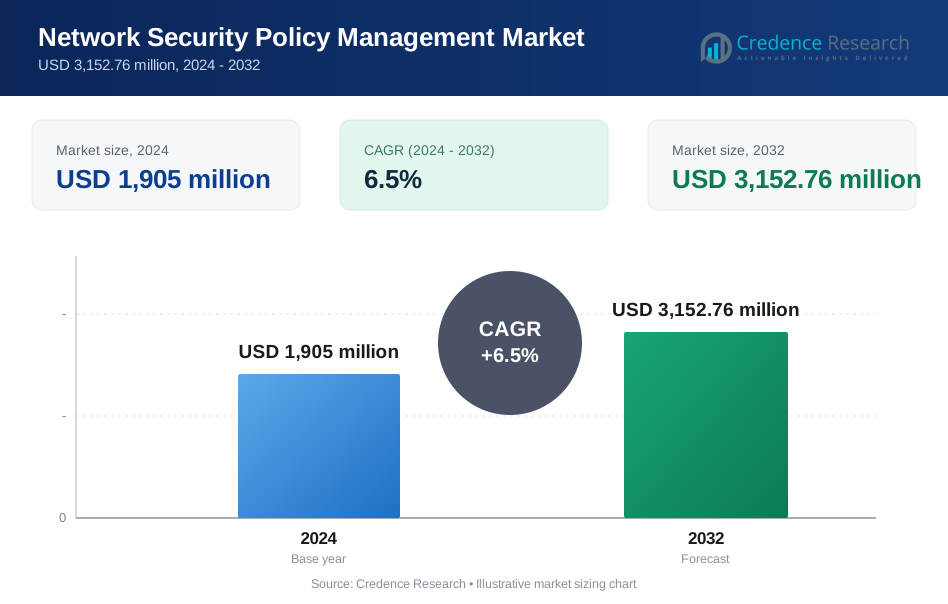
The Network Security Policy Management Market is expected to grow from USD 1,905 million in 2024 to USD 3,152.76 million by 2032, reflecting a compound annual growth rate (CAGR) of 6.5%.
The Network Security Policy Management market is driven by the increasing frequency and sophistication of cyber threats, compelling organizations to adopt robust security frameworks. As businesses expand their digital operations, the need for comprehensive policy management solutions to safeguard sensitive data and ensure compliance with regulations grows. The rise of cloud-based services, remote work, and IoT integration further accelerates the demand for advanced security management tools. Additionally, the increasing complexity of network infrastructures and the need for real-time monitoring fuel the market’s growth. Trends such as automation of security policies, the integration of AI and machine learning for threat detection, and the shift towards unified security platforms are shaping the future of the industry. As cyber-attacks evolve, organizations are investing in next-generation security solutions to enhance their network resilience, compliance capabilities, and overall risk management strategies. These factors contribute to a positive growth trajectory for the Network Security Policy Management market.
The Network Security Policy Management market is globally diverse, with North America and Europe leading in market share due to their advanced technological infrastructure and stringent regulatory requirements. North America accounts for approximately 35% of the market, driven by high demand for cybersecurity solutions in sectors like finance, healthcare, and government. Europe follows closely with a market share of around 30%, influenced by GDPR and other data protection laws. Key players shaping the market include Check Point Software Technologies, Tufin, McAfee, Palo Alto Networks, and AlgoSec Inc. These companies provide comprehensive solutions to manage and enforce security policies, offering advanced tools for real-time threat monitoring, compliance management, and risk mitigation. Their continuous innovation and strategic partnerships drive growth across regions, particularly in the wake of evolving cyber threats.
Market Drivers:
Increasing Cyber Threats and Security Breaches:
The growing frequency and sophistication of cyberattacks are significant drivers of the Network Security Policy Management market. Organizations face rising threats such as ransomware, phishing, and advanced persistent threats (APTs) that target vulnerabilities within their network systems. For instance, a survey by PwC revealed that Indian organizations are most concerned about cloud-related threats and attacks on connected devices. As cyberattacks become more complex, the need for advanced network security policy management solutions is more crucial than ever. These tools help businesses effectively monitor, enforce, and update security policies to prevent unauthorized access, ensuring the integrity and confidentiality of sensitive data.
Expanding Digital Transformation and Cloud Adoption:
With the acceleration of digital transformation, many organizations are migrating their operations to cloud-based platforms. This shift increases the complexity of network security as businesses must secure multi-cloud environments and distributed networks. For example, a KPMG report highlights that government organizations are increasingly adopting cloud-based technology to enhance citizen engagement and service delivery. Network Security Policy Management solutions enable businesses to streamline their security operations, ensuring proper policy enforcement across various digital assets and endpoints. The growing adoption of cloud services further propels the demand for scalable and flexible security management tools that can integrate seamlessly with cloud infrastructure and adapt to evolving network demands.
Regulatory Compliance and Data Privacy Requirements:
As data privacy regulations such as GDPR and CCPA become more stringent, organizations are under increasing pressure to maintain compliance with these laws. Non-compliance can result in hefty fines and reputational damage. For instance, a survey by Secureframe found that 94% of organizations believe their customers would not buy from them if they did not protect data properly. Network Security Policy Management tools offer essential capabilities for automating and managing compliance processes, ensuring that organizations adhere to security standards and privacy regulations. This growing regulatory environment compels businesses to implement advanced security frameworks and monitoring systems, driving the adoption of policy management solutions.
Remote Work and Increased IoT Connectivity:
The rise of remote work and the growing adoption of IoT devices have expanded the attack surface for businesses, making network security more challenging. Securing remote endpoints and IoT devices requires comprehensive security policy management to ensure consistent enforcement across all devices and users. For example, a report by Lookout found that 92% of remote workers use personal devices for work tasks, which increases security risks. Network Security Policy Management solutions provide centralized control and real-time monitoring, enabling businesses to protect their network from potential vulnerabilities associated with remote work and connected devices. This trend is fueling demand for advanced policy management solutions to safeguard networks from evolving threats.
Market Trends:
Integration of AI and Machine Learning:
One of the key trends in the Network Security Policy Management market is the integration of artificial intelligence (AI) and machine learning (ML) technologies. These tools enable security systems to analyze vast amounts of data in real time, detecting and responding to emerging threats more effectively. For instance, a report by EC-Council highlights that AI and ML can significantly enhance cybersecurity by automating threat detection, policy enforcement, and incident response, reducing the need for manual intervention and improving the efficiency of network security management. As cyber threats become increasingly sophisticated, AI-driven solutions are helping organizations stay ahead of potential risks.
Cloud-Native Security Solutions:
As businesses continue to adopt cloud services, there is a noticeable shift towards cloud-native network security policy management solutions. These platforms are designed to operate seamlessly in multi-cloud environments, offering enhanced scalability, flexibility, and ease of integration. For example, a report by SentinelOne indicates that cloud-native security platforms provide real-time insights and automated compliance, which are crucial for managing security across distributed cloud infrastructures. Cloud-native solutions allow organizations to enforce security policies across distributed cloud infrastructures, providing consistent protection regardless of where data or applications are hosted. This trend reflects the growing demand for security tools that can scale with an organization’s digital transformation and cloud adoption.
Automation of Security Policy Management:
The automation of network security policy management is rapidly gaining traction as organizations seek to improve operational efficiency and reduce human error. Automated solutions streamline tasks such as policy creation, enforcement, monitoring, and updates. For instance, a report by AlgoSec explains that security policy automation can significantly reduce manual tasks, minimize false positive alerts, and decrease downtime. By reducing manual intervention, businesses can more effectively manage security policies across complex networks and ensure consistent compliance with industry regulations. Automation also enables real-time threat detection and immediate response, ensuring that security protocols are enforced quickly and effectively.
Shift Towards Unified Security Platforms:
Another trend in the market is the movement toward unified security platforms that integrate network security policy management with other cybersecurity functions. These platforms allow organizations to consolidate various security tools, providing centralized control and better visibility across their network. For example, Microsoft’s unified security operations platform combines extended detection and response (XDR) with security information and event management (SIEM) to offer comprehensive protection. By combining policy management with threat intelligence, incident response, and compliance monitoring, unified platforms streamline security operations and enhance overall risk management. This trend is driving the demand for solutions that offer comprehensive, integrated protection for complex, modern network infrastructures.
Market Challenges Analysis:
Complexity of Multi-Network Environments:
One of the major challenges facing the Network Security Policy Management market is the increasing complexity of multi-network environments. As organizations adopt hybrid cloud infrastructures, integrate IoT devices, and expand remote work initiatives, managing security policies across diverse networks becomes a daunting task. Different platforms, devices, and applications require tailored security measures, and enforcing consistent policies across these varied systems can be difficult. Additionally, network boundaries are no longer confined to traditional perimeters, which makes it harder to monitor and secure traffic. This complexity can lead to gaps in security coverage, increased risk of vulnerabilities, and challenges in maintaining regulatory compliance.
Evolving Threat Landscape and Resource Constraints:
The rapidly evolving nature of cyber threats presents another significant challenge for network security policy management. Hackers are continuously developing new tactics to exploit vulnerabilities, and traditional security tools may struggle to keep up with these advancements. Organizations often face difficulty in quickly adapting their security policies to counteract these new threats. Furthermore, many businesses, particularly small and medium-sized enterprises (SMEs), are constrained by limited resources, which may hinder their ability to invest in advanced network security management solutions. Without adequate investment in technology, skilled personnel, and continuous policy updates, organizations may find it challenging to effectively protect their networks against the latest cyber threats and security breaches.
Market Segmentation Analysis:
By Component
The Network Security Policy Management market is divided into two main components: solutions and services. The solution segment encompasses software tools and platforms that enable businesses to define, enforce, and manage security policies across their networks. These solutions include policy management software, compliance management tools, configuration management systems, and threat intelligence platforms. They are essential for organizations to protect their IT infrastructure and comply with industry regulations, ensuring that security policies are consistently enforced across all devices and platforms. As cyber threats become more sophisticated, the demand for advanced network security solutions that can automate policy enforcement, monitor threats in real time, and ensure compliance with regulatory standards is on the rise. These solutions are critical to businesses seeking to minimize security risks and improve operational efficiency, making the solution segment the primary growth driver in the Network Security Policy Management market.
By Solution
The solution segment in the Network Security Policy Management market is further divided into various types of software and platforms, each serving a specific function in managing network security policies. Key solutions include policy management software, compliance management tools, configuration management systems, and threat intelligence platforms. Policy management software, the leading sub-segment, allows businesses to define and enforce security policies across their network infrastructure, ensuring consistency and protection from cyber threats. Compliance management tools are also essential, enabling organizations to meet industry-specific regulatory requirements and avoid penalties for non-compliance. Configuration management systems play a vital role in automating the configuration and monitoring of network devices, reducing errors and improving security posture. These solutions provide centralized control, streamline security operations, and help businesses address evolving cyber threats effectively. As organizations prioritize network security, the demand for comprehensive solutions in this segment continues to grow, contributing to the overall market expansion.
Segments:
Based on Component:
- Software
- Cloud-Based
- On-Premise
- Services
-
- Professional Services
- Managed Services
Based on Solution:
- Security Policy Management
- Change Management System
- Risk and Vulnerability Analysis
- Application Connectivity Management
Based on End-use:
- Banking
- Financial Services and Insurance (BFSI)
- Healthcare, Government
- IT & Telecom, Retail, Transportation
- Energy & Utilities
- Others
Based on Enterprise Size:
- Small & Medium Enterprises (SMEs)
- Large Enterprises
Based on the Geography:
- North America
- U.S.
- Canada
- Mexico
- Europe
- Germany
- France
- U.K.
- Italy
- Spain
- Rest of Europe
- Asia Pacific
- China
- Japan
- India
- South Korea
- South-east Asia
- Rest of Asia Pacific
- Latin America
- Brazil
- Argentina
- Rest of Latin America
- Middle East & Africa
- GCC Countries
- South Africa
- Rest of the Middle East and Africa
Regional Analysis:
North America
North America remains the leading region in the Network Security Policy Management market, commanding a substantial share due to its advanced technological landscape and high demand for robust cybersecurity solutions. The region’s market share is projected to be around 35% in 2024, driven by the rapid adoption of cloud computing, the increasing number of connected devices, and the growing sophistication of cyber threats. The United States is at the forefront of this growth, with its large-scale enterprises, critical infrastructure, and government organizations investing heavily in cybersecurity to protect sensitive data and maintain compliance with regulations such as HIPAA, PCI-DSS, and the CCPA. The presence of major market players, coupled with ongoing innovations in AI and machine learning, positions North America as a key hub for the development and deployment of next-generation network security policy management solutions. Additionally, the rise of remote work and the shift toward hybrid IT environments are accelerating the need for comprehensive, scalable, and efficient security solutions across various industries, including finance, healthcare, and IT services. As cyber risks continue to evolve, the demand for automated and centralized network security management tools will further reinforce North America’s leadership in the market.
Europe
Europe is a significant player in the Network Security Policy Management market, holding an estimated market share of 30% in 2024. This is primarily driven by stringent data privacy laws, such as the General Data Protection Regulation (GDPR), which have made network security management a high priority for businesses operating within the European Union. As businesses across Europe digitalize their operations, the need for comprehensive security policies and tools to safeguard data and ensure compliance has grown substantially. Key markets within Europe, including Germany, the United Kingdom, France, and the Netherlands, are witnessing an increased adoption of security policy management solutions to address emerging cybersecurity threats, such as ransomware, phishing attacks, and data breaches. The rapid digital transformation of sectors like finance, healthcare, and manufacturing in Europe further fuels the demand for effective network security solutions. Moreover, the shift toward hybrid cloud environments and the proliferation of IoT devices across various industries are driving organizations to seek out solutions that can provide centralized control and real-time monitoring. The growing emphasis on data protection, combined with evolving cyber threats and stricter compliance regulations, positions Europe for continued growth in the Network Security Policy Management market, with future expansion likely to be supported by an increase in investment from both public and private sectors in securing digital infrastructures.
Key Player Analysis:
- Check Point Software Technologies Ltd.
- Tufin
- Odyssey Consultants
- McAfee
- Juniper Networks
- Sophos Ltd.
- FireMon, LLC.
- Palo Alto Networks, Inc.
- AlgoSec Inc.
- Integration OPAQ Networks
Competitive Analysis:
The Network Security Policy Management market is highly competitive, with leading players continually advancing their solutions to address evolving cybersecurity challenges. Companies like Check Point Software Technologies, Tufin, McAfee, Palo Alto Networks, and AlgoSec Inc. are at the forefront, offering a wide range of security management solutions tailored to protect complex network infrastructures. For instance, a survey by a government cybersecurity authority highlighted that over 70% of organizations have adopted AI-driven security solutions to automate policy enforcement and enhance threat detection. These players are leveraging cutting-edge technologies such as artificial intelligence and machine learning to automate policy enforcement, enhance threat detection, and streamline compliance processes. The competition is intensifying as businesses increasingly prioritize comprehensive, scalable security frameworks. To maintain a competitive edge, companies are focusing on strategic partnerships, acquisitions, and product innovations, while also expanding their offerings to address emerging risks such as cloud security, IoT vulnerabilities, and remote work threats. Continuous innovation and superior customer support are key differentiators in capturing market share and sustaining long-term growth.
Recent Developments:
- In March 2023, Cisco, a provider of cybersecurity and cloud solutions, intends to buy Valtix, a pioneer in the area of cloud network security, from Silicon Valley. Cisco's objectives in the area of multi-cloud network security and the benefit of having tools for monitoring traffic through business apps are two factors that led to the acquisition. The Valtix platform includes capabilities including application defence, secure deployment, and automated cloud application discovery.
- In February 2024, Palo Alto Networksannounced updates to its Panorama solution, enhancing AI-driven policy automation features for hybrid and multi-cloud environments.
- In March 2024, Cisco Systemslaunched new capabilities for its Secure Network Analytics platform, integrating enhanced threat detection and response.
- In April 2024, Tufin expanded its cloud-native security offerings by introducing advanced policy automation for multi-cloud deployments.
Market Concentration & Characteristics:
The Network Security Policy Management market exhibits moderate concentration, with a few key players dominating the landscape. Companies like Check Point Software Technologies, Tufin, McAfee, Palo Alto Networks, and AlgoSec Inc. hold significant market share due to their advanced, comprehensive solutions and strong brand presence. These players invest heavily in research and development to offer innovative features such as AI-driven threat detection, automated policy enforcement, and seamless integration with multi-cloud environments. Smaller players and new entrants contribute to market diversification, but the dominant companies maintain strong customer bases across various industries, including finance, healthcare, and government. The market's characteristics include rapid innovation, high demand for scalable solutions, and a focus on enhancing compliance and real-time monitoring. As cyber threats evolve, the competitive landscape continues to shift, pushing companies to strengthen their offerings and expand their market reach.
Report Coverage:
The research report offers an in-depth analysis based on Enterprise Size, Component, Solution End-User and Geography. It details leading market players, providing an overview of their business, product offerings, investments, revenue streams, and key applications. Additionally, the report includes insights into the competitive environment, SWOT analysis, current market trends, as well as the primary drivers and constraints. Furthermore, it discusses various factors that have driven market expansion in recent years. The report also explores market dynamics, regulatory scenarios, and technological advancements that are shaping the industry. It assesses the impact of external factors and global economic changes on market growth. Lastly, it provides strategic recommendations for new entrants and established companies to navigate the complexities of the market.
Future Outlook:
- The Network Security Policy Management market is expected to continue its growth as cyber threats become more sophisticated.
- Increasing adoption of cloud-based solutions will drive demand for scalable and flexible security management tools.
- Automation of policy enforcement and real-time threat monitoring will be a key focus for future solutions.
- Integration of artificial intelligence and machine learning into security platforms will enhance proactive threat detection.
- Compliance with regulatory frameworks like GDPR and CCPA will remain a significant driver for market growth.
- The rise of remote work and IoT connectivity will further increase the need for robust network security solutions.
- Advanced analytics and unified security platforms will dominate the future market landscape.
- Small and medium-sized enterprises (SMEs) will increasingly adopt network security policy management solutions.
- The growing complexity of multi-cloud environments will necessitate advanced, centralized policy management solutions.
- Strategic partnerships and acquisitions will continue to shape the competitive landscape of the market.
Request a Free Sample
Fill in your details and we'll send you a free sample report.
- Sample data tables & charts
- Research methodology
Market Dynamics
Increasing Cyber Threats and Security Breaches
The rising frequency and sophistication of cyberattacks, such as ransomware and advanced persistent threats, are compelling organizations to adopt advanced network security policy management solutions to protect sensitive data and ensure business continuity.
Expanding Digital Transformation and Cloud Adoption
As organizations migrate to cloud-based platforms and embrace digital transformation, the complexity of securing multi-cloud and hybrid environments increases, driving demand for scalable and flexible policy management tools.
Regulatory Compliance and Data Privacy Requirements
Stringent regulations like GDPR and CCPA require organizations to maintain robust security policies and demonstrate compliance, making automated policy management solutions essential to avoid penalties and reputational damage.
Remote Work and IoT Connectivity
The proliferation of remote work and IoT devices has expanded the attack surface, necessitating centralized and real-time security policy management to ensure consistent protection across diverse endpoints and networks.
Automation and AI Integration in Security Management
The adoption of AI and automation in security policy management enables real-time threat detection, reduces manual errors, and streamlines compliance, making these technologies key drivers for market growth as organizations seek operational efficiency and proactive defense.
Need a Custom Version of This Report?
Tailor the scope, geography, or segments to your exact requirements.
- Custom geography or segment scope
- Direct access to our analyst team
Frequently Asked Questions
What is the current size of the Network Security Policy Management market?
What factors are driving the growth of the Network Security Policy Management market?
What are the key segments within the Network Security Policy Management market?
What are some challenges faced by the Network Security Policy Management market?
Who are the major players in the Network Security Policy Management market?
Table of Content
Chapter 1 Market Segmentation
- 1.1 Segmentation Framework
- 1.1.1 Product and Service Classification
- 1.1.2 Application and End-Use Classification
- 1.1.3 Technology and Solution Classification
- 1.1.4 Customer and Distribution Channel Classification
- 1.1.5 Geographic Segmentation
- 1.1.6 Market Segment Definitions and Boundaries
- 1.2 By End-use
- 1.2.1 Banking, Financial Services and Insurance (BFSI)
- 1.2.2 Healthcare
- 1.2.3 Government
- 1.2.4 IT & Telecom
- 1.2.5 Retail, Transportation, Energy & Utilities
- 1.2.6 Others
- 1.3 By Solution
- 1.3.1 Security Policy Management
- 1.3.2 Change Management System
- 1.3.3 Risk and Vulnerability Analysis
- 1.3.4 Application Connectivity Management
- 1.4 By Component
- 1.4.1 Software (Cloud-Based, On-Premise)
- 1.4.2 Professional Services
- 1.4.3 Managed Services
- 1.5 By Enterprise Size
- 1.5.1 Small & Medium Enterprises (SMEs)
- 1.5.2 Large Enterprises
Chapter 2 Introduction
- 2.1 Report Objectives and Scope
- 2.2 Product Definition and Industry Terminology
- 2.3 Market Inclusions and Exclusions
- 2.4 Research Process
- 2.4.1 Primary Research and Expert Interviews
- 2.4.2 Secondary Research and Source Review
- 2.4.3 Top-Down and Bottom-Up Estimation
- 2.4.4 Data Triangulation and Verification
- 2.5 Market Size Measurement Basis
- 2.5.1 2024: USD 1,905 million → 2032: USD 3,152.76 million
- 2.6 Historical and Forecast Reference Periods
- 2.6.1 Base Year: 2024
- 2.6.2 Forecast Period: 2024-2032
- 2.7 Research Assumptions and Limitations
Chapter 3 Executive Summary
- 3.1 Market Snapshot and Key Findings
- 3.2 Base-Year Market Size, 2024
- 3.3 Forecast Market Size, 2032
- 3.4 Revenue and Volume Growth Outlook
- 3.5 Key Demand and Supply Indicators
- 3.6 Leading Market Segments
- 3.7 Fastest-Growing Market Opportunities
- 3.8 Regional Performance Highlights
- 3.9 Technology and Industry Transformation
- 3.10 Competitive Landscape Summary
- 3.11 Analyst View and Strategic Implications
Chapter 4 Global Network Security Policy Management Market Trends and Developments
- 4.1 Historical Industry Development
- 4.2 Recent Market Trends and Developments
- 4.3 Demand and Customer Behavior Trends
- 4.4 Technology and Product Innovation
- 4.5 Artificial Intelligence, Automation and Digitalization
- 4.6 Local Manufacturing and Supply Chain Realignment
- 4.7 Industry Partnerships, Mergers and Acquisitions
- 4.8 Sustainability and Circular Economy Developments
- 4.9 Government and Private Sector Investment Trends
- 4.10 Emerging Business Models and Commercialization
- 4.11 Industry Developments and Announcements
Chapter 5 Global Network Security Policy Management Market Production, Supply and Demand Analysis
- 5.1 Demand Trend and Consumption Analysis
- 5.2 Demand Forecast, 2024-2032
- 5.3 Production and Output Trend
- 5.4 Production and Output Forecast, 2024-2032
- 5.5 Installed Capacity and Capacity Utilization
- 5.6 Company-Wise Production Plants and Statistics
- 5.6.1 Installed Production Capacity
- 5.6.2 Actual Production
- 5.6.3 Planned Capacity and Expansion Targets
- 5.7 Supply Chain Structure and Procurement Trends
- 5.8 Supply-Demand Gap and Bottlenecks
- 5.9 Import Dependence and Sourcing Structure
- 5.10 Contract Manufacturing and Outsourcing
- 5.11 Regional Supply and Demand Concentration
Chapter 6 Global Network Security Policy Management Market Pricing Analysis
- 6.1 Pricing Structure and Measurement
- 6.2 Historical Pricing Trends
- 6.3 Pricing Outlook, 2024-2032
- 6.4 Average Selling Price and Unit Economics
- 6.5 Pricing by Product and Market Segment
- 6.6 Geographic Pricing Differences
- 6.7 Key Input, Energy, Labor and Logistics Costs
- 6.8 Contract Pricing and Purchasing Models
- 6.9 Pricing Sensitivity and Competitive Positioning
- 6.10 Price, Margin and Profitability Implications
Chapter 7 Global Network Security Policy Management Market Dynamics
- 7.1 Market Growth Drivers
- 7.1.1 Demand-Side Drivers
- 7.1.2 Technology and Innovation Drivers
- 7.1.3 Infrastructure and Investment Drivers
- 7.1.4 Regulatory and Policy Drivers
- 7.2 Market Restraints
- 7.2.1 Cost and Affordability Constraints
- 7.2.2 Technology and Adoption Barriers
- 7.2.3 Supply Chain and Operational Constraints
- 7.3 Market Challenges
- 7.3.1 Competitive Pressure and Margin Erosion
- 7.3.2 Skills, Infrastructure and Implementation Gaps
- 7.4 Emerging Market Opportunities
- 7.5 Market Dynamics Impact and Time-Horizon Assessment
Chapter 8 Global Network Security Policy Management Value Chain Analysis
- 8.1 Industry Value Chain Overview
- 8.2 Upstream Suppliers and Critical Inputs
- 8.3 Technology and Component Providers
- 8.4 Manufacturing or Service Delivery
- 8.5 Distribution, Channel Partners and Integrators
- 8.6 Downstream Applications and End Users
- 8.7 Value Addition and Profit Pools
- 8.8 Vertical Integration and Outsourcing
- 8.9 Supplier Concentration and Risk
- 8.10 Supply Chain Localization and Resilience
Chapter 9 Global Network Security Policy Management Market Regulations and Policies
- 9.1 Relevant Laws, Standards and Compliance Frameworks
- 9.2 Product, Service, Safety and Quality Requirements
- 9.3 Government Policies, Incentives and Subsidies
- 9.4 Imports, Exports and Trade Barriers
- 9.5 Public Procurement and Local Content Requirements
- 9.6 Environmental and Sustainability Compliance
- 9.7 Data Protection, AI and Cybersecurity Compliance
- 9.8 Upcoming Policy Changes and Market Implications
Chapter 10 Global Network Security Policy Management Market Hotspots and Opportunities
- 10.1 Market Opportunity Mapping and Growth Hotspots
- 10.2 High-Growth Applications and Customer Groups
- 10.3 Underserved Markets and White-Space Opportunities
- 10.4 Emerging Technology and Product Opportunities
- 10.5 New Capacity and Investment Hotspots
- 10.6 Market Entry and Expansion Opportunities
- 10.7 Distribution and Partnership Opportunities
- 10.8 Near-Term and Long-Term Commercial Potential
- 10.9 Opportunity Attractiveness and Execution Risks
Chapter 11 Global Network Security Policy Management Market Outlook, 2024-2032
- 11.1 Market Size and Analysis
- 11.1.1 Revenue (Market Measurement: 2024: USD 1,905 million → 2032: USD 3,152.76 million)
- 11.1.2 Market Volume and Quantity Sold
- 11.1.3 Historical Market Size
- 11.1.4 Base-Year Market Size, 2024
- 11.2 Market Forecast, 2024-2032
- 11.2.1 Revenue Forecast to 2032
- 11.2.2 Volume Forecast to 2032
- 11.2.3 CAGR and Year-on-Year Growth
- 11.2.4 Incremental Revenue Opportunity
- 11.3 Forecast Assumptions and Scenario Analysis
- 11.3.1 Base-Case Forecast
- 11.3.2 Optimistic and Conservative Scenarios
- 11.3.3 Technology, Pricing and Policy Sensitivities
- 11.4 Market Attractiveness and Growth Outlook
Chapter 12 Global Network Security Policy Management Market Segmentation and Outlook
- 12.1 Segmentation Summary and Market Shares, 2024
- 12.2 Largest and Fastest-Growing Segments
- 12.3 By End-use - Market Size and Forecast, 2024-2032
- 12.3.1 Segment Definition and Scope
- 12.3.2 Historical Market Size
- 12.3.3 Revenue Forecast, 2024-2032
- 12.3.4 Volume Forecast, 2024-2032
- 12.3.5 Base-Year Market Share, 2024
- 12.3.6 Segment CAGR and Growth Drivers
- 12.3.7 Subsegment Market Size and Forecast
- 12.3.7.1 Banking, Financial Services and Insurance (BFSI)
- 12.3.7.2 Healthcare
- 12.3.7.3 Government
- 12.3.7.4 IT & Telecom
- 12.3.7.5 Retail, Transportation, Energy & Utilities
- 12.3.7.6 Others
- 12.3.8 Subsegment Pricing and Adoption Trends
- 12.3.9 Leading Suppliers and Competition
- 12.3.10 Regional Demand and Opportunities
- 12.4 By Solution - Market Size and Forecast, 2024-2032
- 12.4.1 Segment Definition and Scope
- 12.4.2 Historical Market Size
- 12.4.3 Revenue Forecast, 2024-2032
- 12.4.4 Volume Forecast, 2024-2032
- 12.4.5 Base-Year Market Share, 2024
- 12.4.6 Segment CAGR and Growth Drivers
- 12.4.7 Subsegment Market Size and Forecast
- 12.4.7.1 Security Policy Management
- 12.4.7.2 Change Management System
- 12.4.7.3 Risk and Vulnerability Analysis
- 12.4.7.4 Application Connectivity Management
- 12.4.8 Subsegment Pricing and Adoption Trends
- 12.4.9 Leading Suppliers and Competition
- 12.4.10 Regional Demand and Opportunities
- 12.5 By Component - Market Size and Forecast, 2024-2032
- 12.5.1 Segment Definition and Scope
- 12.5.2 Historical Market Size
- 12.5.3 Revenue Forecast, 2024-2032
- 12.5.4 Volume Forecast, 2024-2032
- 12.5.5 Base-Year Market Share, 2024
- 12.5.6 Segment CAGR and Growth Drivers
- 12.5.7 Subsegment Market Size and Forecast
- 12.5.7.1 Software (Cloud-Based, On-Premise)
- 12.5.7.2 Professional Services
- 12.5.7.3 Managed Services
- 12.5.8 Subsegment Pricing and Adoption Trends
- 12.5.9 Leading Suppliers and Competition
- 12.5.10 Regional Demand and Opportunities
- 12.6 By Enterprise Size - Market Size and Forecast, 2024-2032
- 12.6.1 Segment Definition and Scope
- 12.6.2 Historical Market Size
- 12.6.3 Revenue Forecast, 2024-2032
- 12.6.4 Volume Forecast, 2024-2032
- 12.6.5 Base-Year Market Share, 2024
- 12.6.6 Segment CAGR and Growth Drivers
- 12.6.7 Subsegment Market Size and Forecast
- 12.6.7.1 Small & Medium Enterprises (SMEs)
- 12.6.7.2 Large Enterprises
- 12.6.8 Subsegment Pricing and Adoption Trends
- 12.6.9 Leading Suppliers and Competition
- 12.6.10 Regional Demand and Opportunities
- 12.7 Segment Growth Comparison
- 12.8 Segment Attractiveness and Priority Matrix
Chapter 13 Global Network Security Policy Management End-Use and Application Market Outlook
- 13.1 End-Use Industry and Customer Demand Structure
- 13.2 Leading Applications and Customer Groups
- 13.3 End-Use Market Size, Share and Forecast
- 13.4 Major End-Use Industry Deep Dives
- 13.4.1 Customer Requirements and Use Cases
- 13.4.2 Demand and Replacement Cycles
- 13.4.3 Technical and Regulatory Considerations
- 13.4.4 Purchasing and Procurement Models
- 13.4.5 Leading Vendors and Distribution Channels
- 13.4.6 Forecast and Commercial Opportunities
- 13.5 Emerging Applications and Cross-Segment Demand
- 13.6 End-Use Industry Investment Priorities
Chapter 14 Global Network Security Policy Management Geographic Market Outlook, 2024-2032
- 14.1 Regional Market Size and Share, 2024
- 14.2 Regional Market Forecast, 2024-2032
- 14.3 Regional Pricing, Production and Demand Differences
- 14.4 North America
- 14.4.1 United States
- 14.4.2 Canada
- 14.4.3 Mexico
- 14.5 Europe
- 14.5.1 Germany
- 14.5.2 France
- 14.5.3 Italy
- 14.5.4 United Kingdom
- 14.5.5 Spain
- 14.5.6 Poland
- 14.5.7 Russia
- 14.5.8 Netherlands
- 14.5.9 Belgium
- 14.5.10 Sweden
- 14.5.11 Denmark
- 14.5.12 Norway
- 14.5.13 Rest of Europe
- 14.6 Asia Pacific
- 14.6.1 China
- 14.6.2 India
- 14.6.3 Japan
- 14.6.4 South Korea
- 14.6.5 Thailand
- 14.6.6 Indonesia
- 14.6.7 Vietnam
- 14.6.8 Malaysia
- 14.6.9 Australia
- 14.6.10 Rest of Asia Pacific
- 14.7 Latin America
- 14.7.1 Brazil
- 14.7.2 Argentina
- 14.7.3 Colombia
- 14.7.4 Chile
- 14.7.5 Rest of Latin America
- 14.8 Middle East
- 14.8.1 Saudi Arabia
- 14.8.2 United Arab Emirates
- 14.8.3 Turkey
- 14.8.4 Israel
- 14.8.5 Iran
- 14.8.6 Rest of the Middle East
- 14.9 Africa
- 14.9.1 South Africa
- 14.9.2 Egypt
- 14.9.3 Nigeria
- 14.9.4 Morocco
- 14.9.5 Rest of Africa
- 14.10 Regional Investment, Policy and Supply Chain Differences
- 14.11 Regional Competitive Landscape
- 14.12 Geographic Growth Hotspots
Chapter 15 Global Network Security Policy Management Technology, Innovation and Sustainability Outlook
- 15.1 Technology Landscape and Maturity
- 15.2 Product, Process and Service Innovation
- 15.3 AI, Automation and Digital Tools in the Industry
- 15.4 Technology Adoption and Performance Benchmarking
- 15.5 Innovation Pipeline and R&D Investment
- 15.6 Patent and Intellectual Property Trends
- 15.7 Energy Efficiency and Resource Management
- 15.8 Sustainability, Recycling and Circularity
- 15.9 Technology Roadmap, 2024-2032
- 15.10 Risks of Obsolescence and Technology Substitution
Chapter 16 Global Network Security Policy Management Market Key Strategic Imperatives
- 16.1 Growth and Market Entry Priorities
- 16.2 High-Return Products and Segments
- 16.3 Pricing, Profitability and Cost Optimization
- 16.4 Technology Investment and Product Differentiation
- 16.5 Supply Chain Localization and Resilience
- 16.6 Distribution and Customer Acquisition
- 16.7 Partnership, Acquisition and Capacity Strategy
- 16.8 Regional Expansion Priorities
- 16.9 Short-, Medium- and Long-Term Actions
Chapter 17 Competition Outlook
- 17.1 Industry Competition Characteristics
- 17.2 Market Structure and Concentration
- 17.3 Market Share and Competitive Positioning, 2024
- 17.4 Company-Wise Revenue and Product Benchmarking
- 17.5 Production and Service Capacity Benchmarking
- 17.6 Technology, Pricing and Differentiation
- 17.7 Regional Footprint and Distribution Strength
- 17.8 Mergers, Acquisitions and Strategic Alliances
- 17.9 New Entrants and Competitive Threats
- 17.10 Porter's Five Forces and Industry Attractiveness
- 17.11 Competitive Outlook, 2024-2032
Chapter 18 Company Profiles
- 18.1 Company Coverage and Selection Criteria
- 18.2 Check Point Software Technologies Ltd.
- 18.2.1 Business Description
- 18.2.2 Company Ownership and Geographic Presence
- 18.2.3 Product and Service Portfolio
- 18.2.4 Manufacturing and Operating Footprint
- 18.2.5 Production Capacity and Expansion Plans
- 18.2.6 Financial Performance and Investment
- 18.2.7 Market Share and Competitive Position
- 18.2.8 Technology and Innovation Capabilities
- 18.2.9 Strategic Alliances or Partnerships
- 18.2.10 Recent Developments
- 18.2.11 Growth Strategy and Outlook
- 18.3 Tufin
- 18.4 McAfee
- 18.5 Palo Alto Networks, Inc.
- 18.6 AlgoSec Inc.
- 18.7 Juniper Networks
- 18.8 Sophos Ltd.
- 18.9 FireMon, LLC.
- 18.10 Odyssey Consultants
- 18.11 Cisco Systems
- 18.12 Other Relevant Market Participants
Note: Every listed company is profiled on the structure shown under the first company. The company list is preliminary and may change based on research findings, market developments, data availability and client requirements.
Chapter 19 Disclaimer
- 19.1 Research and Forecast Disclaimer
- 19.2 Data Source and Estimation Limitations
Note: The depth of individual sections depends on data availability for this market. Volume, capacity, trade and other unit-based metrics are included where applicable.

