
Market Overview:
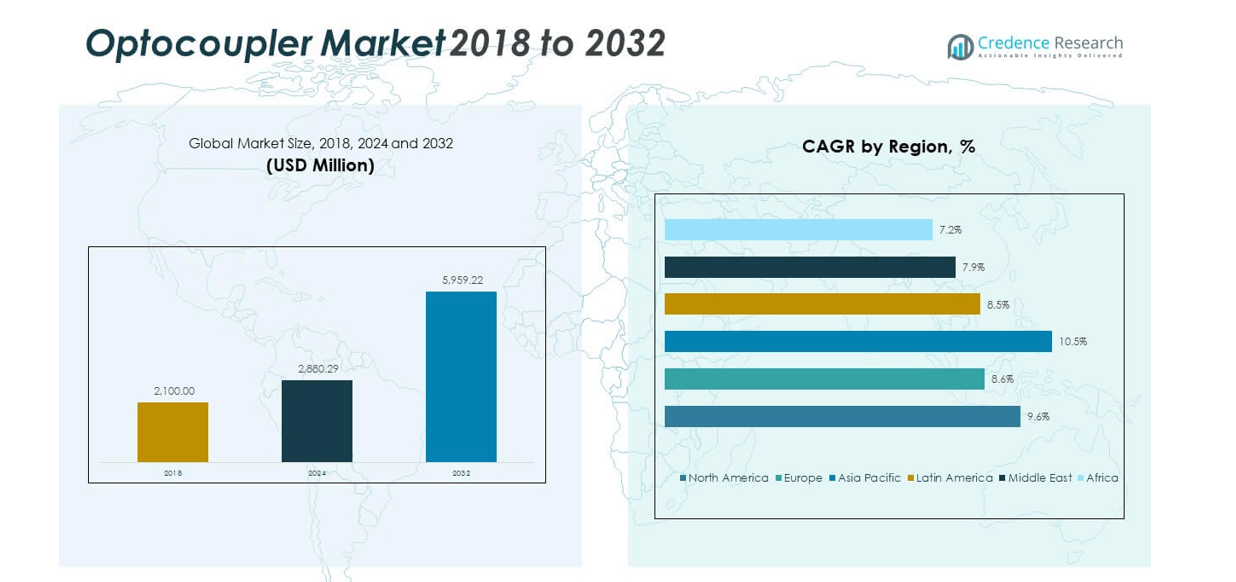
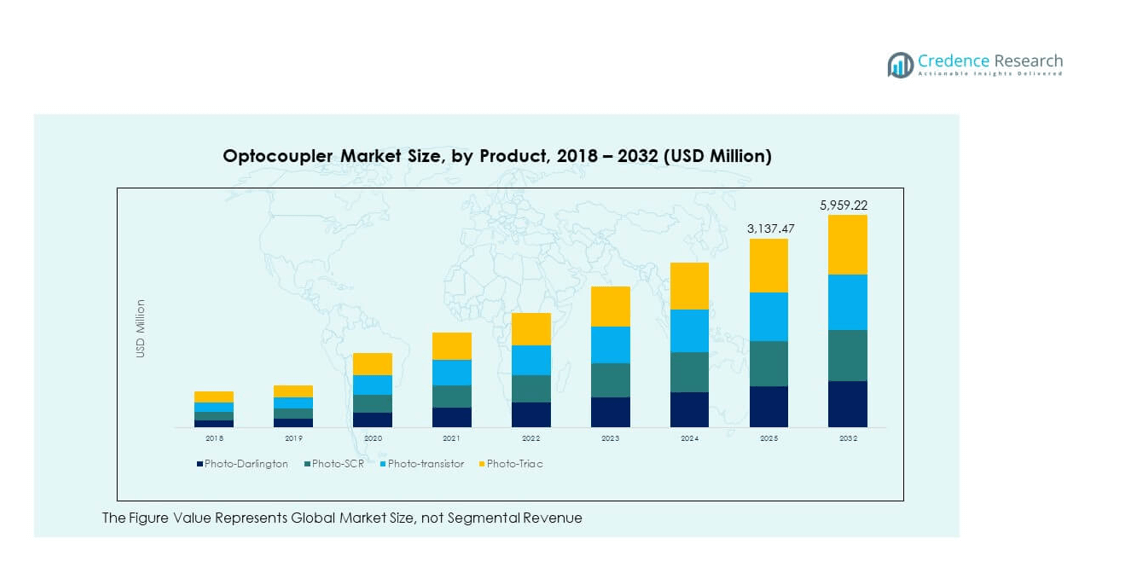
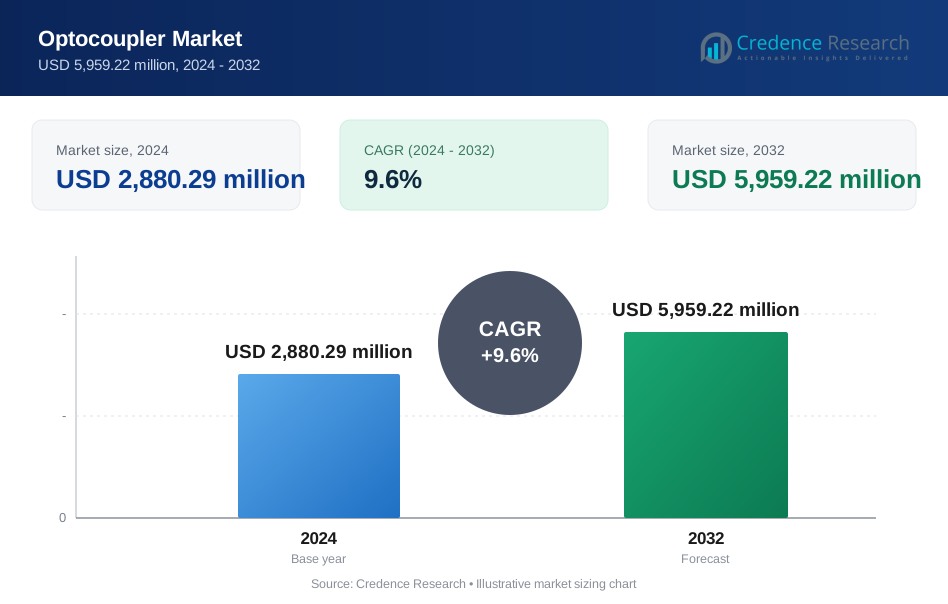
The Optocoupler Market size was valued at USD 2,100.00 million in 2018 to USD 2,880.29 million in 2024 and is anticipated to reach USD 5,959.22 million by 2032, at a CAGR of 9.60% during the forecast period.
| REPORT ATTRIBUTE | DETAILS |
|---|---|
| Historical Period | 2020-2023 |
| Base Year | 2024 |
| Forecast Period | 2025-2032 |
| Optocoupler Market Size 2024 | USD 2,880.29 million |
| Optocoupler Market, CAGR | 9.60% |
| Optocoupler Market Size 2032 | USD 5,959.22 million |
The Optocoupler Market is driven by increasing demand for high-efficiency, low-power isolation devices in industrial and automotive applications. Rising adoption of automation, renewable energy projects, and electric vehicles has accelerated product integration across motor drives, inverters, and control systems. The focus on enhancing safety, performance, and energy efficiency in power systems further supports widespread implementation. Manufacturers are advancing designs for miniaturization, speed improvement, and temperature endurance to meet diverse operational needs.
Asia Pacific leads the Optocoupler Market, driven by strong electronics manufacturing, rapid industrialization, and rising investments in automation across China, Japan, and South Korea. North America follows due to robust demand from automotive, defense, and energy sectors. Europe maintains steady growth supported by stringent safety standards and increasing adoption in industrial equipment. Emerging regions such as Latin America and the Middle East are gradually expanding their presence through infrastructure development and growing semiconductor consumption.
Market Insights:
- The Optocoupler Market size was USD 2,100.00 million in 2018, USD 2,880.29 million in 2024, and is projected to reach USD 5,959.22 million by 2032, growing at a CAGR of 9.60% during the forecast period.
- Asia Pacific leads with a 34.8% share due to its strong electronics manufacturing base and rapid industrial automation growth. North America follows with 27.2%, supported by advanced technology adoption, while Europe holds 21.3%, driven by industrial modernization.
- Asia Pacific remains the fastest-growing region, driven by high semiconductor production, expanding consumer electronics, and increasing investments in electric vehicle infrastructure.
- Photo-transistor optocouplers hold nearly 40% of the market share in 2024, dominating due to their efficiency and wide use in control and communication systems.
- Photo-Darlington and Photo-Triac types collectively account for over 35% of the market, supported by their growing adoption in power regulation, industrial drives, and automation applications.
Market Drivers
Rising Demand for Isolation in High-Voltage and Power Applications
The Optocoupler Market grows with the increasing use of high-voltage and power control systems across industries. Optocouplers ensure reliable isolation between control and power circuits, preventing signal interference and protecting sensitive components. Demand from renewable energy, electric vehicles, and industrial automation strengthens market growth. It supports energy efficiency goals through secure and low-power transmission. Manufacturers integrate optocouplers in motor drives, inverters, and power converters. The need for safety-certified and high-speed devices accelerates innovation. Ongoing R&D enhances performance in harsh environments. Growing industrial electrification continues to boost product demand.
- For instance, Broadcom's ACPL-C799 sigma-delta modulator provides reinforced optical isolation with a linear input range of ±50 mV and supports a 25 kV/μs minimum common mode transient immunity (CMTI). It is certified for system-level safety, features 8.3 mm clearance, and has a maximum operating temperature of +105°C, as detailed in Broadcom’s official product news and datasheet.
Expanding Integration in Consumer Electronics and Smart Devices
Consumer electronics use optocouplers for noise reduction and protection in compact circuit systems. Smartphones, smart TVs, and wearables rely on stable optical isolation for precise data transmission. It helps reduce heat buildup and extend product lifespan. The market benefits from growing adoption of miniaturized and energy-efficient components. Manufacturers innovate with smaller, high-performance optocouplers to fit tight circuit designs. IoT-based devices increase the requirement for consistent signal control. Integration of optocouplers in chargers, adapters, and digital displays improves reliability. Expanding connected device penetration strengthens consumer electronics growth worldwide.
- For instance, Toshiba’s TLP2363 opto-isolator, launched for industrial and consumer circuits, delivers a maximum data rate of 10 Mbps and withstands isolation voltages of up to 3,750 Vrms. It features immunity to common-mode transient voltages up to ±20 kV/μs and operates across a temperature range from –40°C to +105°C, as stated in product release and documentation.
Increasing Adoption in Industrial Automation and Control Systems
Automation industries adopt optocouplers for real-time control and system reliability. Programmable logic controllers (PLCs) and sensor networks depend on them for voltage isolation and protection. The Optocoupler Market gains traction from expanding industrial digitization and Industry 4.0 initiatives. It enhances system stability under fluctuating power conditions. Integration in servo drives and process control units strengthens factory productivity. High-speed switching capability supports precise motion and robotic control. Optocouplers ensure smooth operation of automated equipment in demanding conditions. Rising factory modernization drives strong demand across manufacturing hubs.
Accelerating Use in Automotive and Electric Vehicle Applications
Automotive applications increasingly deploy optocouplers for battery management and motor control. Electric and hybrid vehicles require high-isolation components for signal safety. It supports powertrain efficiency and prevents data distortion between subsystems. The Optocoupler Market benefits from rising EV production worldwide. Automotive-grade optocouplers withstand extreme temperature and vibration. Integration into advanced driver assistance systems enhances operational reliability. High insulation voltage ratings support safety-critical electronics. Growing vehicle electrification encourages continuous innovation in optical isolation technology.
Market Trends
Development of High-Speed and Wide-Bandgap Compatible Optocouplers
Manufacturers focus on high-speed optocouplers that support wide-bandgap semiconductors like SiC and GaN. These materials require components with higher switching speeds and voltage endurance. It enables better performance in fast-switching power systems. The Optocoupler Market trends toward compact, low-latency designs that enhance inverter and converter efficiency. Companies introduce digital isolation devices to replace traditional couplers in advanced power circuits. These designs allow greater efficiency in EVs and renewable systems. Growing demand for compact power modules drives further R&D. Faster signal response remains a key differentiator for new models.
- For instance, Broadcom’s ACNT-H343 and ACNT-H61L optocouplers offer up to 2,262 VPEAK working insulation voltage, 12,000 VPEAK transient overvoltage, and support for high-voltage SiC/GaN inverters for industrial and EV applications, as published in Broadcom’s product documentation.
Integration of Optocouplers with Smart Sensing and Control Platforms
Smart factories and digital control systems demand optocouplers integrated with sensing functions. This trend supports predictive maintenance and enhances operational safety. It allows simultaneous data transmission and signal protection in one compact unit. The Optocoupler Market moves toward multifunctional components compatible with IoT platforms. Advanced couplers now feature real-time diagnostic feedback for industrial applications. Integration into microcontrollers ensures seamless process control. Manufacturers invest in embedded designs for enhanced data precision. Smart integration continues to drive adoption across automated systems.
Growing Use of Optocouplers in Renewable Energy and Grid Stability Systems
Renewable energy projects employ optocouplers for inverter control and grid synchronization. Solar and wind systems need reliable isolation to prevent electrical surges. It ensures communication stability between control and power sections. The Optocoupler Market expands with global renewable installations. Devices with wide temperature tolerance support outdoor renewable environments. Compact isolation modules help manage distributed power generation. Optocouplers contribute to improved grid safety and reduced downtime. Expansion of green power infrastructure fuels steady market development.
- For instance, Vishay’s upgraded CNY series optocouplers for solar inverters provide repetitive peak isolation up to 1800 V and are deployed in 1500 V grid-tied solar inverter systems for improved insulation and grid safety, as published by Vishay in 2025 and referenced in product upgrade news.
Miniaturization and Package Innovations for Space-Constrained Applications
Advancements in packaging technologies make optocouplers smaller yet more durable. Miniaturization supports high-density circuit designs in portable devices. It aids in integrating optical isolation into space-limited consumer and medical electronics. The Optocoupler Market benefits from new surface-mount packages and chip-scale devices. Companies invest in dual-channel and high-creepage packages to enhance performance. Compact form factors enable wider use in automotive and IoT sensors. New encapsulation materials improve heat resistance and lifespan. Continuous size reduction supports versatility across multiple industries.
Market Challenges Analysis
Rising Competition from Alternative Isolation Technologies
Alternative technologies like digital isolators and transformers challenge traditional optocoupler adoption. These substitutes offer higher speed, longer lifespan, and lower power loss. It reduces the dominance of optical solutions in high-frequency applications. The Optocoupler Market faces pricing pressure as customers shift toward modern isolation devices. Manufacturers must balance innovation with cost efficiency. Dependence on LED-based light transmission also limits device longevity. High switching speed demands exceed the threshold of conventional optocouplers. Continuous upgrades are essential to maintain technological relevance and competitiveness.
Complex Manufacturing and Quality Control Limit Scalability
Producing optocouplers involves complex alignment of optical components and semiconductor materials. Small deviations can impact isolation strength and performance consistency. It increases production costs and yield losses. The Optocoupler Market faces difficulty in scaling due to stringent testing and calibration needs. Maintaining optical clarity and insulation under thermal stress requires precision engineering. Supply chain disruptions of LEDs and photodiodes also affect output. Quality assurance challenges lead to longer certification cycles. Manufacturers must improve automation and inspection systems to sustain production efficiency.
Market Opportunities
Expansion in Electric Mobility and Smart Infrastructure Applications
Rising investments in electric mobility and charging infrastructure create strong growth potential. Optocouplers ensure safe signal isolation in vehicle powertrain and charging units. It supports reliable operation of battery monitoring and inverter circuits. The Optocoupler Market benefits from global EV policy support and infrastructure rollout. Demand for low-noise, high-reliability components continues to expand. Opportunities also emerge in autonomous vehicle and smart grid systems. Companies focusing on automotive-grade certification can capture long-term supply contracts. Growing collaboration between automakers and component suppliers enhances innovation speed.
Emerging Demand Across Medical and Defense Electronic Systems
Medical and defense systems require optocouplers for secure and interference-free data transmission. Sensitive instruments depend on optical isolation to protect patient and operational safety. It ensures signal reliability under electromagnetic exposure and harsh conditions. The Optocoupler Market experiences rising demand for high-insulation devices. Development of compact and radiation-resistant components opens new revenue streams. Medical imaging, diagnostic, and communication tools increasingly integrate optical isolators. Defense electronics rely on optocouplers for mission-critical systems. Expanding government procurement boosts opportunities for specialized manufacturers.
Market Segmentation Analysis:
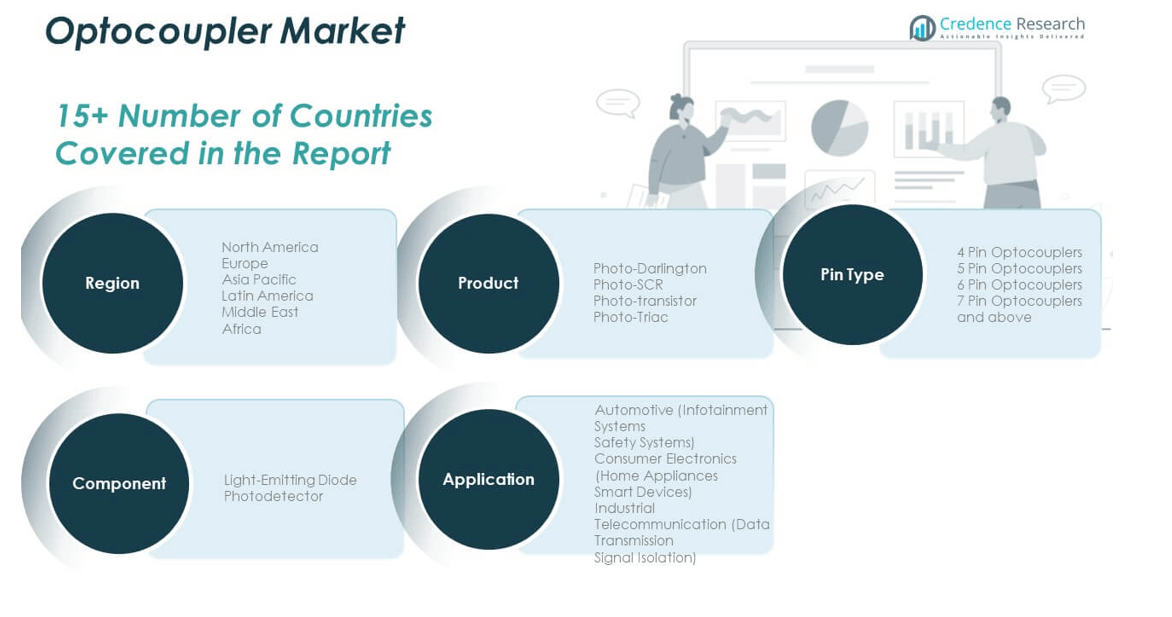
The Optocoupler Market demonstrates diversified growth across multiple product categories and applications.
By product type, photo-transistor optocouplers dominate due to their high sensitivity, fast response, and cost efficiency, making them ideal for industrial control systems and communication equipment. Photo-Darlington devices find use in precision instrumentation requiring high current transfer ratios, while photo-SCR and photo-triac types serve power regulation and AC control applications. The demand for multi-functional, high-speed components continues to strengthen as industries advance toward greater automation and energy efficiency.
- For example, Lite-On Technology’s LTV-814 optocoupler provides 5,000 Vrms isolation voltage and is widely used in industrial control and power supply systems. It supports an operating temperature range of -30 °C to +100 °C, ensuring stable optical isolation and noise immunity in demanding environments, as specified in Lite-On’s official datasheet.
By pin configuration, 4-pin optocouplers hold a significant market share due to their widespread integration in consumer electronics and industrial systems. 5-pin and 6-pin models provide better isolation and higher functionality for automotive and telecommunication applications. The 7-pin and above variants cater to complex systems requiring enhanced switching performance and low-noise signal transmission. It benefits from continuous design improvements focused on reducing footprint while increasing voltage endurance.
By component structure, light-emitting diodes (LEDs) remain essential for signal transmission, while photodetectors contribute to precision and speed.
By application, the market sees strong traction from automotive systems like infotainment and safety electronics, alongside robust adoption in industrial automation. The consumer electronics segment continues expanding through smart home devices, while telecommunication applications grow with 5G deployment and data isolation needs. Continuous innovation in miniaturization and optical efficiency drives performance upgrades across all segments.
- For instance, ON Semiconductor's FOD817 series is selected for industrial motor drivers, PLC modules, and consumer appliances offering up to 600% CTR with guaranteed 5kV insulation, per official documentation and distributor listings updated October 2025.
Segmentation:
By Product Type
- Photo-Darlington
- Photo-SCR
- Photo-Transistor
- Photo-Triac
By Pin Type
- 4 Pin Optocouplers
- 5 Pin Optocouplers
- 6 Pin Optocouplers
- 7 Pin Optocouplers and above
By Component
- Light-Emitting Diode (LED)
- Photodetector
By Application
- Automotive (Infotainment Systems, Safety Systems)
- Consumer Electronics (Home Appliances, Smart Devices)
- Industrial
- Telecommunication (Data Transmission, Signal Isolation)
By Region
- North America
- U.S.
- Canada
- Mexico
- Europe
- Germany
- France
- U.K.
- Italy
- Spain
- Rest of Europe
- Asia Pacific
- China
- Japan
- India
- South Korea
- South-east Asia
- Rest of Asia Pacific
- Latin America
- Brazil
- Argentina
- Rest of Latin America
- Middle East & Africa
- GCC Countries
- South Africa
- Rest of the Middle East and Africa
Regional Analysis:
North America
The North America Optocoupler Market size was valued at USD 602.70 million in 2018 to USD 813.95 million in 2024 and is anticipated to reach USD 1,681.11 million by 2032, at a CAGR of 9.6% during the forecast period. North America accounts for 27.2% of the global market share, driven by strong adoption across automotive, defense, and industrial automation sectors. The region’s demand is supported by the growing use of optocouplers in electric vehicles, data centers, and telecommunication systems. It benefits from advanced semiconductor manufacturing and R&D investments from major companies in the United States. The expansion of renewable energy projects and smart grids further strengthens demand. Increasing integration of optoelectronic components in high-voltage systems improves safety and performance. The U.S. leads in innovation, while Canada and Mexico contribute through automotive and electronics manufacturing. Robust infrastructure and government initiatives for energy-efficient technologies sustain long-term growth in the region.
Europe
The Europe Optocoupler Market size was valued at USD 447.30 million in 2018 to USD 584.04 million in 2024 and is anticipated to reach USD 1,124.82 million by 2032, at a CAGR of 8.6% during the forecast period. Europe represents 21.3% of the global market share, with demand led by Germany, the UK, and France. The region emphasizes sustainable manufacturing, automotive electrification, and industrial digitalization. It supports large-scale adoption of optocouplers in control systems and automation networks. The market benefits from strong engineering expertise and high investments in renewable energy. Automotive OEMs increasingly use optocouplers in battery management and safety systems. It continues to grow with Industry 4.0 initiatives improving production efficiency. European companies focus on product reliability, low-power operation, and miniaturization to meet evolving industry standards.
Asia Pacific
The Asia Pacific Optocoupler Market size was valued at USD 812.70 million in 2018 to USD 1,145.91 million in 2024 and is anticipated to reach USD 2,528.50 million by 2032, at a CAGR of 10.5% during the forecast period. Asia Pacific holds the largest 34.8% share, led by China, Japan, South Korea, and India. It benefits from large-scale semiconductor manufacturing, rapid industrialization, and expanding electronics production. The region’s dominance stems from strong domestic demand for automotive, telecommunication, and consumer devices. It witnesses extensive use of optocouplers in power systems and smart devices. Continuous infrastructure growth and government support for automation boost adoption. Companies in China and Japan invest heavily in high-speed, low-noise optical components. The demand for reliable isolation technology in renewable and 5G applications drives market expansion.
Latin America
The Latin America Optocoupler Market size was valued at USD 124.32 million in 2018 to USD 168.76 million in 2024 and is anticipated to reach USD 322.21 million by 2032, at a CAGR of 8.5% during the forecast period. Latin America captures 4.4% of the global market share, supported by industrial modernization and growing automation adoption. Brazil leads regional demand with increasing electronics and automotive component manufacturing. The region experiences rising investment in renewable energy, telecom infrastructure, and smart factories. It benefits from gradual integration of optoelectronic devices into power management and industrial systems. Mexico’s electronics exports also contribute to consistent growth. The need for stable signal isolation across harsh operating conditions strengthens product penetration. Local distributors expand partnerships with global suppliers to improve accessibility and competitiveness.
Middle East
The Middle East Optocoupler Market size was valued at USD 65.10 million in 2018 to USD 82.36 million in 2024 and is anticipated to reach USD 149.61 million by 2032, at a CAGR of 7.9% during the forecast period. The region accounts for 3.1% of the global share, with growth led by GCC countries and Israel. Demand is driven by industrial automation, defense electronics, and power infrastructure expansion. It benefits from renewable energy diversification programs and smart grid deployment. The Optocoupler Market supports reliable system performance under high temperatures and challenging environments. Investment in advanced control and monitoring systems fuels adoption across oil and gas operations. Local manufacturing initiatives promote self-sufficiency and technology transfer. Rising construction of industrial facilities further enhances product utilization.
Africa
The Africa Optocoupler Market size was valued at USD 47.88 million in 2018 to USD 85.27 million in 2024 and is anticipated to reach USD 152.97 million by 2032, at a CAGR of 7.2% during the forecast period. Africa represents 2.9% of the global market share, driven by expanding energy, mining, and telecommunications sectors. South Africa remains a key market due to industrial growth and renewable power projects. It shows increasing adoption of optocouplers in electrical grids and automation systems. The region benefits from gradual digitalization and infrastructure upgrades. Local governments encourage technology adoption through smart energy initiatives. Industrial automation adoption continues to rise with urban development. Growing demand for reliable power and efficient communication networks supports steady market expansion.
Key Player Analysis:
- Vishay Intertechnology Inc. (US)
- Broadcom Inc. (US)
- Toshiba Electronic Devices & Storage Corporation (Japan)
- ON Semiconductor (US)
- Infineon Technologies AG (Germany)
- Sharp Corporation (Japan)
- Lite-On Technology Corporation (Taiwan)
- Everlight Electronics (Taiwan)
- Panasonic Corporation (Japan)
- Avago Technologies (US)
- Fairchild Semiconductor (US)
- NEC Corporation (Japan)
- IXYS Integrated Circuits Division (US)
- Isocom Components (UK)
- Senba Sensing Technology Co. Ltd (China)
- Shenzhen Kento Electronic Co. Ltd (China)
- Standex-Meder Electronics (US)
- Kingbright Electronic (Taiwan)
- NTE Electronics (US)
Competitive Analysis:
The Optocoupler Market is characterized by strong competition among global semiconductor and optoelectronic manufacturers. Key players include Vishay Intertechnology Inc., Broadcom Inc., Toshiba Electronic Devices & Storage Corporation, ON Semiconductor, and Infineon Technologies AG. It emphasizes product innovation, high-speed switching, and enhanced isolation performance to meet evolving industrial and automotive standards. Companies invest in R&D to develop compact, energy-efficient designs suited for automation and electric mobility. Strategic partnerships and acquisitions strengthen distribution networks and regional presence. Leading manufacturers focus on long-term contracts with OEMs to secure consistent demand. The shift toward wide-bandgap semiconductor compatibility and IoT integration drives continuous technological advancement. Competitive differentiation relies on reliability, certification standards, and customized design capabilities for diverse end-use applications.
Recent Developments:
- In October 2025, Vishay Intertechnology Inc. announced a major expansion of its inductor and frequency control device portfolio with more than 2,000 new SKUs released across nearly 100 series, including wireless charging inductors and noise suppression solutions, with further launches expected throughout 2025.
- In July 2025, Farnell expanded its partnership with Toshiba Electronic Devices & Storage Corporation, strengthening product availability and distribution in Japan by adding a new portfolio of Toshiba products to its offerings.
- In July 2025, ON Semiconductor (onsemi) partnered with Schaeffler to develop EliteSiC power solutions for plug-in hybrid electric vehicles (PHEVs), targeting increased efficiency and reliability in automotive applications.
Report Coverage:
The research report offers an in-depth analysis based on Product Type, Pin Type, Component, and Application. It details leading market players, providing an overview of their business, product offerings, investments, revenue streams, and key applications. Additionally, the report includes insights into the competitive environment, SWOT analysis, current market trends, as well as the primary drivers and constraints. Furthermore, it discusses various factors that have driven market expansion in recent years. The report also explores market dynamics, regulatory scenarios, and technological advancements that are shaping the industry. It assesses the impact of external factors and global economic changes on market growth. Lastly, it provides strategic recommendations for new entrants and established companies to navigate the complexities of the market.
Future Outlook:
- Growing investments in industrial automation will increase adoption of high-speed, durable optocouplers.
- Expansion of electric vehicle production will boost demand for isolation components in power management systems.
- Integration with wide-bandgap semiconductors will drive performance enhancements across inverter and converter circuits.
- Rising use in renewable energy systems will support efficient control and grid stability operations.
- Ongoing miniaturization and package innovations will enhance functionality for space-constrained electronic devices.
- Development of optocouplers with smart diagnostic capabilities will expand their use in predictive maintenance systems.
- Increasing focus on safety and insulation in industrial and automotive electronics will sustain long-term demand.
- Rapid expansion of 5G and telecommunication infrastructure will create new opportunities for optical signal isolation.
- Strategic collaborations between semiconductor and automation firms will accelerate next-generation product innovation.
- Expanding application in defense, aerospace, and medical electronics will diversify growth avenues globally.
Request a Free Sample
Fill in your details and we'll send you a free sample report.
- Sample data tables & charts
- Research methodology
Need a Custom Version of This Report?
Tailor the scope, geography, or segments to your exact requirements.
- Custom geography or segment scope
- Direct access to our analyst team
Frequently Asked Questions
What is the current market size for the Optocoupler Market, and what is its projected size in 2032?
At what Compound Annual Growth Rate is the Optocoupler Market projected to grow between 2024 and 2032?
Which Optocoupler Market segment held the largest share in 2024?
What is the major growth driving factors for global Optocoupler market?
Who are the leading companies in the Optocoupler Market?
Which region commanded the largest share of the Optocoupler Market in 2024?
Table of Content
Chapter 1. Report Introduction
- 1.1 Report Description & Purpose
- 1.1.1 Report Title & Market Definition
- 1.1.2 Unique Selling Propositions (USP) & Key Differentiators
- 1.1.3 Value Proposition for Stakeholders
- 1.2 Research Objectives
- 1.2.1 Market Sizing Objectives (Volume & Revenue) (Volume Where Applicable)
- 1.2.2 Segmentation Objectives
- 1.2.3 Competitive Intelligence Objectives
- 1.2.4 Forecast & Scenario Objectives
- 1.3 Report Scope
- 1.3.1 Optocoupler Scope – Segments & Subsegments Covered
- 1.3.2 Geographic Scope – Regions & Countries Covered
- 1.3.3 Historical Period, Base Year & Forecast Period (2024; forecast to 2032)
- 1.3.4 Inclusions & Exclusions
- 1.4 Industry Classification & Applicable Codes
- 1.5 Currency, Measurement Units & Valuation Basis
- 1.6 Target Stakeholders
- 1.7 Limitations & Assumptions
Chapter 2. Executive Summary
- 2.1 Global Optocoupler Market Snapshot
- 2.1.1 Market Size – Historical (2024) & Forecast (2024-2032) (2024: USD 2,880.29 million → 2032: USD 5,959.22 million)
- 2.1.2 Volume & Revenue – Global Totals (Volume Where Applicable)
- 2.1.3 Key Market Highlights – Top Five Facts
- 2.2 Optocoupler Market Segmentation Snapshot
- 2.2.1 Market Split by Region – 2024 vs. 2032
- 2.3 Competitive Snapshot
- 2.3.1 Top 10 Players by Revenue Share – 2024
- 2.3.2 Top 10 Players by Volume Share – 2024 (Volume Where Applicable)
- 2.3.3 Recent Strategic Developments (18-Month Summary)
- 2.4 Key Investment Highlights & Strategic Conclusions
Chapter 3. Optocoupler Market Dynamics & Industry Analysis
- 3.1 Market Overview & Context
- 3.1.1 Optocoupler Market Position in the Broader Industry Value Chain
- 3.1.2 Demand Structure & Purchasing Dynamics
- 3.1.3 Market Maturity & Development Stage by Region
- 3.2 Optocoupler Market Drivers
- 3.3 Optocoupler Market Restraints & Challenges
- 3.4 Optocoupler Market Opportunities
- 3.5 Porter's Five Forces Analysis
- 3.5.1 Threat of New Entrants
- 3.5.2 Bargaining Power of Suppliers
- 3.5.3 Bargaining Power of Buyers
- 3.5.4 Threat of Substitutes
- 3.5.5 Competitive Rivalry – Intensity Assessment
- 3.6 Optocoupler Value Chain Analysis
- 3.6.1 Upstream – Key Inputs, Resources & Suppliers
- 3.6.1.1 Key Input/Resource 1
- 3.6.1.2 Key Input/Resource 2
- 3.6.1.3 Key Input/Resource 3
- 3.6.2 Midstream – Core Operations & Value Creation
- 3.6.2.1 Operating Model & Process Overview
- 3.6.2.2 Key Operating Locations & Capabilities by Company
- 3.6.3 Downstream – Market Channels & End Users
- 3.6.3.1 Direct Sales & Customer Engagement Channels
- 3.6.3.2 Indirect Sales, Intermediaries & Partner Channels
- 3.6.4 Value Chain Profitability Analysis
- 3.6.1 Upstream – Key Inputs, Resources & Suppliers
- 3.7 PESTEL Analysis
- 3.7.1 Political Factors
- 3.7.2 Economic Factors
- 3.7.3 Social Factors
- 3.7.4 Technological Factors
- 3.7.5 Environmental Factors
- 3.7.6 Legal Factors
- 3.8 Optocoupler Supply Chain Analysis
- 3.8.1 Critical Input & Resource Availability Risk Assessment
- 3.8.2 Supplier & Operational Concentration Risk (Geographic Exposure)
- 3.8.3 Supply & Service Disruption Impact Analysis
- 3.9 Regulatory & Policy Landscape
Note: The regulatory and policy landscape section covers regulations based on their applicability to the market, Optocoupler category, geography, and scope of the study. Only regulatory frameworks with a material impact on operations, compliance, trade, sustainability, or market access are analyzed in detail.
Chapter 4. Key Investment Pockets & Opportunity Analysis
- 4.1 Optocoupler Market Attractiveness Analysis
- 4.1.1 By Region – Investment Attractiveness Matrix (Market Size × CAGR)
- 4.2 Absolute Revenue Growth Opportunity
- 4.2.1 By Region – Absolute Revenue Growth Through 2032
- 4.3 Incremental Demand Opportunity
- 4.3.1 By Region – Incremental Demand Through 2032
- 4.3.2 Segment – Incremental Demand
- 4.4 Emerging Submarket Opportunity Deep Dive (Subject to Applicability)
- 4.5 Priority Market Opportunity Scorecards
- 4.5.1 United States
- 4.5.2 Europe
- 4.5.3 Asia
- 4.5.4 Middle East & Africa
Note: Priority market opportunity scorecards reflect the geographic scope and strategic relevance of the study. Listed markets are indicative and may be adapted to the industry.
Chapter 5. Optocoupler Cross-Border Trade & Market Access Analysis
- 5.1 International Trade & Cross-Border Activity Overview
- 5.1.1 Global Export Value by Country (2024)
- 5.1.2 Global Export Volume by Country (2024) (Volume Where Applicable)
- 5.1.3 Global Import Value by Country (2024)
- 5.1.4 Global Import Volume by Country (2024) (Volume Where Applicable)
- 5.1.5 Net Trade Balance by Country (2024)
- 5.2 Export Analysis – Segment
- 5.2.1 Category 1 (Applicable Classification Code)
- 5.2.2 Category 2 (Applicable Classification Code)
- 5.2.3 Category 3 (Applicable Classification Code)
- 5.2.4 Category 4 (Applicable Classification Code)
- 5.2.5 Category 5 (Applicable Classification Code)
- 5.3 Import Analysis – Segment
- 5.3.1 Category 1 (Applicable Classification Code)
- 5.3.2 Category 2 (Applicable Classification Code)
- 5.3.3 Category 3 (Applicable Classification Code)
- 5.3.4 Category 4 (Applicable Classification Code)
- 5.3.5 Category 5 (Applicable Classification Code)
- 5.4 Cross-Border Pricing & Transaction Benchmarks
- 5.4.1 Export Pricing – Segment & Country
- 5.4.2 Import Pricing – Segment & Source Country
- 5.4.3 Price Trends (2024)
- 5.5 Key Cross-Border Trade & Delivery Routes
- 5.5.1 Cross-Border Trade/Delivery Route 1
- 5.5.2 Cross-Border Trade/Delivery Route 2
- 5.5.3 Cross-Border Trade/Delivery Route 3
- 5.5.4 Cross-Border Trade/Delivery Route 4
- 5.5.5 Cross-Border Trade/Delivery Route 5
- 5.6 Trade Policy & Market Access Impact Assessment
- 5.6.1 Tariff & Non-Tariff Barriers
- 5.6.2 Regional Trade & Economic Integration Frameworks
- 5.6.3 Bilateral & Multilateral Trade Agreements
- 5.6.4 Cross-Border Operating, Licensing & Localization Requirements
Note: This chapter applies where cross-border trade or delivery is relevant to Optocoupler. Goods, services, and digital offerings are assessed using applicable classifications and transaction measures. Import-export volumes, trade balances, and route analyses are included only where meaningful to the market.
Chapter 6. Competitive Landscape & Company Benchmarking
- 6.1 Optocoupler Market Concentration & Structure
- 6.1.1 Herfindahl-Hirschman Index (HHI) – the historical period vs. 2024
- 6.1.2 Leading, Mid-Sized & Emerging Player Structure
- 6.1.3 Global, Regional & Local Player Dynamics
- 6.2 Optocoupler Market Share Analysis – 2024
- 6.2.1 Global Revenue Share by Company
- 6.2.2 Global Volume Share by Company (Volume Where Applicable)
- 6.2.3 Regional Revenue Share
- 6.2.4 Market Share Evolution (the historical period vs. 2024)
- 6.2.5 Company Market Share by Key Segment
- 6.2.6 Company Market Share by Customer Group
- 6.3 Operating Scale, Capacity & Infrastructure Analysis
- 6.3.1 Global Operating Scale & Supply Capacity
- 6.3.2 Resource Utilization & Operating Efficiency
- 6.3.3 Output, Service Delivery & Activity Metrics
- 6.3.4 Operating Footprint & Infrastructure Map
- 6.3.5 Planned Operational & Capacity Expansion
- 6.4 Optocoupler Competitive Benchmarking Matrix
- 6.4.1 Revenue, Growth, Profitability & Operating Metric Comparison
- 6.4.2 Channel Revenue Mix
- 6.4.3 Geographic Revenue Exposure
- 6.4.4 R&D Intensity
- 6.4.5 Sustainability Maturity
- 6.5 Strategic Developments in Optocoupler (Last 24 Months)
- 6.5.1 Mergers, Acquisitions & Divestments
- 6.5.2 New Products, Services & Solutions in Optocoupler
- 6.5.3 Operational & Infrastructure Expansions
- 6.5.4 Strategic Alliances, Joint Ventures & Partnerships
- 6.5.5 Distribution Expansion & Market Entry
- 6.5.6 Sustainability & ESG Initiatives
- 6.6 Competitive Strategy Mapping
- 6.6.1 Leader, Challenger, Follower & Niche Classification
- 6.6.2 Pricing Strategy Comparison
- 6.6.3 Channel Strategy Matrix
Note: Strategic developments are included based on their materiality and the availability of reliable information.
Chapter 7. Global Optocoupler Market – By Sales & Delivery Channel
- 7.1 Segment Overview
- 7.1.1 Volume & Revenue Split by Channel (2024 & 2032) (Volume Where Applicable)
- 7.1.2 Channel Mix Evolution (2024-2032)
Chapter 8. Regional Market Analysis – Global Overview
- 8.1 Global Regional Overview
- 8.1.1 Regional Volume Share (Volume Where Applicable)
- 8.1.2 Regional Revenue Share
- 8.1.3 Regional Volume by Region (Volume Where Applicable)
- 8.1.4 Regional Revenue by Region
- 8.1.5 Regional Forecast Through 2032
- 8.2 Cross-Regional Segment Analysis
- 8.2.1 By Sales & Delivery Channel
- 8.2.2 By Competitive Positioning & Price Tier
Chapter 9. North America Optocoupler Market
- 9.1 United States
- 9.2 Canada
- 9.3 Mexico
Chapter 10. Europe Optocoupler Market
- 10.1 Germany
- 10.2 France
- 10.3 Italy
- 10.4 United Kingdom
- 10.5 Spain
- 10.6 Poland
- 10.7 Russia
- 10.8 Netherlands
- 10.9 Belgium
- 10.10 Sweden
- 10.11 Denmark
- 10.12 Norway
- 10.13 Rest of Europe
Chapter 11. Asia Pacific Optocoupler Market
- 11.1 China
- 11.2 India
- 11.3 Japan
- 11.4 South Korea
- 11.5 Thailand
- 11.6 Indonesia
- 11.7 Vietnam
- 11.8 Malaysia
- 11.9 Australia
- 11.10 Rest of Asia Pacific
Chapter 12. Latin America Optocoupler Market
- 12.1 Brazil
- 12.2 Argentina
- 12.3 Colombia
- 12.4 Chile
- 12.5 Rest of Latin America
Chapter 13. Middle East Optocoupler Market
- 13.1 Saudi Arabia
- 13.2 United Arab Emirates
- 13.3 Turkey
- 13.4 Israel
- 13.5 Iran
- 13.6 Rest of the Middle East
Chapter 14. Africa Optocoupler Market
- 14.1 South Africa
- 14.2 Egypt
- 14.3 Nigeria
- 14.4 Morocco
- 14.5 Rest of Africa
Chapter 15. Optocoupler Company Profiles
- 15.1 [Company 01]
- 15.1.1 Company Overview
- 15.1.2 Key Management Personnel
- 15.1.3 Products & Services Portfolio
- 15.1.4 Financial Performance
- 15.1.5 Key Market Focus & Geographic Presence
- 15.1.6 Recent Developments & Strategic Initiatives
Note: The company profile list is preliminary and may change based on research findings, market developments, data availability, and client requirements.
Chapter 16. Appendices
- Appendix A – List of Abbreviations & Acronyms
- Appendix B – Industry Classification Code Reference – Full Series
- Appendix C – Supply, Output & Operating Capacity Data Tables
- Appendix D – End-Use & Demand Base Tables
- Appendix E – Demand, Adoption & Usage Assumptions
- Appendix F – Pricing & Revenue Metric Reference Tables
- Appendix G – Company Operations & Infrastructure Database
- Appendix H – Cross-Border Trade & Activity Data Tables (Where Applicable)
- Appendix I – Regulatory Summary Tables
- Appendix J – Primary Research Participant List (Anonymized)
- Appendix K – Primary Research Questionnaire Framework
- Appendix L – Data Sources & Bibliography
- Appendix M – Market Size Divergence & Source Comparison
Chapter 17. Research Methodology
- 17.1 Research Framework & Philosophy
- 17.2 Secondary Research – Sources, Hierarchy & Data Extraction
- 17.3 Data Modeling – Bottom-Up & Top-Down Market Sizing
- 17.4 Primary Research – Stakeholder Framework, LOI & Sample Sizes
- 17.5 Forecast Methodology – Regression, Scenario & Sensitivity Analysis
- 17.6 Quality Control – Four-Layer Validation Framework
- 17.7 Limitations & Standard Assumptions
- 17.8 Disclaimer
