
Market Overview
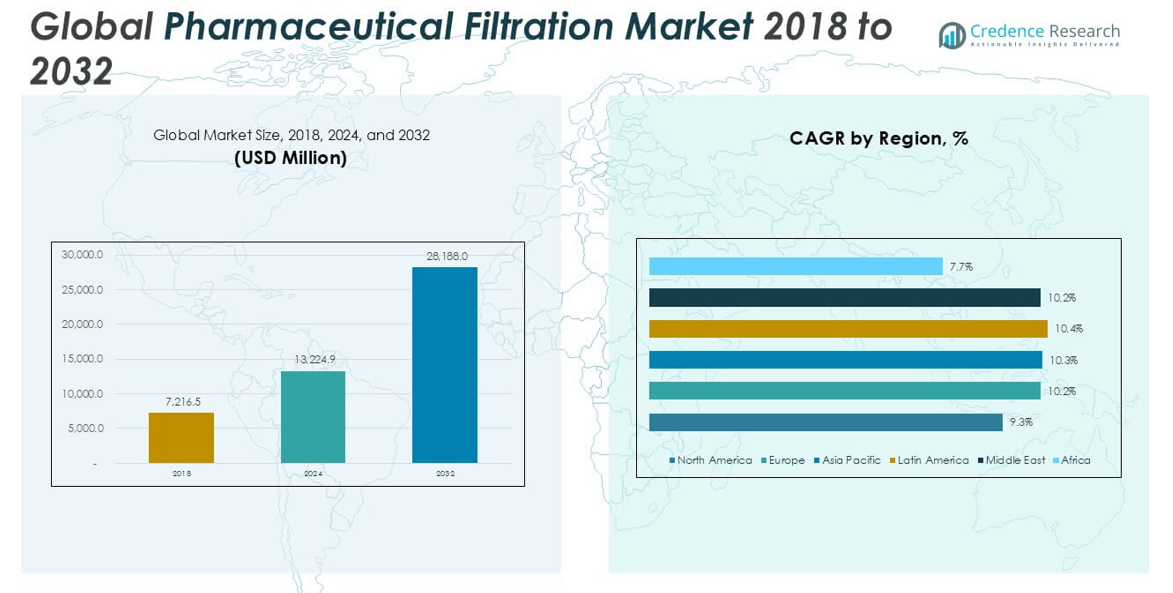
The Global Pharmaceutical Filtration Market is projected to grow from USD13,224.9 million in 2024 to an estimated USD28,188.0 million by 2032, with a compound annual growth rate (CAGR) of 9.93% from 2025 to 2032.
| REPORT ATTRIBUTE | DETAILS |
|---|---|
| Historical Period | 2020-2023 |
| Base Year | 2024 |
| Forecast Period | 2025-2032 |
| Pharmaceutical Filtration Market Size 2024 | USD13,224.9 million |
| Pharmaceutical Filtration Market, CAGR | 9.93% |
| Pharmaceutical Filtration Market Size 2032 | USD28,188.0 million |
Key drivers fueling the market include the growing prevalence of chronic diseases, which has boosted pharmaceutical and biologics production worldwide. Moreover, advancements in nanofiber and membrane technologies are enhancing the efficiency and precision of filtration systems. The rising adoption of single-use filtration systems and increased outsourcing of pharmaceutical manufacturing to contract manufacturing organizations (CMOs) are also notable trends. In addition, regulatory pressures to ensure sterile processing environments and minimize contamination risks are propelling innovation and demand in the sector.
Geographically, North America dominates the pharmaceutical filtration market due to its advanced healthcare infrastructure, strong R&D investment, and presence of major pharmaceutical players. Europe follows closely with increasing biopharmaceutical production, while the Asia-Pacific region is expected to witness the fastest growth, driven by expanding pharmaceutical industries in countries like China and India. Leading market players include Merck KGaA, Sartorius AG, Danaher Corporation, 3M Company, Thermo Fisher Scientific, and GE Healthcare, all of which are continuously innovating to meet evolving industry demands.
Market Insights
- The Global Pharmaceutical Filtration Market is projected to grow from USD 13,224.9 million in 2024 to USD 28,188.0 million by 2032, at a CAGR of 9.93% between 2025 and 2032.
- Growth is driven by rising demand for sterile and high-purity filtration in biopharmaceutical and vaccine manufacturing processes.
- Increasing prevalence of chronic diseases fuels the need for advanced filtration systems in drug production.
- Advancements in membrane and nanofiber technologies enhance filtration precision and operational efficiency.
- High operational costs, complex validation requirements, and raw material supply issues act as major restraints.
- North America leads the market due to strong infrastructure and innovation, while Asia Pacific shows the fastest growth due to expanding pharma industries.
- Key players such as Merck KGaA, Sartorius AG, Thermo Fisher Scientific, and Danaher Corporation dominate through continuous innovation and global reach.
Market Drivers
Rising Biopharmaceutical Production Accelerates Demand for Advanced Filtration Solutions
The Global Pharmaceutical Filtration Market benefits significantly from the rapid growth of the biopharmaceutical sector. The increasing development and commercialization of monoclonal antibodies, vaccines, and cell therapies require sterile and highly efficient filtration systems. Biopharmaceutical processes involve complex biological materials that demand specialized filters to remove particulates, microbes, and endotoxins without altering the product. Filtration plays a critical role in ensuring the safety and efficacy of these therapies. The need for contamination control and regulatory compliance strengthens the adoption of advanced filtration technologies. It enables manufacturers to maintain product integrity and meet stringent industry standards.
- For instance, over 1.1 billion sterile filtration units were supplied to biopharmaceutical manufacturers worldwide, supporting the production of more than 400 million doses of monoclonal antibodies and vaccines in that year.
Stringent Regulatory Frameworks Encourage Innovation in Filtration Technologies
Regulatory bodies such as the FDA and EMA have imposed strict guidelines for aseptic processing in pharmaceutical manufacturing. These regulations compel manufacturers to implement high-performance filtration systems that guarantee sterility. The Global Pharmaceutical Filtration Market responds to this pressure through investments in membrane technologies and high-throughput filtration systems. Compliance requirements drive demand for filters with validated performance and traceability features. It supports the use of single-use systems that reduce cross-contamination risks and simplify cleaning procedures. Regulatory scrutiny also promotes continuous innovation in filter materials and formats.
- For instance, according to a 2023 survey of leading pharmaceutical companies, more than 320,000 single-use filtration assemblies with full regulatory validation were deployed in FDA- and EMA-regulated facilities, reflecting the market’s focus on compliance and innovation.
Growth in Contract Manufacturing Boosts Demand for Scalable Filtration Solutions
The expanding role of contract manufacturing organizations (CMOs) has led to a surge in the need for flexible and scalable filtration systems. Pharmaceutical companies increasingly outsource production to CMOs to reduce operational costs and speed up time-to-market. This shift creates strong demand for modular and disposable filtration setups that support rapid product changeovers. The Global Pharmaceutical Filtration Market addresses these needs by offering customizable and application-specific solutions. It helps CMOs maintain production efficiency while ensuring quality control. The trend supports steady market growth across both developed and emerging economies.
Rising Focus on Sterile Drug Formulations Supports Market Expansion
The increasing preference for sterile drug formulations, including injectables and ophthalmic solutions, requires reliable and precise filtration systems. These products must meet strict sterility requirements, which makes filtration a vital step in manufacturing. The Global Pharmaceutical Filtration Market supports this trend by supplying filters designed for high-retention capacity and low extractables. It ensures consistent product purity and protects patients from potential contamination risks. The rise in chronic diseases and hospital admissions fuels demand for such formulations. Pharmaceutical companies depend on robust filtration technologies to meet evolving healthcare needs.
Market Trends
Adoption of Single-Use Filtration Systems Enhances Operational Efficiency
Pharmaceutical manufacturers are increasingly shifting toward single-use filtration systems to streamline production and minimize contamination risks. These systems offer convenience, reduce cleaning validation requirements, and support faster turnaround between production batches. The Global Pharmaceutical Filtration Market is responding to this trend by introducing pre-sterilized, disposable filter assemblies that suit diverse bioprocessing applications. It allows companies to simplify workflows while ensuring regulatory compliance. Single-use systems also help reduce downtime and improve overall production efficiency. Their growing popularity reflects the industry's focus on flexible, contamination-free operations.
- For instance, over 18,000 single-use filtration systems were deployed across pharmaceutical manufacturing sites in North America and Europe, with more than 4,500 systems installed in new bioprocessing facilities to support rapid batch changeovers and minimize cross-contamination, as reported by company registries and regulatory filings.
Integration of Automation and Smart Filtration Drives Process Optimization
Automation and digital monitoring are transforming traditional filtration practices across pharmaceutical facilities. Companies are incorporating smart filtration systems with real-time monitoring, pressure sensors, and automated control features to optimize performance and ensure batch consistency. The Global Pharmaceutical Filtration Market is witnessing a rise in demand for such intelligent systems, especially in large-scale bioprocessing plants. It helps manufacturers reduce human error, improve traceability, and increase operational transparency. The integration of digital technologies strengthens predictive maintenance and quality assurance. This trend is aligning with broader goals of digital transformation in pharmaceutical production.
- For instance, in 2024, more than 2,700 pharmaceutical production lines globally were equipped with automated filtration systems featuring integrated sensors and digital monitoring, as documented in industry association surveys and equipment supplier reports.
Emergence of Nanofiber and Advanced Membrane Materials Improves Filtration Precision
Innovation in filter media is reshaping filtration standards and performance benchmarks. The development of nanofiber-based and composite membrane materials is enhancing the ability to remove fine particles, viruses, and endotoxins without compromising flow rates. The Global Pharmaceutical Filtration Market is advancing through these materials that offer superior retention, higher throughput, and chemical compatibility. It supports consistent product quality while reducing filter replacement frequency. These next-generation membranes are gaining acceptance in both upstream and downstream processing. Their adoption reflects the growing emphasis on product purity and process reliability.
Expansion of Continuous Manufacturing Supports Demand for High-Capacity Filters
Pharmaceutical manufacturers are moving toward continuous manufacturing to improve scalability and production efficiency. This shift requires filtration systems capable of handling uninterrupted processing over extended periods. The Global Pharmaceutical Filtration Market addresses this trend by providing durable, high-capacity filters that maintain performance stability. It enables seamless integration of filtration into continuous workflows without compromising sterility or quality. The growing interest in continuous manufacturing aligns with regulatory encouragement and industry-wide efforts to reduce production costs. Filtration solutions tailored for this model are gaining traction across major pharmaceutical hubs.
Market Challenges
High Operational Costs and Complex Validation Processes Restrain Market Growth
Pharmaceutical filtration systems often involve high capital investment and ongoing operational costs, especially for advanced and high-capacity solutions. The need for stringent validation protocols, cleanroom environments, and compliance with global regulatory standards further adds to expenses. The Global Pharmaceutical Filtration Market faces resistance from smaller manufacturers that struggle to afford these technologies. It also demands significant time and resources for system qualification and documentation. The complexity of maintaining sterility and ensuring compatibility with diverse drug formulations limits rapid adoption. Cost-intensive procedures can delay implementation and reduce operational flexibility.
- For instance, industry data shows that the initial investment for an advanced pharmaceutical filtration system-including equipment, cleanroom upgrades, and validation-can exceed 500,000 units for a mid-sized facility, while annual operational and maintenance costs may add another 100,000 to 200,000 units, making such systems a substantial financl hurdle for smaller manufacturers
Supply Chain Disruptions and Limited Availability of Specialized Materials Pose Risks
Global supply chain disruptions impact the availability of key filtration components, including specialized membranes and polymeric materials. Manufacturers often face delays in acquiring critical parts, affecting production timelines and market responsiveness. The Global Pharmaceutical Filtration Market remains vulnerable to raw material shortages and geopolitical factors that interrupt cross-border logistics. It depends heavily on a few suppliers for high-quality filtration media, increasing exposure to sourcing risks. The shortage of skilled personnel to manage and validate filtration systems further complicates operations. These challenges hinder timely scaling of filtration capacity across manufacturing sites.
Market Opportunities
Rising Demand for Biologics and Personalized Medicines Creates Growth Avenues
The expanding biopharmaceutical sector presents strong growth potential for specialized filtration technologies. Demand for monoclonal antibodies, gene therapies, and personalized medicines continues to rise, requiring advanced sterile filtration solutions at various production stages. The Global Pharmaceutical Filtration Market is well-positioned to support this shift with scalable, high-precision systems. It enables manufacturers to meet quality standards while adapting to evolving therapeutic needs. Personalized treatment approaches also require flexible filtration setups that support small-batch, high-potency formulations. This evolving landscape opens opportunities for innovation in filter design and application.
Emerging Markets and Regulatory Advancements Support Future Expansion
Developing countries are investing in pharmaceutical manufacturing infrastructure, creating demand for efficient and cost-effective filtration systems. Local production initiatives, supported by favorable government policies, are accelerating the adoption of modern filtration technologies. The Global Pharmaceutical Filtration Market stands to benefit from these developments by offering region-specific solutions that align with both international and domestic standards. It can also tap into public-private partnerships and healthcare reforms aimed at improving drug quality. Expanding regulatory harmonization across regions reduces entry barriers and supports global distribution goals. These trends create long-term opportunities for market penetration and revenue growth.
Market Segmentation Analysis
By Product
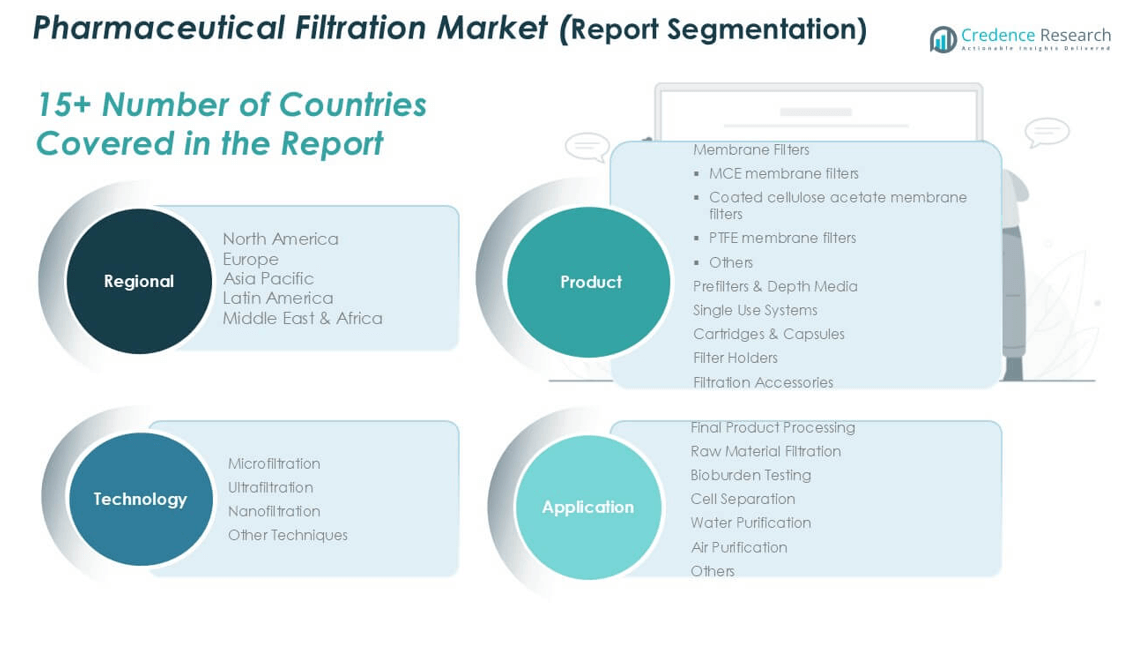
The product segment of the Global Pharmaceutical Filtration Market includes membrane filters, prefilters and depth media, single-use systems, cartridges and capsules, filter holders, and filtration accessories. Membrane filters hold the largest revenue share due to their critical role in ensuring sterility and product purity across pharmaceutical applications. Among membrane filters, MCE, coated cellulose acetate, and PTFE variants are widely adopted for their high filtration efficiency and chemical resistance. Single-use systems are gaining momentum due to their ability to reduce cross-contamination and streamline operations. Prefilters and depth media offer strong dirt-holding capacity, making them essential for primary filtration stages. Cartridges, capsules, and accessories support operational flexibility and system integration.
- For instance, leading pharmaceutical companies reported using over 100,000,000 membrane filter units annually in sterile drug manufacturing facilities worldwide in 2024, reflecting their critical role in large-scale production.
By Technology
The technology segment is categorized into microfiltration, ultrafiltration, nanofiltration, and other techniques. Microfiltration dominates the market owing to its widespread use in bacterial removal and particle separation from liquids and gases. Ultrafiltration is commonly applied in protein separation and virus removal, supporting the growth of biopharmaceuticals. Nanofiltration, although smaller in share, is expanding with its ability to retain small organic molecules and salts. Other techniques, including reverse osmosis and crossflow filtration, contribute to niche applications. The Global Pharmaceutical Filtration Market benefits from the evolution of these technologies in enhancing throughput and product safety.
- For instance, over 12,000 pharmaceutical manufacturing sites globally had upgraded to advanced microfiltration and ultrafiltration systems to improve product safety and process efficiency.
By Application
The application segment includes final product processing, raw material filtration, bioburden testing, cell separation, water purification, air purification, and others. Final product processing leads the market due to its direct impact on drug quality and patient safety. Raw material filtration and bioburden testing are essential to remove contaminants before manufacturing. Cell separation supports biotechnology workflows, while water and air purification ensure cleanroom compliance. The Global Pharmaceutical Filtration Market supports these applications by offering tailored solutions that meet strict regulatory and performance standards.
Segments
Based on Product
- Membrane Filters
- MCE membrane filters
- Coated cellulose acetate membrane filters
- PTFE membrane filters
- Others
- Prefilters & Depth Media
- Single Use Systems
- Cartridges & Capsules
- Filter Holders
- Filtration Accessories
Based on Technology
- Microfiltration
- Ultrafiltration
- Nanofiltration
- Other Techniques
Based on Application
- Final Product Processing
- Raw Material Filtration
- Bioburden Testing
- Cell Separation
- Water Purification
- Air Purification
- Others
Based on Region
- North America
- U.S.
- Canada
- Mexico
- Europe
- UK
- France
- Germany
- Italy
- Spain
- Russia
- Belgium
- Netherlands
- Austria
- Sweden
- Poland
- Denmark
- Switzerland
- Rest of Europe
- Asia Pacific
- China
- Japan
- South Korea
- India
- Australia
- Thailand
- Indonesia
- Vietnam
- Malaysia
- Philippines
- Taiwan
- Rest of Asia Pacific
- Latin America
- Brazil
- Argentina
- Peru
- Chile
- Colombia
- Rest of Latin America
- Middle East
- UAE
- KSA
- Israel
- Turkey
- Iran
- Rest of Middle East
- Africa
- Egypt
- Nigeria
- Algeria
- Morocco
- Rest of Africa
Regional Analysis
North America Pharmaceutical Filtration Market
The North America Pharmaceutical Filtration Market reached USD 2,361.59 million in 2024 and is projected to grow to USD 4,791.96 million by 2032, registering a CAGR of 9.3%. It accounted for approximately 17.85% of the global market share in 2024. The region benefits from a strong presence of major pharmaceutical manufacturers, well-established healthcare infrastructure, and consistent regulatory oversight. High investment in biologics and vaccine production further drives demand for advanced filtration technologies. The United States leads the regional market due to its extensive biopharmaceutical pipeline and high adoption of single-use filtration systems. It continues to witness strong R\&D activity and expansion in contract manufacturing.
Europe Pharmaceutical Filtration Market
Europe generated USD 2,930.82 million in 2024 and is expected to reach USD 6,390.22 million by 2032, growing at a CAGR of 10.2%. It held a 22.15% share of the global Pharmaceutical Filtration Market in 2024. Countries such as Germany, France, and the UK are driving growth through increased biologics manufacturing and strict compliance with EU pharmaceutical quality standards. The market benefits from public-private partnerships and strong regulatory frameworks that mandate sterile processing practices. Growing biosimilar production and cell therapy research support filtration demand. Innovation in nanofiltration and ultrafiltration is gaining momentum across the region.
Asia Pacific Pharmaceutical Filtration Market
Asia Pacific led the global market in 2024 with a valuation of USD 4,678.02 million and is projected to reach USD 10,235.06 million by 2032, expanding at a CAGR of 10.3%. It contributed 35.38% of the global market share in 2024, making it the largest regional market. China, India, and Japan are key contributors due to the rapid growth of pharmaceutical manufacturing, government support, and rising healthcare expenditures. The region’s growing generics industry and increasing presence of international CMOs fuel demand for cost-effective filtration solutions. Infrastructure expansion and greater focus on regulatory alignment with global standards are supporting long-term growth.
Latin America Pharmaceutical Filtration Market
Latin America reached USD 1,530.31 million in 2024 and is forecast to grow to USD 3,382.56 million by 2032 at a CAGR of 10.4%. It represented 11.57% of the global market share in 2024. Brazil and Mexico dominate this region, supported by improving pharmaceutical exports and rising domestic drug production. Regulatory modernization and efforts to localize drug manufacturing are boosting demand for sterile and efficient filtration systems. The market is gradually adopting single-use systems to enhance production efficiency and reduce contamination risks. Growth in biologics and specialty drug manufacturing creates further opportunities.
Middle East Pharmaceutical Filtration Market
The Middle East Pharmaceutical Filtration Market was valued at USD 726.05 million in 2024 and is expected to reach USD 1,581.35 million by 2032, reflecting a CAGR of 10.2%. It accounted for 5.49% of the global market share in 2024. The United Arab Emirates and Saudi Arabia are driving regional demand due to significant investments in healthcare infrastructure and pharmaceutical self-sufficiency. Governments are promoting local drug manufacturing and encouraging international partnerships. This increases the need for high-quality filtration equipment that meets global standards. It remains a promising market for companies expanding in emerging economies.
Africa Pharmaceutical Filtration Market
Africa’s market stood at USD 998.10 million in 2024 and is anticipated to reach USD 1,806.85 million by 2032, growing at a CAGR of 7.7%. It captured 7.54% of the global Pharmaceutical Filtration Market share in 2024. South Africa and Nigeria lead the region with growing pharmaceutical production capabilities and international aid-driven healthcare programs. Despite infrastructure and regulatory limitations, demand is rising for affordable, efficient filtration technologies. Global efforts to improve vaccine manufacturing capacity and essential drug availability in Africa support steady market expansion. It presents long-term opportunities for filtration technology providers focused on cost-effective and scalable systems.
Key players
- Thermo Fisher Scientific, Inc.
- Merck KGaA
- Graver Technologies
- Danaher Corporation
- 3M
- Sartorius AG
- Amazon Filters Ltd.
- Koch Membrane Systems Inc.
- Meissner Filtration Products, Inc.
- Microdyn-Nadir US, Inc.
Competitive Analysis
The Global Pharmaceutical Filtration Market is highly competitive, driven by innovation, product performance, and regulatory compliance. Leading companies such as Thermo Fisher Scientific, Merck KGaA, and Danaher Corporation dominate through broad product portfolios and strategic acquisitions. It sees continuous investment in membrane technology, single-use systems, and high-capacity filtration solutions. Players like Sartorius AG and 3M focus on precision filtration for biologics and personalized therapies. Mid-sized firms, including Graver Technologies and Meissner Filtration Products, target niche applications with tailored solutions. Regional players such as Amazon Filters and Microdyn-Nadir enhance competition through cost-effective offerings and customized support. The market favors companies that deliver reliability, scalability, and compliance-ready systems.
Recent Developments
- In February 2025, Thermo Fisher Scientific acquired Solventum's purification and filtration business for approximately $4.1 billion to enhance its bioprocessing capabilities and expand its filtration solutions. This acquisition will add Solventum's purification and filtration technologies to Thermo Fisher's Life Sciences Solutions segment. The deal is expected to close by the end of 2025, subject to regulatory approvals.
Market Concentration and Characteristics
The Global Pharmaceutical Filtration Market exhibits moderate to high market concentration, with a few multinational players holding a significant share. It is characterized by strong regulatory compliance, technology-driven innovation, and high barriers to entry due to stringent validation requirements. The market favors companies with advanced R&D capabilities, diverse product portfolios, and global distribution networks. Product quality, sterility assurance, and compatibility with biologics are critical factors influencing buyer decisions. It shows a growing preference for single-use systems, automation, and specialized filtration technologies. Strategic partnerships, acquisitions, and regional expansions continue to shape competitive dynamics.
Report Coverage
The research report offers an in-depth analysis based on Product, Technology, Application and Region. It details leading market players, providing an overview of their business, product offerings, investments, revenue streams, and key applications. Additionally, the report includes insights into the competitive environment, SWOT analysis, current market trends, as well as the primary drivers and constraints. Furthermore, it discusses various factors that have driven market expansion in recent years. The report also explores market dynamics, regulatory scenarios, and technological advancements that are shaping the industry. It assesses the impact of external factors and global economic changes on market growth. Lastly, it provides strategic recommendations for new entrants and established companies to navigate the complexities of the market.
Future Outlook
- The rising demand for monoclonal antibodies, cell therapies, and vaccines will continue to drive the need for specialized filtration solutions across upstream and downstream processes.
- Single-use filtration systems will gain wider acceptance due to their efficiency, reduced risk of cross-contamination, and ability to support flexible manufacturing environments.
- Leading companies will increase investments in membrane materials and nanotechnology to enhance filtration precision, throughput, and compatibility with high-potency formulations.
- Automation, IoT sensors, and real-time monitoring tools will become standard in filtration processes, improving traceability, process control, and operational efficiency.
- Tightening global regulations will encourage pharmaceutical manufacturers to adopt validated, high-performance filtration systems that ensure sterility and batch integrity.
- The shift toward continuous processing in pharmaceutical production will increase demand for robust, high-capacity filtration systems capable of sustained operation.
- Rapid expansion of pharmaceutical manufacturing in Asia Pacific, Latin America, and the Middle East will create new opportunities for filtration technology providers.
- The need for tailored filtration systems will grow to accommodate the unique properties of advanced therapeutics, including biologics, biosimilars, and gene therapies.
- Pharmaceutical companies will rely more on CMOs, which will boost demand for scalable, pre-validated, and flexible filtration systems to support diverse product lines.
- Manufacturers will innovate sustainable filter designs and disposal methods, aligning with global environmental standards and reducing operational waste.

Request a Free Sample
Fill in your details and we'll send you a free sample report.
- Sample data tables & charts
- Research methodology
Market Dynamics
Growth in Biopharmaceutical Production
The rapid expansion of the biopharmaceutical sector, including monoclonal antibodies, vaccines, and cell therapies, requires advanced filtration systems to ensure sterility and product integrity. This drives demand for specialized filters capable of handling complex biological materials and meeting stringent regulatory standards.
Stringent Regulatory Requirements
Global regulatory bodies such as the FDA and EMA mandate strict aseptic processing and sterility assurance in pharmaceutical manufacturing. These requirements push manufacturers to adopt high-performance, validated filtration technologies, fueling innovation and market growth.
Adoption of Single-Use Filtration Systems
Pharmaceutical manufacturers are increasingly implementing single-use filtration systems to minimize cross-contamination risks, reduce cleaning validation efforts, and enable faster production changeovers. This trend supports operational efficiency and aligns with the industry's move toward flexible manufacturing.
Advancements in Membrane and Nanofiber Technologies
Continuous innovation in membrane materials and nanofiber technology is enhancing filtration precision, throughput, and chemical compatibility. These advancements enable more effective removal of particulates, microbes, and endotoxins, supporting the production of high-purity pharmaceuticals and biologics.
Expansion of Contract Manufacturing Organizations (CMOs)
The growing reliance on CMOs for pharmaceutical production increases demand for scalable, modular, and disposable filtration solutions. CMOs require flexible systems that can support diverse product lines and rapid batch changeovers, driving further adoption of advanced filtration technologies.
Need a Custom Version of This Report?
Tailor the scope, geography, or segments to your exact requirements.
- Custom geography or segment scope
- Direct access to our analyst team
Frequently Asked Questions
What is the market size of the Global Pharmaceutical Filtration Market in 2023, and what are the projections for 2032 and the CAGR?
Why is the adoption of single-use filtration systems increasing?
Which regions are leading in the pharmaceutical filtration market?
Who are the major players in the global pharmaceutical filtration market?
Table of Content
Chapter 1 Market Segmentation
- 1.1 Segmentation Framework
- 1.1.1 Product and Service Classification
- 1.1.2 Application and End-Use Classification
- 1.1.3 Technology and Solution Classification
- 1.1.4 Customer and Distribution Channel Classification
- 1.1.5 Geographic Segmentation
- 1.1.6 Market Segment Definitions and Boundaries
- 1.2 By Product
- 1.2.1 Membrane Filters
- 1.2.2 Prefilters & Depth Media
- 1.2.3 Single Use Systems
- 1.2.4 Cartridges & Capsules
- 1.2.5 Filter Holders
- 1.2.6 Filtration Accessories
- 1.3 By Technology
- 1.3.1 Microfiltration
- 1.3.2 Ultrafiltration
- 1.3.3 Nanofiltration
- 1.3.4 Other Techniques
- 1.4 By Application
- 1.4.1 Final Product Processing
- 1.4.2 Raw Material Filtration
- 1.4.3 Bioburden Testing
- 1.4.4 Cell Separation
- 1.4.5 Water Purification
- 1.4.6 Air Purification
Chapter 2 Introduction
- 2.1 Report Objectives and Scope
- 2.2 Product Definition and Industry Terminology
- 2.3 Market Inclusions and Exclusions
- 2.4 Research Process
- 2.4.1 Primary Research and Expert Interviews
- 2.4.2 Secondary Research and Source Review
- 2.4.3 Top-Down and Bottom-Up Estimation
- 2.4.4 Data Triangulation and Verification
- 2.5 Market Size Measurement Basis
- 2.5.1 2024: USD 13,224.9 million → 2032: USD 28,188.0 million
- 2.6 Historical and Forecast Reference Periods
- 2.6.1 Base Year: 2024
- 2.6.2 Forecast Period: 2024-2032
- 2.7 Research Assumptions and Limitations
Chapter 3 Executive Summary
- 3.1 Market Snapshot and Key Findings
- 3.2 Base-Year Market Size, 2024
- 3.3 Forecast Market Size, 2032
- 3.4 Revenue and Volume Growth Outlook
- 3.5 Key Demand and Supply Indicators
- 3.6 Leading Market Segments
- 3.7 Fastest-Growing Market Opportunities
- 3.8 Regional Performance Highlights
- 3.9 Technology and Industry Transformation
- 3.10 Competitive Landscape Summary
- 3.11 Analyst View and Strategic Implications
Chapter 4 Global Pharmaceutical Filtration Market Trends and Developments
- 4.1 Historical Industry Development
- 4.2 Recent Market Trends and Developments
- 4.3 Demand and Customer Behavior Trends
- 4.4 Technology and Product Innovation
- 4.5 Artificial Intelligence, Automation and Digitalization
- 4.6 Local Manufacturing and Supply Chain Realignment
- 4.7 Industry Partnerships, Mergers and Acquisitions
- 4.8 Sustainability and Circular Economy Developments
- 4.9 Government and Private Sector Investment Trends
- 4.10 Emerging Business Models and Commercialization
- 4.11 Industry Developments and Announcements
Chapter 5 Global Pharmaceutical Filtration Market Production, Supply and Demand Analysis
- 5.1 Demand Trend and Consumption Analysis
- 5.2 Demand Forecast, 2024-2032
- 5.3 Production and Output Trend
- 5.4 Production and Output Forecast, 2024-2032
- 5.5 Installed Capacity and Capacity Utilization
- 5.6 Company-Wise Production Plants and Statistics
- 5.6.1 Installed Production Capacity
- 5.6.2 Actual Production
- 5.6.3 Planned Capacity and Expansion Targets
- 5.7 Supply Chain Structure and Procurement Trends
- 5.8 Supply-Demand Gap and Bottlenecks
- 5.9 Import Dependence and Sourcing Structure
- 5.10 Contract Manufacturing and Outsourcing
- 5.11 Regional Supply and Demand Concentration
Chapter 6 Global Pharmaceutical Filtration Market Pricing Analysis
- 6.1 Pricing Structure and Measurement
- 6.2 Historical Pricing Trends
- 6.3 Pricing Outlook, 2024-2032
- 6.4 Average Selling Price and Unit Economics
- 6.5 Pricing by Product and Market Segment
- 6.6 Geographic Pricing Differences
- 6.7 Key Input, Energy, Labor and Logistics Costs
- 6.8 Contract Pricing and Purchasing Models
- 6.9 Pricing Sensitivity and Competitive Positioning
- 6.10 Price, Margin and Profitability Implications
Chapter 7 Global Pharmaceutical Filtration Market Dynamics
- 7.1 Market Growth Drivers
- 7.1.1 Demand-Side Drivers
- 7.1.2 Technology and Innovation Drivers
- 7.1.3 Infrastructure and Investment Drivers
- 7.1.4 Regulatory and Policy Drivers
- 7.2 Market Restraints
- 7.2.1 Cost and Affordability Constraints
- 7.2.2 Technology and Adoption Barriers
- 7.2.3 Supply Chain and Operational Constraints
- 7.3 Market Challenges
- 7.3.1 Competitive Pressure and Margin Erosion
- 7.3.2 Skills, Infrastructure and Implementation Gaps
- 7.4 Emerging Market Opportunities
- 7.5 Market Dynamics Impact and Time-Horizon Assessment
Chapter 8 Global Pharmaceutical Filtration Value Chain Analysis
- 8.1 Industry Value Chain Overview
- 8.2 Upstream Suppliers and Critical Inputs
- 8.3 Technology and Component Providers
- 8.4 Manufacturing or Service Delivery
- 8.5 Distribution, Channel Partners and Integrators
- 8.6 Downstream Applications and End Users
- 8.7 Value Addition and Profit Pools
- 8.8 Vertical Integration and Outsourcing
- 8.9 Supplier Concentration and Risk
- 8.10 Supply Chain Localization and Resilience
Chapter 9 Global Pharmaceutical Filtration Market Regulations and Policies
- 9.1 Relevant Laws, Standards and Compliance Frameworks
- 9.2 Product, Service, Safety and Quality Requirements
- 9.3 Government Policies, Incentives and Subsidies
- 9.4 Imports, Exports and Trade Barriers
- 9.5 Public Procurement and Local Content Requirements
- 9.6 Environmental and Sustainability Compliance
- 9.7 Upcoming Policy Changes and Market Implications
Chapter 10 Global Pharmaceutical Filtration Market Hotspots and Opportunities
- 10.1 Market Opportunity Mapping and Growth Hotspots
- 10.2 High-Growth Applications and Customer Groups
- 10.3 Underserved Markets and White-Space Opportunities
- 10.4 Emerging Technology and Product Opportunities
- 10.5 New Capacity and Investment Hotspots
- 10.6 Market Entry and Expansion Opportunities
- 10.7 Distribution and Partnership Opportunities
- 10.8 Near-Term and Long-Term Commercial Potential
- 10.9 Opportunity Attractiveness and Execution Risks
Chapter 11 Global Pharmaceutical Filtration Market Outlook, 2024-2032
- 11.1 Market Size and Analysis
- 11.1.1 Revenue (Market Measurement: 2024: USD 13,224.9 million → 2032: USD 28,188.0 million)
- 11.1.2 Market Volume and Quantity Sold
- 11.1.3 Historical Market Size
- 11.1.4 Base-Year Market Size, 2024
- 11.2 Market Forecast, 2024-2032
- 11.2.1 Revenue Forecast to 2032
- 11.2.2 Volume Forecast to 2032
- 11.2.3 CAGR and Year-on-Year Growth
- 11.2.4 Incremental Revenue Opportunity
- 11.3 Forecast Assumptions and Scenario Analysis
- 11.3.1 Base-Case Forecast
- 11.3.2 Optimistic and Conservative Scenarios
- 11.3.3 Technology, Pricing and Policy Sensitivities
- 11.4 Market Attractiveness and Growth Outlook
Chapter 12 Global Pharmaceutical Filtration Market Segmentation and Outlook
- 12.1 Segmentation Summary and Market Shares, 2024
- 12.2 Largest and Fastest-Growing Segments
- 12.3 By Product - Market Size and Forecast, 2024-2032
- 12.3.1 Segment Definition and Scope
- 12.3.2 Historical Market Size
- 12.3.3 Revenue Forecast, 2024-2032
- 12.3.4 Volume Forecast, 2024-2032
- 12.3.5 Base-Year Market Share, 2024
- 12.3.6 Segment CAGR and Growth Drivers
- 12.3.7 Subsegment Market Size and Forecast
- 12.3.7.1 Membrane Filters
- 12.3.7.2 Prefilters & Depth Media
- 12.3.7.3 Single Use Systems
- 12.3.7.4 Cartridges & Capsules
- 12.3.7.5 Filter Holders
- 12.3.7.6 Filtration Accessories
- 12.3.8 Subsegment Pricing and Adoption Trends
- 12.3.9 Leading Suppliers and Competition
- 12.3.10 Regional Demand and Opportunities
- 12.4 By Technology - Market Size and Forecast, 2024-2032
- 12.4.1 Segment Definition and Scope
- 12.4.2 Historical Market Size
- 12.4.3 Revenue Forecast, 2024-2032
- 12.4.4 Volume Forecast, 2024-2032
- 12.4.5 Base-Year Market Share, 2024
- 12.4.6 Segment CAGR and Growth Drivers
- 12.4.7 Subsegment Market Size and Forecast
- 12.4.7.1 Microfiltration
- 12.4.7.2 Ultrafiltration
- 12.4.7.3 Nanofiltration
- 12.4.7.4 Other Techniques
- 12.4.8 Subsegment Pricing and Adoption Trends
- 12.4.9 Leading Suppliers and Competition
- 12.4.10 Regional Demand and Opportunities
- 12.5 By Application - Market Size and Forecast, 2024-2032
- 12.5.1 Segment Definition and Scope
- 12.5.2 Historical Market Size
- 12.5.3 Revenue Forecast, 2024-2032
- 12.5.4 Volume Forecast, 2024-2032
- 12.5.5 Base-Year Market Share, 2024
- 12.5.6 Segment CAGR and Growth Drivers
- 12.5.7 Subsegment Market Size and Forecast
- 12.5.7.1 Final Product Processing
- 12.5.7.2 Raw Material Filtration
- 12.5.7.3 Bioburden Testing
- 12.5.7.4 Cell Separation
- 12.5.7.5 Water Purification
- 12.5.7.6 Air Purification
- 12.5.8 Subsegment Pricing and Adoption Trends
- 12.5.9 Leading Suppliers and Competition
- 12.5.10 Regional Demand and Opportunities
- 12.6 Segment Growth Comparison
- 12.7 Segment Attractiveness and Priority Matrix
Chapter 13 Global Pharmaceutical Filtration End-Use and Application Market Outlook
- 13.1 End-Use Industry and Customer Demand Structure
- 13.2 Leading Applications and Customer Groups
- 13.3 End-Use Market Size, Share and Forecast
- 13.4 Major End-Use Industry Deep Dives
- 13.4.1 Customer Requirements and Use Cases
- 13.4.2 Demand and Replacement Cycles
- 13.4.3 Technical and Regulatory Considerations
- 13.4.4 Purchasing and Procurement Models
- 13.4.5 Leading Vendors and Distribution Channels
- 13.4.6 Forecast and Commercial Opportunities
- 13.5 Emerging Applications and Cross-Segment Demand
- 13.6 End-Use Industry Investment Priorities
Chapter 14 Global Pharmaceutical Filtration Geographic Market Outlook, 2024-2032
- 14.1 Regional Market Size and Share, 2024
- 14.2 Regional Market Forecast, 2024-2032
- 14.3 Regional Pricing, Production and Demand Differences
- 14.4 North America
- 14.4.1 United States
- 14.4.2 Canada
- 14.4.3 Mexico
- 14.5 Europe
- 14.5.1 Germany
- 14.5.2 France
- 14.5.3 Italy
- 14.5.4 United Kingdom
- 14.5.5 Spain
- 14.5.6 Poland
- 14.5.7 Russia
- 14.5.8 Netherlands
- 14.5.9 Belgium
- 14.5.10 Sweden
- 14.5.11 Denmark
- 14.5.12 Norway
- 14.5.13 Rest of Europe
- 14.6 Asia Pacific
- 14.6.1 China
- 14.6.2 India
- 14.6.3 Japan
- 14.6.4 South Korea
- 14.6.5 Thailand
- 14.6.6 Indonesia
- 14.6.7 Vietnam
- 14.6.8 Malaysia
- 14.6.9 Australia
- 14.6.10 Rest of Asia Pacific
- 14.7 Latin America
- 14.7.1 Brazil
- 14.7.2 Argentina
- 14.7.3 Colombia
- 14.7.4 Chile
- 14.7.5 Rest of Latin America
- 14.8 Middle East
- 14.8.1 Saudi Arabia
- 14.8.2 United Arab Emirates
- 14.8.3 Turkey
- 14.8.4 Israel
- 14.8.5 Iran
- 14.8.6 Rest of the Middle East
- 14.9 Africa
- 14.9.1 South Africa
- 14.9.2 Egypt
- 14.9.3 Nigeria
- 14.9.4 Morocco
- 14.9.5 Rest of Africa
- 14.10 Regional Investment, Policy and Supply Chain Differences
- 14.11 Regional Competitive Landscape
- 14.12 Geographic Growth Hotspots
Chapter 15 Global Pharmaceutical Filtration Technology, Innovation and Sustainability Outlook
- 15.1 Technology Landscape and Maturity
- 15.2 Product, Process and Service Innovation
- 15.3 AI, Automation and Digital Tools in the Industry
- 15.4 Technology Adoption and Performance Benchmarking
- 15.5 Innovation Pipeline and R&D Investment
- 15.6 Patent and Intellectual Property Trends
- 15.7 Energy Efficiency and Resource Management
- 15.8 Sustainability, Recycling and Circularity
- 15.9 Technology Roadmap, 2024-2032
- 15.10 Risks of Obsolescence and Technology Substitution
Chapter 16 Global Pharmaceutical Filtration Market Key Strategic Imperatives
- 16.1 Growth and Market Entry Priorities
- 16.2 High-Return Products and Segments
- 16.3 Pricing, Profitability and Cost Optimization
- 16.4 Technology Investment and Product Differentiation
- 16.5 Supply Chain Localization and Resilience
- 16.6 Distribution and Customer Acquisition
- 16.7 Partnership, Acquisition and Capacity Strategy
- 16.8 Regional Expansion Priorities
- 16.9 Short-, Medium- and Long-Term Actions
Chapter 17 Competition Outlook
- 17.1 Industry Competition Characteristics
- 17.2 Market Structure and Concentration
- 17.3 Market Share and Competitive Positioning, 2024
- 17.4 Company-Wise Revenue and Product Benchmarking
- 17.5 Production and Service Capacity Benchmarking
- 17.6 Technology, Pricing and Differentiation
- 17.7 Regional Footprint and Distribution Strength
- 17.8 Mergers, Acquisitions and Strategic Alliances
- 17.9 New Entrants and Competitive Threats
- 17.10 Porter's Five Forces and Industry Attractiveness
- 17.11 Competitive Outlook, 2024-2032
Chapter 18 Company Profiles
- 18.1 Company Coverage and Selection Criteria
- 18.2 Thermo Fisher Scientific, Inc.
- 18.2.1 Business Description
- 18.2.2 Company Ownership and Geographic Presence
- 18.2.3 Product and Service Portfolio
- 18.2.4 Manufacturing and Operating Footprint
- 18.2.5 Production Capacity and Expansion Plans
- 18.2.6 Financial Performance and Investment
- 18.2.7 Market Share and Competitive Position
- 18.2.8 Technology and Innovation Capabilities
- 18.2.9 Strategic Alliances or Partnerships
- 18.2.10 Recent Developments
- 18.2.11 Growth Strategy and Outlook
- 18.3 Merck KGaA
- 18.4 Danaher Corporation
- 18.5 3M
- 18.6 Sartorius AG
- 18.7 Graver Technologies
- 18.8 Amazon Filters Ltd.
- 18.9 Koch Membrane Systems Inc.
- 18.10 Meissner Filtration Products, Inc.
- 18.11 Microdyn-Nadir US, Inc.
- 18.12 Other Relevant Market Participants
Note: Every listed company is profiled on the structure shown under the first company. The company list is preliminary and may change based on research findings, market developments, data availability and client requirements.
Chapter 19 Disclaimer
- 19.1 Research and Forecast Disclaimer
- 19.2 Data Source and Estimation Limitations
Note: The depth of individual sections depends on data availability for this market. Volume, capacity, trade and other unit-based metrics are included where applicable.

