Market overview
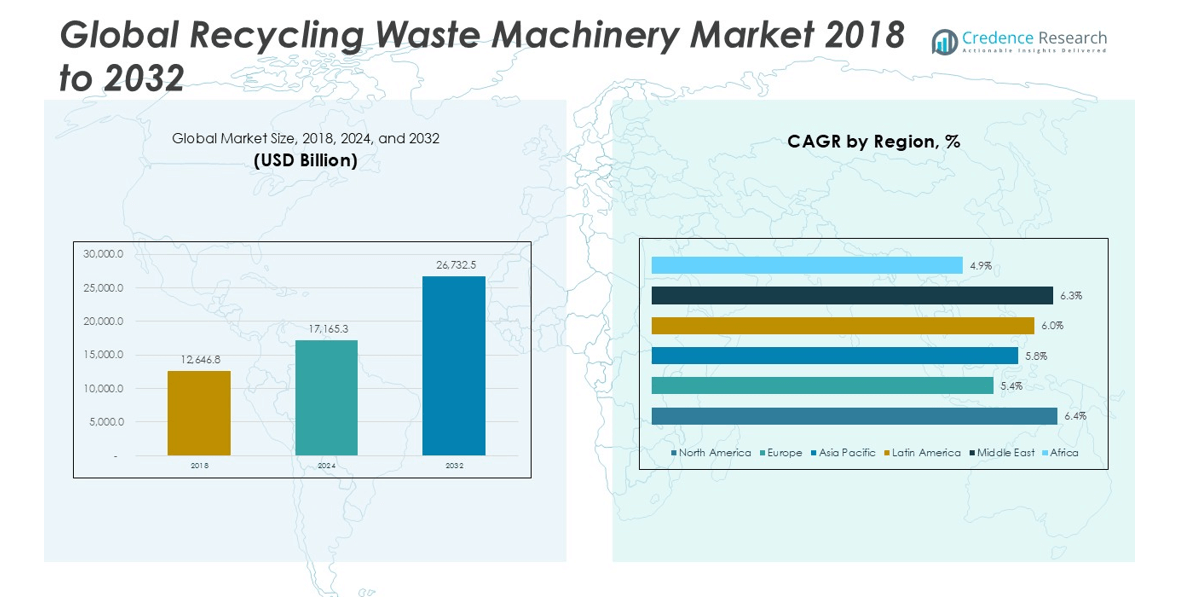
The Global Recycling Waste Machinery Market size was valued at USD 12,646.8 Billion in 2018 and is projected to reach USD 17,165.3 Billion by 2024. It is anticipated to grow to USD 26,732.5 Billion by 2032, at a CAGR of 5.74% during the forecast period.
| REPORT ATTRIBUTE | DETAILS |
|---|---|
| Historical Period | 2020-2023 |
| Base Year | 2024 |
| Forecast Period | 2025-2032 |
| Recycling Waste Machinery Market Size 2024 | USD 17,165.3 Billion |
| Recycling Waste Machinery Market, CAGR | 5.74% |
| Recycling Waste Machinery Market Size 2032 | USD 26,732.5 Billion |
The Global Recycling Waste Machinery Market features key players including Amey Engineers, MBM Corporation, Sweed Machinery, Inc., SSI Shredding Systems, Inc., Vecoplan, LLC, HALCO, Satake, TOMRA, and Cimbria. These companies lead innovation in equipment such as shredders, optical sorters, and balers and maintain strong global footprints. Regionally, Europe commanded approximately 26.8% of market share in 2024, supported by rigorous recycling regulations and high adoption rates of advanced machinery. Asia Pacific followed closely, capturing around 34.9% of the market in 2024, driven by rapid urbanisation and expanding industrial waste streams. North America held roughly 23.4% of the market share in 2024, underpinned by mature infrastructure and large municipal recycling programmes.

Market Insights
- The Global Recycling Waste Machinery Market was valued at USD 17,165.3 Billion in 2024 and is projected to reach USD 26,732.5 Billion by 2032 at a CAGR of 5.74%.
- Rising global waste volumes and stricter eco‑regulations are driving investments in recycling machinery, especially shredders which held a 36% segment share in 2024
- Key trends include the rapid adoption of AI‑enabled optical sorters, circular economy initiatives boosting material reuse (metal held a 36.4% share by proceed material), and mobile modular processing units in emerging markets.
- Market dynamics show major players such as Amey Engineers, MBM Corporation, SSI Shredding Systems, Vecoplan, HALCO, Satake, TOMRA and Cimbria expanding regionally, but high capital costs and fragmented waste streams still restrain widespread deployment.
- Regionally, Asia Pacific commanded the largest share at about 34.9% in 2024, followed by Europe (26.8%) and North America (23.4%), with Latin America, Middle East and Africa growing at above‑average CAGRs.
Market Segmentation Analysis:
By Equipment Type
The Shredders segment dominates the recycling machinery market, accounting for 36% of total revenue in 2024. Horizontal shredders hold the largest share due to their higher throughput and efficiency in processing bulky waste streams. The growth of this segment is driven by increased demand for size-reduction in plastic, metal, and municipal waste, as well as the rising need for pre-processing in recycling facilities. Granulators, shears, and separators follow with smaller shares, driven by niche applications in material recovery, particularly in metals and plastics.
- For instance, SSI Shredding Systems’ PRI-MAX industrial shredder is widely adopted for metal and tire recycling because of its ability to process more than 20 tons per hour.
By Proceed Material
The Metal sub-segment leads in the recycling machinery market, capturing 36.4% of revenue in 2024. This dominance is attributed to the high value of metals, especially in industrial and automotive recycling. With growing demand for metal recovery from e-waste, scrap metal, and used machinery, this segment is supported by stringent regulations and high material recovery rates. Plastic follows with a significant share (30%), driven by the push for higher recycling rates and closed-loop systems, while cardboard and construction waste are growing steadily in municipal recycling programs.
- For instance, global equipment manufacturer Metso introduced its N-Series metal shredders designed for high-yield recovery of ferrous and non-ferrous materials, enhancing plant throughput across recycling facilities.
By End User
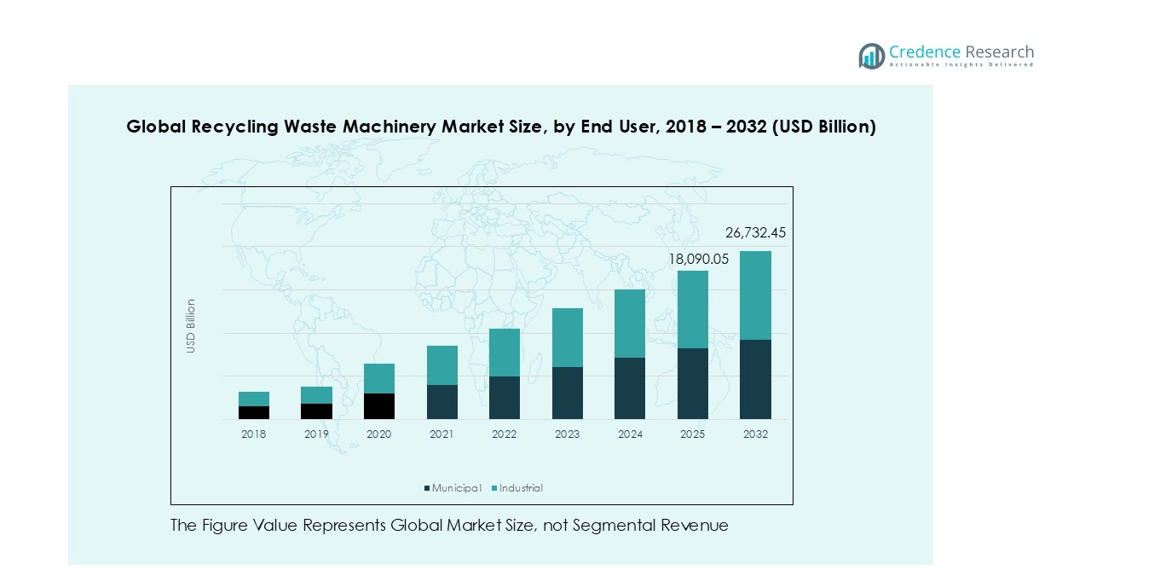
In the End User segmentation, Municipal recycling leads with 45.1% of the market share in 2024. The growth in this sector is propelled by urbanisation, stricter waste management regulations, and growing government investments in recycling infrastructure. Industrial users, however, are catching up, with a projected 54.9% share, driven by businesses’ increasing investment in recycling technologies for in-house waste management, driven by sustainability goals and cost savings in scrap recycling. The push for zero-waste manufacturing and circular economy adoption is expected to further boost this sector.
Key Growth Drivers
Increasing Waste Generation
One of the primary growth drivers in the global recycling waste machinery market is the rising volume of waste generated globally. As urbanisation accelerates and consumer consumption increases, waste production, particularly in metropolitan areas, continues to grow. This surge in waste creates a need for efficient, automated recycling systems. Governments worldwide are implementing stricter waste management regulations and setting higher recycling targets, further driving the demand for advanced recycling machinery. The pressure to reduce landfill waste and promote sustainable waste management is pushing investments in recycling technologies.
- For instance, Caterpillar has been developing compact material handlers, such as the Cat MH3022, specifically designed for recycling facilities to enhance safety and productivity.
Government Regulations and Sustainability Initiatives
Tighter regulations around waste disposal and growing environmental sustainability mandates are significant drivers of the recycling machinery market. Countries are adopting more stringent waste segregation policies and extending producer responsibility for recycling. These regulatory frameworks are encouraging the development and adoption of advanced recycling machinery to handle different waste streams efficiently. Additionally, global sustainability initiatives, such as the Paris Agreement and circular economy principles, are prompting businesses and governments to focus on reducing landfill usage and maximizing resource recovery, stimulating demand for cutting-edge recycling solutions.
- For instance, Italian company SOREMA designed and installed a custom PET bottle recycling line in Myanmar that effectively handles high contamination levels in collected bottles, allowing reuse in new bottle production.
Technological Advancements
Technological innovations in recycling equipment, such as automation, AI integration, and smart sensors, are playing a crucial role in the market's growth. These advancements improve the efficiency and precision of sorting, processing, and separating materials, reducing the cost and time involved in recycling operations. Additionally, the development of more energy-efficient machines and the integration of machine learning to enhance material identification are further enhancing the market's potential. As technologies continue to evolve, recycling processes become faster, more accurate, and capable of handling complex waste streams, fueling further market expansion.
Key Trends & Opportunities
Rise of E-Waste Recycling
A significant trend in the recycling waste machinery market is the growing focus on electronic waste (e-waste) recycling. With the rapid advancement of technology, a massive volume of obsolete electronic devices such as smartphones, computers, and televisions is being discarded each year. These products contain valuable materials, including rare metals, that can be recovered through specialized recycling machinery. As e-waste generation increases, recycling companies are investing in machinery tailored for electronic waste to recover precious metals, plastics, and other components, presenting substantial growth opportunities in this sector.
- For instance, Apple’s “Daisy” robot can disassemble up to 1.2 Billion iPhones annually, recovering key materials such as tungsten and cobalt for reuse in new devices.
Adoption of Circular Economy Practices
The adoption of circular economy principles is creating substantial opportunities within the recycling machinery market. As industries and governments focus on reducing waste and promoting the reuse and recycling of materials, the demand for machinery that can process diverse waste streams, including plastics, metals, and organic matter, is growing. Circular economy initiatives encourage designing products with their end-of-life phase in mind, leading to innovations in recycling technologies. Companies involved in recycling are investing in equipment that supports the efficient recovery of materials for reuse, promoting sustainability and reducing environmental impact.
- For instance, ZenRobotics in Finland has developed AI-powered robots capable of sorting up to 4,000 items per hour, enhancing throughput and reducing labor dependency in plastic waste processing.

Key Challenges
High Initial Investment Costs
A major challenge facing the recycling waste machinery market is the high initial investment required for advanced machinery. Recycling equipment such as shredders, optical sorters, and granulators involve significant capital expenditures, which can be a barrier for small and medium-sized recycling businesses. While these technologies offer long-term savings and operational efficiencies, the upfront costs can be prohibitive. As a result, many companies hesitate to invest in cutting-edge equipment, limiting the adoption of advanced recycling technologies, particularly in emerging markets with limited financial resources.
Complexity of Material Handling
Another challenge in the recycling machinery market is the complexity of handling diverse waste streams. Waste materials vary significantly in terms of composition, size, and contaminant levels, making it difficult to design machinery that can effectively process all types of materials. For instance, plastics, metals, and organic waste require different processing methods, which can complicate equipment design and increase operational costs. Recycling facilities need machinery that can adapt to varying waste inputs while maintaining efficiency, which requires ongoing innovation and customization to address the diverse nature of waste materials.
Regional Analysis
North America
North America is a prominent region in the global recycling waste machinery market, with a market size of USD 2,922.68 Billion in 2018. The market is projected to reach USD 4,016.18 Billion by 2024 and USD 6,356.98 Billion by 2032, growing at a CAGR of 6.4% during the forecast period. The region holds a significant market share, driven by robust government regulations promoting recycling, technological advancements in waste management, and growing demand for efficient recycling solutions across industrial and municipal sectors. The market expansion is supported by increasing waste generation and investments in sustainable recycling infrastructure.
Europe
Europe holds a substantial share of the global recycling waste machinery market, with a market size of USD 3,457.64 Billion in 2018. The region is expected to grow to USD 4,603.23 Billion by 2024 and USD 6,982.52 Billion by 2032, at a CAGR of 5.4%. Europe’s growth is primarily driven by stringent environmental regulations, including the EU’s circular economy initiatives, and a focus on sustainable waste management. The region’s advanced recycling systems and high recycling rates in both municipal and industrial sectors contribute significantly to its dominant position in the market.
Asia Pacific
Asia Pacific is expected to experience significant growth in the recycling waste machinery market, with an estimated market size of USD 4,398.56 Billion in 2018. By 2024, the market is projected to reach USD 5,986.26 Billion, and USD 9,356.36 Billion by 2032, at a CAGR of 5.8%. The rapid urbanisation, industrialisation, and increasing waste generation in countries like China, India, and Japan are key drivers of market growth in the region. The Asia Pacific region is adopting modern recycling technologies to address waste management challenges and support sustainable practices, contributing to its growing market share.
Latin America
The recycling waste machinery market in Latin America was valued at USD 1,096.48 Billion in 2018 and is projected to reach USD 1,513.98 Billion by 2024 and USD 2,411.27 Billion by 2032, growing at a CAGR of 6.0%. The region’s market growth is driven by increasing governmental initiatives, urbanisation, and rising environmental awareness regarding waste management. Countries like Brazil and Mexico are investing in advanced recycling machinery to cope with the growing waste volumes. The adoption of circular economy principles and rising demand for resource recovery are fueling further market expansion in Latin America.
Middle East
The Middle East recycling waste machinery market had a value of USD 408.49 Billion in 2018, expected to reach USD 574.30 Billion by 2024 and USD 935.64 Billion by 2032, growing at a CAGR of 6.3%. The region’s growth is fueled by increasing investments in sustainable infrastructure, growing industrial waste generation, and government regulations aimed at enhancing recycling rates. Countries like the UAE and Saudi Arabia are focusing on waste-to-resource projects and smart recycling technologies. As environmental sustainability becomes a priority, the market for recycling machinery continues to expand in the Middle East.
Africa
Africa’s recycling waste machinery market was valued at USD 362.96 Billion in 2018. It is expected to grow to USD 471.31 Billion by 2024 and USD 689.70 Billion by 2032, at a CAGR of 4.9%. The market growth is primarily driven by increasing urbanisation, the expansion of recycling programs, and the rising need for sustainable waste management solutions in fast-growing economies like South Africa, Nigeria, and Egypt. Challenges like limited recycling infrastructure are being addressed through international partnerships and investments in waste-to-energy projects, contributing to the region’s growing share in the global market.

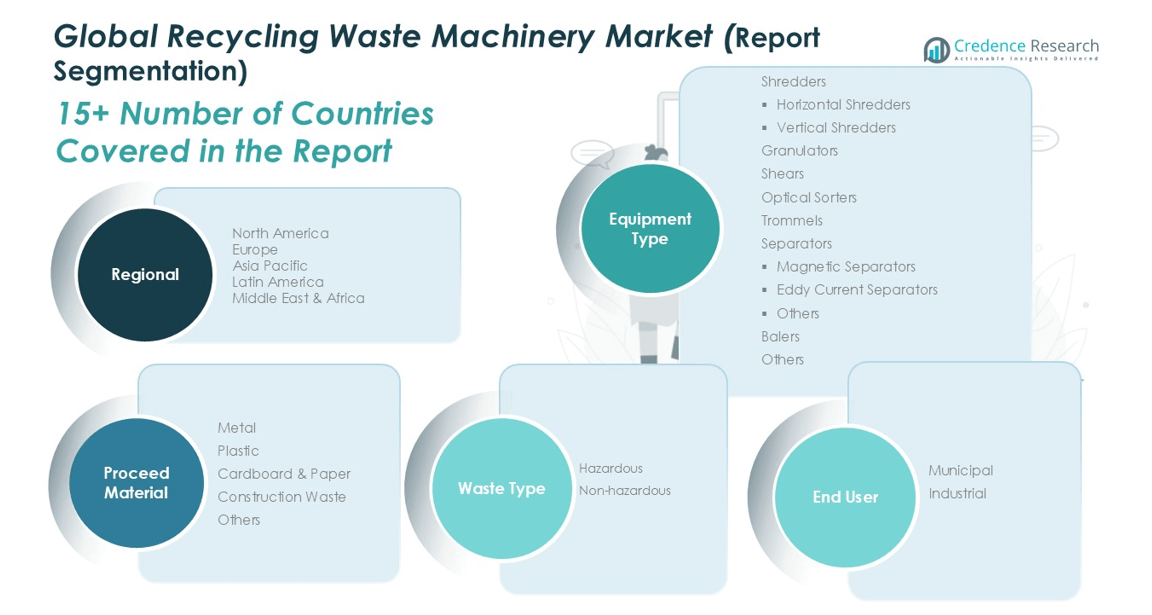
Market Segmentations:
By Equipment Type:
- Shredders
- Horizontal Shredders
- Vertical Shredders
- Granulators
- Shears
- Optical Sorters
- Trommels
- Separators
- Magnetic Separators
- Eddy Current Separators
- Others
- Balers
- Others
By Proceed Material:
- Metal
- Plastic
- Cardboard & Paper
- Construction Waste
- Others
By Waste Type:
- Hazardous
- Non-hazardous
By End User:
- Municipal
- Industrial
By Geography
- North America
- U.S.
- Canada
- Mexico
- Europe
- Germany
- France
- U.K.
- Italy
- Spain
- Rest of Europe
- Asia Pacific
- China
- Japan
- India
- South Korea
- South-east Asia
- Rest of Asia Pacific
- Latin America
- Brazil
- Argentina
- Rest of Latin America
- Middle East & Africa
- GCC Countries
- South Africa
- Rest of the Middle East and Africa
Competitive Landscape
The global recycling waste machinery market is highly competitive, with key players such as Amey Engineers, MBM Corporation, Sweed Machinery, Inc., SSI Shredding Systems, Inc., Vecoplan, LLC, HALCO, Satake, TOMRA, Cimbria, and others dominating the landscape. These companies compete based on factors like technological innovation, product efficiency, customer service, and regional market presence. The market is characterized by a mix of established players and new entrants, all vying for market share in a growing industry driven by stricter environmental regulations and the push for sustainable waste management practices. Key players are investing heavily in R&D to develop advanced recycling technologies, such as automated sorting systems, high-efficiency shredders, and smart machines with AI integration, to meet the rising demand for effective waste management solutions. Strategic partnerships, mergers, and acquisitions are common strategies used by these players to enhance their product portfolios, expand their geographical reach, and strengthen their competitive position in the market.
Key Player Analysis
- Amey Engineers
- BM Corporation
- Sweed Machinery, Inc.
- SSI Shredding Systems, Inc.
- Vecoplan, LLC
- HALCO
- Satake
- TOMRA
- Cimbria
- Other Key Players
Recent Developments
- In January 2025, ANDRITZ acquired ATN Engineering B.V., a Dutch company specialising in advanced recycling technologies.
- In July 2025, Metso signed an agreement to acquire the recycling operations of TL Solution, enhancing its mill‑lining technology recycling business.
- In October 2025, Northstar Recycling Co. acquired Waste Technology Services (WTS), a provider of environmental consulting and circular‑economy recycling solutions.
- In June 2025, TOMRA Recycling launched its new‑generation X‑TRACT™ X‑ray transmission (XRT) sorter for wood waste, enhancing separation of inerts, metals, plastics and glass in recycling streams.
Report Coverage
The research report offers an in-depth analysis based on Equipment Type, Proceed Material, Waste Type, End User and Geography. It details leading market players, providing an overview of their business, product offerings, investments, revenue streams, and key applications. Additionally, the report includes insights into the competitive environment, SWOT analysis, current market trends, as well as the primary drivers and constraints. Furthermore, it discusses various factors that have driven market expansion in recent years. The report also explores market dynamics, regulatory scenarios, and technological advancements that are shaping the industry. It assesses the impact of external factors and global economic changes on market growth. Lastly, it provides strategic recommendations for new entrants and established companies to navigate the complexities of the market.
Future Outlook
- The market will continue to expand as waste generation rises globally, driving demand for efficient machinery across municipal and industrial sectors.
- Manufacturers will increasingly adopt advanced automation, robotics and AI‑powered sorting solutions to improve recovery rates and reduce operational costs.
- Circular economy initiatives and extended producer responsibility mandates will push companies to invest more in high‑performance recycling equipment.
- Growing demand for recycled content in industries such as automotive, packaging and construction will boost investment in size‑reduction and separation machinery.
- Emerging markets in Asia‑Pacific, Latin America and the Middle East will become stronger growth zones as infrastructure investments rise and regulatory frameworks mature.
- Integration of IoT, real‑time monitoring and data analytics in recycling systems will enable predictive maintenance, throughput optimisation and lower downtime.
- Equipment manufacturers will increasingly focus on modular and mobile recycling units to serve small‑scale operations and remote locations efficiently.
- The market will face consolidation through strategic alliances, acquisitions and partnerships as players seek to broaden technology portfolios and global reach.
- Volatility in commodity prices and supply‑chain disruptions will drive interest in machinery that can handle diverse feedstocks and adapt to changing waste compositions.
- Sustainability and energy‑efficiency will become differentiating factors, with companies prioritising equipment that reduces carbon footprint and meets green procurement standards.

Request a Free Sample
Fill in your details and we'll send you a free sample report.
- Sample data tables & charts
- Research methodology
Need a Custom Version of This Report?
Tailor the scope, geography, or segments to your exact requirements.
- Custom geography or segment scope
- Direct access to our analyst team
Frequently Asked Questions
What is the current market size for the Global Recycling Waste Machinery Market, and what is its projected size in 2032?
At what Compound Annual Growth Rate is the Global Recycling Waste Machinery Market projected to grow between 2025 and 2032?
Which Global Recycling Waste Machinery Market segment held the largest share in 2024?
What are the primary factors fueling the growth of the Global Recycling Waste Machinery Market?
Who are the leading companies in the Global Recycling Waste Machinery Market?
Table of Content
Chapter 1. Report Introduction
- 1.1 Report Description & Purpose
- 1.1.1 Report Title & Market Definition
- 1.1.2 Unique Selling Propositions (USP) & Key Differentiators
- 1.1.3 Value Proposition for Stakeholders
- 1.2 Research Objectives
- 1.2.1 Market Sizing Objectives (Volume & Revenue)
- 1.2.2 Segmentation Objectives
- 1.2.3 Competitive Intelligence Objectives
- 1.2.4 Forecast & Scenario Objectives
- 1.3 Report Scope
- 1.3.1 Recycling Waste Machinery Scope – Types & Subtypes Covered
- 1.3.2 Geographic Scope – Regions & Countries Covered
- 1.3.3 Historical Period, Base Year & Forecast Period (2024; forecast to 2032)
- 1.3.4 Inclusions & Exclusions
- 1.4 HS Code & Classification Framework
- 1.5 Currency, Units & Pricing Basis
- 1.6 Target Stakeholders
- 1.7 Limitations & Assumptions
Chapter 2. Executive Summary
- 2.1 Global Recycling Waste Machinery Market Snapshot
- 2.1.1 Market Size – Historical (2024) & Forecast (2024-2032) (2024: USD 17,165.3 Billion → 2032: USD 26,732.5 Billion)
- 2.1.2 Volume & Revenue – Global Totals
- 2.1.3 Key Market Highlights – Top Five Facts
- 2.2 Recycling Waste Machinery Market Segmentation Snapshot
- 2.2.1 Market Split by Region – 2024 vs. 2032
- 2.3 Competitive Snapshot
- 2.3.1 Top 10 Players by Revenue Share – 2024
- 2.3.2 Top 10 Players by Volume Share – 2024
- 2.3.3 Recent Strategic Developments (18-Month Summary)
- 2.4 Key Investment Highlights & Strategic Conclusions
Chapter 3. Recycling Waste Machinery Market Dynamics & Industry Analysis
- 3.1 Market Overview & Context
- 3.1.1 Recycling Waste Machinery Market Position in the Broader Automotive Value Chain
- 3.1.2 OEM vs. Replacement Market Dynamics
- 3.1.3 Market Maturity & Development Stage by Region
- 3.2 Recycling Waste Machinery Market Drivers
- 3.3 Recycling Waste Machinery Market Restraints & Challenges
- 3.4 Recycling Waste Machinery Market Opportunities
- 3.5 Porter's Five Forces Analysis
- 3.5.1 Threat of New Entrants
- 3.5.2 Bargaining Power of Suppliers
- 3.5.3 Bargaining Power of Buyers
- 3.5.4 Threat of Substitutes
- 3.5.5 Competitive Rivalry – Intensity Assessment
- 3.6 Recycling Waste Machinery Value Chain Analysis
- 3.6.1 Upstream – Raw Material/Input Suppliers
- 3.6.1.1 Raw Material/Input 1
- 3.6.1.2 Raw Material/Input 2
- 3.6.1.3 Raw Material/Input 3
- 3.6.2 Midstream – Production/Manufacturing/Service Delivery
- 3.6.2.1 Production/Process Overview
- 3.6.2.2 Key Facility Locations & Capacity by Manufacturer
- 3.6.3 Downstream – Distribution & End Consumer
- 3.6.3.1 Primary Channel – B2B/OEM
- 3.6.3.2 Secondary Channels – Dealer, Retail, Online, Direct
- 3.6.4 Value Chain Profitability Analysis
- 3.6.1 Upstream – Raw Material/Input Suppliers
- 3.7 PESTEL Analysis
- 3.7.1 Political Factors
- 3.7.2 Economic Factors
- 3.7.3 Social Factors
- 3.7.4 Technological Factors
- 3.7.5 Environmental Factors
- 3.7.6 Legal Factors
- 3.8 Recycling Waste Machinery Supply Chain Analysis
- 3.8.1 Raw Material/Input Supply Risk Assessment
- 3.8.2 Manufacturing Concentration Risk (Geographic Exposure)
- 3.8.3 Trade Disruption Impact Analysis
- 3.9 Regulatory & Policy Landscape
Note: The regulatory and policy landscape section covers regulations based on their applicability to the market, Recycling Waste Machinery category, geography, and scope of the study. Only regulatory frameworks with a material impact on operations, compliance, trade, sustainability, or market access are analyzed in detail.
Chapter 4. Key Investment Pockets & Opportunity Analysis
- 4.1 Recycling Waste Machinery Market Attractiveness Analysis
- 4.1.1 By Region – Investment Attractiveness Matrix (Volume × CAGR)
- 4.2 Absolute Revenue Growth Opportunity
- 4.2.1 By Region – Absolute USD Growth Through 2032
- 4.3 Incremental Volume Opportunity
- 4.3.1 By Region – Incremental Volume Through 2032
- 4.3.2 Segment – Incremental Volume
- 4.4 Emerging Submarket Opportunity Deep Dive (Subject to Applicability)
- 4.5 Emerging Market Opportunity Scorecards
- 4.5.1 United States
- 4.5.2 Europe
- 4.5.3 Asia
- 4.5.4 Middle East & Africa
Note: Emerging Market Opportunity Scorecards will be included based on relevance and strategic importance. Regions listed are indicative and may vary depending on data availability and market dynamics.
Chapter 5. Recycling Waste Machinery Import-Export Analysis & Trade Flows
- 5.1 Global Trade Overview
- 5.1.1 Global Export Value by Country (2024)
- 5.1.2 Global Export Volume by Country (2024)
- 5.1.3 Global Import Value by Country (2024)
- 5.1.4 Global Import Volume by Country (2024)
- 5.1.5 Net Trade Balance by Country (2024)
- 5.2 Export Analysis – Segment
- 5.2.1 Type 1 (HS Code)
- 5.2.2 Type 2 (HS Code)
- 5.2.3 Type 3 (HS Code)
- 5.2.4 Type 4 (HS Code)
- 5.2.5 Type 5 (HS Code)
- 5.3 Import Analysis – Segment
- 5.3.1 Type 1 (HS Code)
- 5.3.2 Type 2 (HS Code)
- 5.3.3 Type 3 (HS Code)
- 5.3.4 Type 4 (HS Code)
- 5.3.5 Type 5 (HS Code)
- 5.4 Average Unit Trade Prices
- 5.4.1 Average Export Price – Segment & Country
- 5.4.2 Average Import Price – Segment & Source Country
- 5.4.3 Price Trends (2024)
- 5.5 Key Trade Route Analysis
- 5.5.1 Trade Route 1
- 5.5.2 Trade Route 2
- 5.5.3 Trade Route 3
- 5.5.4 Trade Route 4
- 5.5.5 Trade Route 5
- 5.6 Trade Policy Impact Assessment
- 5.6.1 US Anti-Dumping & Section 301 Tariffs
- 5.6.2 EU Customs Union Impact
- 5.6.3 Major Free Trade Agreements
- 5.6.4 USMCA Rules of Origin
Note: Trade policy analysis will be included only where relevant to the Recycling Waste Machinery market.
Chapter 6. Competitive Landscape & Company Benchmarking
- 6.1 Recycling Waste Machinery Market Concentration & Structure
- 6.1.1 Herfindahl-Hirschman Index (HHI) – vs. 2024
- 6.1.2 Tier 1, Tier 2 & Tier 3 Market Structure
- 6.1.3 Global, Regional & Local Player Dynamics
- 6.2 Recycling Waste Machinery Market Share Analysis – 2024
- 6.2.1 Global Revenue Share by Company
- 6.2.2 Global Volume Share by Company
- 6.2.3 Regional Revenue Share
- 6.2.4 Market Share Evolution ( vs. 2024)
- 6.2.5 OEM Segment Share by Company
- 6.2.6 Replacement Segment Share by Company
- 6.3 Production/Delivery Capacity & Facility Analysis
- 6.3.1 Global Installed Capacity
- 6.3.2 Capacity Utilization Rates
- 6.3.3 Production/Output Volume
- 6.3.4 Facility Locations & Capacity Map
- 6.3.5 Planned Capacity Additions
- 6.4 Recycling Waste Machinery Competitive Benchmarking Matrix
- 6.4.1 Revenue, Volume, CAGR & Profitability Comparison
- 6.4.2 Channel Revenue Mix
- 6.4.3 Geographic Revenue Exposure
- 6.4.4 R&D Intensity
- 6.4.5 Sustainability Maturity
- 6.5 Strategic Developments in Recycling Waste Machinery (Last 24 Months)
- 6.5.1 Mergers, Acquisitions & Divestments
- 6.5.2 New Recycling Waste Machinery Launches
- 6.5.3 Facility Expansions
- 6.5.4 Strategic Alliances, Joint Ventures & Partnerships
- 6.5.5 Distribution Expansion & Market Entry
- 6.5.6 Sustainability & ESG Initiatives
- 6.6 Competitive Strategy Mapping
- 6.6.1 Leader, Challenger, Follower & Niche Classification
- 6.6.2 Pricing Strategy Comparison
- 6.6.3 Channel Strategy Matrix
Note: Strategic developments are included based on their materiality and the availability of reliable information.
Chapter 7. Global Recycling Waste Machinery Market – By Distribution Channel
- 7.1 Segment Overview
- 7.1.1 Volume & Revenue Split by Channel (2024 & 2032)
- 7.1.2 Channel Mix Evolution (2024-2032)
Chapter 8. Regional Market Analysis – Global Overview
- 8.1 Global Regional Overview
- 8.1.1 Regional Volume Share
- 8.1.2 Regional Revenue Share
- 8.1.3 Regional Volume by Region
- 8.1.4 Regional Revenue by Region
- 8.1.5 Regional Forecast Through 2032
- 8.2 Cross-Regional Segment Analysis
- 8.2.1 By Distribution Channel
- 8.2.2 By Brand/Price Tier
Chapter 9. North America Recycling Waste Machinery Market
- 9.1 United States
- 9.2 Canada
- 9.3 Mexico
Chapter 10. Europe Recycling Waste Machinery Market
- 10.1 Germany
- 10.2 France
- 10.3 Italy
- 10.4 United Kingdom
- 10.5 Spain
- 10.6 Poland
- 10.7 Russia
- 10.8 Netherlands
- 10.9 Belgium
- 10.10 Sweden
- 10.11 Denmark
- 10.12 Norway
- 10.13 Rest of Europe
Chapter 11. Asia Pacific Recycling Waste Machinery Market
- 11.1 China
- 11.2 India
- 11.3 Japan
- 11.4 South Korea
- 11.5 Thailand
- 11.6 Indonesia
- 11.7 Vietnam
- 11.8 Malaysia
- 11.9 Australia
- 11.10 Rest of Asia Pacific
Chapter 12. Latin America Recycling Waste Machinery Market
- 12.1 Brazil
- 12.2 Argentina
- 12.3 Colombia
- 12.4 Chile
- 12.5 Rest of Latin America
Chapter 13. Middle East Recycling Waste Machinery Market
- 13.1 Saudi Arabia
- 13.2 United Arab Emirates
- 13.3 Turkey
- 13.4 Israel
- 13.5 Iran
- 13.6 Rest of the Middle East
Chapter 14. Africa Recycling Waste Machinery Market
- 14.1 South Africa
- 14.2 Egypt
- 14.3 Nigeria
- 14.4 Morocco
- 14.5 Rest of Africa
Chapter 15. Recycling Waste Machinery Company Profiles
- 15.1 [Company 01]
- 15.1.1 Company Overview
- 15.1.2 Key Management Personnel
- 15.1.3 Products & Services Portfolio
- 15.1.4 Financial Performance
- 15.1.5 Key Market Focus & Geographic Presence
- 15.1.6 Recent Developments & Strategic Initiatives
Note: The company profile list is preliminary and may change based on research findings, market developments, data availability, and client requirements.
Chapter 16. Appendices
- Appendix A – List of Abbreviations & Acronyms
- Appendix B – Industry Classification Code Reference – Full Series
- Appendix C – Production & Capacity Data Tables
- Appendix D – End-Use & Demand Base Tables
- Appendix E – Consumption & Replacement Rate Assumptions
- Appendix F – ASP Reference Tables
- Appendix G – Manufacturing & Facility Database
- Appendix H – Import-Export Data Tables
- Appendix I – Regulatory Summary Tables
- Appendix J – Primary Research Participant List (Anonymized)
- Appendix K – Primary Research Questionnaire Framework
- Appendix L – Data Sources & Bibliography
- Appendix M – Market Size Divergence & Source Comparison
Chapter 17. Research Methodology
- 17.1 Research Framework & Philosophy
- 17.2 Secondary Research – Sources, Hierarchy & Data Extraction
- 17.3 Data Modeling – Bottom-Up & Top-Down Market Sizing
- 17.4 Primary Research – Stakeholder Framework, LOI & Sample Sizes
- 17.5 Forecast Methodology – Regression, Scenario & Sensitivity Analysis
- 17.6 Quality Control – Four-Layer Validation Framework
- 17.7 Limitations & Standard Assumptions
- 17.8 Disclaimer