Market Overview
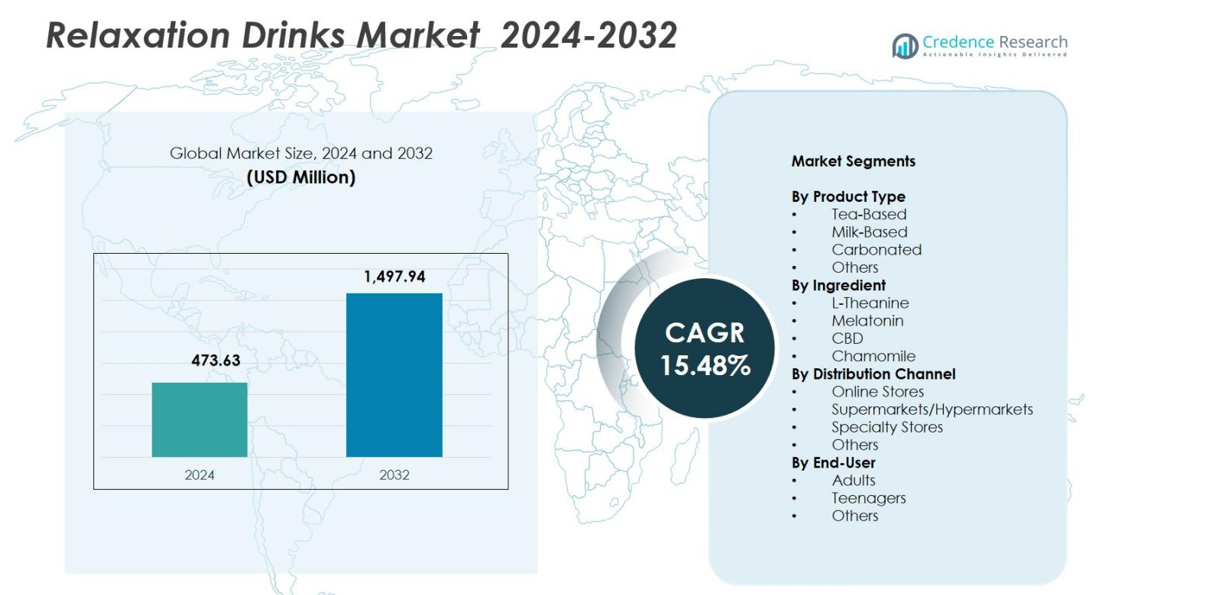
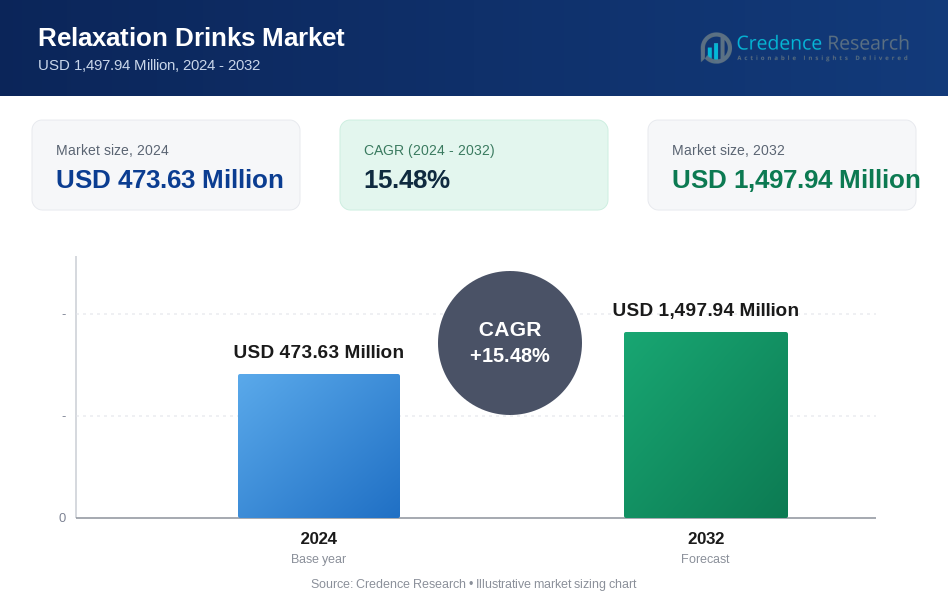
Relaxation Drinks Market size was valued at USD 473.63 Million in 2024 and is anticipated to reach USD 1,497.94 Million by 2032, at a CAGR of 15.48% during the forecast period.
| REPORT ATTRIBUTE | DETAILS |
|---|---|
| Historical Period | 2020-2023 |
| Base Year | 2024 |
| Forecast Period | 2025-2032 |
| Relaxation Drinks Market Size 2024 | USD 473.63 Million |
| Relaxation Drinks Market, CAGR | 15.48% |
| Relaxation Drinks Market Size 2032 | USD 1,497.94 Million |
Relaxation Drinks Market features leading brands such as Tranquini, Just Chill, Neuro Bliss, Marley’s Mellow Mood, VIB Relaxation Drink, Zenify, Be Happy, Dream Water, Som Sleep, and Slow Cow, each strengthening their presence through innovative formulations focused on stress relief, mood enhancement, and sleep support. These companies emphasize clean-label ingredients, botanical blends, and functional actives like L-theanine, chamomile, CBD, and melatonin to meet rising wellness demand. North America dominated the Relaxation Drinks Market in 2024 with a 38.4% share, driven by strong consumer adoption, retail penetration, and growing preference for natural calming beverages across urban populations.
Market Insights
- Relaxation Drinks Market reached USD 473.63 Million in 2024 and is projected to reach USD 1,497.94 Million by 2032, growing at a 15.48% CAGR through the forecast period.
- Strong market drivers include rising global stress levels, growing adoption of natural calming solutions, and increasing preference for L-theanine–based formulations, which held a 37.2% share in the ingredient segment.
- Key trends include accelerating demand for CBD- and melatonin-infused beverages and rapid expansion of online channels supported by subscription models and wellness-focused digital marketing.
- Major players such as Tranquini, Just Chill, Dream Water, Som Sleep, and Slow Cow strengthen market growth through formulation innovation, clean-label offerings, and expanded retail presence.
- Regionally, North America led with a 38.4% share in 2024, followed by Europe at 27.1% and Asia-Pacific at 22.8%, reflecting rising consumer awareness and growing adoption of herbal and functional relaxation drinks worldwide.
Market Segmentation Analysis
By Product Type
The Relaxation Drinks Market is segmented into tea-based, milk-based, carbonated, and other formulations, with tea-based drinks holding the dominant 41.6% share in 2024. Their leadership stems from rising consumer preference for natural, herbal calming beverages enriched with chamomile, L-theanine, and botanical infusions. Tea-based formats benefit from clean-label trends, caffeine-free evening consumption, and strong penetration across both retail and online channels. Carbonated relaxation drinks are gaining traction among younger consumers seeking functional alternatives to soft drinks, while milk-based options remain niche but continue to expand due to demand for sleep-supporting formulations.
- For instance, Recess introduced a new Recess Mood flavor line infused with magnesium and adaptogens, gaining traction in major U.S. grocery chains as consumers sought functional relaxation beverages.
By Ingredient
Within ingredient-based segmentation, L-theanine leads the market with a 37.2% share in 2024, driven by its scientifically recognized calming effects without drowsiness. Its compatibility with tea-based formulations strengthens adoption across global markets. Melatonin-based drinks follow closely due to increasing sleep-related health concerns, while CBD-infused beverages are experiencing rapid expansion in regions with favorable regulatory frameworks. Chamomile remains a widely accepted natural ingredient, supporting growth among consumers seeking herbal relaxation solutions. Overall, ingredient innovation and clinical efficacy validation continue to enhance product differentiation.
- For instance, functional-beverage brands started to emphasize botanical ingredients more a market-analysis piece notes that drinks combining chamomile or lavender with relaxation claims are “emerging as popular natural sleep solutions.
By Distribution Channel
The distribution landscape is dominated by supermarkets/hypermarkets with a 46.8% share in 2024, supported by strong product visibility, trusted retail environments, and increasing in-store promotions for functional beverages. Online stores are rapidly expanding due to subscription-based purchasing, influencer-driven marketing, and rising consumer demand for convenient doorstep delivery. Specialty stores attract health-conscious buyers seeking premium relaxation blends, while other channels, including wellness outlets and pharmacies, continue to broaden availability. The segment’s growth is driven by expanding retail penetration and rising consumer education on stress-relief and sleep-support beverages.
Key Growth Drivers
Rising Stress Levels and Demand for Natural Calming Solutions
The Relaxation Drinks Market is expanding as global stress, anxiety, and sleep-related issues rise across working professionals, students, and urban populations. Consumers increasingly seek natural, non-pharmaceutical calming alternatives, boosting demand for beverages infused with L-theanine, chamomile, magnesium, and botanical extracts. The preference for clean-label, non-addictive formats supports broader adoption across age groups. This shift toward wellness-oriented consumption strongly accelerates product penetration, encouraging manufacturers to expand formulations that support relaxation, mood enhancement, and improved sleep quality.
- For instance, Recess introduced magnesium-infused “Recess Mood” variants featuring adaptogens such as L-theanine and lemon balm to address rising stress and emotional-wellness needs.
Growing Adoption of Functional Beverages in Mainstream Retail
Functional beverages have moved from niche wellness categories to mainstream retail shelves, significantly enhancing market visibility for relaxation drinks. Supermarkets, hypermarkets, and convenience stores increasingly allocate shelf space to stress-relief beverages, supported by strong merchandising and in-store trial campaigns. Expanding partnerships between relaxation drink brands and retail chains further drive volume growth. Enhanced distribution across physical and online channels ensures greater accessibility, motivating new consumers to experiment with calming beverages as part of routine lifestyle and nighttime relaxation habits.
- For instance, relaxing functional beverages those containing adaptogens, L-theanine, magnesium, or herbal extracts are expected to become “mainstream” by 2025 as demand rises for mental-wellness drinks among busy, stressed populations.
Innovation in Ingredients and Product Formulations
Ingredient innovation plays a central role in driving market growth as companies introduce advanced blends combining amino acids, herbal extracts, adaptogens, and melatonin-based sleep aids. Scientific validation of ingredients like L-theanine, CBD, and valerian root enhances consumer confidence and encourages premium product adoption. The emergence of sugar-free, vegan, and low-calorie formulations aligns with evolving health and sustainability preferences. These innovations enable brands to differentiate offerings, target diverse consumer groups, and expand applications from sleep enhancement to daytime stress management.
Key Trends & Opportunities
Rapid Expansion of CBD and Botanical-Infused Relaxation Beverages
CBD-infused relaxation drinks represent a high-impact opportunity, driven by rising demand for plant-based anxiety and mood-support solutions. As regulatory frameworks evolve, brands increasingly integrate hemp-derived cannabinoids, adaptogens such as ashwagandha, and herbal blends into premium formulations. Botanical-based relaxation beverages appeal to consumers seeking non-synthetic, wellness-centric products with perceived mental-health benefits. This trend supports market premiumization and encourages continuous innovation in functional ingredient combinations, packaging formats, and flavor diversification across global markets.
- For instance, Trip extended its CBD-based calming drinks into major European retailers, including Waitrose and Tesco, strengthening mainstream access to botanical relaxation beverages.
Growth of E-Commerce and Personalized Wellness Consumption
The acceleration of online retail provides major expansion opportunities as consumers embrace personalized wellness solutions. E-commerce platforms enable direct-to-consumer subscription models, customized sleep and relaxation bundles, and targeted digital marketing campaigns. Online channels also facilitate consumer education through reviews, influencer recommendations, and comparative product insights. As individuals prioritize tailored stress-relief strategies, brands leveraging data-driven personalization and digital engagement are positioned to capture substantial market share, particularly among younger, health-conscious demographics.
- For instance, the online channel is cited as the fastest-growing distribution channel for functional drinks in the U.S., reflecting accelerating digital adoption among health- and wellness-oriented consumers.
Key Challenges
Regulatory Complexity Surrounding Functional Ingredients
The Relaxation Drinks Market faces regulatory hurdles due to varying global guidelines relating to melatonin, CBD, and other active calming ingredients. Restrictions on dosage limits, labeling requirements, and permissible claims create operational challenges for multinational brands. Frequent regulatory updates require continuous reformulation efforts and compliance monitoring, increasing costs and slowing product launches. These complexities also limit the geographic expansion of certain relaxation drink formulations, making regulatory navigation a critical barrier for consistent market scaling.
Consumer Skepticism and Need for Scientific Validation
Despite rising interest, some consumers remain cautious about the efficacy and safety of relaxation drinks, especially those containing newer ingredients such as CBD or melatonin. The absence of universal scientific consensus and inconsistent product quality across brands contribute to trust gaps. Ensuring standardized formulations, clinical evidence, and transparent labeling becomes essential to strengthen consumer confidence. Brands that fail to demonstrate measurable relaxation or sleep benefits risk low repeat purchases, posing a challenge to sustained market adoption and long-term growth.
Regional Analysis
North America
North America holds the largest 38.4% share of the Relaxation Drinks Market in 2024, driven by rising stress-related lifestyle issues and strong consumer acceptance of functional wellness beverages. The region benefits from widespread availability of tea-based, melatonin-infused, and CBD-enhanced drinks across supermarkets, specialty stores, and online platforms. Innovation-led brands and active marketing campaigns further strengthen demand, particularly among millennials and urban professionals seeking natural stress-relief alternatives. Expanding regulatory clarity for hemp-derived ingredients and increasing adoption of sleep-support beverages continue to reinforce North America’s leadership.
Europe
Europe accounts for a 27.1% share of the market in 2024, supported by growing health-conscious consumer behavior and increasing preference for botanical, non-pharmaceutical calming solutions. The region’s strong herbal tradition boosts demand for chamomile, valerian, and L-theanine formulations. Regulatory oversight encourages product standardization, enhancing consumer trust and brand penetration. Retail chains across Germany, the UK, France, and the Nordics are increasingly promoting functional beverage assortments, strengthening market visibility. Rising sleep-related disorders, coupled with expanding e-commerce adoption, fuel continued growth across key European countries.
Asia-Pacific
Asia-Pacific captures a 22.8% share of the Relaxation Drinks Market, driven by rapid urbanization, rising work-related stress, and increasing adoption of functional beverages across China, Japan, South Korea, and Southeast Asia. Traditional wellness ingredients such as green tea extracts and herbal infusions support strong regional alignment with relaxation beverages. Expanding middle-class income, digital retail growth, and heightened interest in mental wellness accelerate product demand. Manufacturers are actively launching region-specific flavors and formulations to cater to cultural preferences. The region’s growing youth population further boosts consumption of stress-relief and sleep-enhancing drinks.
Latin America
Latin America represents an 8.6% share in 2024, supported by rising awareness of mental wellness, expanding retail penetration, and increasing consumer openness toward functional beverages. Countries such as Brazil, Mexico, and Colombia show growing demand for herbal and natural relaxation drinks, particularly those incorporating chamomile and passionflower. E-commerce growth and social media-driven wellness trends amplify exposure to premium stress-relief products. However, varying regulatory frameworks for active ingredients pose moderate challenges. Despite this, increasing urban lifestyles and evolving health priorities continue to widen market opportunities across the region.
Middle East & Africa
The Middle East & Africa region holds a 3.1% share of the Relaxation Drinks Market in 2024, driven by rising adoption of wellness beverages among urban consumers and growing retail modernization across the GCC and South Africa. The market is expanding as consumers seek natural, non-caffeinated drinks that support sleep and relaxation in fast-paced environments. Increasing tourism, premium café culture, and higher disposable incomes contribute to wider product availability. While regulatory constraints and limited awareness restrict faster growth, the region shows strong potential fueled by growing health and wellness trends.
Market Segmentations
By Product Type
- Tea-Based
- Milk-Based
- Carbonated
- Others
By Ingredient
- L-Theanine
- Melatonin
- CBD
- Chamomile
By Distribution Channel
- Online Stores
- Supermarkets/Hypermarkets
- Specialty Stores
- Others
By End-User
- Adults
- Teenagers
- Others
By Geography
- North America
- U.S.
- Canada
- Mexico
- Europe
- Germany
- France
- U.K.
- Italy
- Spain
- Rest of Europe
- Asia Pacific
- China
- Japan
- India
- South Korea
- South-east Asia
- Rest of Asia Pacific
- Latin America
- Brazil
- Argentina
- Rest of Latin America
- Middle East & Africa
- GCC Countries
- South Africa
- Rest of the Middle East and Africa
Competitive Landscape
The competitive landscape of the Relaxation Drinks Market features key players such as Tranquini, Just Chill, Neuro Bliss, Marley’s Mellow Mood, VIB Relaxation Drink, Zenify, Be Happy, Dream Water, Som Sleep, and Slow Cow. These companies focus on expanding product portfolios with functional formulations incorporating ingredients like L-theanine, melatonin, chamomile, CBD, and herbal botanicals to strengthen market positioning. Brands increasingly compete through clean-label offerings, sugar-free variants, and scientifically supported calming benefits aimed at wellness-focused consumers. Strategic collaborations with retailers, enhanced digital marketing, and subscription-based online sales models further elevate brand visibility. Innovation in flavor profiles, packaging formats, and sleep-enhancement blends continues to differentiate products in a rapidly growing functional beverage category. With rising consumer demand for stress-relief and sleep-aid drinks, companies prioritize R&D investments, regulatory compliance, and geographic expansion to capture emerging opportunities across global markets.
Key Player Analysis
- Dream Water
- VIB Relaxation Drink
- Just Chill
- Slow Cow
- Som Sleep
- Zenify
- Marley’s Mellow Mood
- Tranquini
- Neuro Bliss
- Be Happy
Recent Developments
- In July 2025, Gatorade launched Gatorade Hydration Booster Relax, a functional drink mix formulated with L-Theanine and magnesium targeting consumers seeking relaxation and recovery beyond traditional sports hydration.
- In 2025, Prime Drink Group announced its intent to acquire Relax Downlow, marking the group’s entry into the fast-growing relaxation beverage segment
Report Coverage
The research report offers an in-depth analysis based on Product Type, Ingredient, Distribution Channel, End User and Geography. It details leading market players, providing an overview of their business, product offerings, investments, revenue streams, and key applications. Additionally, the report includes insights into the competitive environment, SWOT analysis, current market trends, as well as the primary drivers and constraints. Furthermore, it discusses various factors that have driven market expansion in recent years. The report also explores market dynamics, regulatory scenarios, and technological advancements that are shaping the industry. It assesses the impact of external factors and global economic changes on market growth. Lastly, it provides strategic recommendations for new entrants and established companies to navigate the complexities of the market.
Future Outlook
- The market will expand rapidly as consumers increasingly prioritize mental wellness and natural stress-relief solutions.
- Brands will introduce advanced formulations combining adaptogens, amino acids, herbal extracts, and sleep-support ingredients.
- CBD-infused relaxation beverages will gain broader acceptance as regulatory environments evolve across global markets.
- Online retail and subscription models will drive strong repeat purchases and higher consumer engagement.
- Clean-label, sugar-free, and vegan relaxation drinks will attract health-conscious buyers seeking functional alternatives.
- Retail penetration will deepen as supermarkets and specialty stores allocate more shelf space to relaxation beverages.
- Customizable and personalized relaxation drink blends will emerge, supported by digital wellness platforms.
- Scientific validation and clinical studies will strengthen consumer trust and product credibility.
- Premiumization trends will increase demand for botanical-rich and multifunctional relaxation beverages.
- Global expansion will accelerate as brands enter emerging markets with culturally adapted formulations.
Request a Free Sample
Fill in your details and we'll send you a free sample report.
- Sample data tables & charts
- Research methodology
Market Dynamics
Rising Stress Levels and Demand for Natural Calming Solutions
Increasing global stress, anxiety, and sleep-related issues among working professionals, students, and urban populations are driving consumers to seek natural, non-pharmaceutical calming alternatives. This trend boosts demand for relaxation drinks infused with L-theanine, chamomile, magnesium, and botanical extracts.
Mainstream Retail Adoption of Functional Beverages
Relaxation drinks are moving from niche wellness categories to mainstream retail shelves, with supermarkets and hypermarkets expanding shelf space and in-store promotions for stress-relief beverages. This enhances product visibility and accessibility, encouraging broader consumer adoption.
Innovation in Ingredients and Product Formulations
Brands are introducing advanced blends combining amino acids, herbal extracts, adaptogens, and melatonin-based sleep aids. Scientific validation of ingredients like L-theanine and CBD increases consumer confidence and supports premium product adoption.
Rapid Expansion of CBD and Botanical-Infused Beverages
Evolving regulatory frameworks and rising demand for plant-based anxiety and mood-support solutions are fueling the growth of CBD- and botanical-infused relaxation drinks. These products appeal to wellness-focused consumers seeking non-synthetic, functional beverages.
Growth of E-Commerce and Personalized Wellness Consumption
The acceleration of online retail and subscription models enables direct-to-consumer sales, personalized wellness bundles, and targeted digital marketing. This trend is particularly strong among younger, health-conscious demographics, driving repeat purchases and higher engagement.
Need a Custom Version of This Report?
Tailor the scope, geography, or segments to your exact requirements.
- Custom geography or segment scope
- Direct access to our analyst team
Frequently Asked Questions
What is the current market size for Relaxation Drinks Market, and what is its projected size in 2032?
At what Compound Annual Growth Rate is the Relaxation Drinks Market projected to grow between 2024 and 2032?
What are the primary factors fueling the growth of the Relaxation Drinks Market?
Who are the major players in this market?
Who are the leading companies in the Relaxation Drinks Market?
Table of Content
Chapter 1 Market Segmentation
- 1.1 Segmentation Framework
- 1.1.1 Product and Service Classification
- 1.1.2 Application and End-Use Classification
- 1.1.3 Technology and Solution Classification
- 1.1.4 Customer and Distribution Channel Classification
- 1.1.5 Geographic Segmentation
- 1.1.6 Market Segment Definitions and Boundaries
- 1.2 By End-User
- 1.2.1 Adults
- 1.2.2 Teenagers
- 1.2.3 Others
- 1.3 By Ingredient
- 1.3.1 L-Theanine
- 1.3.2 Melatonin
- 1.3.3 CBD
- 1.3.4 Chamomile
- 1.4 By Product Type
- 1.4.1 Tea-Based
- 1.4.2 Milk-Based
- 1.4.3 Carbonated
- 1.4.4 Others
Chapter 2 Introduction
- 2.1 Report Objectives and Scope
- 2.2 Product Definition and Industry Terminology
- 2.3 Market Inclusions and Exclusions
- 2.4 Research Process
- 2.4.1 Primary Research and Expert Interviews
- 2.4.2 Secondary Research and Source Review
- 2.4.3 Top-Down and Bottom-Up Estimation
- 2.4.4 Data Triangulation and Verification
- 2.5 Market Size Measurement Basis
- 2.5.1 2024: USD 473.63 Million → 2032: USD 1,497.94 Million
- 2.6 Historical and Forecast Reference Periods
- 2.6.1 Base Year: 2024
- 2.6.2 Forecast Period: 2024-2032
- 2.7 Research Assumptions and Limitations
Chapter 3 Executive Summary
- 3.1 Market Snapshot and Key Findings
- 3.2 Base-Year Market Size, 2024
- 3.3 Forecast Market Size, 2032
- 3.4 Revenue and Volume Growth Outlook
- 3.5 Key Demand and Supply Indicators
- 3.6 Leading Market Segments
- 3.7 Fastest-Growing Market Opportunities
- 3.8 Regional Performance Highlights
- 3.9 Technology and Industry Transformation
- 3.10 Competitive Landscape Summary
- 3.11 Analyst View and Strategic Implications
Chapter 4 Global Relaxation Drinks Market Trends and Developments
- 4.1 Historical Industry Development
- 4.2 Recent Market Trends and Developments
- 4.3 Demand and Customer Behavior Trends
- 4.4 Technology and Product Innovation
- 4.5 Artificial Intelligence, Automation and Digitalization
- 4.6 Local Manufacturing and Supply Chain Realignment
- 4.7 Industry Partnerships, Mergers and Acquisitions
- 4.8 Sustainability and Circular Economy Developments
- 4.9 Government and Private Sector Investment Trends
- 4.10 Emerging Business Models and Commercialization
- 4.11 Industry Developments and Announcements
Chapter 5 Global Relaxation Drinks Market Production, Supply and Demand Analysis
- 5.1 Demand Trend and Consumption Analysis
- 5.2 Demand Forecast, 2024-2032
- 5.3 Production and Output Trend
- 5.4 Production and Output Forecast, 2024-2032
- 5.5 Installed Capacity and Capacity Utilization
- 5.6 Company-Wise Production Plants and Statistics
- 5.6.1 Installed Production Capacity
- 5.6.2 Actual Production
- 5.6.3 Planned Capacity and Expansion Targets
- 5.7 Supply Chain Structure and Procurement Trends
- 5.8 Supply-Demand Gap and Bottlenecks
- 5.9 Import Dependence and Sourcing Structure
- 5.10 Contract Manufacturing and Outsourcing
- 5.11 Regional Supply and Demand Concentration
Chapter 6 Global Relaxation Drinks Market Pricing Analysis
- 6.1 Pricing Structure and Measurement
- 6.2 Historical Pricing Trends
- 6.3 Pricing Outlook, 2024-2032
- 6.4 Average Selling Price and Unit Economics
- 6.5 Pricing by Product and Market Segment
- 6.6 Geographic Pricing Differences
- 6.7 Key Input, Energy, Labor and Logistics Costs
- 6.8 Contract Pricing and Purchasing Models
- 6.9 Pricing Sensitivity and Competitive Positioning
- 6.10 Price, Margin and Profitability Implications
Chapter 7 Global Relaxation Drinks Market Dynamics
- 7.1 Market Growth Drivers
- 7.1.1 Demand-Side Drivers
- 7.1.2 Technology and Innovation Drivers
- 7.1.3 Infrastructure and Investment Drivers
- 7.1.4 Regulatory and Policy Drivers
- 7.2 Market Restraints
- 7.2.1 Cost and Affordability Constraints
- 7.2.2 Technology and Adoption Barriers
- 7.2.3 Supply Chain and Operational Constraints
- 7.3 Market Challenges
- 7.3.1 Competitive Pressure and Margin Erosion
- 7.3.2 Skills, Infrastructure and Implementation Gaps
- 7.4 Emerging Market Opportunities
- 7.5 Market Dynamics Impact and Time-Horizon Assessment
Chapter 8 Global Relaxation Drinks Value Chain Analysis
- 8.1 Industry Value Chain Overview
- 8.2 Upstream Suppliers and Critical Inputs
- 8.3 Technology and Component Providers
- 8.4 Manufacturing or Service Delivery
- 8.5 Distribution, Channel Partners and Integrators
- 8.6 Downstream Applications and End Users
- 8.7 Value Addition and Profit Pools
- 8.8 Vertical Integration and Outsourcing
- 8.9 Supplier Concentration and Risk
- 8.10 Supply Chain Localization and Resilience
Chapter 9 Global Relaxation Drinks Market Regulations and Policies
- 9.1 Relevant Laws, Standards and Compliance Frameworks
- 9.2 Product, Service, Safety and Quality Requirements
- 9.3 Government Policies, Incentives and Subsidies
- 9.4 Imports, Exports and Trade Barriers
- 9.5 Public Procurement and Local Content Requirements
- 9.6 Environmental and Sustainability Compliance
- 9.7 Upcoming Policy Changes and Market Implications
Chapter 10 Global Relaxation Drinks Market Hotspots and Opportunities
- 10.1 Market Opportunity Mapping and Growth Hotspots
- 10.2 High-Growth Applications and Customer Groups
- 10.3 Underserved Markets and White-Space Opportunities
- 10.4 Emerging Technology and Product Opportunities
- 10.5 New Capacity and Investment Hotspots
- 10.6 Market Entry and Expansion Opportunities
- 10.7 Distribution and Partnership Opportunities
- 10.8 Near-Term and Long-Term Commercial Potential
- 10.9 Opportunity Attractiveness and Execution Risks
Chapter 11 Global Relaxation Drinks Market Outlook, 2024-2032
- 11.1 Market Size and Analysis
- 11.1.1 Revenue (Market Measurement: 2024: USD 473.63 Million → 2032: USD 1,497.94 Million)
- 11.1.2 Market Volume and Quantity Sold
- 11.1.3 Historical Market Size
- 11.1.4 Base-Year Market Size, 2024
- 11.2 Market Forecast, 2024-2032
- 11.2.1 Revenue Forecast to 2032
- 11.2.2 Volume Forecast to 2032
- 11.2.3 CAGR and Year-on-Year Growth
- 11.2.4 Incremental Revenue Opportunity
- 11.3 Forecast Assumptions and Scenario Analysis
- 11.3.1 Base-Case Forecast
- 11.3.2 Optimistic and Conservative Scenarios
- 11.3.3 Technology, Pricing and Policy Sensitivities
- 11.4 Market Attractiveness and Growth Outlook
Chapter 12 Global Relaxation Drinks Market Segmentation and Outlook
- 12.1 Segmentation Summary and Market Shares, 2024
- 12.2 Largest and Fastest-Growing Segments
- 12.3 By End-User - Market Size and Forecast, 2024-2032
- 12.3.1 Segment Definition and Scope
- 12.3.2 Historical Market Size
- 12.3.3 Revenue Forecast, 2024-2032
- 12.3.4 Volume Forecast, 2024-2032
- 12.3.5 Base-Year Market Share, 2024
- 12.3.6 Segment CAGR and Growth Drivers
- 12.3.7 Subsegment Market Size and Forecast
- 12.3.7.1 Adults
- 12.3.7.2 Teenagers
- 12.3.7.3 Others
- 12.3.8 Subsegment Pricing and Adoption Trends
- 12.3.9 Leading Suppliers and Competition
- 12.3.10 Regional Demand and Opportunities
- 12.4 By Ingredient - Market Size and Forecast, 2024-2032
- 12.4.1 Segment Definition and Scope
- 12.4.2 Historical Market Size
- 12.4.3 Revenue Forecast, 2024-2032
- 12.4.4 Volume Forecast, 2024-2032
- 12.4.5 Base-Year Market Share, 2024
- 12.4.6 Segment CAGR and Growth Drivers
- 12.4.7 Subsegment Market Size and Forecast
- 12.4.7.1 L-Theanine
- 12.4.7.2 Melatonin
- 12.4.7.3 CBD
- 12.4.7.4 Chamomile
- 12.4.8 Subsegment Pricing and Adoption Trends
- 12.4.9 Leading Suppliers and Competition
- 12.4.10 Regional Demand and Opportunities
- 12.5 By Product Type - Market Size and Forecast, 2024-2032
- 12.5.1 Segment Definition and Scope
- 12.5.2 Historical Market Size
- 12.5.3 Revenue Forecast, 2024-2032
- 12.5.4 Volume Forecast, 2024-2032
- 12.5.5 Base-Year Market Share, 2024
- 12.5.6 Segment CAGR and Growth Drivers
- 12.5.7 Subsegment Market Size and Forecast
- 12.5.7.1 Tea-Based
- 12.5.7.2 Milk-Based
- 12.5.7.3 Carbonated
- 12.5.7.4 Others
- 12.5.8 Subsegment Pricing and Adoption Trends
- 12.5.9 Leading Suppliers and Competition
- 12.5.10 Regional Demand and Opportunities
- 12.6 Segment Growth Comparison
- 12.7 Segment Attractiveness and Priority Matrix
Chapter 13 Global Relaxation Drinks End-Use and Application Market Outlook
- 13.1 End-Use Industry and Customer Demand Structure
- 13.2 Leading Applications and Customer Groups
- 13.3 End-Use Market Size, Share and Forecast
- 13.4 Major End-Use Industry Deep Dives
- 13.4.1 Customer Requirements and Use Cases
- 13.4.2 Demand and Replacement Cycles
- 13.4.3 Technical and Regulatory Considerations
- 13.4.4 Purchasing and Procurement Models
- 13.4.5 Leading Vendors and Distribution Channels
- 13.4.6 Forecast and Commercial Opportunities
- 13.5 Emerging Applications and Cross-Segment Demand
- 13.6 End-Use Industry Investment Priorities
Chapter 14 Global Relaxation Drinks Geographic Market Outlook, 2024-2032
- 14.1 Regional Market Size and Share, 2024
- 14.2 Regional Market Forecast, 2024-2032
- 14.3 Regional Pricing, Production and Demand Differences
- 14.4 North America
- 14.4.1 United States
- 14.4.2 Canada
- 14.4.3 Mexico
- 14.5 Europe
- 14.5.1 Germany
- 14.5.2 France
- 14.5.3 Italy
- 14.5.4 United Kingdom
- 14.5.5 Spain
- 14.5.6 Poland
- 14.5.7 Russia
- 14.5.8 Netherlands
- 14.5.9 Belgium
- 14.5.10 Sweden
- 14.5.11 Denmark
- 14.5.12 Norway
- 14.5.13 Rest of Europe
- 14.6 Asia Pacific
- 14.6.1 China
- 14.6.2 India
- 14.6.3 Japan
- 14.6.4 South Korea
- 14.6.5 Thailand
- 14.6.6 Indonesia
- 14.6.7 Vietnam
- 14.6.8 Malaysia
- 14.6.9 Australia
- 14.6.10 Rest of Asia Pacific
- 14.7 Latin America
- 14.7.1 Brazil
- 14.7.2 Argentina
- 14.7.3 Colombia
- 14.7.4 Chile
- 14.7.5 Rest of Latin America
- 14.8 Middle East
- 14.8.1 Saudi Arabia
- 14.8.2 United Arab Emirates
- 14.8.3 Turkey
- 14.8.4 Israel
- 14.8.5 Iran
- 14.8.6 Rest of the Middle East
- 14.9 Africa
- 14.9.1 South Africa
- 14.9.2 Egypt
- 14.9.3 Nigeria
- 14.9.4 Morocco
- 14.9.5 Rest of Africa
- 14.10 Regional Investment, Policy and Supply Chain Differences
- 14.11 Regional Competitive Landscape
- 14.12 Geographic Growth Hotspots
Chapter 15 Global Relaxation Drinks Technology, Innovation and Sustainability Outlook
- 15.1 Technology Landscape and Maturity
- 15.2 Product, Process and Service Innovation
- 15.3 AI, Automation and Digital Tools in the Industry
- 15.4 Technology Adoption and Performance Benchmarking
- 15.5 Innovation Pipeline and R&D Investment
- 15.6 Patent and Intellectual Property Trends
- 15.7 Energy Efficiency and Resource Management
- 15.8 Sustainability, Recycling and Circularity
- 15.9 Technology Roadmap, 2024-2032
- 15.10 Risks of Obsolescence and Technology Substitution
Chapter 16 Global Relaxation Drinks Market Key Strategic Imperatives
- 16.1 Growth and Market Entry Priorities
- 16.2 High-Return Products and Segments
- 16.3 Pricing, Profitability and Cost Optimization
- 16.4 Technology Investment and Product Differentiation
- 16.5 Supply Chain Localization and Resilience
- 16.6 Distribution and Customer Acquisition
- 16.7 Partnership, Acquisition and Capacity Strategy
- 16.8 Regional Expansion Priorities
- 16.9 Short-, Medium- and Long-Term Actions
Chapter 17 Competition Outlook
- 17.1 Industry Competition Characteristics
- 17.2 Market Structure and Concentration
- 17.3 Market Share and Competitive Positioning, 2024
- 17.4 Company-Wise Revenue and Product Benchmarking
- 17.5 Production and Service Capacity Benchmarking
- 17.6 Technology, Pricing and Differentiation
- 17.7 Regional Footprint and Distribution Strength
- 17.8 Mergers, Acquisitions and Strategic Alliances
- 17.9 New Entrants and Competitive Threats
- 17.10 Porter's Five Forces and Industry Attractiveness
- 17.11 Competitive Outlook, 2024-2032
Chapter 18 Company Profiles
- 18.1 Company Coverage and Selection Criteria
- 18.2 Tranquini
- 18.2.1 Business Description
- 18.2.2 Company Ownership and Geographic Presence
- 18.2.3 Product and Service Portfolio
- 18.2.4 Manufacturing and Operating Footprint
- 18.2.5 Production Capacity and Expansion Plans
- 18.2.6 Financial Performance and Investment
- 18.2.7 Market Share and Competitive Position
- 18.2.8 Technology and Innovation Capabilities
- 18.2.9 Strategic Alliances or Partnerships
- 18.2.10 Recent Developments
- 18.2.11 Growth Strategy and Outlook
- 18.3 Just Chill
- 18.4 Neuro Bliss
- 18.5 Marley’s Mellow Mood
- 18.6 VIB Relaxation Drink
- 18.7 Zenify
- 18.8 Be Happy
- 18.9 Dream Water
- 18.10 Som Sleep
- 18.11 Slow Cow
- 18.12 Other Relevant Market Participants
Note: Every listed company is profiled on the structure shown under the first company. The company list is preliminary and may change based on research findings, market developments, data availability and client requirements.
Chapter 19 Disclaimer
- 19.1 Research and Forecast Disclaimer
- 19.2 Data Source and Estimation Limitations
Note: The depth of individual sections depends on data availability for this market. Volume, capacity, trade and other unit-based metrics are included where applicable.