Executive Summary & Core Metrics
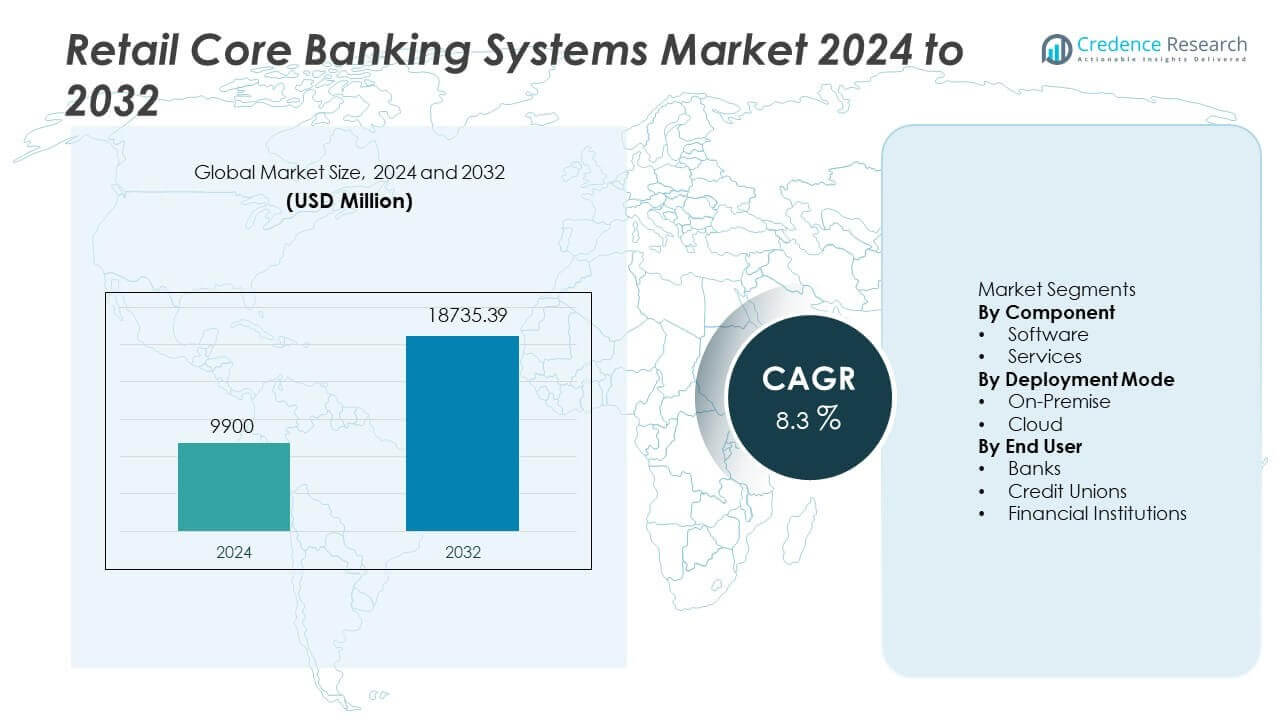
The global retail core banking systems market was valued at USD 9,900 million in 2024 and is projected to reach USD 18,735.39 million by 2032, expanding at a compound annual growth rate (CAGR) of 8.3% during the forecast period, according to Credence Research. This growth reflects rising modernization of legacy banking platforms, strong demand for real-time transaction processing, expansion of digital banking channels and increasing adoption of cloud-ready core banking infrastructure.
| REPORT ATTRIBUTE | DETAILS |
|---|---|
| Historical Period | 2020-2023 |
| Base Year | 2024 |
| Forecast Period | 2025-2032 |
| Retail Core Banking Systems Market Size 2024 | USD 9,900 million |
| Retail Core Banking Systems Market, CAGR | 8.3% |
| Retail Core Banking Systems Market Size 2032 | USD 18,735.39 million |
The global retail core banking systems market is characterized by the presence of banking software vendors, IT services providers and financial technology platform companies competing on scalability, cloud deployment, API integration, cybersecurity, compliance automation and real-time processing performance. Leading players focus on software modules and services that support deposits, payments, lending, customer onboarding, digital banking, analytics and regulatory reporting. Strategic priorities across the sector include cloud-native architecture, microservices deployment, open banking APIs, AI-enabled analytics, cybersecurity upgrades, compliance automation and legacy core modernization for banks, credit unions and financial institutions.
Strategic Market Insights
- Market growth is primarily driven by modernization of core banking platforms, strong demand for real-time transaction processing, expansion of mobile and online banking and rising need for automation across retail banking operations.
- Dominant industry trends highlight rapid adoption of cloud-native platforms, open banking API support, AI-enabled analytics and modular architectures that help banks deliver faster services, stronger fraud checks and personalized retail offerings.
- The competitive landscape is defined by leading vendors expanding microservices, cybersecurity capabilities, cloud deployment models and compliance automation tools while helping traditional banks manage legacy system complexity.
- According to Credence Research regional mapping, Asia Pacific represents the largest market, accounting for a definitive 31.2% share due to rapid digital banking adoption, growing financial inclusion, large consumer bases and strong demand for scalable retail banking platforms.
Retail Core Banking Systems Market Segmentation Analysis
By Component
- Software
- Services
Data compiled by Credence Research confirms that software constitutes the dominant component segment, accounting for near 62% market share in 2024. Software leads due to rising modernization of core platforms, advanced transaction processing needs and increasing migration from legacy banking systems. Banks invest in software modules that support payments, deposits, lending, customer onboarding, digital account management, fraud controls and compliance reporting. Demand is also supported by automation of back-office processes, real-time transaction handling and integration with mobile banking channels.
Services hold the remaining near 38% share and continue to expand through consulting, implementation, maintenance, support and managed service contracts. Banks rely on technical assistance to reduce operational burden, manage platform upgrades and avoid disruption during migration. Service demand remains strong because core banking replacement requires careful planning, regulatory alignment, data migration and long-term vendor support.
Temenos upgraded Temenos Infinity with processing capacity reaching 100,000 transactions per second during benchmark tests, supporting large-scale retail workloads and reducing response time to under 50 milliseconds across digital journeys.
By Deployment Mode
- On-Premise
- Cloud
Credence Research identifies cloud deployment as the leading deployment mode, accounting for near 55% of global market share in 2024. Cloud deployment leads because banks increasingly adopt scalable, subscription-based and agile platforms to reduce infrastructure costs and accelerate digital banking initiatives. Cloud platforms enable faster software updates, stronger cybersecurity layering, flexible data management and easier integration with fintech ecosystems. Financial institutions also favor cloud infrastructure for API-based integrations that support mobile banking, open finance and digital customer journeys.
On-premise deployment holds near 45% share, supported by security-sensitive institutions and banks operating under strict regulatory control requirements. Traditional banking environments continue to retain on-premise platforms where data sovereignty, internal control and legacy architecture remain key priorities. However, cloud deployment continues gaining stronger adoption as banks transition toward modular, microservice-based and scalable operating models.
Oracle Banking Cloud Services uses microservices and open APIs across its platform architecture, enabling scalable deployment and regional expansion for major banking institutions.
By End User
- Banks
- Credit Unions
- Financial Institutions
Banks dominate the end-user segment with near 71% market share in 2024. Their leadership is supported by larger investment capacity, regulated operating models and the need to manage large retail customer bases across deposits, loans, payments and digital service channels. Large banks adopt advanced core platforms to upgrade legacy systems, improve transaction processing, digitalize customer journeys and automate compliance tasks. Core modernization also helps banks improve product launch speed, customer service and operational resilience.
Credit unions hold near 17% share, supported by community banking modernization and demand for simplified lending, deposits and member service platforms. Financial institutions account for the remaining near 12% share as fintech players, digital lenders and specialized finance companies adopt modular core systems to support faster onboarding, digital payments, retail loans and embedded financial services. Credence Research indicates that banks will remain the dominant end-user group due to their scale, regulatory obligations and long-term modernization needs.
Key Market Dynamics
Primary Market Drivers
Rapid Shift Toward Digital Banking Platforms
Growing adoption of online and mobile banking is driving demand for advanced retail core banking systems. Banks need scalable platforms that can process real-time payments, instant account updates, digital onboarding and fast loan approvals. Legacy systems often limit agility, increase maintenance costs and slow customer service delivery. Modern platforms allow banks to automate operations, reduce manual workloads and support seamless digital banking experiences. Credence Research identifies digital transformation as a core growth driver as banks work to improve service speed and expand access across retail customers. Fiserv’s Signature core platform supports high-volume, real-time transaction processing and integrates customer identification and Know Your Customer capabilities for regulatory compliance.
Need to Improve Transaction Speed and Data Accuracy
Retail banking volumes continue to rise across digital payments, mobile transfers, account updates and online service channels. Core banking systems must process transactions with high accuracy, low latency and strong uptime performance. Faster funds transfer improves customer experience and strengthens loyalty, while accurate data processing reduces operational risk. Banks are adopting advanced data models and modern architecture to support secure transaction handling at scale. TCS BaNCS provides a universal financial solution designed for high performance and distributed scalability, supporting major financial institutions such as State Bank of India with resilient transaction processing and business continuity.
Rising Demand for Real-Time Analytics and Compliance Support
Banks increasingly need real-time data to support credit checks, fraud alerts, risk scoring, customer segmentation and personalized product delivery. Advanced core systems support analytics that improve product decisions, loan approvals and fraud detection. Compliance requirements are also increasing as digital payments, data privacy and financial crime monitoring become more complex. Retail banks are investing in platforms that automate reporting, audit tasks and regulatory workflows. Credence Research indicates that analytics and compliance automation will remain major drivers as banks seek faster decisions, lower manual errors and improved regulatory readiness.
Key Trends & Structural Opportunities
Growth of Cloud-Native and API-Driven Architecture
Cloud-native and API-driven banking architecture is becoming a major trend across the retail core banking systems market. Cloud platforms enable faster deployment, lower setup costs and scalable operations during peak transaction demand. API-based design supports integration with mobile apps, fintech partners, payment platforms and open banking ecosystems. Open banking regulations encourage secure data connections across financial services, creating upgrade opportunities for vendors. Temenos Banking Cloud recorded processing capacity of 150,000 API calls per second during load tests and deployed more than 200 modular banking services across active cloud clients.
Increased Adoption of AI and Automation Features
AI and automation are reshaping retail banking operations by improving fraud detection, document checks, credit scoring and customer service workflows. Banks use AI-enabled analytics to identify transaction anomalies, automate back-office tasks and personalize retail banking offers. Automation reduces branch workload, improves accuracy and shortens service delivery timelines. These capabilities create strong opportunities for core banking vendors that embed intelligent decision-making into platform modules. FIS deployed an AI-driven risk engine that processes large volumes of payment events for global banks and detects fraud patterns at high speed during validation tests.
Shift Toward Modular and Microservices-Based Core Platforms
Banks are increasingly moving toward modular and microservices-based core banking platforms to improve flexibility and reduce dependency on monolithic legacy systems. Modular architecture allows banks to upgrade selected functions such as lending, payments, deposits or onboarding without replacing the entire system at once. This approach reduces migration risk and supports faster product launches. Microservices also improve scalability and allow banks to integrate new fintech capabilities more easily. Credence Research identifies modular core banking as a structural opportunity because traditional banks want modernization without service disruption.
Industry Challenges
High Cost of Migration from Legacy Systems
Migration from legacy core systems remains a major challenge for large banks. Long implementation timelines increase IT spending, vendor coordination needs and internal resource requirements. Legacy environments contain complex data structures, custom workflows and dependent applications that must be carefully mapped before migration. Banks may delay upgrades due to operational disruption risk, compliance concerns and uncertainty around return on investment. These factors slow platform transition, especially among traditional financial institutions with large customer bases and deeply embedded legacy infrastructure.
Cybersecurity and Data Privacy Concerns
Digital core banking platforms face rising cyber threats across payment channels, mobile banking interfaces and API-connected systems. Banks require strong encryption, secure access controls, fraud monitoring and audit-ready data management. Data breaches can damage customer trust, create regulatory penalties and increase reputational risk. Regulatory pressure around privacy, financial crime prevention and digital payment security continues to increase compliance costs. These concerns can slow adoption cycles, especially when banks evaluate cloud migration or open banking integrations.
Detailed Regional Analysis
| Region | Market Share (%) | Strategic Regional Catalysts & Insights |
| Asia Pacific | 31.2% | Global leader. Driven by rapid digital banking adoption, financial inclusion initiatives, large consumer bases, mobile banking growth and demand for scalable banking platforms. |
| North America | 26.6% | Strong demand market. Supported by high IT spending, cloud migration, fintech integration, real-time processing needs and modernization programs across major banks. |
| Europe | 20.5% | Mature regional market. Driven by legacy upgrades, digital compliance requirements, open banking regulations and demand for secure multi-channel banking. |
| Latin America | 11.4% | Developing regional market. Supported by fintech growth, retail banking expansion, micro-loans, online banking adoption and financial inclusion efforts. |
| Middle East & Africa | 10.3% | Emerging territory. Driven by government-led financial inclusion, cloud-based banking modernization and demand for real-time retail banking access. |
Asia Pacific leads the global retail core banking systems market with a 31.2% share, according to Credence Research. The region benefits from rapid digitalization, rising bank penetration and growing demand for retail banking services across emerging economies. Banks and fintech-backed institutions are deploying modern core banking platforms to support mobile banking, digital accounts, retail lending and financial inclusion. Large consumer bases in countries such as India, China and Southeast Asian markets create demand for scalable platforms that can handle high transaction volumes. Regulatory support for digital finance further strengthens adoption across the region.
North America holds 26.6% of the global market, supported by widespread digital banking adoption and strong IT infrastructure. Major banks and financial institutions invest heavily in modern core systems, cloud migration and fintech integration. High demand for real-time processing, compliance automation, secure data management and seamless online services drives growth. The United States remains a major hub for platform modernization due to strong bank technology budgets and high customer expectations for digital services. Regulatory support and demand for secure, efficient banking systems reinforce regional market strength.
Europe accounts for 20.5% of the global retail core banking systems market. Growth is supported by banks modernizing legacy platforms and regulators pushing for updated, compliant and secure financial systems. Financial institutions are adopting cloud-enabled core banking solutions to improve data security, transaction speed and operational resilience. Open banking regulations and multi-channel banking demand encourage API-ready and modular platform adoption. Growth in mobile banking and digital customer engagement continues to strengthen uptake across major European economies. Compliance, privacy and operational resilience remain central to technology investment decisions.
Latin America holds near 11.4% share of the global market. Regional banks and fintech players are adopting core banking systems to support expanding retail customer bases, personal banking, digital accounts and micro-loan services. Online banking adoption is increasing as consumers seek convenient financial access. Financial inclusion programs and growth in digital payments support platform modernization. Brazil, Mexico and other regional markets continue investing in scalable core systems to expand banking access. While budget constraints remain a challenge, fintech growth and retail banking expansion support steady demand.
The Middle East & Africa account for roughly 10.3% of the global retail core banking systems market. Growth is supported by emerging banks modernizing legacy systems, government-led financial inclusion initiatives and rising demand for digital banking access. Banks are deploying cloud-based core systems to reach underserved populations, offer real-time services and expand retail banking across urban and rural markets. Gulf countries are investing in digital banking infrastructure, while African markets are adopting mobile-first banking models. Modern core platforms are expected to play a key role in expanding financial services access across the region.
Competitive Landscape & Recent Developments
The retail core banking systems market is highly competitive, with leading providers competing through cloud readiness, API connectivity, real-time processing, compliance automation and digital onboarding capabilities. Key players include Temenos AG, Fiserv Inc., Tata Consultancy Services, Infosys Limited, Oracle Corporation, Finastra, SAP SE, HCL Technologies, NCR Corporation and Avaloq Group. These companies offer modernized core platforms that support deposits, lending, payments, customer management, analytics and regulatory reporting.
Market leaders are developing API-driven architectures, AI capabilities, cybersecurity modules and cloud-native platforms to help banks improve operational efficiency. Many vendors form partnerships with fintech companies to deliver integrated payment, lending and compliance services. Banks continue to invest in legacy modernization, scalable infrastructure and embedded services, strengthening long-term vendor relationships. Demand for cloud deployment, automation, digital onboarding and real-time transaction processing continues to shape competitive strategy across global markets.
Recent Industry Developments (2025)
- In December 2025, Temenos AG was named Best Core Banking System at the Banking Tech Awards 2025, reflecting its global leadership and ongoing innovation in retail and modular core banking.
- In May 2025, Tata Consultancy Services partnered with Mongolia’s Khan Bank to modernize and future-proof operations using the TCS BaNCS Global Banking Platform with AI and machine learning capabilities.
- In February 2025, Finastra announced that its Finastra Phoenix retail core banking solution was named a top system by Celent and Gartner in the U.S. market.

Request a Free Sample
Fill in your details and we'll send you a free sample report.
- Sample data tables & charts
- Research methodology
Need a Custom Version of This Report?
Tailor the scope, geography, or segments to your exact requirements.
- Custom geography or segment scope
- Direct access to our analyst team
Frequently Asked Questions
What is the current and projected size of the global retail core banking systems market?
What is the projected growth rate of the retail core banking systems industry over the forecast period?
Which component segment holds the maximum market share within the retail core banking systems industry?
Which deployment mode dominates the retail core banking systems market?
Which end user leads the retail core banking systems market?
Which region commands the highest market share in the global retail core banking systems space?
Table of Content
Chapter 1 Market Segmentation
- 1.1 Segmentation Framework
- 1.1.1 Product and Service Classification
- 1.1.2 Application and End-Use Classification
- 1.1.3 Technology and Solution Classification
- 1.1.4 Customer and Distribution Channel Classification
- 1.1.5 Geographic Segmentation
- 1.1.6 Market Segment Definitions and Boundaries
Chapter 2 Introduction
- 2.1 Report Objectives and Scope
- 2.2 Product Definition and Industry Terminology
- 2.3 Market Inclusions and Exclusions
- 2.4 Research Process
- 2.4.1 Primary Research and Expert Interviews
- 2.4.2 Secondary Research and Source Review
- 2.4.3 Top-Down and Bottom-Up Estimation
- 2.4.4 Data Triangulation and Verification
- 2.5 Market Size Measurement Basis
- 2.5.1 2024: USD 9,900 million → 2032: USD 18,735.39 million
- 2.6 Historical and Forecast Reference Periods
- 2.6.1 Base Year: 2024
- 2.6.2 Forecast Period: 2024-2032
- 2.7 Research Assumptions and Limitations
Chapter 3 Executive Summary
- 3.1 Market Snapshot and Key Findings
- 3.2 Base-Year Market Size, 2024
- 3.3 Forecast Market Size, 2032
- 3.4 Revenue and Volume Growth Outlook
- 3.5 Key Demand and Supply Indicators
- 3.6 Leading Market Segments
- 3.7 Fastest-Growing Market Opportunities
- 3.8 Regional Performance Highlights
- 3.9 Technology and Industry Transformation
- 3.10 Competitive Landscape Summary
- 3.11 Analyst View and Strategic Implications
Chapter 4 Global Retail Core Banking Systems Market Trends and Developments
- 4.1 Historical Industry Development
- 4.2 Recent Market Trends and Developments
- 4.3 Demand and Customer Behavior Trends
- 4.4 Technology and Product Innovation
- 4.5 Artificial Intelligence, Automation and Digitalization
- 4.6 Local Manufacturing and Supply Chain Realignment
- 4.7 Industry Partnerships, Mergers and Acquisitions
- 4.8 Sustainability and Circular Economy Developments
- 4.9 Government and Private Sector Investment Trends
- 4.10 Emerging Business Models and Commercialization
- 4.11 Industry Developments and Announcements
Chapter 5 Global Retail Core Banking Systems Market Supply and Demand Analysis
- 5.1 Demand Trend and Consumption Analysis
- 5.2 Demand Forecast, 2024-2032
- 5.3 Supply Chain Structure and Procurement Trends
- 5.4 Supply-Demand Gap and Bottlenecks
- 5.5 Import Dependence and Sourcing Structure
- 5.6 Regional Supply and Demand Concentration
Chapter 6 Global Retail Core Banking Systems Market Pricing Analysis
- 6.1 Pricing Structure and Measurement
- 6.2 Historical Pricing Trends
- 6.3 Pricing Outlook, 2024-2032
- 6.4 Pricing by Product and Market Segment
- 6.5 Geographic Pricing Differences
- 6.6 Key Input, Energy, Labor and Logistics Costs
- 6.7 Contract Pricing and Purchasing Models
- 6.8 Pricing Sensitivity and Competitive Positioning
- 6.9 Price, Margin and Profitability Implications
Chapter 7 Global Retail Core Banking Systems Market Dynamics
- 7.1 Market Growth Drivers
- 7.1.1 Demand-Side Drivers
- 7.1.2 Technology and Innovation Drivers
- 7.1.3 Infrastructure and Investment Drivers
- 7.1.4 Regulatory and Policy Drivers
- 7.2 Market Restraints
- 7.2.1 Cost and Affordability Constraints
- 7.2.2 Technology and Adoption Barriers
- 7.2.3 Supply Chain and Operational Constraints
- 7.3 Market Challenges
- 7.3.1 Competitive Pressure and Margin Erosion
- 7.3.2 Skills, Infrastructure and Implementation Gaps
- 7.4 Emerging Market Opportunities
- 7.5 Market Dynamics Impact and Time-Horizon Assessment
Chapter 8 Global Retail Core Banking Systems Value Chain Analysis
- 8.1 Industry Value Chain Overview
- 8.2 Upstream Suppliers and Critical Inputs
- 8.3 Technology and Component Providers
- 8.4 Manufacturing or Service Delivery
- 8.5 Distribution, Channel Partners and Integrators
- 8.6 Downstream Applications and End Users
- 8.7 Value Addition and Profit Pools
- 8.8 Vertical Integration and Outsourcing
- 8.9 Supplier Concentration and Risk
- 8.10 Supply Chain Localization and Resilience
Chapter 9 Global Retail Core Banking Systems Market Regulations and Policies
- 9.1 Relevant Laws, Standards and Compliance Frameworks
- 9.2 Product, Service, Safety and Quality Requirements
- 9.3 Government Policies, Incentives and Subsidies
- 9.4 Imports, Exports and Trade Barriers
- 9.5 Public Procurement and Local Content Requirements
- 9.6 Data Protection, AI and Cybersecurity Compliance
- 9.7 Upcoming Policy Changes and Market Implications
Chapter 10 Global Retail Core Banking Systems Market Hotspots and Opportunities
- 10.1 Market Opportunity Mapping and Growth Hotspots
- 10.2 High-Growth Applications and Customer Groups
- 10.3 Underserved Markets and White-Space Opportunities
- 10.4 Emerging Technology and Product Opportunities
- 10.5 New Capacity and Investment Hotspots
- 10.6 Market Entry and Expansion Opportunities
- 10.7 Distribution and Partnership Opportunities
- 10.8 Near-Term and Long-Term Commercial Potential
- 10.9 Opportunity Attractiveness and Execution Risks
Chapter 11 Global Retail Core Banking Systems Market Outlook, 2024-2032
- 11.1 Market Size and Analysis
- 11.1.1 Revenue (Market Measurement: 2024: USD 9,900 million → 2032: USD 18,735.39 million)
- 11.1.2 Historical Market Size
- 11.1.3 Base-Year Market Size, 2024
- 11.2 Market Forecast, 2024-2032
- 11.2.1 Revenue Forecast to 2032
- 11.2.2 CAGR and Year-on-Year Growth
- 11.2.3 Incremental Revenue Opportunity
- 11.3 Forecast Assumptions and Scenario Analysis
- 11.3.1 Base-Case Forecast
- 11.3.2 Optimistic and Conservative Scenarios
- 11.3.3 Technology, Pricing and Policy Sensitivities
- 11.4 Market Attractiveness and Growth Outlook
Chapter 12 Global Retail Core Banking Systems Market Segmentation and Outlook
- 12.1 Segmentation Summary and Market Shares, 2024
- 12.2 Largest and Fastest-Growing Segments
- 12.3 Segment Growth Comparison
- 12.4 Segment Attractiveness and Priority Matrix
Chapter 13 Global Retail Core Banking Systems Geographic Market Outlook, 2024-2032
- 13.1 Regional Market Size and Share, 2024
- 13.2 Regional Market Forecast, 2024-2032
- 13.3 Regional Pricing, Production and Demand Differences
- 13.4 North America
- 13.4.1 United States
- 13.4.2 Canada
- 13.4.3 Mexico
- 13.5 Europe
- 13.5.1 Germany
- 13.5.2 France
- 13.5.3 Italy
- 13.5.4 United Kingdom
- 13.5.5 Spain
- 13.5.6 Poland
- 13.5.7 Russia
- 13.5.8 Netherlands
- 13.5.9 Belgium
- 13.5.10 Sweden
- 13.5.11 Denmark
- 13.5.12 Norway
- 13.5.13 Rest of Europe
- 13.6 Asia Pacific
- 13.6.1 China
- 13.6.2 India
- 13.6.3 Japan
- 13.6.4 South Korea
- 13.6.5 Thailand
- 13.6.6 Indonesia
- 13.6.7 Vietnam
- 13.6.8 Malaysia
- 13.6.9 Australia
- 13.6.10 Rest of Asia Pacific
- 13.7 Latin America
- 13.7.1 Brazil
- 13.7.2 Argentina
- 13.7.3 Colombia
- 13.7.4 Chile
- 13.7.5 Rest of Latin America
- 13.8 Middle East
- 13.8.1 Saudi Arabia
- 13.8.2 United Arab Emirates
- 13.8.3 Turkey
- 13.8.4 Israel
- 13.8.5 Iran
- 13.8.6 Rest of the Middle East
- 13.9 Africa
- 13.9.1 South Africa
- 13.9.2 Egypt
- 13.9.3 Nigeria
- 13.9.4 Morocco
- 13.9.5 Rest of Africa
- 13.10 Regional Investment, Policy and Supply Chain Differences
- 13.11 Regional Competitive Landscape
- 13.12 Geographic Growth Hotspots
Chapter 14 Global Retail Core Banking Systems Technology, Innovation and Sustainability Outlook
- 14.1 Technology Landscape and Maturity
- 14.2 Product, Process and Service Innovation
- 14.3 AI, Automation and Digital Tools in the Industry
- 14.4 Technology Adoption and Performance Benchmarking
- 14.5 Innovation Pipeline and R&D Investment
- 14.6 Energy Efficiency and Resource Management
- 14.7 Sustainability, Recycling and Circularity
- 14.8 Technology Roadmap, 2024-2032
- 14.9 Risks of Obsolescence and Technology Substitution
Chapter 15 Global Retail Core Banking Systems Market Key Strategic Imperatives
- 15.1 Growth and Market Entry Priorities
- 15.2 High-Return Products and Segments
- 15.3 Pricing, Profitability and Cost Optimization
- 15.4 Technology Investment and Product Differentiation
- 15.5 Supply Chain Localization and Resilience
- 15.6 Distribution and Customer Acquisition
- 15.7 Partnership, Acquisition and Capacity Strategy
- 15.8 Regional Expansion Priorities
- 15.9 Short-, Medium- and Long-Term Actions
Chapter 16 Competition Outlook
- 16.1 Industry Competition Characteristics
- 16.2 Market Structure and Concentration
- 16.3 Market Share and Competitive Positioning, 2024
- 16.4 Company-Wise Revenue and Product Benchmarking
- 16.5 Production and Service Capacity Benchmarking
- 16.6 Technology, Pricing and Differentiation
- 16.7 Regional Footprint and Distribution Strength
- 16.8 Mergers, Acquisitions and Strategic Alliances
- 16.9 New Entrants and Competitive Threats
- 16.10 Porter's Five Forces and Industry Attractiveness
- 16.11 Competitive Outlook, 2024-2032
Chapter 17 Company Profiles
- 17.1 Company Coverage and Selection Criteria
- 17.2 Leading Market Participants – Standard Profile Structure
- 17.2.1 Business Description
- 17.2.2 Company Ownership and Geographic Presence
- 17.2.3 Product and Service Portfolio
- 17.2.4 Manufacturing and Operating Footprint
- 17.2.5 Financial Performance and Investment
- 17.2.6 Market Share and Competitive Position
- 17.2.7 Technology and Innovation Capabilities
- 17.2.8 Strategic Alliances or Partnerships
- 17.2.9 Recent Developments
- 17.2.10 Growth Strategy and Outlook
- 17.3 Other Relevant Market Participants
Note: Every listed company is profiled on the structure shown under the first company. The company list is preliminary and may change based on research findings, market developments, data availability and client requirements.
Chapter 18 Disclaimer
- 18.1 Research and Forecast Disclaimer
- 18.2 Data Source and Estimation Limitations
Note: The depth of individual sections depends on data availability for this market. Volume, capacity, trade and other unit-based metrics are included where applicable.