
Market Overview:
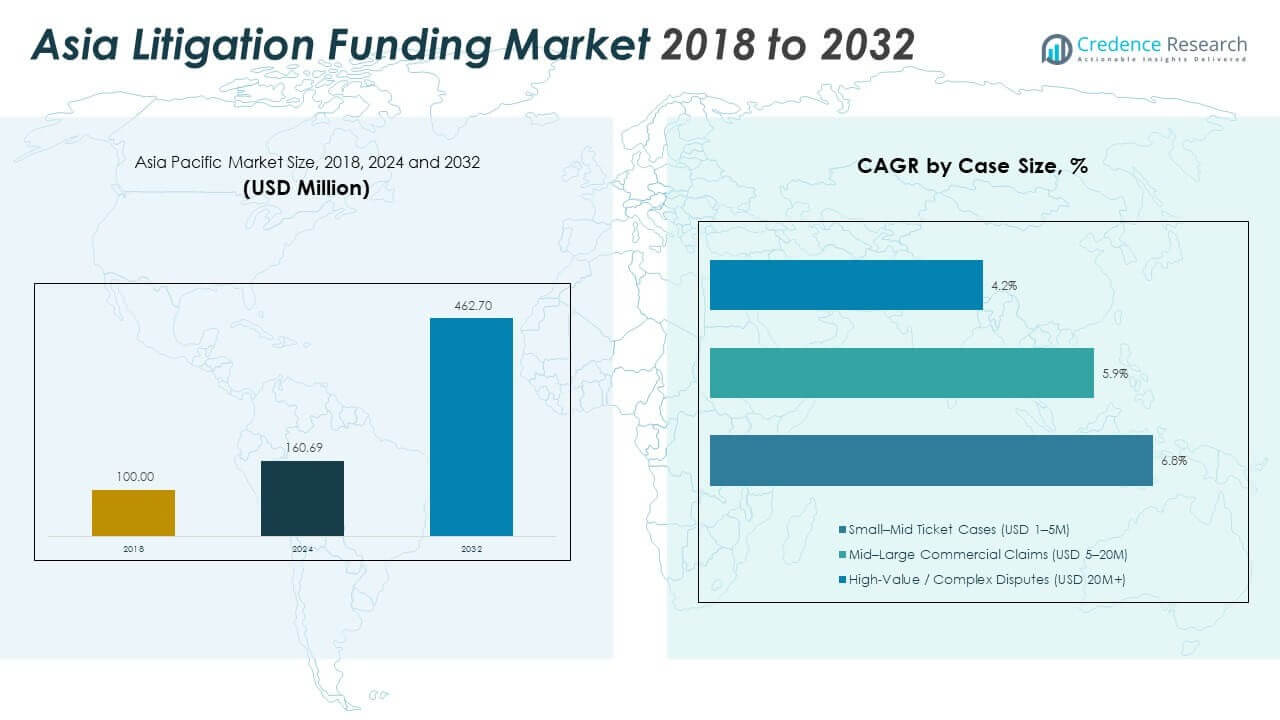
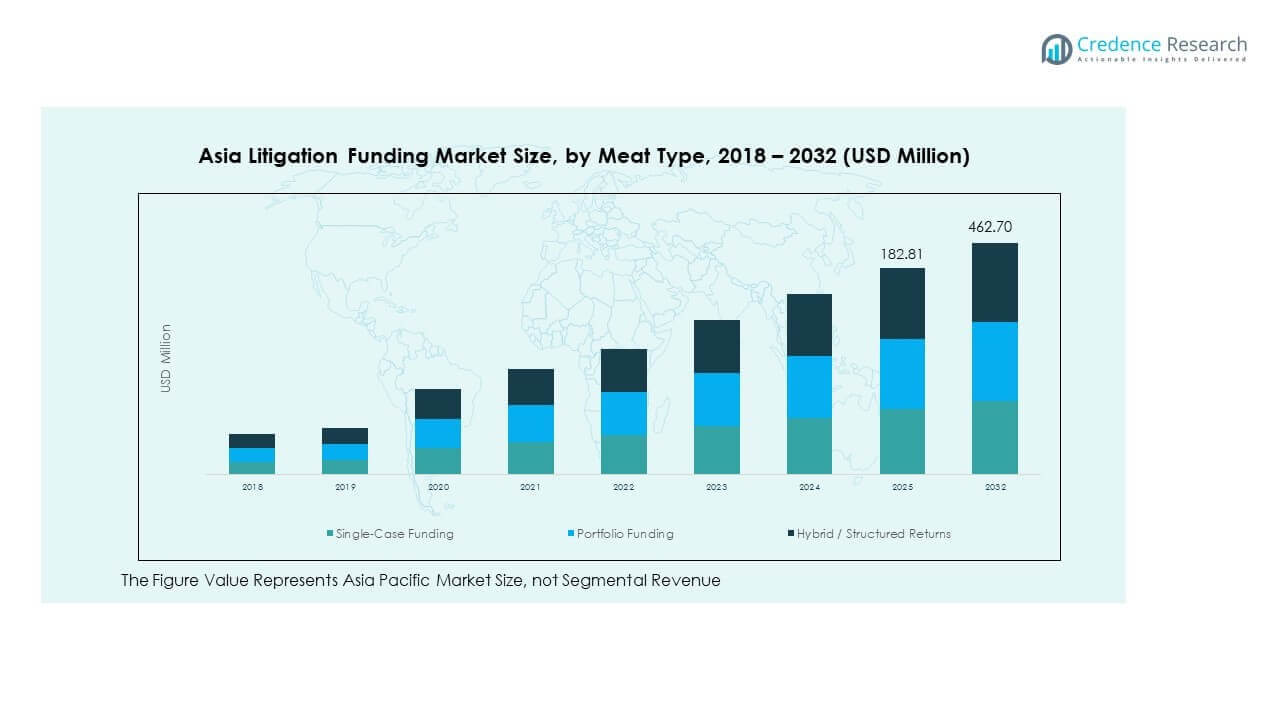
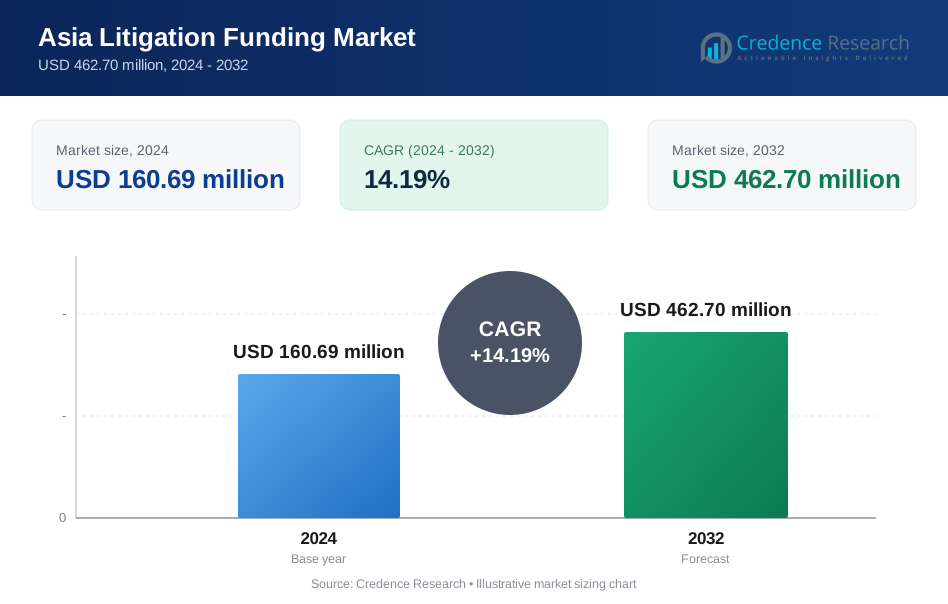
The Asia Litigation Funding Market size was valued at USD 100.00 million in 2018 to USD 160.69 million in 2024 and is anticipated to reach USD 462.70 million by 2032, at a CAGR of 14.19% during the forecast period.
| REPORT ATTRIBUTE | DETAILS |
|---|---|
| Historical Period | 2020-2023 |
| Base Year | 2024 |
| Forecast Period | 2025-2032 |
| Asia Litigation Funding Market Size 2024 | USD 160.69 million |
| Asia Litigation Funding Market, CAGR | 14.19% |
| Asia Litigation Funding Market Size 2032 | USD 462.70 million |
The market grows due to rising legal costs and demand for risk-sharing solutions. Corporates seek funding to pursue valid claims without capital strain. Law firms use funding to manage cash flow and client risk. Cross-border trade disputes increase case complexity and duration. Arbitration growth supports demand for structured legal finance. Regulatory acceptance in select Asian jurisdictions improves confidence. Insolvency and restructuring cases expand funding use. Portfolio funding gains interest among repeat litigants. These drivers collectively strengthen adoption across dispute types.
Regional performance reflects legal maturity and dispute intensity. Singapore and Hong Kong lead due to strong arbitration ecosystems. Australia remains important with established litigation finance practices. Japan and South Korea show steady progress through legal modernization. India and Southeast Asia emerge due to high dispute volumes. Infrastructure, energy, and commercial sectors drive claims. Regulatory clarity improves gradually in emerging markets. International funders expand regional footprints to capture long-term opportunities.
Market Insights
- The Asia Litigation Funding Market was valued at USD 100.00 million in 2018, reached USD 160.69 million in 2024, and is projected to hit USD 462.70 million by 2032, reflecting a CAGR of 14.19% driven by rising legal costs and demand for risk-sharing.
- East Asia leads with about 38% share due to strong arbitration hubs in Hong Kong and legal maturity in Japan, while Southeast Asia holds 32% supported by Singapore’s funding-friendly framework, and South Asia & Oceania account for 30% led by Australia’s established litigation finance ecosystem.
- Southeast Asia emerges as the fastest-growing subregion with a 32% share, supported by cross-border trade disputes, SME demand, and increasing acceptance of third-party funding across Indonesia and Malaysia.
- By case size, high-value or complex disputes (USD 20M+) show the strongest momentum with 6.8%, followed by mid–large commercial claims (USD 5–20M) at 5.9%, reflecting funder focus on larger, scalable returns.
- Small–mid ticket cases (USD 1–5M) grow at 4.2%, indicating steady uptake among SMEs seeking affordable access to funded litigation while managing financial exposure.
Market Drivers
Rising Awareness Among Businesses Regarding Alternative Legal Financing Models
The Asia Litigation Funding Market benefits from growing awareness about the benefits of third-party litigation finance. Companies seek to reduce legal cost burdens and mitigate risk by shifting expenses to external funders. This shift allows small and mid-sized firms to pursue justice without financial constraints. Businesses use funding to unlock value in meritorious claims previously left dormant. Corporate legal departments also favor non-recourse funding options to manage cash flows better. Legal finance now plays a role in broader financial planning for disputes. Educated decision-making has increased interest in structured litigation funding. Awareness campaigns by funders and law firms have further accelerated adoption. This trend continues to push demand in corporate, commercial, and insolvency cases.
- For instance, Burford Capital has invested over USD 236 million in Asia, Australia, and the Middle East through 2024, reflecting rising corporate engagement with litigation finance solutions in these regions.
Evolving Legal Frameworks Supporting Third-Party Litigation Funding Legitimacy
The Asia Litigation Funding Market has gained traction due to regulatory reforms in key jurisdictions. Singapore and Hong Kong amended legal codes to allow third-party funding in international arbitration. These steps created legal certainty, prompting new entrants and fund deployment. Structured regulation assures funders of enforceability and return protection. Japan and India also consider legal reforms to recognize litigation funding explicitly. This regulatory maturity supports trust between funders, clients, and law firms. Governments seek to attract global arbitration activity, with litigation funding as an enabler. Clearer frameworks also reduce ethical uncertainties and define funder-client responsibilities. Legal certainty plays a vital role in market growth and fund inflow.
- For instance, Omni Bridgeway is recognised as a top‑ranked funder in Asia with Band 1 status in the Chambers Litigation Support Guide, indicating strong professional acceptance of funded dispute resolution under current legal frameworks.
Growth In High-Value Cross-Border Commercial And Arbitration Cases
Commercial disputes across borders are driving demand in the Asia Litigation Funding Market. Cross-border arbitration is complex, time-consuming, and expensive, especially in infrastructure, construction, and trade. Legal financing allows claimants to pursue high-stake claims without locking capital. Arbitration hubs like Singapore and Hong Kong are hotspots for this trend. Large law firms now partner with funders to offer clients a complete litigation solution. Cases involving sovereign entities and multinational firms attract specialized funders. Arbitration clause enforcement also boosts demand for long-term funding. Third-party support helps firms manage risk and scale litigation across jurisdictions. Cross-border funding continues to expand its share in regional portfolios.
Increased Corporate Willingness To Monetize Legal Claims For Financial Efficiency
Corporate litigation strategies are evolving in the Asia Litigation Funding Market. Companies increasingly view litigation assets as monetizable financial tools. Claimants seek upfront capital to reinvest or offset financial distress. Finance departments now work closely with legal teams to assess claim value. This internal collaboration strengthens the case for third-party litigation support. Even Fortune 500 firms use funding to reduce legal budget volatility. Funders offer flexible structures, from portfolio-based funding to single-case deals. The result is higher engagement across industries like banking, construction, and energy. This mindset shift will continue to support market expansion.
Market Trends
Rising Popularity Of Portfolio-Based Litigation Funding Over Single-Case Agreements
The Asia Litigation Funding Market is shifting toward portfolio-based funding models. Law firms and corporates prefer to bundle multiple cases under one funding agreement. This model offers predictable cash flows and reduced funder exposure per case. It also improves underwriting efficiency for funders managing multiple assets. Clients gain strategic leverage with access to capital across multiple claims. Portfolio deals often come with better pricing and flexible repayment structures. This approach is attractive to both mature firms and new claimants. It reduces the pressure on any single case to deliver strong returns. Portfolio funding is becoming a core strategy among leading players in the region.
Increased Use Of AI And Legal Tech For Risk Assessment And Case Evaluation
Technology integration is reshaping the Asia Litigation Funding Market. Funders now deploy AI tools to assess legal risk, case duration, and potential returns. Machine learning platforms help scan legal documents, contracts, and case precedents. Automated risk models speed up funding decisions and improve case selection. AI-driven analytics reduce due diligence time and lower operational costs. Legal tech enhances transparency, helping funders better communicate with clients. Predictive models also support more accurate litigation cost estimation. This results in quicker term sheet generation and contract negotiation. Tech-driven efficiencies are now a standard in leading funder operations.
- For instance, companies like LexisNexis and Westlaw Edge incorporate AI analytics that litigation funders use globally including in Asia to analyze case outcomes, counsel history, and risk factors quickly.
Law Firms Establishing Strategic Partnerships With Funders To Offer Integrated Services
Law firms are entering strategic partnerships with litigation funders in the Asia Litigation Funding Market. These alliances improve client retention by offering end-to-end legal and funding solutions. Clients benefit from immediate access to legal support without initial capital requirements. Law firms reduce non-recoverable expenses and boost financial predictability. These partnerships also help funders access a consistent deal pipeline. Integrated services are gaining traction across corporate disputes and arbitration matters. Some law firms even co-create fund structures for long-term engagements. These alliances elevate client confidence and market professionalism. This trend is expected to strengthen over the forecast period.
Rising Demand From Insolvency, Class Action, And Shareholder Litigation Segments
The Asia Litigation Funding Market is seeing growing activity in niche litigation areas. Funders are expanding into insolvency disputes, where distressed firms need capital to recover assets. Class action suits also present attractive opportunities due to large claim volumes. Shareholder litigation, especially in listed firms, drives investor-funded cases. Funders back whistleblower claims and governance-related disputes. Legal reforms allowing collective redress further support this expansion. These segments offer higher returns and clear litigation pathways. Funders build specialized teams to focus on these high-yield sectors. The trend will intensify with increasing corporate governance scrutiny across Asia.
- For instance, litigation funder IMF Bentham has publicly stated its active involvement in financing class actions and insolvency litigation in Australia and Asia‑Pacific, reflecting growing niche demand.
Market Challenges Analysis
Regulatory Uncertainty In Emerging Jurisdictions Limits Scalable Market Penetration
The Asia Litigation Funding Market faces challenges from inconsistent regulatory environments. While Singapore and Hong Kong have well-defined frameworks, many Asian nations lack clarity. India, Indonesia, and Thailand show growing interest, but legal grey areas persist. This uncertainty affects funder confidence and complicates contract enforceability. Clients in unregulated markets face ethical and procedural ambiguities. Inconsistent court acceptance of third-party funding also limits broader adoption. Funders hesitate to enter these markets without judicial precedent or statutory recognition. Regulatory fragmentation stalls uniform growth and limits capital inflow. Establishing a common understanding of legal finance remains a priority across emerging jurisdictions.
Limited Legal Awareness Among SMEs And Lack Of Institutional Infrastructure Many potential clients in the Asia Litigation Funding Market lack knowledge about legal financing. Small and mid-sized enterprises are unaware of available funding options for litigation. Legal professionals in tier-two cities often do not advise clients on litigation finance. Infrastructure to support legal funding—such as arbitration centers and trained personnel—is also limited. This hinders seamless case processing, especially outside major cities. Educational efforts remain sporadic and underfunded across key countries. Without institutional support, funders struggle to scale operations efficiently. Local resistance and traditional legal practices further slowdown adoption. Bridging this awareness gap is critical for sustained regional growth.
Market Opportunities
Expansion Into Untapped Markets With High Litigation Volume And Economic Complexity
The Asia Litigation Funding Market holds strong opportunity in untapped geographies with rising litigation needs. Countries like India, Vietnam, and Indonesia offer large case volumes across sectors. Economic complexity leads to more disputes in trade, infrastructure, and financial services. Funders entering these regions early can establish leadership and build local networks. Local partnerships with law firms and bar associations can fast-track market access. Growing digitalization of court systems also improves transparency. These factors align to create long-term opportunity in developing Asia.
Introduction Of Tailored Financial Products For Niche Legal Segments
There is growing potential to offer specialized funding products in the Asia Litigation Funding Market. Custom solutions for IP disputes, environmental litigation, and contract enforcement are gaining demand. Products tailored to startups, NGOs, or public interest groups can also create new channels. Expanding into pre-litigation advisory and post-award monetization services adds revenue streams. Funders who innovate product design will strengthen competitive edge across diverse Asian markets.
Market Segmentation Analysis
By Funding Type
The Asia Litigation Funding Market includes varied funding types catering to different dispute formats. Commercial litigation funding holds a strong share due to rising corporate disputes and contract enforcement needs. Arbitration and cross-border disputes drive funding demand in hubs like Singapore and Hong Kong. Insolvency and restructuring claims attract funders seeking distressed asset recovery. Portfolio and law firm financing grows as firms seek capital to manage multiple client claims with predictable cost structures.
- For instance, the Chambers Litigation Funding Guide confirms active third-party funder participation in Singapore’s arbitration sector under established frameworks.
By Investment Structure
Single-case funding remains common in high-stake disputes with clear legal merit. Portfolio funding gains momentum by allowing funders to diversify risk across multiple cases. Hybrid or structured returns attract investors seeking flexible repayment models based on outcome success. The Asia Litigation Funding Market sees a shift toward portfolio-backed models due to higher capital efficiency.
By Case Size
Small–mid ticket cases (USD 1–5M) support access to justice for SMEs but grow at a slower rate. Mid–large commercial claims (USD 5–20M) dominate due to attractive return profiles and broader applicability. High-value or complex disputes (USD 20M+) lead in CAGR as funders target major arbitration and cross-border claims requiring long-term capital.
By End User
Corporates and SMEs drive funding adoption to manage legal costs and unlock claim value. Law firms use funding to improve client service and reduce financial exposure. Insolvency practitioners rely on litigation finance to recover claims during restructuring. Arbitration claimants seek third-party funding to pursue expensive cross-jurisdictional cases efficiently.
- For instance, funders like Omni Bridgeway and Burford regularly support insolvency litigation in Asia-Pacific, enabling recovery for creditors.
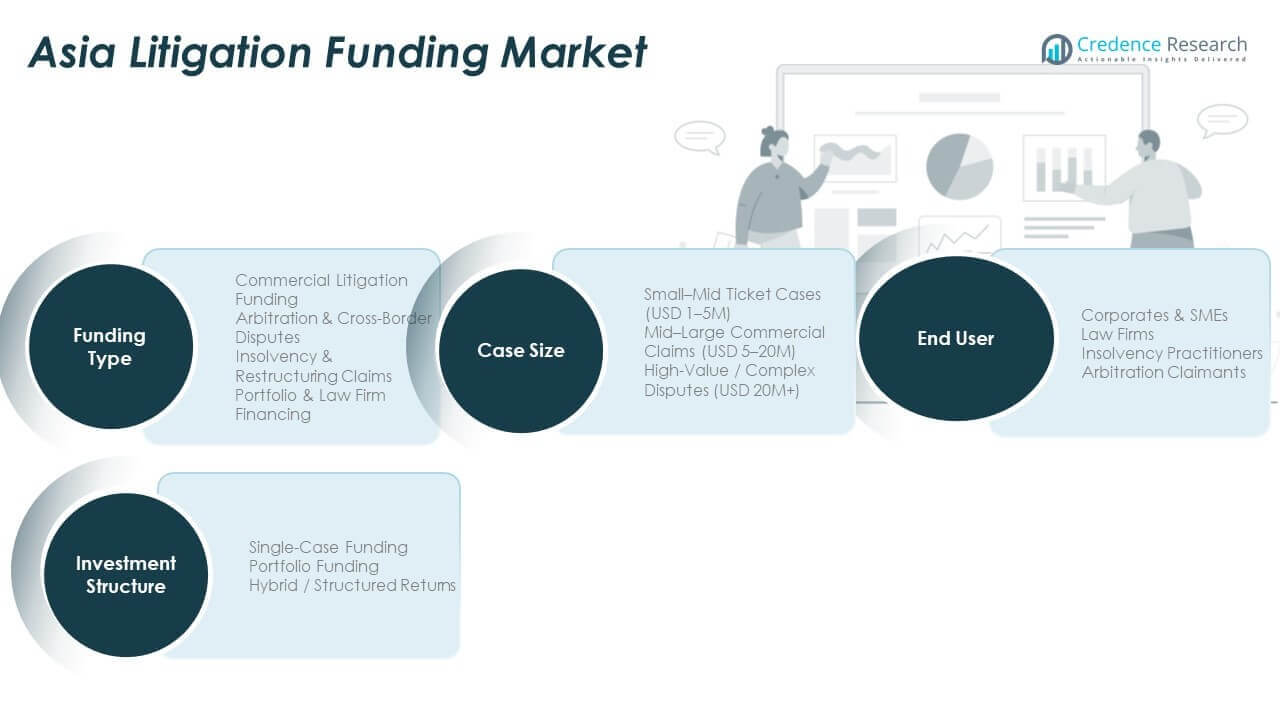
Segmentation
By Funding Type
- Commercial Litigation Funding
- Arbitration & Cross-Border Disputes
- Insolvency & Restructuring Claims
- Portfolio & Law Firm Financing
By Investment Structure
- Single-Case Funding
- Portfolio Funding
- Hybrid / Structured Returns
By Case Size
- Small–Mid Ticket Cases (USD 1–5M)
- Mid–Large Commercial Claims (USD 5–20M)
- High-Value / Complex Disputes (USD 20M+)
By End User
- Corporates & SMEs
- Law Firms
- Insolvency Practitioners
- Arbitration Claimants
Regional Analysis
East Asia
East Asia holds the largest share in the Asia Litigation Funding Market, accounting for nearly 38% of the regional revenue. Hong Kong leads due to its strong arbitration infrastructure and clear regulatory stance on third-party funding. South Korea and Japan show rising interest, supported by legal modernization efforts and corporate demand for litigation risk management. Law firms in these countries increasingly explore funding options for high-value disputes. The region benefits from strong international trade activity, leading to more commercial conflicts. International funders continue to expand in East Asia due to its legal maturity and stable enforcement systems.
Southeast Asia
Southeast Asia represents 32% of the Asia Litigation Funding Market and is growing due to demand from cross-border disputes and arbitration cases. Singapore anchors the region, supported by its pro-funding legal framework and leadership in global arbitration. Indonesia, Malaysia, and the Philippines show rising engagement in litigation finance, especially in construction and insolvency claims. Funders explore partnerships with regional law firms to improve market access. SMEs in the region adopt funding to manage commercial disputes without straining cash reserves. Regulatory clarity remains a work in progress in parts of the region, but interest in legal finance continues to rise.
South Asia and Oceania
South Asia and Oceania contribute 30% to the Asia Litigation Funding Market, with Australia and India being key markets. Australia has a mature litigation funding environment with active domestic players and large-scale class actions. India shows strong potential due to high litigation volumes and rising awareness among corporates and insolvency professionals. Courts in India are increasingly open to recognizing third-party funding, especially in commercial and arbitration matters. Law firms and funders in Oceania pursue structured portfolio deals, targeting complex disputes. Demand for litigation finance in South Asia is driven by cost-sensitive clients and regulatory interest in alternative dispute funding.
Key Player Analysis
- Omni Bridgeway
- Burford Capital
- IMF Bentham
- Harbour Litigation Funding
- Liti Capital
Competitive Analysis
The Asia Litigation Funding Market features a mix of global players, regional specialists, and legal investment firms. Major international funders such as Omni Bridgeway, Burford Capital, and Therium actively invest in high-value cases across Asia. These companies lead in Singapore, Hong Kong, and Australia due to their structured offerings and regulatory experience. Regional firms such as Litigation Capital Management (LCM) and IMF Bentham hold significant presence in Oceania and Southeast Asia. Local legal advisory firms also collaborate with funders to handle emerging markets like India and Indonesia. Competitive intensity is shaped by the type of cases targeted and the level of legal infrastructure in each subregion. Players differentiate based on investment structure, claim evaluation speed, and funding flexibility. Portfolio-based financing is gaining traction among top-tier law firms and institutional clients. Legal tech integration and AI-based risk models further strengthen the capabilities of established players. Smaller firms focus on niche cases such as insolvency, restructuring, or environmental litigation. Strategic partnerships with law firms and arbitration centers remain key to regional expansion. The market continues to attract new entrants with specialized dispute funding models and hybrid investment products.
Recent Developments
- In September 2025, Burford Capital announced a strategic minority investment in Kindleworth to support the launch and expansion of next-generation law firms, combining Burford's legal finance expertise with Kindleworth's firm-building capabilities. This partnership aims to empower entrepreneurial lawyers and create investment opportunities in Kindleworth-backed firms.
- In April 2025, Omni Bridgeway completed a major partnership with Ares Management Corp., where Ares acquired a 70% interest in Omni Bridgeway's litigation finance fund (Bridg Continuation 9) for approximately A$320 million ($204 million).
Report Coverage
The research report offers an in-depth analysis based on Funding Type, Investment Structure, Case Size, End User. It details leading market players, providing an overview of their business, product offerings, investments, revenue streams, and key applications. Additionally, the report includes insights into the competitive environment, SWOT analysis, current market trends, as well as the primary drivers and constraints. Furthermore, it discusses various factors that have driven market expansion in recent years. The report also explores market dynamics, regulatory scenarios, and technological advancements that are shaping the industry. It assesses the impact of external factors and global economic changes on market growth. Lastly, it provides strategic recommendations for new entrants and established companies to navigate the complexities of the market.
Future Outlook
- Demand for litigation finance is expected to grow across commercial, arbitration, and restructuring claims.
- Portfolio funding models will dominate, offering better returns and risk diversification for funders.
- High-value disputes will attract the most capital due to their stronger return profiles and rising complexity.
- Corporate legal departments will adopt litigation funding as a standard financial tool in risk management.
- Southeast Asia and South Asia will offer strong growth due to litigation volumes and evolving legal systems.
- AI-powered legal tech will transform due diligence, risk analysis, and funding decision timelines.
- Strategic partnerships between law firms and funders will expand, offering bundled legal-finance services.
- Regulatory frameworks will evolve in emerging markets, boosting funder confidence and case enforceability.
- New funding products will target niche areas like ESG, IP litigation, and public interest cases.
- Global players will increase market penetration through acquisitions, local partnerships, and regional hubs.
Request a Free Sample
Fill in your details and we'll send you a free sample report.
- Sample data tables & charts
- Research methodology
Need a Custom Version of This Report?
Tailor the scope, geography, or segments to your exact requirements.
- Custom geography or segment scope
- Direct access to our analyst team
Frequently Asked Questions
What is the current market size for Asia Litigation Funding Market, and what is its projected size in 2032?
At what Compound Annual Growth Rate is the Asia Litigation Funding Market projected to grow between 2024 and 2032?
Which Asia Litigation Funding Market segment held the largest share in 2024?
What are the primary factors fueling the growth of the Asia Litigation Funding Market?
Who are the leading companies in the Asia Litigation Funding Market?
Which region commanded the largest share of the Asia Litigation Funding Market in 2024?
Table of Content
Chapter 1. Report Introduction
- 1.1 Report Description & Purpose
- 1.1.1 Report Title & Market Definition
- 1.1.2 Unique Selling Propositions (USP) & Key Differentiators
- 1.1.3 Value Proposition for Stakeholders
- 1.2 Research Objectives
- 1.2.1 Market Sizing Objectives (Volume & Revenue)
- 1.2.2 Segmentation Objectives
- 1.2.3 Competitive Intelligence Objectives
- 1.2.4 Forecast & Scenario Objectives
- 1.3 Report Scope
- 1.3.1 Asia Litigation Funding Scope – Types & Subtypes Covered
- 1.3.2 Geographic Scope – Regions & Countries Covered
- 1.3.3 Historical Period, Base Year & Forecast Period (2024; forecast to 2032)
- 1.3.4 Inclusions & Exclusions
- 1.4 HS Code & Classification Framework
- 1.5 Currency, Units & Pricing Basis
- 1.6 Target Stakeholders
- 1.7 Limitations & Assumptions
Chapter 2. Executive Summary
- 2.1 Global Asia Litigation Funding Market Snapshot
- 2.1.1 Market Size – Historical (2024) & Forecast (2024-2032) (2024: USD 160.69 million → 2032: USD 462.70 million)
- 2.1.2 Volume & Revenue – Global Totals
- 2.1.3 Key Market Highlights – Top Five Facts
- 2.2 Asia Litigation Funding Market Segmentation Snapshot
- 2.2.1 Market Split by Region – 2024 vs. 2032
- 2.3 Competitive Snapshot
- 2.3.1 Top 10 Players by Revenue Share – 2024
- 2.3.2 Top 10 Players by Volume Share – 2024
- 2.3.3 Recent Strategic Developments (18-Month Summary)
- 2.4 Key Investment Highlights & Strategic Conclusions
Chapter 3. Asia Litigation Funding Market Dynamics & Industry Analysis
- 3.1 Market Overview & Context
- 3.1.1 Asia Litigation Funding Market Position in the Broader Automotive Value Chain
- 3.1.2 OEM vs. Replacement Market Dynamics
- 3.1.3 Market Maturity & Development Stage by Region
- 3.2 Asia Litigation Funding Market Drivers
- 3.3 Asia Litigation Funding Market Restraints & Challenges
- 3.4 Asia Litigation Funding Market Opportunities
- 3.5 Porter's Five Forces Analysis
- 3.5.1 Threat of New Entrants
- 3.5.2 Bargaining Power of Suppliers
- 3.5.3 Bargaining Power of Buyers
- 3.5.4 Threat of Substitutes
- 3.5.5 Competitive Rivalry – Intensity Assessment
- 3.6 Asia Litigation Funding Value Chain Analysis
- 3.6.1 Upstream – Raw Material/Input Suppliers
- 3.6.1.1 Raw Material/Input 1
- 3.6.1.2 Raw Material/Input 2
- 3.6.1.3 Raw Material/Input 3
- 3.6.2 Midstream – Production/Manufacturing/Service Delivery
- 3.6.2.1 Production/Process Overview
- 3.6.2.2 Key Facility Locations & Capacity by Manufacturer
- 3.6.3 Downstream – Distribution & End Consumer
- 3.6.3.1 Primary Channel – B2B/OEM
- 3.6.3.2 Secondary Channels – Dealer, Retail, Online, Direct
- 3.6.4 Value Chain Profitability Analysis
- 3.6.1 Upstream – Raw Material/Input Suppliers
- 3.7 PESTEL Analysis
- 3.7.1 Political Factors
- 3.7.2 Economic Factors
- 3.7.3 Social Factors
- 3.7.4 Technological Factors
- 3.7.5 Environmental Factors
- 3.7.6 Legal Factors
- 3.8 Asia Litigation Funding Supply Chain Analysis
- 3.8.1 Raw Material/Input Supply Risk Assessment
- 3.8.2 Manufacturing Concentration Risk (Geographic Exposure)
- 3.8.3 Trade Disruption Impact Analysis
- 3.9 Regulatory & Policy Landscape
Note: The regulatory and policy landscape section covers regulations based on their applicability to the market, Asia Litigation Funding category, geography, and scope of the study. Only regulatory frameworks with a material impact on operations, compliance, trade, sustainability, or market access are analyzed in detail.
Chapter 4. Key Investment Pockets & Opportunity Analysis
- 4.1 Asia Litigation Funding Market Attractiveness Analysis
- 4.1.1 By Region – Investment Attractiveness Matrix (Volume × CAGR)
- 4.2 Absolute Revenue Growth Opportunity
- 4.2.1 By Region – Absolute USD Growth Through 2032
- 4.3 Incremental Volume Opportunity
- 4.3.1 By Region – Incremental Volume Through 2032
- 4.3.2 Segment – Incremental Volume
- 4.4 Emerging Submarket Opportunity Deep Dive (Subject to Applicability)
- 4.5 Emerging Market Opportunity Scorecards
- 4.5.1 United States
- 4.5.2 Europe
- 4.5.3 Asia
- 4.5.4 Middle East & Africa
Note: Emerging Market Opportunity Scorecards will be included based on relevance and strategic importance. Regions listed are indicative and may vary depending on data availability and market dynamics.
Chapter 5. Asia Litigation Funding Import-Export Analysis & Trade Flows
- 5.1 Global Trade Overview
- 5.1.1 Global Export Value by Country (2024)
- 5.1.2 Global Export Volume by Country (2024)
- 5.1.3 Global Import Value by Country (2024)
- 5.1.4 Global Import Volume by Country (2024)
- 5.1.5 Net Trade Balance by Country (2024)
- 5.2 Export Analysis – Segment
- 5.2.1 Type 1 (HS Code)
- 5.2.2 Type 2 (HS Code)
- 5.2.3 Type 3 (HS Code)
- 5.2.4 Type 4 (HS Code)
- 5.2.5 Type 5 (HS Code)
- 5.3 Import Analysis – Segment
- 5.3.1 Type 1 (HS Code)
- 5.3.2 Type 2 (HS Code)
- 5.3.3 Type 3 (HS Code)
- 5.3.4 Type 4 (HS Code)
- 5.3.5 Type 5 (HS Code)
- 5.4 Average Unit Trade Prices
- 5.4.1 Average Export Price – Segment & Country
- 5.4.2 Average Import Price – Segment & Source Country
- 5.4.3 Price Trends (2024)
- 5.5 Key Trade Route Analysis
- 5.5.1 Trade Route 1
- 5.5.2 Trade Route 2
- 5.5.3 Trade Route 3
- 5.5.4 Trade Route 4
- 5.5.5 Trade Route 5
- 5.6 Trade Policy Impact Assessment
- 5.6.1 US Anti-Dumping & Section 301 Tariffs
- 5.6.2 EU Customs Union Impact
- 5.6.3 Major Free Trade Agreements
- 5.6.4 USMCA Rules of Origin
Note: Trade policy analysis will be included only where relevant to the Asia Litigation Funding market.
Chapter 6. Competitive Landscape & Company Benchmarking
- 6.1 Asia Litigation Funding Market Concentration & Structure
- 6.1.1 Herfindahl-Hirschman Index (HHI) – vs. 2024
- 6.1.2 Tier 1, Tier 2 & Tier 3 Market Structure
- 6.1.3 Global, Regional & Local Player Dynamics
- 6.2 Asia Litigation Funding Market Share Analysis – 2024
- 6.2.1 Global Revenue Share by Company
- 6.2.2 Global Volume Share by Company
- 6.2.3 Regional Revenue Share
- 6.2.4 Market Share Evolution ( vs. 2024)
- 6.2.5 OEM Segment Share by Company
- 6.2.6 Replacement Segment Share by Company
- 6.3 Production/Delivery Capacity & Facility Analysis
- 6.3.1 Global Installed Capacity
- 6.3.2 Capacity Utilization Rates
- 6.3.3 Production/Output Volume
- 6.3.4 Facility Locations & Capacity Map
- 6.3.5 Planned Capacity Additions
- 6.4 Asia Litigation Funding Competitive Benchmarking Matrix
- 6.4.1 Revenue, Volume, CAGR & Profitability Comparison
- 6.4.2 Channel Revenue Mix
- 6.4.3 Geographic Revenue Exposure
- 6.4.4 R&D Intensity
- 6.4.5 Sustainability Maturity
- 6.5 Strategic Developments in Asia Litigation Funding (Last 24 Months)
- 6.5.1 Mergers, Acquisitions & Divestments
- 6.5.2 New Asia Litigation Funding Launches
- 6.5.3 Facility Expansions
- 6.5.4 Strategic Alliances, Joint Ventures & Partnerships
- 6.5.5 Distribution Expansion & Market Entry
- 6.5.6 Sustainability & ESG Initiatives
- 6.6 Competitive Strategy Mapping
- 6.6.1 Leader, Challenger, Follower & Niche Classification
- 6.6.2 Pricing Strategy Comparison
- 6.6.3 Channel Strategy Matrix
Note: Strategic developments are included based on their materiality and the availability of reliable information.
Chapter 7. Global Asia Litigation Funding Market – By Distribution Channel
- 7.1 Segment Overview
- 7.1.1 Volume & Revenue Split by Channel (2024 & 2032)
- 7.1.2 Channel Mix Evolution (2024-2032)
Chapter 8. Regional Market Analysis – Global Overview
- 8.1 Global Regional Overview
- 8.1.1 Regional Volume Share
- 8.1.2 Regional Revenue Share
- 8.1.3 Regional Volume by Region
- 8.1.4 Regional Revenue by Region
- 8.1.5 Regional Forecast Through 2032
- 8.2 Cross-Regional Segment Analysis
- 8.2.1 By Distribution Channel
- 8.2.2 By Brand/Price Tier
Chapter 9. North America Asia Litigation Funding Market
- 9.1 United States
- 9.2 Canada
- 9.3 Mexico
Chapter 10. Europe Asia Litigation Funding Market
- 10.1 Germany
- 10.2 France
- 10.3 Italy
- 10.4 United Kingdom
- 10.5 Spain
- 10.6 Poland
- 10.7 Russia
- 10.8 Netherlands
- 10.9 Belgium
- 10.10 Sweden
- 10.11 Denmark
- 10.12 Norway
- 10.13 Rest of Europe
Chapter 11. Asia Pacific Asia Litigation Funding Market
- 11.1 China
- 11.2 India
- 11.3 Japan
- 11.4 South Korea
- 11.5 Thailand
- 11.6 Indonesia
- 11.7 Vietnam
- 11.8 Malaysia
- 11.9 Australia
- 11.10 Rest of Asia Pacific
Chapter 12. Latin America Asia Litigation Funding Market
- 12.1 Brazil
- 12.2 Argentina
- 12.3 Colombia
- 12.4 Chile
- 12.5 Rest of Latin America
Chapter 13. Middle East Asia Litigation Funding Market
- 13.1 Saudi Arabia
- 13.2 United Arab Emirates
- 13.3 Turkey
- 13.4 Israel
- 13.5 Iran
- 13.6 Rest of the Middle East
Chapter 14. Africa Asia Litigation Funding Market
- 14.1 South Africa
- 14.2 Egypt
- 14.3 Nigeria
- 14.4 Morocco
- 14.5 Rest of Africa
Chapter 15. Asia Litigation Funding Company Profiles
- 15.1 [Company 01]
- 15.1.1 Company Overview
- 15.1.2 Key Management Personnel
- 15.1.3 Products & Services Portfolio
- 15.1.4 Financial Performance
- 15.1.5 Key Market Focus & Geographic Presence
- 15.1.6 Recent Developments & Strategic Initiatives
Note: The company profile list is preliminary and may change based on research findings, market developments, data availability, and client requirements.
Chapter 16. Appendices
- Appendix A – List of Abbreviations & Acronyms
- Appendix B – Industry Classification Code Reference – Full Series
- Appendix C – Production & Capacity Data Tables
- Appendix D – End-Use & Demand Base Tables
- Appendix E – Consumption & Replacement Rate Assumptions
- Appendix F – ASP Reference Tables
- Appendix G – Manufacturing & Facility Database
- Appendix H – Import-Export Data Tables
- Appendix I – Regulatory Summary Tables
- Appendix J – Primary Research Participant List (Anonymized)
- Appendix K – Primary Research Questionnaire Framework
- Appendix L – Data Sources & Bibliography
- Appendix M – Market Size Divergence & Source Comparison
Chapter 17. Research Methodology
- 17.1 Research Framework & Philosophy
- 17.2 Secondary Research – Sources, Hierarchy & Data Extraction
- 17.3 Data Modeling – Bottom-Up & Top-Down Market Sizing
- 17.4 Primary Research – Stakeholder Framework, LOI & Sample Sizes
- 17.5 Forecast Methodology – Regression, Scenario & Sensitivity Analysis
- 17.6 Quality Control – Four-Layer Validation Framework
- 17.7 Limitations & Standard Assumptions
- 17.8 Disclaimer
