
Market Overview
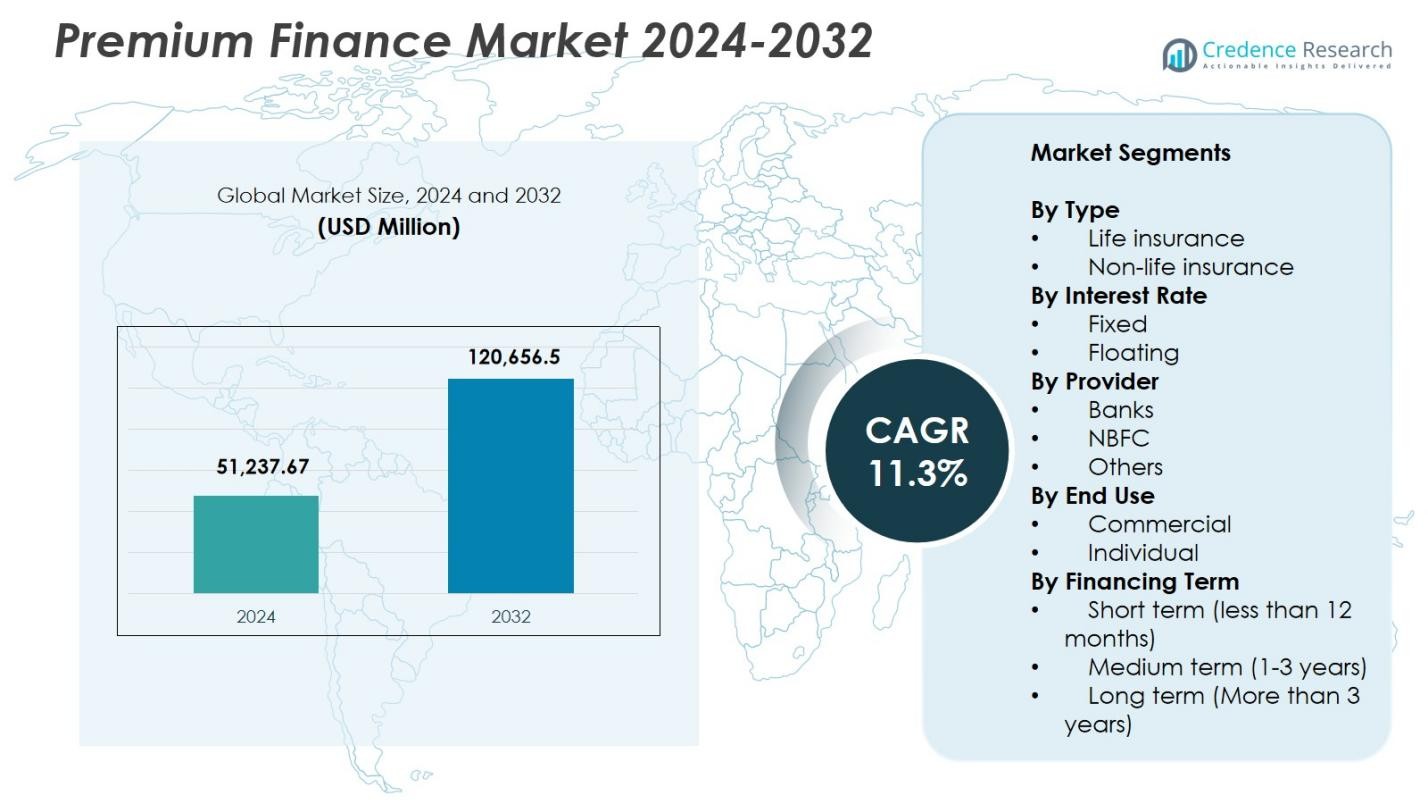
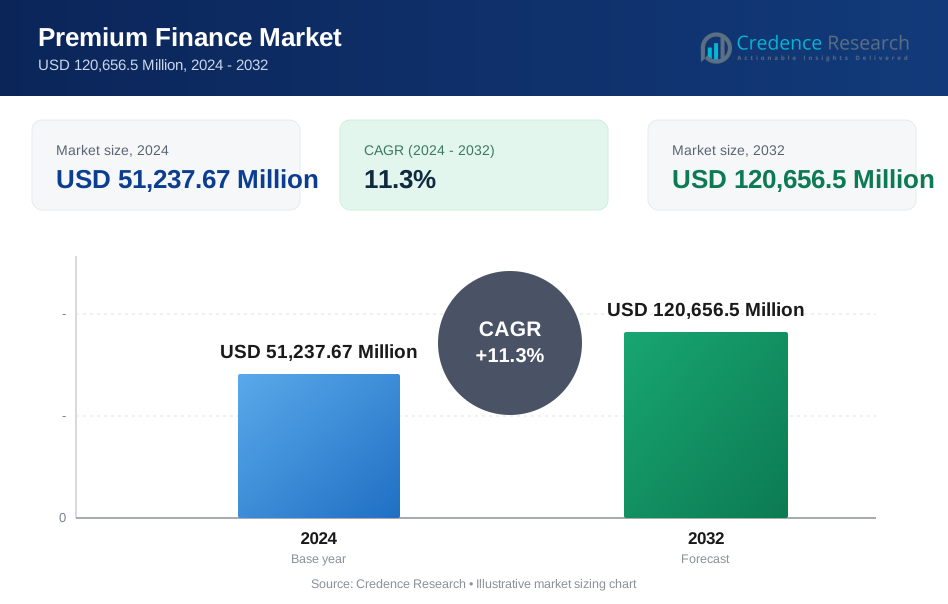
Premium Finance Market size was valued at USD 51,237.67 Million in 2024 and is anticipated to reach USD 120,656.5 Million by 2032, at a CAGR of 11.3% during the forecast period.
| REPORT ATTRIBUTE | DETAILS |
|---|---|
| Historical Period | 2020-2023 |
| Base Year | 2024 |
| Forecast Period | 2025-2032 |
| Premium Finance Market Size 2024 | USD 51,237.67 Million |
| Premium Finance Market, CAGR | 11.3% |
| Premium Finance Market Size 2032 | USD 120,656.5 Million |
Premium Finance Market features leading participants such as AFCO Credit, Agile Premium Finance, ARI Financial Group, Byline Bank, First Insurance Funding (Wintrust), IPFS, JP Morgan, Lincoln National, Truist Insurance Holdings, and Valley National Bancorp, each strengthening market presence through advanced lending platforms and expanded insurer partnerships. North America led the market with a 41.6% share in 2024, driven by strong adoption of premium-financed life insurance and well-established financial institutions offering flexible policy funding. Europe held a 27.3% share, supported by rising commercial insurance costs and increasing integration of premium financing into corporate and wealth-planning strategies.
Market Insights
- Premium Finance Market reached USD 51,237.67 Million in 2024 and will grow USD 120,656.5 at a CAGR of 11.3% through 2032.
- Rising demand for high-value life insurance fuels growth, with the life insurance segment holding 62.4% share as affluent clients adopt liquidity-preserving financing structures.
- Digital lending platforms, automated underwriting, and embedded finance models reshape market trends, enabling faster approvals and expanding adoption across SMEs and high-net-worth individuals.
- Key players strengthen market position through expanded insurer partnerships and advanced lending solutions, while banks lead the provider segment with a 7% share, supported by strong capital capacity.
- North America leads regional demand with 6% share, followed by Europe at 27.3% and Asia-Pacific at 21.4%, driven by strong insurance penetration, wealth expansion, and increasing need for structured premium financing across commercial and personal markets.
 Market Segmentation Analysis:
By Type
Life insurance dominated the Premium Finance Market with a 62.4% share in 2024, driven by rising demand for high-value life policies, estate-planning strategies, and liquidity-focused financing solutions for affluent clients. The segment benefits from increasing adoption of interest-only financing structures that help preserve cash flow while maintaining long-term coverage. Non-life insurance held a 37.6% share, supported by commercial clients financing large property, casualty, and specialty insurance premiums. Expanding risk-management requirements across corporate sectors continues to reinforce demand for structured premium finance in both categories.
- For instance, Bajaj Finserv provides premium financing for life insurance to help affluent individuals preserve liquidity and secure family legacies. Clients fund premiums via loans, retaining capital for investments or business needs.
By Interest Rate
Fixed-rate financing led the market with a 68.1% share in 2024, as borrowers preferred predictable repayment structures amid fluctuating interest-rate environments. This segment grows as insurers, banks, and premium finance companies market long-term stability to high-net-worth individuals and corporate policyholders seeking consistent cost planning. Floating-rate financing captured a 31.9% share, driven by clients targeting lower short-term financing costs and benefiting from rate resets during easing monetary cycles. The shift toward diversified lending products continues to expand both fixed and floating offerings across premium finance providers.
- For instance, J.P. Morgan Private Bank offers life insurance premium financing with fixed or variable interest rates tailored to estate planning, allowing clients to collateralize policy cash value without liquidating assets.
By Provider
Banks accounted for the largest position in this segment with a 54.7% share in 2024, supported by their strong capital base, integrated insurance-lending platforms, and ability to offer competitive interest terms. NBFCs held a 33.5% share, driven by flexible underwriting, faster loan approvals, and increasing penetration among small to mid-sized commercial clients. Other providers, including specialized finance firms and brokerage-linked lenders, represented 11.8%, gaining traction as they offer tailored financing solutions for life and commercial insurance policies. Strengthening distribution networks continues to improve market accessibility across all provider categories.
Key Growth Drivers
Growing Demand for High-Value Life Insurance Policies
The Premium Finance Market expands rapidly as affluent individuals increasingly fund high-value life insurance policies through structured financing. Demand rises as policyholders leverage premium finance to preserve liquidity, optimize estate-planning structures, and enhance wealth-transfer efficiency. Financial institutions offer interest-only and collateral-flexible arrangements, enabling borrowers to maintain long-term coverage without large upfront payments. As tax-efficient wealth management becomes a priority, premium financing strengthens its relevance, driving strong adoption among high-net-worth clients and family offices seeking leverage-based insurance strategies.
- For instance, IPFS Corporation offers premium financing solutions that streamline cash flow for agents and high-net-worth insureds by covering large policy premiums via loans secured by policy value.
Rising Commercial Insurance Costs Driving Corporate Adoption
Businesses increasingly rely on premium finance to manage escalating commercial insurance costs across property, casualty, liability, and specialty lines. Corporations use financing to maintain coverage levels while preserving operational cash flow, reducing upfront capital strain, and aligning insurance expenses with revenue cycles. Growing risk exposures in sectors such as construction, logistics, and energy further accelerate adoption. As insurers tighten underwriting standards, corporate buyers turn to premium finance providers for flexible repayment structures, supporting steady market growth across small, mid-size, and large enterprises.
- For instance, First Insurance Funding, a Wintrust company, provides premium finance across all 50 U.S. states for trucking and transportation businesses' commercial auto coverage, handling over $16 billion in annual loan volume to ease premium burdens.
Expansion of Bank and NBFC Financing Capabilities
Banks and NBFCs expand premium finance offerings supported by strong capital reserves, integrated digital underwriting systems, and diversified risk portfolios. Their ability to offer competitive interest rates, seamless policy-lender coordination, and enhanced borrower servicing attracts both individual and commercial clients. NBFCs gain momentum by providing fast approvals and customized financing options for high-risk or underserved segments. As financial institutions strengthen distribution partnerships with insurers and brokers, premium finance becomes more accessible, driving continuous market penetration and accelerating long-term adoption.
Key Trends & Opportunities
Digitalization and Automation Transforming Premium Finance
Digital lending platforms, automated underwriting, and API-enabled insurer integrations reshape market operations, enabling faster approvals, transparent documentation, and real-time premium payment management. Lenders leverage analytics to assess borrower profiles more accurately, improving risk scoring and reducing defaults. Embedded finance models allow brokers and insurers to offer financing options at the point of sale, increasing conversion rates. This digital shift creates significant opportunities for providers to scale operations, enhance customer experience, and expand into underserved small business and retail insurance segments.
- For instance, HDFC ERGO integrated over 300 API services through Apigee into its insurance superapps, facilitating seamless connections with partners like garages and retailers for embedded customer journeys and streamlined back-end operations.
Growing Use of Premium Finance in Estate and Wealth Planning
Premium financing gains prominence as wealth managers incorporate leveraged insurance into estate-planning and tax-optimization strategies. High-net-worth clients increasingly use financed policies to cover estate taxes, protect business succession plans, and enhance generational wealth transfer without liquidating assets. As private banks and advisory firms expand structured insurance solutions, cross-selling opportunities rise. This trend positions premium finance as an attractive tool within holistic wealth-planning portfolios, opening significant growth avenues across ultra-HNI, private banking, and family-office ecosystems.
- For instance, Synovus Life Finance structures customized premium financing loans collateralized by policy cash values for high-net-worth individuals, allowing borrowed funds to pay premiums while retaining client liquidity for investments and avoiding sales of illiquid assets like real estate.
Key Challenges
Interest Rate Volatility Impacting Borrowing Affordability
Fluctuating interest rates present a major challenge as rising borrowing costs reduce affordability and profitability for financed insurance strategies. Higher rates increase total repayment obligations, leading some borrowers to reconsider long-term commitments or restructure collateral arrangements. Lenders must frequently reassess risk exposure, especially in floating-rate portfolios. This volatility pressures both borrowers and finance providers, potentially slowing new transaction volumes during tightening monetary cycles and increasing the risk of policy lapses or refinancing difficulties in unstable rate environments.
Stringent Collateral and Underwriting Requirements
Premium finance transactions often require robust collateral, detailed credit assessments, and rigorous lender-insurer coordination, creating barriers for certain borrowers. High-value policies, particularly in life insurance, demand comprehensive financial documentation and strict loan-to-value controls, limiting access for clients with variable income profiles or limited assets. These stringent requirements increase processing complexity for lenders and may delay approvals. As regulatory scrutiny intensifies, maintaining compliance while managing credit risk becomes more challenging, restricting expansion in some emerging or high-risk customer segments.
Regional Analysis
North America
North America led the Premium Finance Market with a 41.6% share in 2024, supported by strong penetration of high-value life insurance policies, advanced wealth-planning practices, and a mature network of banks and premium finance companies. The United States drives regional dominance as high-net-worth clients and corporate buyers increasingly use financing to manage liquidity and rising insurance costs. Robust digital lending infrastructure, extensive broker partnerships, and favorable estate-planning frameworks further accelerate adoption. Canada contributes steady growth as insurers and financial institutions expand premium finance offerings for commercial and personal policyholders.
Europe
Europe held a 27.3% share in 2024, driven by growing use of premium financing in corporate insurance, professional indemnity, and specialty risk segments. The region experiences strong adoption in the United Kingdom, Germany, and France as businesses utilize financing tools to manage rising premiums and regulatory-driven coverage requirements. Wealth managers in Western Europe increasingly integrate financed life insurance into tax-efficient legacy-planning strategies. Digital lending expansion and cross-border insurer–lender collaborations support market growth. Southern and Eastern Europe witness emerging demand as SMEs adopt premium finance to preserve working capital and enhance cash-flow stability.
Asia-Pacific
Asia-Pacific accounted for 21.4% of the market in 2024, reflecting rapid expansion in commercial insurance, rising HNI populations, and growing adoption of leveraged insurance strategies across major economies. Strong market momentum in China, Japan, India, and Australia is fueled by rising insurance penetration, increasing regulatory compliance needs, and the availability of flexible financing products from banks and NBFCs. Corporate clients across manufacturing, infrastructure, and logistics rely on premium finance to manage increasing premiums. As wealth accumulation accelerates in emerging markets, premium-financed life insurance gains traction, driving long-term growth in the region.
Latin America
Latin America captured a 6.8% share in 2024, supported by expanding commercial insurance requirements, rising adoption of risk-management frameworks, and growing awareness of premium finance among small and mid-sized enterprises. Countries such as Brazil, Mexico, and Chile lead regional uptake as businesses seek financing solutions to manage rising liability, property, and specialty insurance costs. While high interest rates pose challenges, demand increases for flexible repayment structures and digital onboarding. Strengthening partnerships between insurers, brokers, and financial institutions enhances accessibility, driving broader regional participation in premium financing solutions.
Middle East & Africa
The Middle East & Africa region represented 2.9% of the market in 2024, driven by increasing demand for commercial and specialty insurance in construction, energy, and logistics industries. Wealth growth in GCC countries boosts adoption of premium-financed life insurance among high-net-worth individuals. Banks and regional finance companies expand offerings to support premium payment flexibility amid rising policy values. In Africa, gradual insurance-market development and SME growth create new opportunities, though limited financial access and credit constraints slow progress. Ongoing regulatory modernization and digital lending support incremental market expansion.
Market Segmentations:
By Type
- Life insurance
- Non-life insurance
By Interest Rate
- Fixed
- Floating
By Provider
- Banks
- NBFC
- Others
By End Use
- Commercial
- Individual
By Financing Term
- Short term (less than 12 months)
- Medium term (1-3 years)
- Long term (More than 3 years)
By Geography
- North America
- U.S.
- Canada
- Mexico
- Europe
- Germany
- France
- U.K.
- Italy
- Spain
- Rest of Europe
- Asia Pacific
- China
- Japan
- India
- South Korea
- South-east Asia
- Rest of Asia Pacific
- Latin America
- Brazil
- Argentina
- Rest of Latin America
- Middle East & Africa
- GCC Countries
- South Africa
- Rest of the Middle East and Africa
Competitive Landscape
The competitive landscape of the Premium Finance Market features leading participants such as AFCO Credit, Agile Premium Finance, ARI Financial Group, Byline Bank, First Insurance Funding (Wintrust), IPFS, JP Morgan, Lincoln National, Truist Insurance Holdings, and Valley National Bancorp. Market dynamics are shaped by diversified product portfolios, interest-rate strategies, and expanding digital lending capabilities that enhance underwriting speed and customer onboarding. Banks maintain strong influence through integrated insurance–lending ecosystems and competitive capital access, while specialized finance companies strengthen their position through flexible loan structures and niche policy-financing expertise. Providers increasingly invest in automation, risk analytics, and broker-integrated platforms to improve decision-making and reduce processing overheads. Strategic partnerships with insurers and independent agencies continue to expand distribution reach and drive transaction volumes. As interest-rate environments evolve, players focus on pricing efficiency, collateral management, and long-term relationship models to retain market share and support scalable growth across life and commercial insurance financing segments.
Key Player Analysis
- Lincoln National
- Byline Bank
- JP Morgan
- IPFS
- Valley National Bancorp
- First Insurance Funding (Wintrust)
- ARI Financial Group
- Agile Premium Finance
- Truist Insurance Holdings
- AFCO Credit
Recent Developments
- In April 2024 IPFS Corporation acquired Stonemark, Inc., adding over 4,000 agencies and their team to its premium finance operations.
- In June 2023 Agile Premium Finance entered into a strategic partnership with Pavo Insurance Solutions to deliver an enhanced premium finance marketplace for insurers and brokers.
- In December 2024 AFCO Direct partnered with ePayPolicy to integrate premium finance options into digital payment systems for insurance agencies and carriers.
Report Coverage
The research report offers an in-depth analysis based on Type, Interest Rate, Provider, End Use, Financing Term and Geography. It details leading market players, providing an overview of their business, product offerings, investments, revenue streams, and key applications. Additionally, the report includes insights into the competitive environment, SWOT analysis, current market trends, as well as the primary drivers and constraints. Furthermore, it discusses various factors that have driven market expansion in recent years. The report also explores market dynamics, regulatory scenarios, and technological advancements that are shaping the industry. It assesses the impact of external factors and global economic changes on market growth. Lastly, it provides strategic recommendations for new entrants and established companies to navigate the complexities of the market.
Future Outlook
- Premium finance adoption will rise as high-net-worth individuals increasingly integrate leveraged life insurance into estate and wealth-planning strategies.
- Digital lending platforms will streamline underwriting, accelerate approvals, and expand market access across individual and commercial segments.
- Corporate demand for premium finance will grow as businesses manage escalating property, liability, and specialty insurance costs.
- Banks and NBFCs will enhance product innovation, offering more flexible repayment options and risk-adjusted interest structures.
- Embedded finance models will expand as insurers and brokers integrate financing directly into policy sales workflows.
- Growth in commercial construction, logistics, and energy sectors will increase demand for financed insurance coverage.
- Expanding regulatory compliance requirements will push more companies toward premium-financed coverage to manage rising costs.
- Wealth accumulation in Asia-Pacific and the Middle East will accelerate adoption of financed life insurance solutions.
- Partnerships between insurers, brokers, and finance providers will strengthen distribution networks and customer acquisition.
- Advanced analytics and AI-driven risk assessment will improve borrower profiling and reduce default risks, enhancing market stability.
Request a Free Sample
Fill in your details and we'll send you a free sample report.
- Sample data tables & charts
- Research methodology
Need a Custom Version of This Report?
Tailor the scope, geography, or segments to your exact requirements.
- Custom geography or segment scope
- Direct access to our analyst team
Frequently Asked Questions
What is the current market size for the Premium Finance Market, and what is its projected size in 2032?
At what Compound Annual Growth Rate is the Premium Finance Market projected to grow between 2025 and 2032?
Which Premium Finance Market segment held the largest share in 2024?
What are the primary factors fueling the growth of the Premium Finance Market?
Who are the leading companies in the Premium Finance Market?
Which region commanded the largest share of the Premium Finance Market in 2024?
Table of Content
Chapter 1. Report Introduction
- 1.1 Report Description & Purpose
- 1.1.1 Report Title & Market Definition
- 1.1.2 Unique Selling Propositions (USP) & Key Differentiators
- 1.1.3 Value Proposition for Stakeholders
- 1.2 Research Objectives
- 1.2.1 Market Sizing Objectives (Volume & Revenue)
- 1.2.2 Segmentation Objectives
- 1.2.3 Competitive Intelligence Objectives
- 1.2.4 Forecast & Scenario Objectives
- 1.3 Report Scope
- 1.3.1 Premium Finance Scope – Types & Subtypes Covered
- 1.3.2 Geographic Scope – Regions & Countries Covered
- 1.3.3 Historical Period, Base Year & Forecast Period (2024; forecast to 2032)
- 1.3.4 Inclusions & Exclusions
- 1.4 HS Code & Classification Framework
- 1.5 Currency, Units & Pricing Basis
- 1.6 Target Stakeholders
- 1.7 Limitations & Assumptions
Chapter 2. Executive Summary
- 2.1 Global Premium Finance Market Snapshot
- 2.1.1 Market Size – Historical (2024) & Forecast (2024-2032) (2024: USD 51,237.67 Million → 2032: USD 120,656.5 Million)
- 2.1.2 Volume & Revenue – Global Totals
- 2.1.3 Key Market Highlights – Top Five Facts
- 2.2 Premium Finance Market Segmentation Snapshot
- 2.2.1 Market Split by Region – 2024 vs. 2032
- 2.3 Competitive Snapshot
- 2.3.1 Top 10 Players by Revenue Share – 2024
- 2.3.2 Top 10 Players by Volume Share – 2024
- 2.3.3 Recent Strategic Developments (18-Month Summary)
- 2.4 Key Investment Highlights & Strategic Conclusions
Chapter 3. Premium Finance Market Dynamics & Industry Analysis
- 3.1 Market Overview & Context
- 3.1.1 Premium Finance Market Position in the Broader Automotive Value Chain
- 3.1.2 OEM vs. Replacement Market Dynamics
- 3.1.3 Market Maturity & Development Stage by Region
- 3.2 Premium Finance Market Drivers
- 3.3 Premium Finance Market Restraints & Challenges
- 3.4 Premium Finance Market Opportunities
- 3.5 Porter's Five Forces Analysis
- 3.5.1 Threat of New Entrants
- 3.5.2 Bargaining Power of Suppliers
- 3.5.3 Bargaining Power of Buyers
- 3.5.4 Threat of Substitutes
- 3.5.5 Competitive Rivalry – Intensity Assessment
- 3.6 Premium Finance Value Chain Analysis
- 3.6.1 Upstream – Raw Material/Input Suppliers
- 3.6.1.1 Raw Material/Input 1
- 3.6.1.2 Raw Material/Input 2
- 3.6.1.3 Raw Material/Input 3
- 3.6.2 Midstream – Production/Manufacturing/Service Delivery
- 3.6.2.1 Production/Process Overview
- 3.6.2.2 Key Facility Locations & Capacity by Manufacturer
- 3.6.3 Downstream – Distribution & End Consumer
- 3.6.3.1 Primary Channel – B2B/OEM
- 3.6.3.2 Secondary Channels – Dealer, Retail, Online, Direct
- 3.6.4 Value Chain Profitability Analysis
- 3.6.1 Upstream – Raw Material/Input Suppliers
- 3.7 PESTEL Analysis
- 3.7.1 Political Factors
- 3.7.2 Economic Factors
- 3.7.3 Social Factors
- 3.7.4 Technological Factors
- 3.7.5 Environmental Factors
- 3.7.6 Legal Factors
- 3.8 Premium Finance Supply Chain Analysis
- 3.8.1 Raw Material/Input Supply Risk Assessment
- 3.8.2 Manufacturing Concentration Risk (Geographic Exposure)
- 3.8.3 Trade Disruption Impact Analysis
- 3.9 Regulatory & Policy Landscape
Note: The regulatory and policy landscape section covers regulations based on their applicability to the market, Premium Finance category, geography, and scope of the study. Only regulatory frameworks with a material impact on operations, compliance, trade, sustainability, or market access are analyzed in detail.
Chapter 4. Key Investment Pockets & Opportunity Analysis
- 4.1 Premium Finance Market Attractiveness Analysis
- 4.1.1 By Region – Investment Attractiveness Matrix (Volume × CAGR)
- 4.2 Absolute Revenue Growth Opportunity
- 4.2.1 By Region – Absolute USD Growth Through 2032
- 4.3 Incremental Volume Opportunity
- 4.3.1 By Region – Incremental Volume Through 2032
- 4.3.2 Segment – Incremental Volume
- 4.4 Emerging Submarket Opportunity Deep Dive (Subject to Applicability)
- 4.5 Emerging Market Opportunity Scorecards
- 4.5.1 United States
- 4.5.2 Europe
- 4.5.3 Asia
- 4.5.4 Middle East & Africa
Note: Emerging Market Opportunity Scorecards will be included based on relevance and strategic importance. Regions listed are indicative and may vary depending on data availability and market dynamics.
Chapter 5. Premium Finance Import-Export Analysis & Trade Flows
- 5.1 Global Trade Overview
- 5.1.1 Global Export Value by Country (2024)
- 5.1.2 Global Export Volume by Country (2024)
- 5.1.3 Global Import Value by Country (2024)
- 5.1.4 Global Import Volume by Country (2024)
- 5.1.5 Net Trade Balance by Country (2024)
- 5.2 Export Analysis – Segment
- 5.2.1 Type 1 (HS Code)
- 5.2.2 Type 2 (HS Code)
- 5.2.3 Type 3 (HS Code)
- 5.2.4 Type 4 (HS Code)
- 5.2.5 Type 5 (HS Code)
- 5.3 Import Analysis – Segment
- 5.3.1 Type 1 (HS Code)
- 5.3.2 Type 2 (HS Code)
- 5.3.3 Type 3 (HS Code)
- 5.3.4 Type 4 (HS Code)
- 5.3.5 Type 5 (HS Code)
- 5.4 Average Unit Trade Prices
- 5.4.1 Average Export Price – Segment & Country
- 5.4.2 Average Import Price – Segment & Source Country
- 5.4.3 Price Trends (2024)
- 5.5 Key Trade Route Analysis
- 5.5.1 Trade Route 1
- 5.5.2 Trade Route 2
- 5.5.3 Trade Route 3
- 5.5.4 Trade Route 4
- 5.5.5 Trade Route 5
- 5.6 Trade Policy Impact Assessment
- 5.6.1 US Anti-Dumping & Section 301 Tariffs
- 5.6.2 EU Customs Union Impact
- 5.6.3 Major Free Trade Agreements
- 5.6.4 USMCA Rules of Origin
Note: Trade policy analysis will be included only where relevant to the Premium Finance market.
Chapter 6. Competitive Landscape & Company Benchmarking
- 6.1 Premium Finance Market Concentration & Structure
- 6.1.1 Herfindahl-Hirschman Index (HHI) – vs. 2024
- 6.1.2 Tier 1, Tier 2 & Tier 3 Market Structure
- 6.1.3 Global, Regional & Local Player Dynamics
- 6.2 Premium Finance Market Share Analysis – 2024
- 6.2.1 Global Revenue Share by Company
- 6.2.2 Global Volume Share by Company
- 6.2.3 Regional Revenue Share
- 6.2.4 Market Share Evolution ( vs. 2024)
- 6.2.5 OEM Segment Share by Company
- 6.2.6 Replacement Segment Share by Company
- 6.3 Production/Delivery Capacity & Facility Analysis
- 6.3.1 Global Installed Capacity
- 6.3.2 Capacity Utilization Rates
- 6.3.3 Production/Output Volume
- 6.3.4 Facility Locations & Capacity Map
- 6.3.5 Planned Capacity Additions
- 6.4 Premium Finance Competitive Benchmarking Matrix
- 6.4.1 Revenue, Volume, CAGR & Profitability Comparison
- 6.4.2 Channel Revenue Mix
- 6.4.3 Geographic Revenue Exposure
- 6.4.4 R&D Intensity
- 6.4.5 Sustainability Maturity
- 6.5 Strategic Developments in Premium Finance (Last 24 Months)
- 6.5.1 Mergers, Acquisitions & Divestments
- 6.5.2 New Premium Finance Launches
- 6.5.3 Facility Expansions
- 6.5.4 Strategic Alliances, Joint Ventures & Partnerships
- 6.5.5 Distribution Expansion & Market Entry
- 6.5.6 Sustainability & ESG Initiatives
- 6.6 Competitive Strategy Mapping
- 6.6.1 Leader, Challenger, Follower & Niche Classification
- 6.6.2 Pricing Strategy Comparison
- 6.6.3 Channel Strategy Matrix
Note: Strategic developments are included based on their materiality and the availability of reliable information.
Chapter 7. Global Premium Finance Market – By Distribution Channel
- 7.1 Segment Overview
- 7.1.1 Volume & Revenue Split by Channel (2024 & 2032)
- 7.1.2 Channel Mix Evolution (2024-2032)
Chapter 8. Regional Market Analysis – Global Overview
- 8.1 Global Regional Overview
- 8.1.1 Regional Volume Share
- 8.1.2 Regional Revenue Share
- 8.1.3 Regional Volume by Region
- 8.1.4 Regional Revenue by Region
- 8.1.5 Regional Forecast Through 2032
- 8.2 Cross-Regional Segment Analysis
- 8.2.1 By Distribution Channel
- 8.2.2 By Brand/Price Tier
Chapter 9. North America Premium Finance Market
- 9.1 United States
- 9.2 Canada
- 9.3 Mexico
Chapter 10. Europe Premium Finance Market
- 10.1 Germany
- 10.2 France
- 10.3 Italy
- 10.4 United Kingdom
- 10.5 Spain
- 10.6 Poland
- 10.7 Russia
- 10.8 Netherlands
- 10.9 Belgium
- 10.10 Sweden
- 10.11 Denmark
- 10.12 Norway
- 10.13 Rest of Europe
Chapter 11. Asia Pacific Premium Finance Market
- 11.1 China
- 11.2 India
- 11.3 Japan
- 11.4 South Korea
- 11.5 Thailand
- 11.6 Indonesia
- 11.7 Vietnam
- 11.8 Malaysia
- 11.9 Australia
- 11.10 Rest of Asia Pacific
Chapter 12. Latin America Premium Finance Market
- 12.1 Brazil
- 12.2 Argentina
- 12.3 Colombia
- 12.4 Chile
- 12.5 Rest of Latin America
Chapter 13. Middle East Premium Finance Market
- 13.1 Saudi Arabia
- 13.2 United Arab Emirates
- 13.3 Turkey
- 13.4 Israel
- 13.5 Iran
- 13.6 Rest of the Middle East
Chapter 14. Africa Premium Finance Market
- 14.1 South Africa
- 14.2 Egypt
- 14.3 Nigeria
- 14.4 Morocco
- 14.5 Rest of Africa
Chapter 15. Premium Finance Company Profiles
- 15.1 [Company 01]
- 15.1.1 Company Overview
- 15.1.2 Key Management Personnel
- 15.1.3 Products & Services Portfolio
- 15.1.4 Financial Performance
- 15.1.5 Key Market Focus & Geographic Presence
- 15.1.6 Recent Developments & Strategic Initiatives
Note: The company profile list is preliminary and may change based on research findings, market developments, data availability, and client requirements.
Chapter 16. Appendices
- Appendix A – List of Abbreviations & Acronyms
- Appendix B – Industry Classification Code Reference – Full Series
- Appendix C – Production & Capacity Data Tables
- Appendix D – End-Use & Demand Base Tables
- Appendix E – Consumption & Replacement Rate Assumptions
- Appendix F – ASP Reference Tables
- Appendix G – Manufacturing & Facility Database
- Appendix H – Import-Export Data Tables
- Appendix I – Regulatory Summary Tables
- Appendix J – Primary Research Participant List (Anonymized)
- Appendix K – Primary Research Questionnaire Framework
- Appendix L – Data Sources & Bibliography
- Appendix M – Market Size Divergence & Source Comparison
Chapter 17. Research Methodology
- 17.1 Research Framework & Philosophy
- 17.2 Secondary Research – Sources, Hierarchy & Data Extraction
- 17.3 Data Modeling – Bottom-Up & Top-Down Market Sizing
- 17.4 Primary Research – Stakeholder Framework, LOI & Sample Sizes
- 17.5 Forecast Methodology – Regression, Scenario & Sensitivity Analysis
- 17.6 Quality Control – Four-Layer Validation Framework
- 17.7 Limitations & Standard Assumptions
- 17.8 Disclaimer
