
Market Overview
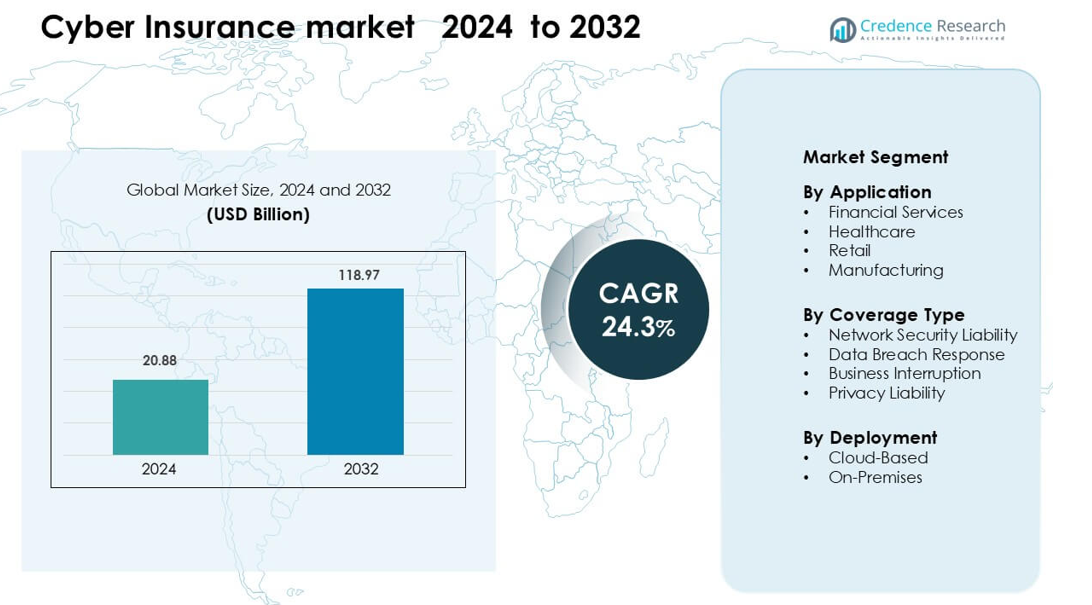
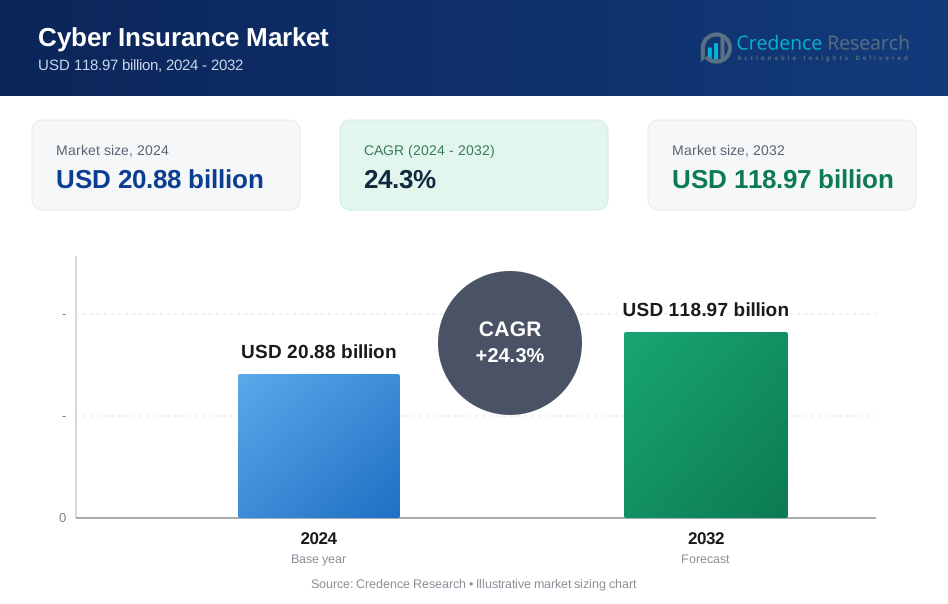
Cyber Insurance market was valued at USD 20.88 billion in 2024 and is anticipated to reach USD 118.97 billion by 2032, growing at a CAGR of 24.3 % during the forecast period.
| REPORT ATTRIBUTE | DETAILS |
|---|---|
| Historical Period | 2020-2023 |
| Base Year | 2024 |
| Forecast Period | 2025-2032 |
| Cyber Insurance Market Size 2024 | USD 20.88 billion |
| Cyber Insurance Market, CAGR | 24.3% |
| Cyber Insurance Market Size 2032 | USD 118.97 billion |
The Cyber Insurance market is shaped by major players such as Munich ReGroup, Zurich Insurance Company Limited, Lockton Companies Inc., Berkshire Hathaway Inc., AXA XL, Lloyd’s of London, American International Group Inc., Chubb Limited (ACE Limited), Allianz Group, and AON Plc. These insurers compete through advanced underwriting tools, stronger incident-response partnerships, and broader coverage offerings tailored for high-risk sectors. North America leads the market with about 38% share due to strict regulations, high digital adoption, and rising cyberattack frequency, making the region the strongest contributor to global demand.
Market Insights
- Cyber Insurance market was valued at USD 20.88 billion in 2024 and is anticipated to reach USD 118.97 billion by 2032, growing at a CAGR of 24.3 % during the forecast period.
- Growing ransomware frequency and rising breach-related costs drive heavy adoption across financial services, which hold the largest share at about 38% due to high exposure and strong compliance pressure.
- AI-driven underwriting, automated threat scoring, and bundled security services shape key trends as insurers shift toward predictive models and real-time monitoring partnerships.
- Competition intensifies as major players expand incident-response networks and tighten underwriting to control rising claim ratios; premium adjustments and stricter policy terms remain common.
- North America leads with roughly 38% share, followed by Europe at about 28% and Asia Pacific near 22%, supported by rapid digital adoption and higher regulatory enforcement across major economies.
Market Segmentation Analysis:
By Application
Financial services hold the dominant share at about 38% in 2024 because banks and insurers face frequent ransomware, fraud, and data-theft attacks. The sector adopts cyber insurance to manage regulatory penalties and reduce recovery costs after breaches. Strong digital adoption in payments, mobile banking, and wealth platforms increases exposure across networks. Healthcare follows as hospitals expand electronic record systems, while retail and manufacturing gain traction due to rising attacks on POS systems and connected production lines. Demand rises as firms seek rapid incident response, forensic support, and legal protection.
- For instance, in a major incident, JPMorgan Chase disclosed a cyber breach that compromised data from over 83 million customer accounts.
By Coverage Type
Network security liability leads this segment with nearly 35% share in 2024 due to rising attacks targeting firewalls, servers, and enterprise networks. Companies prefer this coverage because it offers protection against unauthorized access, malware infiltration, and operational shutdowns. Data breach response grows as firms prioritize quick notification, credit monitoring, and digital forensics after exposure events. Business interruption coverage expands as cloud outages and cyber incidents disrupt daily operations, while privacy liability gains momentum as stricter global data-protection rules increase compliance risks.
- For instance, Beazley describes a claim in which a threat actor accessed three separate Office 365 accounts as part of a malicious attack, which ultimately resulted in over a thousand employees requiring breach notification and credit-monitoring services.
By Deployment
Cloud-based deployment dominates with about 57% share in 2024 as enterprises shift workloads to public and hybrid cloud environments. Insurers offer scalable policies that align with multi-cloud setups, real-time monitoring, and rapid threat detection. Adoption rises because cloud platforms face heightened risks from misconfigurations, insecure APIs, and credential theft. On-premises solutions continue in sectors with strict data-control rules, yet growth remains slower due to higher maintenance costs. The shift toward SaaS applications, remote work models, and digital transformation drives strong preference for cloud-aligned coverage.
Key Growth Drivers
Rising Frequency and Severity of Cyberattacks
Growing attack volumes push companies toward structured cyber-risk transfer. Enterprises face higher ransomware payouts, credential-theft cases, and business-email compromise events, which damage operations and reputation. Many organizations now store critical data on cloud and hybrid systems, increasing exposure across multiple access points. Attackers use AI-driven phishing and automated intrusion tools that bypass traditional defenses. This shift forces firms to adopt policies that cover financial loss, forensic analysis, and legal liabilities. Demand rises as insurers enhance underwriting models and offer broader coverage to support faster recovery and stronger resilience.
- For instance, Aon reported that in Q4 2024, its clients average ransom payment was US$553,959, while the median was US$110,890, reflecting more granular risk modeling.
Expanding Regulatory and Compliance Pressure
Governments enforce stricter rules on data handling, breach reporting, and consumer privacy. Firms must meet timelines for notifying authorities and affected customers after an incident, which raises financial and legal obligations. Regulations like GDPR, HIPAA, and sector-specific mandates increase penalties for improper data protection. Companies adopt cyber insurance to support compliance, cover investigation expenses, and ensure structured response. Growing audits, risk assessments, and certification needs also encourage demand. Businesses rely on insurance to handle privacy-related claims and minimize exposure during enforcement actions, driving wider market acceptance.
- For instance, Amazon received a GDPR fine of €746 million issued by Luxembourg’s CNPD for violations related to targeted advertising, making it the largest penalty imposed undr the regulation.
Rapid Digital Transformation Across Industries
Organizations invest in cloud platforms, mobile applications, automation, and connected devices to boost efficiency. This rapid digital shift introduces new vulnerabilities, especially across distributed workforces and third-party systems. Hybrid architectures link multiple networks, raising risks linked to misconfigurations and unauthorized access. Industries with complex supply chains depend on integrated IT systems, which increases the impact of disruptions. Cyber insurance helps companies manage downtime, cover operational losses, and strengthen continuity planning. Rising adoption of digital tools ensures steady growth as firms seek structured financial protection.
Key Trend & Opportunity
Integration of Advanced Analytics and AI in Underwriting
Insurers adopt AI-based tools to improve risk scoring, threat prediction, and real-time monitoring. Analytics support accurate pricing and reduce uncertainty linked to evolving attack patterns. Companies benefit from personalized policies aligned with network size, security maturity, and industry behavior. AI-enabled dashboards help organizations detect anomalies, improve patch cycles, and measure compliance readiness. This integration creates opportunities for insurers to offer value-added advisory services. Strong demand for proactive defense models, rather than reactive claims support, drives new product offerings and deeper market engagement.
- For instance, Munich Re’s automated underwriting platform REALYTIX ZERO (with its CoPilot feature) is used by 50 clients in 15 countries, supports more than 25 insurance products, and has over 4,000 users, enabling rapid product design and real-time risk evaluation.
Growth in Cyber Insurance for SMEs
Small and midsize firms adopt digital tools but lack advanced cybersecurity resources. They face increasing phishing, ransomware, and credential-theft incidents that create high operational loss. Insurers develop simplified policies with faster onboarding, lower premiums, and bundled security services. Managed detection, automated backup support, and security training programs increase adoption. Opportunities grow as SMEs seek affordable coverage that includes response teams and legal support. Rising attacks targeting vulnerable small businesses strengthen demand, expanding the market beyond traditional large-enterprise clients.
- For instance, Coalition reports that in 44% of ransomware events its Incident Response (IR) team negotiated ransom payments down by an average of 60%.
Key Challenge
High Loss Ratios and Rising Claim Costs
Increasing ransomware events raise claim payouts, which strain insurer profitability. Many policies now face frequent filing due to evolving malware and targeted intrusions. High recovery expenses linked to system restoration, legal actions, and breach notification increase financial pressure. Insurers tighten underwriting standards and raise premiums, creating barriers for customers. Some firms face reduced coverage limits or stricter policy conditions. Managing loss ratios while expanding market reach remains a key challenge as attackers improve tools and exploit growing digital footprints.
Limited Historical Data and Underwriting Complexity
Cyber risks evolve faster than traditional insurance categories, creating gaps in long-term claim modeling. Lack of standardized reporting makes it difficult to measure incident frequency, severity, and root causes. Insurers struggle to price policies accurately due to variables like network size, cybersecurity maturity, and third-party exposure. Uncertain risks linked to cloud outages, supply chain attacks, and zero-day vulnerabilities add complexity. This limited visibility forces companies to refine assessment tools and rely on cautious underwriting, slowing broader adoption and posing challenges to stable growth.
Regional Analysis
North America
North America holds the largest share at about 38% in 2024 due to strong adoption across banking, healthcare, and technology firms that operate large digital systems. Demand grows as companies face high ransomware activity and strict reporting rules. U.S. enterprises deploy cyber insurance to manage breach-related costs, operational downtime, and legal liabilities. Cloud migration and remote-work expansion increase exposure, pushing insurers to offer broader coverage. Canada also sees steady growth as mid-sized firms strengthen cybersecurity programs. Strong regulatory pressure and rising cybercrime keep North America in a leading position.
Europe
Europe accounts for nearly 28% share in 2024 as firms face strict GDPR-driven compliance requirements that raise financial and legal risks. Companies adopt cyber insurance to meet breach-notification timelines and reduce penalties tied to improper data handling. Strong uptake appears in financial services, manufacturing, and retail, where digital systems remain vulnerable. The U.K., Germany, and France lead demand due to frequent cyberattacks. Insurers offer specialized privacy-liability coverage to support growing digital operations. Increasing IoT usage, cross-border data activity, and rapid digitization boost Europe’s overall market expansion.
Asia Pacific
Asia Pacific captures around 22% share in 2024 as digital adoption accelerates across financial services, e-commerce, telecom, and manufacturing. Companies face rising ransomware, cloud-security failures, and supply-chain intrusions as they scale operations. China, Japan, South Korea, and India drive most demand due to growing enterprise networks and large consumer-data volumes. Firms use cyber insurance to manage business interruption and regulatory exposure linked to data-protection laws. Expanding digital payments, mobile-commerce growth, and connected-device usage support strong market momentum across the region.
Latin America
Latin America holds about 7% share in 2024 as businesses strengthen cybersecurity in response to growing malware, phishing, and financial-fraud incidents. Brazil and Mexico lead adoption due to expanding digital banking and e-commerce platforms that store sensitive user data. Companies seek cyber insurance to offset financial loss and operational disruptions linked to attacks. Rising cloud migration also increases risk exposure across corporate networks. Limited cybersecurity readiness among small and midsize enterprises creates demand for affordable and simplified coverage options, supporting steady market expansion in the region.
Middle East & Africa
Middle East & Africa account for nearly 5% share in 2024 as governments and large enterprises modernize digital infrastructure. Banks, energy firms, and telecom operators face targeted cyber threats, driving adoption of network-security liability and business-interruption coverage. Countries like the UAE, Saudi Arabia, and South Africa lead due to strong digital-transformation programs. Organizations invest in cyber insurance to manage compliance risks and rising breach-response costs. Growing cloud adoption and smart-city initiatives widen exposure, creating gradual but consistent demand across the region.
Market Segmentations:
By Application
- Financial Services
- Healthcare
- Retail
- Manufacturing
By Coverage Type
- Network Security Liability
- Data Breach Response
- Business Interruption
- Privacy Liability
By Deployment
- Cloud-Based
- On-Premises
By Geography
- North America
- U.S.
- Canada
- Mexico
- Europe
- Germany
- France
- U.K.
- Italy
- Spain
- Rest of Europe
- Asia Pacific
- China
- Japan
- India
- South Korea
- South-east Asia
- Rest of Asia Pacific
- Latin America
- Brazil
- Argentina
- Rest of Latin America
- Middle East & Africa
- GCC Countries
- South Africa
- Rest of the Middle East and Africa
Competitive Landscape
The Cyber Insurance market features strong competition led by major players such as Munich ReGroup, Zurich Insurance Company Limited, Lockton Companies Inc., Berkshire Hathaway Inc., AXA XL, Lloyd’s of London, American International Group Inc., Chubb Limited (ACE Limited), Allianz Group, and AON Plc. These companies expand their portfolios with advanced cyber-risk modeling, threat-intelligence partnerships, and real-time monitoring tools that improve underwriting accuracy. Many insurers introduce flexible policies tailored for SMEs, large enterprises, and high-risk sectors such as finance and healthcare. Strategic collaborations with cybersecurity firms, incident-response providers, and cloud-service platforms strengthen preparedness and reduce claim severity. Growing ransomware attacks and rising claim costs push insurers to refine coverage limits, enhance assessment frameworks, and develop proactive risk-mitigation services. This competitive ecosystem encourages continuous innovation in coverage design, pricing structures, and digital-risk advisory solutions.
Key Player Analysis
- Munich ReGroup or Munich Reinsurance Company
- Zurich Insurance Company Limited
- Lockton Companies Inc.
- Berkshire Hathaway Inc.
- AXA XL
- Lloyd's of London
- American International Group Inc.
- Chubb Limited (ACE Limited)
- Allianz Group
- AON Plc
Recent Developments
- In October 2025, AXA XL launched a new cyber solution for construction firms in Europe, Asia, and Australia, offered as an endorsement to its cyber insurance policies to address sector-specific operational and ransomware risks.
- In April 2025, Lloyd’s of London invested in cyber-risk analytics firm BreachBits to help syndicates and brokers assess cyber exposures more accurately and improve cyber insurance performance across the Lloyd’s market.
- In November 2024, Lloyd’s also co-published guidance with the Association of British Insurers on how (re)insurers should define and manage major cyber events, supporting more consistent wording and claims handling in cyber insurance contracts
Report Coverage
The research report offers an in-depth analysis based on Application, Coverage Type, Deployment and Geography. It details leading market players, providing an overview of their business, product offerings, investments, revenue streams, and key applications. Additionally, the report includes insights into the competitive environment, SWOT analysis, current market trends, as well as the primary drivers and constraints. Furthermore, it discusses various factors that have driven market expansion in recent years. The report also explores market dynamics, regulatory scenarios, and technological advancements that are shaping the industry. It assesses the impact of external factors and global economic changes on market growth. Lastly, it provides strategic recommendations for new entrants and established companies to navigate the complexities of the market.
Future Outlook
- Demand will grow as firms integrate advanced cybersecurity tools and seek stronger financial protection.
- Insurers will expand AI-driven underwriting to improve pricing accuracy and reduce claim uncertainty.
- Ransomware risks will push companies toward broader business-interruption coverage.
- Small and midsize enterprises will adopt cyber insurance faster due to rising digital exposure.
- Cloud-security failures will drive development of specialized policies for multi-cloud environments.
- Partnerships between insurers and cybersecurity vendors will expand to offer bundled defense services.
- Regulators will enforce stricter reporting rules, increasing demand for compliance-aligned coverage.
- Global supply-chain attacks will encourage policies focused on third-party risk.
- Coverage limits and policy terms will evolve as insurers manage higher loss ratios.
- Emerging technologies like IoT and AI will reshape risk models and create new coverage opportunities.
Request a Free Sample
Fill in your details and we'll send you a free sample report.
- Sample data tables & charts
- Research methodology
Need a Custom Version of This Report?
Tailor the scope, geography, or segments to your exact requirements.
- Custom geography or segment scope
- Direct access to our analyst team
Frequently Asked Questions
What is the current market size for Cyber Insurance market, and what is its projected size in 2032?
At what Compound Annual Growth Rate is Cyber Insurance market projected to grow between 2025 and 2032?
Who are the major players in the global cyber insurance market?
What are the major market drivers of the cyber insurance industry?
What are the major market restraints of the cyber insurance industry?
What are the major market opportunities of the cyber insurance industry?
Who are the leading companies in Cyber Insurance market?
Table of Content
Chapter 1. Report Introduction
- 1.1 Report Description & Purpose
- 1.1.1 Report Title & Market Definition
- 1.1.2 Unique Selling Propositions (USP) & Key Differentiators
- 1.1.3 Value Proposition for Stakeholders
- 1.2 Research Objectives
- 1.2.1 Market Sizing Objectives (Volume & Revenue)
- 1.2.2 Segmentation Objectives
- 1.2.3 Competitive Intelligence Objectives
- 1.2.4 Forecast & Scenario Objectives
- 1.3 Report Scope
- 1.3.1 Cyber Insurance Scope – Types & Subtypes Covered
- 1.3.2 Geographic Scope – Regions & Countries Covered
- 1.3.3 Historical Period, Base Year & Forecast Period (2024; forecast to 2032)
- 1.3.4 Inclusions & Exclusions
- 1.4 HS Code & Classification Framework
- 1.5 Currency, Units & Pricing Basis
- 1.6 Target Stakeholders
- 1.7 Limitations & Assumptions
Chapter 2. Executive Summary
- 2.1 Global Cyber Insurance Market Snapshot
- 2.1.1 Market Size – Historical (2024) & Forecast (2024-2032) (2024: USD 20.88 billion → 2032: USD 118.97 billion)
- 2.1.2 Volume & Revenue – Global Totals
- 2.1.3 Key Market Highlights – Top Five Facts
- 2.2 Cyber Insurance Market Segmentation Snapshot
- 2.2.1 Market Split by Region – 2024 vs. 2032
- 2.3 Competitive Snapshot
- 2.3.1 Top 10 Players by Revenue Share – 2024
- 2.3.2 Top 10 Players by Volume Share – 2024
- 2.3.3 Recent Strategic Developments (18-Month Summary)
- 2.4 Key Investment Highlights & Strategic Conclusions
Chapter 3. Cyber Insurance Market Dynamics & Industry Analysis
- 3.1 Market Overview & Context
- 3.1.1 Cyber Insurance Market Position in the Broader Automotive Value Chain
- 3.1.2 OEM vs. Replacement Market Dynamics
- 3.1.3 Market Maturity & Development Stage by Region
- 3.2 Cyber Insurance Market Drivers
- 3.3 Cyber Insurance Market Restraints & Challenges
- 3.4 Cyber Insurance Market Opportunities
- 3.5 Porter's Five Forces Analysis
- 3.5.1 Threat of New Entrants
- 3.5.2 Bargaining Power of Suppliers
- 3.5.3 Bargaining Power of Buyers
- 3.5.4 Threat of Substitutes
- 3.5.5 Competitive Rivalry – Intensity Assessment
- 3.6 Cyber Insurance Value Chain Analysis
- 3.6.1 Upstream – Raw Material/Input Suppliers
- 3.6.1.1 Raw Material/Input 1
- 3.6.1.2 Raw Material/Input 2
- 3.6.1.3 Raw Material/Input 3
- 3.6.2 Midstream – Production/Manufacturing/Service Delivery
- 3.6.2.1 Production/Process Overview
- 3.6.2.2 Key Facility Locations & Capacity by Manufacturer
- 3.6.3 Downstream – Distribution & End Consumer
- 3.6.3.1 Primary Channel – B2B/OEM
- 3.6.3.2 Secondary Channels – Dealer, Retail, Online, Direct
- 3.6.4 Value Chain Profitability Analysis
- 3.6.1 Upstream – Raw Material/Input Suppliers
- 3.7 PESTEL Analysis
- 3.7.1 Political Factors
- 3.7.2 Economic Factors
- 3.7.3 Social Factors
- 3.7.4 Technological Factors
- 3.7.5 Environmental Factors
- 3.7.6 Legal Factors
- 3.8 Cyber Insurance Supply Chain Analysis
- 3.8.1 Raw Material/Input Supply Risk Assessment
- 3.8.2 Manufacturing Concentration Risk (Geographic Exposure)
- 3.8.3 Trade Disruption Impact Analysis
- 3.9 Regulatory & Policy Landscape
Note: The regulatory and policy landscape section covers regulations based on their applicability to the market, Cyber Insurance category, geography, and scope of the study. Only regulatory frameworks with a material impact on operations, compliance, trade, sustainability, or market access are analyzed in detail.
Chapter 4. Key Investment Pockets & Opportunity Analysis
- 4.1 Cyber Insurance Market Attractiveness Analysis
- 4.1.1 By Region – Investment Attractiveness Matrix (Volume × CAGR)
- 4.2 Absolute Revenue Growth Opportunity
- 4.2.1 By Region – Absolute USD Growth Through 2032
- 4.3 Incremental Volume Opportunity
- 4.3.1 By Region – Incremental Volume Through 2032
- 4.3.2 Segment – Incremental Volume
- 4.4 Emerging Submarket Opportunity Deep Dive (Subject to Applicability)
- 4.5 Emerging Market Opportunity Scorecards
- 4.5.1 United States
- 4.5.2 Europe
- 4.5.3 Asia
- 4.5.4 Middle East & Africa
Note: Emerging Market Opportunity Scorecards will be included based on relevance and strategic importance. Regions listed are indicative and may vary depending on data availability and market dynamics.
Chapter 5. Cyber Insurance Import-Export Analysis & Trade Flows
- 5.1 Global Trade Overview
- 5.1.1 Global Export Value by Country (2024)
- 5.1.2 Global Export Volume by Country (2024)
- 5.1.3 Global Import Value by Country (2024)
- 5.1.4 Global Import Volume by Country (2024)
- 5.1.5 Net Trade Balance by Country (2024)
- 5.2 Export Analysis – Segment
- 5.2.1 Type 1 (HS Code)
- 5.2.2 Type 2 (HS Code)
- 5.2.3 Type 3 (HS Code)
- 5.2.4 Type 4 (HS Code)
- 5.2.5 Type 5 (HS Code)
- 5.3 Import Analysis – Segment
- 5.3.1 Type 1 (HS Code)
- 5.3.2 Type 2 (HS Code)
- 5.3.3 Type 3 (HS Code)
- 5.3.4 Type 4 (HS Code)
- 5.3.5 Type 5 (HS Code)
- 5.4 Average Unit Trade Prices
- 5.4.1 Average Export Price – Segment & Country
- 5.4.2 Average Import Price – Segment & Source Country
- 5.4.3 Price Trends (2024)
- 5.5 Key Trade Route Analysis
- 5.5.1 Trade Route 1
- 5.5.2 Trade Route 2
- 5.5.3 Trade Route 3
- 5.5.4 Trade Route 4
- 5.5.5 Trade Route 5
- 5.6 Trade Policy Impact Assessment
- 5.6.1 US Anti-Dumping & Section 301 Tariffs
- 5.6.2 EU Customs Union Impact
- 5.6.3 Major Free Trade Agreements
- 5.6.4 USMCA Rules of Origin
Note: Trade policy analysis will be included only where relevant to the Cyber Insurance market.
Chapter 6. Competitive Landscape & Company Benchmarking
- 6.1 Cyber Insurance Market Concentration & Structure
- 6.1.1 Herfindahl-Hirschman Index (HHI) – vs. 2024
- 6.1.2 Tier 1, Tier 2 & Tier 3 Market Structure
- 6.1.3 Global, Regional & Local Player Dynamics
- 6.2 Cyber Insurance Market Share Analysis – 2024
- 6.2.1 Global Revenue Share by Company
- 6.2.2 Global Volume Share by Company
- 6.2.3 Regional Revenue Share
- 6.2.4 Market Share Evolution ( vs. 2024)
- 6.2.5 OEM Segment Share by Company
- 6.2.6 Replacement Segment Share by Company
- 6.3 Production/Delivery Capacity & Facility Analysis
- 6.3.1 Global Installed Capacity
- 6.3.2 Capacity Utilization Rates
- 6.3.3 Production/Output Volume
- 6.3.4 Facility Locations & Capacity Map
- 6.3.5 Planned Capacity Additions
- 6.4 Cyber Insurance Competitive Benchmarking Matrix
- 6.4.1 Revenue, Volume, CAGR & Profitability Comparison
- 6.4.2 Channel Revenue Mix
- 6.4.3 Geographic Revenue Exposure
- 6.4.4 R&D Intensity
- 6.4.5 Sustainability Maturity
- 6.5 Strategic Developments in Cyber Insurance (Last 24 Months)
- 6.5.1 Mergers, Acquisitions & Divestments
- 6.5.2 New Cyber Insurance Launches
- 6.5.3 Facility Expansions
- 6.5.4 Strategic Alliances, Joint Ventures & Partnerships
- 6.5.5 Distribution Expansion & Market Entry
- 6.5.6 Sustainability & ESG Initiatives
- 6.6 Competitive Strategy Mapping
- 6.6.1 Leader, Challenger, Follower & Niche Classification
- 6.6.2 Pricing Strategy Comparison
- 6.6.3 Channel Strategy Matrix
Note: Strategic developments are included based on their materiality and the availability of reliable information.
Chapter 7. Global Cyber Insurance Market – By Distribution Channel
- 7.1 Segment Overview
- 7.1.1 Volume & Revenue Split by Channel (2024 & 2032)
- 7.1.2 Channel Mix Evolution (2024-2032)
Chapter 8. Regional Market Analysis – Global Overview
- 8.1 Global Regional Overview
- 8.1.1 Regional Volume Share
- 8.1.2 Regional Revenue Share
- 8.1.3 Regional Volume by Region
- 8.1.4 Regional Revenue by Region
- 8.1.5 Regional Forecast Through 2032
- 8.2 Cross-Regional Segment Analysis
- 8.2.1 By Distribution Channel
- 8.2.2 By Brand/Price Tier
Chapter 9. North America Cyber Insurance Market
- 9.1 United States
- 9.2 Canada
- 9.3 Mexico
Chapter 10. Europe Cyber Insurance Market
- 10.1 Germany
- 10.2 France
- 10.3 Italy
- 10.4 United Kingdom
- 10.5 Spain
- 10.6 Poland
- 10.7 Russia
- 10.8 Netherlands
- 10.9 Belgium
- 10.10 Sweden
- 10.11 Denmark
- 10.12 Norway
- 10.13 Rest of Europe
Chapter 11. Asia Pacific Cyber Insurance Market
- 11.1 China
- 11.2 India
- 11.3 Japan
- 11.4 South Korea
- 11.5 Thailand
- 11.6 Indonesia
- 11.7 Vietnam
- 11.8 Malaysia
- 11.9 Australia
- 11.10 Rest of Asia Pacific
Chapter 12. Latin America Cyber Insurance Market
- 12.1 Brazil
- 12.2 Argentina
- 12.3 Colombia
- 12.4 Chile
- 12.5 Rest of Latin America
Chapter 13. Middle East Cyber Insurance Market
- 13.1 Saudi Arabia
- 13.2 United Arab Emirates
- 13.3 Turkey
- 13.4 Israel
- 13.5 Iran
- 13.6 Rest of the Middle East
Chapter 14. Africa Cyber Insurance Market
- 14.1 South Africa
- 14.2 Egypt
- 14.3 Nigeria
- 14.4 Morocco
- 14.5 Rest of Africa
Chapter 15. Cyber Insurance Company Profiles
- 15.1 [Company 01]
- 15.1.1 Company Overview
- 15.1.2 Key Management Personnel
- 15.1.3 Products & Services Portfolio
- 15.1.4 Financial Performance
- 15.1.5 Key Market Focus & Geographic Presence
- 15.1.6 Recent Developments & Strategic Initiatives
Note: The company profile list is preliminary and may change based on research findings, market developments, data availability, and client requirements.
Chapter 16. Appendices
- Appendix A – List of Abbreviations & Acronyms
- Appendix B – Industry Classification Code Reference – Full Series
- Appendix C – Production & Capacity Data Tables
- Appendix D – End-Use & Demand Base Tables
- Appendix E – Consumption & Replacement Rate Assumptions
- Appendix F – ASP Reference Tables
- Appendix G – Manufacturing & Facility Database
- Appendix H – Import-Export Data Tables
- Appendix I – Regulatory Summary Tables
- Appendix J – Primary Research Participant List (Anonymized)
- Appendix K – Primary Research Questionnaire Framework
- Appendix L – Data Sources & Bibliography
- Appendix M – Market Size Divergence & Source Comparison
Chapter 17. Research Methodology
- 17.1 Research Framework & Philosophy
- 17.2 Secondary Research – Sources, Hierarchy & Data Extraction
- 17.3 Data Modeling – Bottom-Up & Top-Down Market Sizing
- 17.4 Primary Research – Stakeholder Framework, LOI & Sample Sizes
- 17.5 Forecast Methodology – Regression, Scenario & Sensitivity Analysis
- 17.6 Quality Control – Four-Layer Validation Framework
- 17.7 Limitations & Standard Assumptions
- 17.8 Disclaimer
