
Market Overview:
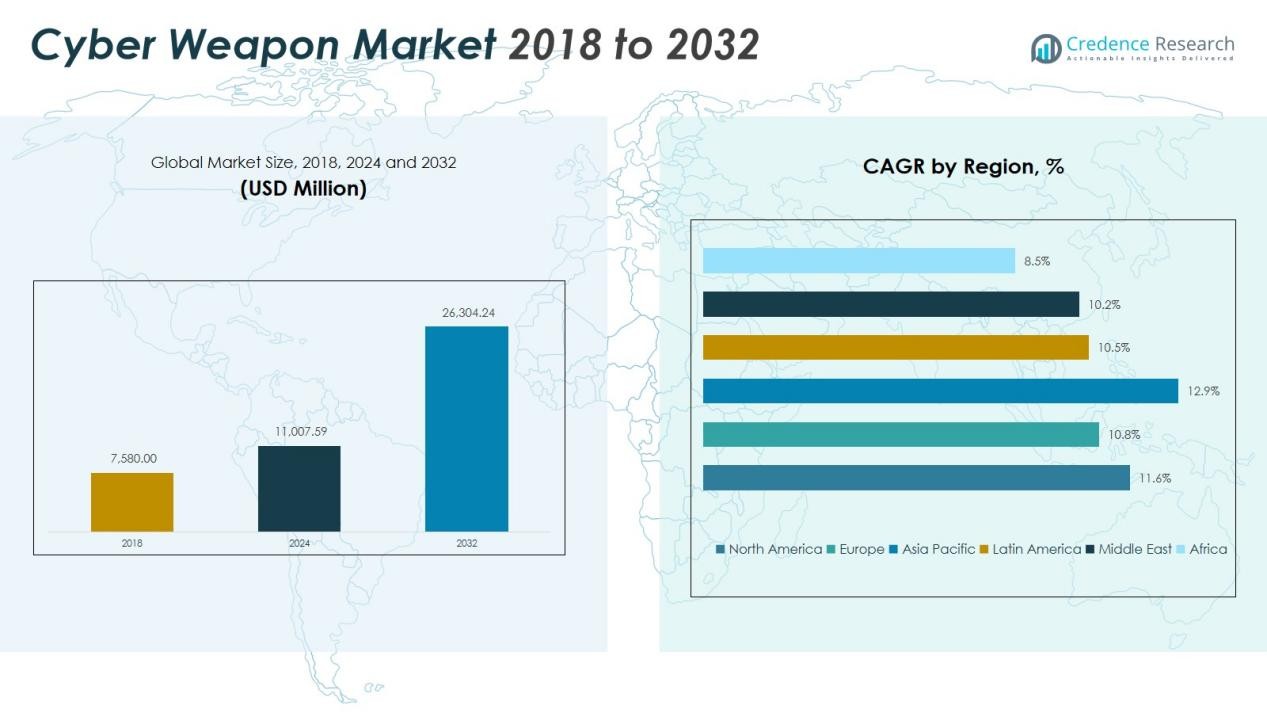
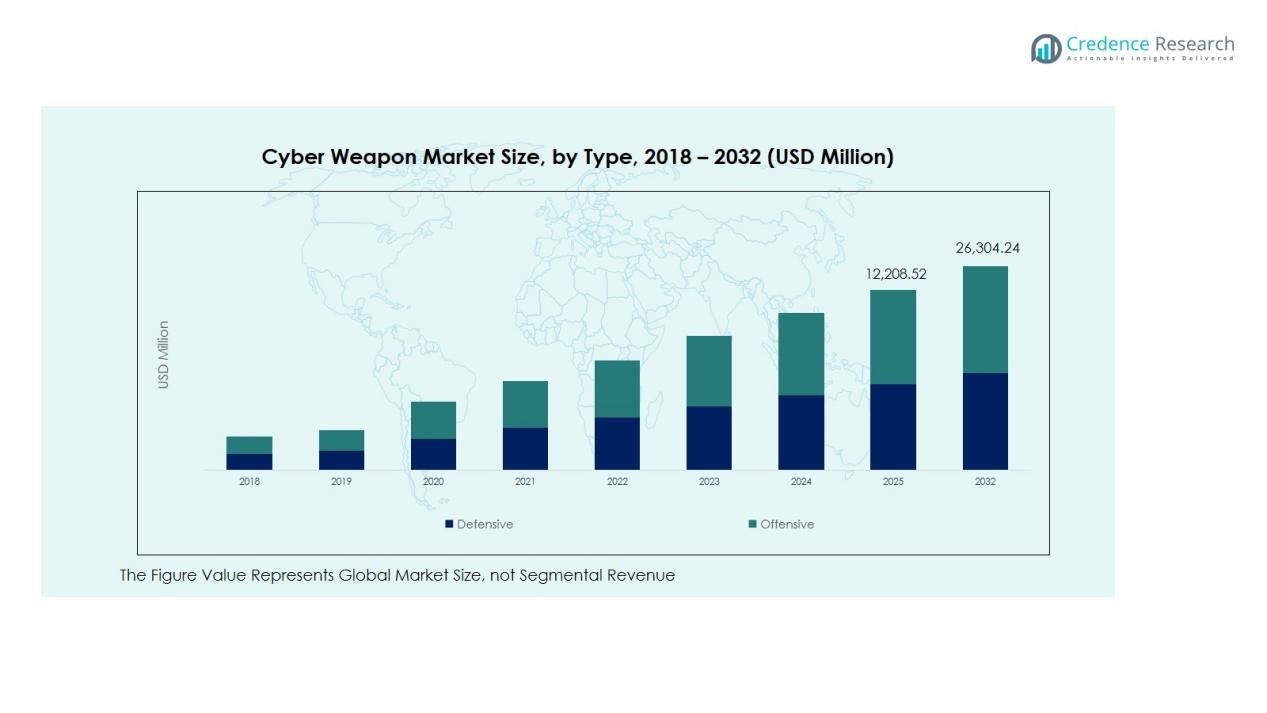
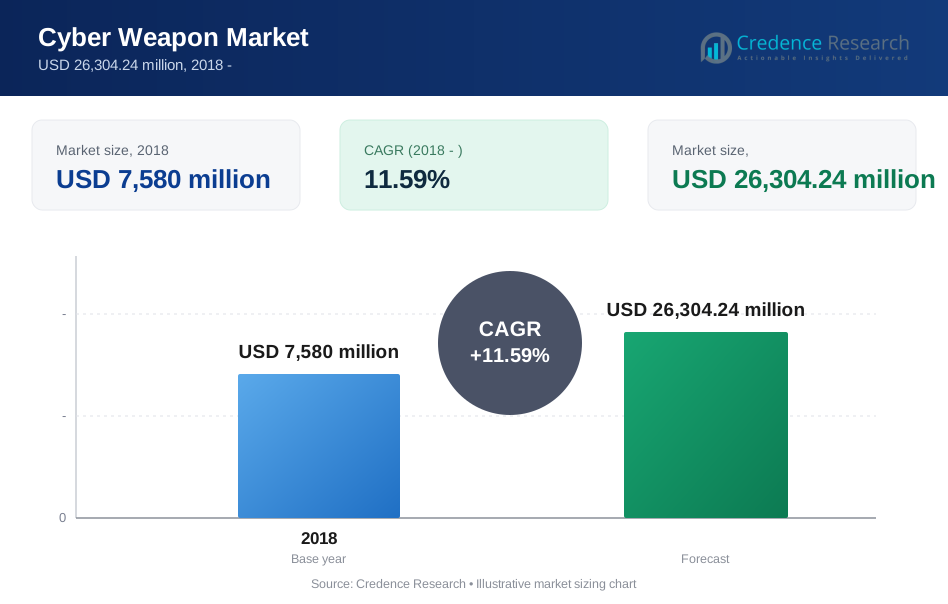
The Global Cyber Weapon Market size was valued at USD 7,580 million in 2018 to USD 11,007.59 million in 2024 and is anticipated to reach USD 26,304.24 million by 2032, at a CAGR of 11.59% during the forecast period.
| REPORT ATTRIBUTE | DETAILS |
|---|---|
| Historical Period | 2020-2023 |
| Base Year | 2024 |
| Forecast Period | 2025-2032 |
| Cyber Weapon Market Size 2024 | USD 11,007.59 Million |
| Cyber Weapon Market, CAGR | 11.59% |
| Cyber Weapon Market Size 2032 | USD 26,304.24 Million |
Key drivers include heightened geopolitical tensions, expanding cyberattack surfaces, and the growing reliance on digital networks for national security and defense operations. Governments and defense agencies are heavily investing in AI-driven threat detection, malware countermeasures, and advanced encryption systems. The proliferation of state-sponsored cyber activities and increasing awareness about cybersecurity resilience are further boosting demand for cyber weapons globally.
Regionally, North America dominates the market due to strong defense infrastructure and high cybersecurity budgets in the U.S. and Canada. Europe follows, supported by robust regulatory frameworks and increased cyber defense collaboration among NATO countries. The Asia-Pacific region is witnessing the fastest growth, driven by expanding military modernization programs, increasing cyber threats, and large-scale digital transformation initiatives across China, India, and Japan.
Market Insights:
- The Global Cyber Weapon Market was valued at USD 7,580 million in 2018, reached USD 11,007.59 million in 2024, and is projected to attain USD 26,304.24 million by 2032, growing at a CAGR of 11.59% during the forecast period.
- North America leads the market with a 34% share due to advanced defense infrastructure, strong cybersecurity budgets, and early adoption of digital warfare systems.
- Europe holds 26% of the share, supported by NATO-led cyber defense programs and strict regulatory frameworks enhancing cybersecurity across key industries.
- Asia Pacific follows with 28% of the market and is the fastest-growing region, driven by military modernization, AI integration, and increasing cyber threats in China, India, Japan, and South Korea.
- By type, defensive cyber weapons account for 58% of total revenue, while offensive cyber weapons represent 42%, reflecting rising global investments in both protection and counterattack capabilities.
Market Drivers:
Rising Geopolitical Tensions and State-Sponsored Cyber Operations
The Global Cyber Weapon Market is expanding due to increasing geopolitical conflicts and cyber espionage campaigns. Governments are deploying offensive and defensive cyber tools to safeguard national interests and disrupt adversary networks. It benefits from growing state-sponsored cyberattacks targeting financial systems, defense infrastructure, and communication networks. Nations are investing heavily in digital warfare capabilities to strengthen deterrence and intelligence gathering. The trend underscores cyber dominance as a critical component of modern defense strategy.
- For instance, Taiwan's government networks faced an average of 2.4 million daily cyberattacks in 2024 attributed to Chinese state-backed hackers, representing a 100% increase from the 1.2 million daily average in 2023, while the country's telecommunications sector experienced a 650% surge in targeted cyberattacks.
Growing Threats to Critical Infrastructure and National Security
The growing vulnerability of power grids, transportation systems, and defense communication networks is accelerating the demand for advanced cyber weapons. It enables governments to prevent, detect, and neutralize cyber intrusions before they escalate. High-profile ransomware and sabotage incidents have prompted countries to adopt proactive cyber defense postures. The development of malware and counter-malware tools supports rapid response mechanisms during crises. Governments are prioritizing cybersecurity funding to ensure resilience against evolving digital threats.
- For instance, the United States allocated more than 100 million dollars in FY2025 grants to bolster state, local, and tribal cybersecurity defenses, including a dedicated 91.7 million for state/local improvements and 12.1 million for tribal initiatives.
Advancements in Artificial Intelligence and Cybersecurity Technologies
Rapid progress in artificial intelligence, machine learning, and behavioral analytics is transforming cyber warfare capabilities. It allows faster detection and prediction of hostile actions in complex digital environments. AI-powered cyber weapons enhance precision, automation, and adaptability during digital conflicts. Defense contractors are integrating autonomous threat assessment tools to minimize human intervention. The growing fusion of AI and cyber technologies continues to shape the next generation of cyber defense systems.
Expansion of Defense Budgets and Strategic Collaborations
Increasing defense expenditure among major economies is fueling the adoption of offensive and defensive cyber tools. It has encouraged joint ventures between technology firms, cybersecurity providers, and government agencies. Collaborative research projects aim to strengthen national and allied cyber resilience. The integration of private-sector innovation enhances capability development and intelligence sharing. Rising defense allocations ensure sustained investments in secure, scalable, and sophisticated cyber weapon systems.
Market Trends:
Integration of Artificial Intelligence and Machine Learning in Cyber Warfare Systems
The Global Cyber Weapon Market is witnessing a strong shift toward AI- and ML-powered cyber defense and offense systems. Advanced algorithms now detect and neutralize threats with greater speed and accuracy than manual methods. It enables autonomous response mechanisms that minimize human error during high-pressure cyber conflicts. Defense organizations are adopting predictive analytics to identify attack patterns and simulate potential threats. AI-driven adaptive malware, self-learning intrusion detection systems, and automated vulnerability scanners are redefining cyber warfare dynamics. Governments and private defense firms are collaborating to develop AI frameworks that strengthen cyber situational awareness and real-time intelligence sharing. These developments reflect a growing preference for intelligent, self-evolving digital defense systems across global security networks.
- For instance, DARPA's AI Cyber Challenge demonstrated that autonomous AI systems identified 77% of 70 synthetic vulnerabilities planted in code and successfully patched 43 of them, with Team Atlanta's winning system processing efficiency costs averaging $152 per task compared to traditional bug bounty costs running into thousands.
Growing Emphasis on Offensive Cyber Capabilities and Cyber Deterrence Strategies
Countries are expanding their offensive cyber capabilities to establish deterrence and strategic dominance in the digital arena. It supports national defense agencies in disrupting enemy infrastructure, espionage channels, and communication networks. Cyber arsenals are now being treated with the same strategic importance as nuclear or conventional weapons. Governments are formalizing doctrines to regulate offensive operations under military command structures. The market is also seeing a rise in ethical hacking units and digital strike forces dedicated to proactive defense. Emerging technologies such as quantum cryptography and blockchain are being explored for secure communication and attack prevention. The trend signals a long-term transformation in how nations define and exercise power in cyberspace.
- For instance, the UK Ministry of Defence announced in May 2025 a new Cyber and Electromagnetic Command with £1 billion in investment, establishing unified command over offensive cyber operations coordinated with the previously established National Cyber Force, with the capability to conduct offensive cyber strikes integrated into the Digital Targeting Web system enabling real-time weapon targeting across platforms.
Market Challenges Analysis:
Regulatory Uncertainty and Ethical Concerns Over Cyber Weapon Deployment
The Global Cyber Weapon Market faces major hurdles due to unclear international regulations and ethical constraints. Countries lack unified frameworks governing the creation and use of offensive digital weapons. It raises concerns about accountability, attribution, and proportional response in cyber conflicts. The absence of global treaties increases risks of misuse and escalation between rival states. Ethical debates on state-sponsored hacking and collateral damage to civilian systems further complicate policy formation. Defense agencies must balance offensive capabilities with legal obligations and public trust. These uncertainties limit transparency and slow down collaborative cybersecurity initiatives.
Rapidly Evolving Threat Landscape and Technology Obsolescence
The constant evolution of malware and attack vectors challenges the long-term effectiveness of cyber weapons. It forces governments and defense firms to upgrade tools continuously to counter new vulnerabilities. Short innovation cycles create high development costs and operational risks. Cyber weapons can quickly lose impact once detected or neutralized by adversaries. Ensuring resilience against zero-day exploits requires significant R&D investments and advanced threat intelligence. Smaller nations and organizations often lack resources to maintain such rapid adaptation. The growing sophistication of hackers continues to pressure defense systems to evolve faster and smarter.
Market Opportunities:
Rising Demand for Advanced Defensive Cyber Capabilities and Intelligence Systems
The Global Cyber Weapon Market presents strong opportunities in developing advanced defensive cyber solutions for governments and enterprises. The growing frequency of ransomware and espionage attacks has increased demand for next-generation firewalls, AI-driven monitoring tools, and real-time intrusion detection systems. It enables continuous protection of critical infrastructure such as defense networks, power grids, and financial institutions. Governments are investing in predictive analytics platforms to identify threats before they occur. The expansion of cyber threat intelligence sharing between allies creates new opportunities for global defense collaboration. Companies offering scalable, automated, and adaptive defense platforms are likely to gain competitive advantage. Rising cybersecurity awareness supports the adoption of hybrid cyber defense systems across both public and private sectors.
Emergence of Cybersecurity-as-a-Service and International Defense Partnerships
The growing shift toward Cybersecurity-as-a-Service models is opening new commercial avenues for defense technology providers. It allows organizations to access advanced protection tools without extensive infrastructure costs. Defense contractors are forming international partnerships to co-develop cyber arsenals and training programs. Emerging economies in Asia-Pacific and the Middle East are investing in sovereign cyber defense ecosystems. Collaborative programs between government and private players encourage innovation in quantum-safe encryption and autonomous cyber response systems. The increasing focus on digital sovereignty and strategic alliances continues to expand market reach. Rising demand for managed cyber defense services creates sustained growth potential for industry leaders.
Market Segmentation Analysis:
By Type
The Global Cyber Weapon Market is segmented into defensive and offensive types. Defensive cyber weapons dominate due to rising demand for threat detection, data protection, and infrastructure security. It plays a vital role in safeguarding national defense systems and private networks from sophisticated attacks. Offensive cyber weapons are gaining traction with governments investing in tactical cyber strike capabilities. Growing geopolitical tensions and digital espionage have increased the use of offensive tools for intelligence and counterattack operations. The balance between these two types reflects the evolving nature of modern cyber warfare.
- For instance, Fortinet's FortiGate 600F next-generation firewall achieved a 99.88% security effectiveness score in independent third-party testing, blocking 100% of client-initiated exploits and evasions while maintaining 10 Gbps of threat protection throughput
By Application
Cyber weapons are increasingly applied in national defensive systems, industrial control systems, communication networks, automated transportation systems, and smart power grids. National defense applications lead the market, driven by continuous investments in cyber resilience. It supports governments in securing classified data and preventing cyber intrusions. Industrial control and communication systems follow closely, with organizations focusing on preventing operational disruptions. The demand for smart power grid protection is expanding due to the integration of IoT and digital energy management platforms.
By End-User
Key end-users include government, defense, BFSI, corporate, and others. Government and defense sectors account for the largest share, driven by ongoing digital modernization of security systems. It benefits from strong funding for cyber intelligence and warfare programs. The BFSI sector also contributes significantly due to the growing need for fraud detection and transaction security. Corporate adoption is accelerating with increased awareness of ransomware and insider threats.
Segmentations:
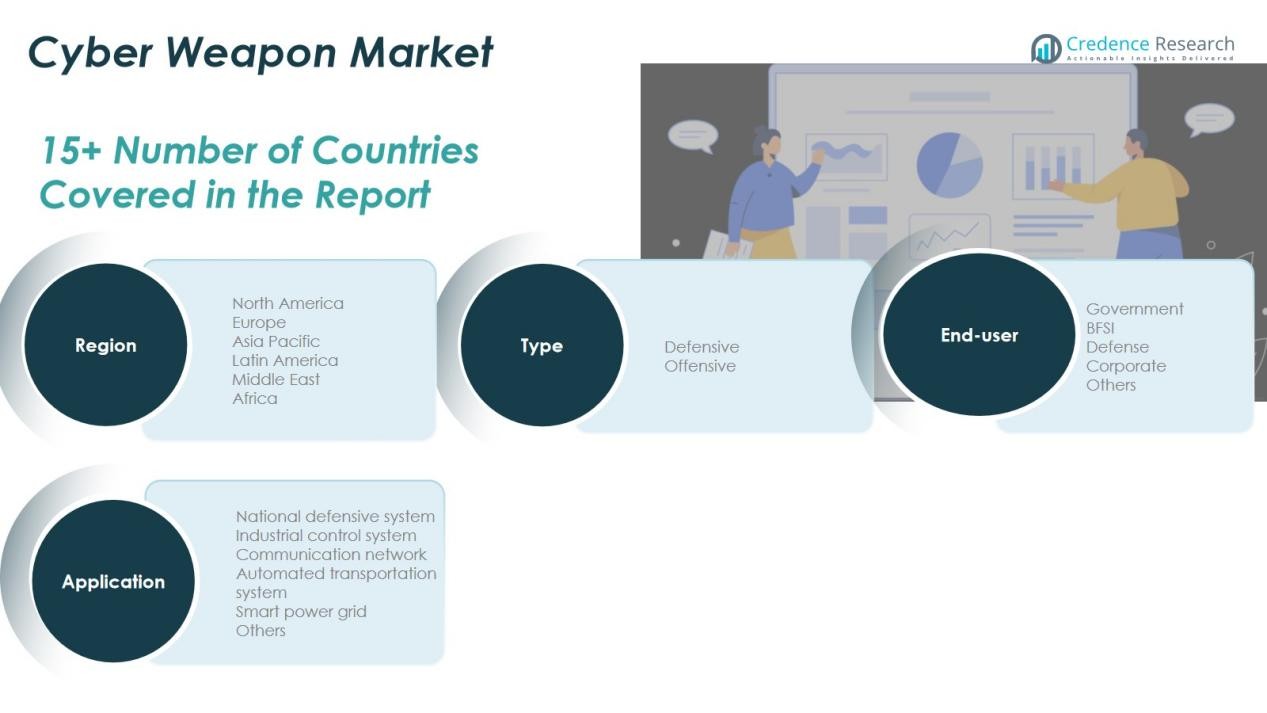
By Type
- Defensive
- Offensive
By Application
- National Defensive System
- Industrial Control System
- Communication Network
- Automated Transportation System
- Smart Power Grid
- Others
By End-User
- Government
- BFSI
- Defense
- Corporate
- Others
By Region
North America
- U.S.
- Canada
- Mexico
- Europe
- U.K.
- France
- Germany
- Italy
- Spain
- Russia
- Rest of Europe
Asia Pacific
- China
- Japan
- South Korea
- India
- Australia
- Southeast Asia
- Rest of Asia Pacific
Latin America
- Brazil
- Argentina
- Rest of Latin America
Middle East
- GCC Countries
- Israel
- Turkey
- Rest of Middle East
Africa
- South Africa
- Egypt
- Rest of Africa
Regional Analysis:
North America
The North America Cyber Weapon Market size was valued at USD 2,922.85 million in 2018 to USD 4,196.03 million in 2024 and is anticipated to reach USD 10,014.07 million by 2032, at a CAGR of 11.6% during the forecast period. North America holds the largest share of the Global Cyber Weapon Market, accounting for over 34% of total revenue. The region benefits from strong defense budgets, advanced cybersecurity infrastructure, and early adoption of digital warfare technologies. It continues to lead in developing offensive and defensive cyber capabilities through major defense contractors and government-backed programs. The U.S. Department of Defense and Homeland Security play critical roles in funding cyber weapon R&D. Growing incidents of ransomware and cyber espionage have increased the focus on national cyber resilience. High investments in AI-based defense systems further strengthen regional market dominance.
Europe
The Europe Cyber Weapon Market size was valued at USD 1,872.26 million in 2018 to USD 2,606.30 million in 2024 and is anticipated to reach USD 5,859.34 million by 2032, at a CAGR of 10.8% during the forecast period. Europe accounts for around 26% of the market share, driven by rising digital threats and increasing cooperation among NATO members. The region emphasizes cyber defense modernization to protect energy, transportation, and communication networks. It benefits from coordinated efforts by the European Union to strengthen collective cybersecurity frameworks. Countries such as the U.K., Germany, and France invest heavily in military-grade cyber intelligence programs. The region’s focus on regulatory compliance, such as GDPR, enhances the need for secure digital ecosystems. Expansion of national cyber command centers supports continuous growth.
Asia Pacific
The Asia Pacific Cyber Weapon Market size was valued at USD 1,925.32 million in 2018 to USD 2,915.31 million in 2024 and is anticipated to reach USD 7,662.45 million by 2032, at a CAGR of 12.9% during the forecast period. Asia Pacific holds a 28% market share and is the fastest-growing regional segment. Rapid digital transformation, rising geopolitical tensions, and large-scale defense modernization projects drive regional demand. It experiences strong government initiatives in China, India, Japan, and South Korea aimed at developing indigenous cyber defense programs. Increasing cyberattacks targeting government and corporate systems have accelerated investments in advanced threat detection tools. The region’s expanding IT infrastructure and growing reliance on smart technologies create a wide attack surface. Continuous innovation in AI-based cyber solutions enhances regional competitiveness.
Latin America
The Latin America Cyber Weapon Market size was valued at USD 439.64 million in 2018 to USD 631.73 million in 2024 and is anticipated to reach USD 1,390.70 million by 2032, at a CAGR of 10.5% during the forecast period. Latin America accounts for nearly 6% of the market share, supported by gradual digitalization across public and private sectors. The region faces growing threats to banking networks and government institutions, pushing adoption of cybersecurity defense tools. It benefits from rising regional cooperation and international cybersecurity partnerships. Countries like Brazil and Mexico are enhancing national cyber capabilities through policy reforms and training programs. The demand for managed security services is expanding as organizations seek affordable defense solutions. Local technology start-ups are emerging to provide specialized digital threat management tools.
Middle East
The Middle East Cyber Weapon Market size was valued at USD 294.86 million in 2018 to USD 401.71 million in 2024 and is anticipated to reach USD 868.18 million by 2032, at a CAGR of 10.2% during the forecast period. The region contributes about 4% of total market revenue, fueled by rising investment in critical infrastructure protection. Governments are adopting cyber defense strategies to secure energy grids, defense networks, and financial systems. It benefits from the establishment of national cybersecurity agencies and regional alliances focused on digital resilience. Countries such as Israel, Saudi Arabia, and the UAE lead in adopting advanced cyber technologies. The growth of smart city projects has further raised the need for network protection. The region’s focus on cybersecurity awareness and digital governance supports steady expansion.
Africa
The Africa Cyber Weapon Market size was valued at USD 125.07 million in 2018 to USD 256.52 million in 2024 and is anticipated to reach USD 509.49 million by 2032, at a CAGR of 8.5% during the forecast period. Africa holds approximately 2% of the market share, reflecting early-stage adoption of cyber defense infrastructure. Growing internet penetration and digital banking have increased exposure to cyber threats. It is witnessing government-led initiatives to strengthen cybersecurity policies and public awareness. Countries such as South Africa and Egypt are leading regional investments in network defense and digital monitoring. Limited technical expertise and budget constraints remain key challenges. International collaboration and capacity-building programs are supporting gradual development across the region.
Key Player Analysis:
- A.E. Systems (U.K.)
- Airbus S.A.S (Netherlands)
- FireEye, Inc. (U.S.)
- Broadcom (U.S.)
- Northrop Grumman (U.S.)
- Avast Software (Czech Republic)
- Boeing (U.S.)
- Kaspersky Lab (Russia)
- Cisco Systems (U.S.)
- McAfee L.L.C. (U.S.)
- Lockheed Martin Corporation (U.S.)
Competitive Analysis:
The Global Cyber Weapon Market is highly competitive with several leading defense and cybersecurity companies developing advanced digital warfare solutions. Major players include B.A.E. Systems (U.K.), Airbus S.A.S (Netherlands), FireEye, Inc. (U.S.), Broadcom (U.S.), Northrop Grumman (U.S.), Avast Software (Czech Republic), and Boeing (U.S.). It is characterized by continuous innovation, heavy R&D investment, and strategic collaborations with government defense agencies. Companies focus on expanding AI-driven threat detection, encryption technologies, and offensive cyber capabilities. Partnerships between defense contractors and technology firms are increasing to enhance operational readiness and digital intelligence. Strong emphasis on national security projects supports long-term contracts and recurring revenue streams. The competition centers on developing scalable, secure, and adaptive cyber platforms capable of neutralizing advanced digital threats.
Recent Developments:
- In August 2025, B.A.E. Systems announced a strategic investment in Oxford Dynamics, a UK-based AI start-up, to enhance its defense capabilities through advanced artificial intelligence and data analytics for rapid deployment across air, land, sea, space, and cyber domains.
- In July 2025, Airbus marked 25 years as an integrated company, highlighting its continued evolution and integration of various business lines under the Airbus umbrella, with ongoing strategic focus on aerospace innovation and global expansion.
Report Coverage:
The research report offers an in-depth analysis based on Type, Application, End-User and Region. It details leading market players, providing an overview of their business, product offerings, investments, revenue streams, and key applications. Additionally, the report includes insights into the competitive environment, SWOT analysis, current market trends, as well as the primary drivers and constraints. Furthermore, it discusses various factors that have driven market expansion in recent years. The report also explores market dynamics, regulatory scenarios, and technological advancements that are shaping the industry. It assesses the impact of external factors and global economic changes on market growth. Lastly, it provides strategic recommendations for new entrants and established companies to navigate the complexities of the market.
Future Outlook:
- The Global Cyber Weapon Market will experience strong growth driven by rising digital warfare threats and geopolitical rivalries.
- Governments will increase investments in AI-powered and quantum-resistant cyber defense systems.
- Integration of autonomous technologies will enhance real-time threat detection and countermeasure precision.
- Defense agencies will prioritize the development of indigenous cyber weapon programs for strategic independence.
- Collaborations between defense contractors and private cybersecurity firms will expand global innovation networks.
- Cyber deterrence strategies will become a central part of national defense doctrines.
- Cloud security and data protection solutions will gain prominence across critical infrastructure sectors.
- Emerging economies will strengthen their cyber capabilities through public–private partnerships and global alliances.
- Ethical and regulatory frameworks will evolve to balance national security needs with international law.
- Continuous technological advancements will redefine digital warfare and sustain long-term market opportunities.
Request a Free Sample
Fill in your details and we'll send you a free sample report.
- Sample data tables & charts
- Research methodology
Need a Custom Version of This Report?
Tailor the scope, geography, or segments to your exact requirements.
- Custom geography or segment scope
- Direct access to our analyst team
Frequently Asked Questions
What is the current market size for the Global Cyber Weapon Market, and what is its projected size in 2032?
At what Compound Annual Growth Rate is the Global Cyber Weapon Market projected to grow between 2024 and 2032?
Which Global Cyber Weapon Market segment held the largest share in 2024?
What are the primary factors fueling the growth of the Global Cyber Weapon Market?
Who are the leading companies in the Global Cyber Weapon Market?
Which region commanded the largest share of the Global Cyber Weapon Market in 2024?
Table of Content
Chapter 1. Report Introduction
- 1.1 Report Description & Purpose
- 1.1.1 Report Title & Market Definition
- 1.1.2 Unique Selling Propositions (USP) & Key Differentiators
- 1.1.3 Value Proposition for Stakeholders
- 1.2 Research Objectives
- 1.2.1 Market Sizing Objectives (Volume & Revenue)
- 1.2.2 Segmentation Objectives
- 1.2.3 Competitive Intelligence Objectives
- 1.2.4 Forecast & Scenario Objectives
- 1.3 Report Scope
- 1.3.1 Cyber Weapon Scope – Types & Subtypes Covered
- 1.3.2 Geographic Scope – Regions & Countries Covered
- 1.3.3 Historical Period, Base Year & Forecast Period (2018; forecast to the forecast period)
- 1.3.4 Inclusions & Exclusions
- 1.4 HS Code & Classification Framework
- 1.5 Currency, Units & Pricing Basis
- 1.6 Target Stakeholders
- 1.7 Limitations & Assumptions
Chapter 2. Executive Summary
- 2.1 Global Cyber Weapon Market Snapshot
- 2.1.1 Market Size – Historical (2018) & Forecast (the forecast period) (2018: USD 7,580 million → forecast year: USD 26,304.24 million)
- 2.1.2 Volume & Revenue – Global Totals
- 2.1.3 Key Market Highlights – Top Five Facts
- 2.2 Cyber Weapon Market Segmentation Snapshot
- 2.2.1 Market Split by Region – 2018 vs.
- 2.3 Competitive Snapshot
- 2.3.1 Top 10 Players by Revenue Share – 2018
- 2.3.2 Top 10 Players by Volume Share – 2018
- 2.3.3 Recent Strategic Developments (18-Month Summary)
- 2.4 Key Investment Highlights & Strategic Conclusions
Chapter 3. Cyber Weapon Market Dynamics & Industry Analysis
- 3.1 Market Overview & Context
- 3.1.1 Cyber Weapon Market Position in the Broader Automotive Value Chain
- 3.1.2 OEM vs. Replacement Market Dynamics
- 3.1.3 Market Maturity & Development Stage by Region
- 3.2 Cyber Weapon Market Drivers
- 3.3 Cyber Weapon Market Restraints & Challenges
- 3.4 Cyber Weapon Market Opportunities
- 3.5 Porter's Five Forces Analysis
- 3.5.1 Threat of New Entrants
- 3.5.2 Bargaining Power of Suppliers
- 3.5.3 Bargaining Power of Buyers
- 3.5.4 Threat of Substitutes
- 3.5.5 Competitive Rivalry – Intensity Assessment
- 3.6 Cyber Weapon Value Chain Analysis
- 3.6.1 Upstream – Raw Material/Input Suppliers
- 3.6.1.1 Raw Material/Input 1
- 3.6.1.2 Raw Material/Input 2
- 3.6.1.3 Raw Material/Input 3
- 3.6.2 Midstream – Production/Manufacturing/Service Delivery
- 3.6.2.1 Production/Process Overview
- 3.6.2.2 Key Facility Locations & Capacity by Manufacturer
- 3.6.3 Downstream – Distribution & End Consumer
- 3.6.3.1 Primary Channel – B2B/OEM
- 3.6.3.2 Secondary Channels – Dealer, Retail, Online, Direct
- 3.6.4 Value Chain Profitability Analysis
- 3.6.1 Upstream – Raw Material/Input Suppliers
- 3.7 PESTEL Analysis
- 3.7.1 Political Factors
- 3.7.2 Economic Factors
- 3.7.3 Social Factors
- 3.7.4 Technological Factors
- 3.7.5 Environmental Factors
- 3.7.6 Legal Factors
- 3.8 Cyber Weapon Supply Chain Analysis
- 3.8.1 Raw Material/Input Supply Risk Assessment
- 3.8.2 Manufacturing Concentration Risk (Geographic Exposure)
- 3.8.3 Trade Disruption Impact Analysis
- 3.9 Regulatory & Policy Landscape
Note: The regulatory and policy landscape section covers regulations based on their applicability to the market, Cyber Weapon category, geography, and scope of the study. Only regulatory frameworks with a material impact on operations, compliance, trade, sustainability, or market access are analyzed in detail.
Chapter 4. Key Investment Pockets & Opportunity Analysis
- 4.1 Cyber Weapon Market Attractiveness Analysis
- 4.1.1 By Region – Investment Attractiveness Matrix (Volume × CAGR)
- 4.2 Absolute Revenue Growth Opportunity
- 4.2.1 By Region – Absolute USD Growth Through the forecast period
- 4.3 Incremental Volume Opportunity
- 4.3.1 By Region – Incremental Volume Through the forecast period
- 4.3.2 Segment – Incremental Volume
- 4.4 Emerging Submarket Opportunity Deep Dive (Subject to Applicability)
- 4.5 Emerging Market Opportunity Scorecards
- 4.5.1 United States
- 4.5.2 Europe
- 4.5.3 Asia
- 4.5.4 Middle East & Africa
Note: Emerging Market Opportunity Scorecards will be included based on relevance and strategic importance. Regions listed are indicative and may vary depending on data availability and market dynamics.
Chapter 5. Cyber Weapon Import-Export Analysis & Trade Flows
- 5.1 Global Trade Overview
- 5.1.1 Global Export Value by Country (2018)
- 5.1.2 Global Export Volume by Country (2018)
- 5.1.3 Global Import Value by Country (2018)
- 5.1.4 Global Import Volume by Country (2018)
- 5.1.5 Net Trade Balance by Country (2018)
- 5.2 Export Analysis – Segment
- 5.2.1 Type 1 (HS Code)
- 5.2.2 Type 2 (HS Code)
- 5.2.3 Type 3 (HS Code)
- 5.2.4 Type 4 (HS Code)
- 5.2.5 Type 5 (HS Code)
- 5.3 Import Analysis – Segment
- 5.3.1 Type 1 (HS Code)
- 5.3.2 Type 2 (HS Code)
- 5.3.3 Type 3 (HS Code)
- 5.3.4 Type 4 (HS Code)
- 5.3.5 Type 5 (HS Code)
- 5.4 Average Unit Trade Prices
- 5.4.1 Average Export Price – Segment & Country
- 5.4.2 Average Import Price – Segment & Source Country
- 5.4.3 Price Trends (2018)
- 5.5 Key Trade Route Analysis
- 5.5.1 Trade Route 1
- 5.5.2 Trade Route 2
- 5.5.3 Trade Route 3
- 5.5.4 Trade Route 4
- 5.5.5 Trade Route 5
- 5.6 Trade Policy Impact Assessment
- 5.6.1 US Anti-Dumping & Section 301 Tariffs
- 5.6.2 EU Customs Union Impact
- 5.6.3 Major Free Trade Agreements
- 5.6.4 USMCA Rules of Origin
Note: Trade policy analysis will be included only where relevant to the Cyber Weapon market.
Chapter 6. Competitive Landscape & Company Benchmarking
- 6.1 Cyber Weapon Market Concentration & Structure
- 6.1.1 Herfindahl-Hirschman Index (HHI) – vs. 2018
- 6.1.2 Tier 1, Tier 2 & Tier 3 Market Structure
- 6.1.3 Global, Regional & Local Player Dynamics
- 6.2 Cyber Weapon Market Share Analysis – 2018
- 6.2.1 Global Revenue Share by Company
- 6.2.2 Global Volume Share by Company
- 6.2.3 Regional Revenue Share
- 6.2.4 Market Share Evolution ( vs. 2018)
- 6.2.5 OEM Segment Share by Company
- 6.2.6 Replacement Segment Share by Company
- 6.3 Production/Delivery Capacity & Facility Analysis
- 6.3.1 Global Installed Capacity
- 6.3.2 Capacity Utilization Rates
- 6.3.3 Production/Output Volume
- 6.3.4 Facility Locations & Capacity Map
- 6.3.5 Planned Capacity Additions
- 6.4 Cyber Weapon Competitive Benchmarking Matrix
- 6.4.1 Revenue, Volume, CAGR & Profitability Comparison
- 6.4.2 Channel Revenue Mix
- 6.4.3 Geographic Revenue Exposure
- 6.4.4 R&D Intensity
- 6.4.5 Sustainability Maturity
- 6.5 Strategic Developments in Cyber Weapon (Last 24 Months)
- 6.5.1 Mergers, Acquisitions & Divestments
- 6.5.2 New Cyber Weapon Launches
- 6.5.3 Facility Expansions
- 6.5.4 Strategic Alliances, Joint Ventures & Partnerships
- 6.5.5 Distribution Expansion & Market Entry
- 6.5.6 Sustainability & ESG Initiatives
- 6.6 Competitive Strategy Mapping
- 6.6.1 Leader, Challenger, Follower & Niche Classification
- 6.6.2 Pricing Strategy Comparison
- 6.6.3 Channel Strategy Matrix
Note: Strategic developments are included based on their materiality and the availability of reliable information.
Chapter 7. Global Cyber Weapon Market – By Distribution Channel
- 7.1 Segment Overview
- 7.1.1 Volume & Revenue Split by Channel (2018 & )
- 7.1.2 Channel Mix Evolution (the forecast period)
Chapter 8. Regional Market Analysis – Global Overview
- 8.1 Global Regional Overview
- 8.1.1 Regional Volume Share
- 8.1.2 Regional Revenue Share
- 8.1.3 Regional Volume by Region
- 8.1.4 Regional Revenue by Region
- 8.1.5 Regional Forecast Through the forecast period
- 8.2 Cross-Regional Segment Analysis
- 8.2.1 By Distribution Channel
- 8.2.2 By Brand/Price Tier
Chapter 9. North America Cyber Weapon Market
- 9.1 United States
- 9.2 Canada
- 9.3 Mexico
Chapter 10. Europe Cyber Weapon Market
- 10.1 Germany
- 10.2 France
- 10.3 Italy
- 10.4 United Kingdom
- 10.5 Spain
- 10.6 Poland
- 10.7 Russia
- 10.8 Netherlands
- 10.9 Belgium
- 10.10 Sweden
- 10.11 Denmark
- 10.12 Norway
- 10.13 Rest of Europe
Chapter 11. Asia Pacific Cyber Weapon Market
- 11.1 China
- 11.2 India
- 11.3 Japan
- 11.4 South Korea
- 11.5 Thailand
- 11.6 Indonesia
- 11.7 Vietnam
- 11.8 Malaysia
- 11.9 Australia
- 11.10 Rest of Asia Pacific
Chapter 12. Latin America Cyber Weapon Market
- 12.1 Brazil
- 12.2 Argentina
- 12.3 Colombia
- 12.4 Chile
- 12.5 Rest of Latin America
Chapter 13. Middle East Cyber Weapon Market
- 13.1 Saudi Arabia
- 13.2 United Arab Emirates
- 13.3 Turkey
- 13.4 Israel
- 13.5 Iran
- 13.6 Rest of the Middle East
Chapter 14. Africa Cyber Weapon Market
- 14.1 South Africa
- 14.2 Egypt
- 14.3 Nigeria
- 14.4 Morocco
- 14.5 Rest of Africa
Chapter 15. Cyber Weapon Company Profiles
- 15.1 [Company 01]
- 15.1.1 Company Overview
- 15.1.2 Key Management Personnel
- 15.1.3 Products & Services Portfolio
- 15.1.4 Financial Performance
- 15.1.5 Key Market Focus & Geographic Presence
- 15.1.6 Recent Developments & Strategic Initiatives
Note: The company profile list is preliminary and may change based on research findings, market developments, data availability, and client requirements.
Chapter 16. Appendices
- Appendix A – List of Abbreviations & Acronyms
- Appendix B – Industry Classification Code Reference – Full Series
- Appendix C – Production & Capacity Data Tables
- Appendix D – End-Use & Demand Base Tables
- Appendix E – Consumption & Replacement Rate Assumptions
- Appendix F – ASP Reference Tables
- Appendix G – Manufacturing & Facility Database
- Appendix H – Import-Export Data Tables
- Appendix I – Regulatory Summary Tables
- Appendix J – Primary Research Participant List (Anonymized)
- Appendix K – Primary Research Questionnaire Framework
- Appendix L – Data Sources & Bibliography
- Appendix M – Market Size Divergence & Source Comparison
Chapter 17. Research Methodology
- 17.1 Research Framework & Philosophy
- 17.2 Secondary Research – Sources, Hierarchy & Data Extraction
- 17.3 Data Modeling – Bottom-Up & Top-Down Market Sizing
- 17.4 Primary Research – Stakeholder Framework, LOI & Sample Sizes
- 17.5 Forecast Methodology – Regression, Scenario & Sensitivity Analysis
- 17.6 Quality Control – Four-Layer Validation Framework
- 17.7 Limitations & Standard Assumptions
- 17.8 Disclaimer
