
| REPORT ATTRIBUTE | DETAILS |
|---|---|
| Historical Period | 2020-2023 |
| Base Year | 2024 |
| Forecast Period | 2025-2032 |
| Sclareolide Market Size 2024 | USD 64.27 million |
| Sclareolide Market, CAGR | 6.71% |
| Sclareolide Market Size 2032 | USD 107.79 million |
Market Overview
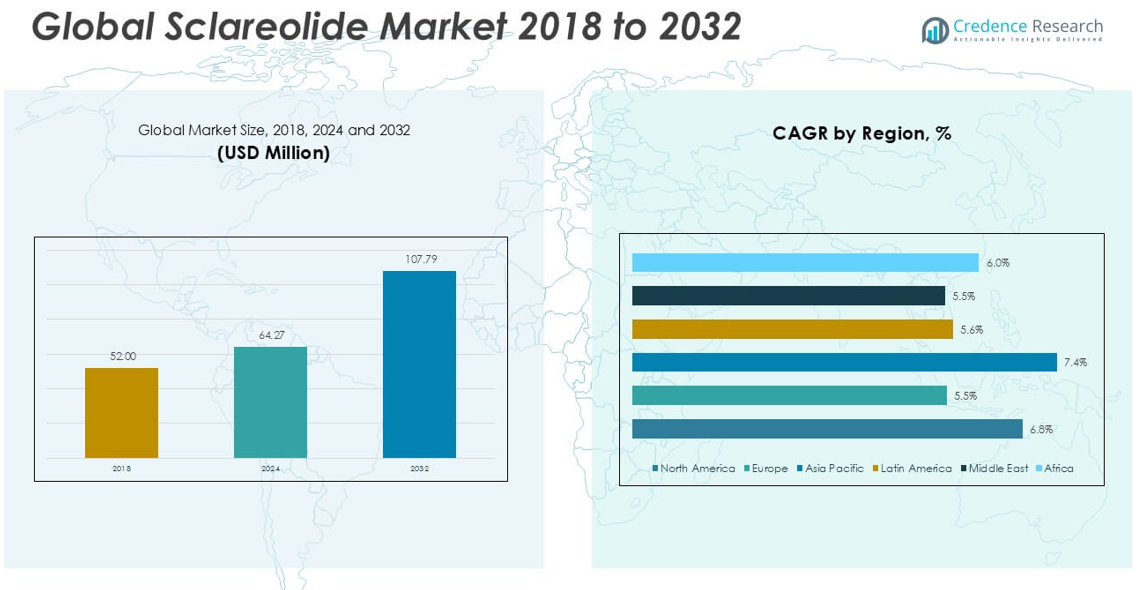
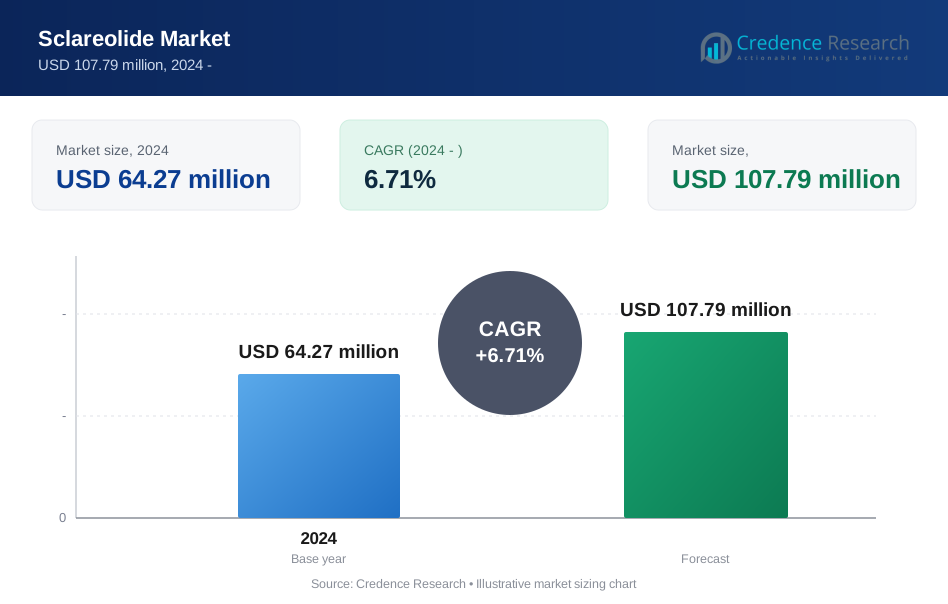
The Global Sclareolide Market is projected to grow from USD 64.27 million in 2024 to an estimated USD 107.79 million by 2032, with a compound annual growth rate (CAGR) of 6.71% from 2025 to 2032.
Key drivers fueling the market include the increasing consumer preference for natural products in the personal care and food sectors, coupled with the expanding use of sclareolide as a fixative in perfumes and as a flavoring agent. Rising awareness of health and wellness trends is also driving the incorporation of sclareolide in weight management supplements. Additionally, the market is witnessing a trend toward cleaner labeling and plant-derived ingredients, further accelerating demand. Advancements in extraction technologies and improved supply chain efficiencies are enhancing product availability and quality, supporting overall market growth.
Geographically, North America holds a significant share of the global sclareolide market due to the strong presence of the cosmetics and dietary supplement industries. Europe follows closely, driven by stringent regulations favoring natural ingredients. The Asia-Pacific region is expected to witness the fastest growth over the forecast period, attributed to increasing consumer awareness and expanding industrial applications. Key players operating in this market include Firmenich, Avoca Inc., Xi’an Sonwu Biotech Co. Ltd., Capot Chemical Co. Ltd., and Wuhan Dahua Weiye Pharmaceutical Co. Ltd.
Market Insights
- The Global Sclareolide Market is set to grow from USD 64.27 million in 2024 to USD 107.79 million by 2032, with a CAGR of 6.71% from 2025 to 2032.
- Increasing demand for natural, plant-based ingredients across cosmetics, food, and health products is driving market expansion.
- Rising adoption of sclareolide in weight management supplements supports growth in the health and wellness sector.
- Advancements in extraction technologies and cleaner labeling trends enhance product acceptance and availability.
- Limited raw material availability and supply chain challenges may restrict consistent production and pricing stability.
- North America and Europe dominate the market due to their strong personal care industries and preference for natural products.
- Asia Pacific is projected to witness the fastest growth, supported by increasing consumer awareness and expanding industrial applications.
Market Drivers
Growing Demand for Natural Ingredients in Personal Care and Cosmetics Drives Market Growth
The Global Sclareolide Market benefits significantly from the rising consumer preference for natural and plant-based ingredients in personal care and cosmetics. Brands are focusing on replacing synthetic components with bio-based alternatives to meet clean-label demands. Sclareolide’s natural origin and its role as a fragrance enhancer make it an attractive choice for manufacturers. It is widely used in perfumes and skincare products due to its fixative properties and compatibility with natural formulations. Companies in the cosmetics sector are launching new product lines featuring sclareolide to align with consumer expectations. This strong market movement toward natural solutions is expected to continue supporting the growth of the Global Sclareolide Market.
- For instance, the cosmetics segment is the largest application area for sclareolide, with global consumption estimated in the hundreds of millions of units, reflecting its widespread use as a natural fragrance and skincare ingredient.
Expanding Use of Sclareolide in the Food and Beverage Industry Supports Market Advancement
The use of sclareolide in the food and beverage industry is steadily increasing due to its role as a flavoring agent and its potential functional benefits. It enhances the sensory profile of products, making it valuable for food manufacturers aiming to improve taste and aroma. The Global Sclareolide Market benefits from the rising production of flavored beverages, confectionery, and specialty foods where sclareolide provides a unique advantage. Consumers are becoming more interested in foods with natural flavorings, creating new opportunities for product development. This rising demand in the food sector further strengthens the market’s expansion and encourages innovation.
- For instance, sclareolide is now used in the formulation of thousands of food and beverage products globally, as manufacturers seek to capitalize on consumer demand for natural flavoring agents
Rising Interest in Weight Management Solutions Stimulates Sclareolide Adoption
The Global Sclareolide Market is experiencing growth from the increasing focus on weight management products. Sclareolide is gaining attention for its potential role in supporting body weight regulation, which is becoming a key selling point for health supplement brands. It is being incorporated into dietary supplements that target metabolism enhancement and fat reduction. Consumer demand for natural weight management alternatives is pushing manufacturers to explore sclareolide-based formulations. This growing segment continues to attract investment and product development, strengthening the market’s position across the health and wellness industry.
Technological Improvements in Extraction and Processing Enhance Product Availability
The Global Sclareolide Market is advancing due to improvements in extraction and processing technologies that increase yield and purity. Efficient extraction methods are making it easier to obtain sclareolide from natural sources without compromising quality. These advancements reduce production costs and ensure a more stable supply chain, which supports manufacturers in meeting rising global demand. Companies are investing in research to refine extraction processes and improve scalability. Reliable sourcing and consistent quality are essential factors driving long-term growth and competitive differentiation in the market. This steady technological progress ensures that the Global Sclareolide Market can meet the evolving needs of various industries.
Market Trends
Increasing Preference for Plant-Derived Fragrance Ingredients Shapes Market Trends
The Global Sclareolide Market is seeing a rising trend toward the use of plant-derived fragrance ingredients in the cosmetics and personal care sector. Consumers are showing greater interest in natural and sustainable products, prompting manufacturers to reformulate their offerings. It is gaining popularity for its natural fixative properties and subtle fragrance profile that blend well with essential oils. Brands are launching new product lines that highlight natural ingredients, including sclareolide, to attract health-conscious buyers. The shift toward transparency in labeling and sourcing further supports this movement. This growing preference for botanical ingredients continues to shape product development strategies within the market.
- For instance, sclareolide products—primarily used as fragrance fixatives—were produced and sold in the hundreds of millions of units globally in 2025, with the cosmetics industry accounting for the largest share of end use
Product Innovation Driven by Clean-Label and Functional Food Demands
The Global Sclareolide Market is influenced by the growing demand for clean-label and functional food products. Food manufacturers are introducing products that use sclareolide for both flavor enhancement and potential health benefits. It is being adopted in product formulations that meet consumer demand for recognizable, plant-based ingredients. Companies are focusing on launching new flavors and formulations that align with wellness trends. Functional beverages, dietary supplements, and health-focused snacks are emerging as key application areas. This focus on innovation is creating new pathways for market growth and product diversification.
- For instance, more than 65 out of every 100 consumers are willing to pay a higher price for food products with clean-label ingredients, directly influencing the adoption of plant-based additives like sclareolide in new product launches
Rising Application in Weight Management Supplements Gains Market Attention
The Global Sclareolide Market is following a growing trend in the weight management sector, where consumers are seeking natural alternatives to traditional fat-burning ingredients. Sclareolide is being used in formulations that support metabolism and body composition management. It is becoming a key ingredient in dietary supplements targeting consumers interested in natural health solutions. The demand for plant-derived weight control products is expanding across both developed and emerging markets. Product launches in this category are focusing on natral efficacy and minimal side effects. This ongoing trend is expected to remain a strong driver for market interest and investment.
Sustainable Sourcing and Eco-Friendly Production Gain Strong Industry Focus
The Global Sclareolide Market is showing a clear shift toward sustainable sourcing and eco-friendly production practices. Companies are prioritizing ethical sourcing and improved supply chain traceability to meet environmental expectations. It is benefiting from increased investment in sustainable extraction methods that minimize resource consumption. The industry is focusing on reducing environmental impact while maintaining product quality and scalability. Consumer awareness about sustainability is influencing purchasing decisions across key regions. This heightened focus on green practices is shaping long-term strategies and competitive positioning within the market.
Market Challenges
Limited Raw Material Availability and Supply Chain Constraints Impact Market Stability
The Global Sclareolide Market faces challenges related to the limited availability of raw materials and supply chain disruptions. Sclareolide is primarily derived from clary sage, which requires specific climatic conditions and controlled cultivation practices. It depends on agricultural yields that can fluctuate due to weather patterns and farming limitations. Seasonal variations and limited cultivation areas can restrict raw material supply and create sourcing difficulties for manufacturers. Supply chain inefficiencies and transportation delays further complicate product availability. These constraints can lead to inconsistent pricing and hinder manufacturers from meeting growing global demand.
- For instance, global sclareolide sales reached over 5,000 kilograms per month from a single major Chinese supplier in 2025, highlighting both the scale of industrial demand and the reliance on a limited number of high-volume producers
Regulatory Compliance and Quality Standard Requirements Create Entry Barriers
The Global Sclareolide Market encounters significant hurdles in meeting strict regulatory standards and quality requirements across different regions. Companies must comply with food safety, cosmetic, and pharmaceutical regulations that vary by country. It must pass rigorous testing to ensure product safety, consistency, and traceability. Failure to meet regulatory benchmarks can delay product approvals and limit market entry. Small and medium-sized companies may find it difficult to navigate complex registration processes and manage high compliance costs. These regulatory barriers can slow market expansion and limit opportunities for new entrants.
Market Opportunities
Expanding Consumer Demand for Natural and Functional Products Creates Growth Opportunities
The Global Sclareolide Market holds strong growth potential due to the increasing consumer demand for natural, plant-based, and functional products. It can meet the needs of health-conscious consumers who prefer ingredients with both sensory and potential wellness benefits. Rising interest in natural weight management solutions, clean-label cosmetics, and plant-derived flavorings presents new avenues for product development. Companies can explore innovative formulations that integrate sclareolide into emerging health and beauty trends. Growing awareness of the benefits of botanical ingredients provides a supportive market environment. This consumer-driven demand opens new opportunities for manufacturers to diversify applications across multiple industries.
Rising Investment in Sustainable Extraction and Advanced Processing Supports Market Expansion
The Global Sclareolide Market is positioned to benefit from increasing investments in sustainable sourcing and advanced processing technologies. Companies can focus on developing eco-friendly extraction methods that improve yield and ensure long-term resource availability. It can gain wider acceptance through sustainable production practices that align with global environmental goals. Opportunities exist for manufacturers to differentiate by offering certified sustainable and high-purity sclareolide. Advancements in processing can also improve supply chain efficiency and reduce production costs. These improvements create favorable conditions for market growth and long-term competitiveness.
Market Segmentation Analysis
By Type
The Global Sclareolide Market is segmented into Natural, Synthetic, and Others. The natural segment holds a significant share due to strong consumer preference for plant-derived ingredients. It is widely used in cosmetics and food applications, supported by the growing demand for clean-label products. Synthetic sclareolide offers cost advantages and consistent supply, making it attractive for large-scale manufacturers. Some companies prefer synthetic options to manage pricing and supply chain challenges. The Others segment, which includes blended or alternative formulations, serves niche applications and specialized industries. Each type presents distinct advantages, enabling manufacturers to target diverse market needs.
- For instance, industry data shows that global sclareolide consumption reached hundreds of millions of units in 2025, with the natural and synthetic segments together accounting for the majority of this volume, and the Others segment serving specialized demand
By Application
The Global Sclareolide Market is divided into Cosmetics, Tobacco, Beverage, and Others based on application. Cosmetics is the leading segment, driven by the widespread use of sclareolide in perfumes and skincare products. It serves as a natural fixative and enhances fragrance stability, which attracts major cosmetic brands. The tobacco segment uses sclareolide to improve flavor profiles and enhance consumer experience. It finds growing application in the beverage segment where it contributes to flavor development in specialty drinks. The Others segment covers applications in dietary supplements and other niche industries that leverage sclareolide’s functional benefits. Each application area creates unique growth opportunities for the market.
- For instance, surveys report that the cosmetics segment accounted for the largest share of sclareolide consumption in 2025, with demand from the tobacco and beverage sectors also totaling in the tens of millions of units, and the Others segment showing rapid growth in niche uses

Segments
Based on Type
- Natural
- Synthetic
- Others
Based on Application
- Cosmetics
- Tobacco
- Beverage
- Others
Based on Region
- North America
- U.S.
- Canada
- Mexico
- Europe
- UK
- France
- Germany
- Italy
- Spain
- Russia
- Belgium
- Netherlands
- Austria
- Sweden
- Poland
- Denmark
- Switzerland
- Rest of Europe
- Asia Pacific
- China
- Japan
- South Korea
- India
- Australia
- Thailand
- Indonesia
- Vietnam
- Malaysia
- Philippines
- Taiwan
- Rest of Asia Pacific
- Latin America
- Brazil
- Argentina
- Peru
- Chile
- Colombia
- Rest of Latin America
- Middle East
- UAE
- KSA
- Israel
- Turkey
- Iran
- Rest of Middle East
- Africa
- Egypt
- Nigeria
- Algeria
- Morocco
- Rest of Africa
Regional Analysi
North America Sclareolide Market
The North America Sclareolide Market was valued at USD 15.50 million in 2024 and is projected to reach USD 26.20 million by 2032, registering a CAGR of 6.8% from 2025 to 2032. It holds approximately 24.1% of the global market share in 2024. The region benefits from strong consumer demand for natural cosmetics and dietary supplements. It supports the expansion of sclareolide applications across the personal care, food, and pharmaceutical industries. Leading companies are focusing on developing plant-based solutions to meet clean-label and sustainability preferences. The region’s advanced processing facilities and well-established supply chain infrastructure continue to strengthen its competitive position in the global market.
Europe Sclareolide Market
The Europe Sclareolide Market reached USD 11.84 million in 2024 and is expected to grow to USD 18.14 million by 2032, at a CAGR of 5.5%. It accounts for 18.4% of the global market share in 2024. The market is supported by strict regulations favoring natural and safe ingredients in cosmetics and food products. It is seeing consistent growth due to consumer preference for botanical-based fragrances and flavors. The presence of leading personal care brands in countries such as France, Germany, and the United Kingdom contributes to the region’s market strength. Regulatory alignment with sustainable sourcing standards further promotes sclareolide adoption.
Asia Pacific Sclareolide Market
The Asia Pacific Sclareolide Market was valued at USD 28.01 million in 2024 and is projected to reach USD 49.57 million by 2032, registering the fastest CAGR of 7.4%. It holds the largest 43.6% share of the global market in 2024. The region’s growth is driven by expanding consumer markets in China, India, Japan, and South Korea. It benefits from rising demand for natural ingredients in cosmetics, beverages, and health supplements. Companies in the region are investing in large-scale production and cost-effective sourcing. The increasing influence of local beauty trends and dietary preferences strengthens its leading market position.
Latin America Sclareolide Market
The Latin America Sclareolide Market reached USD 3.10 million in 2024 and is expected to grow to USD 4.77 million by 2032, at a CAGR of 5.6%. It represents 4.8% of the global market share in 2024. The region shows steady growth in fragrance and flavor applications, particularly in Brazil and Mexico. It benefits from increasing consumer interest in plant-derived ingredients and local herbal formulations. Companies are expanding distribution networks to improve product availability. Growing awareness of natural beauty and wellness products supports market development across the region.
Middle East Sclareolide Market
The Middle East Sclareolide Market was valued at USD 2.06 million in 2024 and is projected to reach USD 3.14 million by 2032, growing at a CAGR of 5.5%. It accounts for 3.2% of the global market share in 2024. The market is expanding steadily with rising interest in luxury personal care and fragrance products. It benefits from the strong cultural preference for perfumes and essential oils. Countries such as the United Arab Emirates and Saudi Arabia lead regional demand. Companies are focusing on introducing premium natural fragrances to meet evolving consumer tastes.
Africa Sclareolide Market
The Africa Sclareolide Market reached USD 3.75 million in 2024 and is expected to grow to USD 5.97 million by 2032, registering a CAGR of 6.0%. It holds 3.7% of the global market share in 2024. The market is supported by growing demand for natural and affordable cosmetic products. It benefits from increasing urbanization and rising disposable incomes across key markets such as South Africa and Nigeria. Local and international companies are expanding their product offerings to tap into the region’s untapped potential. It continues to develop with the introduction of plant-based personal care and food products.
Key players
- Avoca Inc
- Danobat
- Wuhan Dahua
- Haotian
- App Chem-Bio
- Greenlife
- Jinjin
- Capot
Competitive Analysis
The Global Sclareolide Market is moderately fragmented with several established and regional players competing for market share. It is driven by strong demand for natural ingredients across personal care, food, and health sectors, encouraging key players to focus on product quality, sustainable sourcing, and technological improvements. Companies such as Avoca Inc and Wuhan Dahua lead the market with strong production capacities and diversified product portfolios. Emerging players like Haotian and Jinjin are gaining market presence by offering competitive pricing and reliable supply chains. Innovation in extraction methods and strategic partnerships with end-use industries strengthen the position of leading players. The market favors companies that can ensure consistent supply, meet international quality standards, and adapt to evolving consumer preferences. Competitive strategies focus on regional expansion, product innovation, and improved sustainability practices.
Recent Developments
- On March 14, 2025, Ashland Inc. finalized the sale of its Avoca business to Mane, including the transfer of Avoca's sclareolide production facilities. This sale effectively transferred the Avoca business, which produces sclareolide (a fragrance fixative) and offers contract manufacturing services, from Ashland to Mane. The Avoca business was the last entity remaining from Ashland's previous acquisition of Pharmachem.
Market Concentration and Characteristics
The Global Sclareolide Market demonstrates a moderately concentrated structure with a mix of established multinational corporations and regional manufacturers. It features key players who dominate through extensive product portfolios, advanced extraction technologies, and strong distribution networks. The market’s characteristics include a growing emphasis on natural and sustainable sourcing, driving competition based on product quality and supply reliability. Smaller players focus on niche applications and cost-competitive offerings to capture specific segments. The market’s dynamic nature encourages innovation in sustainable production and formulation development. It values companies that can effectively balance quality, cost efficiency, and environmental responsibility while meeting diverse industry demands across cosmetics, food, and pharmaceuticals. This competitive landscape shapes the market’s steady growth and evolving strategies.
Report Coverage
The research report offers an in-depth analysis based on Type, Application and Region. It details leading market players, providing an overview of their business, product offerings, investments, revenue streams, and key applications. Additionally, the report includes insights into the competitive environment, SWOT analysis, current market trends, as well as the primary drivers and constraints. Furthermore, it discusses various factors that have driven market expansion in recent years. The report also explores market dynamics, regulatory scenarios, and technological advancements that are shaping the industry. It assesses the impact of external factors and global economic changes on market growth. Lastly, it provides strategic recommendations for new entrants and established companies to navigate the complexities of the market.
Future Outlook
- The Global Sclareolide Market will continue expanding due to growing consumer demand for natural and plant-based ingredients across cosmetics and food industries.
- It will benefit from technological advancements that improve extraction efficiency and product purity, reducing production costs.
- Rising awareness of sustainable sourcing will encourage manufacturers to adopt eco-friendly cultivation and extraction practices.
- The market will see increased integration of sclareolide in weight management supplements, driven by consumer focus on health and wellness.
- Expansion in emerging economies, particularly in Asia Pacific, will accelerate market growth owing to rising disposable incomes and evolving beauty trends.
- Product innovation will remain key, with companies developing novel formulations that leverage sclareolide’s multifunctional properties.
- Regulatory frameworks favoring natural and safe ingredients will push more brands to incorporate sclareolide into their portfolios.
- Strategic partnerships between raw material suppliers and end-use manufacturers will optimize supply chains and ensure consistent availability.
- Digital marketing and e-commerce platforms will play a growing role in expanding sclareolide product reach to a wider consumer base.
- The market will continue facing challenges related to raw material supply and quality control, requiring ongoing investment in sustainable agriculture and processing technologies.
Request a Free Sample
Fill in your details and we'll send you a free sample report.
- Sample data tables & charts
- Research methodology
Need a Custom Version of This Report?
Tailor the scope, geography, or segments to your exact requirements.
- Custom geography or segment scope
- Direct access to our analyst team
Frequently Asked Questions
What is the current size of the Sclareolide Market?
What factors are driving the growth of the Sclareolide Market?
What are some challenges faced by the Sclareolide Market?
Who are the major players in the Sclareolide Market?
Table of Content
Chapter 1. Report Introduction
- 1.1 Report Description & Purpose
- 1.1.1 Report Title & Market Definition
- 1.1.2 Unique Selling Propositions (USP) & Key Differentiators
- 1.1.3 Value Proposition for Stakeholders
- 1.2 Research Objectives
- 1.2.1 Market Sizing Objectives (Volume & Revenue)
- 1.2.2 Segmentation Objectives
- 1.2.3 Competitive Intelligence Objectives
- 1.2.4 Forecast & Scenario Objectives
- 1.3 Report Scope
- 1.3.1 Sclareolide Scope – Types & Subtypes Covered
- 1.3.2 Geographic Scope – Regions & Countries Covered
- 1.3.3 Historical Period, Base Year & Forecast Period (2024; forecast to the forecast period)
- 1.3.4 Inclusions & Exclusions
- 1.4 HS Code & Classification Framework
- 1.5 Currency, Units & Pricing Basis
- 1.6 Target Stakeholders
- 1.7 Limitations & Assumptions
Chapter 2. Executive Summary
- 2.1 Global Sclareolide Market Snapshot
- 2.1.1 Market Size – Historical (2024) & Forecast (the forecast period) (2024: USD 64.27 million → forecast year: USD 107.79 million)
- 2.1.2 Volume & Revenue – Global Totals
- 2.1.3 Key Market Highlights – Top Five Facts
- 2.2 Sclareolide Market Segmentation Snapshot
- 2.2.1 Market Split by Region – 2024 vs.
- 2.3 Competitive Snapshot
- 2.3.1 Top 10 Players by Revenue Share – 2024
- 2.3.2 Top 10 Players by Volume Share – 2024
- 2.3.3 Recent Strategic Developments (18-Month Summary)
- 2.4 Key Investment Highlights & Strategic Conclusions
Chapter 3. Sclareolide Market Dynamics & Industry Analysis
- 3.1 Market Overview & Context
- 3.1.1 Sclareolide Market Position in the Broader Automotive Value Chain
- 3.1.2 OEM vs. Replacement Market Dynamics
- 3.1.3 Market Maturity & Development Stage by Region
- 3.2 Sclareolide Market Drivers
- 3.3 Sclareolide Market Restraints & Challenges
- 3.4 Sclareolide Market Opportunities
- 3.5 Porter's Five Forces Analysis
- 3.5.1 Threat of New Entrants
- 3.5.2 Bargaining Power of Suppliers
- 3.5.3 Bargaining Power of Buyers
- 3.5.4 Threat of Substitutes
- 3.5.5 Competitive Rivalry – Intensity Assessment
- 3.6 Sclareolide Value Chain Analysis
- 3.6.1 Upstream – Raw Material/Input Suppliers
- 3.6.1.1 Raw Material/Input 1
- 3.6.1.2 Raw Material/Input 2
- 3.6.1.3 Raw Material/Input 3
- 3.6.2 Midstream – Production/Manufacturing/Service Delivery
- 3.6.2.1 Production/Process Overview
- 3.6.2.2 Key Facility Locations & Capacity by Manufacturer
- 3.6.3 Downstream – Distribution & End Consumer
- 3.6.3.1 Primary Channel – B2B/OEM
- 3.6.3.2 Secondary Channels – Dealer, Retail, Online, Direct
- 3.6.4 Value Chain Profitability Analysis
- 3.6.1 Upstream – Raw Material/Input Suppliers
- 3.7 PESTEL Analysis
- 3.7.1 Political Factors
- 3.7.2 Economic Factors
- 3.7.3 Social Factors
- 3.7.4 Technological Factors
- 3.7.5 Environmental Factors
- 3.7.6 Legal Factors
- 3.8 Sclareolide Supply Chain Analysis
- 3.8.1 Raw Material/Input Supply Risk Assessment
- 3.8.2 Manufacturing Concentration Risk (Geographic Exposure)
- 3.8.3 Trade Disruption Impact Analysis
- 3.9 Regulatory & Policy Landscape
Note: The regulatory and policy landscape section covers regulations based on their applicability to the market, Sclareolide category, geography, and scope of the study. Only regulatory frameworks with a material impact on operations, compliance, trade, sustainability, or market access are analyzed in detail.
Chapter 4. Key Investment Pockets & Opportunity Analysis
- 4.1 Sclareolide Market Attractiveness Analysis
- 4.1.1 By Region – Investment Attractiveness Matrix (Volume × CAGR)
- 4.2 Absolute Revenue Growth Opportunity
- 4.2.1 By Region – Absolute USD Growth Through the forecast period
- 4.3 Incremental Volume Opportunity
- 4.3.1 By Region – Incremental Volume Through the forecast period
- 4.3.2 Segment – Incremental Volume
- 4.4 Emerging Submarket Opportunity Deep Dive (Subject to Applicability)
- 4.5 Emerging Market Opportunity Scorecards
- 4.5.1 United States
- 4.5.2 Europe
- 4.5.3 Asia
- 4.5.4 Middle East & Africa
Note: Emerging Market Opportunity Scorecards will be included based on relevance and strategic importance. Regions listed are indicative and may vary depending on data availability and market dynamics.
Chapter 5. Sclareolide Import-Export Analysis & Trade Flows
- 5.1 Global Trade Overview
- 5.1.1 Global Export Value by Country (2024)
- 5.1.2 Global Export Volume by Country (2024)
- 5.1.3 Global Import Value by Country (2024)
- 5.1.4 Global Import Volume by Country (2024)
- 5.1.5 Net Trade Balance by Country (2024)
- 5.2 Export Analysis – Segment
- 5.2.1 Type 1 (HS Code)
- 5.2.2 Type 2 (HS Code)
- 5.2.3 Type 3 (HS Code)
- 5.2.4 Type 4 (HS Code)
- 5.2.5 Type 5 (HS Code)
- 5.3 Import Analysis – Segment
- 5.3.1 Type 1 (HS Code)
- 5.3.2 Type 2 (HS Code)
- 5.3.3 Type 3 (HS Code)
- 5.3.4 Type 4 (HS Code)
- 5.3.5 Type 5 (HS Code)
- 5.4 Average Unit Trade Prices
- 5.4.1 Average Export Price – Segment & Country
- 5.4.2 Average Import Price – Segment & Source Country
- 5.4.3 Price Trends (2024)
- 5.5 Key Trade Route Analysis
- 5.5.1 Trade Route 1
- 5.5.2 Trade Route 2
- 5.5.3 Trade Route 3
- 5.5.4 Trade Route 4
- 5.5.5 Trade Route 5
- 5.6 Trade Policy Impact Assessment
- 5.6.1 US Anti-Dumping & Section 301 Tariffs
- 5.6.2 EU Customs Union Impact
- 5.6.3 Major Free Trade Agreements
- 5.6.4 USMCA Rules of Origin
Note: Trade policy analysis will be included only where relevant to the Sclareolide market.
Chapter 6. Competitive Landscape & Company Benchmarking
- 6.1 Sclareolide Market Concentration & Structure
- 6.1.1 Herfindahl-Hirschman Index (HHI) – vs. 2024
- 6.1.2 Tier 1, Tier 2 & Tier 3 Market Structure
- 6.1.3 Global, Regional & Local Player Dynamics
- 6.2 Sclareolide Market Share Analysis – 2024
- 6.2.1 Global Revenue Share by Company
- 6.2.2 Global Volume Share by Company
- 6.2.3 Regional Revenue Share
- 6.2.4 Market Share Evolution ( vs. 2024)
- 6.2.5 OEM Segment Share by Company
- 6.2.6 Replacement Segment Share by Company
- 6.3 Production/Delivery Capacity & Facility Analysis
- 6.3.1 Global Installed Capacity
- 6.3.2 Capacity Utilization Rates
- 6.3.3 Production/Output Volume
- 6.3.4 Facility Locations & Capacity Map
- 6.3.5 Planned Capacity Additions
- 6.4 Sclareolide Competitive Benchmarking Matrix
- 6.4.1 Revenue, Volume, CAGR & Profitability Comparison
- 6.4.2 Channel Revenue Mix
- 6.4.3 Geographic Revenue Exposure
- 6.4.4 R&D Intensity
- 6.4.5 Sustainability Maturity
- 6.5 Strategic Developments in Sclareolide (Last 24 Months)
- 6.5.1 Mergers, Acquisitions & Divestments
- 6.5.2 New Sclareolide Launches
- 6.5.3 Facility Expansions
- 6.5.4 Strategic Alliances, Joint Ventures & Partnerships
- 6.5.5 Distribution Expansion & Market Entry
- 6.5.6 Sustainability & ESG Initiatives
- 6.6 Competitive Strategy Mapping
- 6.6.1 Leader, Challenger, Follower & Niche Classification
- 6.6.2 Pricing Strategy Comparison
- 6.6.3 Channel Strategy Matrix
Note: Strategic developments are included based on their materiality and the availability of reliable information.
Chapter 7. Global Sclareolide Market – By Distribution Channel
- 7.1 Segment Overview
- 7.1.1 Volume & Revenue Split by Channel (2024 & )
- 7.1.2 Channel Mix Evolution (the forecast period)
Chapter 8. Regional Market Analysis – Global Overview
- 8.1 Global Regional Overview
- 8.1.1 Regional Volume Share
- 8.1.2 Regional Revenue Share
- 8.1.3 Regional Volume by Region
- 8.1.4 Regional Revenue by Region
- 8.1.5 Regional Forecast Through the forecast period
- 8.2 Cross-Regional Segment Analysis
- 8.2.1 By Distribution Channel
- 8.2.2 By Brand/Price Tier
Chapter 9. North America Sclareolide Market
- 9.1 United States
- 9.2 Canada
- 9.3 Mexico
Chapter 10. Europe Sclareolide Market
- 10.1 Germany
- 10.2 France
- 10.3 Italy
- 10.4 United Kingdom
- 10.5 Spain
- 10.6 Poland
- 10.7 Russia
- 10.8 Netherlands
- 10.9 Belgium
- 10.10 Sweden
- 10.11 Denmark
- 10.12 Norway
- 10.13 Rest of Europe
Chapter 11. Asia Pacific Sclareolide Market
- 11.1 China
- 11.2 India
- 11.3 Japan
- 11.4 South Korea
- 11.5 Thailand
- 11.6 Indonesia
- 11.7 Vietnam
- 11.8 Malaysia
- 11.9 Australia
- 11.10 Rest of Asia Pacific
Chapter 12. Latin America Sclareolide Market
- 12.1 Brazil
- 12.2 Argentina
- 12.3 Colombia
- 12.4 Chile
- 12.5 Rest of Latin America
Chapter 13. Middle East Sclareolide Market
- 13.1 Saudi Arabia
- 13.2 United Arab Emirates
- 13.3 Turkey
- 13.4 Israel
- 13.5 Iran
- 13.6 Rest of the Middle East
Chapter 14. Africa Sclareolide Market
- 14.1 South Africa
- 14.2 Egypt
- 14.3 Nigeria
- 14.4 Morocco
- 14.5 Rest of Africa
Chapter 15. Sclareolide Company Profiles
- 15.1 [Company 01]
- 15.1.1 Company Overview
- 15.1.2 Key Management Personnel
- 15.1.3 Products & Services Portfolio
- 15.1.4 Financial Performance
- 15.1.5 Key Market Focus & Geographic Presence
- 15.1.6 Recent Developments & Strategic Initiatives
Note: The company profile list is preliminary and may change based on research findings, market developments, data availability, and client requirements.
Chapter 16. Appendices
- Appendix A – List of Abbreviations & Acronyms
- Appendix B – Industry Classification Code Reference – Full Series
- Appendix C – Production & Capacity Data Tables
- Appendix D – End-Use & Demand Base Tables
- Appendix E – Consumption & Replacement Rate Assumptions
- Appendix F – ASP Reference Tables
- Appendix G – Manufacturing & Facility Database
- Appendix H – Import-Export Data Tables
- Appendix I – Regulatory Summary Tables
- Appendix J – Primary Research Participant List (Anonymized)
- Appendix K – Primary Research Questionnaire Framework
- Appendix L – Data Sources & Bibliography
- Appendix M – Market Size Divergence & Source Comparison
Chapter 17. Research Methodology
- 17.1 Research Framework & Philosophy
- 17.2 Secondary Research – Sources, Hierarchy & Data Extraction
- 17.3 Data Modeling – Bottom-Up & Top-Down Market Sizing
- 17.4 Primary Research – Stakeholder Framework, LOI & Sample Sizes
- 17.5 Forecast Methodology – Regression, Scenario & Sensitivity Analysis
- 17.6 Quality Control – Four-Layer Validation Framework
- 17.7 Limitations & Standard Assumptions
- 17.8 Disclaimer
