
Market Overview:
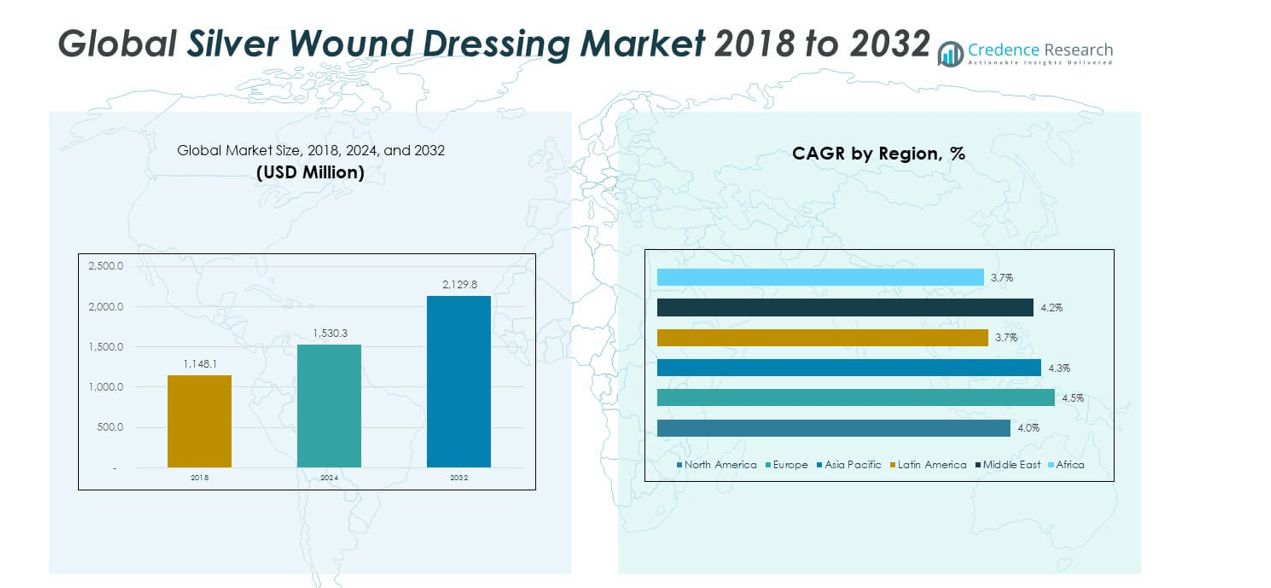
The Global Silver Wound Dressing Market size was valued at USD 1,148.1 million in 2018 to USD 1,530.3 million in 2024 and is anticipated to reach USD 2,129.8 million by 2032, at a CAGR of 4.19% during the forecast period.
| REPORT ATTRIBUTE | DETAILS |
|---|---|
| Historical Period | 2020-2023 |
| Base Year | 2024 |
| Forecast Period | 2025-2032 |
| Silver Wound Dressing Market Size 2024 | USD 1,530.3 million |
| Silver Wound Dressing Market, CAGR | 4.19% |
| Silver Wound Dressing Market Size 2032 | USD 2,129.8 million |
The market growth is driven by rising cases of chronic wounds and burn injuries, expanding geriatric populations, and growing awareness about advanced wound care solutions. Increasing adoption of antimicrobial dressings to prevent infections, especially in hospitals and long-term care facilities, further boosts demand, while technological innovations in nano-silver formulations enhance healing efficiency.
North America leads the global silver wound dressing market due to its advanced healthcare infrastructure, high healthcare spending, and early adoption of innovative wound care products. Europe follows, supported by rising cases of diabetic ulcers and chronic wounds. The Asia-Pacific region is emerging rapidly, fueled by expanding healthcare access, increasing diabetic populations, and heightened awareness of infection control standards in countries like India, China, and Japan.
Market Insights:
- The Global Silver Wound Dressing Market size was valued at USD 1,148.1 million in 2018, reached USD 1,530.3 million in 2024, and is projected to reach USD 2,129.8 million by 2032, growing at a CAGR of 4.19% during the forecast period.
- North America holds the largest regional share of 33%, driven by advanced healthcare systems, strong reimbursement structures, and high chronic wound prevalence. Europe follows with 29%, supported by technological innovation and a well-established clinical framework. Asia Pacific ranks third with 26%, propelled by healthcare expansion and a rising diabetic population.
- Asia Pacific is the fastest-growing region, supported by growing investments in hospital infrastructure, improved access to wound care products, and increasing awareness of infection management in countries such as China and India.
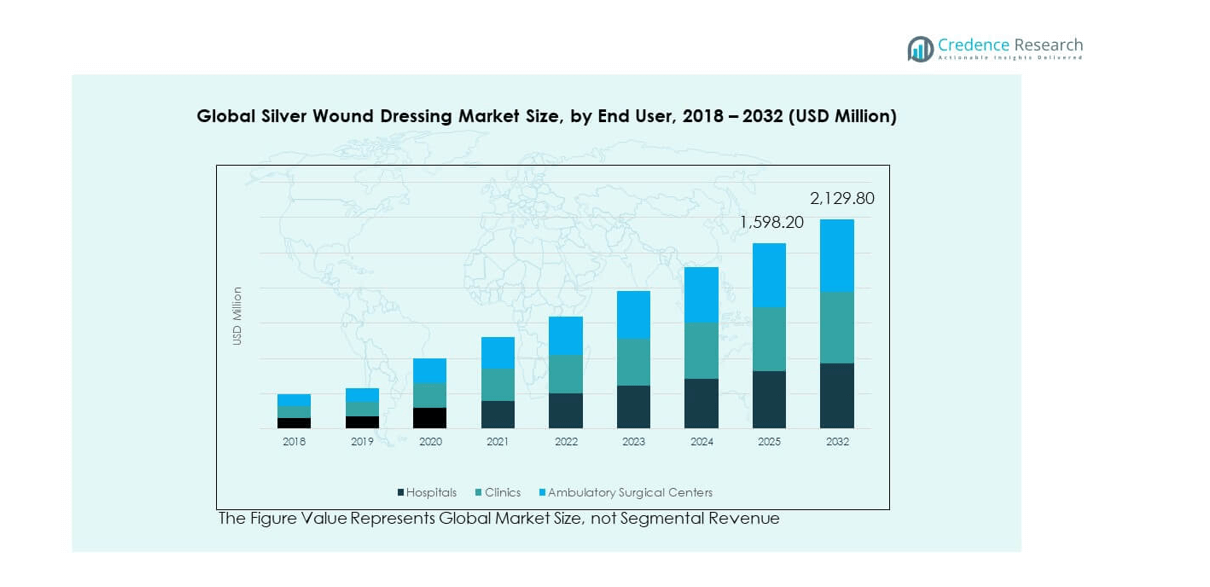
- Hospitals dominate the end-user segment with around 45% share, reflecting strong institutional demand for infection prevention and chronic wound treatment.
- Clinics and ambulatory surgical centers together account for roughly 55% of the market, indicating the growing shift toward outpatient wound care and minimally invasive treatment facilities worldwide.
Market Drivers in the Global Silver Wound Dressing Market
Increasing Prevalence of Chronic Diseases and Diabetes
A robust rise in cases of chronic diseases and diabetes consistently propels the Global Silver Wound Dressing Market. Chronic wounds and diabetic ulcers require long-term management, which intensifies the demand for advanced wound care products. Hospital audits have highlighted a significant number of inpatients with diabetes who develop at least one chronic ulcer during their stay. Clinical guidelines are shifting toward solutions with antimicrobial activity, recognizing silver’s proven efficacy in lowering bacterial burdens and reducing dressing change intervals. The wide spectrum of antibacterial activity provided by silver dressings supports their growing adoption across both outpatient and inpatient healthcare settings. Payors in Canada and Germany have expanded coverage for silver alginate codes, supporting home-bound diabetic care. The market reflects this shift as therapy days per patient expand, boosting bulk purchasing from group organizations. A surge in chronic wound incidence is driving the fundamental strength of the market, with advanced silver wound dressings gaining preference for optimized treatment.
- For instance, a 2009 multi-center clinical evaluation involving 126 patients with exuding chronic wounds treated with Smith+Nephew's ALLEVYN Ag dressing found a significant reduction in the majority of clinical signs of infection. However, the study also showed that 27% of patients achieved complete wound closure during a median study period of 21 days.
Growth in Surgical Procedures and Burn Injuries
The Global Silver Wound Dressing Market sees considerable growth due to increasing surgical procedures and rising rates of burn injuries worldwide. As more elective surgeries and trauma cases arise, healthcare providers focus on post-operative wound management and infection control strategies. The need for rapid healing and reduced hospital stays elevates the utilization of silver dressings in hospitals and clinics. Silver’s antimicrobial properties play a critical role in preventing infection, especially in complex wounds resulting from surgeries or burn events. Acute wounds from sports activities, auto accidents, and military operations further contribute to the heightened adoption of silver-based dressings for rapid recovery. Greater awareness of advanced wound care treatments encourages hospitals to shift away from traditional options, while expanding healthcare budgets enable more comprehensive clinical access to silver-infused products.
- For instance, Mölnlycke’s Mepilex Ag dressing can stay in place for up to 7 days when treating partial-thickness burns, and clinical studies show infection rates as low as 0–3% for patients using these advanced silver dressings.
Impact of Aging Population and Elective Surgeries
A progressively aging global population drives demand for advanced wound care solutions within the Global Silver Wound Dressing Market. Older individuals experience higher susceptibility to chronic wounds due to reduced skin regenerative capability and underlying health conditions. Elective surgeries performed for aging-related conditions amplify the requirement for antimicrobial wound dressings. Geriatric patients benefit from advanced silver dressings, which lower infection risk and promote faster tissue repair. Countries in Europe, the United States, and Japan see medium-term growth from these factors, with healthcare systems prioritizing wound management as an essential service. Silver dressings strengthen clinical outcomes in elderly populations, underpinning a stable market trajectory for high-value products and comprehensive wound care protocols.
Mandates for Hospital Infection Control and Technological Advancements
Hospital mandates emphasizing infection control and ongoing advancements in wound dressing technology serve as pivotal market drivers. New hospital regulations require the use of antimicrobial barriers in wound dressings to curb the occurrence of hospital-acquired infections and improve patient outcomes. Silver wound dressings deliver critical efficacy through strong antibacterial performance, reducing overall healthcare costs linked with prolonged stays or recurring infections. Innovations in nano-engineered silver dressings drive adoption in developed markets, with payors and healthcare systems supporting reimbursement for technologically advanced products. E-commerce expansion has also accelerated access for home healthcare applications, aligning with increased home management of wounds and rising telehealth adoption. These combined drivers sustain product demand and broaden the addressable market scope.
Adoption of Smart and Nano-Silver Technologies in Dressings
The development and market adoption of smart dressings and nano-silver technologies distinguish the key trends in the Global Silver Wound Dressing Market. Medical device manufacturers now offer nanocrystalline silver dressings, which release antimicrobial agents in a controlled manner for prolonged effectiveness. Hydrogel and hydrofiber formulations are gaining momentum for home healthcare and outpatient settings due to superior moisture management and infection prevention. There is steady replacement of older dressing materials with newer smart options that combine diagnostics, monitoring sensors, and silver ions to optimize healing processes. Adoption cycles are shortening as healthcare systems recognize the clinical and economic advantages of these intelligent products, leading to faster market penetration.
- For instance, foam-based nano-silver dressings from major suppliers allow dressing changes to be reduced from daily to once every 3–7 days, while maintaining optimal exudate control and antimicrobial efficacy in clinical use.
Shift Toward Outpatient Care and Home Healthcare
A pronounced shift toward outpatient care and home healthcare settings shapes the trajectory of the Global Silver Wound Dressing Market. Providers recommend silver dressings for chronic wounds managed outside institutional settings, responding to the demands for comfort, flexibility, and faster wound closure. Retail and online pharmacy expansion allows consumers easy access to advanced silver wound care solutions without dependence on hospital supply chains. Telehealth platforms have enabled remote monitoring, with clinicians guiding patients on dressing changes, further improving the continuity of care. Home healthcare increasingly contributes to overall product demand, indicating a sustainable trend in decentralized wound management, especially for aging populations and chronic disease patients.
- For instance, the use of advanced wound care products like silver hydrogel and foam dressings, when combined with telehealth for remote monitoring, has been shown to improve clinical outcomes and may extend dressing change intervals in home healthcare settings.
Growth in Minimally Invasive and Cost-Effective Treatments
Increasing preference for minimally invasive wound dressing options and the need for cost-effective solutions represent prevailing trends. Health systems target reduced procedural complexity, shorter hospital stays, and improved patient outcomes by promoting dressings that combine ease of use with advanced antimicrobial activity. The reimbursement landscape in markets like Europe and North America now welcomes silver alginate and advanced hydrofiber codes for home-bound patients. Manufacturers have responded with lighter, faster-acting dressings, facilitating excellent healing profiles at lower costs per patient. Government and regulatory support for affordable wound care encourages broader adoption of economically viable silver-infused dressings, establishing them as the preferred standard for multiple wound types.
Rising Demand in Emerging Economies and New Product Innovations
The Global Silver Wound Dressing Market observes rising demand in emerging markets such as India, China, Brazil, and parts of Africa. These regions offer substantial growth potential due to improving healthcare infrastructure, a surge in chronic and traumatic wound incidents, and greater awareness regarding advanced wound management. Local and international manufacturers launch new products tailored for these markets, leveraging lower production costs and region-specific regulatory approvals. Innovations targeting unique market needs, such as rapid-healing dressings for tropical climates and affordable single-use packs, contribute to a dynamic product landscape. These trends highlight the increasing globalization and diversity of the silver wound dressing market.
Market Challenges Analysis in the Global Silver Wound Dressing Market
High Product Costs and Limited Healthcare Funding in Developing Regions
Premium pricing for silver-infused dressings presents a persistent challenge for the Global Silver Wound Dressing Market. Hospitals and care providers in low-resource regions often struggle to justify the procurement of high-value products when budgets are constrained. Insurance coverage and reimbursement policies are inconsistent, making the adoption of advanced wound dressings commercially unviable for wide segments of the population. Some patients may experience allergic reactions to silver or have contraindications that limit product usage. Varying regulatory standards and prolonged approval processes for new products further slow market penetration, especially in economically emerging countries. This combination restricts overall access, resulting in slower growth in price-sensitive geographies.
Variable Clinical Evidence and Alternatives in Wound Care
The Global Silver Wound Dressing Market faces challenges from variable clinical evidence supporting efficacy, as well as competition from alternative wound care technologies. Not all wounds respond equally to silver, and conflicting clinical trials or physician experiences lead to mixed recommendations and limits in prescription rates. Institutions may opt for less expensive alternatives like iodine-based, foam, or hydrocellular dressings, particularly if antimicrobial needs are moderate. Regulatory complications, such as delayed approvals and mandatory safety trials for innovative products, increase the barriers for new entrants. Strategic players must continuously substantiate clinical outcomes, clarify product differentiation, and overcome medical skepticism in order to preserve market share. Heavy reliance on proven protocols and reluctance to change entrenched practices can slow the overall growth of advanced silver wound dressing adoption.
Market Opportunities in the Global Silver Wound Dressing Market
Expanding Applications Through Technological Advancements and Telehealth Integration
Significant opportunities arise in the Global Silver Wound Dressing Market from ongoing technological advancements and the integration of telehealth solutions. Emerging smart dressings featuring sensors for moisture and bacterial load monitoring enable better wound management and incentivize healthcare providers to utilize silver dressings in both acute and chronic care settings. E-commerce and telemedicine platforms streamline distribution channels, allowing patients in remote areas to gain access to advanced wound solutions. This trend enhances product reach and retention rates, creating new demand in previously underserved segments. The market stands ready to benefit from innovations that transform traditional wound care practices, sustaining its relevance in the evolving global landscape.
Growing Demand in Emerging Markets and Expansion of Home Healthcare
Expansion opportunities in the Global Silver Wound Dressing Market are closely tied to rising healthcare investments in emerging markets. Countries with rapidly improving medical infrastructure, increased diabetic populations, and a surge in trauma cases present favorable conditions. Home healthcare and outpatient care intensify as aging societies prioritize comfort and convenience, supporting broader distribution for consumer-grade silver wound products. Manufacturers find growth by launching affordable, locally adapted dressings and fostering public awareness campaigns. This approach positions silver wound dressings as accessible, essential solutions for advanced wound care across diverse global demographics.
Market Segmentation Analysis:
By Product Type
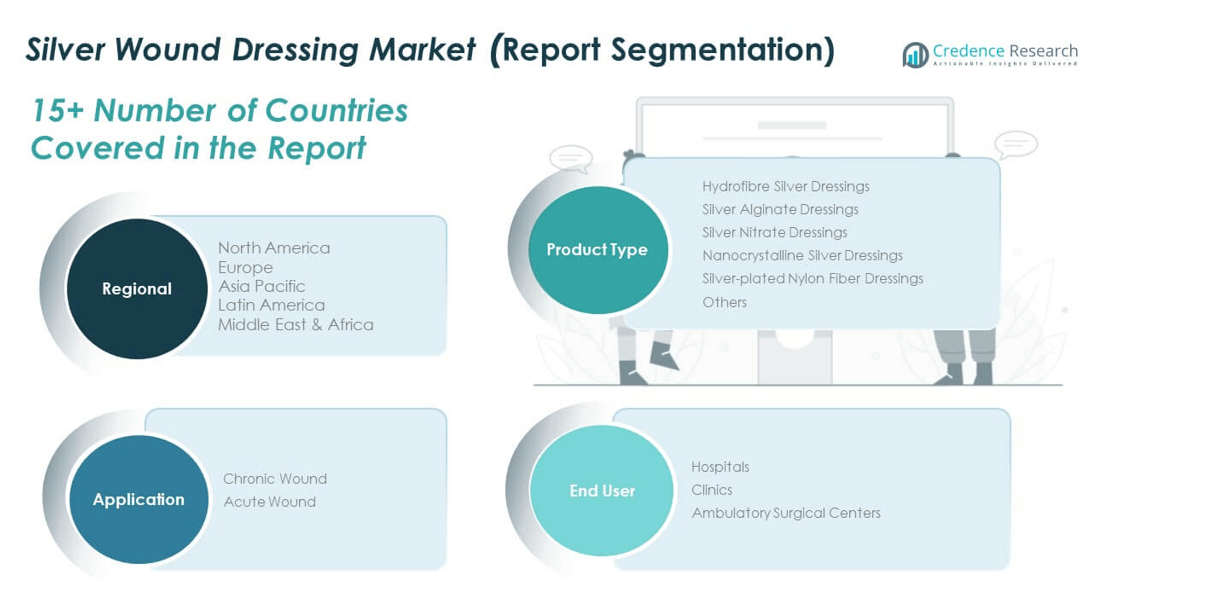
The Global Silver Wound Dressing Market includes hydrofibre, alginate, nitrate, nanocrystalline, and silver-plated nylon fiber dressings. Hydrofibre and nanocrystalline types dominate due to superior antimicrobial action and moisture management. Silver alginate dressings hold strong demand in chronic wound care because of high absorption capacity. Silver-plated nylon fiber dressings gain traction in burns and surgical wounds for faster recovery. Continuous innovations in fiber composition and coating technology expand product variety and clinical applications.
- For instance, clinical trials have shown that Convatec’s AQUACEL Ag hydrofiber dressing can significantly reduce pain and the frequency of dressing changes for certain wound types compared to traditional treatments like silver sulfadiazine, by gelling on contact with wound fluid and maintaining a moist healing environment. In addition, PAUL HARTMANN’s Sorbalgon Ag alginate dressing absorbs more than 14 times its weight in exudate and releases silver ions to protect the dressing from a wide spectrum of bacteria for up to seven days.
By Application
The market serves two key applications-chronic and acute wounds. Chronic wounds, including diabetic ulcers, venous ulcers, and pressure sores, hold the major share due to growing elderly populations and lifestyle diseases. Acute wounds, such as burns and surgical incisions, show rising adoption of advanced dressings for infection control and reduced healing time. The growing preference for antimicrobial dressings across hospital and outpatient care settings strengthens market penetration.
- For instance, clinical studies on silver dressings have shown benefits in some specific chronic and acute wound types by providing an antimicrobial barrier and helping to manage infection. While some trials have reported reductions in infection rates, these results are inconsistent, and high-quality evidence is insufficient to conclude that silver dressings reliably accelerate healing faster than conventional therapy.
By End User
Hospitals account for the largest share, driven by high patient inflow and strong focus on infection prevention. Clinics follow with increasing outpatient procedures and wound management programs. Ambulatory surgical centers show steady growth, supported by demand for cost-effective wound care solutions and faster turnover. The Global Silver Wound Dressing Market benefits from healthcare facility upgrades, wider product accessibility, and rising awareness of advanced wound management practices among medical professionals.
Segmentation:
By Product Type
- Hydrofibre Silver Dressings
- Silver Alginate Dressings
- Silver Nitrate Dressings
- Nanocrystalline Silver Dressings
- Silver-Plated Nylon Fiber Dressings
- Others
By Application
- Chronic Wounds
- Acute Wounds
By End User
- Hospitals
- Clinics
- Ambulatory Surgical Centers
By Region
- North America
- U.S.
- Canada
- Europe
- Germany
- France
- Italy
- U.K.
- Russia
- Rest of Europe
- Asia-Pacific
- India
- China
- Japan
- Rest of Asia-Pacific
- Latin America
- Brazil
- Mexico
- Rest of Latin America
- Middle East and Africa
- GCC Countries
- South Africa
- Rest of Middle East and Africa
Regional Analysis:
North America
The North America Silver Wound Dressing Market size was valued at USD 379.11 million in 2018, reached USD 499.21 million in 2024, and is anticipated to reach USD 683.45 million by 2032, at a CAGR of 4.0% during the forecast period. North America holds a market share of 33% in the Global Silver Wound Dressing Market. It leads due to advanced healthcare infrastructure, strong reimbursement policies, and the presence of major players such as 3M (Solventum), Smith+Nephew, and Cardinal Health. Rising cases of diabetic foot ulcers and surgical wounds strengthen product demand. Hospitals and wound care centers actively adopt silver dressings for infection prevention and faster healing. The U.S. remains the primary contributor owing to technological innovations and high per capita healthcare spending. Canada follows with growing adoption in outpatient wound care. Continuous research investment and product awareness programs drive sustained growth.
Europe
The Europe Silver Wound Dressing Market size was valued at USD 284.50 million in 2018, reached USD 385.77 million in 2024, and is anticipated to reach USD 549.06 million by 2032, at a CAGR of 4.5% during the forecast period. Europe accounts for a 29% share of the Global Silver Wound Dressing Market. It benefits from rising chronic wound prevalence, strong healthcare funding, and advanced wound management protocols. The UK, Germany, and France dominate regional demand due to large elderly populations and robust clinical adoption of antimicrobial dressings. Regulatory support for infection control standards enhances product credibility. Local manufacturers emphasize eco-friendly, cost-effective solutions. Increased awareness of hospital-acquired infection risks supports steady adoption across public and private healthcare systems. The market remains innovation-driven with a focus on nanotechnology-based silver dressings.
Asia Pacific
The Asia Pacific Silver Wound Dressing Market size was valued at USD 302.18 million in 2018, reached USD 406.05 million in 2024, and is anticipated to reach USD 571.21 million by 2032, at a CAGR of 4.3% during the forecast period. The region holds a 26% share of the Global Silver Wound Dressing Market. Rapid healthcare infrastructure development and growing awareness of advanced wound care drive market expansion. China, Japan, and India lead regional demand due to a high patient base and increasing diabetes prevalence. Rising investments in hospital facilities and improved healthcare accessibility boost product penetration. Domestic companies are expanding silver-based dressing production to meet growing needs. The adoption of modern wound care products in rural areas is increasing through government-led healthcare initiatives. The market benefits from expanding distribution networks and rising training programs for wound management professionals.
Latin America
The Latin America Silver Wound Dressing Market size was valued at USD 84.04 million in 2018, reached USD 109.20 million in 2024, and is anticipated to reach USD 146.74 million by 2032, at a CAGR of 3.7% during the forecast period. Latin America represents an 8% share of the Global Silver Wound Dressing Market. Brazil and Mexico dominate the regional landscape with growing hospital capacities and modernization of healthcare systems. The demand for infection-control wound products is growing due to higher awareness of post-surgical complications. Public health programs promoting advanced wound care enhance product adoption. Economic stabilization and imports of high-performance dressings support gradual growth. Local partnerships between manufacturers and distributors improve product availability in secondary cities. Government investment in chronic disease management further strengthens long-term demand.
Middle East
The Middle East Silver Wound Dressing Market size was valued at USD 66.36 million in 2018, reached USD 88.71 million in 2024, and is anticipated to reach USD 123.95 million by 2032, at a CAGR of 4.2% during the forecast period. The region captures a 7% share of the Global Silver Wound Dressing Market. GCC countries lead with increasing hospital infrastructure, growing surgical volumes, and preference for premium wound care solutions. High diabetes prevalence drives continuous demand for chronic wound management products. Governments invest heavily in healthcare modernization and infection control programs. Israel and Turkey also contribute with innovation-driven wound care technologies. Medical tourism and expanding private hospital networks boost market penetration. The increasing import of advanced dressings supports quality improvement across treatment facilities.
Africa
The Africa Silver Wound Dressing Market size was valued at USD 31.92 million in 2018, reached USD 41.36 million in 2024, and is anticipated to reach USD 55.37 million by 2032, at a CAGR of 3.7% during the forecast period. Africa holds a 4% share of the Global Silver Wound Dressing Market. The region is in an early growth phase, driven by improving access to healthcare services and growing awareness of infection control. South Africa leads regional demand, followed by Egypt, where wound care programs are expanding in urban hospitals. Economic development and donor-supported health initiatives aid product penetration. Rising cases of trauma and chronic ulcers increase the need for advanced dressings. Local distribution partnerships help widen access in underserved areas. The market is set to gain traction with better infrastructure and training in wound management practices.
Key Player Analysis:
- Smith+Nephew
- Solventum (formerly 3M’s healthcare business)
- Convatec Group PLC
- Coloplast Group
- Mölnlycke AB
- Cardinal Health
- Medline Industries, LP
- PAUL HARTMANN AG
- Advanced Medical Solutions Group plc
- Braun SE
- MedWay Group
- Other Key Players (including emerging regional and specialty wound care companies)
Competitive Analysis:
The Global Silver Wound Dressing Market is moderately consolidated, with key players focusing on product innovation and global expansion. It is driven by companies such as Smith+Nephew, Solventum, Mölnlycke AB, Convatec Group PLC, and Coloplast Group, which dominate the market through strong distribution networks and continuous R&D investments. Companies emphasize antimicrobial performance, cost efficiency, and advanced materials to maintain competitiveness. Strategic collaborations with healthcare providers and research institutions enhance market presence. Continuous technological innovation in nanocrystalline and hydrofibre formulations supports market leadership and brand differentiation.
Recent Developments:
- In September 2025, Cardinal Health highlighted its growth strategy in wound care, including new distribution partnerships for silver-based dressings, as detailed at the annual Baird Healthcare Conference and supported by official transcripts.
- In April 2024, Solventum became an independent entity following its spin-off from 3M, an event confirmed by formal statements from 3M and coverage in leading business news outlets.
- In August 2023, Coloplast expanded its wound care segment by acquiring Kerecis, a leading innovator in biologics wound management, as documented in official corporate disclosures and business press releases.
Report Coverage:
The research report offers an in-depth analysis based on product type, application, and end user. It details leading market players, providing an overview of their business, product offerings, investments, revenue streams, and key applications. Additionally, the report includes insights into the competitive environment, SWOT analysis, current market trends, as well as the primary drivers and constraints. Furthermore, it discusses various factors that have driven market expansion in recent years. The report also explores market dynamics, regulatory scenarios, and technological advancements that are shaping the industry. It assesses the impact of external factors and global economic changes on market growth. Lastly, it provides strategic recommendations for new entrants and established companies to navigate the complexities of the market.
Future Outlook:
- Rising global demand for infection-preventive and antimicrobial wound care solutions.
- Increasing adoption of nanocrystalline and hydrofibre-based dressings in hospitals.
- Expansion of outpatient and home-care wound treatment boosting product accessibility.
- Strong focus on sustainable materials and eco-friendly manufacturing processes.
- Technological advances improving moisture retention and healing efficiency.
- Growing government and private investment in chronic wound management programs.
- Expansion of healthcare infrastructure in developing countries strengthening demand.
- Integration of smart dressings with sensors for real-time wound monitoring.
- Collaborations between manufacturers and healthcare providers enhancing R&D.
- Rising awareness among clinicians and patients supporting long-term market stability

Request a Free Sample
Fill in your details and we'll send you a free sample report.
- Sample data tables & charts
- Research methodology
Market Dynamics
Increasing Prevalence of Chronic Diseases and Diabetes
The rising incidence of chronic diseases and diabetes leads to more cases of chronic wounds and ulcers, which require long-term management with advanced wound care products like silver dressings. This trend is especially pronounced in aging populations and regions with high diabetes rates, driving sustained demand for antimicrobial wound solutions.
Growth in Surgical Procedures and Burn Injuries
An increase in elective surgeries, trauma cases, and burn injuries globally has heightened the need for effective post-operative and acute wound management. Silver wound dressings are favored in these scenarios for their proven infection control and ability to promote faster healing, leading to greater adoption in hospitals and clinics.
Mandates for Hospital Infection Control and Technological Advancements
Stricter hospital regulations and infection control mandates are pushing healthcare providers to adopt antimicrobial dressings, with silver-based products offering strong antibacterial efficacy. Ongoing technological innovations, such as nano-silver and smart dressings, further enhance healing outcomes and support market growth.
Shift Toward Outpatient Care and Home Healthcare
The movement toward outpatient and home-based wound care is expanding the market for silver wound dressings, as patients and providers seek convenient, effective, and infection-preventive solutions outside traditional hospital settings. Telehealth and e-commerce platforms are making advanced dressings more accessible, fueling broader market penetration.
Rising Demand in Emerging Economies and New Product Innovations
Emerging markets like India, China, and Brazil are experiencing rapid growth in healthcare infrastructure and awareness of advanced wound care, increasing demand for silver dressings. Manufacturers are responding with innovative, affordable products tailored to local needs, further expanding the global market.
Need a Custom Version of This Report?
Tailor the scope, geography, or segments to your exact requirements.
- Custom geography or segment scope
- Direct access to our analyst team
Frequently Asked Questions
What is the current market size for the Global Silver Wound Dressing Market, and what is its projected size in 2032?
At what Compound Annual Growth Rate is the Global Silver Wound Dressing Market projected to grow between 2025 and 2032?
Which Global Silver Wound Dressing Market segment held the largest share in 2024?
What are the primary factors fueling the growth of the Global Silver Wound Dressing Market?
Who are the leading companies in the Global Silver Wound Dressing Market?
Who are the major players in this market?
Table of Content
Chapter 1 Market Segmentation
- 1.1 Segmentation Framework
- 1.1.1 Product and Service Classification
- 1.1.2 Application and End-Use Classification
- 1.1.3 Technology and Solution Classification
- 1.1.4 Customer and Distribution Channel Classification
- 1.1.5 Geographic Segmentation
- 1.1.6 Market Segment Definitions and Boundaries
- 1.2 By End User
- 1.2.1 Hospitals
- 1.2.2 Clinics
- 1.2.3 Ambulatory Surgical Centers
- 1.3 By Application
- 1.3.1 Chronic Wounds
- 1.3.2 Acute Wounds
- 1.4 By Product Type
- 1.4.1 Hydrofibre Silver Dressings
- 1.4.2 Silver Alginate Dressings
- 1.4.3 Silver Nitrate Dressings
- 1.4.4 Nanocrystalline Silver Dressings
- 1.4.5 Silver-Plated Nylon Fiber Dressings
- 1.4.6 Others
Chapter 2 Introduction
- 2.1 Report Objectives and Scope
- 2.2 Product Definition and Industry Terminology
- 2.3 Market Inclusions and Exclusions
- 2.4 Research Process
- 2.4.1 Primary Research and Expert Interviews
- 2.4.2 Secondary Research and Source Review
- 2.4.3 Top-Down and Bottom-Up Estimation
- 2.4.4 Data Triangulation and Verification
- 2.5 Market Size Measurement Basis
- 2.5.1 2018: USD 1,148.1 million → 2032: USD 2,129.8 million
- 2.6 Historical and Forecast Reference Periods
- 2.6.1 Base Year: 2018
- 2.6.2 Forecast Period: 2018-2032
- 2.7 Research Assumptions and Limitations
Chapter 3 Executive Summary
- 3.1 Market Snapshot and Key Findings
- 3.2 Base-Year Market Size, 2018
- 3.3 Forecast Market Size, 2032
- 3.4 Revenue and Volume Growth Outlook
- 3.5 Key Demand and Supply Indicators
- 3.6 Leading Market Segments
- 3.7 Fastest-Growing Market Opportunities
- 3.8 Regional Performance Highlights
- 3.9 Technology and Industry Transformation
- 3.10 Competitive Landscape Summary
- 3.11 Analyst View and Strategic Implications
Chapter 4 Global Silver Wound Dressing Market Trends and Developments
- 4.1 Historical Industry Development
- 4.2 Recent Market Trends and Developments
- 4.3 Demand and Customer Behavior Trends
- 4.4 Technology and Product Innovation
- 4.5 Artificial Intelligence, Automation and Digitalization
- 4.6 Local Manufacturing and Supply Chain Realignment
- 4.7 Industry Partnerships, Mergers and Acquisitions
- 4.8 Sustainability and Circular Economy Developments
- 4.9 Government and Private Sector Investment Trends
- 4.10 Emerging Business Models and Commercialization
- 4.11 Industry Developments and Announcements
Chapter 5 Global Silver Wound Dressing Market Production, Supply and Demand Analysis
- 5.1 Demand Trend and Consumption Analysis
- 5.2 Demand Forecast, 2018-2032
- 5.3 Production and Output Trend
- 5.4 Production and Output Forecast, 2018-2032
- 5.5 Installed Capacity and Capacity Utilization
- 5.6 Company-Wise Production Plants and Statistics
- 5.6.1 Installed Production Capacity
- 5.6.2 Actual Production
- 5.6.3 Planned Capacity and Expansion Targets
- 5.7 Supply Chain Structure and Procurement Trends
- 5.8 Supply-Demand Gap and Bottlenecks
- 5.9 Import Dependence and Sourcing Structure
- 5.10 Contract Manufacturing and Outsourcing
- 5.11 Regional Supply and Demand Concentration
Chapter 6 Global Silver Wound Dressing Market Pricing Analysis
- 6.1 Pricing Structure and Measurement
- 6.2 Historical Pricing Trends
- 6.3 Pricing Outlook, 2018-2032
- 6.4 Average Selling Price and Unit Economics
- 6.5 Pricing by Product and Market Segment
- 6.6 Geographic Pricing Differences
- 6.7 Key Input, Energy, Labor and Logistics Costs
- 6.8 Contract Pricing and Purchasing Models
- 6.9 Pricing Sensitivity and Competitive Positioning
- 6.10 Price, Margin and Profitability Implications
Chapter 7 Global Silver Wound Dressing Market Dynamics
- 7.1 Market Growth Drivers
- 7.1.1 Demand-Side Drivers
- 7.1.2 Technology and Innovation Drivers
- 7.1.3 Infrastructure and Investment Drivers
- 7.1.4 Regulatory and Policy Drivers
- 7.2 Market Restraints
- 7.2.1 Cost and Affordability Constraints
- 7.2.2 Technology and Adoption Barriers
- 7.2.3 Supply Chain and Operational Constraints
- 7.3 Market Challenges
- 7.3.1 Competitive Pressure and Margin Erosion
- 7.3.2 Skills, Infrastructure and Implementation Gaps
- 7.4 Emerging Market Opportunities
- 7.5 Market Dynamics Impact and Time-Horizon Assessment
Chapter 8 Global Silver Wound Dressing Value Chain Analysis
- 8.1 Industry Value Chain Overview
- 8.2 Upstream Suppliers and Critical Inputs
- 8.3 Technology and Component Providers
- 8.4 Manufacturing or Service Delivery
- 8.5 Distribution, Channel Partners and Integrators
- 8.6 Downstream Applications and End Users
- 8.7 Value Addition and Profit Pools
- 8.8 Vertical Integration and Outsourcing
- 8.9 Supplier Concentration and Risk
- 8.10 Supply Chain Localization and Resilience
Chapter 9 Global Silver Wound Dressing Market Regulations and Policies
- 9.1 Relevant Laws, Standards and Compliance Frameworks
- 9.2 Product, Service, Safety and Quality Requirements
- 9.3 Government Policies, Incentives and Subsidies
- 9.4 Imports, Exports and Trade Barriers
- 9.5 Public Procurement and Local Content Requirements
- 9.6 Environmental and Sustainability Compliance
- 9.7 Upcoming Policy Changes and Market Implications
Chapter 10 Global Silver Wound Dressing Market Hotspots and Opportunities
- 10.1 Market Opportunity Mapping and Growth Hotspots
- 10.2 High-Growth Applications and Customer Groups
- 10.3 Underserved Markets and White-Space Opportunities
- 10.4 Emerging Technology and Product Opportunities
- 10.5 New Capacity and Investment Hotspots
- 10.6 Market Entry and Expansion Opportunities
- 10.7 Distribution and Partnership Opportunities
- 10.8 Near-Term and Long-Term Commercial Potential
- 10.9 Opportunity Attractiveness and Execution Risks
Chapter 11 Global Silver Wound Dressing Market Outlook, 2018-2032
- 11.1 Market Size and Analysis
- 11.1.1 Revenue (Market Measurement: 2018: USD 1,148.1 million → 2032: USD 2,129.8 million)
- 11.1.2 Market Volume and Quantity Sold
- 11.1.3 Historical Market Size
- 11.1.4 Base-Year Market Size, 2018
- 11.2 Market Forecast, 2018-2032
- 11.2.1 Revenue Forecast to 2032
- 11.2.2 Volume Forecast to 2032
- 11.2.3 CAGR and Year-on-Year Growth
- 11.2.4 Incremental Revenue Opportunity
- 11.3 Forecast Assumptions and Scenario Analysis
- 11.3.1 Base-Case Forecast
- 11.3.2 Optimistic and Conservative Scenarios
- 11.3.3 Technology, Pricing and Policy Sensitivities
- 11.4 Market Attractiveness and Growth Outlook
Chapter 12 Global Silver Wound Dressing Market Segmentation and Outlook
- 12.1 Segmentation Summary and Market Shares, 2018
- 12.2 Largest and Fastest-Growing Segments
- 12.3 By End User - Market Size and Forecast, 2018-2032
- 12.3.1 Segment Definition and Scope
- 12.3.2 Historical Market Size
- 12.3.3 Revenue Forecast, 2018-2032
- 12.3.4 Volume Forecast, 2018-2032
- 12.3.5 Base-Year Market Share, 2018
- 12.3.6 Segment CAGR and Growth Drivers
- 12.3.7 Subsegment Market Size and Forecast
- 12.3.7.1 Hospitals
- 12.3.7.2 Clinics
- 12.3.7.3 Ambulatory Surgical Centers
- 12.3.8 Subsegment Pricing and Adoption Trends
- 12.3.9 Leading Suppliers and Competition
- 12.3.10 Regional Demand and Opportunities
- 12.4 By Application - Market Size and Forecast, 2018-2032
- 12.4.1 Segment Definition and Scope
- 12.4.2 Historical Market Size
- 12.4.3 Revenue Forecast, 2018-2032
- 12.4.4 Volume Forecast, 2018-2032
- 12.4.5 Base-Year Market Share, 2018
- 12.4.6 Segment CAGR and Growth Drivers
- 12.4.7 Subsegment Market Size and Forecast
- 12.4.7.1 Chronic Wounds
- 12.4.7.2 Acute Wounds
- 12.4.8 Subsegment Pricing and Adoption Trends
- 12.4.9 Leading Suppliers and Competition
- 12.4.10 Regional Demand and Opportunities
- 12.5 By Product Type - Market Size and Forecast, 2018-2032
- 12.5.1 Segment Definition and Scope
- 12.5.2 Historical Market Size
- 12.5.3 Revenue Forecast, 2018-2032
- 12.5.4 Volume Forecast, 2018-2032
- 12.5.5 Base-Year Market Share, 2018
- 12.5.6 Segment CAGR and Growth Drivers
- 12.5.7 Subsegment Market Size and Forecast
- 12.5.7.1 Hydrofibre Silver Dressings
- 12.5.7.2 Silver Alginate Dressings
- 12.5.7.3 Silver Nitrate Dressings
- 12.5.7.4 Nanocrystalline Silver Dressings
- 12.5.7.5 Silver-Plated Nylon Fiber Dressings
- 12.5.7.6 Others
- 12.5.8 Subsegment Pricing and Adoption Trends
- 12.5.9 Leading Suppliers and Competition
- 12.5.10 Regional Demand and Opportunities
- 12.6 Segment Growth Comparison
- 12.7 Segment Attractiveness and Priority Matrix
Chapter 13 Global Silver Wound Dressing End-Use and Application Market Outlook
- 13.1 End-Use Industry and Customer Demand Structure
- 13.2 Leading Applications and Customer Groups
- 13.3 End-Use Market Size, Share and Forecast
- 13.4 Major End-Use Industry Deep Dives
- 13.4.1 Customer Requirements and Use Cases
- 13.4.2 Demand and Replacement Cycles
- 13.4.3 Technical and Regulatory Considerations
- 13.4.4 Purchasing and Procurement Models
- 13.4.5 Leading Vendors and Distribution Channels
- 13.4.6 Forecast and Commercial Opportunities
- 13.5 Emerging Applications and Cross-Segment Demand
- 13.6 End-Use Industry Investment Priorities
Chapter 14 Global Silver Wound Dressing Geographic Market Outlook, 2018-2032
- 14.1 Regional Market Size and Share, 2018
- 14.2 Regional Market Forecast, 2018-2032
- 14.3 Regional Pricing, Production and Demand Differences
- 14.4 North America
- 14.4.1 United States
- 14.4.2 Canada
- 14.4.3 Mexico
- 14.5 Europe
- 14.5.1 Germany
- 14.5.2 France
- 14.5.3 Italy
- 14.5.4 United Kingdom
- 14.5.5 Spain
- 14.5.6 Poland
- 14.5.7 Russia
- 14.5.8 Netherlands
- 14.5.9 Belgium
- 14.5.10 Sweden
- 14.5.11 Denmark
- 14.5.12 Norway
- 14.5.13 Rest of Europe
- 14.6 Asia Pacific
- 14.6.1 China
- 14.6.2 India
- 14.6.3 Japan
- 14.6.4 South Korea
- 14.6.5 Thailand
- 14.6.6 Indonesia
- 14.6.7 Vietnam
- 14.6.8 Malaysia
- 14.6.9 Australia
- 14.6.10 Rest of Asia Pacific
- 14.7 Latin America
- 14.7.1 Brazil
- 14.7.2 Argentina
- 14.7.3 Colombia
- 14.7.4 Chile
- 14.7.5 Rest of Latin America
- 14.8 Middle East
- 14.8.1 Saudi Arabia
- 14.8.2 United Arab Emirates
- 14.8.3 Turkey
- 14.8.4 Israel
- 14.8.5 Iran
- 14.8.6 Rest of the Middle East
- 14.9 Africa
- 14.9.1 South Africa
- 14.9.2 Egypt
- 14.9.3 Nigeria
- 14.9.4 Morocco
- 14.9.5 Rest of Africa
- 14.10 Regional Investment, Policy and Supply Chain Differences
- 14.11 Regional Competitive Landscape
- 14.12 Geographic Growth Hotspots
Chapter 15 Global Silver Wound Dressing Technology, Innovation and Sustainability Outlook
- 15.1 Technology Landscape and Maturity
- 15.2 Product, Process and Service Innovation
- 15.3 AI, Automation and Digital Tools in the Industry
- 15.4 Technology Adoption and Performance Benchmarking
- 15.5 Innovation Pipeline and R&D Investment
- 15.6 Patent and Intellectual Property Trends
- 15.7 Energy Efficiency and Resource Management
- 15.8 Sustainability, Recycling and Circularity
- 15.9 Technology Roadmap, 2018-2032
- 15.10 Risks of Obsolescence and Technology Substitution
Chapter 16 Global Silver Wound Dressing Market Key Strategic Imperatives
- 16.1 Growth and Market Entry Priorities
- 16.2 High-Return Products and Segments
- 16.3 Pricing, Profitability and Cost Optimization
- 16.4 Technology Investment and Product Differentiation
- 16.5 Supply Chain Localization and Resilience
- 16.6 Distribution and Customer Acquisition
- 16.7 Partnership, Acquisition and Capacity Strategy
- 16.8 Regional Expansion Priorities
- 16.9 Short-, Medium- and Long-Term Actions
Chapter 17 Competition Outlook
- 17.1 Industry Competition Characteristics
- 17.2 Market Structure and Concentration
- 17.3 Market Share and Competitive Positioning, 2018
- 17.4 Company-Wise Revenue and Product Benchmarking
- 17.5 Production and Service Capacity Benchmarking
- 17.6 Technology, Pricing and Differentiation
- 17.7 Regional Footprint and Distribution Strength
- 17.8 Mergers, Acquisitions and Strategic Alliances
- 17.9 New Entrants and Competitive Threats
- 17.10 Porter's Five Forces and Industry Attractiveness
- 17.11 Competitive Outlook, 2018-2032
Chapter 18 Company Profiles
- 18.1 Company Coverage and Selection Criteria
- 18.2 Smith+Nephew
- 18.2.1 Business Description
- 18.2.2 Company Ownership and Geographic Presence
- 18.2.3 Product and Service Portfolio
- 18.2.4 Manufacturing and Operating Footprint
- 18.2.5 Production Capacity and Expansion Plans
- 18.2.6 Financial Performance and Investment
- 18.2.7 Market Share and Competitive Position
- 18.2.8 Technology and Innovation Capabilities
- 18.2.9 Strategic Alliances or Partnerships
- 18.2.10 Recent Developments
- 18.2.11 Growth Strategy and Outlook
- 18.3 Solventum (formerly 3M’s healthcare business)
- 18.4 Convatec Group PLC
- 18.5 Coloplast Group
- 18.6 Mölnlycke AB
- 18.7 Cardinal Health
- 18.8 Medline Industries, LP
- 18.9 PAUL HARTMANN AG
- 18.10 Advanced Medical Solutions Group plc
- 18.11 B. Braun SE
- 18.12 Other Relevant Market Participants
Note: Every listed company is profiled on the structure shown under the first company. The company list is preliminary and may change based on research findings, market developments, data availability and client requirements.
Chapter 19 Disclaimer
- 19.1 Research and Forecast Disclaimer
- 19.2 Data Source and Estimation Limitations
Note: The depth of individual sections depends on data availability for this market. Volume, capacity, trade and other unit-based metrics are included where applicable.

