
Market Overview:
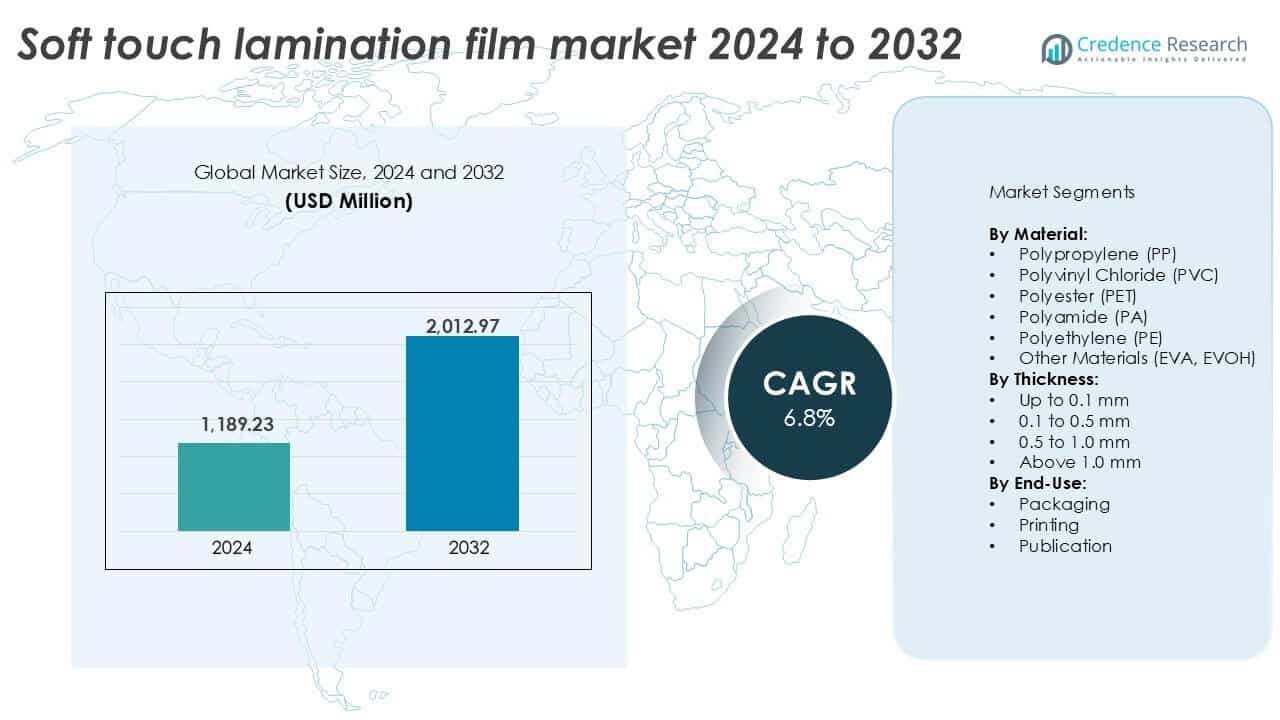
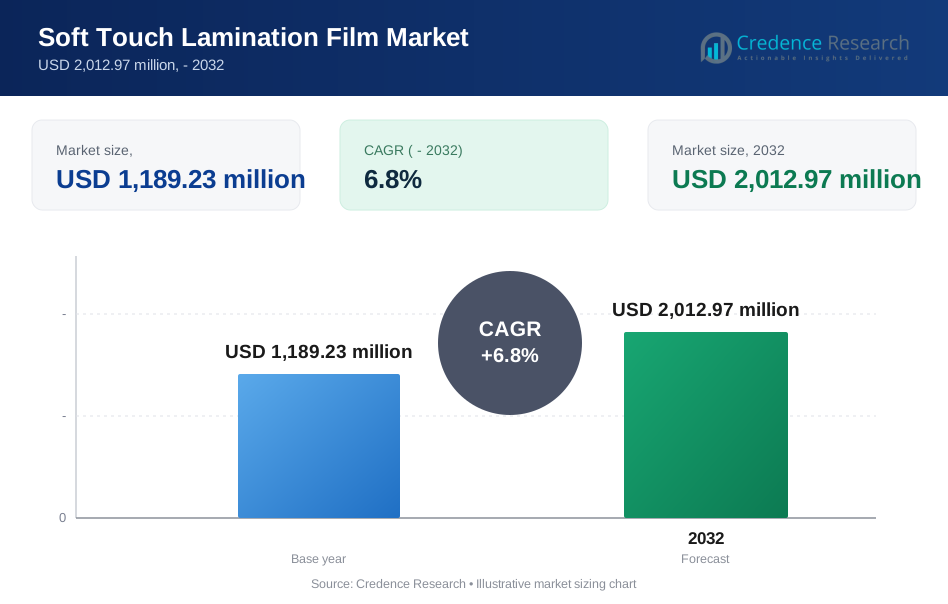
The Soft Touch Lamination Film Market size was valued at USD 1,189.23 million in 2024 and is anticipated to reach USD 2,012.97 million by 2032, at a CAGR of 6.8% during the forecast period.
| REPORT ATTRIBUTE | DETAILS |
|---|---|
| Historical Period | 2020-2023 |
| Base Year | 2024 |
| Forecast Period | 2025-2032 |
| Soft Touch Lamination Film Market Size 2024 | USD 1,189.23 million |
| Soft Touch Lamination Film Market, CAGR | 6.8% |
| Soft Touch Lamination Film Market Size 2032 | USD 2,012.97 million |
Key players in the soft touch lamination film market include Amcor Limited, Avery Dennison Corporation, Cosmo Films Ltd., Taghleef Industries SLU, and Dow Chemical Co., all of which hold significant global footprints. These companies dominate through wide product portfolios, strong R&D focus, and established customer bases in packaging and print sectors. Amcor and Avery Dennison lead in innovation and global supply reach, while Cosmo Films and Taghleef excel in high-performance laminates for luxury packaging. Regionally, Asia-Pacific leads the market with a 31% share, driven by large-scale manufacturing in China, rapid retail growth in India, and strong demand in Japan and South Korea. North America and Europe follow with 28% and 26% shares respectively, supported by established print industries and growing demand for sustainable premium packaging. Latin America and the Middle East & Africa together contribute the remaining 15%, showing steady growth potential in niche segments.
Market Insights
- The Soft Touch Lamination Film Market was valued at USD 1,189.23 million in 2024 and is projected to reach USD 2,012.97 million by 2032, growing at a CAGR of 6.8%.
- Demand for premium, tactile packaging in cosmetics, electronics, and luxury food drives market growth globally.
- Sustainable and recyclable soft-touch films are gaining traction as brands seek eco-friendly yet high-impact finishes.
- Key players include Amcor, Avery Dennison, Cosmo Films, and Taghleef Industries, competing on product performance and global reach.
- Asia-Pacific leads with 31% market share, followed by North America at 28% and Europe at 26%; Polypropylene (PP) dominates the material segment, while 0.1 to 0.5 mm thickness films are the most widely used across applications.
Market Segmentation Analysis:
By Material
Polypropylene (PP) leads the material segment in the soft touch lamination film market, accounting for the largest revenue share. Its low cost, lightweight properties, and recyclability support wide use across packaging and print finishing. Polyester (PET) follows due to its excellent clarity, tear resistance, and durability in high-end print and publication applications. Polyvinyl Chloride (PVC) and Polyethylene (PE) serve niche needs where chemical resistance or flexibility is prioritized. Other materials like EVA and EVOH remain limited to specialty use cases, such as barrier-sensitive packaging. Polyamide (PA) sees moderate adoption in technical and industrial prints.
- For instance, Cosmo Films Ltd. (Cosmo First) offers soft-touch lamination films made of BOPP (biaxially oriented polypropylene) with a high haze value of approximately 85% to 95% to achieve its matte velvet finish, and a coefficient of friction of 0.30 to 0.40, which balances tactile smoothness with efficient converting
By Thickness
The 0.1 to 0.5 mm thickness segment dominates the market with the highest share, driven by its optimal balance between protection and flexibility. This range is widely adopted in consumer product packaging, premium labels, and brochures, where visual appeal and tactile quality matter. Films below 0.1 mm serve cost-sensitive applications, but lack durability. Thicker films from 0.5 to 1.0 mm are used in rigid box wrapping and high-end display prints. Above 1.0 mm thickness remains a niche category for specialty projects that require impact resistance and structure.
- For instance, Derprosa by Taghleef Industries offers soft-touch films with 35 µm base thickness and 12 µm adhesive coating, widely used in cosmetic and luxury packaging.
By End-Use
Packaging is the dominant end-use segment, holding the largest share due to growing demand for luxury packaging in cosmetics, electronics, and premium food. Soft touch lamination enhances shelf appeal and provides scratch resistance, making it ideal for retail packaging. The printing segment also shows strong demand in high-end business cards, book covers, and promotional materials. Publication use is smaller but steady, focused on magazine covers and art books where tactile finish adds value. The shift toward experiential branding supports ongoing adoption across these segments.
Key Growth Drivers
Rising Demand for Premium Packaging Across Consumer Goods
The demand for premium packaging continues to rise in sectors like cosmetics, electronics, and luxury food products. Brands are investing in visual and tactile appeal to differentiate products on shelves. Soft touch lamination film offers a smooth, matte finish that enhances the perceived value of packaging. It improves abrasion resistance while providing a unique feel that appeals to customers. As unboxing experiences influence consumer behavior, companies adopt soft-touch films to elevate branding. High growth in direct-to-consumer (D2C) models also drives the need for packaging that reflects premium quality. With consumer preference shifting toward minimal yet elegant designs, soft touch lamination finds growing relevance across packaging lines.
- For instance, Amcor developed a soft-touch film used by a global skincare brand, offering a matte finish with <20 gloss units and achieving 1.5× higher scratch resistance than untreated BOPP films.
Growth of High-Quality Print and Publication Applications
Soft touch lamination films are increasingly adopted in the print and publication sector due to their protective and aesthetic benefits. These films are used in book covers, brochures, and business cards to add a velvet-like texture and ensure scratch resistance. The rise in demand for customized marketing collateral and luxury catalogues in retail, hospitality, and real estate boosts adoption. Print service providers prefer soft-touch films to offer premium finishes that attract brand-conscious clients. Digital printing advancements also enable broader use of these films, supporting small-batch, high-quality outputs. As publishers seek to enhance reader experience in physical formats, this segment is expected to sustain strong growth.
- For instance, Derprosa’s DL Soft Touch® film was adopted by Pearson Spain for premium educational book covers to provide a velvet-like tactile experience. While the original version is known for exceptional contact clarity and color enhancement, the newer Pro-Shield 4x4 variant provides the high rub and scratch resistance required for heavy-use textbooks.
Expanding Use in Food and Beverage Packaging
The food and beverage sector increasingly adopts soft touch lamination film to boost shelf appeal and brand perception. Premium confectionery, gourmet foods, and organic product lines use soft-touch finishes to signal quality and sophistication. Lamination films also provide moisture and scuff resistance, crucial for preserving visual aesthetics during logistics and handling. Consumer attention toward packaging textures and finishes has prompted manufacturers to shift from gloss or plain matt to soft-touch variants. The films comply with safety regulations for indirect food contact, further expanding usage. Packaging converters cater to evolving retail formats by offering tactile films that improve differentiation and enhance customer engagement.
Key Trends & Opportunities
Shift Toward Sustainable and Recyclable Lamination Films
Sustainability is a major trend shaping the market. Consumers and regulators demand environmentally responsible materials, pushing manufacturers to innovate with recyclable or bio-based soft touch films. Polypropylene and polyester-based variants are more recyclable compared to multi-material laminates. Some suppliers are developing solvent-free adhesive coatings and biodegradable films to reduce environmental impact. Circular economy initiatives in packaging create opportunities for recyclable soft-touch films in both retail and e-commerce. Brands seek sustainable packaging solutions without compromising premium aesthetics, which opens demand for eco-friendly soft-touch technologies. This trend encourages R&D investments in greener film formulations and recycling-compatible barrier coatings.
- For instance, Taghleef Industries launched Nativia® soft-touch PLA films made from renewable resources, offering industrial compostability under EN 13432 and thickness options from 23 to 50 microns.
Growth in Digital Print Compatibility and Customization Needs
The rise of digital and short-run printing supports wider adoption of soft touch lamination films. These films offer excellent compatibility with digital presses, allowing printers to deliver personalized and small-batch luxury prints. Marketers increasingly demand high-quality finishes for targeted campaigns, driving demand for tactile laminates. Developments in printable surface coatings have improved ink adhesion and post-print finishing performance. Custom designs with spot UV, foil stamping, or embossing pair well with soft-touch bases, creating visual and tactile contrast. This presents opportunities for converters and print service providers to offer premium print-on-demand products. As personalization becomes a core marketing strategy, demand for such films continues to grow.
Key Challenges
High Cost Compared to Conventional Lamination Films
One of the major barriers to adoption is the higher cost of soft touch lamination films compared to standard matte or gloss films. The production process involves advanced coatings and specialty substrates, which increases manufacturing expenses. Small- and medium-scale printers or packaging firms may find the cost unjustifiable for high-volume or low-margin projects. This limits its use to premium and niche applications. Price-sensitive markets in emerging economies are slower to adopt due to budget constraints. While automation and volume production may bring down prices over time, cost remains a key hurdle for broader deployment across everyday packaging and printing needs.
Performance Issues Under Extreme Conditions
While soft touch lamination films offer premium aesthetics, they can underperform in high-humidity or extreme temperature environments. Prolonged exposure to moisture or heat can degrade the tactile coating, resulting in surface discoloration or reduced softness. This limits their use in certain logistics or storage settings. Additionally, some coatings are prone to fingerprints and scuff marks if not properly treated, which affects product appearance. These limitations require brands and converters to carefully match lamination choices with end-use environments. Ongoing R&D aims to enhance durability without compromising softness, but current performance constraints remain a challenge in broader industrial or mass-market applications.
Regional Analysis
North America
North America holds a significant share of the global soft touch lamination film market, accounting for around 28% of the total revenue. Strong demand from the packaging, publishing, and commercial printing sectors supports regional growth. The U.S. leads with its advanced print industry and strong emphasis on premium packaging for cosmetics, electronics, and beverages. Canadian firms adopt soft-touch films in luxury branding and high-end promotional materials. The growing e-commerce and D2C business models also drive adoption across consumer goods. Sustainability initiatives further push demand for recyclable and eco-friendly soft-touch laminates.
Europe
Europe captures close to 26% of the market, with high penetration in luxury packaging and premium print applications. Countries like Germany, France, and Italy lead the demand due to strong presence of cosmetics, fashion, and gourmet food industries. European printers widely use soft-touch films in brochures, catalogues, and brand marketing. Regulatory pressure for sustainable materials also drives development of recyclable variants. Technological innovation and adoption of bio-based lamination contribute to steady regional growth. Western Europe dominates, while Eastern Europe shows emerging demand in commercial print and folding carton packaging.
Asia-Pacific
Asia-Pacific is the fastest-growing region and holds about 31% of the market share. Rising disposable income and expanding retail packaging needs in China, India, Japan, and Southeast Asia support demand. Consumer preference for premium, tactile packaging drives adoption in personal care, electronics, and food segments. China leads in production and export of lamination films, supported by cost-efficient manufacturing. Japan and South Korea favor soft-touch films in high-end publishing and technology product packaging. India shows growing use in branding-focused print services. Regional innovation and digital printing adoption further stimulate growth.
Latin America
Latin America holds an estimated 7% share in the global market. Brazil and Mexico are key contributors, driven by demand for premium product packaging and print advertising. The region sees rising adoption in the food, beauty, and consumer electronics segments. Although growth is moderate, improving infrastructure in the printing and packaging industries supports increased usage. Local converters adopt soft touch films in marketing materials and folding cartons. Economic fluctuations and pricing sensitivity pose challenges, but urban retail expansion continues to create long-term growth opportunities.
Middle East & Africa (MEA)
The MEA region accounts for approximately 4% of global market share. The UAE and Saudi Arabia lead, driven by demand for luxury packaging in perfume, cosmetics, and high-end gift items. The print sector in the Gulf Cooperation Council (GCC) countries shows growing interest in tactile finishes for premium brochures and event materials. Africa’s market remains in early stages, with slow adoption due to cost concerns and limited local production. However, expansion in the retail and hospitality sectors is expected to support gradual demand for soft-touch lamination in select urban areas.
Market Segmentations:
By Material:
- Polypropylene (PP)
- Polyvinyl Chloride (PVC)
- Polyester (PET)
- Polyamide (PA)
- Polyethylene (PE)
- Other Materials (EVA, EVOH)
By Thickness:
- Up to 0.1 mm
- 0.1 to 0.5 mm
- 0.5 to 1.0 mm
- Above 1.0 mm
By End-Use:
- Packaging
- Printing
- Publication
By Geography:
- North America
- U.S.
- Canada
- Mexico
- Europe
- Germany
- France
- U.K.
- Italy
- Spain
- Rest of Europe
- Asia Pacific
- China
- Japan
- India
- South Korea
- South-east Asia
- Rest of Asia Pacific
- Latin America
- Brazil
- Argentina
- Rest of Latin America
- Middle East & Africa
- GCC Countries
- South Africa
- Rest of the Middle East and Africa
Competitive Landscape
The competitive landscape of the soft touch lamination film market is moderately consolidated, with key players focusing on innovation, material enhancement, and regional expansion. Companies like Amcor Limited, Avery Dennison Corporation, Cosmo Films Ltd., and Taghleef Industries SLU lead through strong global distribution networks and diverse product portfolios. These players invest in R&D to develop recyclable and specialty-grade soft touch films compatible with various printing technologies. Firms such as DUNMORE Corporation, Jet Technologies, and Monotech Systems Ltd. cater to regional and niche demands by offering customized solutions and technical support. Strategic partnerships with packaging converters and printing houses help companies expand their market presence. Mergers and acquisitions continue as players aim to strengthen product lines and reach new customer segments. Price competitiveness and sustainability performance remain key differentiators in this space. As demand for premium, tactile finishes rise across industries, competition is expected to intensify, particularly in emerging markets with rising print and packaging needs.
Key Player Analysis
- Jet Technologies
- Ampacet Corporation
- Avery Dennison Corporation
- Pragati Corporation
- Cosmo Films, Ltd.
- Monotech Systems Ltd.
- Taghleef Industries SLU
- DUNMORE Corporation
- Flex film Limited
- Dow Chemical Co.
- Doro Tape (UK) Ltd.
- Amcor Limited
Recent Developments
- In 2025, Nobelus, a leading unsupported film and thermal laminate supplier, launched a new line of print web films designed for flexible packaging applications. These films, which have no adhesive layer, are compatible with solventless and solvent-based adhesives and aim to serve more converters in the flexible packaging space.
- In 2024, Polyart, a leading coating and film manufacturer, launched PolyService, a comprehensive service portfolio divided into five categories. Polyart Group's experts offer efficient decision-making, quick responsiveness, and numerous certifications, ensuring high-quality services and productivity.
- In 2024, Nobelus introduced FineGrit, a unique film for prime label and flexible packaging markets. It features a rough-touch finish, resistant to damage, and is ideal for wet lamination and solventless lamination. The film's rugged feel allows converters to offer diverse labels and packaging formats.
- In May 2023, S-OneLP introduced BOPP Silky Matte Thermal Laminating Film, catering to EMEA converters' needs. The solution reduces transportation costs, improves efficiency, and boosts revenue.
Report Coverage
The research report offers an in-depth analysis based on Material, Thickness, End-Use and Geography. It details leading market players, providing an overview of their business, product offerings, investments, revenue streams, and key applications. Additionally, the report includes insights into the competitive environment, SWOT analysis, current market trends, as well as the primary drivers and constraints. Furthermore, it discusses various factors that have driven market expansion in recent years. The report also explores market dynamics, regulatory scenarios, and technological advancements that are shaping the industry. It assesses the impact of external factors and global economic changes on market growth. Lastly, it provides strategic recommendations for new entrants and established companies to navigate the complexities of the market.
Future Outlook
- Demand for premium packaging will continue to grow across cosmetics, electronics, and gourmet food sectors.
- Use of recyclable and eco-friendly soft touch films will expand due to sustainability regulations.
- Digital printing compatibility will drive adoption in short-run and personalized print applications.
- Asia-Pacific will remain the fastest-growing region, supported by rising retail and manufacturing activities.
- Technological innovation in tactile coatings will enhance durability and scratch resistance.
- E-commerce packaging will increasingly adopt soft touch films for better unboxing experiences.
- Luxury publication and marketing collateral will sustain demand for velvet-like finishes.
- Strategic partnerships between film producers and packaging converters will strengthen supply chains.
- Product differentiation through texture and visual appeal will remain a key brand strategy.
- Rising raw material costs and price sensitivity in emerging markets may challenge adoption in low-margin segments.
Request a Free Sample
Fill in your details and we'll send you a free sample report.
- Sample data tables & charts
- Research methodology
Need a Custom Version of This Report?
Tailor the scope, geography, or segments to your exact requirements.
- Custom geography or segment scope
- Direct access to our analyst team
Frequently Asked Questions
What is the current market size for Soft Touch Lamination Film Market, and what is its projected size in 2032?
At what Compound Annual Growth Rate is the Soft Touch Lamination Film Market projected to grow between 2024 and 2032?
Which Soft Touch Lamination Film Market segment held the largest share in 2024?
What are the primary factors fueling the growth of the Soft Touch Lamination Film Market?
Who are the leading companies in the Soft Touch Lamination Film Market?
Which region commanded the largest share of the Soft Touch Lamination Film Market in 2024?
Table of Content
Chapter 1. Report Introduction
- 1.1 Report Description & Purpose
- 1.1.1 Report Title & Market Definition
- 1.1.2 Unique Selling Propositions (USP) & Key Differentiators
- 1.1.3 Value Proposition for Stakeholders
- 1.2 Research Objectives
- 1.2.1 Market Sizing Objectives (Volume & Revenue)
- 1.2.2 Segmentation Objectives
- 1.2.3 Competitive Intelligence Objectives
- 1.2.4 Forecast & Scenario Objectives
- 1.3 Report Scope
- 1.3.1 Soft Touch Lamination Film Scope – Types & Subtypes Covered
- 1.3.2 Geographic Scope – Regions & Countries Covered
- 1.3.3 Historical Period, Base Year & Forecast Period (the historical period; forecast to 2032)
- 1.3.4 Inclusions & Exclusions
- 1.4 HS Code & Classification Framework
- 1.5 Currency, Units & Pricing Basis
- 1.6 Target Stakeholders
- 1.7 Limitations & Assumptions
Chapter 2. Executive Summary
- 2.1 Global Soft Touch Lamination Film Market Snapshot
- 2.1.1 Market Size – Historical (the historical period) & Forecast (2032) (base year: USD 1,189.23 million → 2032: USD 2,012.97 million)
- 2.1.2 Volume & Revenue – Global Totals
- 2.1.3 Key Market Highlights – Top Five Facts
- 2.2 Soft Touch Lamination Film Market Segmentation Snapshot
- 2.2.1 Market Split by Region – vs. 2032
- 2.3 Competitive Snapshot
- 2.3.1 Top 10 Players by Revenue Share –
- 2.3.2 Top 10 Players by Volume Share –
- 2.3.3 Recent Strategic Developments (18-Month Summary)
- 2.4 Key Investment Highlights & Strategic Conclusions
Chapter 3. Soft Touch Lamination Film Market Dynamics & Industry Analysis
- 3.1 Market Overview & Context
- 3.1.1 Soft Touch Lamination Film Market Position in the Broader Automotive Value Chain
- 3.1.2 OEM vs. Replacement Market Dynamics
- 3.1.3 Market Maturity & Development Stage by Region
- 3.2 Soft Touch Lamination Film Market Drivers
- 3.3 Soft Touch Lamination Film Market Restraints & Challenges
- 3.4 Soft Touch Lamination Film Market Opportunities
- 3.5 Porter's Five Forces Analysis
- 3.5.1 Threat of New Entrants
- 3.5.2 Bargaining Power of Suppliers
- 3.5.3 Bargaining Power of Buyers
- 3.5.4 Threat of Substitutes
- 3.5.5 Competitive Rivalry – Intensity Assessment
- 3.6 Soft Touch Lamination Film Value Chain Analysis
- 3.6.1 Upstream – Raw Material/Input Suppliers
- 3.6.1.1 Raw Material/Input 1
- 3.6.1.2 Raw Material/Input 2
- 3.6.1.3 Raw Material/Input 3
- 3.6.2 Midstream – Production/Manufacturing/Service Delivery
- 3.6.2.1 Production/Process Overview
- 3.6.2.2 Key Facility Locations & Capacity by Manufacturer
- 3.6.3 Downstream – Distribution & End Consumer
- 3.6.3.1 Primary Channel – B2B/OEM
- 3.6.3.2 Secondary Channels – Dealer, Retail, Online, Direct
- 3.6.4 Value Chain Profitability Analysis
- 3.6.1 Upstream – Raw Material/Input Suppliers
- 3.7 PESTEL Analysis
- 3.7.1 Political Factors
- 3.7.2 Economic Factors
- 3.7.3 Social Factors
- 3.7.4 Technological Factors
- 3.7.5 Environmental Factors
- 3.7.6 Legal Factors
- 3.8 Soft Touch Lamination Film Supply Chain Analysis
- 3.8.1 Raw Material/Input Supply Risk Assessment
- 3.8.2 Manufacturing Concentration Risk (Geographic Exposure)
- 3.8.3 Trade Disruption Impact Analysis
- 3.9 Regulatory & Policy Landscape
Note: The regulatory and policy landscape section covers regulations based on their applicability to the market, Soft Touch Lamination Film category, geography, and scope of the study. Only regulatory frameworks with a material impact on operations, compliance, trade, sustainability, or market access are analyzed in detail.
Chapter 4. Key Investment Pockets & Opportunity Analysis
- 4.1 Soft Touch Lamination Film Market Attractiveness Analysis
- 4.1.1 By Region – Investment Attractiveness Matrix (Volume × CAGR)
- 4.2 Absolute Revenue Growth Opportunity
- 4.2.1 By Region – Absolute USD Growth Through 2032
- 4.3 Incremental Volume Opportunity
- 4.3.1 By Region – Incremental Volume Through 2032
- 4.3.2 Segment – Incremental Volume
- 4.4 Emerging Submarket Opportunity Deep Dive (Subject to Applicability)
- 4.5 Emerging Market Opportunity Scorecards
- 4.5.1 United States
- 4.5.2 Europe
- 4.5.3 Asia
- 4.5.4 Middle East & Africa
Note: Emerging Market Opportunity Scorecards will be included based on relevance and strategic importance. Regions listed are indicative and may vary depending on data availability and market dynamics.
Chapter 5. Soft Touch Lamination Film Import-Export Analysis & Trade Flows
- 5.1 Global Trade Overview
- 5.1.1 Global Export Value by Country (the historical period)
- 5.1.2 Global Export Volume by Country (the historical period)
- 5.1.3 Global Import Value by Country (the historical period)
- 5.1.4 Global Import Volume by Country (the historical period)
- 5.1.5 Net Trade Balance by Country (the historical period)
- 5.2 Export Analysis – Segment
- 5.2.1 Type 1 (HS Code)
- 5.2.2 Type 2 (HS Code)
- 5.2.3 Type 3 (HS Code)
- 5.2.4 Type 4 (HS Code)
- 5.2.5 Type 5 (HS Code)
- 5.3 Import Analysis – Segment
- 5.3.1 Type 1 (HS Code)
- 5.3.2 Type 2 (HS Code)
- 5.3.3 Type 3 (HS Code)
- 5.3.4 Type 4 (HS Code)
- 5.3.5 Type 5 (HS Code)
- 5.4 Average Unit Trade Prices
- 5.4.1 Average Export Price – Segment & Country
- 5.4.2 Average Import Price – Segment & Source Country
- 5.4.3 Price Trends (the historical period)
- 5.5 Key Trade Route Analysis
- 5.5.1 Trade Route 1
- 5.5.2 Trade Route 2
- 5.5.3 Trade Route 3
- 5.5.4 Trade Route 4
- 5.5.5 Trade Route 5
- 5.6 Trade Policy Impact Assessment
- 5.6.1 US Anti-Dumping & Section 301 Tariffs
- 5.6.2 EU Customs Union Impact
- 5.6.3 Major Free Trade Agreements
- 5.6.4 USMCA Rules of Origin
Note: Trade policy analysis will be included only where relevant to the Soft Touch Lamination Film market.
Chapter 6. Competitive Landscape & Company Benchmarking
- 6.1 Soft Touch Lamination Film Market Concentration & Structure
- 6.1.1 Herfindahl-Hirschman Index (HHI) – vs.
- 6.1.2 Tier 1, Tier 2 & Tier 3 Market Structure
- 6.1.3 Global, Regional & Local Player Dynamics
- 6.2 Soft Touch Lamination Film Market Share Analysis –
- 6.2.1 Global Revenue Share by Company
- 6.2.2 Global Volume Share by Company
- 6.2.3 Regional Revenue Share
- 6.2.4 Market Share Evolution ( vs. )
- 6.2.5 OEM Segment Share by Company
- 6.2.6 Replacement Segment Share by Company
- 6.3 Production/Delivery Capacity & Facility Analysis
- 6.3.1 Global Installed Capacity
- 6.3.2 Capacity Utilization Rates
- 6.3.3 Production/Output Volume
- 6.3.4 Facility Locations & Capacity Map
- 6.3.5 Planned Capacity Additions
- 6.4 Soft Touch Lamination Film Competitive Benchmarking Matrix
- 6.4.1 Revenue, Volume, CAGR & Profitability Comparison
- 6.4.2 Channel Revenue Mix
- 6.4.3 Geographic Revenue Exposure
- 6.4.4 R&D Intensity
- 6.4.5 Sustainability Maturity
- 6.5 Strategic Developments in Soft Touch Lamination Film (Last 24 Months)
- 6.5.1 Mergers, Acquisitions & Divestments
- 6.5.2 New Soft Touch Lamination Film Launches
- 6.5.3 Facility Expansions
- 6.5.4 Strategic Alliances, Joint Ventures & Partnerships
- 6.5.5 Distribution Expansion & Market Entry
- 6.5.6 Sustainability & ESG Initiatives
- 6.6 Competitive Strategy Mapping
- 6.6.1 Leader, Challenger, Follower & Niche Classification
- 6.6.2 Pricing Strategy Comparison
- 6.6.3 Channel Strategy Matrix
Note: Strategic developments are included based on their materiality and the availability of reliable information.
Chapter 7. Global Soft Touch Lamination Film Market – By Distribution Channel
- 7.1 Segment Overview
- 7.1.1 Volume & Revenue Split by Channel ( & 2032)
- 7.1.2 Channel Mix Evolution (2032)
Chapter 8. Regional Market Analysis – Global Overview
- 8.1 Global Regional Overview
- 8.1.1 Regional Volume Share
- 8.1.2 Regional Revenue Share
- 8.1.3 Regional Volume by Region
- 8.1.4 Regional Revenue by Region
- 8.1.5 Regional Forecast Through 2032
- 8.2 Cross-Regional Segment Analysis
- 8.2.1 By Distribution Channel
- 8.2.2 By Brand/Price Tier
Chapter 9. North America Soft Touch Lamination Film Market
- 9.1 United States
- 9.2 Canada
- 9.3 Mexico
Chapter 10. Europe Soft Touch Lamination Film Market
- 10.1 Germany
- 10.2 France
- 10.3 Italy
- 10.4 United Kingdom
- 10.5 Spain
- 10.6 Poland
- 10.7 Russia
- 10.8 Netherlands
- 10.9 Belgium
- 10.10 Sweden
- 10.11 Denmark
- 10.12 Norway
- 10.13 Rest of Europe
Chapter 11. Asia Pacific Soft Touch Lamination Film Market
- 11.1 China
- 11.2 India
- 11.3 Japan
- 11.4 South Korea
- 11.5 Thailand
- 11.6 Indonesia
- 11.7 Vietnam
- 11.8 Malaysia
- 11.9 Australia
- 11.10 Rest of Asia Pacific
Chapter 12. Latin America Soft Touch Lamination Film Market
- 12.1 Brazil
- 12.2 Argentina
- 12.3 Colombia
- 12.4 Chile
- 12.5 Rest of Latin America
Chapter 13. Middle East Soft Touch Lamination Film Market
- 13.1 Saudi Arabia
- 13.2 United Arab Emirates
- 13.3 Turkey
- 13.4 Israel
- 13.5 Iran
- 13.6 Rest of the Middle East
Chapter 14. Africa Soft Touch Lamination Film Market
- 14.1 South Africa
- 14.2 Egypt
- 14.3 Nigeria
- 14.4 Morocco
- 14.5 Rest of Africa
Chapter 15. Soft Touch Lamination Film Company Profiles
- 15.1 [Company 01]
- 15.1.1 Company Overview
- 15.1.2 Key Management Personnel
- 15.1.3 Products & Services Portfolio
- 15.1.4 Financial Performance
- 15.1.5 Key Market Focus & Geographic Presence
- 15.1.6 Recent Developments & Strategic Initiatives
Note: The company profile list is preliminary and may change based on research findings, market developments, data availability, and client requirements.
Chapter 16. Appendices
- Appendix A – List of Abbreviations & Acronyms
- Appendix B – Industry Classification Code Reference – Full Series
- Appendix C – Production & Capacity Data Tables
- Appendix D – End-Use & Demand Base Tables
- Appendix E – Consumption & Replacement Rate Assumptions
- Appendix F – ASP Reference Tables
- Appendix G – Manufacturing & Facility Database
- Appendix H – Import-Export Data Tables
- Appendix I – Regulatory Summary Tables
- Appendix J – Primary Research Participant List (Anonymized)
- Appendix K – Primary Research Questionnaire Framework
- Appendix L – Data Sources & Bibliography
- Appendix M – Market Size Divergence & Source Comparison
Chapter 17. Research Methodology
- 17.1 Research Framework & Philosophy
- 17.2 Secondary Research – Sources, Hierarchy & Data Extraction
- 17.3 Data Modeling – Bottom-Up & Top-Down Market Sizing
- 17.4 Primary Research – Stakeholder Framework, LOI & Sample Sizes
- 17.5 Forecast Methodology – Regression, Scenario & Sensitivity Analysis
- 17.6 Quality Control – Four-Layer Validation Framework
- 17.7 Limitations & Standard Assumptions
- 17.8 Disclaimer
