
Market Overview:
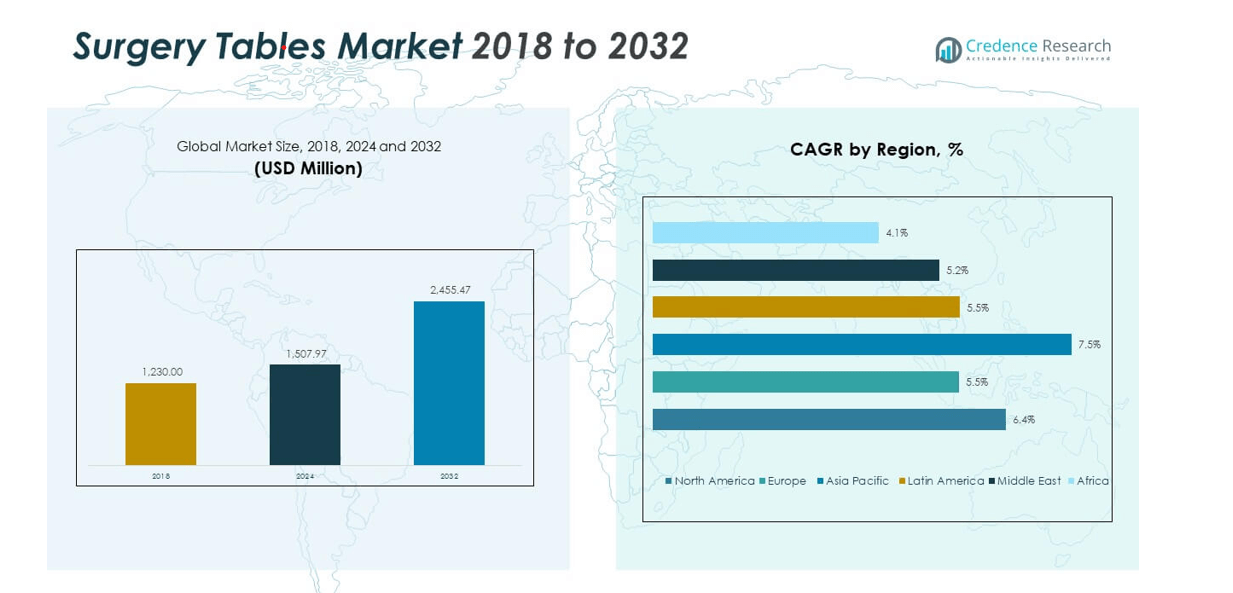
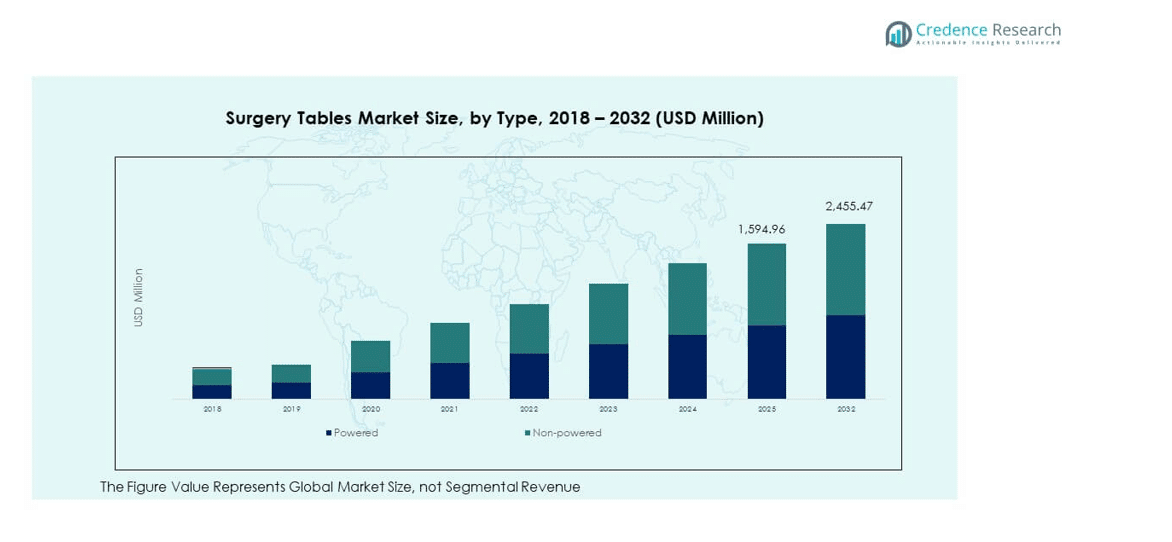
The Global Surgery Tables Market size was valued at USD 1,230.00 million in 2018 to USD 1,507.97 million in 2024 and is anticipated to reach USD 2,455.47 million by 2032, at a CAGR of 6.36% during the forecast period.
| REPORT ATTRIBUTE | DETAILS |
|---|---|
| Historical Period | 2020-2023 |
| Base Year | 2024 |
| Forecast Period | 2025-2032 |
| Surgery Tables Market Size 2024 | USD 1,507.97 million |
| Surgery Tables Market, CAGR | 6.36% |
| Surgery Tables Market Size 2032 | USD 2,455.47 million |
The Global Surgery Tables Market is driven by rising surgical volumes, advancements in operating room infrastructure, and the growing adoption of hybrid operating rooms. Increasing preference for minimally invasive surgeries and patient-centric care solutions has prompted hospitals to invest in technologically advanced and adjustable tables. The integration of imaging compatibility, ergonomic design, and better infection control features enhances surgical precision and safety, further fueling market demand across healthcare facilities.
Regionally, North America dominates due to advanced healthcare infrastructure and higher spending on surgical equipment. Europe follows with strong public healthcare systems and increasing adoption of hybrid operating rooms. The Asia-Pacific region is emerging rapidly, supported by rising healthcare investments, expanding hospital networks, and growing medical tourism in countries such as India, China, and Thailand. Latin America and the Middle East also show potential due to modernizing healthcare facilities and increasing government focus on surgical care expansion.
Market Insights:
- The Global Surgery Tables Market was valued at USD 1,230.00 million in 2018, reaching USD 1,507.97 million in 2024, and is projected to attain USD 2,455.47 million by 2032, growing at a CAGR of 6.36% during the forecast period.
- North America holds the largest regional share at 31%, driven by advanced healthcare infrastructure, high surgical volumes, and adoption of hybrid operating rooms. Europe follows with a 23% share due to strong healthcare systems and modern surgical facility investments.
- Asia Pacific ranks third with a 27% share and is the fastest-growing region, supported by expanding hospital networks, government investments, and the rise of medical tourism across emerging economies.
- Powered surgical tables account for approximately 65% of the market, driven by automation, ergonomic functionality, and integration with advanced surgical equipment.
- Non-powered tables hold around 35% share, maintaining steady demand in smaller hospitals and ambulatory centers due to lower cost and ease of maintenance.
Market Drivers:
Rising Surgical Procedures and Expanding Healthcare Infrastructure
The Global Surgery Tables Market is driven by the increasing number of surgical procedures worldwide, including orthopedic, cardiovascular, and neurological surgeries. Growing aging populations and the rise in chronic diseases have led to a higher need for surgical interventions. Hospitals and specialty clinics are upgrading their surgical infrastructure to enhance patient outcomes. The surge in medical tourism across emerging economies has also accelerated hospital expansions. Governments are investing heavily in healthcare infrastructure and advanced surgical facilities. Manufacturers are responding by developing innovative tables with precise positioning and imaging capabilities. The strong focus on improving surgical accuracy and patient safety continues to support market growth.
- For instance, Hillrom's Trumpf Medical TruSystem 7000dV tables offer a fully motorized adjustment system featuring ±30° lateral tilt, designed to work with Integrated Table Motion for the da Vinci Xi surgical system. The table can accommodate a variety of accessories and can be used for general surgery, orthopedic procedures, and intraoperative imaging.
Technological Integration and Smart Table Design
Integration of advanced technology is transforming the functionality and efficiency of surgical tables. Electric and hydraulic systems now provide better control, movement, and flexibility for surgeons during operations. Smart tables with memory settings and modular components enhance workflow efficiency. Integration with imaging and robotic systems supports real-time surgical precision. The Global Surgery Tables Market benefits from these advancements by aligning with the needs of modern operating rooms. Improved ergonomics and adjustable height functions ensure better patient positioning and comfort. Automated features also reduce manual errors and enhance surgical outcomes. The trend toward hybrid operating rooms is further driving product demand.
- For instance, Getinge’s Maquet Magnus operating table features a lifting range from 535 mm to 1,235 mm and supports inclination angles up to 80° with a 45° tilt, while allowing 360° radiolucent imaging for CT and C-arm integration
Increasing Demand for Minimally Invasive and Robotic Surgeries
The demand for minimally invasive and robotic surgeries is accelerating table innovation. Hospitals are adopting surgery tables compatible with robotic arms and advanced imaging systems. These tables allow better patient positioning and alignment for precision-based procedures. The Global Surgery Tables Market grows through increased use in laparoscopic, orthopedic, and neurosurgical applications. Compact and mobile tables enable flexibility in multi-disciplinary operating rooms. Manufacturers are developing designs with improved stability and load-bearing capacity. Patient-centric features like ease of movement and lower noise levels increase usability. This demand aligns with global healthcare trends focused on efficiency and patient comfort.
Focus on Patient Safety and Infection Control Standards
Patient safety remains a primary driver across all healthcare settings. The Global Surgery Tables Market benefits from stricter regulations promoting sterile and hygienic operating environments. Manufacturers use antimicrobial coatings and materials that resist corrosion and microbial growth. Tables are designed for easy cleaning and maintenance, reducing infection risks. Hospitals prefer models with smooth surfaces and minimal joints for better hygiene. Advanced braking systems and safety locks ensure secure patient positioning during procedures. These improvements align with global initiatives to minimize hospital-acquired infections. The emphasis on safer surgeries continues to support steady adoption across public and private facilities.
Market Trends:
Rising Adoption of Hybrid Operating Rooms
Hospitals are increasingly adopting hybrid operating rooms to combine surgical and imaging capabilities. These setups require versatile tables that can integrate with C-arms, MRI, and CT scanners. The Global Surgery Tables Market benefits from this integration, enabling faster and safer procedures. Surgeons can perform diagnostics and interventions without moving the patient. This trend reduces surgery time and enhances workflow efficiency. Demand for multi-modality compatible tables is growing across advanced hospitals. The adoption trend also supports better outcomes in cardiovascular and neurosurgical operations. Manufacturers are focusing on lightweight yet durable materials to match hybrid room specifications.
- For instance, STERIS’ CMAX X-Ray Image-Guided Surgical Table provides 360° radiolucent carbon fiber tops and supports patients up to 230 kg, optimizing compatibility with Siemens and GE hybrid operating suites
Shift Toward Electric and Battery-Powered Tables
The market is witnessing a clear shift from manual to electric and battery-powered tables. These models offer enhanced control, smoother motion, and precision adjustments. The Global Surgery Tables Market sees growth from hospitals modernizing their operating rooms with automated systems. Surgeons prefer battery-backed models that operate during power interruptions. The trend also reduces dependence on manual effort, improving consistency in table positioning. Energy-efficient motors and low-noise operation are now standard expectations. Manufacturers are integrating user-friendly touch controls and wireless remotes for better usability. This technological transition continues to redefine product standards across the market.
- For instance, Skytron’s 3100A surgical table is equipped with an electric lift system supporting a 227 kg capacity and features 25 programmable motion combinations with a pendant control system, ensuring precise multi-disciplinary functionality
Customization and Modular Design Preferences
Hospitals increasingly seek modular tables that adapt to various surgical disciplines. The Global Surgery Tables Market benefits from designs allowing easy configuration for orthopedic, urological, and gynecological surgeries. Modular systems reduce downtime between procedures and optimize operating room use. Surgeons appreciate customizable attachments and detachable sections for flexibility. Lightweight yet durable frames enhance mobility within hospitals. Manufacturers focus on ergonomic design and intuitive controls for better operator comfort. Demand for reconfigurable and multifunctional tables reflects broader hospital efficiency goals. These innovations improve workflow management while supporting precision surgery.
Growing Demand for Imaging-Compatible and Carbon Fiber Tables
Imaging compatibility has become a key product feature across modern surgical setups. The Global Surgery Tables Market is expanding through increased adoption of carbon fiber tables offering radiolucency. Such materials enhance image clarity during intraoperative imaging. The lightweight design supports easy maneuverability without sacrificing strength. Surgeons benefit from improved visualization during complex operations like orthopedics and spinal surgeries. Hospitals prefer imaging tables for procedures requiring constant image guidance. The trend aligns with global moves toward image-guided and robotic-assisted surgeries. Manufacturers continue investing in materials that balance strength, stability, and transparency to X-rays.
Market Challenges Analysis:
High Cost and Maintenance Burden of Advanced Surgery Tables
The Global Surgery Tables Market faces major challenges due to the high cost of advanced operating room equipment. Many hospitals in developing regions struggle to afford electrically operated and hybrid-compatible tables. Maintenance and repair costs add further pressure to operational budgets. Advanced tables require skilled technicians for setup and calibration, raising labor expenses. Budget constraints in public hospitals often delay upgrades or replacements. Smaller clinics depend on basic manual tables, limiting market expansion. Lack of access to financing options also slows adoption across lower-income regions. Manufacturers must develop cost-effective models to penetrate these markets.
Limited Awareness and Integration Challenges in Emerging Economies
The Global Surgery Tables Market encounters barriers in emerging economies where healthcare modernization is gradual. Many hospitals lack awareness about the long-term efficiency and precision benefits of advanced tables. Poor infrastructure limits the adoption of battery-powered and imaging-compatible models. Training gaps among staff hinder proper use of automated features. Supply chain inefficiencies delay product availability and increase costs. Regulatory approval processes in some countries slow product launches. Limited collaboration between OEMs and healthcare institutions restricts innovation adoption. Addressing these challenges is vital to ensure equitable access to modern surgical solutions worldwide.
Market Opportunities:
Rising Investments in Healthcare Infrastructure and Surgical Facilities
The Global Surgery Tables Market is expected to benefit from expanding healthcare infrastructure projects worldwide. Governments and private players are modernizing hospitals and surgical centers to meet growing demand. New hospital construction and facility upgrades create steady product demand. Increasing healthcare spending in Asia-Pacific and the Middle East opens new sales opportunities. Manufacturers offering customized and region-specific models gain stronger footholds. Growth in medical tourism enhances investment in high-end surgical equipment. This development expands product penetration in emerging economies.
Adoption of AI and Robotics Integration for Precision Surgery
The Global Surgery Tables Market is witnessing opportunities in robotics and AI-based surgery advancements. Smart tables capable of synchronizing with robotic systems improve operational efficiency. Integration of AI-driven positioning systems enhances accuracy in complex surgeries. Hospitals investing in automation seek interoperable tables for future scalability. These innovations also improve surgical outcomes and reduce fatigue for surgeons. Partnerships between tech firms and healthcare equipment providers are accelerating such developments. Demand for intelligent, adaptive, and connected tables will shape the next growth phase for the market.
Market Segmentation Analysis:
By Product Type
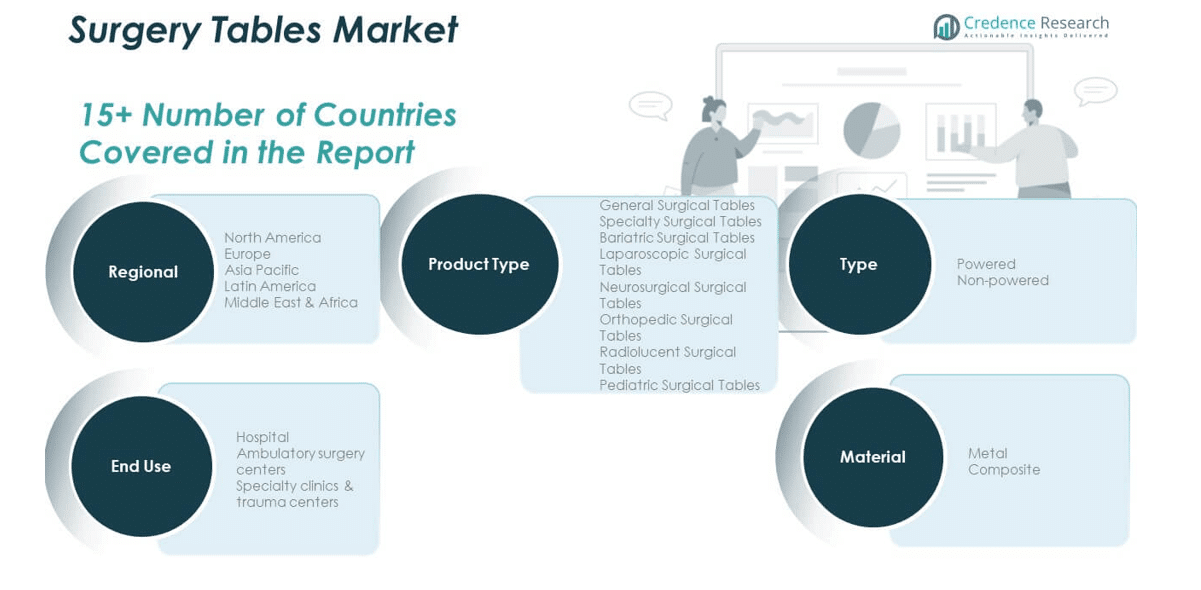
The Global Surgery Tables Market is categorized into general surgical tables, specialty surgical tables, bariatric surgical tables, laparoscopic surgical tables, neurosurgical surgical tables, orthopedic surgical tables, radiolucent surgical tables, and pediatric surgical tables. General surgical tables dominate due to their broad usage across multiple procedures. Specialty and orthopedic tables are growing quickly, supported by advanced surgical technologies and precision needs. Radiolucent tables are gaining traction for imaging compatibility and minimally invasive surgeries. Increasing demand for neurosurgical and laparoscopic tables reflects the global shift toward specialized medical care.
- For instance, Mizuho OSI's ProAxis Spinal Surgery Table allows for controlled, robotically-assisted flexion and extension through an advanced hinge and offers full C-arm and O-arm compatibility for spinal imaging. The table provides a 55-degree range of motion, with up to 35° of flexion and up to 20° of extension, and can make adjustments in 1° increments.
By Type
The market includes powered and non-powered tables. Powered tables hold a major share due to automation, ergonomic flexibility, and improved precision during surgery. Hospitals prefer powered models for their efficiency and integration with hybrid operating rooms. Non-powered tables remain relevant in small clinics and resource-limited settings due to their cost-effectiveness and reliability.
- For instance, in March 2024, Siemens Healthineers announced the FDA clearance of its self-driving, robotic mobile C-arm system, CIARTIC Move. This system features self-driving capabilities and the ability to save and recall up to 12 procedure-specific positions to automate workflows and reduce imaging time during operations. In preclinical testing, it demonstrated significant intraoperative time savings, in one instance showing nearly 50% faster imaging during spine surgery and 55% faster in pelvic surgery compared with traditional mobile C-arms.
By End-use
Hospitals lead the segment due to continuous infrastructure upgrades and higher patient inflow. Ambulatory surgery centers are growing rapidly with demand for outpatient and day-care procedures. Specialty clinics and trauma centers are expanding table usage for specific treatments, driving segment growth.
By Material
Metal tables account for the majority share, offering durability, stability, and strength. Composite tables are witnessing rising demand due to their lightweight design, corrosion resistance, and imaging compatibility. The shift toward radiolucent composite materials highlights the market’s focus on performance and patient safety.
Segmentation:
By Product Type
- General Surgical Tables
- Specialty Surgical Tables
- Bariatric Surgical Tables
- Laparoscopic Surgical Tables
- Neurosurgical Surgical Tables
- Orthopedic Surgical Tables
- Radiolucent Surgical Tables
- Pediatric Surgical Tables
By Type
- Powered
- Non-powered
By End-use
- Hospitals
- Ambulatory Surgery Centers
- Specialty Clinics & Trauma Centers
By Material
- Metal
- Composite
By Region
- North America
- U.S.
- Canada
- Mexico
- Europe
- Germany
- France
- U.K.
- Italy
- Spain
- Rest of Europe
- Asia Pacific
- China
- Japan
- India
- South Korea
- South-east Asia
- Rest of Asia Pacific
- Latin America
- Brazil
- Argentina
- Rest of Latin America
- Middle East & Africa
- GCC Countries
- South Africa
- Rest of the Middle East and Africa
Regional Analysis:
North America
The North America Global Surgery Tables Market size was valued at USD 440.34 million in 2018 to USD 533.21 million in 2024 and is anticipated to reach USD 867.03 million by 2032, at a CAGR of 6.4% during the forecast period. North America holds the largest market share of around 31% in the global market. It is driven by strong healthcare infrastructure, high surgical procedure volumes, and rapid adoption of technologically advanced operating room equipment. Hospitals across the U.S. and Canada are prioritizing hybrid operating rooms and robotic-assisted surgeries. Rising demand for ergonomic and imaging-compatible tables supports continued growth. Favorable reimbursement policies and strong manufacturer presence also boost sales. Investments in healthcare modernization and patient safety standards strengthen the region’s leadership position.
Europe
The Europe Global Surgery Tables Market size was valued at USD 287.82 million in 2018 to USD 337.44 million in 2024 and is anticipated to reach USD 515.04 million by 2032, at a CAGR of 5.5% during the forecast period. Europe accounts for about 23% of the global share. The market benefits from advanced public healthcare systems, increased government investments, and adoption of smart surgical solutions. Hospitals in countries like Germany, France, and the UK focus on modernizing surgical facilities with automation and precision technologies. Growing geriatric populations drive demand for specialized surgeries, boosting the need for advanced operating tables. Manufacturers emphasize CE-certified and ergonomic designs for compliance with EU standards. Integration of robotic systems in operating rooms enhances procedural safety and accuracy.
Asia Pacific
The Asia Pacific Global Surgery Tables Market size was valued at USD 332.10 million in 2018 to USD 423.51 million in 2024 and is anticipated to reach USD 754.57 million by 2032, at a CAGR of 7.5% during the forecast period. Asia Pacific contributes around 27% of the total global share and is the fastest-growing region. Rapid healthcare expansion in China, India, and Japan drives strong demand for modern surgical infrastructure. Governments are increasing healthcare budgets and improving access to advanced medical technologies. Rising medical tourism and growing surgical procedures boost regional sales. Manufacturers expand their production bases to meet local demand efficiently. Improved hospital infrastructure and training initiatives strengthen long-term adoption.
Latin America
The Latin America Global Surgery Tables Market size was valued at USD 90.04 million in 2018 to USD 109.46 million in 2024 and is anticipated to reach USD 167.14 million by 2032, at a CAGR of 5.5% during the forecast period. Latin America accounts for nearly 6% of the global share. Market growth is supported by the expansion of private healthcare facilities and increasing focus on surgical safety. Brazil and Mexico lead the regional market due to rising hospital investments. Growing awareness of advanced medical equipment is encouraging upgrades across surgical units. Economic reforms and healthcare privatization drive equipment modernization. Manufacturers are targeting cost-effective solutions to serve mid-scale hospitals.
Middle East
The Middle East Global Surgery Tables Market size was valued at USD 51.66 million in 2018 to USD 59.71 million in 2024 and is anticipated to reach USD 88.66 million by 2032, at a CAGR of 5.2% during the forecast period. The region holds about 5% of the global share. Market growth is fueled by hospital expansion projects in GCC countries and rising investments in specialized care. Governments are focusing on upgrading healthcare facilities and promoting local manufacturing. The adoption of robotic and hybrid surgical systems is increasing in tertiary hospitals. Growing partnerships with international medical equipment suppliers are enhancing technology accessibility. The trend toward advanced and patient-safe surgical environments drives further demand.
Africa
The Africa Global Surgery Tables Market size was valued at USD 28.04 million in 2018 to USD 44.64 million in 2024 and is anticipated to reach USD 63.03 million by 2032, at a CAGR of 4.1% during the forecast period. Africa represents around 4% of the global market share. The region’s growth is led by gradual improvements in healthcare infrastructure and increased government focus on hospital modernization. South Africa and Egypt remain key markets, supported by ongoing healthcare projects. International aid and private investments are enhancing access to surgical facilities. Demand for cost-effective and durable tables is rising across public hospitals. Manufacturers view Africa as an emerging market with long-term potential due to rising healthcare access and awareness.
Key Player Analysis:
- Hill-Rom Holdings, Inc.
- Steris Plc.
- Stryker Corp.
- Getinge AB
- Shenzhen Mindray Bio-Medical Electronics Co., Ltd.
- Mizuho Corporation (Mizuho OSI, Inc.)
- Skytron LLC
- Alvo Medical
- Allengers Medical Systems Ltd.
Competitive Analysis:
The Global Surgery Tables Market is highly competitive with several international and regional manufacturers offering a wide range of products. It is characterized by innovation in design, ergonomics, and imaging compatibility. Major players focus on developing automated and hybrid-compatible tables to meet hospital modernization demands. Strategic initiatives such as mergers, acquisitions, and product diversification strengthen market positioning. Manufacturers emphasize durable materials, infection control, and advanced control systems to gain a technological edge. Continuous R&D investment and global distribution networks enhance their market reach and brand presence.
Recent Developments:
- In June 2023, Steris Plc. acquired the surgical instrumentation platform from BD (Becton, Dickinson and Company). This deal, valued at $540 million, allowed Steris to serve hospitals and surgery centers more comprehensively by integrating a well-established range of surgical instruments into its healthcare offerings, enhancing its competitive position in infection prevention and operating room equipment.
- In February 2025, Stryker Corp. completed the acquisition of Inari Medical, Inc. for about $4.9 billion. This acquisition expands Stryker's reach in the high-growth peripheral vascular segment with Inari’s innovative solutions for venous thromboembolism (VTE) and mechanical thrombectomy. The integration is set to enhance Stryker’s Neurovascular and interventional portfolios with Inari’s advanced catheter-based devices for clot removal and vascular procedures.
- In July 2025, Getinge AB announced a major strategic partnership with Zimmer Biomet to distribute its operating room (OR) capital products to Ambulatory Surgery Center (ASC) customers across the U.S. and other markets. This collaboration enables a single-source solution for surgical equipment, infection control, and joint replacement implants, streamlining procurement and enhancing value for same-day surgical care providers.
- In January 2024, Shenzhen Mindray Bio-Medical Electronics unveiled a deal to acquire a controlling stake in APT Medical, valued at approximately $927 million. This acquisition will enable Mindray to expand further into cardiovascular and interventional medical devices, leveraging APT’s strength in electrophysiology catheters and related surgical products for heart and vascular health. Mindray also continues to launch innovative diagnostic and surgical technologies in international markets.
Report Coverage:
The research report offers an in-depth analysis based on product type, type, end-use, and material. It details leading market players, providing an overview of their business, product offerings, investments, revenue streams, and key applications. Additionally, the report includes insights into the competitive environment, SWOT analysis, current market trends, as well as the primary drivers and constraints. Furthermore, it discusses various factors that have driven market expansion in recent years. The report also explores market dynamics, regulatory scenarios, and technological advancements that are shaping the industry. It assesses the impact of external factors and global economic changes on market growth. Lastly, it provides strategic recommendations for new entrants and established companies to navigate the complexities of the market.
Future Outlook:
- Growing demand for advanced and automated surgical tables will drive innovation.
- Hybrid operating rooms will remain a major catalyst for product development.
- Hospitals will continue investing in imaging-compatible and modular tables.
- Robotic and AI-assisted surgeries will boost demand for smart positioning systems.
- Emerging economies will experience rapid adoption due to healthcare expansion.
- Manufacturers will prioritize lightweight, corrosion-resistant, and radiolucent materials.
- Strategic partnerships and mergers will strengthen global distribution networks.
- Customization and ergonomic designs will enhance surgeon efficiency and safety.
- Sustainability and energy-efficient technologies will influence purchasing decisions.
- Digital integration with data-driven surgical systems will shape long-term growth.

Request a Free Sample
Fill in your details and we'll send you a free sample report.
- Sample data tables & charts
- Research methodology
Market Dynamics
Rising Surgical Procedures and Expanding Healthcare Infrastructure
The increasing number of surgical procedures globally, driven by aging populations and chronic disease prevalence, is prompting hospitals and clinics to upgrade their surgical infrastructure, directly boosting demand for advanced surgery tables.
Technological Integration and Smart Table Design
Advancements such as electric and hydraulic systems, imaging compatibility, and integration with robotic and AI-assisted surgical systems are making surgery tables more efficient, precise, and attractive to modern healthcare facilities.
Preference for Minimally Invasive and Robotic Surgeries
The shift toward minimally invasive and robotic-assisted surgeries requires tables with enhanced positioning, stability, and compatibility with imaging and robotic equipment, driving innovation and adoption in the market.
Focus on Patient Safety and Infection Control
Stricter regulations and hospital policies around infection control and patient safety are increasing demand for tables with antimicrobial coatings, easy-to-clean surfaces, and advanced safety features, supporting market growth.
Healthcare Investments and Medical Tourism in Emerging Markets
Rising healthcare investments and the growth of medical tourism, especially in Asia Pacific and the Middle East, are expanding hospital networks and increasing the adoption of technologically advanced surgical tables in these regions.
Need a Custom Version of This Report?
Tailor the scope, geography, or segments to your exact requirements.
- Custom geography or segment scope
- Direct access to our analyst team
Frequently Asked Questions
What is the current market size for the Global Surgery Tables Market, and what is its projected size in 2032?
At what Compound Annual Growth Rate is the Global Surgery Tables Market projected to grow between 2025 and 2032?
Which Global Surgery Tables Market segment held the largest share in 2024?
What are the primary factors fueling the growth of the Global Surgery Tables Market?
Who are the major players in this market?
Table of Content
Chapter 1 Market Segmentation
- 1.1 Segmentation Framework
- 1.1.1 Product and Service Classification
- 1.1.2 Application and End-Use Classification
- 1.1.3 Technology and Solution Classification
- 1.1.4 Customer and Distribution Channel Classification
- 1.1.5 Geographic Segmentation
- 1.1.6 Market Segment Definitions and Boundaries
- 1.2 By Type
- 1.2.1 Powered
- 1.2.2 Non-powered
- 1.3 By End-use
- 1.3.1 Hospitals
- 1.3.2 Ambulatory Surgery Centers
- 1.3.3 Specialty Clinics & Trauma Centers
- 1.4 By Material
- 1.4.1 Metal
- 1.4.2 Composite
- 1.5 By Product Type
- 1.5.1 General Surgical Tables
- 1.5.2 Specialty Surgical Tables
- 1.5.3 Bariatric Surgical Tables
- 1.5.4 Laparoscopic Surgical Tables
- 1.5.5 Neurosurgical Surgical Tables
- 1.5.6 Orthopedic Surgical Tables
- 1.5.7 Radiolucent Surgical Tables
- 1.5.8 Pediatric Surgical Tables
Chapter 2 Introduction
- 2.1 Report Objectives and Scope
- 2.2 Product Definition and Industry Terminology
- 2.3 Market Inclusions and Exclusions
- 2.4 Research Process
- 2.4.1 Primary Research and Expert Interviews
- 2.4.2 Secondary Research and Source Review
- 2.4.3 Top-Down and Bottom-Up Estimation
- 2.4.4 Data Triangulation and Verification
- 2.5 Market Size Measurement Basis
- 2.5.1 2018: USD 1,230.00 million → 2032: USD 2,455.47 million
- 2.6 Historical and Forecast Reference Periods
- 2.6.1 Base Year: 2018
- 2.6.2 Forecast Period: 2018-2032
- 2.7 Research Assumptions and Limitations
Chapter 3 Executive Summary
- 3.1 Market Snapshot and Key Findings
- 3.2 Base-Year Market Size, 2018
- 3.3 Forecast Market Size, 2032
- 3.4 Revenue and Volume Growth Outlook
- 3.5 Key Demand and Supply Indicators
- 3.6 Leading Market Segments
- 3.7 Fastest-Growing Market Opportunities
- 3.8 Regional Performance Highlights
- 3.9 Technology and Industry Transformation
- 3.10 Competitive Landscape Summary
- 3.11 Analyst View and Strategic Implications
Chapter 4 Global Surgery Tables Market Trends and Developments
- 4.1 Historical Industry Development
- 4.2 Recent Market Trends and Developments
- 4.3 Demand and Customer Behavior Trends
- 4.4 Technology and Product Innovation
- 4.5 Artificial Intelligence, Automation and Digitalization
- 4.6 Local Manufacturing and Supply Chain Realignment
- 4.7 Industry Partnerships, Mergers and Acquisitions
- 4.8 Sustainability and Circular Economy Developments
- 4.9 Government and Private Sector Investment Trends
- 4.10 Emerging Business Models and Commercialization
- 4.11 Industry Developments and Announcements
Chapter 5 Global Surgery Tables Market Production, Supply and Demand Analysis
- 5.1 Demand Trend and Consumption Analysis
- 5.2 Demand Forecast, 2018-2032
- 5.3 Production and Output Trend
- 5.4 Production and Output Forecast, 2018-2032
- 5.5 Installed Capacity and Capacity Utilization
- 5.6 Company-Wise Production Plants and Statistics
- 5.6.1 Installed Production Capacity
- 5.6.2 Actual Production
- 5.6.3 Planned Capacity and Expansion Targets
- 5.7 Supply Chain Structure and Procurement Trends
- 5.8 Supply-Demand Gap and Bottlenecks
- 5.9 Import Dependence and Sourcing Structure
- 5.10 Contract Manufacturing and Outsourcing
- 5.11 Regional Supply and Demand Concentration
Chapter 6 Global Surgery Tables Market Pricing Analysis
- 6.1 Pricing Structure and Measurement
- 6.2 Historical Pricing Trends
- 6.3 Pricing Outlook, 2018-2032
- 6.4 Average Selling Price and Unit Economics
- 6.5 Pricing by Product and Market Segment
- 6.6 Geographic Pricing Differences
- 6.7 Key Input, Energy, Labor and Logistics Costs
- 6.8 Contract Pricing and Purchasing Models
- 6.9 Pricing Sensitivity and Competitive Positioning
- 6.10 Price, Margin and Profitability Implications
Chapter 7 Global Surgery Tables Market Dynamics
- 7.1 Market Growth Drivers
- 7.1.1 Demand-Side Drivers
- 7.1.2 Technology and Innovation Drivers
- 7.1.3 Infrastructure and Investment Drivers
- 7.1.4 Regulatory and Policy Drivers
- 7.2 Market Restraints
- 7.2.1 Cost and Affordability Constraints
- 7.2.2 Technology and Adoption Barriers
- 7.2.3 Supply Chain and Operational Constraints
- 7.3 Market Challenges
- 7.3.1 Competitive Pressure and Margin Erosion
- 7.3.2 Skills, Infrastructure and Implementation Gaps
- 7.4 Emerging Market Opportunities
- 7.5 Market Dynamics Impact and Time-Horizon Assessment
Chapter 8 Global Surgery Tables Value Chain Analysis
- 8.1 Industry Value Chain Overview
- 8.2 Upstream Suppliers and Critical Inputs
- 8.3 Technology and Component Providers
- 8.4 Manufacturing or Service Delivery
- 8.5 Distribution, Channel Partners and Integrators
- 8.6 Downstream Applications and End Users
- 8.7 Value Addition and Profit Pools
- 8.8 Vertical Integration and Outsourcing
- 8.9 Supplier Concentration and Risk
- 8.10 Supply Chain Localization and Resilience
Chapter 9 Global Surgery Tables Market Regulations and Policies
- 9.1 Relevant Laws, Standards and Compliance Frameworks
- 9.2 Product, Service, Safety and Quality Requirements
- 9.3 Government Policies, Incentives and Subsidies
- 9.4 Imports, Exports and Trade Barriers
- 9.5 Public Procurement and Local Content Requirements
- 9.6 Environmental and Sustainability Compliance
- 9.7 Upcoming Policy Changes and Market Implications
Chapter 10 Global Surgery Tables Market Hotspots and Opportunities
- 10.1 Market Opportunity Mapping and Growth Hotspots
- 10.2 High-Growth Applications and Customer Groups
- 10.3 Underserved Markets and White-Space Opportunities
- 10.4 Emerging Technology and Product Opportunities
- 10.5 New Capacity and Investment Hotspots
- 10.6 Market Entry and Expansion Opportunities
- 10.7 Distribution and Partnership Opportunities
- 10.8 Near-Term and Long-Term Commercial Potential
- 10.9 Opportunity Attractiveness and Execution Risks
Chapter 11 Global Surgery Tables Market Outlook, 2018-2032
- 11.1 Market Size and Analysis
- 11.1.1 Revenue (Market Measurement: 2018: USD 1,230.00 million → 2032: USD 2,455.47 million)
- 11.1.2 Market Volume and Quantity Sold
- 11.1.3 Historical Market Size
- 11.1.4 Base-Year Market Size, 2018
- 11.2 Market Forecast, 2018-2032
- 11.2.1 Revenue Forecast to 2032
- 11.2.2 Volume Forecast to 2032
- 11.2.3 CAGR and Year-on-Year Growth
- 11.2.4 Incremental Revenue Opportunity
- 11.3 Forecast Assumptions and Scenario Analysis
- 11.3.1 Base-Case Forecast
- 11.3.2 Optimistic and Conservative Scenarios
- 11.3.3 Technology, Pricing and Policy Sensitivities
- 11.4 Market Attractiveness and Growth Outlook
Chapter 12 Global Surgery Tables Market Segmentation and Outlook
- 12.1 Segmentation Summary and Market Shares, 2018
- 12.2 Largest and Fastest-Growing Segments
- 12.3 By Type - Market Size and Forecast, 2018-2032
- 12.3.1 Segment Definition and Scope
- 12.3.2 Historical Market Size
- 12.3.3 Revenue Forecast, 2018-2032
- 12.3.4 Volume Forecast, 2018-2032
- 12.3.5 Base-Year Market Share, 2018
- 12.3.6 Segment CAGR and Growth Drivers
- 12.3.7 Subsegment Market Size and Forecast
- 12.3.7.1 Powered
- 12.3.7.2 Non-powered
- 12.3.8 Subsegment Pricing and Adoption Trends
- 12.3.9 Leading Suppliers and Competition
- 12.3.10 Regional Demand and Opportunities
- 12.4 By End-use - Market Size and Forecast, 2018-2032
- 12.4.1 Segment Definition and Scope
- 12.4.2 Historical Market Size
- 12.4.3 Revenue Forecast, 2018-2032
- 12.4.4 Volume Forecast, 2018-2032
- 12.4.5 Base-Year Market Share, 2018
- 12.4.6 Segment CAGR and Growth Drivers
- 12.4.7 Subsegment Market Size and Forecast
- 12.4.7.1 Hospitals
- 12.4.7.2 Ambulatory Surgery Centers
- 12.4.7.3 Specialty Clinics & Trauma Centers
- 12.4.8 Subsegment Pricing and Adoption Trends
- 12.4.9 Leading Suppliers and Competition
- 12.4.10 Regional Demand and Opportunities
- 12.5 By Material - Market Size and Forecast, 2018-2032
- 12.5.1 Segment Definition and Scope
- 12.5.2 Historical Market Size
- 12.5.3 Revenue Forecast, 2018-2032
- 12.5.4 Volume Forecast, 2018-2032
- 12.5.5 Base-Year Market Share, 2018
- 12.5.6 Segment CAGR and Growth Drivers
- 12.5.7 Subsegment Market Size and Forecast
- 12.5.7.1 Metal
- 12.5.7.2 Composite
- 12.5.8 Subsegment Pricing and Adoption Trends
- 12.5.9 Leading Suppliers and Competition
- 12.5.10 Regional Demand and Opportunities
- 12.6 By Product Type - Market Size and Forecast, 2018-2032
- 12.6.1 Segment Definition and Scope
- 12.6.2 Historical Market Size
- 12.6.3 Revenue Forecast, 2018-2032
- 12.6.4 Volume Forecast, 2018-2032
- 12.6.5 Base-Year Market Share, 2018
- 12.6.6 Segment CAGR and Growth Drivers
- 12.6.7 Subsegment Market Size and Forecast
- 12.6.7.1 General Surgical Tables
- 12.6.7.2 Specialty Surgical Tables
- 12.6.7.3 Bariatric Surgical Tables
- 12.6.7.4 Laparoscopic Surgical Tables
- 12.6.7.5 Neurosurgical Surgical Tables
- 12.6.7.6 Orthopedic Surgical Tables
- 12.6.7.7 Radiolucent Surgical Tables
- 12.6.7.8 Pediatric Surgical Tables
- 12.6.8 Subsegment Pricing and Adoption Trends
- 12.6.9 Leading Suppliers and Competition
- 12.6.10 Regional Demand and Opportunities
- 12.7 Segment Growth Comparison
- 12.8 Segment Attractiveness and Priority Matrix
Chapter 13 Global Surgery Tables End-Use and Application Market Outlook
- 13.1 End-Use Industry and Customer Demand Structure
- 13.2 Leading Applications and Customer Groups
- 13.3 End-Use Market Size, Share and Forecast
- 13.4 Major End-Use Industry Deep Dives
- 13.4.1 Customer Requirements and Use Cases
- 13.4.2 Demand and Replacement Cycles
- 13.4.3 Technical and Regulatory Considerations
- 13.4.4 Purchasing and Procurement Models
- 13.4.5 Leading Vendors and Distribution Channels
- 13.4.6 Forecast and Commercial Opportunities
- 13.5 Emerging Applications and Cross-Segment Demand
- 13.6 End-Use Industry Investment Priorities
Chapter 14 Global Surgery Tables Geographic Market Outlook, 2018-2032
- 14.1 Regional Market Size and Share, 2018
- 14.2 Regional Market Forecast, 2018-2032
- 14.3 Regional Pricing, Production and Demand Differences
- 14.4 North America
- 14.4.1 United States
- 14.4.2 Canada
- 14.4.3 Mexico
- 14.5 Europe
- 14.5.1 Germany
- 14.5.2 France
- 14.5.3 Italy
- 14.5.4 United Kingdom
- 14.5.5 Spain
- 14.5.6 Poland
- 14.5.7 Russia
- 14.5.8 Netherlands
- 14.5.9 Belgium
- 14.5.10 Sweden
- 14.5.11 Denmark
- 14.5.12 Norway
- 14.5.13 Rest of Europe
- 14.6 Asia Pacific
- 14.6.1 China
- 14.6.2 India
- 14.6.3 Japan
- 14.6.4 South Korea
- 14.6.5 Thailand
- 14.6.6 Indonesia
- 14.6.7 Vietnam
- 14.6.8 Malaysia
- 14.6.9 Australia
- 14.6.10 Rest of Asia Pacific
- 14.7 Latin America
- 14.7.1 Brazil
- 14.7.2 Argentina
- 14.7.3 Colombia
- 14.7.4 Chile
- 14.7.5 Rest of Latin America
- 14.8 Middle East
- 14.8.1 Saudi Arabia
- 14.8.2 United Arab Emirates
- 14.8.3 Turkey
- 14.8.4 Israel
- 14.8.5 Iran
- 14.8.6 Rest of the Middle East
- 14.9 Africa
- 14.9.1 South Africa
- 14.9.2 Egypt
- 14.9.3 Nigeria
- 14.9.4 Morocco
- 14.9.5 Rest of Africa
- 14.10 Regional Investment, Policy and Supply Chain Differences
- 14.11 Regional Competitive Landscape
- 14.12 Geographic Growth Hotspots
Chapter 15 Global Surgery Tables Technology, Innovation and Sustainability Outlook
- 15.1 Technology Landscape and Maturity
- 15.2 Product, Process and Service Innovation
- 15.3 AI, Automation and Digital Tools in the Industry
- 15.4 Technology Adoption and Performance Benchmarking
- 15.5 Innovation Pipeline and R&D Investment
- 15.6 Patent and Intellectual Property Trends
- 15.7 Energy Efficiency and Resource Management
- 15.8 Sustainability, Recycling and Circularity
- 15.9 Technology Roadmap, 2018-2032
- 15.10 Risks of Obsolescence and Technology Substitution
Chapter 16 Global Surgery Tables Market Key Strategic Imperatives
- 16.1 Growth and Market Entry Priorities
- 16.2 High-Return Products and Segments
- 16.3 Pricing, Profitability and Cost Optimization
- 16.4 Technology Investment and Product Differentiation
- 16.5 Supply Chain Localization and Resilience
- 16.6 Distribution and Customer Acquisition
- 16.7 Partnership, Acquisition and Capacity Strategy
- 16.8 Regional Expansion Priorities
- 16.9 Short-, Medium- and Long-Term Actions
Chapter 17 Competition Outlook
- 17.1 Industry Competition Characteristics
- 17.2 Market Structure and Concentration
- 17.3 Market Share and Competitive Positioning, 2018
- 17.4 Company-Wise Revenue and Product Benchmarking
- 17.5 Production and Service Capacity Benchmarking
- 17.6 Technology, Pricing and Differentiation
- 17.7 Regional Footprint and Distribution Strength
- 17.8 Mergers, Acquisitions and Strategic Alliances
- 17.9 New Entrants and Competitive Threats
- 17.10 Porter's Five Forces and Industry Attractiveness
- 17.11 Competitive Outlook, 2018-2032
Chapter 18 Company Profiles
- 18.1 Company Coverage and Selection Criteria
- 18.2 Hill-Rom Holdings, Inc.
- 18.2.1 Business Description
- 18.2.2 Company Ownership and Geographic Presence
- 18.2.3 Product and Service Portfolio
- 18.2.4 Manufacturing and Operating Footprint
- 18.2.5 Production Capacity and Expansion Plans
- 18.2.6 Financial Performance and Investment
- 18.2.7 Market Share and Competitive Position
- 18.2.8 Technology and Innovation Capabilities
- 18.2.9 Strategic Alliances or Partnerships
- 18.2.10 Recent Developments
- 18.2.11 Growth Strategy and Outlook
- 18.3 Steris Plc.
- 18.4 Stryker Corp.
- 18.5 Getinge AB
- 18.6 Shenzhen Mindray Bio-Medical Electronics Co., Ltd.
- 18.7 Mizuho Corporation (Mizuho OSI, Inc.)
- 18.8 Skytron LLC
- 18.9 Alvo Medical
- 18.10 Allengers Medical Systems Ltd.
- 18.11 Other Relevant Market Participants
Note: Every listed company is profiled on the structure shown under the first company. The company list is preliminary and may change based on research findings, market developments, data availability and client requirements.
Chapter 19 Disclaimer
- 19.1 Research and Forecast Disclaimer
- 19.2 Data Source and Estimation Limitations
Note: The depth of individual sections depends on data availability for this market. Volume, capacity, trade and other unit-based metrics are included where applicable.

