Home » Medical Devices » Operating Room Equipment Market

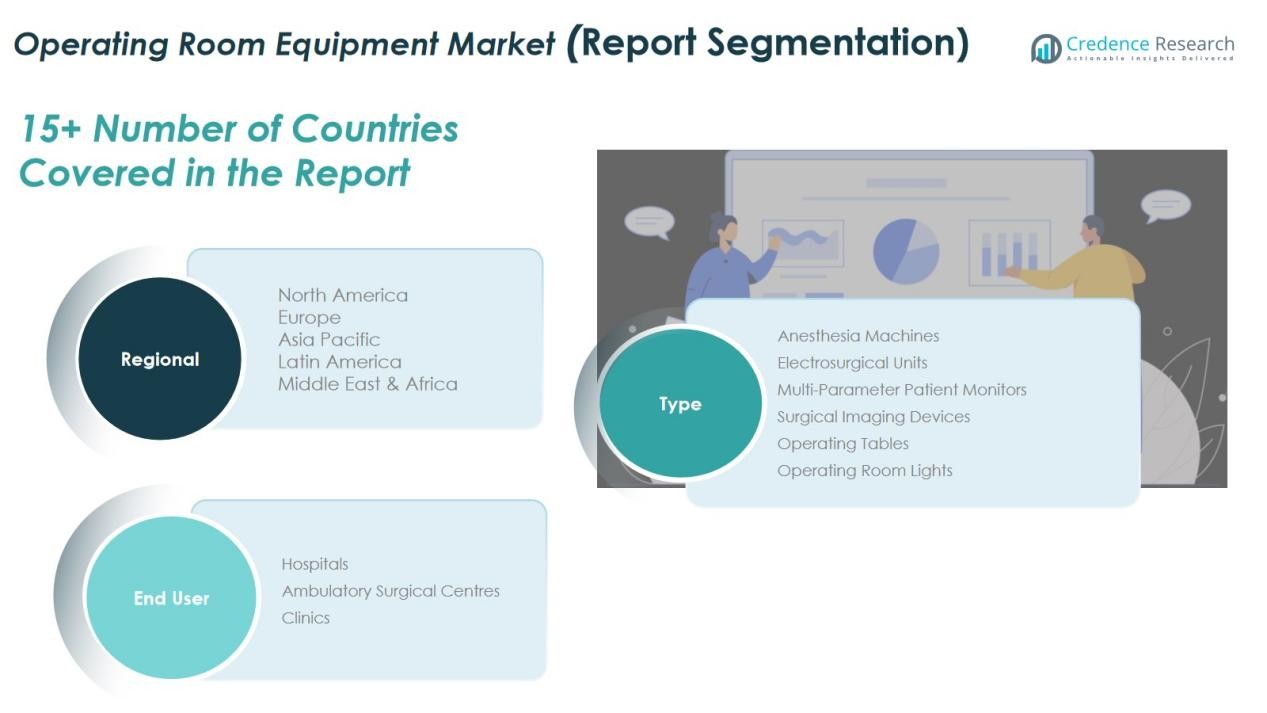
Operating Room Equipment Market By Type (Anesthesia Machines, Electrosurgical Units, Multi-Parameter Patient Monitors, Surgical Imaging Devices, Operating Tables, Operating Room Lights); By End User (Hospitals, Ambulatory Surgical Centres, Clinics) – Growth, Share, Opportunities & Competitive Analysis, 2024 – 2032

Report ID: 7934 | Report Format : Excel, PDF

Market Overview:

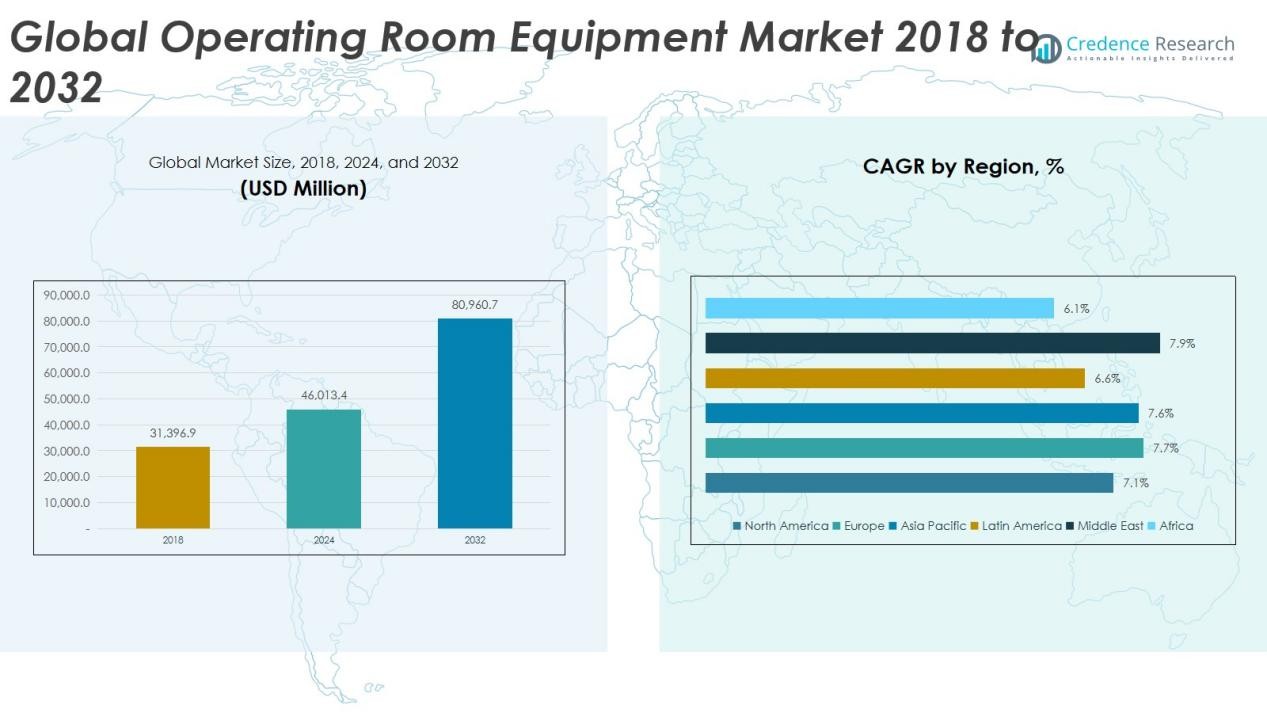
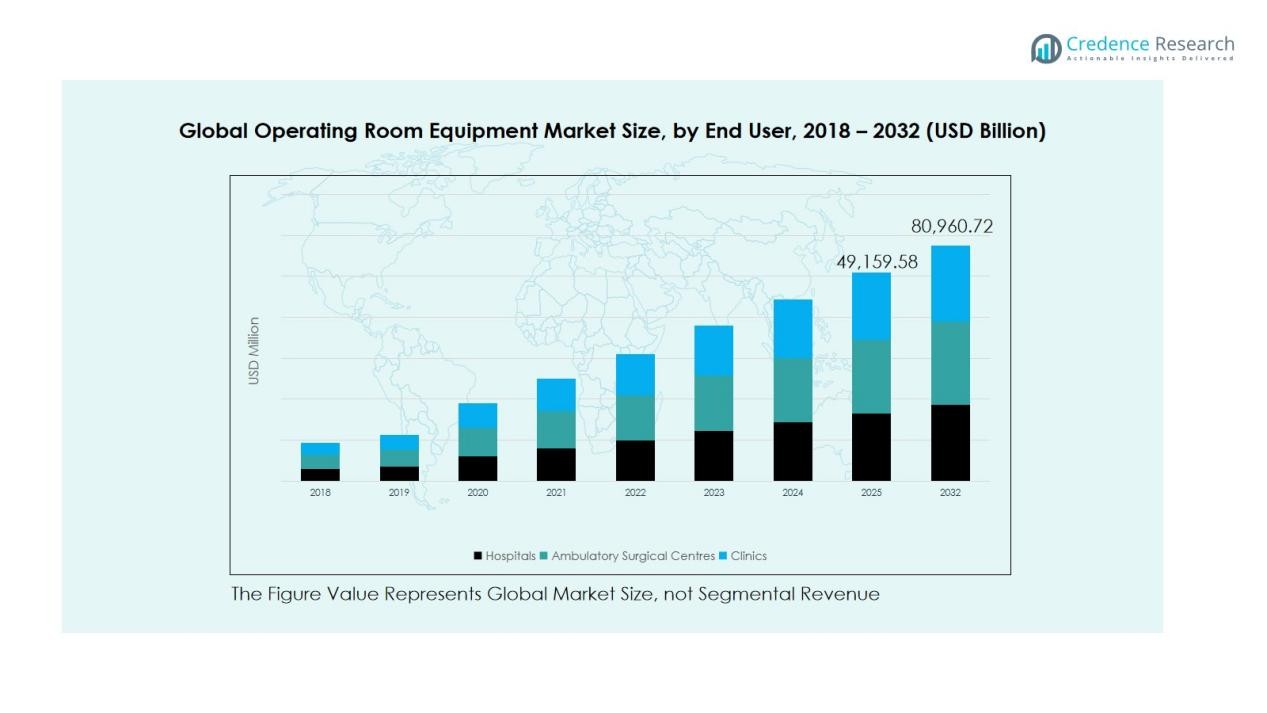
The Operating Room Equipment Market size was valued at USD 31,396.9 million in 2018 to USD  46,013.4 million in 2024 and is anticipated to reach USD  80,960.7 million by 2032, at a CAGR of 7.39% during the forecast period.

REPORT ATTRIBUTE DETAILS
Historical Period 2020-2023
Base Year 2024
Forecast Period 2025-2032
Operating Room Equipment Market Size 2024 USD 46,013.4 Million
Operating Room Equipment Market, CAGR 7.39%
Operating Room Equipment Market Size 2032 USD 80,960.7 Million


The market benefits from growing demand for minimally invasive and robotic-assisted surgeries, supported by technological innovation and patient preference for faster recovery. Continuous upgrades in surgical lighting, operating tables, and integrated OR systems improve workflow and procedural accuracy. The rising prevalence of chronic diseases requiring surgical interventions further strengthens product demand, while the emphasis on infection control and energy efficiency drives replacement cycles and new installations.

Regionally, North America leads the Operating Room Equipment Market due to advanced healthcare infrastructure, high surgical volume, and early technology adoption. Europe follows, supported by strong hospital modernization programs and government healthcare spending. The Asia-Pacific region shows the fastest growth, driven by expanding healthcare access, rising medical tourism, and increasing investments in hospital facilities across China, India, and Southeast Asia.

Market Insights:

  • The Operating Room Equipment Market was valued at USD 31,396.9 million in 2018, reached USD 46,013.4 million in 2024, and is projected to reach USD 80,960.7 million by 2032, growing at a CAGR of 7.39% during 2024–2032.
  • North America accounted for around 38% of the global share in 2024, driven by advanced healthcare infrastructure, high surgical volume, and rapid technology adoption across hospitals.
  • Europe held approximately 28% of the market share, supported by modernization programs, strict healthcare regulations, and strong medical equipment manufacturing bases.
  • Asia-Pacific captured nearly 25% of the share in 2024 and is the fastest-growing region due to rising healthcare investments, medical tourism, and hospital expansion in China, India, and Southeast Asia.
  • By type, surgical imaging devices held about 30% of the market share, while electrosurgical units followed with nearly 22%, supported by increasing adoption in complex and minimally invasive surgical procedures.

Access crucial information at unmatched prices!

Request your sample report today & start making informed decisions powered by Credence Research Inc.!

Download Sample

Market Drivers:

Rising Volume of Surgical Procedures and Expanding Healthcare Infrastructure

The Operating Room Equipment Market grows due to an increasing number of surgical procedures worldwide. Rising cases of chronic diseases and trauma drive higher demand for advanced surgical setups. Hospitals and ambulatory centers continue upgrading their facilities to meet global healthcare standards. It benefits from government investments in modern surgical infrastructure and improved patient outcomes through technology-driven equipment.

  • For Instance, Apollo Hospitals has been a pioneer in adopting robotic surgery in India. In March 2023, the hospital group announced a significant milestone: its network had successfully completed over 10,000 robotic-assisted surgeries in total across India since the technology’s introduction about a decade prior.

Technological Advancements Enhancing Surgical Efficiency and Safety

Rapid innovation in surgical imaging, anesthesia systems, and integrated operating room solutions boosts market growth. Smart OR technologies enable real-time data sharing, improved precision, and reduced human error. The adoption of robotic-assisted and minimally invasive surgery technologies enhances operational efficiency and recovery times. It also increases demand for connected devices and modular OR systems supporting workflow optimization.

  • For instance, Stryker’s Connected OR Hub is a central component of its smart operating room platform, designed to facilitate communication between devices and provide total control of the visualization system from the surgical field.

Growing Preference for Minimally Invasive and Outpatient Surgeries

Patients and healthcare providers prefer less invasive procedures due to reduced pain, shorter stays, and faster recovery. These trends drive demand for compact, efficient, and technologically advanced equipment. The market benefits from rising use of endoscopic, laparoscopic, and robotic-assisted techniques across multiple specialties. It aligns with the global shift toward cost-effective, patient-centered surgical care models.

Increased Emphasis on Infection Control and Regulatory Compliance

Hospitals prioritize safety and hygiene to prevent hospital-acquired infections, driving demand for sterilization and disinfection systems. Manufacturers develop equipment with antimicrobial coatings and improved airflow management systems. Regulatory standards enforce the adoption of certified and energy-efficient products. It ensures long-term trust among healthcare institutions and strengthens replacement demand across modern operating rooms.

Operating Room Equipment Market Size

Market Trends:

Integration of Smart and Hybrid Operating Rooms to Improve Efficiency and Connectivity

The Operating Room Equipment Market witnesses a major trend toward the adoption of smart and hybrid operating rooms. Hospitals are integrating imaging, surgical, and data management systems into a unified environment to enhance precision and efficiency. The trend supports real-time monitoring, digital documentation, and improved collaboration between surgical teams. Demand for interoperable systems that connect anesthesia, lighting, and imaging devices continues to grow. It enables faster decision-making and improved outcomes during complex surgeries. Hospitals investing in hybrid ORs gain flexibility for both minimally invasive and open procedures, reducing overall operational downtime. The move toward connected surgical ecosystems strengthens hospital workflow and patient safety.

  • For instance, UKSH (Universitätsklinikum Schleswig-Holstein) Kiel in Germany achieved an average of 2.4 surgical procedures performed per day across 8 clinical specialties using their multi-purpose hybrid OR, with 87% room occupancy rates and case complexity scores of 6.9, demonstrating significant operational efficiency and the ability to serve diverse surgical disciplines simultaneously.

Sustainability, Ergonomic Design, and AI-Driven Surgical Assistance Gaining Momentum

Global manufacturers are focusing on eco-friendly designs and energy-efficient solutions to align with hospital sustainability goals. Lightweight, modular, and ergonomic operating tables, lights, and ceiling pendants enhance comfort and space optimization. Artificial intelligence and augmented reality are emerging as key tools for surgical guidance and predictive maintenance of equipment. It supports accuracy in complex procedures and lowers equipment-related risks. Growing investments in AI-based imaging and workflow automation continue to transform the surgical environment. The trend reflects a broader shift toward digital transformation, improving consistency and safety across healthcare settings.

  • For Instance, Hillrom offers the TruSystem 7500 Modular OR Table, an established product in its portfolio that has been on the market since at least 2017/2018.

Market Challenges Analysis:

High Installation Costs and Budget Constraints in Healthcare Facilities

The Operating Room Equipment Market faces challenges due to high setup and maintenance costs. Advanced systems such as robotic-assisted surgery tools and hybrid ORs require significant capital investment. Many small and mid-sized hospitals delay upgrades due to limited budgets and reimbursement barriers. It restricts widespread adoption, particularly in emerging economies where funding is limited. Complex installation processes and staff training further increase operational expenses. These financial constraints slow modernization efforts and impact equipment replacement cycles.

Technical Integration Issues and Shortage of Skilled Personnel

Integrating multiple devices and digital platforms within operating rooms creates compatibility and interoperability challenges. Hospitals struggle to align new technologies with existing infrastructure and safety protocols. A shortage of trained surgical staff and technicians limits effective use of advanced systems. It affects workflow efficiency and increases maintenance errors. Frequent software updates and cybersecurity risks add operational difficulties. Such challenges make seamless adoption of next-generation operating room equipment more difficult across healthcare settings.

Operating Room Equipment Market Share

Market Opportunities:

Growing Investments in Hospital Modernization and Digital Healthcare Infrastructure

The Operating Room Equipment Market offers strong opportunities through hospital infrastructure upgrades and digital transformation initiatives. Governments and private investors are expanding budgets to build technologically advanced healthcare facilities. Smart hospitals integrating connected devices and digital workflow management systems are increasing in number. It benefits from global emphasis on quality care, safety, and operational efficiency. The trend supports demand for integrated OR solutions, robotic platforms, and data-driven decision tools. Growing telemedicine and remote monitoring adoption further encourage investment in connected surgical environments.

Emergence of AI-Driven Surgery and Customizable Equipment Solutions

Artificial intelligence, augmented reality, and machine learning are creating new growth paths for manufacturers. These technologies improve surgical precision, reduce human error, and optimize real-time decision-making. It opens opportunities for companies offering predictive maintenance, image-guided surgery, and adaptive OR integration. Demand for customizable and modular equipment also grows, allowing healthcare providers to tailor operating rooms to specific specialties. Partnerships between medical technology firms and software developers enhance innovation and system interoperability. Expanding R&D investments in automation and smart analytics continue to shape the next generation of surgical care solutions.

Market Segmentation Analysis:

By Type

The Operating Room Equipment Market is segmented by type into anesthesia machines, electrosurgical units, multi-parameter patient monitors, surgical imaging devices, operating tables, and operating room lights. Surgical imaging devices and electrosurgical units account for a major share due to their essential role in complex procedures. It gains strong demand from hospitals investing in advanced visualization and precision tools to improve surgical accuracy. Multi-parameter monitors continue to see steady growth, driven by the need for continuous patient monitoring and safety compliance. Anesthesia machines maintain solid adoption in both general and specialty surgeries. Operating tables and lights contribute significantly to workflow optimization and ergonomic efficiency, supporting the global modernization of surgical facilities.

  • For Instance, Siemens Healthineers introduced the ARTIS icono angiography system in March 2019, and it is designed to help reduce procedure times through features like “Case Flows” and “DynaCT”. Specific features, such as Syngo DynaCT High Speed, can reduce the time needed for low-contrast 3D imaging from 20 seconds to eight seconds.

By End User

By end user, the market is divided into hospitals, ambulatory surgical centers, and clinics. Hospitals dominate due to their extensive surgical capacity and continuous equipment upgrades supported by capital investments. It benefits from the increasing shift toward hybrid and digital operating rooms within large healthcare institutions. Ambulatory surgical centers are expanding rapidly, supported by demand for cost-effective, minimally invasive procedures. Clinics represent a growing segment, particularly in emerging economies focusing on outpatient and specialized care. This segmentation reflects the market’s balance between high-volume institutional demand and expanding decentralized surgical care models.

  • For instance, the Surgery Center of Oklahoma, a physician-owned and managed facility known for its transparent pricing model, employs advanced surgical techniques and streamlined workflows to provide high-quality, cost-effective care.

Segmentations:

By Type:

  • Anesthesia Machines
  • Electrosurgical Units
  • Multi-Parameter Patient Monitors
  • Surgical Imaging Devices
  • Operating Tables
  • Operating Room Lights

By End User:

  • Hospitals
  • Ambulatory Surgical Centres
  • Clinics

By Region:

North America

  • U.S.
  • Canada
  • Mexico
  • Europe
  • UK
  • France
  • Germany
  • Italy
  • Spain
  • Russia
  • Rest of Europe

Asia Pacific

  • China
  • Japan
  • South Korea
  • India
  • Australia
  • Southeast Asia
  • Rest of Asia Pacific

Latin America

  • Brazil
  • Argentina
  • Rest of Latin America

Middle East

  • GCC Countries
  • Israel
  • Turkey
  • Rest of Middle East

Africa

  • South Africa
  • Egypt
  • Rest of Africa

Operating Room Equipment Market Segmentation

Regional Analysis:

North America Dominating Through Advanced Infrastructure and Early Technology Adoption

North America leads the Operating Room Equipment Market with a strong focus on healthcare innovation and modernization. The U.S. drives most regional revenue, supported by high surgical volumes, advanced hospital infrastructure, and rapid adoption of robotic and minimally invasive technologies. The region benefits from favorable reimbursement systems and large-scale government investments in healthcare digitization. It experiences continuous demand for smart OR integration and AI-based monitoring solutions across major healthcare networks. Canada and Mexico follow, driven by ongoing expansion in public healthcare facilities and increased medical device imports.

Europe Strengthened by Modernization and Strict Healthcare Standards

Europe holds a significant market share, supported by hospital modernization programs and adherence to strict safety and quality regulations. Countries like Germany, France, and the UK are investing heavily in upgrading surgical suites with energy-efficient and digital systems. It benefits from a mature healthcare ecosystem emphasizing precision, patient safety, and sustainable practices. The growing presence of regional manufacturers strengthens supply networks across the continent. Southern and Eastern European countries are catching up with increased healthcare funding and focus on infection control compliance in surgical environments.

Asia-Pacific Emerging as the Fastest-Growing Region with Expanding Healthcare Access

Asia-Pacific is expected to record the highest growth rate, supported by large-scale hospital construction and healthcare reforms. China, India, and Japan lead the regional expansion with strong investments in surgical infrastructure and domestic production capabilities. It gains traction from rising medical tourism, aging populations, and growing awareness of advanced surgical care. The demand for affordable, efficient, and technologically modern equipment continues to increase across both public and private sectors. Southeast Asia and Australia also contribute to regional momentum, promoting partnerships with global manufacturers to improve hospital technology standards.

Key Player Analysis:

  • Koninklijke Philips N.V.
  • Medtronic
  • Getinge AB
  • Stryker Corporation
  • Siemens Healthineers AG
  • GE HealthCare
  • Drägerwerk AG & Co. KGaA
  • Baxter International Inc.
  • Mizuho

Competitive Analysis:

The Operating Room Equipment Market features intense competition among global leaders focusing on innovation, product integration, and technological advancement. Key players include Koninklijke Philips N.V., Medtronic, Getinge AB, Stryker Corporation, Siemens Healthineers AG, GE HealthCare, and Drägerwerk AG & Co. KGaA. It demonstrates a diverse competitive landscape where companies emphasize developing smart OR systems, advanced imaging tools, and ergonomic surgical solutions. Continuous investments in R&D and collaborations with healthcare institutions drive product differentiation and market share expansion. Firms are also targeting emerging economies through partnerships and regional manufacturing initiatives to strengthen supply chains. Growing demand for AI-enabled systems, hybrid ORs, and energy-efficient devices encourages strategic acquisitions and portfolio diversification among top manufacturers.

Recent Developments:

  • In January 2025, Bridgefield Capital entered into a definitive agreement to acquire the Philips Emergency Care Business; the deal is expected to close during 2025.
  • In May 2025, Medtronic announced plans to spin off its diabetes business into a standalone company, initiating a process projected to take up to 18 months.

Shape Your Report to Specific Countries or Regions & Enjoy 30% Off!

Report Coverage:

The research report offers an in-depth analysis based on Type, End User and Region. It details leading market players, providing an overview of their business, product offerings, investments, revenue streams, and key applications. Additionally, the report includes insights into the competitive environment, SWOT analysis, current market trends, as well as the primary drivers and constraints. Furthermore, it discusses various factors that have driven market expansion in recent years. The report also explores market dynamics, regulatory scenarios, and technological advancements that are shaping the industry. It assesses the impact of external factors and global economic changes on market growth. Lastly, it provides strategic recommendations for new entrants and established companies to navigate the complexities of the market.

Future Outlook:

  • The Operating Room Equipment Market will advance toward fully integrated and digitally connected surgical environments.
  • Artificial intelligence and augmented reality will enhance surgical precision and reduce human error.
  • Hybrid operating rooms combining imaging and surgical systems will become standard in advanced hospitals.
  • Manufacturers will focus on compact, modular, and energy-efficient equipment designs to meet sustainability goals.
  • Growing demand for minimally invasive and outpatient procedures will drive innovation in portable and ergonomic systems.
  • AI-based predictive maintenance will improve equipment reliability and reduce operational downtime.
  • Telemedicine and remote surgery capabilities will expand, enabling real-time expert collaboration across locations.
  • Automation and data-driven workflow management will streamline surgical preparation and patient monitoring.
  • Emerging markets in Asia-Pacific, Latin America, and the Middle East will witness rapid infrastructure development and product adoption.
  • Healthcare providers will prioritize interoperability and cybersecurity to ensure safe and seamless integration of digital OR systems.
CHAPTER NO. 1 : GENESIS OF THE MARKET
1.1 Market Prelude – Introduction & Scope
1.2 The Big Picture – Objectives & Vision
1.3 Strategic Edge – Unique Value Proposition
1.4 Stakeholder Compass – Key Beneficiaries
CHAPTER NO. 2 : EXECUTIVE LENS
2.1 Pulse of the Industry – Market Snapshot
2.2 Growth Arc – Revenue Projections (USD Million)
2.3. Premium Insights – Based on Primary Interviews
CHAPTER NO. 3 : OPERATING ROOM EQUIPMENT MARKET FORCES & INDUSTRY PULSE
3.1 Foundations of Change – Market Overview
3.2 Catalysts of Expansion – Key Market Drivers
    3.2.1 Momentum Boosters – Growth Triggers
    3.2.2 Innovation Fuel – Disruptive Technologies
3.3 Headwinds & Crosswinds – Market Restraints
    3.3.1 Regulatory Tides – Compliance Challenges
    3.3.2 Economic Frictions – Inflationary Pressures
3.4 Untapped Horizons – Growth Potential & Opportunities
3.5 Strategic Navigation – Industry Frameworks
    3.5.1 Market Equilibrium – Porter’s Five Forces
    3.5.2 Ecosystem Dynamics – Value Chain Analysis
    3.5.3 Macro Forces – PESTEL Breakdown
CHAPTER NO. 4 :KEY INVESTMENT EPICENTER
4.1 Regional Goldmines – High-Growth Geographies
4.2 Product Frontiers – Lucrative Type Categories
4.3 End User Sweet Spots – Emerging Demand Segments
CHAPTER NO. 5: REVENUE TRAJECTORY & WEALTH MAPPING
5.1 Momentum Metrics – Forecast & Growth Curves
5.2 Regional Revenue Footprint – Market Share Insights
5.3 Segmental Wealth Flow – Type & End User Revenue
CHAPTER NO. 6 : TRADE & COMMERCE ANALYSIS
6.1.Import Analysis By Region
6.1.1. Global Operating Room Equipment Market Import Revenue By Region
6.2.Export Analysis By Region
6.2.1. Global Operating Room Equipment Market Export Revenue By Region
CHAPTER NO. 7 : COMPETITION ANALYSIS
7.1.Company Market Share Analysis
7.1.1. Global Operating Room Equipment Market: Company Market Share
7.2. Global Operating Room Equipment Market Company Revenue Market Share
7.3.Strategic Developments
7.3.1.Acquisitions & Mergers
7.3.2. New Product Launch
7.3.3. Regional Expansion
7.4. Competitive Dashboard
7.5.      Company Assessment Metrics, 2024
CHAPTER NO. 8 : OPERATING ROOM EQUIPMENT MARKET – BY TYPE SEGMENT ANALYSIS
8.1.Operating Room Equipment Market Overview By Type Segment
8.1.1. Operating Room Equipment Market Revenue Share By Type
8.2.      Anesthesia Machines
8.3.      Electrosurgical Units
8.4.      Multi-Parameter Patient Monitors
8.5.      Surgical Imaging Devices
8.6.      Operating Tables
8.7.      Operating Room Lights
CHAPTER NO. 9 : OPERATING ROOM EQUIPMENT MARKET – BY END USER SEGMENT ANALYSIS
9.1.Operating Room Equipment Market Overview By End User Segment
9.1.1. Operating Room Equipment Market Revenue Share By End User
9.2.      Hospitals
9.3.      Ambulatory Surgical Centres
9.4.      Clinics
CHAPTER NO. 10 : OPERATING ROOM EQUIPMENT MARKET – REGIONAL ANALYSIS
10.1.Operating Room Equipment Market Overview By Region Segment
10.1.1. Global Operating Room Equipment Market Revenue Share By Region
10.1.2.Regions
10.1.3.Global Operating Room Equipment Market Revenue By Region
10.1.4. Type
10.1.5.Global Operating Room Equipment Market Revenue By Type
10.1.6.End User
10.1.7. Global Operating Room Equipment Market Revenue By End User
CHAPTER NO. 11 : NORTH AMERICA OPERATING ROOM EQUIPMENT MARKET – COUNTRY ANALYSIS
11.1. North America Operating Room Equipment Market Overview By Country Segment
11.1.1. North America Operating Room Equipment Market Revenue Share By Region
11.2.North America
11.2.1.North America Operating Room Equipment Market Revenue By Country
11.2.2.Type
11.2.3. North America Operating Room Equipment Market Revenue By Type
11.2.4.End User
11.2.5. North America Operating Room Equipment Market Revenue By End User
11.3.U.S.
11.4.Canada
11.5.Mexico
CHAPTER NO. 12 : EUROPE OPERATING ROOM EQUIPMENT MARKET – COUNTRY ANALYSIS
12.1. Europe Operating Room Equipment Market Overview By Country Segment
12.1.1. Europe Operating Room Equipment Market Revenue Share By Region
12.2.Europe
12.2.1.Europe Operating Room Equipment Market Revenue By Country
12.2.2. Type
12.2.3.Europe Operating Room Equipment Market Revenue By Type
12.2.4.End User
12.2.5. Europe Operating Room Equipment Market Revenue By End User
12.3.UK
12.4.France
12.5.Germany
12.6.Italy
12.7.Spain
12.8.Russia
12.9.   Rest of Europe
CHAPTER NO. 13 : ASIA PACIFIC OPERATING ROOM EQUIPMENT MARKET – COUNTRY ANALYSIS
13.1.Asia Pacific Operating Room Equipment Market Overview By Country Segment
13.1.1.Asia Pacific Operating Room Equipment Market Revenue Share By Region
13.2.Asia Pacific
13.2.1. Asia Pacific Operating Room Equipment Market Revenue By Country
13.2.2.Type
13.2.3.Asia Pacific Operating Room Equipment Market Revenue By Type
13.2.4.End User
13.2.5.Asia Pacific Operating Room Equipment Market Revenue By End User
13.3.China
13.4.Japan
13.5.South Korea
13.6.India
13.7.Australia
13.8.Southeast Asia
13.9. Rest of Asia Pacific
CHAPTER NO. 14 : LATIN AMERICA OPERATING ROOM EQUIPMENT MARKET – COUNTRY ANALYSIS
14.1.Latin America Operating Room Equipment Market Overview By Country Segment
14.1.1.Latin America Operating Room Equipment Market Revenue Share By Region
14.2. Latin America
14.2.1. Latin America Operating Room Equipment Market Revenue By Country
14.2.2.Type
14.2.3. Latin America Operating Room Equipment Market Revenue By Type
14.2.4.End User
14.2.5. Latin America Operating Room Equipment Market Revenue By End User
14.3.Brazil
14.4.Argentina
14.5.Rest of Latin America
CHAPTER NO. 15 : MIDDLE EAST OPERATING ROOM EQUIPMENT MARKET – COUNTRY ANALYSIS
15.1.Middle East Operating Room Equipment Market Overview By Country Segment
15.1.1.Middle East Operating Room Equipment Market Revenue Share By Region
15.2.Middle East
15.2.1. Middle East Operating Room Equipment Market Revenue By Country
15.2.2.Type
15.2.3.Middle East Operating Room Equipment Market Revenue By Type
15.2.4.End User
15.2.5.Middle East Operating Room Equipment Market Revenue By End User
15.3.GCC Countries
15.4. Israel
15.5. Turkey
15.6.Rest of Middle East
CHAPTER NO. 16 : AFRICA OPERATING ROOM EQUIPMENT MARKET – COUNTRY ANALYSIS
16.1. Africa Operating Room Equipment Market Overview By Country Segment
16.1.1.Africa Operating Room Equipment Market Revenue Share By Region
16.2. Africa
16.2.1.Africa Operating Room Equipment Market Revenue By Country
16.2.2.Type
16.2.3.Africa Operating Room Equipment Market Revenue By Type
16.2.4.End User
16.2.5. Africa Operating Room Equipment Market Revenue By End User
16.3. South Africa
16.4.Egypt
16.5.Rest of Africa
CHAPTER NO. 17 : COMPANY PROFILES
17.1. Koninklijke Philips N.V.
17.1.2.Product Portfolio
17.1.3.Financial Overview
17.1.4.Recent Developments
17.1.5.Growth Strategy
17.1.6.SWOT Analysis
17.2.     Medtronic
17.3.     Getinge AB
17.4.     Stryker Corporation
17.5.     Siemens Healthineers AG
17.6.     GE HealthCare
17.7.     Drägerwerk AG & Co. KGaA
17.8.     Baxter International Inc.
17.9.     Mizuho
17.10.   Other Key Players

Request Free Sample

We prioritize the confidentiality and security of your data. Our promise: your information remains private.

Ready to Transform Data into Decisions?

Request Your Sample Report and Start Your Journey of Informed Choices


Providing the strategic compass for industry titans.

cr-clients-logos

Frequently Asked Questions:

What is the current market size for the Operating Room Equipment Market, and what is its projected size in 2032?

The Operating Room Equipment Market was valued at USD 31,396.9 million in 2018, reached USD 46,013.4 million in 2024, and is projected to reach USD 80,960.7 million by 2032.

At what Compound Annual Growth Rate is the Operating Room Equipment Market expected to grow between 2024 and 2032?

The market is projected to grow at a CAGR of 7.39% during the forecast period from 2024 to 2032.

Which segment held the largest share of the Operating Room Equipment Market in 2024?

The surgical imaging devices and electrosurgical units segment held the largest market share in 2024, driven by their essential role in complex and minimally invasive surgeries.

What are the key factors fueling the growth of the Operating Room Equipment Market?

Key factors include rising surgical procedures, expanding hospital infrastructure, advancements in smart OR technologies, and growing adoption of minimally invasive techniques.

Who are the leading companies in the Operating Room Equipment Market?

Leading companies include Koninklijke Philips N.V., Medtronic, Getinge AB, Stryker Corporation, Siemens Healthineers AG, GE HealthCare, and Drägerwerk AG & Co. KGaA.

Which region commanded the largest share of the Operating Room Equipment Market in 2024?

North America dominated the market in 2024, supported by advanced healthcare infrastructure, high surgical volume, and early adoption of innovative operating room technologies.

About Author

Shweta Bisht

Shweta Bisht

Healthcare & Biotech Analyst

Shweta is a healthcare and biotech researcher with strong analytical skills in chemical and agri domains.

View Profile

Related Reports

Medical Tapes and Bandages Market

The Medical Tapes and Bandages Market size was valued at USD 8.08 Billion in 2024 and is anticipated to reach USD 11.76 Billion by 2032, at a CAGR of 4.8% during the forecast period.

Voice Prosthesis Market

Voice Prosthesis Market size was valued at USD 335.36 million in 2024 and is anticipated to reach USD 546.74 million by 2032, at a CAGR of 6.3% during the forecast period.

Electrodermal Activity Detecting Devices Market

The Electrodermal Activity Detecting Devices Market size was valued at USD 1,020.00 million in 2018 to USD 1,466.88 million in 2024 and is anticipated to reach USD 3,452.45 million by 2032, at a CAGR of 11.39% during the forecast period.  

Neoantigen-Based Personalized Cancer Therapeutic Vaccines Market

The Neoantigen-Based Personalized Cancer Therapeutic Vaccines Market was valued at USD 357.16 million in 2024 and is anticipated to reach USD 1078.2 million by 2032, growing at a CAGR of 14.81% during the forecast period.

Surgical Generators Market

Surgical Generators market size reached USD 1,788.5 million in 2024 and is projected to grow to USD 3,175.54 million by 2032, recording a CAGR of 7.44% during the forecast period.

Photomedicine Market

The Photomedicine Market was valued at USD 498.14 million in 2024 and is projected to reach USD 702.46 million by 2032, expanding at a CAGR of 4.39% during the forecast period.

Hereditary Testing Market

Hereditary testing market was valued at USD 7.74 billion in 2024 and is anticipated to reach USD 14.12 billion by 2032, growing at a CAGR of 7.8% during the forecast period.

Neonatal Intensive Care Respiratory Devices Market

Neonatal Intensive Care Respiratory Devices market size reached USD 1,760.33 million in 2024 and is projected to grow to USD 2,522.59 million by 2032, registering a CAGR of 4.6% during the forecast period.

Flow Imaging Microscopy Analysis Market

Flow Imaging Microscopy Analysis Market size was valued USD 44.6 million in 2024 and is anticipated to reach USD 77.26 million by 2032, at a CAGR of 7.11% during the forecast period.

Digital Brain Health Market

The Digital Brain Health Market was valued at USD 231,118 million in 2024 and is projected to reach USD 406,401.5 million by 2032, growing at a CAGR of 7.31% during the forecast period.

Enteral Tube Feeding Formula Market

Enteral Tube feeding formula market was valued at USD 7.68 billion in 2024 and is anticipated to reach USD 11.53 billion by 2032, growing at a CAGR of 5.21 % during the forecast period.

Biochip Scanner Market

Biochip Scanner Market size was valued at USD 13.32 Billion in 2024 and is anticipated to reach USD 30.48 Billion by 2032, at a CAGR of 10.9% during the forecast period.

Licence Option

The report comes as a view-only PDF document, optimized for individual clients. This version is recommended for personal digital use and does not allow printing. Use restricted to one purchaser only.
$4999

To meet the needs of modern corporate teams, our report comes in two formats: a printable PDF and a data-rich Excel sheet. This package is optimized for internal analysis. Unlimited users allowed within one corporate location (e.g., regional office).
$6999

The report will be delivered in printable PDF format along with the report’s data Excel sheet. This license offers 100 Free Analyst hours where the client can utilize Credence Research Inc. research team. Permitted for unlimited global use by all users within the purchasing corporation, such as all employees of a single company.
$12999

Report delivery within 24 to 48 hours

Credence Staff 3

WILLIAM, North America

Support Staff at Credence Research

KEITH PHILLIPS, Europe

Lee - CR Sales Staff

LEE VALLANCE, Asia Pacific

Kieran Jameson

KIERAN JAMESON, Australia

Smallform of Sample request
User Review

Thank you for the data! The numbers are exactly what we asked for and what we need to build our business case.

Materials Scientist
(privacy requested)

User Review

The report was an excellent overview of the Industrial Burners market. This report does a great job of breaking everything down into manageable chunks.

Imre Hof
Management Assistant, Bekaert

cr-clients-logos

Request Sample