Market overview
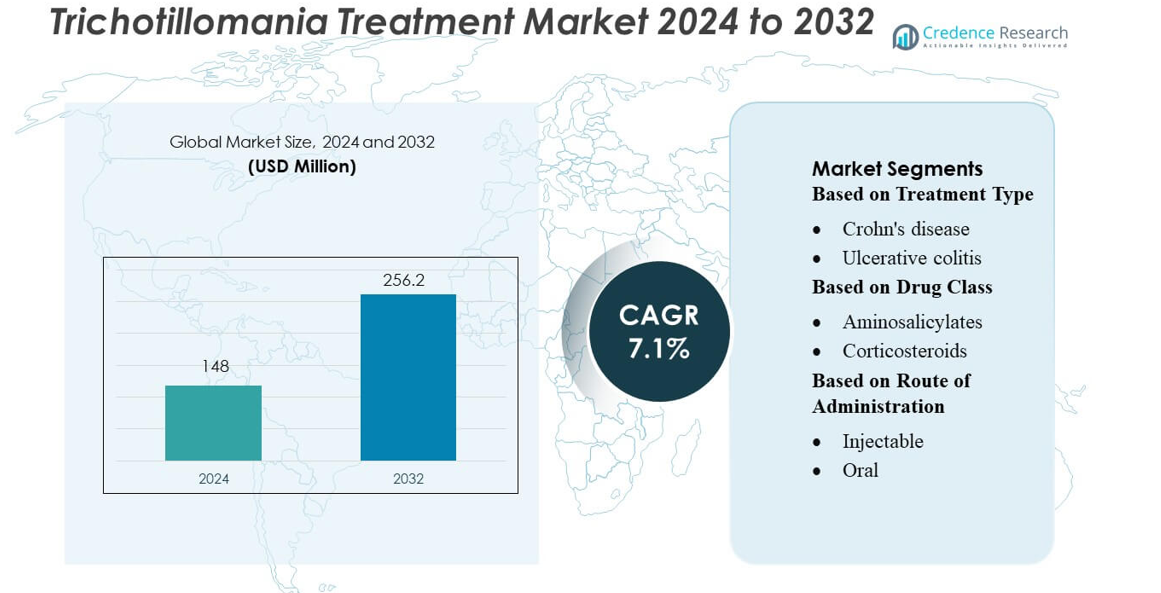
Trichotillomania Treatment Market size was valued USD 148 million in 2024 and is anticipated to reach USD 256.2 million by 2032, at a CAGR of 7.1% during the forecast period.
| REPORT ATTRIBUTE |
DETAILS |
| Historical Period |
2020-2023 |
| Base Year |
2024 |
| Forecast Period |
2025-2032 |
| Trichotillomania Treatment MarketSize 2024 |
USD 148 million |
| Trichotillomania Treatment Market, CAGR |
7.1% |
| Trichotillomania Treatment Market Size 2032 |
USD 256.2 million |
The Trichotillomania Treatment Market is shaped by a mix of pharmaceutical developers, digital-therapeutic innovators, and behavioral-health solution providers that focus on advancing neuropsychiatric care and improving access to evidence-based interventions. These players continue to refine cognitive–behavioral therapy platforms, expand tele-mental health services, and explore pharmacological pathways linked to compulsive behaviors and impulse control. North America leads the global market with approximately 40% share, supported by strong clinical awareness, extensive mental-health infrastructure, and rapid adoption of digital and remote-care technologies. Growing investment in research, patient-engagement tools, and personalized treatment models further reinforces regional dominance.
Market Insights
- The Trichotillomania Treatment Market was valued at USD 148 million in 2024 and is projected to reach USD 256.2 million by 2032, registering a CAGR of 7.1%, reflecting growing demand for structured behavioral therapies and digital treatment solutions.
- Rising focus on neurobehavioral research and increased adoption of cognitive–behavioral therapy, habit-reversal training, and tele-mental health services continues to drive market expansion across diverse patient groups.
- Digital therapeutics, wearable behavioral-intervention tools, and AI-enabled monitoring systems are emerging as key trends, strengthening treatment personalization and engagement.
- Market restraint persists due to limited FDA-approved pharmacological options and high relapse rates, which challenge long-term adherence and highlight the need for more robust clinical evidence.
- North America leads with 40% share, supported by advanced mental-health infrastructure, while first-line behavioral therapy remains the dominant segment, reflecting strong preference for non-pharmacological intervention models globally.
Access crucial information at unmatched prices!
Request your sample report today & start making informed decisions powered by Credence Research Inc.!
Download Sample
Market Segmentation Analysis:
By Treatment Type
Crohn’s disease represents the dominant treatment type segment, holding the largest share due to its higher prevalence and greater need for long-term therapeutic management compared with ulcerative colitis. Demand remains strong as patients require sustained disease-modifying therapies to manage chronic inflammation, fistulizing complications, and treatment-resistant progression. Increasing adoption of biologics and advanced immunomodulators continues to reinforce Crohn’s disease as the leading segment, supported by expanding clinical recommendations favoring early intensive therapy. Ulcerative colitis follows, benefiting from improved diagnostic rates and growing acceptance of targeted therapies that support long-term remission.
- For instance, AstraZeneca is currently running a Phase IIa trial of its immunomodulator AZD7798 in moderate to severe Crohn’s disease with an estimated enrollment of 192 patients.
By Drug Class
First-line treatment dominates the drug class segment, driven primarily by the widespread use of aminosalicylates and corticosteroids for initial symptom control and flare management. These agents maintain the largest share because they are routinely prescribed immediately after diagnosis and remain essential in mild to moderate disease. Among second-line options, TNF inhibitors show strong uptake due to proven efficacy in refractory cases, while IL inhibitors, JAK inhibitors, anti-integrins, and S1P receptor modulators expand therapeutic choices for complex presentations. Combination therapy, particularly TNF inhibitors with thiopurines, continues to gain traction for enhancing remission durability.
- For instance, KarXT (xanomeline-trospium), a dual M1/M4 muscarinic agonist, which showed in a 52-week open-label EMERGENT-4 trial that over 75 % of patients achieved more than 30 % reduction in PANSS total score (mean reduction of 33.3 points from baseline 98.4).
By Route of Administration
The injectable segment leads the route of administration category, supported by the dominant use of biologics—including TNF inhibitors, IL inhibitors, and anti-integrins—which require parenteral delivery for optimal therapeutic activity. This segment holds the largest share due to strong clinician preference, high patient response rates, and the ongoing introduction of advanced injectable agents. Oral therapies follow closely as JAK inhibitors and S1P receptor modulators gain adoption for their convenience and rapid onset of action. Rectal formulations remain niche, primarily supporting localized symptom management in lower-tract involvement.
Key Growth Drivers
Rising Awareness and Early Diagnosis
Growing public and clinical awareness of trichotillomania significantly drives market expansion as more individuals seek early diagnosis and treatment. Increased mental-health advocacy, improved screening tools, and integration of behavioral assessment protocols in primary care support earlier identification of the disorder. This trend enables timely intervention with behavioral therapy and pharmacological options, improving treatment adherence and outcomes. As awareness campaigns gain momentum across schools, workplaces, and digital health platforms, the diagnosed population continues to expand, strengthening demand for evidence-based therapeutic solutions.
- For instance, Bayer’s agronomic data, field-trial results, and product label guidance, has reduced internal response times to customer queries by 60% and saved frontline employees up to 4 hours per week.
Advancements in Behavioral Therapy and Digital Therapeutics
The market benefits strongly from expanding access to structured behavioral therapies, particularly Habit Reversal Training (HRT) and Cognitive Behavioral Therapy (CBT). The introduction of digital therapeutics, tele-therapy, and app-based behavioral programs increases treatment reach for underserved and remote populations. Clinicians increasingly adopt technology-enabled platforms that provide real-time symptom tracking, personalized interventions, and continuous monitoring. These advancements enhance therapy engagement, reduce relapse frequency, and support scalable treatment delivery models, positioning behavioral solutions as a central growth driver in the trichotillomania treatment landscape.
- For instance, Roche’s navify Analytics and navify Monitoring platforms now form a suite of over 30 digital solutions, helping laboratories convert raw operational data into actionable insights to reduce test turnaround times and improve staffing efficiency.
Growing Adoption of Pharmacological Interventions
Increasing clinical interest in pharmacological options—including SSRIs, glutamate modulators, and off-label agents such as N-acetylcysteine—contributes to market growth. As research highlights their potential to reduce impulsivity and hair-pulling frequency, clinicians integrate these medications into multimodal treatment plans. Expanding psychiatric guidelines, rising prescription volumes, and continuous investigation of novel compounds stimulate adoption. The demand for medication-based solutions also grows among patients seeking alternatives to long-term therapy or requiring combination approaches for severe or treatment-resistant cases.
Key Trends & Opportunities
Expansion of Personalized and Combination Therapy Approaches
A major trend shaping the market is the shift toward personalized treatment strategies that combine behavioral, pharmacological, and digital interventions. Clinicians increasingly tailor therapy intensity, medication selection, and monitoring tools based on symptom severity, comorbidities, and patient history. This approach improves long-term management and reduces relapse risk. The trend creates opportunities for integrated care pathways, cross-disciplinary collaborations, and hybrid therapeutic models that leverage both therapist-guided and self-directed treatment options.
- For instance, AbbVie’s ARCH (R&D Convergence Hub) aggregates data from over 200 internal and external sources, amassing more than 2 billion knowledge points to guide therapeutic design.
Increasing Use of Wearable and Biofeedback-Based Solutions
Technological innovation drives emerging opportunities in wearable devices designed to detect and interrupt hair-pulling behaviors through motion sensors, vibrotactile feedback, and pattern recognition. These solutions offer continuous support outside clinical settings, helping patients manage subconscious or stress-triggered behaviors. The trend supports non-invasive, real-time intervention and enhances data collection for clinicians. Growing investment in sensor technology, AI-based behavioral analytics, and remote monitoring tools broadens the commercial potential of tech-enabled therapies within the market.
- For instance, Novartis equipped field teams with 75 pocket-sized Authentifield sensor devices across 15 priority countries in Q4 2023, slashing counterfeit drug authentication time from roughly six weeks to just a few days.
Rising Integration of Tele-Mental Health Platforms
The accelerated adoption of tele-mental health services provides an opportunity for broader treatment accessibility. Virtual therapy platforms enable individuals with limited access to specialized clinicians to receive regular behavioral sessions and medication consultations. Remote delivery also increases privacy and reduces stigma, encouraging treatment uptake among adolescents and adults. This trend expands the patient base and supports scalable, cost-efficient treatment models that complement conventional in-person practices.
Key Challenges
Limited FDA-Approved Pharmacological Options
A significant challenge is the lack of FDA-approved medications specifically indicated for trichotillomania. Most pharmacological treatments remain off-label, creating variability in physician prescribing patterns and treatment efficacy. The absence of dedicated regulatory-approved drugs slows innovation from pharmaceutical companies and limits patient confidence in medication-based approaches. This gap underscores the need for robust clinical trials, targeted drug development, and clearer therapeutic guidelines.
High Relapse Rates and Low Treatment Adherence
Despite advancements, long-term management remains difficult due to high relapse rates and inconsistent patient adherence to behavioral therapy. Trichotillomania’s chronic and episodic nature often leads to fluctuating symptom control, requiring ongoing commitment that many patients find challenging. Limited availability of trained behavioral therapists, therapy fatigue, and psychological stigma further reduce engagement. These barriers hinder sustained treatment success and underscore the need for more accessible, user-friendly, and reinforcement-driven therapy models.
Regional Analysis
North America
North America holds the largest market share of around 40%, driven by strong mental-health awareness, high diagnostic rates, and widespread access to behavioral therapy and digital therapeutic platforms. The region benefits from the presence of specialized clinicians, well-established tele-mental health services, and growing adoption of app-based habit-reversal tools. Rising clinical recognition of body-focused repetitive behaviors (BFRBs) further strengthens early detection and treatment uptake. Pharmaceutical usage for off-label interventions continues to rise, supported by active research and expanding insurance coverage for behavioral health services.
Europe
Europe accounts for nearly 28% of the market, supported by expanding mental-health infrastructure, integration of behavioral therapy into public healthcare pathways, and strong awareness campaigns across Western European countries. Access to cognitive behavioral therapy and teleconsultation platforms continues to improve as governments emphasize digital health adoption. The region benefits from structured clinical guidelines and increased funding for psychiatric research, leading to broader acceptance of multimodal treatment approaches. Growing emphasis on adolescent mental-health services also supports market expansion, as early-stage diagnosis becomes more common across schools and community health systems.
Asia-Pacific
Asia-Pacific holds approximately 22% of the market, driven by rising mental-health awareness and expanding access to psychiatric and behavioral therapy services in urban centers. Increasing acceptance of digital health platforms and mobile-based anxiety-management tools supports growing treatment adoption. Countries such as Japan, South Korea, Australia, and China are witnessing higher diagnosis rates as stigma gradually declines. Investment in tele-therapy and mental-health start-ups accelerates treatment accessibility. However, disparities between urban and rural regions persist, creating opportunities for low-cost digital interventions and awareness-focused programs to strengthen long-term market penetration
Latin America
Latin America represents about 6% of the market, gradually expanding as awareness of trichotillomania and related BFRBs increases across Brazil, Mexico, Argentina, and Chile. Growth is supported by improving access to psychologists trained in behavioral therapy and rising adoption of mobile mental-health applications targeting anxiety and compulsive behaviors. Public health initiatives focused on youth mental health also play a role in expanding diagnosis rates. Despite progress, limited specialist availability and socioeconomic barriers continue to affect treatment consistency. These gaps make tele-psychiatry and scalable digital therapeutic platforms key opportunities for market expansion.
Middle East & Africa
The Middle East & Africa holds an estimated 4% market share, with growth driven by increasing investments in mental-health services and expanding psychiatric care infrastructure in wealthier Gulf nations. Awareness of body-focused repetitive behaviors is gradually rising, leading to improved diagnosis and early intervention. Adoption of tele-mental health solutions has accelerated accessibility, especially in underserved regions. However, limited availability of specialized behavioral therapists and varying cultural perceptions of mental health restrain broader adoption. As digital therapeutic platforms gain traction, opportunities emerge for scalable, low-resource treatment approaches across the region.
Market Segmentations:
By Treatment Type
- Crohn’s disease
- Ulcerative colitis
By Drug Class
- Aminosalicylates
- Corticosteroids
By Route of Administration
By Geography
- North America
- Europe
- Germany
- France
- U.K.
- Italy
- Spain
- Rest of Europe
- Asia Pacific
- China
- Japan
- India
- South Korea
- South-east Asia
- Rest of Asia Pacific
- Latin America
- Brazil
- Argentina
- Rest of Latin America
- Middle East & Africa
- GCC Countries
- South Africa
- Rest of the Middle East and Africa
Competitive Landscape
The competitive landscape of the Trichotillomania Treatment Market features key players such as AstraZeneca, Bristol Myers Squibb Company, Pfizer, Inc., Takeda Pharmaceutical Company Ltd, Bayer AG, Merck & Co. Inc., F. Hoffmann-La Roche Ltd., AbbVie Inc., Novartis AG, and PTC Therapeutics Inc. The Trichotillomania Treatment Market continues to evolve as companies, research institutions, and digital-therapeutic developers expand their focus on neurobehavioral disorders and impulse-control conditions. Competition centers on advancing cognitive–behavioral therapy delivery models, enhancing tele-mental health platforms, and developing pharmacological options that target glutamate regulation, serotonergic pathways, and compulsive-behavior circuits. Emerging digital therapeutics, including app-based habit-reversal systems and wearable behavioral-monitoring devices, intensify innovation and broaden patient reach. Stakeholders increasingly prioritize clinical evidence, patient-engagement tools, and integrated care models, driving a shift toward personalized treatment strategies. This environment encourages partnerships, cross-sector collaborations, and investment in next-generation therapeutic modalities.
Shape Your Report to Specific Countries or Regions & Enjoy 30% Off!
Key Player Analysis
Recent Developments
- In May 2025, Teva Pharmaceuticals, a U.S. affiliate of Teva Pharmaceutical Industries Ltd., and Alvotech announced that the U.S. Food and Drug Administration (FDA) had approved SELARSDI (ustekinumab-aekn) injection as interchangeable with the reference biologic Stelara (ustekinumab). This approval may help the company acquire an enhanced customer base.
- In January 2024, Sanofi announced its plan to acquire Inhibrx, Inc. in a deal valued at up to strengthen its rare disease portfolio with Inhibrx’s experimental drug, INBRX-101. This drug is designed to treat Alpha-1 Antitrypsin Deficiency (AATD), a rare genetic disease that causes progressive lung damage.
- In May 2023, Boehringer Ingelheim announced that the U.S. Food and Drug Administration (FDA) had approved the Cyltezo Pen, a new autoinjector option for Cyltezo (adalimumab-adbm), an FDA-approved Interchangeable biosimilar to Humira (adalimumab)
Report Coverage
The research report offers an in-depth analysis based on Treatment Type, Drug Class, Route of Administration and Geography. It details leading market players, providing an overview of their business, product offerings, investments, revenue streams, and key applications. Additionally, the report includes insights into the competitive environment, SWOT analysis, current market trends, as well as the primary drivers and constraints. Furthermore, it discusses various factors that have driven market expansion in recent years. The report also explores market dynamics, regulatory scenarios, and technological advancements that are shaping the industry. It assesses the impact of external factors and global economic changes on market growth. Lastly, it provides strategic recommendations for new entrants and established companies to navigate the complexities of the market.
Future Outlook
- The market will increasingly adopt digital therapeutics that enhance access to structured behavioral interventions.
- Advancements in wearable technologies will support real-time monitoring and interruption of hair-pulling behaviors.
- Research into neurobiological pathways will accelerate the development of targeted pharmacological therapies.
- Tele-mental health platforms will expand treatment reach, particularly for underserved and remote populations.
- Personalized treatment models will gain prominence as clinicians combine behavioral, digital, and pharmacological approaches.
- Rising awareness campaigns will continue to improve early diagnosis and reduce stigma associated with the disorder.
- Investment in clinical trials will strengthen evidence-based protocols for long-term management.
- Integration of AI-driven behavioral analytics will improve symptom tracking and therapy customization.
- Pediatric and adolescent-focused programs will expand as early identification becomes a healthcare priority.
- Cross-industry collaborations will accelerate innovation and support broader commercialization of new treatment modalities.



