Market Overview
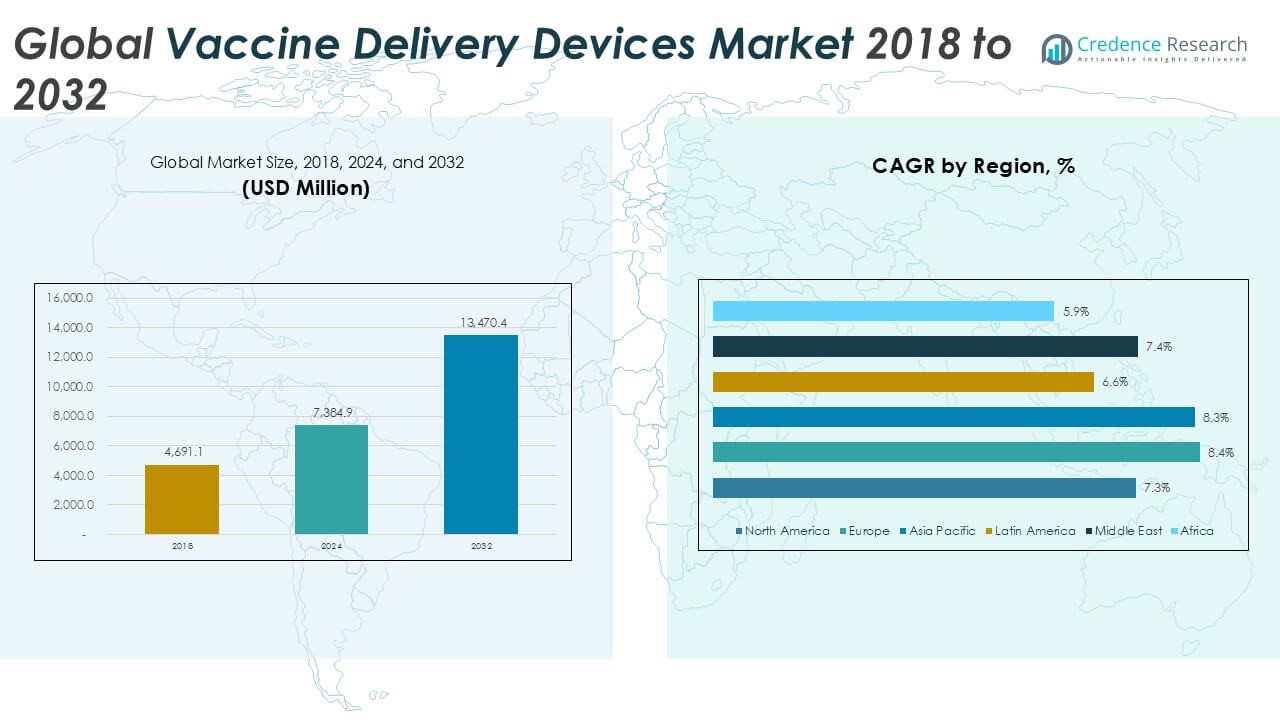
The Global Vaccine Delivery Devices Market is projected to grow from USD 7,384.9 million in 2024 to an estimated USD 13,470.4 million by 2032, with a compound annual growth rate (CAGR) of 7.83% from 2025 to 2032.
| REPORT ATTRIBUTE | DETAILS |
|---|---|
| Historical Period | 2020-2023 |
| Base Year | 2024 |
| Forecast Period | 2025-2032 |
| Vaccine Delivery Devices Market Size 2024 | USD 7,384.9 Million |
| Vaccine Delivery Devices Market, CAGR | 7.83% |
| Vaccine Delivery Devices Market Size 2032 | USD 13,470.4 Million |
Market growth is significantly driven by innovations in needle-free and minimally invasive vaccine delivery technologies, which improve patient compliance and reduce needle-stick injuries. Additionally, the rising geriatric population and increasing prevalence of chronic and infectious diseases have heightened the need for effective vaccination tools. Strategic collaborations between public health organizations and private manufacturers are also fostering R&D investments in smart and targeted delivery mechanisms. Moreover, the expansion of national immunization programs in emerging economies and the global response to pandemics continue to shape industry trends.
Geographically, North America leads the market due to high vaccination rates, strong healthcare infrastructure, and early adoption of advanced delivery technologies. Europe follows closely, supported by proactive immunization initiatives and research funding. The Asia-Pacific region is expected to witness the fastest growth, driven by large population bases, increasing healthcare expenditure, and government-led vaccination drives. Key players in the market include Becton, Dickinson and Company, 3M Company, PharmaJet, Gerresheimer AG, and Vaxxas.
Market Insights
- The market is projected to grow from USD 7,384.9 million in 2024 to USD 13,470.4 million by 2032, at a CAGR of 7.83% from 2025 to 2032.
- Rising demand for efficient immunization programs and advanced delivery technologies is fueling market expansion.
- Innovations in needle-free devices, microneedle patches, and safety syringes are improving patient compliance and safety.
- High production costs and limited access to delivery infrastructure in low-income regions continue to restrain market growth.
- Complex regulatory pathways and the need for user training challenge rapid deployment in developing markets.
- North America leads the market due to strong healthcare systems and early tech adoption, while Asia-Pacific is poised for fastest growth.
- Government initiatives, public-private partnerships, and pandemic preparedness strategies are accelerating regional and global adoption.
Market Drivers
Rising Global Immunization Campaigns and Infectious Disease Prevalence Fuel Demand
Governments and global health organizations continue to prioritize immunization campaigns, expanding vaccination coverage across both developed and developing regions. The Global Vaccine Delivery Devices Market benefits directly from increased investments in vaccine distribution infrastructure and public health outreach. Frequent outbreaks of infectious diseases such as influenza, measles, and COVID-19 highlight the need for efficient and rapid vaccine administration. Emerging pathogens and the threat of future pandemics intensify efforts to build resilient vaccination systems. These conditions create a consistent demand for reliable delivery devices. It supports the growing need for large-scale immunization programs with tools that are accurate, fast, and safe.
- For instance, during Vaccination Week in the Americas 2024, approximately 65,000,000 vaccine doses were administered across the region, targeting a wide range of diseases including COVID-19, influenza, polio, and measles.
Technological Advancements in Delivery Systems Enhance Patient Compliance
Continuous innovation in vaccine delivery technologies drives the shift toward painless, precise, and needle-free methods. The Global Vaccine Delivery Devices Market sees strong momentum from microneedle patches, jet injectors, and auto-disable syringes designed to minimize discomfort and eliminate reuse risks. These advancements improve patient compliance and reduce the anxiety associated with traditional injections. Manufacturers invest in smart delivery systems that allow dose tracking and reduce human error. It enables healthcare providers to administer vaccines more efficiently in diverse clinical and field settings. Demand rises for solutions that combine safety, speed, and ease of use.
- For instance, companies such as Vaxxas and PharmaJet have delivered millions of needle-free vaccine devices for mass immunization campaigns, with Vaxxas alone distributing over 2,000,000 microneedle patch devices for clinical and field trials worldwide by 2025
Growing Geriatric Population and Rising Chronic Disease Burden Expand Market Scope
An aging global population requires continuous protection against vaccine-preventable diseases due to weakened immune systems. The Global Vaccine Delivery Devices Market expands as elderly populations seek regular immunization against influenza, shingles, and pneumonia. Chronic disease prevalence increases vulnerability, prompting higher vaccination rates across all age groups. Governments promote adult and booster vaccination schedules to prevent complications and hospitalizations. It contributes to growing demand for devices tailored for sensitive patients. Market players respond with precision-based and user-friendly devices suitable for home and clinical use.
Strong Support from Public-Private Partnerships and Global Health Agencies
Collaborations between governments, NGOs, and private manufacturers support large-scale production and equitable distribution of vaccines and related devices. The Global Vaccine Delivery Devices Market benefits from these alliances through technology transfer, bulk procurement, and coordinated supply chains. Organizations like GAVI and WHO facilitate funding and technical support, enabling widespread access to vaccine delivery solutions. These partnerships help accelerate device development and deployment in low-resource settings. It ensures that innovation reaches regions with high disease burden and infrastructure challenges. Market growth aligns with global efforts to eliminate preventable diseases.
Market Trends
Growing Adoption of Needle-Free Technologies Drives Innovation in Vaccine Delivery
The industry is witnessing a clear shift toward needle-free technologies aimed at reducing pain, fear, and contamination risks. Devices such as microneedle patches, jet injectors, and inhalable vaccines are gaining attention for their ease of use and minimal invasiveness. The Global Vaccine Delivery Devices Market is benefiting from these innovations, especially in pediatric and geriatric applications. These technologies simplify administration and eliminate the risk of needle-stick injuries. It also improves vaccination rates by enhancing user comfort and healthcare worker safety. Manufacturers are actively developing portable, disposable, and cost-effective needle-free systems.
- For instance, in 2024, over 1,200,000 microneedle patch vaccine doses were administered globally, with a significant uptake in pediatric vaccination programs in the US and Europe (CDC).
Integration of Smart and Connected Devices Enhances Delivery Efficiency
Digital transformation in healthcare is driving the demand for connected vaccine delivery devices that ensure dose accuracy and real-time monitoring. Smart syringes and electronic auto-injectors allow healthcare providers to track administration history, reduce dosing errors, and maintain compliance. The Global Vaccine Delivery Devices Market is evolving to include smart systems that integrate with electronic health records. These devices also support cold chain monitoring, improving vaccine storage and handling. It contributes to safer immunization programs and better resource management. Regulatory bodies are supporting these technologies through fast-tracked approvals and guidance frameworks.
- For instance, by the end of 2024, more than 850,000 smart syringe devices were deployed in immunization programs across 30 countries, enabling real-time dose tracking and reducing administration errors (WHO).
Focus on Self-Administration Devices for Home-Based Vaccination Solutions
Patient preference is shifting toward home-based healthcare, encouraging the development of self-administration vaccine devices. Auto-injectors, prefilled syringes, and wearable patches are gaining traction in remote and low-access regions. The Global Vaccine Delivery Devices Market is responding by designing devices that offer safety, simplicity, and minimal training requirements. It helps reduce the burden on healthcare facilities and improves access in underserved populations. Pharmaceutical companies are collaborating with medtech firms to introduce user-centric products. Demand is expected to grow for compact, single-dose devices suitable for personal use.
Sustainable and Eco-Friendly Devices Gain Momentum in Product Development
Environmental concerns are influencing the design and packaging of vaccine delivery systems. Companies are reducing plastic waste by developing biodegradable components and recyclable materials. The Global Vaccine Delivery Devices Market is witnessing increased focus on sustainability as stakeholders aim to minimize medical waste. It aligns with global health initiatives promoting green healthcare practices. Manufacturers are also optimizing production processes to lower carbon emissions and improve energy efficiency. These trends encourage regulatory and industry support for sustainable innovation.
Market Challenges
High Production Costs and Supply Chain Limitations Restrain Widespread Adoption
The high cost of manufacturing advanced vaccine delivery devices remains a major barrier for low- and middle-income countries. Components like microneedles, smart injectors, and specialty coatings require complex production processes and regulatory approvals. The Global Vaccine Delivery Devices Market faces difficulties in scaling these technologies for global use due to limited affordability and infrastructure gaps. It must overcome logistical issues such as cold chain requirements and safe disposal of single-use devices. These limitations slow product rollout in remote or resource-poor areas. Price sensitivity and procurement challenges hinder broader access in public immunization programs.
- For instance, the estimated total cost to start up and produce 100 million doses of an mRNA vaccine-including facility setup, equipment, materials, labor, and fill-finish operations-can reach $270 million for certain products, with single-use consumables and raw materials alone accounting for over $59 million and $162 million, respectively
Regulatory Complexities and User Training Requirements Impede Market Penetration
Navigating varied regulatory frameworks across regions presents delays in product approvals and market entry. Many advanced devices require strict compliance with safety, sterility, and accuracy standards. The Global Vaccine Delivery Devices Market must address the challenge of training healthcare workers and end-users, especially in self-administration scenarios. It complicates deployment in regions with limited health literacy or technical support. Inconsistent policy environments further create uncertainty for manufacturers and investors. Market growth depends on building consistent regulatory pathways and user education strategies worldwide.
Market Opportunities
Expansion of National Immunization Programs in Emerging Economies Creates Growth Potential
Emerging economies are strengthening their healthcare infrastructure and expanding national immunization programs, offering new growth avenues for vaccine delivery solutions. Governments in Asia, Africa, and Latin America are investing in routine immunizations and pandemic preparedness, which drives demand for advanced delivery devices. The Global Vaccine Delivery Devices Market can leverage this momentum by offering cost-effective, easy-to-use products tailored for mass administration. It supports the shift toward broader coverage, especially in underserved rural populations. Partnerships with public health agencies and local distributors improve market reach. Rising healthcare budgets and global funding initiatives amplify these opportunities.
Technological Advancements and Personalized Vaccination Drive Future Innovation
Rapid progress in biotechnology and medical devices enables the development of personalized and targeted vaccine delivery systems. Devices such as wearable injectors, dissolvable microneedles, and prefilled syringes enhance safety, accuracy, and patient compliance. The Global Vaccine Delivery Devices Market can capitalize on these innovations to meet evolving clinical and consumer needs. It enables integration with digital health platforms, improving vaccination tracking and data analytics. Rising interest in home-based and self-administered healthcare solutions creates a favorable environment for next-generation devices. Companies investing in R\&D and user-centered designs will gain competitive advantage in the years ahead.
Market Segmentation Analysis
By Device Type
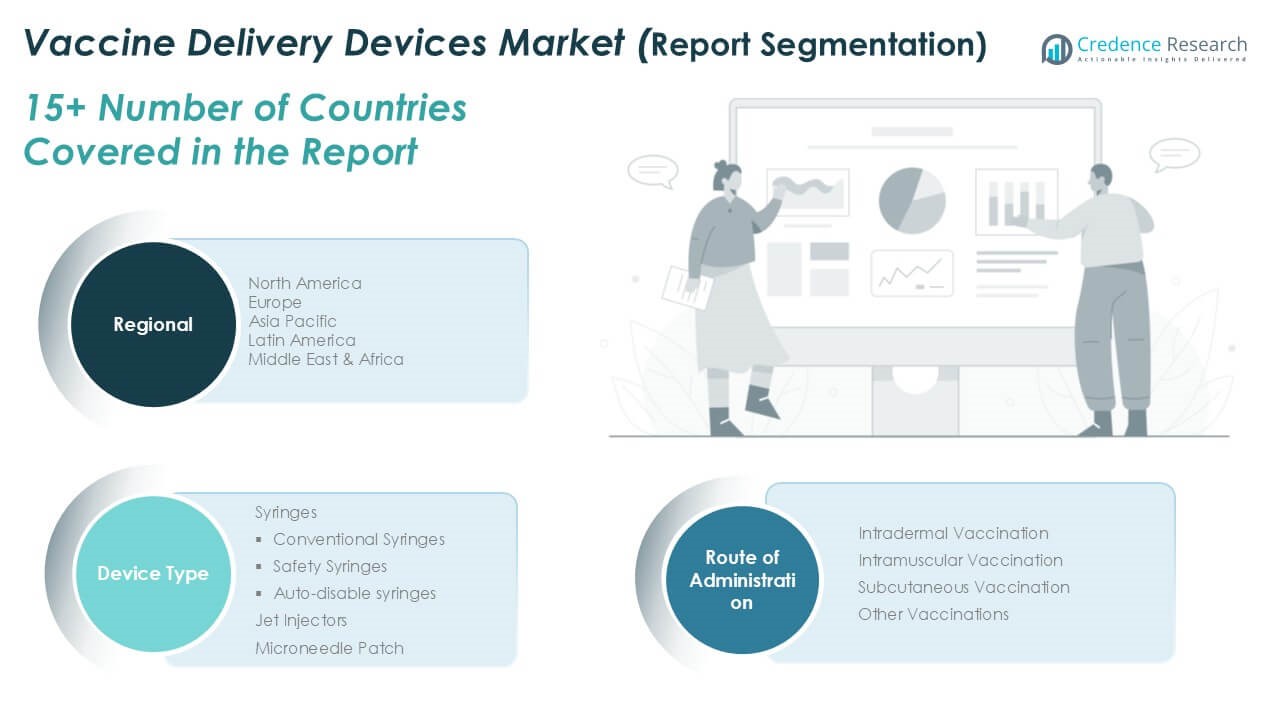
The Global Vaccine Delivery Devices Market, segmented by device type, includes syringes, jet injectors, and microneedle patches. Syringes dominate the market, with sub-segments such as conventional syringes, safety syringes, and auto-disable syringes playing critical roles in mass immunization programs. Auto-disable syringes gain preference in public health campaigns due to their single-use design, which prevents reuse and ensures patient safety. Safety syringes also hold a significant share, driven by rising awareness about needle-stick injuries among healthcare workers. Jet injectors are gaining momentum for needle-free delivery, especially in pediatric and needle-phobic populations. Microneedle patches represent an emerging segment with strong potential, offering a painless and user-friendly alternative for both healthcare settings and self-administration.
- For instance, global production of syringes exceeds 16 billion units annually, with over 8 billion auto-disable syringes used specifically in public health immunization campaigns each year.
By Route of Administration
Segmented by route of administration, the Global Vaccine Delivery Devices Market includes intradermal, intramuscular, subcutaneous, and other vaccination methods. Intramuscular vaccination accounts for the largest revenue share, supported by its widespread application in routine immunization and pandemic responses. It enables deep tissue penetration, leading to strong immune responses, particularly for flu, hepatitis, and COVID-19 vaccines. Subcutaneous vaccination is commonly used for specific vaccines like MMR and offers ease of administration. Intradermal delivery is gaining popularity for dose-sparing benefits and is increasingly used in clinical trials and research. Other routes, including oral and nasal administration, are under continuous evaluation to expand delivery options and improve patient compliance.
- For instance, it is estimated that more than 3.5 billion intramuscular vaccinations are administered globally each year, compared to 1.2 billion subcutaneous and 300 million intradermal vaccinations.
Segments
Based on Device Type
- Syringes
- Conventional Syringes
- Safety Syringes
- Auto-disable syringes
- Jet Injectors
- Microneedle Patch
Based on Route of Administration
- Intradermal Vaccination
- Intramuscular Vaccination
- Subcutaneous Vaccination
- Other Vaccinations
Based on Region
- North America
- U.S.
- Canada
- Mexico
- Europe
- UK
- France
- Germany
- Italy
- Spain
- Russia
- Belgium
- Netherlands
- Austria
- Sweden
- Poland
- Denmark
- Switzerland
- Rest of Europe
- Asia Pacific
- China
- Japan
- South Korea
- India
- Australia
- Thailand
- Indonesia
- Vietnam
- Malaysia
- Philippines
- Taiwan
- Rest of Asia Pacific
- Latin America
- Brazil
- Argentina
- Peru
- Chile
- Colombia
- Rest of Latin America
- Middle East
- UAE
- KSA
- Israel
- Turkey
- Iran
- Rest of Middle East
- Africa
- Egypt
- Nigeria
- Algeria
- Morocco
- Rest of Africa
Regional Analysis
North America Vaccine Delivery Devices Market
The North America Vaccine Delivery Devices Market reached USD 1,764.35 million in 2024 and is projected to hit USD 3,098.19 million by 2032, expanding at a CAGR of 7.3%. It accounted for approximately 23.9% of the global market share in 2024. The United States leads the region with widespread adoption of advanced injection technologies, coupled with government-led immunization initiatives. Strong healthcare infrastructure and a high rate of vaccine acceptance contribute significantly to regional growth. Canada follows with investments in intradermal and microneedle systems, driven by its emphasis on needle-free solutions. Strategic partnerships among biopharma players and medical device manufacturers support innovation in delivery methods.
Europe Vaccine Delivery Devices Market
The Europe Vaccine Delivery Devices Market was valued at USD 1,664.13 million in 2024 and is estimated to reach USD 3,170.93 million by 2032, growing at a CAGR of 8.4%. The region represented 22.5% of the global market share in 2024. Germany, France, and the UK remain central hubs for medical device production and vaccine technology development. It benefits from strong regulatory support and increasing government funding for immunization programs. The rising geriatric population and demand for booster doses create consistent demand for effective and minimally invasive delivery systems. Collaborative research among EU member states also drives innovation across delivery platforms.
Asia Pacific Vaccine Delivery Devices Market
The Asia Pacific Vaccine Delivery Devices Market stood at USD 2,561.50 million in 2024 and is expected to reach USD 4,849.33 million by 2032, advancing at a CAGR of 8.3%. It commanded the highest market share globally at 34.8% in 2024. China, India, and Japan play pivotal roles in production and consumption of delivery devices, driven by large-scale immunization campaigns. Rising healthcare spending, urbanization, and expansion of private healthcare facilities enhance market penetration. It benefits from growing investments in smart injector technologies and mobile vaccination units. Domestic players are increasingly collaborating with global firms to improve device distribution in rural areas.
Latin America Vaccine Delivery Devices Market
The Latin America Vaccine Delivery Devices Market generated USD 728.78 million in 2024 and is forecast to reach USD 1,212.33 million by 2032, with a CAGR of 6.6%. The region accounted for 9.9% of the global market share in 2024. Brazil and Mexico dominate the market due to their proactive immunization drives and rising demand for pediatric vaccine solutions. Public-private collaborations aim to introduce more cost-efficient and less invasive delivery methods. It is witnessing growth in auto-disable syringe adoption to curb contamination risks. Infrastructure development in public health continues to widen the access to vaccination services across underserved communities.
Middle East Vaccine Delivery Devices Market
The Middle East Vaccine Delivery Devices Market reached USD 482.13 million in 2024 and is set to climb to USD 848.63 million by 2032, registering a CAGR of 7.4%. It made up 6.5% of the global market share in 2024. Countries like Saudi Arabia and the UAE are actively upgrading their healthcare systems with innovative delivery tools. It shows increasing preference for prefilled syringes and safety-engineered devices to reduce needle-stick injuries. National immunization schedules and pandemic preparedness strategies are key growth drivers. Government tenders for procurement of advanced vaccine delivery systems are becoming more frequent in the region.
Africa Vaccine Delivery Devices Market
The Africa Vaccine Delivery Devices Market was valued at USD 183.99 million in 2024 and is expected to reach USD 290.96 million by 2032, growing at a CAGR of 5.9%. The region contributed 2.5% of the global market share in 2024. It faces challenges such as limited access to healthcare services and underdeveloped distribution channels. South Africa leads in adoption, supported by NGO partnerships and mobile immunization initiatives. It is gradually integrating auto-disable syringes and thermostable delivery systems in rural areas. Increased international funding is expected to improve access and accelerate deployment of efficient vaccine administration tools.
Key players
- BD (Becton, Dickinson and Company)
- PharmaJet, Inc.
- Vaxxas
- Schott AG
- Gerresheimer AG
- Corium International, Inc.
- Bioject Medical Technologies, Inc.
Competitive Analysis
The Global Vaccine Delivery Devices Market features a competitive landscape marked by innovation, strategic collaborations, and geographic expansion. Major players such as BD maintain a stronghold through a broad product portfolio and global distribution networks. Emerging companies like PharmaJet and Vaxxas are gaining traction by introducing needle-free and microneedle delivery systems that enhance patient compliance and safety. Schott AG and Gerresheimer AG contribute significantly by supplying high-quality glass and polymer-based containers for vaccine storage and delivery. It fosters competition through continuous R\&D, with companies focusing on device efficiency, safety, and cost-effectiveness. The market remains dynamic, with established firms acquiring or partnering with startups to integrate cutting-edge technologies.
Recent Developments
- On January 20, 2025, BD showcased its Evolve On‑body Injector and iDFill RFID‑enabled prefillable syringe systems at Pharmapack 2025 in Paris, highlighting improved ease of use, dose accuracy, and connected capabilities
Market Concentration and Characteristics
The Global Vaccine Delivery Devices Market exhibits moderate to high market concentration, with a few dominant players such as BD, Gerresheimer AG, and PharmaJet holding significant revenue shares. It features a mix of established manufacturers and emerging innovators focusing on advanced technologies like needle-free injectors and microneedle patches. The market is characterized by high regulatory standards, strong demand for safety and precision, and increasing preference for self-administration solutions. Product differentiation, continuous innovation, and global distribution capabilities define competitive strength. It responds quickly to public health needs, pandemic outbreaks, and evolving immunization strategies. Strategic partnerships and R&D investments play a critical role in shaping its future.
Report Coverage
The research report offers an in-depth analysis based on Device Type, Route of Administration and Region. It details leading market players, providing an overview of their business, product offerings, investments, revenue streams, and key applications. Additionally, the report includes insights into the competitive environment, SWOT analysis, current market trends, as well as the primary drivers and constraints. Furthermore, it discusses various factors that have driven market expansion in recent years. The report also explores market dynamics, regulatory scenarios, and technological advancements that are shaping the industry. It assesses the impact of external factors and global economic changes on market growth. Lastly, it provides strategic recommendations for new entrants and established companies to navigate the complexities of the market.
Future Outlook
- Needle-free delivery systems such as jet injectors and microneedle patches will gain wider acceptance due to rising demand for painless and safer alternatives to conventional syringes.
- Auto-injectors and wearable vaccine delivery devices will see growth as healthcare shifts toward home-based and patient-centric care models.
- Smart vaccine delivery devices with dose-tracking features will integrate with electronic health records to enhance monitoring and compliance across healthcare systems.
- Manufacturers will focus on eco-friendly materials and recyclable components to reduce medical waste and align with global sustainability goals.
- Expanding immunization programs in Asia, Africa, and Latin America will create strong demand for affordable and durable vaccine delivery devices.
- Governments and international health agencies will prioritize stockpiling and rapid deployment systems to support emergency vaccination campaigns.
- Specialized devices designed for children and elderly patients will become more prevalent, offering improved comfort, safety, and ease of use.
- Efforts to harmonize international regulatory standards will speed up approval processes, enabling faster market entry for new devices.
- Collaborations between manufacturers, NGOs, and governments will strengthen supply chains and promote equitable access to advanced delivery technologies.
- New delivery systems tailored to specific patient profiles and vaccine types will enhance precision, reduce side effects, and improve immunization outcomes.

Request a Free Sample
Fill in your details and we'll send you a free sample report.
- Sample data tables & charts
- Research methodology
Market Dynamics
Expansion of Global Immunization Campaigns
Governments and international health organizations are investing heavily in expanding immunization coverage, driving demand for efficient and scalable vaccine delivery devices to support mass vaccination efforts and pandemic preparedness.
Technological Advancements in Needle-Free and Minimally Invasive Devices
Innovations such as microneedle patches, jet injectors, and smart syringes are improving patient compliance, reducing needle-stick injuries, and enabling safer, more comfortable vaccine administration, thus accelerating market adoption.
Rising Geriatric Population and Chronic Disease Prevalence
The increasing number of elderly individuals and the growing burden of chronic and infectious diseases are boosting the need for regular and booster vaccinations, fueling demand for user-friendly and precise delivery devices.
Public-Private Partnerships and R&D Investments
Strategic collaborations between governments, NGOs, and private manufacturers are fostering technology transfer, bulk procurement, and accelerated development of advanced vaccine delivery systems, especially in emerging economies.
Shift Toward Home-Based and Self-Administration Solutions
The trend toward patient-centric care and home-based healthcare is increasing the adoption of auto-injectors, prefilled syringes, and wearable patches, making vaccination more accessible and reducing the burden on healthcare facilities.
Need a Custom Version of This Report?
Tailor the scope, geography, or segments to your exact requirements.
- Custom geography or segment scope
- Direct access to our analyst team
Frequently Asked Questions
What was the market size of the Global Vaccine Delivery Devices Market in 2023, and what is the forecast for 2032?
Which factors are driving the growth of the vaccine delivery devices market?
What are the key technologies shaping the vaccine delivery devices market?
Which regions are expected to witness the highest market growth?
Who are the leading players in the Global Vaccine Delivery Devices Market?
Table of Content
Chapter 1 Market Segmentation
- 1.1 Segmentation Framework
- 1.1.1 Product and Service Classification
- 1.1.2 Application and End-Use Classification
- 1.1.3 Technology and Solution Classification
- 1.1.4 Customer and Distribution Channel Classification
- 1.1.5 Geographic Segmentation
- 1.1.6 Market Segment Definitions and Boundaries
- 1.2 By End User
- 1.2.1 Hospitals & Clinics
- 1.2.2 Ambulatory Surgical Centers
- 1.2.3 Home Care Settings
- 1.2.4 Public Health Agencies
- 1.3 By Device Type
- 1.3.1 Conventional Syringes
- 1.3.2 Safety Syringes
- 1.3.3 Auto-disable Syringes
- 1.3.4 Jet Injectors
- 1.3.5 Microneedle Patches
- 1.4 By Route of Administration
- 1.4.1 Intradermal Vaccination
- 1.4.2 Intramuscular Vaccination
- 1.4.3 Subcutaneous Vaccination
- 1.4.4 Other Vaccinations
Chapter 2 Introduction
- 2.1 Report Objectives and Scope
- 2.2 Product Definition and Industry Terminology
- 2.3 Market Inclusions and Exclusions
- 2.4 Research Process
- 2.4.1 Primary Research and Expert Interviews
- 2.4.2 Secondary Research and Source Review
- 2.4.3 Top-Down and Bottom-Up Estimation
- 2.4.4 Data Triangulation and Verification
- 2.5 Market Size Measurement Basis
- 2.5.1 2023: USD 6,850 million → 2032: USD 13,470.4 million
- 2.6 Historical and Forecast Reference Periods
- 2.6.1 Base Year: 2023
- 2.6.2 Forecast Period: 2023-2032
- 2.7 Research Assumptions and Limitations
Chapter 3 Executive Summary
- 3.1 Market Snapshot and Key Findings
- 3.2 Base-Year Market Size, 2023
- 3.3 Forecast Market Size, 2032
- 3.4 Revenue and Volume Growth Outlook
- 3.5 Key Demand and Supply Indicators
- 3.6 Leading Market Segments
- 3.7 Fastest-Growing Market Opportunities
- 3.8 Regional Performance Highlights
- 3.9 Technology and Industry Transformation
- 3.10 Competitive Landscape Summary
- 3.11 Analyst View and Strategic Implications
Chapter 4 Global Vaccine Delivery Devices Market Trends and Developments
- 4.1 Historical Industry Development
- 4.2 Recent Market Trends and Developments
- 4.3 Demand and Customer Behavior Trends
- 4.4 Technology and Product Innovation
- 4.5 Artificial Intelligence, Automation and Digitalization
- 4.6 Local Manufacturing and Supply Chain Realignment
- 4.7 Industry Partnerships, Mergers and Acquisitions
- 4.8 Sustainability and Circular Economy Developments
- 4.9 Government and Private Sector Investment Trends
- 4.10 Emerging Business Models and Commercialization
- 4.11 Industry Developments and Announcements
Chapter 5 Global Vaccine Delivery Devices Market Production, Supply and Demand Analysis
- 5.1 Demand Trend and Consumption Analysis
- 5.2 Demand Forecast, 2023-2032
- 5.3 Production and Output Trend
- 5.4 Production and Output Forecast, 2023-2032
- 5.5 Installed Capacity and Capacity Utilization
- 5.6 Company-Wise Production Plants and Statistics
- 5.6.1 Installed Production Capacity
- 5.6.2 Actual Production
- 5.6.3 Planned Capacity and Expansion Targets
- 5.7 Supply Chain Structure and Procurement Trends
- 5.8 Supply-Demand Gap and Bottlenecks
- 5.9 Import Dependence and Sourcing Structure
- 5.10 Contract Manufacturing and Outsourcing
- 5.11 Regional Supply and Demand Concentration
Chapter 6 Global Vaccine Delivery Devices Market Pricing Analysis
- 6.1 Pricing Structure and Measurement
- 6.2 Historical Pricing Trends
- 6.3 Pricing Outlook, 2023-2032
- 6.4 Average Selling Price and Unit Economics
- 6.5 Pricing by Product and Market Segment
- 6.6 Geographic Pricing Differences
- 6.7 Key Input, Energy, Labor and Logistics Costs
- 6.8 Contract Pricing and Purchasing Models
- 6.9 Pricing Sensitivity and Competitive Positioning
- 6.10 Price, Margin and Profitability Implications
Chapter 7 Global Vaccine Delivery Devices Market Dynamics
- 7.1 Market Growth Drivers
- 7.1.1 Demand-Side Drivers
- 7.1.2 Technology and Innovation Drivers
- 7.1.3 Infrastructure and Investment Drivers
- 7.1.4 Regulatory and Policy Drivers
- 7.2 Market Restraints
- 7.2.1 Cost and Affordability Constraints
- 7.2.2 Technology and Adoption Barriers
- 7.2.3 Supply Chain and Operational Constraints
- 7.3 Market Challenges
- 7.3.1 Competitive Pressure and Margin Erosion
- 7.3.2 Skills, Infrastructure and Implementation Gaps
- 7.4 Emerging Market Opportunities
- 7.5 Market Dynamics Impact and Time-Horizon Assessment
Chapter 8 Global Vaccine Delivery Devices Value Chain Analysis
- 8.1 Industry Value Chain Overview
- 8.2 Upstream Suppliers and Critical Inputs
- 8.3 Technology and Component Providers
- 8.4 Manufacturing or Service Delivery
- 8.5 Distribution, Channel Partners and Integrators
- 8.6 Downstream Applications and End Users
- 8.7 Value Addition and Profit Pools
- 8.8 Vertical Integration and Outsourcing
- 8.9 Supplier Concentration and Risk
- 8.10 Supply Chain Localization and Resilience
Chapter 9 Global Vaccine Delivery Devices Market Regulations and Policies
- 9.1 Relevant Laws, Standards and Compliance Frameworks
- 9.2 Product, Service, Safety and Quality Requirements
- 9.3 Government Policies, Incentives and Subsidies
- 9.4 Imports, Exports and Trade Barriers
- 9.5 Public Procurement and Local Content Requirements
- 9.6 Environmental and Sustainability Compliance
- 9.7 Upcoming Policy Changes and Market Implications
Chapter 10 Global Vaccine Delivery Devices Market Hotspots and Opportunities
- 10.1 Market Opportunity Mapping and Growth Hotspots
- 10.2 High-Growth Applications and Customer Groups
- 10.3 Underserved Markets and White-Space Opportunities
- 10.4 Emerging Technology and Product Opportunities
- 10.5 New Capacity and Investment Hotspots
- 10.6 Market Entry and Expansion Opportunities
- 10.7 Distribution and Partnership Opportunities
- 10.8 Near-Term and Long-Term Commercial Potential
- 10.9 Opportunity Attractiveness and Execution Risks
Chapter 11 Global Vaccine Delivery Devices Market Outlook, 2023-2032
- 11.1 Market Size and Analysis
- 11.1.1 Revenue (Market Measurement: 2023: USD 6,850 million → 2032: USD 13,470.4 million)
- 11.1.2 Market Volume and Quantity Sold
- 11.1.3 Historical Market Size
- 11.1.4 Base-Year Market Size, 2023
- 11.2 Market Forecast, 2023-2032
- 11.2.1 Revenue Forecast to 2032
- 11.2.2 Volume Forecast to 2032
- 11.2.3 CAGR and Year-on-Year Growth
- 11.2.4 Incremental Revenue Opportunity
- 11.3 Forecast Assumptions and Scenario Analysis
- 11.3.1 Base-Case Forecast
- 11.3.2 Optimistic and Conservative Scenarios
- 11.3.3 Technology, Pricing and Policy Sensitivities
- 11.4 Market Attractiveness and Growth Outlook
Chapter 12 Global Vaccine Delivery Devices Market Segmentation and Outlook
- 12.1 Segmentation Summary and Market Shares, 2023
- 12.2 Largest and Fastest-Growing Segments
- 12.3 By End User - Market Size and Forecast, 2023-2032
- 12.3.1 Segment Definition and Scope
- 12.3.2 Historical Market Size
- 12.3.3 Revenue Forecast, 2023-2032
- 12.3.4 Volume Forecast, 2023-2032
- 12.3.5 Base-Year Market Share, 2023
- 12.3.6 Segment CAGR and Growth Drivers
- 12.3.7 Subsegment Market Size and Forecast
- 12.3.7.1 Hospitals & Clinics
- 12.3.7.2 Ambulatory Surgical Centers
- 12.3.7.3 Home Care Settings
- 12.3.7.4 Public Health Agencies
- 12.3.8 Subsegment Pricing and Adoption Trends
- 12.3.9 Leading Suppliers and Competition
- 12.3.10 Regional Demand and Opportunities
- 12.4 By Device Type - Market Size and Forecast, 2023-2032
- 12.4.1 Segment Definition and Scope
- 12.4.2 Historical Market Size
- 12.4.3 Revenue Forecast, 2023-2032
- 12.4.4 Volume Forecast, 2023-2032
- 12.4.5 Base-Year Market Share, 2023
- 12.4.6 Segment CAGR and Growth Drivers
- 12.4.7 Subsegment Market Size and Forecast
- 12.4.7.1 Conventional Syringes
- 12.4.7.2 Safety Syringes
- 12.4.7.3 Auto-disable Syringes
- 12.4.7.4 Jet Injectors
- 12.4.7.5 Microneedle Patches
- 12.4.8 Subsegment Pricing and Adoption Trends
- 12.4.9 Leading Suppliers and Competition
- 12.4.10 Regional Demand and Opportunities
- 12.5 By Route of Administration - Market Size and Forecast, 2023-2032
- 12.5.1 Segment Definition and Scope
- 12.5.2 Historical Market Size
- 12.5.3 Revenue Forecast, 2023-2032
- 12.5.4 Volume Forecast, 2023-2032
- 12.5.5 Base-Year Market Share, 2023
- 12.5.6 Segment CAGR and Growth Drivers
- 12.5.7 Subsegment Market Size and Forecast
- 12.5.7.1 Intradermal Vaccination
- 12.5.7.2 Intramuscular Vaccination
- 12.5.7.3 Subcutaneous Vaccination
- 12.5.7.4 Other Vaccinations
- 12.5.8 Subsegment Pricing and Adoption Trends
- 12.5.9 Leading Suppliers and Competition
- 12.5.10 Regional Demand and Opportunities
- 12.6 Segment Growth Comparison
- 12.7 Segment Attractiveness and Priority Matrix
Chapter 13 Global Vaccine Delivery Devices End-Use and Application Market Outlook
- 13.1 End-Use Industry and Customer Demand Structure
- 13.2 Leading Applications and Customer Groups
- 13.3 End-Use Market Size, Share and Forecast
- 13.4 Major End-Use Industry Deep Dives
- 13.4.1 Customer Requirements and Use Cases
- 13.4.2 Demand and Replacement Cycles
- 13.4.3 Technical and Regulatory Considerations
- 13.4.4 Purchasing and Procurement Models
- 13.4.5 Leading Vendors and Distribution Channels
- 13.4.6 Forecast and Commercial Opportunities
- 13.5 Emerging Applications and Cross-Segment Demand
- 13.6 End-Use Industry Investment Priorities
Chapter 14 Global Vaccine Delivery Devices Geographic Market Outlook, 2023-2032
- 14.1 Regional Market Size and Share, 2023
- 14.2 Regional Market Forecast, 2023-2032
- 14.3 Regional Pricing, Production and Demand Differences
- 14.4 North America
- 14.4.1 United States
- 14.4.2 Canada
- 14.4.3 Mexico
- 14.5 Europe
- 14.5.1 Germany
- 14.5.2 France
- 14.5.3 Italy
- 14.5.4 United Kingdom
- 14.5.5 Spain
- 14.5.6 Poland
- 14.5.7 Russia
- 14.5.8 Netherlands
- 14.5.9 Belgium
- 14.5.10 Sweden
- 14.5.11 Denmark
- 14.5.12 Norway
- 14.5.13 Rest of Europe
- 14.6 Asia Pacific
- 14.6.1 China
- 14.6.2 India
- 14.6.3 Japan
- 14.6.4 South Korea
- 14.6.5 Thailand
- 14.6.6 Indonesia
- 14.6.7 Vietnam
- 14.6.8 Malaysia
- 14.6.9 Australia
- 14.6.10 Rest of Asia Pacific
- 14.7 Latin America
- 14.7.1 Brazil
- 14.7.2 Argentina
- 14.7.3 Colombia
- 14.7.4 Chile
- 14.7.5 Rest of Latin America
- 14.8 Middle East
- 14.8.1 Saudi Arabia
- 14.8.2 United Arab Emirates
- 14.8.3 Turkey
- 14.8.4 Israel
- 14.8.5 Iran
- 14.8.6 Rest of the Middle East
- 14.9 Africa
- 14.9.1 South Africa
- 14.9.2 Egypt
- 14.9.3 Nigeria
- 14.9.4 Morocco
- 14.9.5 Rest of Africa
- 14.10 Regional Investment, Policy and Supply Chain Differences
- 14.11 Regional Competitive Landscape
- 14.12 Geographic Growth Hotspots
Chapter 15 Global Vaccine Delivery Devices Technology, Innovation and Sustainability Outlook
- 15.1 Technology Landscape and Maturity
- 15.2 Product, Process and Service Innovation
- 15.3 AI, Automation and Digital Tools in the Industry
- 15.4 Technology Adoption and Performance Benchmarking
- 15.5 Innovation Pipeline and R&D Investment
- 15.6 Patent and Intellectual Property Trends
- 15.7 Energy Efficiency and Resource Management
- 15.8 Sustainability, Recycling and Circularity
- 15.9 Technology Roadmap, 2023-2032
- 15.10 Risks of Obsolescence and Technology Substitution
Chapter 16 Global Vaccine Delivery Devices Market Key Strategic Imperatives
- 16.1 Growth and Market Entry Priorities
- 16.2 High-Return Products and Segments
- 16.3 Pricing, Profitability and Cost Optimization
- 16.4 Technology Investment and Product Differentiation
- 16.5 Supply Chain Localization and Resilience
- 16.6 Distribution and Customer Acquisition
- 16.7 Partnership, Acquisition and Capacity Strategy
- 16.8 Regional Expansion Priorities
- 16.9 Short-, Medium- and Long-Term Actions
Chapter 17 Competition Outlook
- 17.1 Industry Competition Characteristics
- 17.2 Market Structure and Concentration
- 17.3 Market Share and Competitive Positioning, 2023
- 17.4 Company-Wise Revenue and Product Benchmarking
- 17.5 Production and Service Capacity Benchmarking
- 17.6 Technology, Pricing and Differentiation
- 17.7 Regional Footprint and Distribution Strength
- 17.8 Mergers, Acquisitions and Strategic Alliances
- 17.9 New Entrants and Competitive Threats
- 17.10 Porter's Five Forces and Industry Attractiveness
- 17.11 Competitive Outlook, 2023-2032
Chapter 18 Company Profiles
- 18.1 Company Coverage and Selection Criteria
- 18.2 Becton, Dickinson and Company (BD)
- 18.2.1 Business Description
- 18.2.2 Company Ownership and Geographic Presence
- 18.2.3 Product and Service Portfolio
- 18.2.4 Manufacturing and Operating Footprint
- 18.2.5 Production Capacity and Expansion Plans
- 18.2.6 Financial Performance and Investment
- 18.2.7 Market Share and Competitive Position
- 18.2.8 Technology and Innovation Capabilities
- 18.2.9 Strategic Alliances or Partnerships
- 18.2.10 Recent Developments
- 18.2.11 Growth Strategy and Outlook
- 18.3 PharmaJet, Inc.
- 18.4 Vaxxas
- 18.5 Gerresheimer AG
- 18.6 Schott AG
- 18.7 Corium International, Inc.
- 18.8 Bioject Medical Technologies, Inc.
- 18.9 3M Company
- 18.10 West Pharmaceutical Services
- 18.11 Terumo Corporation
- 18.12 Other Relevant Market Participants
Note: Every listed company is profiled on the structure shown under the first company. The company list is preliminary and may change based on research findings, market developments, data availability and client requirements.
Chapter 19 Disclaimer
- 19.1 Research and Forecast Disclaimer
- 19.2 Data Source and Estimation Limitations
Note: The depth of individual sections depends on data availability for this market. Volume, capacity, trade and other unit-based metrics are included where applicable.