
Market Overview
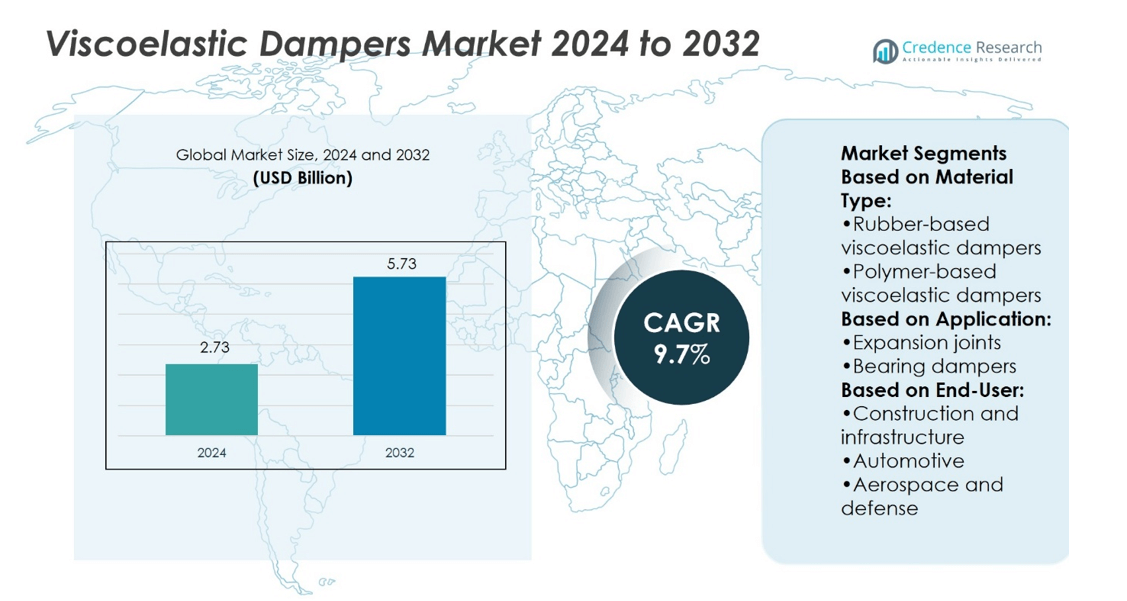
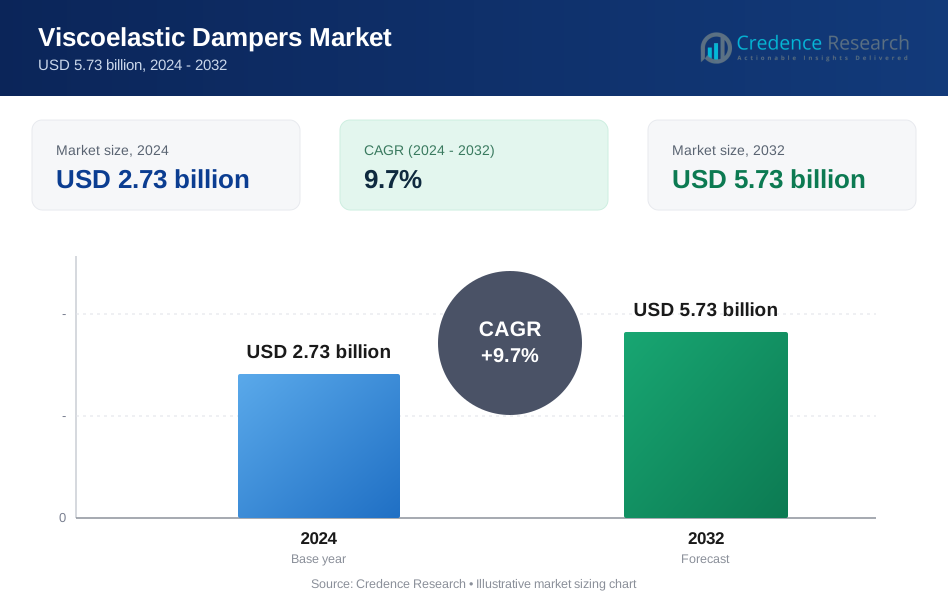
Viscoelastic Dampers Market size was valued at USD 2.73 billion in 2024 and is anticipated to reach USD 5.73 billion by 2032, at a CAGR of 9.7% during the forecast period.
| REPORT ATTRIBUTE | DETAILS |
|---|---|
| Historical Period | 2020-2023 |
| Base Year | 2024 |
| Forecast Period | 2025-2032 |
| Viscoelastic Dampers Market Size 2024 | USD 2.73 billion |
| Viscoelastic Dampers Market, CAGR | 9.7% |
| Viscoelastic Dampers Market Size 2032 | USD 5.73 billion |
The Viscoelastic Dampers Market grows through strong demand driven by seismic safety regulations, urbanization, and large-scale infrastructure projects. It benefits from increasing adoption in high-rise buildings, bridges, and industrial facilities where vibration control is critical. Rising focus on sustainability supports the use of durable, eco-friendly damping materials. Technological advancements in polymers enhance performance under diverse conditions and reduce long-term maintenance needs. Integration with smart monitoring systems further strengthens efficiency and reliability. Expanding applications across automotive, aerospace, and machinery sectors ensure continuous growth. These combined drivers and trends position viscoelastic dampers as a core component of resilient infrastructure worldwide.
North America leads the Viscoelastic Dampers Market with strong regulatory support, while Asia-Pacific records the fastest growth through rapid urbanization and large-scale infrastructure projects. Europe maintains significant share driven by retrofitting programs and sustainable construction practices, whereas Latin America and the Middle East & Africa show gradual adoption supported by urban development initiatives. Key players shaping the competitive landscape include ZF Friedrichshafen AG, BorgWarner, CONTINENTAL AG, Schaeffler Group, Delphi, Visteon, General Motors, TrelleborgVibracoustic, Tuopu, and Hubei Guangao.
Market Insights
- Viscoelastic Dampers Market size was valued at USD 2.73 billion in 2024 and is anticipated to reach USD 5.73 billion by 2032, at a CAGR of 9.7%.
- Seismic safety regulations, urbanization, and infrastructure projects drive consistent adoption in construction and industrial sectors.
- Trends include polymer-based innovations, eco-friendly damping materials, and integration with smart monitoring systems.
- The competitive landscape features strong players focusing on R&D, cost optimization, and global expansion strategies.
- High installation costs and technical complexities remain restraints that limit adoption in cost-sensitive regions.
- North America leads with regulatory enforcement, Europe grows through retrofitting, and Asia-Pacific shows fastest expansion with mega projects.
- Latin America and Middle East & Africa gradually adopt dampers supported by urban development and modernization programs.
Market Drivers
Seismic Safety Regulations Driving Adoption
Governments worldwide impose strict building codes to ensure safety during earthquakes. The Viscoelastic Dampers Market benefits directly from these mandates, as dampers reduce vibrations and structural risks. It provides an effective solution for high-rise buildings, bridges, and industrial facilities. Compliance with regulations drives large-scale adoption in seismic zones. Urban planners prioritize structures with damping systems to meet resilience standards. This regulatory push ensures long-term demand and market growth.
- For instance, Miller Metal Fabrication expanded its Bridgeville facility by 60,000 square feet, completing construction around 2022. The facility is equipped with fiber lasers capable of high-speed cutting for various metals, which enhances efficiency for industrial projects.
Rising Infrastructure Investments Globally
Countries invest heavily in new infrastructure, including commercial complexes, airports, and transport systems. The Viscoelastic Dampers Market grows as developers integrate dampers to enhance durability and safety. It supports longer lifespans for critical projects while reducing repair costs. Mega infrastructure projects in Asia and the Middle East increase product demand. Growing urbanization and modernization programs strengthen this trend further. Infrastructure upgrades in mature economies also maintain steady adoption rates.
- For instance, Geuder’s NanoEdge® single-use trephines feature blade progression of 0.0625 mm per quarter-turn and 0.25 mm per full rotation for highly precise corneal cuts in keratoplasty.
Technological Advancements and Material Innovation
Research drives continuous improvements in damping materials and installation methods. The Viscoelastic Dampers Market benefits from innovative polymers that offer better energy dissipation. It enhances flexibility for applications in varied climates and structural conditions. Advancements also reduce installation complexity and maintenance needs. Manufacturers develop customizable solutions tailored to project-specific demands. These innovations improve cost efficiency and strengthen product competitiveness in global markets.
Focus on Building Resilience and Sustainability
Resilience against disasters remains a priority for governments and private developers. The Viscoelastic Dampers Market plays a key role in ensuring safety without heavy structural modifications. It aligns with sustainability goals by reducing material use and extending building life cycles. Growing awareness of climate-related risks strengthens adoption in both developed and developing regions. Energy-efficient solutions appeal to environmentally conscious construction firms. The dual focus on resilience and sustainability drives continuous market expansion.
Market Trends
Integration with Smart and Adaptive Structures
The Viscoelastic Dampers Market shows strong momentum with the integration of smart structural technologies. It supports real-time monitoring of vibration and energy dissipation in buildings and bridges. Sensors combined with dampers enhance adaptive response to dynamic loads. Architects and engineers increasingly adopt these solutions in urban construction projects. Smart city initiatives amplify the use of intelligent damping systems. This trend ensures safer, more efficient infrastructure aligned with modern design needs.
- For instance, 3M supplied its VHB™ tapes for a major construction project in Singapore, the Jewel Changi Airport. The tapes were used to bond over 9,000 glass panels in the building's facade, demonstrating their strength, durability, and ability to handle the dynamic loads of a large structure.
Adoption in High-Rise and Complex Constructions
The construction of tall towers and large-span bridges fuels steady demand for advanced damping systems. The Viscoelastic Dampers Market benefits from engineering designs that require vibration control without adding heavy structural weight. It provides effective protection against wind-induced oscillations and seismic activities. Developers adopt dampers to extend structural life and ensure safety. Urbanization drives large-scale construction in Asia-Pacific and the Middle East. This trend positions dampers as a critical component in future architectural projects.
- For instance, LMK Thermosafe’s Thermosafe Type B Induction Drum Heater warms a 205-liter steel drum using an alternating current power source, such as a 110/120V supply rated at 1,500 watts. Two units can be stacked to cover the full drum height safely in Zone 2 areas.
Shift Toward Lightweight and High-Performance Materials
Manufacturers focus on developing viscoelastic materials with superior energy absorption capacity. The Viscoelastic Dampers Market evolves through the use of polymers that perform consistently across temperature ranges. It reduces maintenance needs and enhances long-term reliability. Lightweight designs improve installation efficiency for both retrofits and new constructions. Research efforts continue to optimize cost-performance balance. This trend reinforces industry competitiveness while addressing varied global construction demands.
Growth of Retrofit and Renovation Applications
Aging infrastructure across developed regions increases the importance of structural retrofitting. The Viscoelastic Dampers Market expands as governments and private developers prioritize safety upgrades. It enables cost-effective reinforcement without complete structural overhauls. Public spending on infrastructure rehabilitation supports this trend across North America and Europe. Building owners adopt dampers to meet new safety standards and extend asset lifecycles. Growing emphasis on resilience ensures retrofitting remains a critical growth area for the market.
Market Challenges Analysis
High Installation Costs and Technical Complexity
The Viscoelastic Dampers Market faces a major challenge due to high upfront costs and technical demands. It requires specialized expertise for design, placement, and integration within complex structures. Limited availability of trained professionals in emerging markets slows large-scale adoption. High initial investment discourages smaller construction firms from implementing damping systems. Retrofitting older buildings with dampers also increases project expenses and timelines. These financial and technical barriers restrict widespread deployment, particularly in cost-sensitive regions.
Performance Limitations under Variable Conditions
The Viscoelastic Dampers Market encounters issues related to material behavior in diverse environments. It shows reduced efficiency when exposed to extreme temperatures or long-term stress cycles. Consistent performance remains difficult in projects located in highly variable climatic zones. Concerns about long-term durability create hesitation among infrastructure developers. Limited standardization in testing methods adds to uncertainty in performance evaluation. These challenges slow acceptance in some markets and highlight the need for continued material innovation.
Market Opportunities
Rising Demand in Emerging Economies
The Viscoelastic Dampers Market holds strong opportunities in rapidly urbanizing regions such as Asia-Pacific, Latin America, and the Middle East. It supports large-scale construction projects where seismic safety and long-term durability are priorities. Governments allocate significant funds toward resilient infrastructure, creating new demand channels. Expanding metro systems, airports, and high-rise developments increase the scope of adoption. Local manufacturing initiatives further reduce costs, making dampers more accessible. These factors combine to create robust growth prospects across developing economies.
Advancements in Material Science and Customization
The Viscoelastic Dampers Market benefits from continuous research in polymers and high-performance materials. It enables manufacturers to deliver products with improved thermal stability, flexibility, and cost efficiency. Custom-designed dampers tailored to specific building requirements gain traction among global developers. Integration with digital monitoring tools expands functionality and strengthens adoption. Growing focus on sustainability encourages eco-friendly damping solutions aligned with green construction standards. These advancements create a pathway for broader applications and long-term competitive advantage.
Market Segmentation Analysis:
By Material Type
The Viscoelastic Dampers Market by material type divides into rubber-based and polymer-based dampers. Rubber-based dampers remain widely adopted for their flexibility and cost-effectiveness in construction projects. Polymer-based dampers gain traction due to superior thermal stability and energy dissipation capabilities. It supports performance in extreme environments where traditional rubber faces durability issues. Developers and engineers prefer advanced polymer-based solutions for high-rise and specialized infrastructure. The growing shift toward material innovation strengthens overall market adoption.
- For instance, During early interim analysis of Phase III trials for exa-cel (now known as Casgevy™), data presented showed that 24 of 27 evaluable patients with transfusion-dependent beta-thalassemia (TDT) achieved transfusion independence
By Application
The Viscoelastic Dampers Market by application includes building and construction, seismic dampers, wind dampers, vibration control dampers, bridges and infrastructures, expansion joints, bearing dampers, industrial machinery, machinery mounts, equipment vibration control, automotive, engine mounts, suspension systems, noise and vibration control, and others. It finds maximum use in building and construction where structural stability is essential. Seismic and wind dampers hold significant demand in earthquake-prone and high-wind regions. Industrial machinery applications expand as manufacturers seek vibration reduction in equipment. Automotive applications such as engine mounts and suspension systems also contribute steadily to growth. Diverse application areas ensure continuous market expansion across industries.
- For instance, Pall’s pilot microfiltration system successfully treated raw water with turbidity levels as high as 450 NTU, yet still delivered filtrate turbidity under 0.1 NTU across extended operations. This performance minimized downtime and reduced the reliance on chemical pre-treatment in municipal facilities.
By End-User
The Viscoelastic Dampers Market by end-user segments into construction and infrastructure, automotive, aerospace and defense, and manufacturing and machinery. Construction and infrastructure dominate adoption due to regulatory safety requirements and urban development projects. Automotive applications continue to expand with rising focus on passenger comfort and vehicle durability. Aerospace and defense sectors adopt dampers for noise, vibration, and shock management in aircraft and defense systems. Manufacturing and machinery use it to safeguard high-precision equipment and enhance operational efficiency. Strong demand across these sectors underlines the versatile value of viscoelastic dampers in global markets.
Segments:
Based on Material Type:
- Rubber-based viscoelastic dampers
- Polymer-based viscoelastic dampers
Based on Application:
- Expansion joints
- Bearing dampers
Based on End-User:
- Construction and infrastructure
- Automotive
- Aerospace and defense
Based on the Geography:
- North America
- U.S.
- Canada
- Mexico
- Europe
- UK
- France
- Germany
- Italy
- Spain
- Russia
- Belgium
- Netherlands
- Austria
- Sweden
- Poland
- Denmark
- Switzerland
- Rest of Europe
- Asia Pacific
- China
- Japan
- South Korea
- India
- Australia
- Thailand
- Indonesia
- Vietnam
- Malaysia
- Philippines
- Taiwan
- Rest of Asia Pacific
- Latin America
- Brazil
- Argentina
- Peru
- Chile
- Colombia
- Rest of Latin America
- Middle East
- UAE
- KSA
- Israel
- Turkey
- Iran
- Rest of Middle East
- Africa
- Egypt
- Nigeria
- Algeria
- Morocco
- Rest of Africa
Regional Analysis
North America
North America accounted for 34% share of the Viscoelastic Dampers Market in 2024, leading global adoption. Strong enforcement of seismic safety regulations in the United States and Canada drives consistent demand for damping solutions in high-rise buildings, bridges, and critical infrastructure. It benefits from mature construction practices where safety and long-term performance remain priorities. The presence of advanced research facilities and material innovation centers supports continuous product development. Retrofit projects in earthquake-prone areas of California and new infrastructure investments across urban regions sustain steady growth. North America also integrates dampers into smart building projects, aligning with energy efficiency and resilience goals.
Europe
Europe represented 27% share of the Viscoelastic Dampers Market in 2024, supported by widespread urban renewal and sustainability-driven construction practices. It maintains robust demand due to strict EU building codes and emphasis on energy efficiency. Countries such as Germany, Italy, and France focus heavily on retrofitting aging infrastructure with damping systems. Rising investments in transport projects, bridges, and metro systems also strengthen adoption. European manufacturers invest in polymer-based innovations to improve thermal stability and eco-friendly performance. With governments prioritizing climate resilience, Europe ensures viscoelastic dampers remain integral to both new builds and rehabilitation projects.
Asia-Pacific
Asia-Pacific held 29% share of the Viscoelastic Dampers Market in 2024, ranking as the fastest-growing region. Rapid urbanization in China, India, and Southeast Asia generates demand for damping solutions in skyscrapers, airports, and transport corridors. It supports large-scale infrastructure investments backed by government funding and private capital. Frequent seismic activity in Japan and parts of Southeast Asia fuels adoption of seismic dampers for structural resilience. Growing construction of bridges and industrial facilities further accelerates market growth. Regional suppliers focus on cost-efficient materials to meet rising demand from developing economies. Asia-Pacific is expected to expand its share further due to continuous mega project developments.
Latin America
Latin America captured 6% share of the Viscoelastic Dampers Market in 2024, reflecting growing but still emerging adoption. Brazil, Mexico, and Chile drive regional demand through investments in commercial construction and seismic safety projects. It faces challenges from limited awareness and budget constraints among smaller developers. Government-led initiatives for urban renewal and transportation networks support gradual integration of damping technologies. International partnerships with global manufacturers help improve accessibility of advanced solutions. Latin America is projected to see steady gains as resilience-focused construction policies gain momentum.
Middle East & Africa
The Middle East & Africa accounted for 4% share of the Viscoelastic Dampers Market in 2024, representing the smallest but steadily developing region. Large-scale construction projects in the UAE, Saudi Arabia, and Qatar create demand for vibration control systems in skyscrapers, airports, and stadiums. It benefits from government-backed infrastructure modernization programs, particularly under Vision 2030 initiatives. Africa shows slower adoption due to limited construction budgets but holds potential in South Africa and Nigeria through urban development. Growing interest in sustainable and resilient building practices adds momentum to regional adoption. With continued infrastructure expansion, this region will remain a niche but promising contributor.
Key Player Analysis
- ZF Friedrichshafen AG
- Tuopu
- Delphi
- BorgWarner
- Hubei Guangao
- CONTINENTAL AG
- General Motors
- TrelleborgVibracoustic
- Visteon
- Schaeffler Group
Competitive Analysis
The Viscoelastic Dampers Market include ZF Friedrichshafen AG, Tuopu, Delphi, BorgWarner, Hubei Guangao, CONTINENTAL AG, General Motors, TrelleborgVibracoustic, Visteon, and Schaeffler Group. The Viscoelastic Dampers Market shows a highly competitive landscape shaped by innovation, regional expansion, and strong focus on application-specific solutions. Companies compete by advancing material technologies that improve thermal stability, energy absorption, and long-term durability across construction, automotive, and industrial uses. Strategic collaborations with infrastructure developers and automotive manufacturers support deeper market penetration. Regional firms emphasize cost-effective solutions, while global players prioritize R&D-driven designs for advanced performance. The competitive dynamic highlights a balance between affordability and high-end innovation, ensuring continuous growth opportunities across diverse end-use sectors.
Recent Developments
- In June 2024, Alcon received FDA clearance for its UNITY Vitreoretinal Cataract System (VCS) and UNITY Cataract System (CS). These are the first products from Alcon's new Unity portfolio. This clearance marks a significant milestone for Alcon, as it expands its offerings in the eye care market.
- In April 2024, Carl Zeiss Meditec AG announced the acquisition of the Dutch Ophthalmic Research Center (D.O.R.C.). This strategic move aims to consolidate the companies' strengths and drive innovation in ophthalmic medical devices and surgery.
- In January 2024, Rayner, a UK-based ophthalmic company, acquired Sophi, a Swiss manufacturer known for its innovative phacoemulsification systems. The acquisition aims to diversify Rayner's surgical offerings, integrating Sophi's advanced fluidics and wireless technologies to improve cataract surgery outcomes.
- In April 2023, Canadian eye health company Bausch + Lomb launched the StableVisc cohesive ophthalmic viscosurgical device (OVD) and the TotalVisc Viscoelastic System in the US. The company stated that StableVisc helps maintain space in the eye’s anterior chamber, allowing doctors to remove and replace the clouded natural lens.
Report Coverage
The research report offers an in-depth analysis based on Material Type, Application, End-User and Geography. It details leading market players, providing an overview of their business, product offerings, investments, revenue streams, and key applications. Additionally, the report includes insights into the competitive environment, SWOT analysis, current market trends, as well as the primary drivers and constraints. Furthermore, it discusses various factors that have driven market expansion in recent years. The report also explores market dynamics, regulatory scenarios, and technological advancements that are shaping the industry. It assesses the impact of external factors and global economic changes on market growth. Lastly, it provides strategic recommendations for new entrants and established companies to navigate the complexities of the market.
Future Outlook
- The market will expand through rising adoption in seismic safety projects.
- Demand will grow in high-rise buildings and smart infrastructure developments.
- Polymer-based dampers will gain share due to better performance and durability.
- Retrofit projects will create consistent opportunities in developed economies.
- Emerging economies will drive demand with large-scale construction programs.
- Automotive applications will expand with focus on vibration and noise reduction.
- Integration with digital monitoring systems will increase product value.
- Material innovation will reduce costs and improve energy dissipation efficiency.
- Government regulations will continue to enforce adoption in safety-critical projects.
- Sustainability goals will push the use of eco-friendly damping solutions.
Request a Free Sample
Fill in your details and we'll send you a free sample report.
- Sample data tables & charts
- Research methodology
Need a Custom Version of This Report?
Tailor the scope, geography, or segments to your exact requirements.
- Custom geography or segment scope
- Direct access to our analyst team
Frequently Asked Questions
What is the current market size for Viscoelastic Dampers Market, and what is its projected size in 2032?
At what Compound Annual Growth Rate is the Viscoelastic Dampers Market projected to grow beteen 2025 and 2032?
What are the primary factors fueling the growth of the Viscoelastic Dampers Market?
Who are the leading companies in the Viscoelastic Dampers Market?
Table of Content
Chapter 1. Report Introduction
- 1.1 Report Description & Purpose
- 1.1.1 Report Title & Market Definition
- 1.1.2 Unique Selling Propositions (USP) & Key Differentiators
- 1.1.3 Value Proposition for Stakeholders
- 1.2 Research Objectives
- 1.2.1 Market Sizing Objectives (Volume & Revenue)
- 1.2.2 Segmentation Objectives
- 1.2.3 Competitive Intelligence Objectives
- 1.2.4 Forecast & Scenario Objectives
- 1.3 Report Scope
- 1.3.1 Viscoelastic Dampers Scope – Types & Subtypes Covered
- 1.3.2 Geographic Scope – Regions & Countries Covered
- 1.3.3 Historical Period, Base Year & Forecast Period (2024; forecast to 2032)
- 1.3.4 Inclusions & Exclusions
- 1.4 HS Code & Classification Framework
- 1.5 Currency, Units & Pricing Basis
- 1.6 Target Stakeholders
- 1.7 Limitations & Assumptions
Chapter 2. Executive Summary
- 2.1 Global Viscoelastic Dampers Market Snapshot
- 2.1.1 Market Size – Historical (2024) & Forecast (2024-2032) (2024: USD 2.73 billion → 2032: USD 5.73 billion)
- 2.1.2 Volume & Revenue – Global Totals
- 2.1.3 Key Market Highlights – Top Five Facts
- 2.2 Viscoelastic Dampers Market Segmentation Snapshot
- 2.2.1 Market Split by Region – 2024 vs. 2032
- 2.3 Competitive Snapshot
- 2.3.1 Top 10 Players by Revenue Share – 2024
- 2.3.2 Top 10 Players by Volume Share – 2024
- 2.3.3 Recent Strategic Developments (18-Month Summary)
- 2.4 Key Investment Highlights & Strategic Conclusions
Chapter 3. Viscoelastic Dampers Market Dynamics & Industry Analysis
- 3.1 Market Overview & Context
- 3.1.1 Viscoelastic Dampers Market Position in the Broader Automotive Value Chain
- 3.1.2 OEM vs. Replacement Market Dynamics
- 3.1.3 Market Maturity & Development Stage by Region
- 3.2 Viscoelastic Dampers Market Drivers
- 3.3 Viscoelastic Dampers Market Restraints & Challenges
- 3.4 Viscoelastic Dampers Market Opportunities
- 3.5 Porter's Five Forces Analysis
- 3.5.1 Threat of New Entrants
- 3.5.2 Bargaining Power of Suppliers
- 3.5.3 Bargaining Power of Buyers
- 3.5.4 Threat of Substitutes
- 3.5.5 Competitive Rivalry – Intensity Assessment
- 3.6 Viscoelastic Dampers Value Chain Analysis
- 3.6.1 Upstream – Raw Material/Input Suppliers
- 3.6.1.1 Raw Material/Input 1
- 3.6.1.2 Raw Material/Input 2
- 3.6.1.3 Raw Material/Input 3
- 3.6.2 Midstream – Production/Manufacturing/Service Delivery
- 3.6.2.1 Production/Process Overview
- 3.6.2.2 Key Facility Locations & Capacity by Manufacturer
- 3.6.3 Downstream – Distribution & End Consumer
- 3.6.3.1 Primary Channel – B2B/OEM
- 3.6.3.2 Secondary Channels – Dealer, Retail, Online, Direct
- 3.6.4 Value Chain Profitability Analysis
- 3.6.1 Upstream – Raw Material/Input Suppliers
- 3.7 PESTEL Analysis
- 3.7.1 Political Factors
- 3.7.2 Economic Factors
- 3.7.3 Social Factors
- 3.7.4 Technological Factors
- 3.7.5 Environmental Factors
- 3.7.6 Legal Factors
- 3.8 Viscoelastic Dampers Supply Chain Analysis
- 3.8.1 Raw Material/Input Supply Risk Assessment
- 3.8.2 Manufacturing Concentration Risk (Geographic Exposure)
- 3.8.3 Trade Disruption Impact Analysis
- 3.9 Regulatory & Policy Landscape
Note: The regulatory and policy landscape section covers regulations based on their applicability to the market, Viscoelastic Dampers category, geography, and scope of the study. Only regulatory frameworks with a material impact on operations, compliance, trade, sustainability, or market access are analyzed in detail.
Chapter 4. Key Investment Pockets & Opportunity Analysis
- 4.1 Viscoelastic Dampers Market Attractiveness Analysis
- 4.1.1 By Region – Investment Attractiveness Matrix (Volume × CAGR)
- 4.2 Absolute Revenue Growth Opportunity
- 4.2.1 By Region – Absolute USD Growth Through 2032
- 4.3 Incremental Volume Opportunity
- 4.3.1 By Region – Incremental Volume Through 2032
- 4.3.2 Segment – Incremental Volume
- 4.4 Emerging Submarket Opportunity Deep Dive (Subject to Applicability)
- 4.5 Emerging Market Opportunity Scorecards
- 4.5.1 United States
- 4.5.2 Europe
- 4.5.3 Asia
- 4.5.4 Middle East & Africa
Note: Emerging Market Opportunity Scorecards will be included based on relevance and strategic importance. Regions listed are indicative and may vary depending on data availability and market dynamics.
Chapter 5. Viscoelastic Dampers Import-Export Analysis & Trade Flows
- 5.1 Global Trade Overview
- 5.1.1 Global Export Value by Country (2024)
- 5.1.2 Global Export Volume by Country (2024)
- 5.1.3 Global Import Value by Country (2024)
- 5.1.4 Global Import Volume by Country (2024)
- 5.1.5 Net Trade Balance by Country (2024)
- 5.2 Export Analysis – Segment
- 5.2.1 Type 1 (HS Code)
- 5.2.2 Type 2 (HS Code)
- 5.2.3 Type 3 (HS Code)
- 5.2.4 Type 4 (HS Code)
- 5.2.5 Type 5 (HS Code)
- 5.3 Import Analysis – Segment
- 5.3.1 Type 1 (HS Code)
- 5.3.2 Type 2 (HS Code)
- 5.3.3 Type 3 (HS Code)
- 5.3.4 Type 4 (HS Code)
- 5.3.5 Type 5 (HS Code)
- 5.4 Average Unit Trade Prices
- 5.4.1 Average Export Price – Segment & Country
- 5.4.2 Average Import Price – Segment & Source Country
- 5.4.3 Price Trends (2024)
- 5.5 Key Trade Route Analysis
- 5.5.1 Trade Route 1
- 5.5.2 Trade Route 2
- 5.5.3 Trade Route 3
- 5.5.4 Trade Route 4
- 5.5.5 Trade Route 5
- 5.6 Trade Policy Impact Assessment
- 5.6.1 US Anti-Dumping & Section 301 Tariffs
- 5.6.2 EU Customs Union Impact
- 5.6.3 Major Free Trade Agreements
- 5.6.4 USMCA Rules of Origin
Note: Trade policy analysis will be included only where relevant to the Viscoelastic Dampers market.
Chapter 6. Competitive Landscape & Company Benchmarking
- 6.1 Viscoelastic Dampers Market Concentration & Structure
- 6.1.1 Herfindahl-Hirschman Index (HHI) – vs. 2024
- 6.1.2 Tier 1, Tier 2 & Tier 3 Market Structure
- 6.1.3 Global, Regional & Local Player Dynamics
- 6.2 Viscoelastic Dampers Market Share Analysis – 2024
- 6.2.1 Global Revenue Share by Company
- 6.2.2 Global Volume Share by Company
- 6.2.3 Regional Revenue Share
- 6.2.4 Market Share Evolution ( vs. 2024)
- 6.2.5 OEM Segment Share by Company
- 6.2.6 Replacement Segment Share by Company
- 6.3 Production/Delivery Capacity & Facility Analysis
- 6.3.1 Global Installed Capacity
- 6.3.2 Capacity Utilization Rates
- 6.3.3 Production/Output Volume
- 6.3.4 Facility Locations & Capacity Map
- 6.3.5 Planned Capacity Additions
- 6.4 Viscoelastic Dampers Competitive Benchmarking Matrix
- 6.4.1 Revenue, Volume, CAGR & Profitability Comparison
- 6.4.2 Channel Revenue Mix
- 6.4.3 Geographic Revenue Exposure
- 6.4.4 R&D Intensity
- 6.4.5 Sustainability Maturity
- 6.5 Strategic Developments in Viscoelastic Dampers (Last 24 Months)
- 6.5.1 Mergers, Acquisitions & Divestments
- 6.5.2 New Viscoelastic Dampers Launches
- 6.5.3 Facility Expansions
- 6.5.4 Strategic Alliances, Joint Ventures & Partnerships
- 6.5.5 Distribution Expansion & Market Entry
- 6.5.6 Sustainability & ESG Initiatives
- 6.6 Competitive Strategy Mapping
- 6.6.1 Leader, Challenger, Follower & Niche Classification
- 6.6.2 Pricing Strategy Comparison
- 6.6.3 Channel Strategy Matrix
Note: Strategic developments are included based on their materiality and the availability of reliable information.
Chapter 7. Global Viscoelastic Dampers Market – By Distribution Channel
- 7.1 Segment Overview
- 7.1.1 Volume & Revenue Split by Channel (2024 & 2032)
- 7.1.2 Channel Mix Evolution (2024-2032)
Chapter 8. Regional Market Analysis – Global Overview
- 8.1 Global Regional Overview
- 8.1.1 Regional Volume Share
- 8.1.2 Regional Revenue Share
- 8.1.3 Regional Volume by Region
- 8.1.4 Regional Revenue by Region
- 8.1.5 Regional Forecast Through 2032
- 8.2 Cross-Regional Segment Analysis
- 8.2.1 By Distribution Channel
- 8.2.2 By Brand/Price Tier
Chapter 9. North America Viscoelastic Dampers Market
- 9.1 United States
- 9.2 Canada
- 9.3 Mexico
Chapter 10. Europe Viscoelastic Dampers Market
- 10.1 Germany
- 10.2 France
- 10.3 Italy
- 10.4 United Kingdom
- 10.5 Spain
- 10.6 Poland
- 10.7 Russia
- 10.8 Netherlands
- 10.9 Belgium
- 10.10 Sweden
- 10.11 Denmark
- 10.12 Norway
- 10.13 Rest of Europe
Chapter 11. Asia Pacific Viscoelastic Dampers Market
- 11.1 China
- 11.2 India
- 11.3 Japan
- 11.4 South Korea
- 11.5 Thailand
- 11.6 Indonesia
- 11.7 Vietnam
- 11.8 Malaysia
- 11.9 Australia
- 11.10 Rest of Asia Pacific
Chapter 12. Latin America Viscoelastic Dampers Market
- 12.1 Brazil
- 12.2 Argentina
- 12.3 Colombia
- 12.4 Chile
- 12.5 Rest of Latin America
Chapter 13. Middle East Viscoelastic Dampers Market
- 13.1 Saudi Arabia
- 13.2 United Arab Emirates
- 13.3 Turkey
- 13.4 Israel
- 13.5 Iran
- 13.6 Rest of the Middle East
Chapter 14. Africa Viscoelastic Dampers Market
- 14.1 South Africa
- 14.2 Egypt
- 14.3 Nigeria
- 14.4 Morocco
- 14.5 Rest of Africa
Chapter 15. Viscoelastic Dampers Company Profiles
- 15.1 [Company 01]
- 15.1.1 Company Overview
- 15.1.2 Key Management Personnel
- 15.1.3 Products & Services Portfolio
- 15.1.4 Financial Performance
- 15.1.5 Key Market Focus & Geographic Presence
- 15.1.6 Recent Developments & Strategic Initiatives
Note: The company profile list is preliminary and may change based on research findings, market developments, data availability, and client requirements.
Chapter 16. Appendices
- Appendix A – List of Abbreviations & Acronyms
- Appendix B – Industry Classification Code Reference – Full Series
- Appendix C – Production & Capacity Data Tables
- Appendix D – End-Use & Demand Base Tables
- Appendix E – Consumption & Replacement Rate Assumptions
- Appendix F – ASP Reference Tables
- Appendix G – Manufacturing & Facility Database
- Appendix H – Import-Export Data Tables
- Appendix I – Regulatory Summary Tables
- Appendix J – Primary Research Participant List (Anonymized)
- Appendix K – Primary Research Questionnaire Framework
- Appendix L – Data Sources & Bibliography
- Appendix M – Market Size Divergence & Source Comparison
Chapter 17. Research Methodology
- 17.1 Research Framework & Philosophy
- 17.2 Secondary Research – Sources, Hierarchy & Data Extraction
- 17.3 Data Modeling – Bottom-Up & Top-Down Market Sizing
- 17.4 Primary Research – Stakeholder Framework, LOI & Sample Sizes
- 17.5 Forecast Methodology – Regression, Scenario & Sensitivity Analysis
- 17.6 Quality Control – Four-Layer Validation Framework
- 17.7 Limitations & Standard Assumptions
- 17.8 Disclaimer
