| REPORT ATTRIBUTE | DETAILS |
|---|---|
| Historical Period | 2020-2023 |
| Base Year | 2024 |
| Forecast Period | 2025-2032 |
| Zirconium Nitride Market Size 2024 | USD 108.3 million |
| Zirconium Nitride Market, CAGR | 7.60% |
| Zirconium Nitride Market Size 2032 | USD 194.6 million |
Market overview
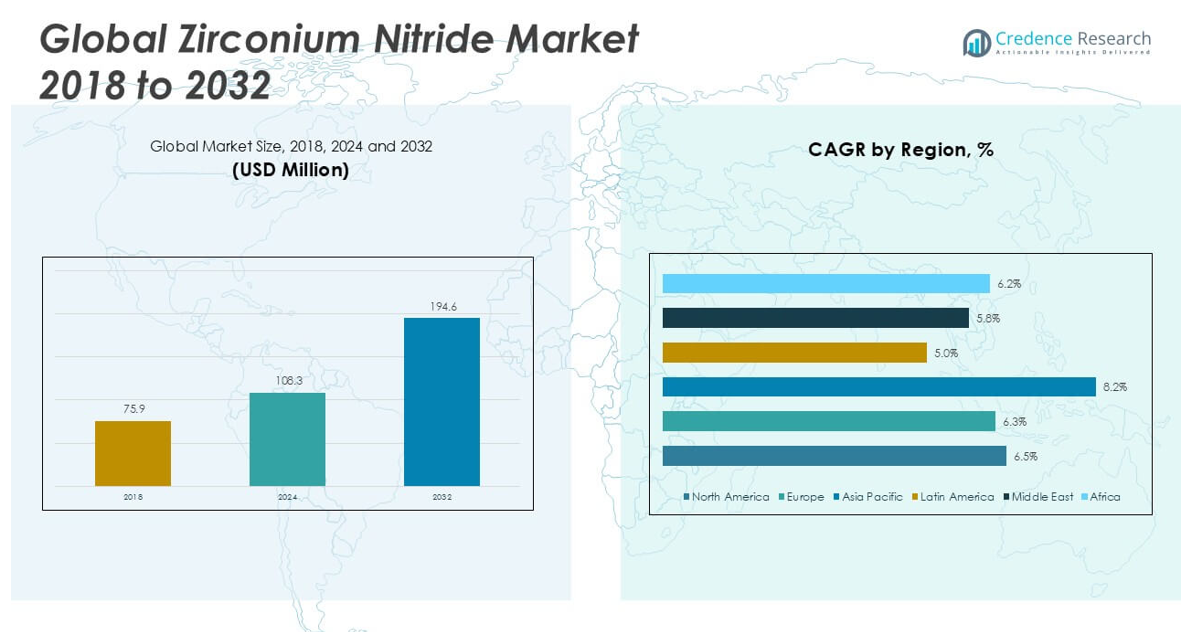
The Zirconium Nitride market size was valued at USD 75.9 million in 2018, reached USD 108.3 million in 2024, and is anticipated to reach USD 194.6 million by 2032, growing at a CAGR of 7.60% during the forecast period.
The Zirconium Nitride market is highly competitive, with key players such as American Elements, Nanografi Nano Technology, Stanford Advanced Materials (SAM), Materion Corporation, Plansee SE, Thermo Fisher Scientific, and H.C. Starck Tungsten GmbH leading the global landscape. These companies focus on expanding their product portfolios, enhancing coating technologies, and strengthening their global supply chains to maintain a competitive edge. Asia Pacific dominates the market with a commanding share of approximately 39.9% in 2024, driven by rapid industrialization and growing demand in automotive, electronics, and cutting tool applications. North America and Europe follow as significant regions, supported by advanced manufacturing capabilities and strong end-user industries.
Market Insights
- The Zirconium Nitride market was valued at USD 75.9 million in 2018, reached USD 108.3 million in 2024, and is projected to reach USD 194.6 million by 2032, growing at a CAGR of 7.60% during the forecast period.
- The market is driven by increasing demand for high-performance coatings in industrial cutting tools, automotive, aerospace, and electronics sectors, with Industrial Grade holding the largest segment share of around 45-50%.
- Growing adoption of Zirconium Nitride in medical devices, eco-friendly coatings, and optical applications is a key market trend, supported by continuous advancements in thin-film technologies.
- The market is highly competitive, with major players like American Elements, Nanografi Nano Technology, Stanford Advanced Materials, and Thermo Fisher Scientific focusing on product innovation, regional expansion, and strategic partnerships.
- Asia Pacific leads the market with a 39.9% share in 2024, followed by North America at 25.8% and Europe at 21.4%, while Latin America, Middle East, and Africa hold smaller shares.
Market Segmentation Analysis:
By Grade:
The Industrial Grade segment holds the largest market share in the Zirconium Nitride market, accounting for approximately 45-50% of the total revenue in 2024. This dominance is driven by its extensive use in hard coatings, industrial tools, and wear-resistant applications due to its superior hardness and chemical stability. The Optical Grade follows, driven by its increasing adoption in decorative coatings and optical devices requiring aesthetic finishes and durability. The Pharmaceutical Grade segment remains niche but is steadily growing, supported by advancements in medical coatings and biocompatible applications. The Others segment covers specialty uses with limited market penetration.
- For instance, Oerlikon Balzers developed the BALINIT® ZrN coating, which achieves a hardness of 2,400 HV and is widely applied in industrial cutting tools to significantly reduce wear.
By Application:
Industrial Cutting Tools represent the dominant application segment, capturing around 35-40% of the market share in 2024. This leadership is attributed to Zirconium Nitride's excellent wear resistance, low friction properties, and ability to enhance tool life in high-precision machining. The Coating segment is another significant contributor, supported by its rising demand in both decorative and functional protective layers across multiple industries. Applications in Aerospace and Automotive are expanding due to the material's lightweight, corrosion-resistant properties that improve component performance. Electronics/Optics and Medical/Pharmaceutical segments are emerging, driven by innovations in thin-film technologies and biocompatible solutions. The Others segment includes specialized applications in niche markets.
- For instance, GKN Aerospace utilizes Zirconium Nitride coatings to improve wear resistance on engine components, achieving component service life extensions of over 1,500 additional flight hours.
Market Overview
Increasing Demand in Industrial Cutting Tools
The growing need for high-performance cutting tools in automotive, aerospace, and general manufacturing is a major driver for the Zirconium Nitride market. Zirconium Nitride coatings significantly enhance the hardness, thermal stability, and wear resistance of cutting tools, extending their operational life and reducing downtime. As precision machining and high-speed manufacturing gain prominence, the demand for Zirconium Nitride-coated tools is expected to surge, supporting productivity improvements and cost efficiencies across industries.
- For instance, Sandvik Coromant reported that their ZrN-coated end mills achieved sustained cutting speeds of 350 m/min in dry machining of aluminum alloys, substantially improving productivity compared to conventional tools.
Expanding Applications in the Automotive Sector
Zirconium Nitride is increasingly used in automotive components due to its excellent corrosion resistance, lightweight properties, and decorative finish. Automotive manufacturers are adopting Zirconium Nitride coatings to improve the durability and aesthetic appeal of engine parts, brake components, and trim elements. This trend aligns with the rising focus on vehicle longevity and performance, especially in electric and high-performance vehicles, where material efficiency and component reliability are critical.
- For instance, Bosch applies ZrN coatings to piston pins, reducing friction coefficients to as low as 0.4, which has been shown to extend component life in heavy-duty engines by over 20,000 kilometers.
Growth in Electronics and Optical Coatings
The expanding electronics and optics sectors are driving demand for Zirconium Nitride in thin-film applications. Its ability to provide wear resistance, low reflectivity, and chemical stability makes it ideal for use in optical devices, semiconductor components, and display technologies. With continuous advancements in electronics miniaturization and the growing popularity of decorative coatings in consumer devices, Zirconium Nitride is emerging as a preferred material for achieving both functional and aesthetic benefits.
Key Trends & Opportunities
Rising Adoption in Medical and Pharmaceutical Applications
Zirconium Nitride is gaining traction in medical device coatings due to its proven biocompatibility and resistance to bacterial adhesion. This trend is creating new growth opportunities in surgical instruments, implants, and pharmaceutical equipment. The increasing demand for durable, non-toxic coatings in healthcare settings, combined with stringent regulatory requirements, positions Zirconium Nitride as a valuable material in the evolving medical landscape.
- For instance, coatings provided by Ionbond meet ISO 10993-1 biocompatibility standards and are used on surgical scalpels and orthopedic screws that demonstrate over 99% bacterial reduction rates on coated surfaces compared to uncoated stainless steel.
Increased Focus on Sustainable Coating Solutions
As environmental regulations tighten, manufacturers are shifting towards sustainable and non-toxic coating materials. Zirconium Nitride offers an eco-friendly alternative to traditional coatings containing hazardous substances. Its ability to reduce friction and wear also contributes to energy savings in industrial applications. This trend presents an opportunity for market players to develop green coating technologies and cater to industries aiming to minimize their environmental footprint.
- For instance, Hauzer Techno Coating's carbon-free PVD ZrN processes have been adopted in multiple European automotive plants, achieving measurable reductions in lubricant consumption by 30% during component lifespan due to the low-friction properties of the coating.
Key Challenges
High Production Costs
One of the primary challenges in the Zirconium Nitride market is the high cost associated with its production and application processes. Advanced coating technologies such as physical vapor deposition (PVD) require significant capital investment and specialized equipment. These costs can limit the adoption of Zirconium Nitride coatings, particularly among small and medium-sized enterprises, restricting market growth in price-sensitive regions.
Limited Awareness and Availability
Limited awareness of Zirconium Nitride's full potential and restricted access to specialized coating services in developing regions pose challenges for market expansion. Many end-users still prefer conventional materials due to familiarity and easier availability. Bridging this knowledge gap and enhancing global distribution channels remain essential for wider market penetration.
Technological Barriers in Complex Applications
The application of Zirconium Nitride in complex geometries and multi-layered coating systems presents technical difficulties. Achieving uniform thickness and optimal adhesion on intricate surfaces can be challenging, impacting the performance and durability of the coating. These technological barriers may hinder the broader adoption of Zirconium Nitride in emerging high-precision industries unless continuous process improvements are achieved.
Regional Analysis
North America
North America accounted for approximately 25.8% of the global Zirconium Nitride market in 2024, with a market size of USD 27.9 million, up from USD 20.8 million in 2018. The market is projected to reach USD 45.9 million by 2032, growing at a CAGR of 6.5% during the forecast period. Growth in this region is driven by strong demand from the automotive, aerospace, and cutting tool industries, particularly in the United States. The region’s advanced manufacturing capabilities and focus on high-performance materials continue to support market expansion.
Europe
Europe held around 21.4% of the Zirconium Nitride market in 2024, with a value of USD 23.1 million, rising from USD 17.3 million in 2018. The market is anticipated to reach USD 37.9 million by 2032, at a CAGR of 6.3%. The region benefits from robust demand in automotive coatings, industrial cutting tools, and aerospace applications. Germany, France, and the UK are key contributors, supported by stringent quality standards and a growing focus on lightweight, durable materials for precision engineering and advanced manufacturing sectors.
Asia Pacific
Asia Pacific dominated the Zirconium Nitride market in 2024, capturing the largest share of approximately 39.9% with a market size of USD 43.5 million, up from USD 27.0 million in 2018. The market is expected to reach USD 85.6 million by 2032, growing at the highest CAGR of 8.2%. Rapid industrialization, expansion of the automotive and electronics sectors, and significant investments in cutting-edge manufacturing drive regional growth. China, Japan, and India are the primary growth engines, supported by increasing adoption of high-performance coatings and demand for durable industrial tools.
Latin America
Latin America accounted for about 4.0% of the global Zirconium Nitride market in 2024, with a market size of USD 4.4 million, rising from USD 2.7 million in 2018. The market is projected to grow to USD 9.3 million by 2032, at a CAGR of 5.0%. Growth in this region is moderately paced, driven by increasing industrial activity and a gradual rise in automotive production. Brazil and Mexico are the key markets where local manufacturers are increasingly adopting Zirconium Nitride coatings to enhance equipment lifespan and operational efficiency.
Middle East
The Middle East represented approximately 6.2% of the Zirconium Nitride market in 2024, with a value of USD 6.8 million, up from USD 4.6 million in 2018. The market is expected to reach USD 12.8 million by 2032, growing at a CAGR of 5.8%. Demand in this region is supported by the growth of industrial cutting tools and coating applications, particularly in the UAE and Saudi Arabia. Increasing investments in infrastructure, manufacturing, and the expansion of the aerospace sector are contributing to the region’s steady market growth.
Africa
Africa held a smaller share of approximately 2.3% in the Zirconium Nitride market in 2024, with a market size of USD 2.5 million, declining from USD 3.5 million in 2018. The market is projected to slightly recover to USD 2.9 million by 2032, growing at a CAGR of 6.2%. The region faces challenges such as limited industrial capacity and lower adoption of advanced coating technologies. However, growth opportunities exist in niche markets and emerging manufacturing hubs, particularly in South Africa and select North African countries, as industrialization efforts gradually progress.
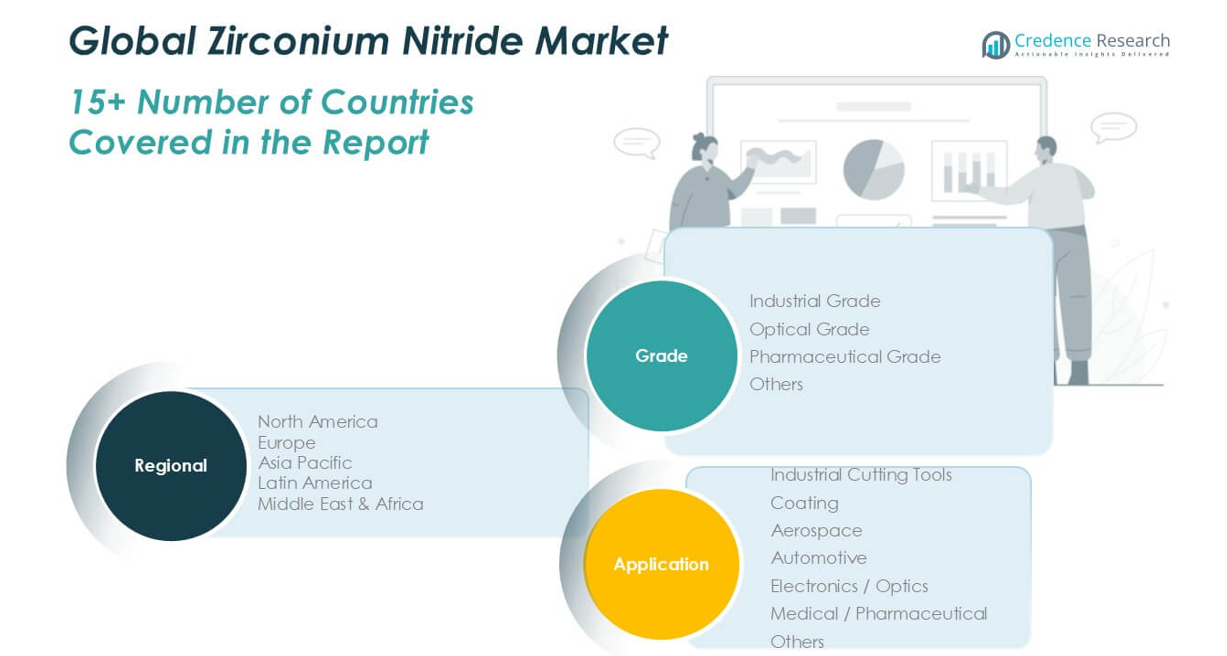
Market Segmentations:
By Grade
- Industrial Grade
- Optical Grade
- Pharmaceutical Grade
- Others
By Application
- Industrial Cutting Tools
- Coating
- Aerospace
- Automotive
- Electronics / Optics
- Medical / Pharmaceutical
- Others
By Geography:
- North America
- U.S.
- Canada
- Mexico
- Europe
- Germany
- France
- U.K.
- Italy
- Spain
- Rest of Europe
- Asia Pacific
- China
- Japan
- India
- South Korea
- South-east Asia
- Rest of Asia Pacific
- Latin America
- Brazil
- Argentina
- Rest of Latin America
- Middle East & Africa
- GCC Countries
- South Africa
- Rest of the Middle East and Africa
Competitive Landscape
The competitive landscape of the Zirconium Nitride market is characterized by the presence of several established players focusing on technological innovation, product diversification, and strategic collaborations to strengthen their market positions. Key companies such as American Elements, Nanografi Nano Technology, Stanford Advanced Materials, Materion Corporation, and Plansee SE are actively investing in research and development to enhance coating performance and expand application areas. Companies like Thermo Fisher Scientific and H.C. Starck Tungsten GmbH leverage their global distribution networks and strong brand recognition to capture a significant share. The market is witnessing increasing consolidation through partnerships and acquisitions as companies aim to broaden their product portfolios and regional presence. Continuous advancements in coating technologies and the growing demand from end-use industries are intensifying competition, driving companies to innovate and optimize their offerings.
Key Player Analysis
- American Elements
- Nanografi Nano Technology
- Stanford Advanced Materials (SAM)
- Materion Corporation
- ALB Materials Inc.
- Plansee SE
- Treibacher Industrie AG
- H.C. Starck Tungsten GmbH
- Thermo Fisher Scientific
- Edgetech Industries LLC
- Advanced Engineering Materials Ltd.
- Jinzhou Haixin Metal Materials Co., Ltd.
- Inframat Advanced Materials
- Goodfellow Corporation
Recent Developments
- In April 2025, American Elements' CEO delivered a keynote at Ceramics Expo 2025, highlighting advancements in nitride materials, including zirconium nitride, and mapping out new research and application pathways.
- In April 2025, H.C. Starck Tungsten GmbH has not publicly announced any specific developments directly related to zirconium nitride. Their recent focus has been on securing over €60 million in funding for innovative battery recycling technology, particularly for recovering valuable metals from battery black mass, which may involve advanced refractory materials but does not explicitly mention zirconium nitride
- In December 2024, SAM introduced micro zirconium nitride (100 μm, 99.9% purity), expanding its portfolio for specialized industrial uses and research.
Market Concentration & Characteristics
The Zirconium Nitride Market exhibits moderate to high market concentration, with a few established players controlling a significant portion of the global share. Leading companies, including American Elements, Nanografi Nano Technology, Stanford Advanced Materials, and Thermo Fisher Scientific, maintain their positions through advanced product offerings, strong distribution networks, and continuous research investments. It is defined by specialized manufacturing processes and strict quality requirements, which create barriers for new entrants. The market prioritizes precision, durability, and performance, particularly in cutting tools, automotive, aerospace, and optical applications. Demand is closely linked to advancements in industrial machining and high-performance coatings. Suppliers focus on building long-term partnerships with end-users to ensure consistent quality and supply reliability. The market structure supports steady pricing dynamics due to the technical complexity and limited number of producers. Asia Pacific holds the dominant regional position, followed by North America and Europe, where high technology adoption and manufacturing capabilities strengthen regional shares.
Report Coverage
The research report offers an in-depth analysis based on Grade, Application, and Geography. It details leading market players, providing an overview of their business, product offerings, investments, revenue streams, and key applications. Additionally, the report includes insights into the competitive environment, SWOT analysis, current market trends, as well as the primary drivers and constraints. Furthermore, it discusses various factors that have driven market expansion in recent years. The report also explores market dynamics, regulatory scenarios, and technological advancements that are shaping the industry. It assesses the impact of external factors and global economic changes on market growth. Lastly, it provides strategic recommendations for new entrants and established companies to navigate the complexities of the market.
Future Outlook
- The Zirconium Nitride Market is expected to grow steadily driven by rising demand for high-performance industrial coatings.
- Increasing adoption in the automotive and aerospace industries will continue to support market expansion.
- Growing use in medical devices and pharmaceutical equipment will open new application opportunities.
- Advancements in coating technologies will improve product quality and expand industrial usage.
- The Asia Pacific region will maintain its leading position due to rapid industrialization and strong manufacturing growth.
- North America and Europe will experience stable growth supported by technological innovation and high-end applications.
- Key players will focus on research and development to introduce more efficient and durable coatings.
- Strategic partnerships and regional expansions will strengthen competitive positions in emerging markets.
- Rising preference for environmentally friendly and sustainable coating materials will drive product development.
- Increasing awareness of Zirconium Nitride’s advantages will improve its penetration across diverse end-use industries.

Request a Free Sample
Fill in your details and we'll send you a free sample report.
- Sample data tables & charts
- Research methodology
Market Dynamics
Expansion of High-Performance Industrial Coatings
The increasing need for durable, wear-resistant coatings in industrial cutting tools, automotive, and aerospace components is driving demand for zirconium nitride. Its superior hardness, chemical stability, and ability to extend tool and component life make it a preferred choice for manufacturers seeking to improve productivity and reduce maintenance costs.
Advancements in Thin-Film and PVD Coating Technologies
Continuous improvements in physical vapor deposition (PVD) and thin-film application methods have enhanced the quality, uniformity, and performance of zirconium nitride coatings. These technological advancements enable broader adoption across complex geometries and high-precision industries, supporting market growth.
Growth in Electronics, Optics, and Decorative Applications
Zirconium nitride's unique combination of low reflectivity, chemical stability, and aesthetic appeal is fueling its use in electronics, optical devices, and decorative coatings. The miniaturization of electronic components and the demand for both functional and visually appealing finishes in consumer devices are expanding its application base.
Rising Adoption in Medical and Pharmaceutical Devices
The proven biocompatibility and antibacterial properties of zirconium nitride are leading to its increased use in medical instruments, implants, and pharmaceutical equipment. Stringent regulatory requirements for safe, durable, and non-toxic coatings in healthcare settings are further accelerating its adoption in this sector.
Shift Toward Sustainable and Eco-Friendly Coating Solutions
Stricter environmental regulations and industry efforts to reduce hazardous substances are prompting manufacturers to adopt zirconium nitride as an eco-friendly alternative to traditional coatings. Its ability to lower friction and wear also contributes to energy savings and reduced lubricant consumption, aligning with sustainability goals.
Need a Custom Version of This Report?
Tailor the scope, geography, or segments to your exact requirements.
- Custom geography or segment scope
- Direct access to our analyst team
Frequently Asked Questions
What is the current size of the Zirconium Nitride Market?
What are the key segments within the Zirconium Nitride Market?
What are some challenges faced by the Zirconium Nitride Market?
Who are the major players in the Zirconium Nitride Market?
Table of Content
Chapter 1 Market Segmentation
- 1.1 Segmentation Framework
- 1.1.1 Product and Service Classification
- 1.1.2 Application and End-Use Classification
- 1.1.3 Technology and Solution Classification
- 1.1.4 Customer and Distribution Channel Classification
- 1.1.5 Geographic Segmentation
- 1.1.6 Market Segment Definitions and Boundaries
- 1.2 By Grade
- 1.2.1 Industrial Grade
- 1.2.2 Optical Grade
- 1.2.3 Pharmaceutical Grade
- 1.2.4 Others
- 1.3 By Application
- 1.3.1 Industrial Cutting Tools
- 1.3.2 Coating
- 1.3.3 Aerospace
- 1.3.4 Automotive
- 1.3.5 Electronics / Optics
- 1.3.6 Medical / Pharmaceutical
- 1.3.7 Others
Chapter 2 Introduction
- 2.1 Report Objectives and Scope
- 2.2 Product Definition and Industry Terminology
- 2.3 Market Inclusions and Exclusions
- 2.4 Research Process
- 2.4.1 Primary Research and Expert Interviews
- 2.4.2 Secondary Research and Source Review
- 2.4.3 Top-Down and Bottom-Up Estimation
- 2.4.4 Data Triangulation and Verification
- 2.5 Market Size Measurement Basis
- 2.5.1 2024: USD 108.3 million → 2032: USD 194.6 million
- 2.6 Historical and Forecast Reference Periods
- 2.6.1 Base Year: 2024
- 2.6.2 Forecast Period: 2024-2032
- 2.7 Research Assumptions and Limitations
Chapter 3 Executive Summary
- 3.1 Market Snapshot and Key Findings
- 3.2 Base-Year Market Size, 2024
- 3.3 Forecast Market Size, 2032
- 3.4 Revenue and Volume Growth Outlook
- 3.5 Key Demand and Supply Indicators
- 3.6 Leading Market Segments
- 3.7 Fastest-Growing Market Opportunities
- 3.8 Regional Performance Highlights
- 3.9 Technology and Industry Transformation
- 3.10 Competitive Landscape Summary
- 3.11 Analyst View and Strategic Implications
Chapter 4 Global Zirconium Nitride Market Trends and Developments
- 4.1 Historical Industry Development
- 4.2 Recent Market Trends and Developments
- 4.3 Demand and Customer Behavior Trends
- 4.4 Technology and Product Innovation
- 4.5 Artificial Intelligence, Automation and Digitalization
- 4.6 Local Manufacturing and Supply Chain Realignment
- 4.7 Industry Partnerships, Mergers and Acquisitions
- 4.8 Sustainability and Circular Economy Developments
- 4.9 Government and Private Sector Investment Trends
- 4.10 Emerging Business Models and Commercialization
- 4.11 Industry Developments and Announcements
Chapter 5 Global Zirconium Nitride Market Production, Supply and Demand Analysis
- 5.1 Demand Trend and Consumption Analysis
- 5.2 Demand Forecast, 2024-2032
- 5.3 Production and Output Trend
- 5.4 Production and Output Forecast, 2024-2032
- 5.5 Installed Capacity and Capacity Utilization
- 5.6 Company-Wise Production Plants and Statistics
- 5.6.1 Installed Production Capacity
- 5.6.2 Actual Production
- 5.6.3 Planned Capacity and Expansion Targets
- 5.7 Supply Chain Structure and Procurement Trends
- 5.8 Supply-Demand Gap and Bottlenecks
- 5.9 Import Dependence and Sourcing Structure
- 5.10 Contract Manufacturing and Outsourcing
- 5.11 Regional Supply and Demand Concentration
Chapter 6 Global Zirconium Nitride Market Pricing Analysis
- 6.1 Pricing Structure and Measurement
- 6.2 Historical Pricing Trends
- 6.3 Pricing Outlook, 2024-2032
- 6.4 Average Selling Price and Unit Economics
- 6.5 Pricing by Product and Market Segment
- 6.6 Geographic Pricing Differences
- 6.7 Key Input, Energy, Labor and Logistics Costs
- 6.8 Contract Pricing and Purchasing Models
- 6.9 Pricing Sensitivity and Competitive Positioning
- 6.10 Price, Margin and Profitability Implications
Chapter 7 Global Zirconium Nitride Market Dynamics
- 7.1 Market Growth Drivers
- 7.1.1 Demand-Side Drivers
- 7.1.2 Technology and Innovation Drivers
- 7.1.3 Infrastructure and Investment Drivers
- 7.1.4 Regulatory and Policy Drivers
- 7.2 Market Restraints
- 7.2.1 Cost and Affordability Constraints
- 7.2.2 Technology and Adoption Barriers
- 7.2.3 Supply Chain and Operational Constraints
- 7.3 Market Challenges
- 7.3.1 Competitive Pressure and Margin Erosion
- 7.3.2 Skills, Infrastructure and Implementation Gaps
- 7.4 Emerging Market Opportunities
- 7.5 Market Dynamics Impact and Time-Horizon Assessment
Chapter 8 Global Zirconium Nitride Value Chain Analysis
- 8.1 Industry Value Chain Overview
- 8.2 Upstream Suppliers and Critical Inputs
- 8.3 Technology and Component Providers
- 8.4 Manufacturing or Service Delivery
- 8.5 Distribution, Channel Partners and Integrators
- 8.6 Downstream Applications and End Users
- 8.7 Value Addition and Profit Pools
- 8.8 Vertical Integration and Outsourcing
- 8.9 Supplier Concentration and Risk
- 8.10 Supply Chain Localization and Resilience
Chapter 9 Global Zirconium Nitride Market Regulations and Policies
- 9.1 Relevant Laws, Standards and Compliance Frameworks
- 9.2 Product, Service, Safety and Quality Requirements
- 9.3 Government Policies, Incentives and Subsidies
- 9.4 Imports, Exports and Trade Barriers
- 9.5 Public Procurement and Local Content Requirements
- 9.6 Environmental and Sustainability Compliance
- 9.7 Upcoming Policy Changes and Market Implications
Chapter 10 Global Zirconium Nitride Market Hotspots and Opportunities
- 10.1 Market Opportunity Mapping and Growth Hotspots
- 10.2 High-Growth Applications and Customer Groups
- 10.3 Underserved Markets and White-Space Opportunities
- 10.4 Emerging Technology and Product Opportunities
- 10.5 New Capacity and Investment Hotspots
- 10.6 Market Entry and Expansion Opportunities
- 10.7 Distribution and Partnership Opportunities
- 10.8 Near-Term and Long-Term Commercial Potential
- 10.9 Opportunity Attractiveness and Execution Risks
Chapter 11 Global Zirconium Nitride Market Outlook, 2024-2032
- 11.1 Market Size and Analysis
- 11.1.1 Revenue (Market Measurement: 2024: USD 108.3 million → 2032: USD 194.6 million)
- 11.1.2 Market Volume and Quantity Sold
- 11.1.3 Historical Market Size
- 11.1.4 Base-Year Market Size, 2024
- 11.2 Market Forecast, 2024-2032
- 11.2.1 Revenue Forecast to 2032
- 11.2.2 Volume Forecast to 2032
- 11.2.3 CAGR and Year-on-Year Growth
- 11.2.4 Incremental Revenue Opportunity
- 11.3 Forecast Assumptions and Scenario Analysis
- 11.3.1 Base-Case Forecast
- 11.3.2 Optimistic and Conservative Scenarios
- 11.3.3 Technology, Pricing and Policy Sensitivities
- 11.4 Market Attractiveness and Growth Outlook
Chapter 12 Global Zirconium Nitride Market Segmentation and Outlook
- 12.1 Segmentation Summary and Market Shares, 2024
- 12.2 Largest and Fastest-Growing Segments
- 12.3 By Grade - Market Size and Forecast, 2024-2032
- 12.3.1 Segment Definition and Scope
- 12.3.2 Historical Market Size
- 12.3.3 Revenue Forecast, 2024-2032
- 12.3.4 Volume Forecast, 2024-2032
- 12.3.5 Base-Year Market Share, 2024
- 12.3.6 Segment CAGR and Growth Drivers
- 12.3.7 Subsegment Market Size and Forecast
- 12.3.7.1 Industrial Grade
- 12.3.7.2 Optical Grade
- 12.3.7.3 Pharmaceutical Grade
- 12.3.7.4 Others
- 12.3.8 Subsegment Pricing and Adoption Trends
- 12.3.9 Leading Suppliers and Competition
- 12.3.10 Regional Demand and Opportunities
- 12.4 By Application - Market Size and Forecast, 2024-2032
- 12.4.1 Segment Definition and Scope
- 12.4.2 Historical Market Size
- 12.4.3 Revenue Forecast, 2024-2032
- 12.4.4 Volume Forecast, 2024-2032
- 12.4.5 Base-Year Market Share, 2024
- 12.4.6 Segment CAGR and Growth Drivers
- 12.4.7 Subsegment Market Size and Forecast
- 12.4.7.1 Industrial Cutting Tools
- 12.4.7.2 Coating
- 12.4.7.3 Aerospace
- 12.4.7.4 Automotive
- 12.4.7.5 Electronics / Optics
- 12.4.7.6 Medical / Pharmaceutical
- 12.4.7.7 Others
- 12.4.8 Subsegment Pricing and Adoption Trends
- 12.4.9 Leading Suppliers and Competition
- 12.4.10 Regional Demand and Opportunities
- 12.5 Segment Growth Comparison
- 12.6 Segment Attractiveness and Priority Matrix
Chapter 13 Global Zirconium Nitride End-Use and Application Market Outlook
- 13.1 End-Use Industry and Customer Demand Structure
- 13.2 Leading Applications and Customer Groups
- 13.3 End-Use Market Size, Share and Forecast
- 13.4 Major End-Use Industry Deep Dives
- 13.4.1 Customer Requirements and Use Cases
- 13.4.2 Demand and Replacement Cycles
- 13.4.3 Technical and Regulatory Considerations
- 13.4.4 Purchasing and Procurement Models
- 13.4.5 Leading Vendors and Distribution Channels
- 13.4.6 Forecast and Commercial Opportunities
- 13.5 Emerging Applications and Cross-Segment Demand
- 13.6 End-Use Industry Investment Priorities
Chapter 14 Global Zirconium Nitride Geographic Market Outlook, 2024-2032
- 14.1 Regional Market Size and Share, 2024
- 14.2 Regional Market Forecast, 2024-2032
- 14.3 Regional Pricing, Production and Demand Differences
- 14.4 North America
- 14.4.1 United States
- 14.4.2 Canada
- 14.4.3 Mexico
- 14.5 Europe
- 14.5.1 Germany
- 14.5.2 France
- 14.5.3 Italy
- 14.5.4 United Kingdom
- 14.5.5 Spain
- 14.5.6 Poland
- 14.5.7 Russia
- 14.5.8 Netherlands
- 14.5.9 Belgium
- 14.5.10 Sweden
- 14.5.11 Denmark
- 14.5.12 Norway
- 14.5.13 Rest of Europe
- 14.6 Asia Pacific
- 14.6.1 China
- 14.6.2 India
- 14.6.3 Japan
- 14.6.4 South Korea
- 14.6.5 Thailand
- 14.6.6 Indonesia
- 14.6.7 Vietnam
- 14.6.8 Malaysia
- 14.6.9 Australia
- 14.6.10 Rest of Asia Pacific
- 14.7 Latin America
- 14.7.1 Brazil
- 14.7.2 Argentina
- 14.7.3 Colombia
- 14.7.4 Chile
- 14.7.5 Rest of Latin America
- 14.8 Middle East
- 14.8.1 Saudi Arabia
- 14.8.2 United Arab Emirates
- 14.8.3 Turkey
- 14.8.4 Israel
- 14.8.5 Iran
- 14.8.6 Rest of the Middle East
- 14.9 Africa
- 14.9.1 South Africa
- 14.9.2 Egypt
- 14.9.3 Nigeria
- 14.9.4 Morocco
- 14.9.5 Rest of Africa
- 14.10 Regional Investment, Policy and Supply Chain Differences
- 14.11 Regional Competitive Landscape
- 14.12 Geographic Growth Hotspots
Chapter 15 Global Zirconium Nitride Technology, Innovation and Sustainability Outlook
- 15.1 Technology Landscape and Maturity
- 15.2 Product, Process and Service Innovation
- 15.3 AI, Automation and Digital Tools in the Industry
- 15.4 Technology Adoption and Performance Benchmarking
- 15.5 Innovation Pipeline and R&D Investment
- 15.6 Patent and Intellectual Property Trends
- 15.7 Energy Efficiency and Resource Management
- 15.8 Sustainability, Recycling and Circularity
- 15.9 Technology Roadmap, 2024-2032
- 15.10 Risks of Obsolescence and Technology Substitution
Chapter 16 Global Zirconium Nitride Market Key Strategic Imperatives
- 16.1 Growth and Market Entry Priorities
- 16.2 High-Return Products and Segments
- 16.3 Pricing, Profitability and Cost Optimization
- 16.4 Technology Investment and Product Differentiation
- 16.5 Supply Chain Localization and Resilience
- 16.6 Distribution and Customer Acquisition
- 16.7 Partnership, Acquisition and Capacity Strategy
- 16.8 Regional Expansion Priorities
- 16.9 Short-, Medium- and Long-Term Actions
Chapter 17 Competition Outlook
- 17.1 Industry Competition Characteristics
- 17.2 Market Structure and Concentration
- 17.3 Market Share and Competitive Positioning, 2024
- 17.4 Company-Wise Revenue and Product Benchmarking
- 17.5 Production and Service Capacity Benchmarking
- 17.6 Technology, Pricing and Differentiation
- 17.7 Regional Footprint and Distribution Strength
- 17.8 Mergers, Acquisitions and Strategic Alliances
- 17.9 New Entrants and Competitive Threats
- 17.10 Porter's Five Forces and Industry Attractiveness
- 17.11 Competitive Outlook, 2024-2032
Chapter 18 Company Profiles
- 18.1 Company Coverage and Selection Criteria
- 18.2 American Elements
- 18.2.1 Business Description
- 18.2.2 Company Ownership and Geographic Presence
- 18.2.3 Product and Service Portfolio
- 18.2.4 Manufacturing and Operating Footprint
- 18.2.5 Production Capacity and Expansion Plans
- 18.2.6 Financial Performance and Investment
- 18.2.7 Market Share and Competitive Position
- 18.2.8 Technology and Innovation Capabilities
- 18.2.9 Strategic Alliances or Partnerships
- 18.2.10 Recent Developments
- 18.2.11 Growth Strategy and Outlook
- 18.3 Nanografi Nano Technology
- 18.4 Stanford Advanced Materials (SAM)
- 18.5 Materion Corporation
- 18.6 Plansee SE
- 18.7 Thermo Fisher Scientific
- 18.8 H.C. Starck Tungsten GmbH
- 18.9 Treibacher Industrie AG
- 18.10 Edgetech Industries LLC
- 18.11 Goodfellow Corporation
- 18.12 Other Relevant Market Participants
Note: Every listed company is profiled on the structure shown under the first company. The company list is preliminary and may change based on research findings, market developments, data availability and client requirements.
Chapter 19 Disclaimer
- 19.1 Research and Forecast Disclaimer
- 19.2 Data Source and Estimation Limitations
Note: The depth of individual sections depends on data availability for this market. Volume, capacity, trade and other unit-based metrics are included where applicable.