
| REPORT ATTRIBUTE | DETAILS |
|---|---|
| Historical Period | 2019-2022 |
| Base Year | 2023 |
| Forecast Period | 2024-2032 |
| Automotive Electronics Control Unit Management (ECU/ECM) Market Size 2023 | USD 55142.2 Million |
| Automotive Electronics Control Unit Management (ECU/ECM) Market, CAGR | 7.00% |
| Automotive Electronics Control Unit Management (ECU/ECM) Market Size 2032 | USD 101376.7 Million |
Market Insights
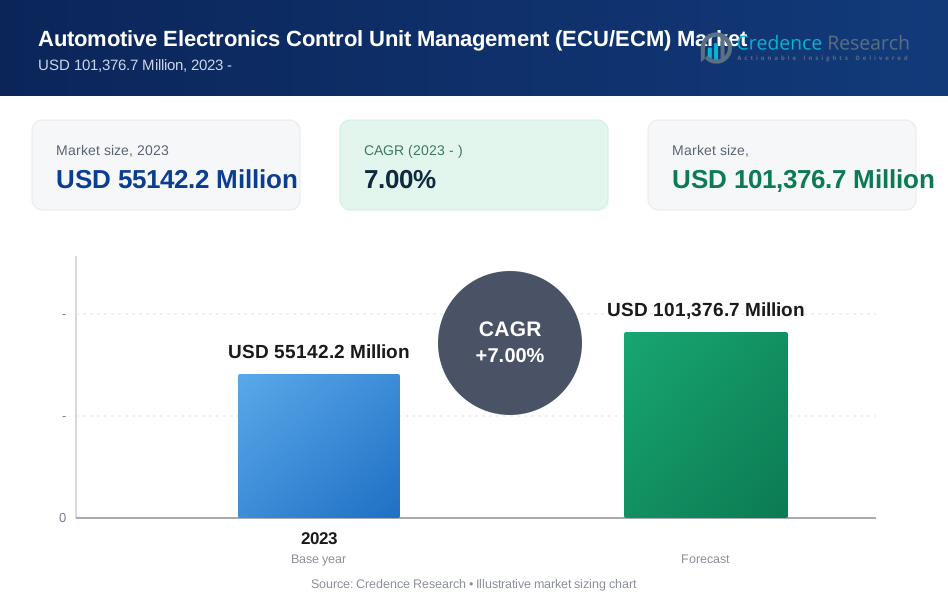
- The Automotive Electronics Control Unit Management (ECU/ECM) Market reached a valuation of USD 55142.2 Million in 2023 and is anticipated to rise to USD 101376.7 Million by 2032, indicating a strong CAGR of 7.00% from 2024 to 2032.
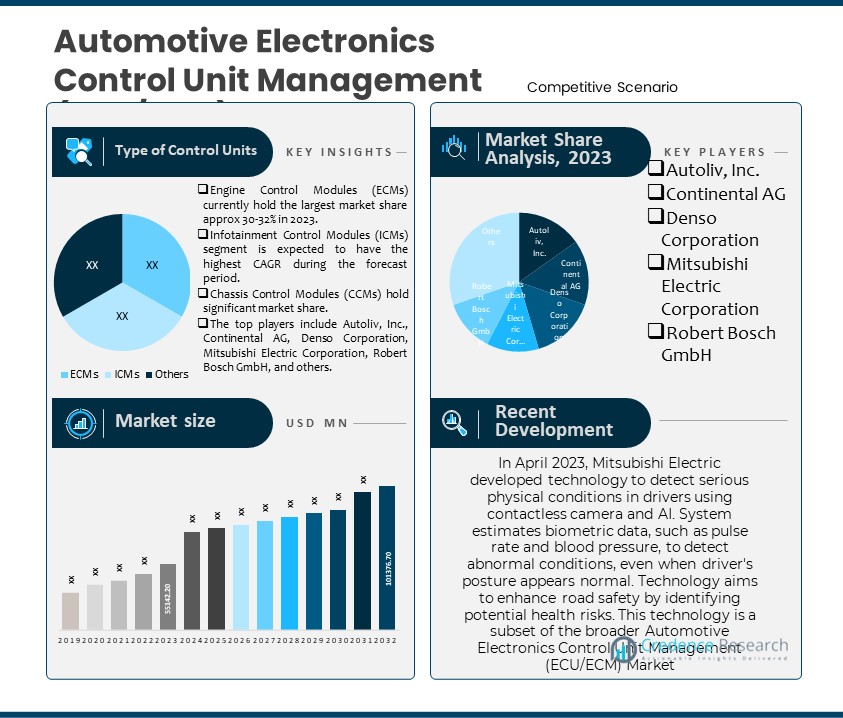
- Among the key segments, Engine Control Modules (ECMs) emerged as the market leader by type, commanding approximately 30-32% of the total market share in 2023. However, Infotainment Control Modules (ICMs) are projected to witness the highest growth rate during the forecast period.
- Conventional ECUs/ECMs currently dominate the market by technology, holding approximately 38-42% of the market share in 2023 due to their widespread usage in basic automotive functions.
- Passenger Cars dominate the market by vehicle type, holding approximately 40-43% of the market share in 2023, primarily driven by the increasing demand for advanced safety features in passenger vehicles.
- Asia Pacific commands the largest share of the market in 2023, followed by Europe and North America with a collective share of just under 55%.
- The surge in demand for Automotive Electronics Control Unit Management (ECU/ECM) systems is propelled by increasing vehicle production and sales, stringent regulations on emissions and vehicle safety standards, and the growing emphasis on vehicle connectivity and advanced driver assistance systems (ADAS).
- Key opportunities in the market include significant growth potential in emerging markets, increased adoption across various vehicle types, and continuous advancements in technology driving market expansion.
Executive Summary
Market Definition
Automotive Electronics Control Unit Management (ECU/ECM) market refers to the industry engaged in the manufacture of Electronic Control Units (ECUs) and Engine Control Modules (ECMs) for automotive ECUs are embedded systems that control various vehicle functions and products applications, such as engine operation, transmission, brakes, suspension, airbags, anti-lock braking system (ABS) and other safety features. The ECM, on the other hand, controls various engine functions, including fuel injection, ignition time, exhaust air recirculation. Increasing demand for advanced driver assistance systems (ADAS), autonomous driving, and connected vehicles has driven the automotive electronic control unit management market. Modern vehicles rely on software and electronics significantly increase efficiency, performance and safety. As a result, the number of ECUs and ECMs used in automotive vehicles has increased exponentially, presenting opportunities for companies operating in this market.
Market Overview
- The Automotive Electronics Control Unit Management (ECU/ECM) Market attained a valuation of USD 55142.2 Million in 2023 and is anticipated to escalate to USD 101376.7 Million by 2032, exhibiting a robust CAGR of 7.00% during the forecast period from 2024 to 2032.
- Among the primary segments, Engine Control Modules (ECMs) dominated the market landscape by type, comprising approximately 60-65% of the total market share in 2023. However, Infotainment Control Modules (ICMs) are expected to observe the highest CAGR over the forecast period.
- The passenger cars segment captured around 45-55% of the market share in 2023, driven by the substantial demand for ECUs and ECMs in passenger vehicle manufacturing and various commercial vehicle productions.
- Conventional ECUs/ECMs held the largest market share in 2023, accounting for approximately 38-42% of the total market, owing to their widespread usage in basic automotive functions.
- Advanced Driver Assistance Systems (ADAS) is projected to witness the highest CAGR during the forecast period., propelled by factors such as increasing demand for advanced safety features and security awareness.
- Asia Pacific constituted a significant portion of the market in 2023, followed by Europe and North America, collectively representing just under 55% of the market share.
- The surge in demand for Automotive Electronics Control Unit Management (ECU/ECM) systems is driven by factors such as increasing vehicle production, stringent regulations on emissions and vehicle safety standards, and the growing emphasis on vehicle connectivity and advanced driver assistance systems (ADAS), fostering market growth, especially in regions like Asia Pacific.
- Rapid advancement in automotive technology, including the complexity of vehicle systems which require specialized ECUs and ECMs, is driving the demand for Automotive Electronics Control Unit Management (ECU/ECM) systems, especially in regions like Asia Pacific where automotive industry growth is significant.
Segmentation by Type of Control Units
- Engine Control Modules (ECMs) currently hold the largest market share approx 30-32% in 2023. ECM is an important component in modern vehicles, while improving engine performance, fuel consumption. Demand for advanced ECMs is expected to increase as more emphasis is placed on fuel efficiency and emissions reduction controlling ignition timing and air recycling.
- Infotainment Control Modules (ICMs) is projected to witness the highest CAGR during the forecast period owing to they play an important role in providing a seamless connectivity and entertainment experience in the autonomous mode of the vehicle.
Segmentation by Vehicle Type
- Passenger Cars currently hold the largest market share approx 45-55% in 2023. The large share of this segment can be attributed to the increasing demand for advanced safety features, such as lane departure warning, adaptive cruise control, and collision avoidance systems, in passenger cars.
- The electric and hybrid vehicles segment is expected to have the highest CAGR during the forecast period. This is due to the increasing adoption of electric and hybrid vehicles, driven by government regulations, sustainable mobility improvement programs.
Segmentation by Technology
- Conventional ECUs/ECMs currently hold the largest market share approx 38-42% in 2023 owing to that thay are widely used in automobiles for basic functions such as engine control, transmission control and brake system control.
- Advanced Driver Assistance Systems (ADAS) segment is projected to witness the highest CAGR during the forecast period. ADAS technology includes features such as lane departure warning, adaptive cruise control and automatic emergency braking, which are becoming increasingly popular in new vehicles Increasing demand for advanced safety features and on the roads increasing security awareness is driving the growth of the ADAS segment.
Segmentation by Region
- Asia Pacific held largest share around 40-42% of the market in 2023. This is due to several factors such as increasing vehicle production and sales, and major automakers in countries such as Japan, South Korea and China, which are known for their innovative technologies and advances in the automotive industry.
- Europe and North America collectively account for just under 55% share in 2023, with North America holding over 20% share in the same year.
- The rest of the world, including Latin America, the Middle East, and Africa, supplies the remaining demand for Automotive Electronics Control Unit Management (ECU/ECM).
Technological advancements in manufacturing the Automotive Electronics Control Unit Management (ECU/ECM), increasing partnerships between tech companies and automakers, are also contributing to market growth.
The Asia-Pacific region held largest share of Automotive Electronics Control Unit Management (ECU/ECM) market. The region has a large and growing automotive industry, with countries such as China, Japan and South Korea among the world’s leading manufacturers. This has led to a demand for ECU/ECM, essential components of modern vehicles in the modern century. For instance, according to the China Auto Market Report, June 2023, in March and April 2023, passenger car sales in China reached 2.02 million and 1.80 million, respectively. They experienced a significant year-on-year increase of 85.3%. Cumulative sales from January to April totaled 6.91 million, a 6.2% rise year-on-year. nother factor that contributes to the industry’s dominance in the ECU/ECM market is the presence of many key players in the industry. Many global automotive companies have established their manufacturing facilities in countries such as GAC Group, Great Wall Motor Group, SAIC Motor, Geely Group, and others, taking advantage of the region’s low labor costs and favorable operating conditions This has led to an increase in ECU/ECM manufacturing in the region , to boost the market further growth. For instance, according to the China Auto Market Report, in April 2023, GAC Group's vehicle sales in China reached 177,224, a 42.57% year-on-year increase, marking the third consecutive month of sales growth. In addition, governments in Asia-Pacific have implemented policies and regulations encouraging the use of advanced vehicle technologies including ECU/ECM. Customers in Asia Pacific demand advanced safety features and convenience technologies in their vehicles, such as emergency braking, departure warning systems and infotainment systems and these features deliver relies heavily on ECU/ECM, driving the market growth regionally.
The North America region witnesses significant growth in the Automotive Electronics Control Unit Management (ECU/ECM) market. This growth can be attributed to various factors, such as Advanced Driver Assistance Systems (ADAS), increasing demand for autonomous and connected vehicles the ECU/ECM market in North America is also driven by vehicle manufacturers and presence of major technology companies. For instance, Ford Motor Company sold 145,559 vehicles in the United States in November 2023. This includes both electric and hybrid vehicles. However, a major trend in the North American ECU/ECM market is the increasing adoption of electric vehicles (EVs). For instance, according to the Environmental Defense Fund, in April 2023, In 2022, Americans bought over 800,000 electric cars, which is 65% more than in 2021. Moreover, as the government sets stricter emission standards and consumers become more environmentally conscious, the demand for EVs is expected to increase , and will increase the need for advanced ECU/ECM systems and even, intelligent devices such as collision avoidance systems, lane departure warnings, and adaptive cruise control. These features rely heavily on ECU/ECM systems, which makes them an essential component of modern vehicles. The integration of transportation solutions is also expected to drive the growth of the ECU/ECM market in North America.
Key Highlights of the Report
The Automotive Electronics Control Unit Management (ECU/ECM) Market is segmented by Type of Control Units, Vehicle Type, Technology, Region, and other key factors. The growing demand for Automotive Electronics Control Unit Management (ECU/ECM) systems is propelled by factors such as increasing vehicle production, stringent regulations on emissions and vehicle safety standards, and the growing emphasis on vehicle connectivity and advanced driver assistance systems (ADAS) across multiple sectors, including passenger cars, commercial vehicles, and electric and hybrid vehicles.
Engine Control Modules (ECMs) dominate the segment, catering to essential functions in vehicle performance and efficiency across various vehicle types due to their widespread application and necessity. Conventional ECUs/ECMs hold a significant market share in terms of technology, offering cost-effective solutions for basic automotive functions.
Advanced Driver Assistance Systems (ADAS) lead the technology segment, driven by increasing demand for advanced safety features and security awareness. While the passenger cars segment remains a major contributor to the market, with significant demand for ECUs and ECMs in vehicle manufacturing and maintenance.
Asia Pacific emerges as the dominant region in the Automotive Electronics Control Unit Management (ECU/ECM) Market, supported by prominent automotive industries and robust manufacturing infrastructure, along with high demand for advanced vehicle technologies.
Key players like Autoliv, Inc., Continental AG, and Denso Corporation compete in the market, focusing on product innovation, distribution channel expansion, and strategic partnerships to maintain competitiveness. Collaborations and technological advancements contribute to Asia Pacific's dominance in the Automotive Electronics Control Unit Management (ECU/ECM) Market, with major players expanding their presence and capabilities in the region to meet growing demand.
What Are The Main Drivers Of The Global Automotive Electronics Control Unit Management (ECU/ECM) Market?
The major factors driving the global Automotive Electronics Control Unit Management (ECU/ECM) market are technological advancements in automotive electronics, especially the introduction of advanced driver assistance systems (ADAS), connectivity features, and hybrid electrical Vehicles increasing demands for safety, performance and comfort are increasingly accepting sophisticated ECUs. In addition, stringent government regulations on emissions and vehicle safety standards encourage automakers to invest in advanced electrical control equipment. Furthermore, a growing trend a the emergence of autonomous vehicles and hybrid electric vehicles contributes significantly to the expansion of the ECU/ECM market globally.
What Are The Major Challenges Faced By The Global Automotive Electronics Control Unit Management (ECU/ECM) Market?
The major challenges in the global Automotive Electronics Control Unit Management (ECU/ECM) market include intense competition, such as cyber security threats due to increased connectivity, the complexity of integrating diverse electronic components within vehicles poses technical hurdles, demanding sophisticated engineering solutions. In addition, the industry faces compliance barriers and evolving standards for emissions, requiring continuous adaptation and innovation and rapid technological development requires significant investment in R&D to be competitive in the market.
What Are The Growth Opportunities In The Global Automotive Electronics Control Unit Management (ECU/ECM) Market?
The global Automotive Electronics Control Unit Management (ECU/ECM) market presents numerous growth opportunities such as increasing demand for connected and autonomous vehicles, stimulating the integration of advanced ECUs. The growing market for electric vehicles also presents opportunities for ECU manufacturers to develop specialized systems that are tailored to the specific requirements of these vehicles. Furthermore, adoption of various strategies among market players makes opportunity for the market.
Market Drivers
The global Automotive Electronics Control Unit Management (ECU/ECM) market is driven by several factors. The following are the key drivers of the global Automotive Electronics Control Unit Management (ECU/ECM) market:
Increasing Production Automotive Vehicles
Increasing production automotive vehicles drives the global Automotive Electronics Control Unit Management (ECU/ECM) market. As the number of vehicles produced increases, so does the demand for the ECU/ECM systems necessary to keep today’s vehicles running smoothly. The increasing trend towards automation and connectivity in vehicles is also driving demand for advanced ECU/ECM systems, which can handle complex tasks such as autonomous driving, safety features, entertainment systems etc. For instance, according to the Japan Automobile Manufacturers Association, Inc., in 2022, motor vehicle production in Japan totaled 7.84 million units, with passenger car production at 6.57 million units. Standard cars decreased by 2.5% to 4.06 million units, small cars grew by 2.8% to 1.20 million units, and minicars rose by 1.3% to 1.30 million units. Truck production increased by 2.6% to 1.18 million units, while bus production climbed by 14.9% to 85,000 units. As incresing production of motor vehicle contributed to this market significantly.
Market Restraints
The global Automotive Electronics Control Unit Management (ECU/ECM) market faces some challenges that may hinder its growth. These include the following:
High Production Costs
The global Automotive Electronics Control Unit Management (ECU/ECM) market is primarily constrained by rapid technological development requires significant investment in R&D to be competitive in the market. this need for constant product innovation may restrain the growth of the Automotive Electronics Control Unit Management (ECU/ECM) market. High R&D costs and short product life of ECU/ECM systems can make it difficult for companies to recoup their investments, potentially hampering market expansion. Moreover, rapid technological change means companies must continuously innovate their products, which can increase production costs and short product life cycles can be affected.
Opportunities
The global Automotive Electronics Control Unit Management (ECU/ECM) market offers significant growth opportunities. These include the following:
Adoption Of Various Strategies Among Market Players
The major companies serving the global Automotive Electronics Control Unit Management (ECU/ECM) Market are Autoliv, Inc., Continental AG, Denso Corporation, Mitsubishi Electric Corporation, Robert Bosch GmbH, among others. The market players are considerably contributing to the market growth by the adoption of various strategies including mergers & acquisitions, collaborations, funding, and new product launches, to stay competitive in the market also makes opportunity for the market growth. For instance, in August 2023, Continental and Amazon Web Services (AWS) are collaborating to accelerate automotive software development through the creation of virtual Electronic Control Units (vECUs). vECU Creator will allow developers to simulate applications and ECU system performance before hardware is finalized, reducing development time by up to twelve months.
Competitive Landscape
Key Players
The global Automotive Electronics Control Unit Management (ECU/ECM) market is highly competitive, with several key players. Some of the major players in the market and their market share are as follows:
- Autoliv, Inc.
- Continental AG
- Denso Corporation
- Mitsubishi Electric Corporation
- Robert Bosch GmbH
- Others
These organizations prioritize product innovation, distribution channel expansion, and mergers and acquisitions to stay competitive.
The global Automotive Electronics Control Unit Management (ECU/ECM) market's key players continually seek to stay ahead by offering new products and developments.
In May 2023, DENSO and USJC partnered to produce insulated gate bipolar transistors (IGBTs) for electric vehicles. Today, they announced the successful entry into mass production of these critical power semiconductors at USJC's 300mm fab. A first shipment ceremony marked the occasion, highlighting the progress made in the past year. As EVs become more prevalent, the demand for advanced electronic control units and software that can manage the complex systems of these vehicles is likely to increase, creating opportunities for companies operating in the ECU/ECM space.
In April 2023, Mitsubishi Electric developed technology to detect serious physical conditions in drivers using contactless camera and AI. System estimates biometric data, such as pulse rate and blood pressure, to detect abnormal conditions, even when driver's posture appears normal. Technology aims to enhance road safety by identifying potential health risks. This technology is a subset of the broader Automotive Electronics Control Unit Management (ECU/ECM) Market.
Summary of Key Findings
- The Automotive Electronics Control Unit Management (ECU/ECM) Market is witnessing substantial growth fueled by increasing demand across various vehicle types, including passenger cars, commercial vehicles, and electric and hybrid vehicles. This growth is driven by factors such as rising vehicle production, stringent regulations on emissions and vehicle safety standards, and the growing emphasis on vehicle connectivity and advanced driver assistance systems (ADAS).
- Market segmentation encompasses factors such as type of control units, vehicle type, technology, region, and others, reflecting the diverse applications and requirements within the Automotive Electronics Control Unit Management (ECU/ECM) industry.
- Engine Control Modules (ECMs) emerge as the dominant type, crucial for optimizing engine performance and efficiency across different vehicle types. Conventional ECUs/ECMs hold a significant market share in terms of technology, offering cost-effective solutions for fundamental automotive functions.
- The passenger cars segment holds a prominent market share, with substantial demand for ECUs and ECMs in vehicle manufacturing and maintenance.
- Conventional ECUs/ECMs dominate the technology segment, thay are widely used in automobiles for basic functions such as engine control, transmission control and brake system control.
Future Outlook
- The Automotive Electronics Control Unit Management (ECU/ECM) Market offers promising growth prospects, especially in emerging markets such as Asia Pacific. This growth is propelled by factors like increasing vehicle production, urbanization, and rising concerns about vehicle efficiency and safety. However, the industry may face challenges from rapid technological advancements and competition from alternative vehicle control methods. To address these challenges, industry stakeholders must prioritize innovation, cost-efficiency, and sustainability.
- Key strategies for maintaining competitiveness in the Automotive Electronics Control Unit Management (ECU/ECM) Market include continuous product innovation, expansion of distribution channels, and strategic partnerships. These efforts will enable companies to adapt to evolving market demands, stay ahead of competitors, and sustain growth in the dynamic automotive technology landscape.
How CXOs Can Benefit from the Credence Research Automotive Electronics Control Unit Management (ECU/ECM) Networks Market Report
The Credence Research Automotive Electronics Control Unit Management (ECU/ECM) Networks Market Report provides CXOs with a comprehensive overview of the market, including:
- Market size and growth forecast: The report provides detailed estimates of the global Automotive Electronics Control Unit Management (ECU/ECM) networks market size, segmented by type of control units, vehicle type, technology, region. It also includes forecasts for the market through 2032, based on key trends and drivers.
- Market segmentation: The report segments the Automotive Electronics Control Unit Management (ECU/ECM) networks market by type of control units, vehicle type, technology, region. The increasing demand for advanced solutions is driven. This segmentation provides CXOs with a granular understanding of the market and the opportunities in each segment.
- Competitive landscape: The report profiles the key players in the Automotive Electronics Control Unit Management (ECU/ECM) networks market and provides insights into their strategies, product offerings, and financial performance. This information can help CXOs to identify and assess their competition.
- Key trends and drivers: The report identifies and analyzes the key trends and drivers that are shaping the Automotive Electronics Control Unit Management (ECU/ECM) networks market. This information can help CXOs to make informed decisions about their investments and strategies.
CXOs can use the insights from the Credence Research Automotive Electronics Control Unit Management (ECU/ECM) Networks Market Report to:
- Identify growth opportunities: The report can help CXOs to identify new growth opportunities in the Automotive Electronics Control Unit Management (ECU/ECM) networks market. For example, the report identifies the growing demand for Automotive Electronics Control Unit Management (ECU/ECM) networks from cloud computing providers and telecom companies as a key opportunity.
- Make informed investment decisions: The report can help CXOs to make informed investment decisions about Automotive Electronics Control Unit Management (ECU/ECM) networks. For example, the report provides insights into the key factors to consider when evaluating Automotive Electronics Control Unit Management (ECU/ECM) providers and selecting Automotive Electronics Control Unit Management (ECU/ECM) solutions.
- Develop competitive strategies: The report can help CXOs to develop competitive strategies for their Automotive Electronics Control Unit Management (ECU/ECM) networks businesses. For example, the report identifies the key strategies that Automotive Electronics Control Unit Management (ECU/ECM) providers are using to differentiate themselves from their competitors.
- Track market developments: The report can help CXOs to track market developments and stay ahead of the curve. For example, the report provides insights into the latest trends and innovations in the Automotive Electronics Control Unit Management (ECU/ECM) networks market.
Overall, the Credence Research Automotive Electronics Control Unit Management (ECU/ECM) Networks Market Report is a valuable resource for CXOs who are looking to gain a deeper understanding of the market and identify opportunities for growth.
Segmentation
- Type of Control Units:
- Engine Control Modules (ECMs)
- Transmission Control Modules (TCMs)
- Body Control Modules (BCMs)
- Chassis Control Modules (CCMs)
- Safety Control Modules (SCMs)
- Infotainment Control Modules (ICMs)
- Telematics Control Units (TCUs)
- Vehicle Type Segmentation:
- Passenger Cars
- Commercial Vehicles
- Electric and Hybrid Vehicles
- Off-road Vehicles
- Two-wheelers
- Technology Segmentation:
- Conventional ECUs/ECMs
- Advanced Driver Assistance Systems (ADAS)
- Connected Car Technologies
- Cybersecurity Solutions
- Electrification and Hybridization
- Autonomous Driving ECUs
- By Region
- North America
- The U.S.
- Canada
- Mexico
- Europe
- Germany
- France
- The U.K.
- Italy
- Spain
- Rest of Europe
- Asia Pacific
- China
- Japan
- India
- South Korea
- South-east Asia
- Rest of Asia Pacific
- Latin America
- Brazil
- Argentina
- Rest of Latin America
- Middle East & Africa
- GCC Countries
- South Africa
- Rest of Middle East and Africa
- North America
Request a Free Sample
Fill in your details and we'll send you a free sample report.
- Sample data tables & charts
- Research methodology
Need a Custom Version of This Report?
Tailor the scope, geography, or segments to your exact requirements.
- Custom geography or segment scope
- Direct access to our analyst team
Frequently Asked Questions
What is the current size of the global Automotive Electronics Control Unit Management (ECU/ECM) market?
What is the expected growth rate of the Automotive Electronics Control Unit Management (ECU/ECM) market between 2024 and 2032?
Which segment is leading the market share in terms of Type of Control Units?
Which Vehicle Type segments governs the demand for Automotive Electronics Control Unit Management (ECU/ECM) in the world?
Which Technology is expected to post the highest CAGR during the forecast period?
What are the major market drivers of the Automotive Electronics Control Unit Management (ECU/ECM) industry?
Table of Content
Chapter 1. Report Introduction
- 1.1 Report Description & Purpose
- 1.1.1 Report Title & Market Definition
- 1.1.2 Unique Selling Propositions (USP) & Key Differentiators
- 1.1.3 Value Proposition for Stakeholders
- 1.2 Research Objectives
- 1.2.1 Market Sizing Objectives (Volume & Revenue) (Volume Where Applicable)
- 1.2.2 Segmentation Objectives
- 1.2.3 Competitive Intelligence Objectives
- 1.2.4 Forecast & Scenario Objectives
- 1.3 Report Scope
- 1.3.1 Automotive Electronics Control Unit Management (ECU/ECM) Scope – Segments & Subsegments Covered
- 1.3.2 Geographic Scope – Regions & Countries Covered
- 1.3.3 Historical Period, Base Year & Forecast Period (2023; forecast to the forecast period)
- 1.3.4 Inclusions & Exclusions
- 1.4 Industry Classification & Applicable Codes
- 1.5 Currency, Measurement Units & Valuation Basis
- 1.6 Target Stakeholders
- 1.7 Limitations & Assumptions
Chapter 2. Executive Summary
- 2.1 Global Automotive Electronics Control Unit Management (ECU/ECM) Market Snapshot
- 2.1.1 Market Size – Historical (2023) & Forecast (the forecast period) (2023: USD 55142.2 Million → forecast year: USD 101,376.7 Million)
- 2.1.2 Volume & Revenue – Global Totals (Volume Where Applicable)
- 2.1.3 Key Market Highlights – Top Five Facts
- 2.2 Automotive Electronics Control Unit Management (ECU/ECM) Market Segmentation Snapshot
- 2.2.1 Market Split by Region – 2023 vs.
- 2.3 Competitive Snapshot
- 2.3.1 Top 10 Players by Revenue Share – 2023
- 2.3.2 Top 10 Players by Volume Share – 2023 (Volume Where Applicable)
- 2.3.3 Recent Strategic Developments (18-Month Summary)
- 2.4 Key Investment Highlights & Strategic Conclusions
Chapter 3. Automotive Electronics Control Unit Management (ECU/ECM) Market Dynamics & Industry Analysis
- 3.1 Market Overview & Context
- 3.1.1 Automotive Electronics Control Unit Management (ECU/ECM) Market Position in the Broader Industry Value Chain
- 3.1.2 Demand Structure & Purchasing Dynamics
- 3.1.3 Market Maturity & Development Stage by Region
- 3.2 Automotive Electronics Control Unit Management (ECU/ECM) Market Drivers
- 3.3 Automotive Electronics Control Unit Management (ECU/ECM) Market Restraints & Challenges
- 3.4 Automotive Electronics Control Unit Management (ECU/ECM) Market Opportunities
- 3.5 Porter's Five Forces Analysis
- 3.5.1 Threat of New Entrants
- 3.5.2 Bargaining Power of Suppliers
- 3.5.3 Bargaining Power of Buyers
- 3.5.4 Threat of Substitutes
- 3.5.5 Competitive Rivalry – Intensity Assessment
- 3.6 Automotive Electronics Control Unit Management (ECU/ECM) Value Chain Analysis
- 3.6.1 Upstream – Key Inputs, Resources & Suppliers
- 3.6.1.1 Key Input/Resource 1
- 3.6.1.2 Key Input/Resource 2
- 3.6.1.3 Key Input/Resource 3
- 3.6.2 Midstream – Core Operations & Value Creation
- 3.6.2.1 Operating Model & Process Overview
- 3.6.2.2 Key Operating Locations & Capabilities by Company
- 3.6.3 Downstream – Market Channels & End Users
- 3.6.3.1 Direct Sales & Customer Engagement Channels
- 3.6.3.2 Indirect Sales, Intermediaries & Partner Channels
- 3.6.4 Value Chain Profitability Analysis
- 3.6.1 Upstream – Key Inputs, Resources & Suppliers
- 3.7 PESTEL Analysis
- 3.7.1 Political Factors
- 3.7.2 Economic Factors
- 3.7.3 Social Factors
- 3.7.4 Technological Factors
- 3.7.5 Environmental Factors
- 3.7.6 Legal Factors
- 3.8 Automotive Electronics Control Unit Management (ECU/ECM) Supply Chain Analysis
- 3.8.1 Critical Input & Resource Availability Risk Assessment
- 3.8.2 Supplier & Operational Concentration Risk (Geographic Exposure)
- 3.8.3 Supply & Service Disruption Impact Analysis
- 3.9 Regulatory & Policy Landscape
Note: The regulatory and policy landscape section covers regulations based on their applicability to the market, Automotive Electronics Control Unit Management (ECU/ECM) category, geography, and scope of the study. Only regulatory frameworks with a material impact on operations, compliance, trade, sustainability, or market access are analyzed in detail.
Chapter 4. Key Investment Pockets & Opportunity Analysis
- 4.1 Automotive Electronics Control Unit Management (ECU/ECM) Market Attractiveness Analysis
- 4.1.1 By Region – Investment Attractiveness Matrix (Market Size × CAGR)
- 4.2 Absolute Revenue Growth Opportunity
- 4.2.1 By Region – Absolute Revenue Growth Through the forecast period
- 4.3 Incremental Demand Opportunity
- 4.3.1 By Region – Incremental Demand Through the forecast period
- 4.3.2 Segment – Incremental Demand
- 4.4 Emerging Submarket Opportunity Deep Dive (Subject to Applicability)
- 4.5 Priority Market Opportunity Scorecards
- 4.5.1 United States
- 4.5.2 Europe
- 4.5.3 Asia
- 4.5.4 Middle East & Africa
Note: Priority market opportunity scorecards reflect the geographic scope and strategic relevance of the study. Listed markets are indicative and may be adapted to the industry.
Chapter 5. Automotive Electronics Control Unit Management (ECU/ECM) Cross-Border Trade & Market Access Analysis
- 5.1 International Trade & Cross-Border Activity Overview
- 5.1.1 Global Export Value by Country (2023)
- 5.1.2 Global Export Volume by Country (2023) (Volume Where Applicable)
- 5.1.3 Global Import Value by Country (2023)
- 5.1.4 Global Import Volume by Country (2023) (Volume Where Applicable)
- 5.1.5 Net Trade Balance by Country (2023)
- 5.2 Export Analysis – Segment
- 5.2.1 Category 1 (Applicable Classification Code)
- 5.2.2 Category 2 (Applicable Classification Code)
- 5.2.3 Category 3 (Applicable Classification Code)
- 5.2.4 Category 4 (Applicable Classification Code)
- 5.2.5 Category 5 (Applicable Classification Code)
- 5.3 Import Analysis – Segment
- 5.3.1 Category 1 (Applicable Classification Code)
- 5.3.2 Category 2 (Applicable Classification Code)
- 5.3.3 Category 3 (Applicable Classification Code)
- 5.3.4 Category 4 (Applicable Classification Code)
- 5.3.5 Category 5 (Applicable Classification Code)
- 5.4 Cross-Border Pricing & Transaction Benchmarks
- 5.4.1 Export Pricing – Segment & Country
- 5.4.2 Import Pricing – Segment & Source Country
- 5.4.3 Price Trends (2023)
- 5.5 Key Cross-Border Trade & Delivery Routes
- 5.5.1 Cross-Border Trade/Delivery Route 1
- 5.5.2 Cross-Border Trade/Delivery Route 2
- 5.5.3 Cross-Border Trade/Delivery Route 3
- 5.5.4 Cross-Border Trade/Delivery Route 4
- 5.5.5 Cross-Border Trade/Delivery Route 5
- 5.6 Trade Policy & Market Access Impact Assessment
- 5.6.1 Tariff & Non-Tariff Barriers
- 5.6.2 Regional Trade & Economic Integration Frameworks
- 5.6.3 Bilateral & Multilateral Trade Agreements
- 5.6.4 Cross-Border Operating, Licensing & Localization Requirements
Note: This chapter applies where cross-border trade or delivery is relevant to Automotive Electronics Control Unit Management (ECU/ECM). Goods, services, and digital offerings are assessed using applicable classifications and transaction measures. Import-export volumes, trade balances, and route analyses are included only where meaningful to the market.
Chapter 6. Competitive Landscape & Company Benchmarking
- 6.1 Automotive Electronics Control Unit Management (ECU/ECM) Market Concentration & Structure
- 6.1.1 Herfindahl-Hirschman Index (HHI) – vs. 2023
- 6.1.2 Leading, Mid-Sized & Emerging Player Structure
- 6.1.3 Global, Regional & Local Player Dynamics
- 6.2 Automotive Electronics Control Unit Management (ECU/ECM) Market Share Analysis – 2023
- 6.2.1 Global Revenue Share by Company
- 6.2.2 Global Volume Share by Company (Volume Where Applicable)
- 6.2.3 Regional Revenue Share
- 6.2.4 Market Share Evolution ( vs. 2023)
- 6.2.5 Company Market Share by Key Segment
- 6.2.6 Company Market Share by Customer Group
- 6.3 Operating Scale, Capacity & Infrastructure Analysis
- 6.3.1 Global Operating Scale & Supply Capacity
- 6.3.2 Resource Utilization & Operating Efficiency
- 6.3.3 Output, Service Delivery & Activity Metrics
- 6.3.4 Operating Footprint & Infrastructure Map
- 6.3.5 Planned Operational & Capacity Expansion
- 6.4 Automotive Electronics Control Unit Management (ECU/ECM) Competitive Benchmarking Matrix
- 6.4.1 Revenue, Growth, Profitability & Operating Metric Comparison
- 6.4.2 Channel Revenue Mix
- 6.4.3 Geographic Revenue Exposure
- 6.4.4 R&D Intensity
- 6.4.5 Sustainability Maturity
- 6.5 Strategic Developments in Automotive Electronics Control Unit Management (ECU/ECM) (Last 24 Months)
- 6.5.1 Mergers, Acquisitions & Divestments
- 6.5.2 New Products, Services & Solutions in Automotive Electronics Control Unit Management (ECU/ECM)
- 6.5.3 Operational & Infrastructure Expansions
- 6.5.4 Strategic Alliances, Joint Ventures & Partnerships
- 6.5.5 Distribution Expansion & Market Entry
- 6.5.6 Sustainability & ESG Initiatives
- 6.6 Competitive Strategy Mapping
- 6.6.1 Leader, Challenger, Follower & Niche Classification
- 6.6.2 Pricing Strategy Comparison
- 6.6.3 Channel Strategy Matrix
Note: Strategic developments are included based on their materiality and the availability of reliable information.
Chapter 7. Global Automotive Electronics Control Unit Management (ECU/ECM) Market – By Sales & Delivery Channel
- 7.1 Segment Overview
- 7.1.1 Volume & Revenue Split by Channel (2023 & ) (Volume Where Applicable)
- 7.1.2 Channel Mix Evolution (the forecast period)
Chapter 8. Regional Market Analysis – Global Overview
- 8.1 Global Regional Overview
- 8.1.1 Regional Volume Share (Volume Where Applicable)
- 8.1.2 Regional Revenue Share
- 8.1.3 Regional Volume by Region (Volume Where Applicable)
- 8.1.4 Regional Revenue by Region
- 8.1.5 Regional Forecast Through the forecast period
- 8.2 Cross-Regional Segment Analysis
- 8.2.1 By Sales & Delivery Channel
- 8.2.2 By Competitive Positioning & Price Tier
Chapter 9. North America Automotive Electronics Control Unit Management (ECU/ECM) Market
- 9.1 United States
- 9.2 Canada
- 9.3 Mexico
Chapter 10. Europe Automotive Electronics Control Unit Management (ECU/ECM) Market
- 10.1 Germany
- 10.2 France
- 10.3 Italy
- 10.4 United Kingdom
- 10.5 Spain
- 10.6 Poland
- 10.7 Russia
- 10.8 Netherlands
- 10.9 Belgium
- 10.10 Sweden
- 10.11 Denmark
- 10.12 Norway
- 10.13 Rest of Europe
Chapter 11. Asia Pacific Automotive Electronics Control Unit Management (ECU/ECM) Market
- 11.1 China
- 11.2 India
- 11.3 Japan
- 11.4 South Korea
- 11.5 Thailand
- 11.6 Indonesia
- 11.7 Vietnam
- 11.8 Malaysia
- 11.9 Australia
- 11.10 Rest of Asia Pacific
Chapter 12. Latin America Automotive Electronics Control Unit Management (ECU/ECM) Market
- 12.1 Brazil
- 12.2 Argentina
- 12.3 Colombia
- 12.4 Chile
- 12.5 Rest of Latin America
Chapter 13. Middle East Automotive Electronics Control Unit Management (ECU/ECM) Market
- 13.1 Saudi Arabia
- 13.2 United Arab Emirates
- 13.3 Turkey
- 13.4 Israel
- 13.5 Iran
- 13.6 Rest of the Middle East
Chapter 14. Africa Automotive Electronics Control Unit Management (ECU/ECM) Market
- 14.1 South Africa
- 14.2 Egypt
- 14.3 Nigeria
- 14.4 Morocco
- 14.5 Rest of Africa
Chapter 15. Automotive Electronics Control Unit Management (ECU/ECM) Company Profiles
- 15.1 [Company 01]
- 15.1.1 Company Overview
- 15.1.2 Key Management Personnel
- 15.1.3 Products & Services Portfolio
- 15.1.4 Financial Performance
- 15.1.5 Key Market Focus & Geographic Presence
- 15.1.6 Recent Developments & Strategic Initiatives
Note: The company profile list is preliminary and may change based on research findings, market developments, data availability, and client requirements.
Chapter 16. Appendices
- Appendix A – List of Abbreviations & Acronyms
- Appendix B – Industry Classification Code Reference – Full Series
- Appendix C – Supply, Output & Operating Capacity Data Tables
- Appendix D – End-Use & Demand Base Tables
- Appendix E – Demand, Adoption & Usage Assumptions
- Appendix F – Pricing & Revenue Metric Reference Tables
- Appendix G – Company Operations & Infrastructure Database
- Appendix H – Cross-Border Trade & Activity Data Tables (Where Applicable)
- Appendix I – Regulatory Summary Tables
- Appendix J – Primary Research Participant List (Anonymized)
- Appendix K – Primary Research Questionnaire Framework
- Appendix L – Data Sources & Bibliography
- Appendix M – Market Size Divergence & Source Comparison
Chapter 17. Research Methodology
- 17.1 Research Framework & Philosophy
- 17.2 Secondary Research – Sources, Hierarchy & Data Extraction
- 17.3 Data Modeling – Bottom-Up & Top-Down Market Sizing
- 17.4 Primary Research – Stakeholder Framework, LOI & Sample Sizes
- 17.5 Forecast Methodology – Regression, Scenario & Sensitivity Analysis
- 17.6 Quality Control – Four-Layer Validation Framework
- 17.7 Limitations & Standard Assumptions
- 17.8 Disclaimer
