
Automotive Disruption Radar Market Overview:
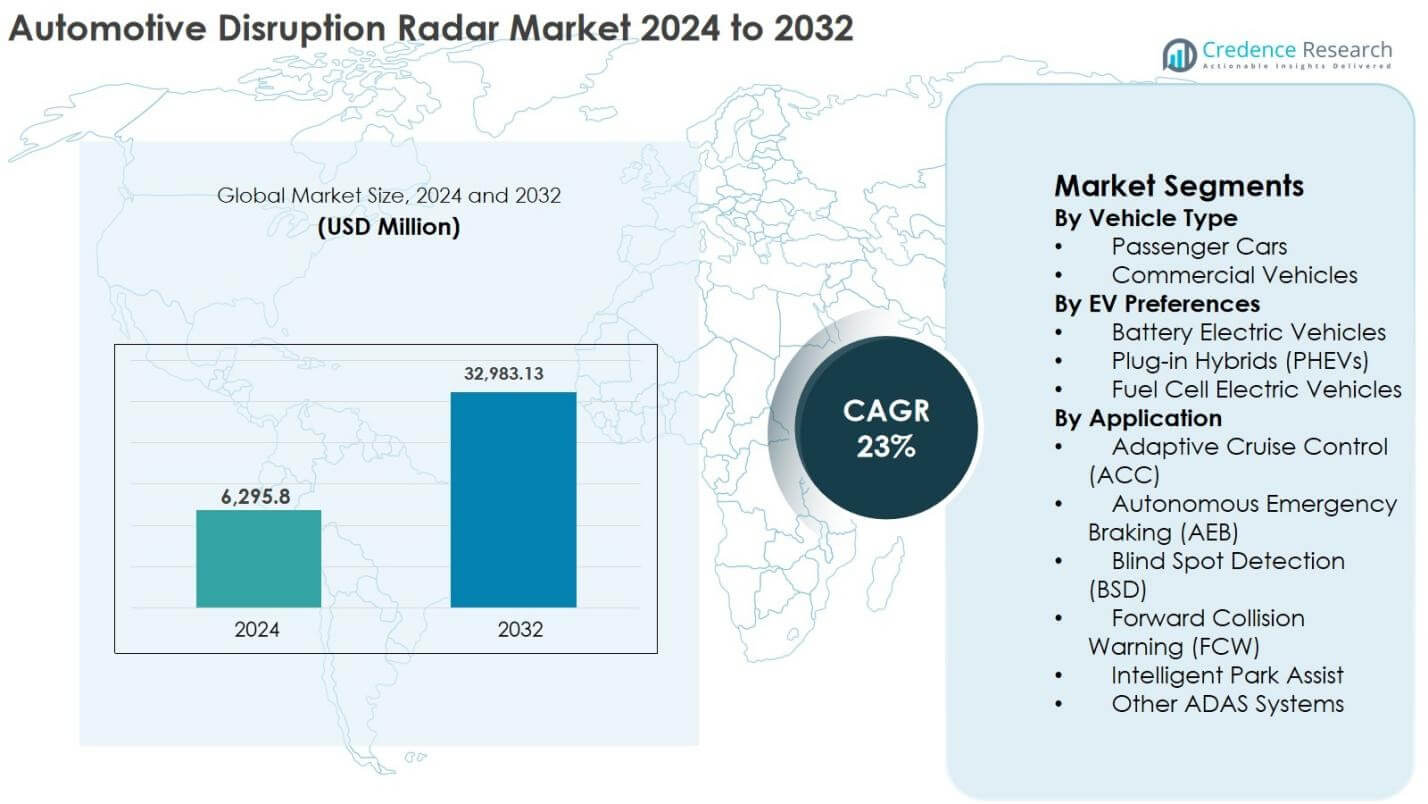
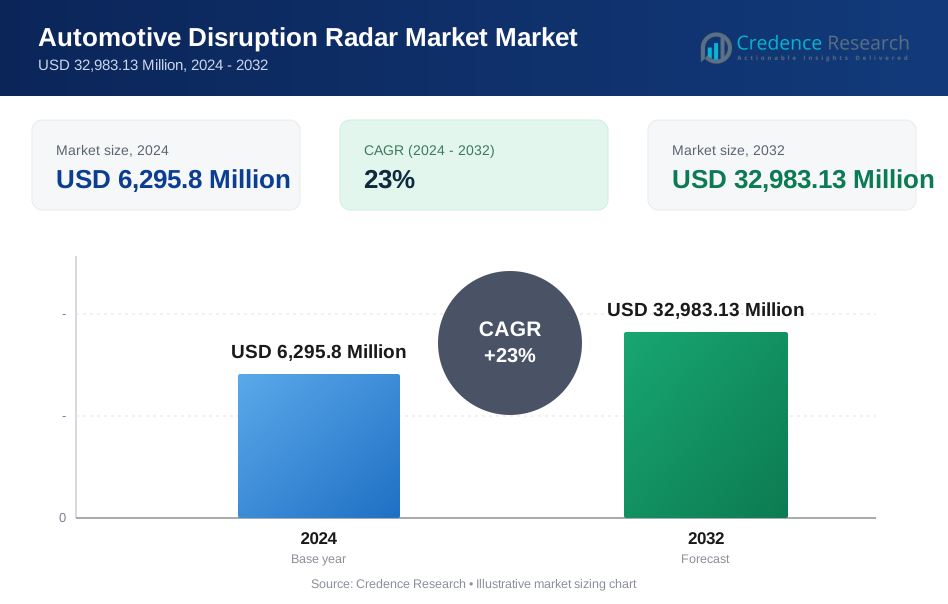
Automotive Disruption Radar market size was valued USD 6,295.8 Million in 2024 and is anticipated to reach USD 32,983.13 Million by 2032, at a CAGR of 23% during the forecast period.
| REPORT ATTRIBUTE | DETAILS |
|---|---|
| Historical Period | 2020-2023 |
| Base Year | 2024 |
| Forecast Period | 2025-2032 |
| Automotive Disruption Radar Market Size 2024 | USD 6,295.8 million |
| Automotive Disruption Radar Market, CAGR | 23% |
| Automotive Disruption Radar Market Size 2032 | USD 32,983.13 million |
Automotive Disruption Radar Market Insights
- Market overview highlights rising adoption of ADAS, radar-based safety systems, and autonomous driving features across passenger cars and commercial vehicles, with passenger cars holding the dominant segment share due to higher integration of intelligent safety and automation technologies.
- Market drivers include regulatory mandates for vehicle safety, growing investments in autonomous mobility, increasing EV penetration, and strong OEM–semiconductor collaboration supporting deployment of high-frequency radar and sensor-fusion platforms.
- Market trends and competitive analysis reflect continuous innovation by leading players focusing on AI-enabled radar perception, multi-sensor fusion, cost-efficient chipsets, and software-defined vehicle architectures to enhance efficiency, reliability, and automation readiness.
- Regional analysis shows Asia Pacific leading the market with 34.5% share in 2024, followed by North America with 31.8% and Europe with 28.6%, while Latin America and Middle East & Africa collectively account for the remaining share, supported by gradual ADAS adoption and fleet modernization.
Automotive Disruption Radar Market Segmentation Analysis:
By Vehicle Type
The Automotive Disruption Radar market by vehicle type is led by the Passenger Cars segment, which accounted for 67.3% share in 2024, driven by rapid adoption of connected mobility features, advanced driver-assistance systems, and rising consumer demand for premium safety technologies in mid- and high-end models. Commercial Vehicles held the remaining share, supported by fleet electrification, logistics automation, and telematics-enabled efficiency. Growth in the dominant Passenger Cars segment is further strengthened by regulatory safety mandates, OEM investments in intelligent cockpit platforms, and technology partnerships that accelerate the deployment of autonomous and semi-autonomous capabilities.
- For instance, Tesla equips all new passenger cars with its Autopilot hardware suite and offers features like Autosteer and Traffic-Aware Cruise Control via over-the-air software updates, illustrating how connected and semi-autonomous functions are becoming standard.
By EV Preferences
Within EV preferences, Battery Electric Vehicles (BEVs) emerged as the dominant sub-segment with a 58.6% market share in 2024, supported by declining battery costs, expansion of fast-charging infrastructure, and strong government incentives promoting zero-emission transportation. Plug-in Hybrids (PHEVs) captured a moderate share due to transitional consumer demand in range-sensitive markets, while Fuel Cell Electric Vehicles (FCEVs) remained niche but gained traction in long-haul and heavy-duty applications. The leadership of BEVs is reinforced by OEM electrification roadmaps, sustainability-driven consumer behavior, and wider integration of software-defined vehicle architectures.
- For instance, BYD has expanded its BEV lineup with models like the Dolphin and Seal, and in 2023 it sold more than 1.57 million BEVs globally, underscoring the scale of fully electric adoption in both mass and premium segments.
By Application
By application, Autonomous Emergency Braking (AEB) represented the dominant sub-segment with a 24.9% share in 2024, reflecting its increasing role as a core safety technology mandated across major automotive markets. AEB adoption is driven by road-safety initiatives, insurance-linked safety scoring models, and advancements in sensor fusion and AI-based perception systems. Other key applications such as Adaptive Cruise Control (ACC), Blind Spot Detection (BSD), Forward Collision Warning (FCW), Intelligent Park Assist, and broader ADAS suites are expanding rapidly, supported by rising automation levels, integration of radar-LiDAR-camera systems, and growing consumer preference for safety-enhancing driving technologies.
Key Growth Drivers
Rapid Advancement of ADAS and Sensor Fusion Technologies
The Automotive Disruption Radar market is experiencing strong growth driven by continuous advancements in advanced driver-assistance systems (ADAS), radar sensing, and sensor-fusion architectures that enhance vehicle safety, situational awareness, and autonomous decision-making. Automakers are integrating high-resolution radar, LiDAR, and camera systems to support functions such as collision avoidance, adaptive cruise control, lane monitoring, and automated parking, which significantly increases the demand for radar-centric intelligence platforms. Regulatory mandates for safety compliance across North America, Europe, and Asia further accelerate deployment, while growing consumer awareness of accident-reduction technologies strengthens adoption across both premium and mass-market vehicle segments. In addition, the evolution toward software-defined vehicles enables continuous feature upgrades through over-the-air updates, improving lifecycle value and operating efficiency. Collaboration between automotive OEMs, semiconductor manufacturers, and AI solution providers continues to expand the ecosystem, reinforcing innovation cycles and positioning radar-enabled intelligence as a foundation for higher-level vehicle automation.
- For instance, Mobileye supplies its EyeQ-based ADAS and perception platforms to multiple global automakers, integrating camera, radar, and mapping data for features like automatic emergency braking and lane-keeping assistance in both premium and high-volume passenger vehicles.
Electrification and Transition Toward Connected, Software-Defined Mobility
The rising penetration of electric vehicles and the transition toward connected, software-defined mobility are major drivers of growth in the Automotive Disruption Radar market. EV platforms rely heavily on radar-based sensing, power-management optimization, predictive maintenance analytics, and intelligent energy-efficiency systems, which amplifies the need for integrated digital monitoring frameworks. Connectivity features such as vehicle-to-everything (V2X) communication, smart charging coordination, and fleet telematics strengthen the importance of real-time disruption analytics in supporting operational intelligence and safety-critical applications. Governments worldwide continue to promote electrification through incentive programs and emissions-reduction policies, encouraging OEMs to accelerate digital transformation within EV architectures. Meanwhile, shared mobility operators, logistics providers, and autonomous fleet developers increasingly adopt radar-enabled monitoring tools to enhance performance, reliability, and regulatory compliance. The convergence of electrification, connectivity, and automation reinforces long-term demand for scalable, data-driven sensing solutions across diverse mobility ecosystems.
- For instance, General Motors’ Ultium-based EVs integrate advanced driver-assistance systems with over-the-air update capability via its Ultifi software platform, enabling continuous improvements in energy management, safety features, and connected services across the vehicle lifecycle.
Rising Investments in Autonomous and Semi-Autonomous Driving Capabilities
Growing investments in autonomous and semi-autonomous driving technologies represent another key growth driver for the Automotive Disruption Radar market, as OEMs, technology firms, and Tier-1 suppliers advance toward Level 2+, Level 3, and higher automation capabilities. Radar systems play a critical role in object detection, distance measurement, traffic interpretation, and real-time navigation support, particularly under low-visibility or complex road conditions where camera-only systems face performance limitations. Pilot projects for robotic taxis, automated shuttles, and urban mobility platforms continue to expand, generating new opportunities for radar-based perception frameworks. Insurance providers and fleet operators are also adopting automation-assisted safety solutions to reduce collision risk, maintenance costs, and operational downtime. Ongoing R&D investments, combined with falling sensor costs and increased chip-level integration, make radar technology more accessible across vehicle price segments. This sustained innovation pipeline strengthens commercialization prospects and supports broader adoption of intelligent automated driving ecosystems.
Key Trends & Opportunities
Integration of AI-Driven Analytics and Cloud-Connected Radar Platforms
A major trend shaping the Automotive Disruption Radar market is the increasing integration of AI-driven analytics, edge computing, and cloud-connected radar platforms that transform raw sensor data into actionable intelligence. Machine-learning-powered perception models improve object-classification accuracy, road-risk prediction, and adaptive safety responses, enabling smarter driver-assistance and autonomous navigation features. Cloud connectivity allows real-time performance benchmarking, fleet-wide data aggregation, remote diagnostics, and continuous algorithm enhancement through feedback learning. This creates opportunities for predictive safety intelligence, decentralized processing architectures, and subscription-based software monetization models. Mobility service providers, EV fleets, and logistics operators benefit from enhanced operational visibility, while OEMs leverage data insights to refine product development and feature optimization. As cybersecurity frameworks and digital-twin simulation tools mature, AI-enhanced radar ecosystems are expected to support more resilient, scalable, and interoperable next-generation mobility infrastructures.
- For instance, NVIDIA’s DRIVE platform combines on-vehicle edge computing with cloud-based AI training and over-the-air model updates, enabling continuous improvement of perception, path-planning, and driver-assistance capabilities for automakers integrating radar and other sensors.
Growing Adoption Across Commercial Fleets, Logistics, and Smart Mobility Ecosystems
Another key trend and opportunity in the Automotive Disruption Radar market is the expanding adoption of radar-enabled intelligence across commercial fleets, logistics networks, urban mobility platforms, and intelligent transportation systems. Fleet operators increasingly deploy radar-based monitoring to enhance collision prevention, driver-behavior assessment, route safety optimization, and automated docking assistance, particularly in high-density transport environments. The rise of e-commerce logistics, last-mile delivery services, and autonomous warehouse vehicles further strengthens demand for reliable sensing solutions capable of operating in complex and congested conditions. Smart-city initiatives and infrastructure modernization programs create additional opportunities for V2X-linked radar applications supporting traffic coordination and pedestrian-safety analytics. Partnerships between automotive manufacturers, telematics providers, and mobility-technology firms enable integrated service models, while emerging markets adopt radar-based safety intelligence to modernize transportation systems and improve road-safety outcomes.
- For instance, Siemens Mobility has deployed intelligent traffic-management and detection systems in cities such as London and Berlin, using roadside sensors and connected infrastructure to improve signal control, traffic safety, and pedestrian protection in dense urban corridors.
Key Challenges
High Technology Integration Costs and Supply-Chain Complexity
One of the major challenges in the Automotive Disruption Radar market is the high cost of technology integration, sensor calibration, and advanced semiconductor components, which can constrain large-scale adoption, particularly in cost-sensitive vehicle segments and developing markets. OEMs must manage complex supply chains involving chip manufacturers, software vendors, Tier-1 suppliers, and AI platform providers, increasing dependency risks and development-cycle uncertainty. The shift toward high-frequency radar, multi-sensor fusion, and edge-AI accelerators also requires significant engineering expertise, testing infrastructure, and validation resources. Price volatility in semiconductor materials and manufacturing capacity constraints can disrupt production timelines and limit scalability. Additionally, balancing cost optimization with performance reliability and safety-critical compliance remains challenging for suppliers attempting to compete in both premium and mass-market applications, reinforcing the need for modular architectures and standardized integration frameworks.
Regulatory Standardization, Data Privacy, and Functional Safety Compliance
Another key challenge for the Automotive Disruption Radar market lies in navigating evolving global regulatory frameworks related to functional safety, data privacy, cybersecurity, and autonomous-driving validation standards. Radar-based systems must comply with stringent performance certification requirements, electromagnetic spectrum regulations, and cross-border approval protocols, which can slow commercialization and increase compliance expenditures for OEMs and technology vendors. Data-driven platforms face growing scrutiny regarding secure data sharing, user-privacy protection, and ethical use of vehicle analytics, particularly in connected and cloud-linked environments. Variations in regulatory maturity across regions complicate market harmonization and technology deployment strategies. At the same time, ensuring fail-safe operation, redundancy design, and robust real-world reliability under diverse road conditions remains critical for safety certification. These regulatory and technical pressures require continuous collaboration between policymakers, industry stakeholders, and standards organizations to support responsible and scalable market expansion.
Regional Analysis
North America
North America held a significant position in the Automotive Disruption Radar market, accounting for 31.8% share in 2024, driven by strong penetration of ADAS-equipped vehicles, rapid development of autonomous mobility pilots, and high consumer adoption of connected car technologies. The United States leads the region, supported by advanced semiconductor ecosystems, strong OEM–technology partnerships, and proactive safety regulations promoting radar-based driver assistance features. Growth is further reinforced by expanding EV deployment, smart mobility initiatives, and increasing investments in AI-driven automotive sensing platforms. Canada and Mexico also contribute to market expansion through manufacturing integration, supply-chain localization, and technology standardization efforts.
Europe
Europe accounted for 28.6% share of the Automotive Disruption Radar market in 2024, supported by stringent road-safety mandates, accelerated electrification strategies, and strong adoption of premium vehicles equipped with advanced radar-assisted safety systems. Germany, France, and the U.K. remain leading contributors, driven by strong automotive R&D ecosystems and early commercialization of Level 2+ and Level 3 assistance technologies. The region benefits from harmonized regulatory frameworks, Euro NCAP safety scoring, and rapid integration of intelligent mobility infrastructure. Ongoing investments in autonomous testing corridors, urban smart-transport programs, and semiconductor innovation continue to strengthen Europe’s long-term technology adoption trajectory.
Asia Pacific
Asia Pacific dominated the Automotive Disruption Radar market with the largest share of 34.5% in 2024, reflecting high vehicle production volumes, rapid urbanization, and strong expansion of EV and ADAS adoption across China, Japan, South Korea, and India. The region benefits from large-scale semiconductor manufacturing, cost-competitive production ecosystems, and rising consumer demand for safety-enhancing driver-assistance features in both mass-market and premium vehicles. Government-led safety and emission initiatives further accelerate technology deployment, while domestic OEMs increasingly integrate radar-centric automation capabilities. Continued growth in connected mobility platforms, fleet modernization, and smart-transport infrastructure reinforces Asia Pacific’s leadership in market expansion.
Latin America
Latin America accounted for 3.1% share of the Automotive Disruption Radar market in 2024, with growth primarily influenced by gradual modernization of vehicle safety standards, rising penetration of telematics-enabled fleets, and increasing adoption of mid-range ADAS features in urban mobility segments. Brazil and Mexico lead the regional market, supported by expanding automotive manufacturing bases and progressive regulatory alignment with global safety frameworks. Market growth remains supported by premium vehicle imports, infrastructure digitization initiatives, and fleet-safety optimization in logistics and commercial transport. However, cost sensitivity and uneven technology accessibility across markets continue to moderate large-scale adoption.
Middle East & Africa
The Middle East & Africa region represented 2.0% share of the Automotive Disruption Radar market in 2024, driven by growing adoption of premium and high-performance vehicles, smart-city mobility initiatives, and increasing fleet-safety investments in logistics and commercial transport sectors. The Gulf Cooperation Council countries lead deployment, supported by smart-infrastructure development and rising demand for advanced safety and driver-assistance technologies. Africa shows emerging adoption, primarily in urban corridors and fleet-management applications. While infrastructure and affordability constraints limit rapid expansion, ongoing investments in intelligent mobility ecosystems and connected vehicle programs are expected to support steady regional growth.
Automotive Disruption Radar Market Segmentations:
By Vehicle Type
- Passenger Cars
- Commercial Vehicles
By EV Preferences
- Battery Electric Vehicles
- Plug-in Hybrids (PHEVs)
- Fuel Cell Electric Vehicles
By Application
- Adaptive Cruise Control (ACC)
- Autonomous Emergency Braking (AEB)
- Blind Spot Detection (BSD)
- Forward Collision Warning (FCW)
- Intelligent Park Assist
- Other ADAS Systems
By Geography
- North America
- U.S.
- Canada
- Mexico
- Europe
- Germany
- France
- U.K.
- Italy
- Spain
- Rest of Europe
- Asia Pacific
- China
- Japan
- India
- South Korea
- South-east Asia
- Rest of Asia Pacific
- Latin America
- Brazil
- Argentina
- Rest of Latin America
- Middle East & Africa
- GCC Countries
- South Africa
- Rest of the Middle East and Africa
Competitive Landscape
The Automotive Disruption Radar market features a dynamic and technology-driven competitive landscape shaped by strong collaboration between automotive OEMs, Tier-1 suppliers, and semiconductor companies developing advanced sensing, ADAS, and autonomous-driving platforms. Leading players such as Robert Bosch GmbH, Continental AG, DENSO Corporation, ZF Friedrichshafen, Valeo, NXP Semiconductors, Texas Instruments, Autoliv Inc., Delphi Automotive Company, and Analog Devices focus on radar sensor innovation, signal-processing chips, and AI-enabled perception software to enhance vehicle safety and automation capabilities. These companies are expanding product portfolios through high-frequency radar modules, multi-sensor fusion architectures, and software-defined vehicle integrations. Strategic initiatives include joint R&D programs with automakers, investments in autonomous mobility pilots, and partnerships with AI and cloud-analytics providers to enable scalable, over-the-air-upgradable safety solutions. Competitive differentiation increasingly centers on radar accuracy, energy efficiency, system reliability, and cost-effective integration across passenger and commercial vehicle platforms, while mergers, technology licensing, and regional manufacturing expansion continue to strengthen market positioning.
Key Player Analysis
- ZF Friedrichshafen
- Valeo
- Robert Bosch GmbH
- Texas Instruments
- Analog
- Continental AG
- Autoliv Inc.
- DENSO Corporation
- Delphi Automotive Company
- NXP Semiconductors
Recent Developments
- In July 2025, Bosch introduced a next-generation radar built on 22nm RF CMOS technology, enabling the integration of advanced digital circuitry into a compact, single-chip design suitable for large-scale production.
- In December 2024, Infineon launched the RASIC CTRX8191F MMIC, a system capable of detecting pedestrians and vehicles at distances of up to 380 meters, supporting high-speed automated highway driving applications.
- In January 2023, Texas Instruments unveiled new automotive battery cell and pack monitoring solutions that deliver exceptionally precise measurement accuracy, helping extend electric vehicle (EV) driving range and enhance operational safety.
Report Coverage
The research report offers an in-depth analysis based on Vehicle Type, EV Preferences, Application and Geography. It details leading market players, providing an overview of their business, product offerings, investments, revenue streams, and key applications. Additionally, the report includes insights into the competitive environment, SWOT analysis, current market trends, as well as the primary drivers and constraints. Furthermore, it discusses various factors that have driven market expansion in recent years. The report also explores market dynamics, regulatory scenarios, and technological advancements that are shaping the industry. It assesses the impact of external factors and global economic changes on market growth. Lastly, it provides strategic recommendations for new entrants and established companies to navigate the complexities of the market.
Future Outlook
- The market will witness increasing integration of high-resolution radar systems to support advanced driver assistance and semi-autonomous capabilities.
- Automakers will adopt software-defined architectures that enable continuous radar performance upgrades through over-the-air updates.
- Radar-AI fusion will play a critical role in improving object detection accuracy and real-time driving decision analytics.
- Commercial fleets and logistics operators will expand the use of radar-enabled safety and monitoring solutions.
- The shift toward electric and connected mobility will accelerate demand for energy-efficient radar sensing platforms.
- Partnerships between OEMs, semiconductor companies, and technology providers will intensify to accelerate innovation cycles.
- Affordability-focused radar modules will gain traction in emerging markets and mid-range vehicle segments.
- Regulatory mandates for road safety and collision-prevention systems will continue to drive large-scale deployment.
- Cloud-linked radar analytics and predictive maintenance capabilities will expand in fleet and smart mobility ecosystems.
- The market will move toward scalable, modular radar platforms that support higher levels of vehicle automation.
Request a Free Sample
Fill in your details and we'll send you a free sample report.
- Sample data tables & charts
- Research methodology
Need a Custom Version of This Report?
Tailor the scope, geography, or segments to your exact requirements.
- Custom geography or segment scope
- Direct access to our analyst team
Frequently Asked Questions
What is the current market size for Automotive Disruption Radar Market, and what is its projected size in 2032?
At what Compound Annual Growth Rate is the Automotive Disruption Radar Market projected to grow between 2024 and 2032?
Which Automotive Disruption Radar Market segment held the largest share in 2024?
What are the primary factors fueling the growth of the Automotive Disruption Radar Market?
Who are the leading companies in the Automotive Disruption Radar Market?
Which region commanded the largest share of the Automotive Disruption Radar Market in 2024?
Table of Content
Chapter 1. Report Introduction
- 1.1 Report Description & Purpose
- 1.1.1 Report Title & Market Definition
- 1.1.2 Unique Selling Propositions (USP) & Key Differentiators
- 1.1.3 Value Proposition for Stakeholders
- 1.2 Research Objectives
- 1.2.1 Market Sizing Objectives (Volume & Revenue)
- 1.2.2 Segmentation Objectives
- 1.2.3 Competitive Intelligence Objectives
- 1.2.4 Forecast & Scenario Objectives
- 1.3 Report Scope
- 1.3.1 Automotive Disruption Radar Market Scope – Types & Subtypes Covered
- 1.3.2 Geographic Scope – Regions & Countries Covered
- 1.3.3 Historical Period, Base Year & Forecast Period (2024; forecast to 2032)
- 1.3.4 Inclusions & Exclusions
- 1.4 HS Code & Classification Framework
- 1.5 Currency, Units & Pricing Basis
- 1.6 Target Stakeholders
- 1.7 Limitations & Assumptions
Chapter 2. Executive Summary
- 2.1 Global Automotive Disruption Radar Market Market Snapshot
- 2.1.1 Market Size – Historical (2024) & Forecast (2024-2032) (2024: USD 6,295.8 Million → 2032: USD 32,983.13 Million)
- 2.1.2 Volume & Revenue – Global Totals
- 2.1.3 Key Market Highlights – Top Five Facts
- 2.2 Automotive Disruption Radar Market Market Segmentation Snapshot
- 2.2.1 Market Split by Region – 2024 vs. 2032
- 2.3 Competitive Snapshot
- 2.3.1 Top 10 Players by Revenue Share – 2024
- 2.3.2 Top 10 Players by Volume Share – 2024
- 2.3.3 Recent Strategic Developments (18-Month Summary)
- 2.4 Key Investment Highlights & Strategic Conclusions
Chapter 3. Automotive Disruption Radar Market Market Dynamics & Industry Analysis
- 3.1 Market Overview & Context
- 3.1.1 Automotive Disruption Radar Market Market Position in the Broader Automotive Value Chain
- 3.1.2 OEM vs. Replacement Market Dynamics
- 3.1.3 Market Maturity & Development Stage by Region
- 3.2 Automotive Disruption Radar Market Market Drivers
- 3.3 Automotive Disruption Radar Market Market Restraints & Challenges
- 3.4 Automotive Disruption Radar Market Market Opportunities
- 3.5 Porter's Five Forces Analysis
- 3.5.1 Threat of New Entrants
- 3.5.2 Bargaining Power of Suppliers
- 3.5.3 Bargaining Power of Buyers
- 3.5.4 Threat of Substitutes
- 3.5.5 Competitive Rivalry – Intensity Assessment
- 3.6 Automotive Disruption Radar Market Value Chain Analysis
- 3.6.1 Upstream – Raw Material/Input Suppliers
- 3.6.1.1 Raw Material/Input 1
- 3.6.1.2 Raw Material/Input 2
- 3.6.1.3 Raw Material/Input 3
- 3.6.2 Midstream – Production/Manufacturing/Service Delivery
- 3.6.2.1 Production/Process Overview
- 3.6.2.2 Key Facility Locations & Capacity by Manufacturer
- 3.6.3 Downstream – Distribution & End Consumer
- 3.6.3.1 Primary Channel – B2B/OEM
- 3.6.3.2 Secondary Channels – Dealer, Retail, Online, Direct
- 3.6.4 Value Chain Profitability Analysis
- 3.6.1 Upstream – Raw Material/Input Suppliers
- 3.7 PESTEL Analysis
- 3.7.1 Political Factors
- 3.7.2 Economic Factors
- 3.7.3 Social Factors
- 3.7.4 Technological Factors
- 3.7.5 Environmental Factors
- 3.7.6 Legal Factors
- 3.8 Automotive Disruption Radar Market Supply Chain Analysis
- 3.8.1 Raw Material/Input Supply Risk Assessment
- 3.8.2 Manufacturing Concentration Risk (Geographic Exposure)
- 3.8.3 Trade Disruption Impact Analysis
- 3.9 Regulatory & Policy Landscape
Note: The regulatory and policy landscape section covers regulations based on their applicability to the market, Automotive Disruption Radar Market category, geography, and scope of the study. Only regulatory frameworks with a material impact on operations, compliance, trade, sustainability, or market access are analyzed in detail.
Chapter 4. Key Investment Pockets & Opportunity Analysis
- 4.1 Automotive Disruption Radar Market Market Attractiveness Analysis
- 4.1.1 By Region – Investment Attractiveness Matrix (Volume × CAGR)
- 4.2 Absolute Revenue Growth Opportunity
- 4.2.1 By Region – Absolute USD Growth Through 2032
- 4.3 Incremental Volume Opportunity
- 4.3.1 By Region – Incremental Volume Through 2032
- 4.3.2 Segment – Incremental Volume
- 4.4 Emerging Submarket Opportunity Deep Dive (Subject to Applicability)
- 4.5 Emerging Market Opportunity Scorecards
- 4.5.1 United States
- 4.5.2 Europe
- 4.5.3 Asia
- 4.5.4 Middle East & Africa
Note: Emerging Market Opportunity Scorecards will be included based on relevance and strategic importance. Regions listed are indicative and may vary depending on data availability and market dynamics.
Chapter 5. Automotive Disruption Radar Market Import-Export Analysis & Trade Flows
- 5.1 Global Trade Overview
- 5.1.1 Global Export Value by Country (2024)
- 5.1.2 Global Export Volume by Country (2024)
- 5.1.3 Global Import Value by Country (2024)
- 5.1.4 Global Import Volume by Country (2024)
- 5.1.5 Net Trade Balance by Country (2024)
- 5.2 Export Analysis – Segment
- 5.2.1 Type 1 (HS Code)
- 5.2.2 Type 2 (HS Code)
- 5.2.3 Type 3 (HS Code)
- 5.2.4 Type 4 (HS Code)
- 5.2.5 Type 5 (HS Code)
- 5.3 Import Analysis – Segment
- 5.3.1 Type 1 (HS Code)
- 5.3.2 Type 2 (HS Code)
- 5.3.3 Type 3 (HS Code)
- 5.3.4 Type 4 (HS Code)
- 5.3.5 Type 5 (HS Code)
- 5.4 Average Unit Trade Prices
- 5.4.1 Average Export Price – Segment & Country
- 5.4.2 Average Import Price – Segment & Source Country
- 5.4.3 Price Trends (2024)
- 5.5 Key Trade Route Analysis
- 5.5.1 Trade Route 1
- 5.5.2 Trade Route 2
- 5.5.3 Trade Route 3
- 5.5.4 Trade Route 4
- 5.5.5 Trade Route 5
- 5.6 Trade Policy Impact Assessment
- 5.6.1 US Anti-Dumping & Section 301 Tariffs
- 5.6.2 EU Customs Union Impact
- 5.6.3 Major Free Trade Agreements
- 5.6.4 USMCA Rules of Origin
Note: Trade policy analysis will be included only where relevant to the Automotive Disruption Radar Market market.
Chapter 6. Competitive Landscape & Company Benchmarking
- 6.1 Automotive Disruption Radar Market Market Concentration & Structure
- 6.1.1 Herfindahl-Hirschman Index (HHI) – vs. 2024
- 6.1.2 Tier 1, Tier 2 & Tier 3 Market Structure
- 6.1.3 Global, Regional & Local Player Dynamics
- 6.2 Automotive Disruption Radar Market Market Share Analysis – 2024
- 6.2.1 Global Revenue Share by Company
- 6.2.2 Global Volume Share by Company
- 6.2.3 Regional Revenue Share
- 6.2.4 Market Share Evolution ( vs. 2024)
- 6.2.5 OEM Segment Share by Company
- 6.2.6 Replacement Segment Share by Company
- 6.3 Production/Delivery Capacity & Facility Analysis
- 6.3.1 Global Installed Capacity
- 6.3.2 Capacity Utilization Rates
- 6.3.3 Production/Output Volume
- 6.3.4 Facility Locations & Capacity Map
- 6.3.5 Planned Capacity Additions
- 6.4 Automotive Disruption Radar Market Competitive Benchmarking Matrix
- 6.4.1 Revenue, Volume, CAGR & Profitability Comparison
- 6.4.2 Channel Revenue Mix
- 6.4.3 Geographic Revenue Exposure
- 6.4.4 R&D Intensity
- 6.4.5 Sustainability Maturity
- 6.5 Strategic Developments in Automotive Disruption Radar Market (Last 24 Months)
- 6.5.1 Mergers, Acquisitions & Divestments
- 6.5.2 New Automotive Disruption Radar Market Launches
- 6.5.3 Facility Expansions
- 6.5.4 Strategic Alliances, Joint Ventures & Partnerships
- 6.5.5 Distribution Expansion & Market Entry
- 6.5.6 Sustainability & ESG Initiatives
- 6.6 Competitive Strategy Mapping
- 6.6.1 Leader, Challenger, Follower & Niche Classification
- 6.6.2 Pricing Strategy Comparison
- 6.6.3 Channel Strategy Matrix
Note: Strategic developments are included based on their materiality and the availability of reliable information.
Chapter 7. Global Automotive Disruption Radar Market Market – By Distribution Channel
- 7.1 Segment Overview
- 7.1.1 Volume & Revenue Split by Channel (2024 & 2032)
- 7.1.2 Channel Mix Evolution (2024-2032)
Chapter 8. Regional Market Analysis – Global Overview
- 8.1 Global Regional Overview
- 8.1.1 Regional Volume Share
- 8.1.2 Regional Revenue Share
- 8.1.3 Regional Volume by Region
- 8.1.4 Regional Revenue by Region
- 8.1.5 Regional Forecast Through 2032
- 8.2 Cross-Regional Segment Analysis
- 8.2.1 By Distribution Channel
- 8.2.2 By Brand/Price Tier
Chapter 9. North America Automotive Disruption Radar Market Market
- 9.1 United States
- 9.2 Canada
- 9.3 Mexico
Chapter 10. Europe Automotive Disruption Radar Market Market
- 10.1 Germany
- 10.2 France
- 10.3 Italy
- 10.4 United Kingdom
- 10.5 Spain
- 10.6 Poland
- 10.7 Russia
- 10.8 Netherlands
- 10.9 Belgium
- 10.10 Sweden
- 10.11 Denmark
- 10.12 Norway
- 10.13 Rest of Europe
Chapter 11. Asia Pacific Automotive Disruption Radar Market Market
- 11.1 China
- 11.2 India
- 11.3 Japan
- 11.4 South Korea
- 11.5 Thailand
- 11.6 Indonesia
- 11.7 Vietnam
- 11.8 Malaysia
- 11.9 Australia
- 11.10 Rest of Asia Pacific
Chapter 12. Latin America Automotive Disruption Radar Market Market
- 12.1 Brazil
- 12.2 Argentina
- 12.3 Colombia
- 12.4 Chile
- 12.5 Rest of Latin America
Chapter 13. Middle East Automotive Disruption Radar Market Market
- 13.1 Saudi Arabia
- 13.2 United Arab Emirates
- 13.3 Turkey
- 13.4 Israel
- 13.5 Iran
- 13.6 Rest of the Middle East
Chapter 14. Africa Automotive Disruption Radar Market Market
- 14.1 South Africa
- 14.2 Egypt
- 14.3 Nigeria
- 14.4 Morocco
- 14.5 Rest of Africa
Chapter 15. Automotive Disruption Radar Market Company Profiles
- 15.1 [Company 01]
- 15.1.1 Company Overview
- 15.1.2 Key Management Personnel
- 15.1.3 Products & Services Portfolio
- 15.1.4 Financial Performance
- 15.1.5 Key Market Focus & Geographic Presence
- 15.1.6 Recent Developments & Strategic Initiatives
Note: The company profile list is preliminary and may change based on research findings, market developments, data availability, and client requirements.
Chapter 16. Appendices
- Appendix A – List of Abbreviations & Acronyms
- Appendix B – Industry Classification Code Reference – Full Series
- Appendix C – Production & Capacity Data Tables
- Appendix D – End-Use & Demand Base Tables
- Appendix E – Consumption & Replacement Rate Assumptions
- Appendix F – ASP Reference Tables
- Appendix G – Manufacturing & Facility Database
- Appendix H – Import-Export Data Tables
- Appendix I – Regulatory Summary Tables
- Appendix J – Primary Research Participant List (Anonymized)
- Appendix K – Primary Research Questionnaire Framework
- Appendix L – Data Sources & Bibliography
- Appendix M – Market Size Divergence & Source Comparison
Chapter 17. Research Methodology
- 17.1 Research Framework & Philosophy
- 17.2 Secondary Research – Sources, Hierarchy & Data Extraction
- 17.3 Data Modeling – Bottom-Up & Top-Down Market Sizing
- 17.4 Primary Research – Stakeholder Framework, LOI & Sample Sizes
- 17.5 Forecast Methodology – Regression, Scenario & Sensitivity Analysis
- 17.6 Quality Control – Four-Layer Validation Framework
- 17.7 Limitations & Standard Assumptions
- 17.8 Disclaimer
