Irritable Bowel Syndrome with Constipation Drugs Market Overview:
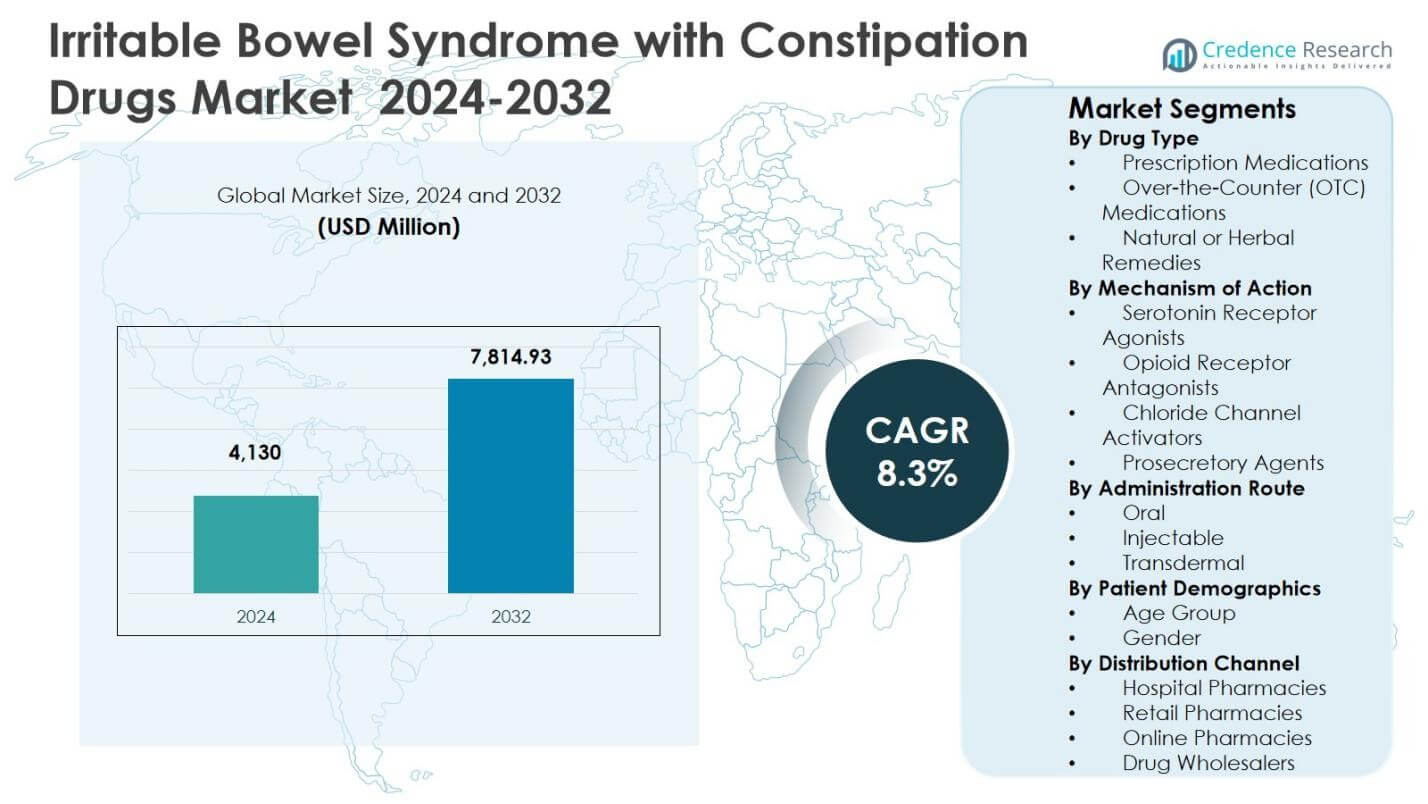
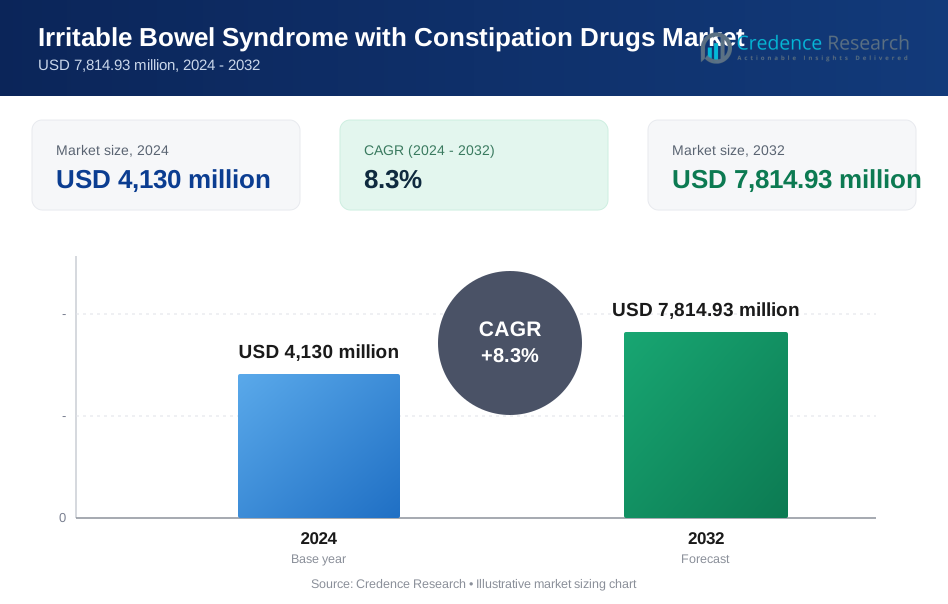
The Irritable Bowel Syndrome with Constipation Drugs Market size was valued at USD 4,130 million in 2024 and is anticipated to reach USD 7,814.93 million by 2032, growing at a CAGR of 8.3% during the forecast period.
| REPORT ATTRIBUTE | DETAILS |
|---|---|
| Historical Period | 2020-2023 |
| Base Year | 2024 |
| Forecast Period | 2025-2032 |
| Irritable Bowel Syndrome with Constipation Drugs Market Size 2024 | USD 4,130 million |
| Irritable Bowel Syndrome with Constipation Drugs Market, CAGR | 8.3% |
| Irritable Bowel Syndrome with Constipation Drugs Market Size 2032 | USD 7,814.93 million |
Irritable Bowel Syndrome with Constipation Drugs Market Insights
- Market growth is driven by increasing prevalence of IBS-C, improved clinical awareness, aging populations, and higher adoption of prescription-based therapies, with prescription medications holding a dominant 68.4% segment share in 2024 due to superior clinical efficacy.
- Key market trends include a shift toward mechanism-based drugs such as prosecretory agents, which accounted for a 42.1% share in 2024, along with growing focus on personalized and long-term oral therapies that enhance patient adherence.
- Market analysis shows leading players focusing on branded drugs, R&D investments, and geographic expansion, while high therapy costs and variable patient response remain key restraints affecting treatment continuity.
- Regionally, North America led the market with a 41.6% share in 2024, followed by Europe at 28.3%, Asia Pacific at 19.7%, Latin America at 6.4%, and Middle East & Africa at 4.0%, reflecting varied healthcare access and adoption levels.
Irritable Bowel Syndrome with Constipation Drugs Market Segmentation Analysis:
By Drug Type:
The Irritable Bowel Syndrome with Constipation Drugs Market by drug type is led by Prescription Medications, which accounted for 68.4% market share in 2024, driven by their proven clinical efficacy, targeted mechanisms, and strong physician preference for chronic IBS-C management. Prescription drugs such as guanylate cyclase-C agonists and chloride channel activators offer sustained symptom relief for abdominal pain and constipation, supporting long-term adherence. Over-the-counter (OTC) medications held 21.6% share, supported by accessibility and cost advantages, while Natural or Herbal Remedies captured 10.0%, driven by growing patient inclination toward complementary therapies.
- For instance, Linaclotide (Linzess by AbbVie/Ironwood) achieved a 33.7% FDA combined responder rate for IBS-C symptoms over 26 weeks in a phase 3 trial, significantly outperforming placebo at 13.9% (P<0.0001), with 50.1% of patients reporting ≥30% abdominal pain reduction.
By Mechanism of Action:
By mechanism of action, Prosecretory Agents dominated the market with a 42.1% share in 2024, supported by their ability to enhance intestinal fluid secretion and improve bowel movement frequency. Drugs in this class demonstrate strong efficacy in reducing constipation severity and abdominal discomfort, driving high prescription volumes. Chloride Channel Activators accounted for 26.7%, benefiting from established safety profiles, while Serotonin Receptor Agonists held 18.9%, driven by motility regulation benefits. Opioid Receptor Antagonists represented 12.3%, supported by niche use in refractory patient populations.
- For instance, Ironwood Pharmaceuticals' linaclotide (290 μg daily) increased weekly spontaneous bowel movements by 3.3 from baseline versus 1.5 for placebo in chronic constipation patients.
By Administration Route:
Based on administration route, Oral formulations dominated the Irritable Bowel Syndrome with Constipation Drugs Market with a 74.8% share in 2024, driven by ease of use, patient convenience, and suitability for long-term therapy. Oral drugs remain the first-line treatment option across mild to severe IBS-C cases, supporting high adherence rates. Injectable formulations accounted for 15.2%, primarily used in specialized clinical settings for targeted intervention. Transdermal delivery held 10.0% share, supported by growing interest in alternative delivery systems that improve compliance and reduce gastrointestinal side effects.
Key Growth Drivers
Rising Prevalence of Irritable Bowel Syndrome with Constipation
The rising prevalence of irritable bowel syndrome with constipation is a major growth driver for the IBS-C drugs market. Increasing consumption of processed foods, low dietary fiber intake, sedentary lifestyles, and elevated stress levels have significantly increased gastrointestinal disorder incidence globally. Improved clinical awareness and standardized diagnostic guidelines have enabled earlier diagnosis and treatment initiation. Growing aging populations further contribute to demand, as reduced gastrointestinal motility is common among elderly patients. Additionally, higher patient willingness to seek medical intervention for chronic digestive symptoms has expanded the treated population, supporting consistent growth in prescription volumes across developed and emerging regions.
- For instance, Ardelyx's IBSRELA (tenapanor) achieved high real-world satisfaction, with 76% of surveyed patients rating it superior to prior therapies and over 70% reporting better daily activity participation, including work and exercise.
Advancements in Targeted and Mechanism-Based Drug Development
Advancements in targeted and mechanism-based drug development continue to propel the IBS-C drugs market. Pharmaceutical companies are increasingly focusing on therapies that address both constipation and abdominal pain through precise biological pathways. Prosecretory agents, chloride channel activators, and selective receptor modulators demonstrate improved efficacy and safety profiles compared to conventional laxatives. These innovations enhance physician confidence and patient adherence to long-term therapy. Ongoing clinical trials and regulatory approvals of novel molecules further strengthen treatment availability, enabling differentiation in a competitive landscape and supporting sustained market expansion driven by innovation-led adoption.
- For instance, Sucampo's Lubiprostone (Amitiza), a chloride channel activator, showed 17.9% overall responders in a phase 3 trial for IBS-C women on 8 mcg twice daily, versus 10.1% on placebo, based on symptom assessments including stool frequency and abdominal pain.
Increasing Healthcare Expenditure and Improved Treatment Awareness
Rising healthcare expenditure and improved awareness of IBS-C treatment options significantly drive market growth. Governments and private healthcare providers are investing in gastroenterology services, diagnostics, and specialty care infrastructure. Educational initiatives targeting physicians and patients have reduced underdiagnosis and increased acceptance of prescription-based management. Expanding insurance coverage for gastrointestinal drugs in developed markets further improves treatment affordability. In parallel, digital health platforms and teleconsultations enhance access to specialist care, accelerating diagnosis and therapy initiation. These combined factors support higher treatment penetration and long-term growth in the IBS-C drugs market.
Key Trends & Opportunities
Growing Shift Toward Personalized and Long-Term IBS-C Therapy
A growing shift toward personalized and long-term IBS-C therapy represents a key trend and opportunity in the market. Clinicians increasingly customize treatment regimens based on symptom severity, patient response, and disease subtype. This approach supports sustained symptom control and improves patient satisfaction. Long-term therapy requirements create recurring revenue opportunities for pharmaceutical companies. Additionally, demand for drugs with better tolerability and minimal side effects is encouraging innovation. Personalized management strategies also support the development of differentiated products, strengthening brand positioning and long-term market competitiveness.
- For instance, Takeda’s AMITIZA (lubiprostone) 8µg twice daily, for example, showed 17.9% overall responders in a combined phase 3 analysis of IBS-C patients over 12 weeks, versus 10.1% placebo, with response rates improving monthly (10.8% to 22.0%).
Expansion Opportunities in Emerging and Underserved Markets
Emerging and underserved markets offer significant growth opportunities for IBS-C drug manufacturers. Improving healthcare infrastructure, rising disposable incomes, and expanding urban populations are increasing access to gastrointestinal care. Awareness of functional bowel disorders is steadily improving, leading to higher diagnosis and treatment rates. Growth of private hospitals and pharmacy networks further enhances drug availability. Pharmaceutical companies are increasingly adopting regional expansion strategies through partnerships, local manufacturing, and targeted marketing initiatives. These efforts support market penetration and unlock long-term growth potential in high-population regions.
- For instance, Ironwood also collaborated with AstraZeneca to co-develop and co-commercialize linaclotide in China, Hong Kong, and Macau, including submission of a Phase 3 trial application for IBS-C patients.
Key Challenges
High Cost of Advanced Therapies and Reimbursement Limitations
High treatment costs and reimbursement limitations remain a major challenge for the IBS-C drugs market. Advanced prescription therapies often carry premium pricing, limiting affordability for a large portion of the patient population. In many regions, insurance coverage for functional gastrointestinal disorders remains restricted, increasing out-of-pocket expenses. This financial burden discourages long-term adherence and delays treatment initiation. Cost sensitivity is particularly high in developing economies, where healthcare spending is constrained. These factors collectively restrict market penetration despite growing disease prevalence and clinical need.
Variability in Treatment Response and Patient Adherence
Variability in treatment response and patient adherence poses a significant challenge to sustained market growth. IBS-C presents heterogeneous symptoms, leading to inconsistent therapeutic outcomes across patient populations. Some patients experience delayed relief or adverse effects, resulting in therapy discontinuation. Long treatment durations further complicate adherence, especially when symptom improvement is gradual. Physicians often require multiple treatment adjustments, increasing clinical complexity. These challenges highlight the need for more predictable, well-tolerated therapies and improved patient education to ensure consistent treatment outcomes and market stability.
Regional Analysis
North America
North America dominated the Irritable Bowel Syndrome with Constipation Drugs Market with a 41.6% market share in 2024, supported by high disease awareness, strong diagnostic rates, and widespread adoption of prescription therapies. The region benefits from advanced healthcare infrastructure, strong gastroenterology specialty networks, and favorable reimbursement policies for IBS-C drugs. High patient adherence to long-term pharmacological treatment and early adoption of novel therapies further strengthen demand. The presence of leading pharmaceutical companies and continuous drug approvals also support sustained market growth across the United States and Canada.
Europe
Europe accounted for a 28.3% market share in 2024, driven by rising prevalence of functional gastrointestinal disorders and strong access to prescription medications. Countries such as Germany, the United Kingdom, France, and Italy contribute significantly due to well-established public healthcare systems and growing physician awareness of IBS-C management. Increasing use of evidence-based treatment guidelines and expanding reimbursement coverage for advanced therapies support market expansion. Additionally, aging populations and improved patient education programs continue to drive steady demand for long-term IBS-C drug therapies across the region.
Asia Pacific
Asia Pacific held a 19.7% market share in 2024, reflecting rapid growth potential driven by improving healthcare access and increasing awareness of gastrointestinal disorders. Urbanization, dietary changes, and rising stress levels have increased IBS-C prevalence across China, India, Japan, and South Korea. Expanding private healthcare facilities and growing pharmaceutical distribution networks support treatment adoption. Although diagnosis rates remain lower than in developed regions, rising healthcare expenditure and improved specialist availability are accelerating market penetration, positioning Asia Pacific as a key growth region during the forecast period.
Latin America
Latin America represented a 6.4% market share in 2024, supported by gradual improvements in healthcare infrastructure and growing awareness of IBS-C treatment options. Brazil, Mexico, and Argentina are key contributors due to increasing access to gastroenterology services and expanding pharmaceutical distribution channels. Rising urban populations and improving insurance coverage support prescription drug adoption. However, cost sensitivity and limited reimbursement for advanced therapies restrain faster growth. Despite these challenges, improving diagnosis rates and physician education initiatives continue to support steady market development across the region.
Middle East & Africa
The Middle East & Africa region accounted for a 4.0% market share in 2024, reflecting emerging adoption of IBS-C drug therapies. Growth is supported by expanding healthcare investments, particularly in Gulf Cooperation Council countries, and increasing awareness of digestive health. Private healthcare expansion and rising medical tourism contribute to improved access to prescription treatments. However, limited specialist availability and lower diagnosis rates in parts of Africa constrain broader adoption. Gradual improvements in healthcare infrastructure and awareness are expected to support incremental market growth over time.
Irritable Bowel Syndrome with Constipation Drugs Market Segmentations:
By Drug Type
- Prescription Medications
- Over-the-Counter (OTC) Medications
- Natural or Herbal Remedies
By Mechanism of Action
- Serotonin Receptor Agonists
- Opioid Receptor Antagonists
- Chloride Channel Activators
- Prosecretory Agents
By Administration Route
- Oral
- Injectable
- Transdermal
By Patient Demographics
- Age Group
- Gender
By Distribution Channel
- Hospital Pharmacies
- Retail Pharmacies
- Online Pharmacies
- Drug Wholesalers
By Geography
- North America
- U.S.
- Canada
- Mexico
- Europe
- Germany
- France
- U.K.
- Italy
- Spain
- Rest of Europe
- Asia Pacific
- China
- Japan
- India
- South Korea
- South-east Asia
- Rest of Asia Pacific
- Latin America
- Brazil
- Argentina
- Rest of Latin America
- Middle East & Africa
- GCC Countries
- South Africa
- Rest of the Middle East and Africa
Competitive Landscape
Competitive landscape in the Irritable Bowel Syndrome with Constipation Drugs Market is shaped by the presence of key players such as AbbVie Inc., Ironwood Pharmaceuticals, Takeda Pharmaceutical Company Limited, AstraZeneca plc, Bausch Health Companies Inc., Ardelyx Inc., and Salix Pharmaceuticals. The market is moderately consolidated, with leading companies focusing on branded prescription therapies supported by strong clinical evidence and physician acceptance. Strategic priorities include portfolio expansion through novel drug development, lifecycle management of approved molecules, and geographic expansion into high-growth emerging markets. Companies actively invest in clinical trials to improve efficacy and safety profiles while addressing both constipation and abdominal pain symptoms. Partnerships, licensing agreements, and selective acquisitions are used to strengthen R&D pipelines and market positioning. Strong sales networks, regulatory approvals, and growing awareness of IBS-C treatment options further intensify competition and reinforce brand differentiation across major regions.
Key Player Analysis
- AbbVie Inc.
- Ironwood Pharmaceuticals
- Takeda Pharmaceutical Company Limited
- AstraZeneca plc
- Bausch Health Companies Inc.
- Ardelyx Inc.
- Salix Pharmaceuticals
- Johnson & Johnson
- Pfizer Inc.
- GlaxoSmithKline plc
Recent Developments
- In November 2025, the U.S. Food and Drug Administration (FDA) approved LINZESS® (linaclotide) for the treatment of irritable bowel syndrome with constipation (IBS-C) in patients aged 7 years and older, expanding its indication into a pediatric population. This approval is a collaboration between Ironwood Pharmaceuticals and AbbVie.
- In May 2025, Ardelyx, Inc. presented new clinical and real-world outcome data for IBSRELA® (tenapanor) at the Digestive Disease Week 2025 Conference, underscoring enhanced evidence supporting its safety, tolerability, and broader clinical understanding in treating adults with IBS-C.
- In May 2025, EnteroBiotix presented positive Phase 2a trial data for EBX-102-02, an oral microbiome therapy showing clinically meaningful improvements in IBS-C symptoms like abdominal pain and bowel habits, with a Phase 2b trial planned for later in 2025.
- In August 2025, Dr. Reddy's Laboratories launched Colozo (linaclotide), a first-in-class generic drug for managing chronic constipation in adults in India, expanding access to IBS-C treatments.
Report Coverage
The research report offers an in-depth analysis based on Drug Type, Mechanism of Action, Administration Route, Patient Demographics, Distribution Channel and Geography. It details leading market players, providing an overview of their business, product offerings, investments, revenue streams, and key applications. Additionally, the report includes insights into the competitive environment, SWOT analysis, current market trends, as well as the primary drivers and constraints. Furthermore, it discusses various factors that have driven market expansion in recent years. The report also explores market dynamics, regulatory scenarios, and technological advancements that are shaping the industry. It assesses the impact of external factors and global economic changes on market growth. Lastly, it provides strategic recommendations for new entrants and established companies to navigate the complexities of the market.
Future Outlook
- The market will continue to expand steadily, supported by rising prevalence of functional gastrointestinal disorders and improved diagnosis rates.
- Demand for prescription-based therapies will increase as physicians prioritize evidence-based and long-term IBS-C management.
- Innovation in mechanism-specific drugs will enhance treatment outcomes and strengthen patient adherence.
- Personalized treatment approaches will gain traction, enabling tailored therapy selection based on symptom profiles.
- Oral drug formulations will remain dominant due to convenience and suitability for chronic use.
- Emerging markets will witness faster growth driven by improving healthcare infrastructure and awareness.
- Strategic collaborations and licensing agreements will accelerate product development and geographic expansion.
- Regulatory approvals of novel therapies will intensify competition and diversify treatment options.
- Digital health platforms will improve patient access to gastroenterology specialists and therapy initiation.
- Focus on improved safety profiles and tolerability will shape future product development strategies.
Request a Free Sample
Fill in your details and we'll send you a free sample report.
- Sample data tables & charts
- Research methodology
Market Dynamics
Rising Prevalence of IBS-C
Increasing incidence of irritable bowel syndrome with constipation, driven by dietary changes, sedentary lifestyles, and aging populations, is expanding the patient pool and fueling demand for effective drug therapies.
Advancements in Targeted and Mechanism-Based Drug Development
Pharmaceutical innovation focusing on prosecretory agents, chloride channel activators, and receptor modulators is improving clinical outcomes, boosting physician confidence, and supporting the adoption of prescription-based therapies.
Improved Clinical Awareness and Diagnosis Rates
Greater awareness among healthcare professionals and patients, along with standardized diagnostic guidelines, is leading to earlier identification and treatment initiation, thereby increasing prescription volumes.
Expansion of Healthcare Infrastructure and Access in Emerging Markets
Growth in private healthcare facilities, rising disposable incomes, and expanding pharmacy networks in emerging regions are improving access to IBS-C treatments and driving market penetration.
Increasing Healthcare Expenditure and Insurance Coverage
Rising healthcare spending and broader insurance coverage for gastrointestinal drugs in developed markets are making advanced therapies more affordable and accessible, supporting long-term market growth.
Need a Custom Version of This Report?
Tailor the scope, geography, or segments to your exact requirements.
- Custom geography or segment scope
- Direct access to our analyst team
Frequently Asked Questions
What is the current market size for Irritable Bowel Syndrome with Constipation Drugs Market, and what is its projected size in 2032?
At what Compound Annual Growth Rate is the Irritable Bowel Syndrome with Constipation Drugs Market projected to grow between 2024 and 2032?
Which Irritable Bowel Syndrome with Constipation Drugs Market segment held the largest share in 2024?
What are the primary factors fueling the growth of the Irritable Bowel Syndrome with Constipation Drugs Market?
Who are the leading companies in the Irritable Bowel Syndrome with Constipation Drugs Market?
Which region commanded the largest share of the Irritable Bowel Syndrome with Constipation Drugs Market in 2024?
Table of Content
Chapter 1 Market Segmentation
- 1.1 Segmentation Framework
- 1.1.1 Product and Service Classification
- 1.1.2 Application and End-Use Classification
- 1.1.3 Technology and Solution Classification
- 1.1.4 Customer and Distribution Channel Classification
- 1.1.5 Geographic Segmentation
- 1.1.6 Market Segment Definitions and Boundaries
- 1.2 By Drug Type
- 1.2.1 Prescription Medications
- 1.2.2 Over-the-Counter (OTC) Medications
- 1.2.3 Natural or Herbal Remedies
- 1.3 By Mechanism of Action
- 1.3.1 Serotonin Receptor Agonists
- 1.3.2 Opioid Receptor Antagonists
- 1.3.3 Chloride Channel Activators
- 1.3.4 Prosecretory Agents
- 1.4 By Administration Route
- 1.4.1 Oral
- 1.4.2 Injectable
- 1.4.3 Transdermal
Chapter 2 Introduction
- 2.1 Report Objectives and Scope
- 2.2 Product Definition and Industry Terminology
- 2.3 Market Inclusions and Exclusions
- 2.4 Research Process
- 2.4.1 Primary Research and Expert Interviews
- 2.4.2 Secondary Research and Source Review
- 2.4.3 Top-Down and Bottom-Up Estimation
- 2.4.4 Data Triangulation and Verification
- 2.5 Market Size Measurement Basis
- 2.5.1 2024: USD 4,130 million → 2032: USD 7,814.93 million
- 2.6 Historical and Forecast Reference Periods
- 2.6.1 Base Year: 2024
- 2.6.2 Forecast Period: 2024-2032
- 2.7 Research Assumptions and Limitations
Chapter 3 Executive Summary
- 3.1 Market Snapshot and Key Findings
- 3.2 Base-Year Market Size, 2024
- 3.3 Forecast Market Size, 2032
- 3.4 Revenue and Volume Growth Outlook
- 3.5 Key Demand and Supply Indicators
- 3.6 Leading Market Segments
- 3.7 Fastest-Growing Market Opportunities
- 3.8 Regional Performance Highlights
- 3.9 Technology and Industry Transformation
- 3.10 Competitive Landscape Summary
- 3.11 Analyst View and Strategic Implications
Chapter 4 Global Irritable Bowel Syndrome with Constipation Drugs Market Trends and Developments
- 4.1 Historical Industry Development
- 4.2 Recent Market Trends and Developments
- 4.3 Demand and Customer Behavior Trends
- 4.4 Technology and Product Innovation
- 4.5 Artificial Intelligence, Automation and Digitalization
- 4.6 Local Manufacturing and Supply Chain Realignment
- 4.7 Industry Partnerships, Mergers and Acquisitions
- 4.8 Sustainability and Circular Economy Developments
- 4.9 Government and Private Sector Investment Trends
- 4.10 Emerging Business Models and Commercialization
- 4.11 Industry Developments and Announcements
Chapter 5 Global Irritable Bowel Syndrome with Constipation Drugs Market Production, Supply and Demand Analysis
- 5.1 Demand Trend and Consumption Analysis
- 5.2 Demand Forecast, 2024-2032
- 5.3 Production and Output Trend
- 5.4 Production and Output Forecast, 2024-2032
- 5.5 Installed Capacity and Capacity Utilization
- 5.6 Company-Wise Production Plants and Statistics
- 5.6.1 Installed Production Capacity
- 5.6.2 Actual Production
- 5.6.3 Planned Capacity and Expansion Targets
- 5.7 Supply Chain Structure and Procurement Trends
- 5.8 Supply-Demand Gap and Bottlenecks
- 5.9 Import Dependence and Sourcing Structure
- 5.10 Contract Manufacturing and Outsourcing
- 5.11 Regional Supply and Demand Concentration
Chapter 6 Global Irritable Bowel Syndrome with Constipation Drugs Market Pricing Analysis
- 6.1 Pricing Structure and Measurement
- 6.2 Historical Pricing Trends
- 6.3 Pricing Outlook, 2024-2032
- 6.4 Average Selling Price and Unit Economics
- 6.5 Pricing by Product and Market Segment
- 6.6 Geographic Pricing Differences
- 6.7 Key Input, Energy, Labor and Logistics Costs
- 6.8 Contract Pricing and Purchasing Models
- 6.9 Pricing Sensitivity and Competitive Positioning
- 6.10 Price, Margin and Profitability Implications
Chapter 7 Global Irritable Bowel Syndrome with Constipation Drugs Market Dynamics
- 7.1 Market Growth Drivers
- 7.1.1 Demand-Side Drivers
- 7.1.2 Technology and Innovation Drivers
- 7.1.3 Infrastructure and Investment Drivers
- 7.1.4 Regulatory and Policy Drivers
- 7.2 Market Restraints
- 7.2.1 Cost and Affordability Constraints
- 7.2.2 Technology and Adoption Barriers
- 7.2.3 Supply Chain and Operational Constraints
- 7.3 Market Challenges
- 7.3.1 Competitive Pressure and Margin Erosion
- 7.3.2 Skills, Infrastructure and Implementation Gaps
- 7.4 Emerging Market Opportunities
- 7.5 Market Dynamics Impact and Time-Horizon Assessment
Chapter 8 Global Irritable Bowel Syndrome with Constipation Drugs Value Chain Analysis
- 8.1 Industry Value Chain Overview
- 8.2 Upstream Suppliers and Critical Inputs
- 8.3 Technology and Component Providers
- 8.4 Manufacturing or Service Delivery
- 8.5 Distribution, Channel Partners and Integrators
- 8.6 Downstream Applications and End Users
- 8.7 Value Addition and Profit Pools
- 8.8 Vertical Integration and Outsourcing
- 8.9 Supplier Concentration and Risk
- 8.10 Supply Chain Localization and Resilience
Chapter 9 Global Irritable Bowel Syndrome with Constipation Drugs Market Regulations and Policies
- 9.1 Relevant Laws, Standards and Compliance Frameworks
- 9.2 Product, Service, Safety and Quality Requirements
- 9.3 Government Policies, Incentives and Subsidies
- 9.4 Imports, Exports and Trade Barriers
- 9.5 Public Procurement and Local Content Requirements
- 9.6 Environmental and Sustainability Compliance
- 9.7 Upcoming Policy Changes and Market Implications
Chapter 10 Global Irritable Bowel Syndrome with Constipation Drugs Market Hotspots and Opportunities
- 10.1 Market Opportunity Mapping and Growth Hotspots
- 10.2 High-Growth Applications and Customer Groups
- 10.3 Underserved Markets and White-Space Opportunities
- 10.4 Emerging Technology and Product Opportunities
- 10.5 New Capacity and Investment Hotspots
- 10.6 Market Entry and Expansion Opportunities
- 10.7 Distribution and Partnership Opportunities
- 10.8 Near-Term and Long-Term Commercial Potential
- 10.9 Opportunity Attractiveness and Execution Risks
Chapter 11 Global Irritable Bowel Syndrome with Constipation Drugs Market Outlook, 2024-2032
- 11.1 Market Size and Analysis
- 11.1.1 Revenue (Market Measurement: 2024: USD 4,130 million → 2032: USD 7,814.93 million)
- 11.1.2 Market Volume and Quantity Sold
- 11.1.3 Historical Market Size
- 11.1.4 Base-Year Market Size, 2024
- 11.2 Market Forecast, 2024-2032
- 11.2.1 Revenue Forecast to 2032
- 11.2.2 Volume Forecast to 2032
- 11.2.3 CAGR and Year-on-Year Growth
- 11.2.4 Incremental Revenue Opportunity
- 11.3 Forecast Assumptions and Scenario Analysis
- 11.3.1 Base-Case Forecast
- 11.3.2 Optimistic and Conservative Scenarios
- 11.3.3 Technology, Pricing and Policy Sensitivities
- 11.4 Market Attractiveness and Growth Outlook
Chapter 12 Global Irritable Bowel Syndrome with Constipation Drugs Market Segmentation and Outlook
- 12.1 Segmentation Summary and Market Shares, 2024
- 12.2 Largest and Fastest-Growing Segments
- 12.3 By Drug Type - Market Size and Forecast, 2024-2032
- 12.3.1 Segment Definition and Scope
- 12.3.2 Historical Market Size
- 12.3.3 Revenue Forecast, 2024-2032
- 12.3.4 Volume Forecast, 2024-2032
- 12.3.5 Base-Year Market Share, 2024
- 12.3.6 Segment CAGR and Growth Drivers
- 12.3.7 Subsegment Market Size and Forecast
- 12.3.7.1 Prescription Medications
- 12.3.7.2 Over-the-Counter (OTC) Medications
- 12.3.7.3 Natural or Herbal Remedies
- 12.3.8 Subsegment Pricing and Adoption Trends
- 12.3.9 Leading Suppliers and Competition
- 12.3.10 Regional Demand and Opportunities
- 12.4 By Mechanism of Action - Market Size and Forecast, 2024-2032
- 12.4.1 Segment Definition and Scope
- 12.4.2 Historical Market Size
- 12.4.3 Revenue Forecast, 2024-2032
- 12.4.4 Volume Forecast, 2024-2032
- 12.4.5 Base-Year Market Share, 2024
- 12.4.6 Segment CAGR and Growth Drivers
- 12.4.7 Subsegment Market Size and Forecast
- 12.4.7.1 Serotonin Receptor Agonists
- 12.4.7.2 Opioid Receptor Antagonists
- 12.4.7.3 Chloride Channel Activators
- 12.4.7.4 Prosecretory Agents
- 12.4.8 Subsegment Pricing and Adoption Trends
- 12.4.9 Leading Suppliers and Competition
- 12.4.10 Regional Demand and Opportunities
- 12.5 By Administration Route - Market Size and Forecast, 2024-2032
- 12.5.1 Segment Definition and Scope
- 12.5.2 Historical Market Size
- 12.5.3 Revenue Forecast, 2024-2032
- 12.5.4 Volume Forecast, 2024-2032
- 12.5.5 Base-Year Market Share, 2024
- 12.5.6 Segment CAGR and Growth Drivers
- 12.5.7 Subsegment Market Size and Forecast
- 12.5.7.1 Oral
- 12.5.7.2 Injectable
- 12.5.7.3 Transdermal
- 12.5.8 Subsegment Pricing and Adoption Trends
- 12.5.9 Leading Suppliers and Competition
- 12.5.10 Regional Demand and Opportunities
- 12.6 Segment Growth Comparison
- 12.7 Segment Attractiveness and Priority Matrix
Chapter 13 Global Irritable Bowel Syndrome with Constipation Drugs Geographic Market Outlook, 2024-2032
- 13.1 Regional Market Size and Share, 2024
- 13.2 Regional Market Forecast, 2024-2032
- 13.3 Regional Pricing, Production and Demand Differences
- 13.4 North America
- 13.4.1 United States
- 13.4.2 Canada
- 13.4.3 Mexico
- 13.5 Europe
- 13.5.1 Germany
- 13.5.2 France
- 13.5.3 Italy
- 13.5.4 United Kingdom
- 13.5.5 Spain
- 13.5.6 Poland
- 13.5.7 Russia
- 13.5.8 Netherlands
- 13.5.9 Belgium
- 13.5.10 Sweden
- 13.5.11 Denmark
- 13.5.12 Norway
- 13.5.13 Rest of Europe
- 13.6 Asia Pacific
- 13.6.1 China
- 13.6.2 India
- 13.6.3 Japan
- 13.6.4 South Korea
- 13.6.5 Thailand
- 13.6.6 Indonesia
- 13.6.7 Vietnam
- 13.6.8 Malaysia
- 13.6.9 Australia
- 13.6.10 Rest of Asia Pacific
- 13.7 Latin America
- 13.7.1 Brazil
- 13.7.2 Argentina
- 13.7.3 Colombia
- 13.7.4 Chile
- 13.7.5 Rest of Latin America
- 13.8 Middle East
- 13.8.1 Saudi Arabia
- 13.8.2 United Arab Emirates
- 13.8.3 Turkey
- 13.8.4 Israel
- 13.8.5 Iran
- 13.8.6 Rest of the Middle East
- 13.9 Africa
- 13.9.1 South Africa
- 13.9.2 Egypt
- 13.9.3 Nigeria
- 13.9.4 Morocco
- 13.9.5 Rest of Africa
- 13.10 Regional Investment, Policy and Supply Chain Differences
- 13.11 Regional Competitive Landscape
- 13.12 Geographic Growth Hotspots
Chapter 14 Global Irritable Bowel Syndrome with Constipation Drugs Technology, Innovation and Sustainability Outlook
- 14.1 Technology Landscape and Maturity
- 14.2 Product, Process and Service Innovation
- 14.3 AI, Automation and Digital Tools in the Industry
- 14.4 Technology Adoption and Performance Benchmarking
- 14.5 Innovation Pipeline and R&D Investment
- 14.6 Patent and Intellectual Property Trends
- 14.7 Energy Efficiency and Resource Management
- 14.8 Sustainability, Recycling and Circularity
- 14.9 Technology Roadmap, 2024-2032
- 14.10 Risks of Obsolescence and Technology Substitution
Chapter 15 Global Irritable Bowel Syndrome with Constipation Drugs Market Key Strategic Imperatives
- 15.1 Growth and Market Entry Priorities
- 15.2 High-Return Products and Segments
- 15.3 Pricing, Profitability and Cost Optimization
- 15.4 Technology Investment and Product Differentiation
- 15.5 Supply Chain Localization and Resilience
- 15.6 Distribution and Customer Acquisition
- 15.7 Partnership, Acquisition and Capacity Strategy
- 15.8 Regional Expansion Priorities
- 15.9 Short-, Medium- and Long-Term Actions
Chapter 16 Competition Outlook
- 16.1 Industry Competition Characteristics
- 16.2 Market Structure and Concentration
- 16.3 Market Share and Competitive Positioning, 2024
- 16.4 Company-Wise Revenue and Product Benchmarking
- 16.5 Production and Service Capacity Benchmarking
- 16.6 Technology, Pricing and Differentiation
- 16.7 Regional Footprint and Distribution Strength
- 16.8 Mergers, Acquisitions and Strategic Alliances
- 16.9 New Entrants and Competitive Threats
- 16.10 Porter's Five Forces and Industry Attractiveness
- 16.11 Competitive Outlook, 2024-2032
Chapter 17 Company Profiles
- 17.1 Company Coverage and Selection Criteria
- 17.2 AbbVie Inc.
- 17.2.1 Business Description
- 17.2.2 Company Ownership and Geographic Presence
- 17.2.3 Product and Service Portfolio
- 17.2.4 Manufacturing and Operating Footprint
- 17.2.5 Production Capacity and Expansion Plans
- 17.2.6 Financial Performance and Investment
- 17.2.7 Market Share and Competitive Position
- 17.2.8 Technology and Innovation Capabilities
- 17.2.9 Strategic Alliances or Partnerships
- 17.2.10 Recent Developments
- 17.2.11 Growth Strategy and Outlook
- 17.3 Ironwood Pharmaceuticals
- 17.4 Takeda Pharmaceutical Company Limited
- 17.5 AstraZeneca plc
- 17.6 Bausch Health Companies Inc.
- 17.7 Ardelyx Inc.
- 17.8 Salix Pharmaceuticals
- 17.9 Johnson & Johnson
- 17.10 Pfizer Inc.
- 17.11 GlaxoSmithKline plc
- 17.12 Other Relevant Market Participants
Note: Every listed company is profiled on the structure shown under the first company. The company list is preliminary and may change based on research findings, market developments, data availability and client requirements.
Chapter 18 Disclaimer
- 18.1 Research and Forecast Disclaimer
- 18.2 Data Source and Estimation Limitations
Note: The depth of individual sections depends on data availability for this market. Volume, capacity, trade and other unit-based metrics are included where applicable.