
Market Overview
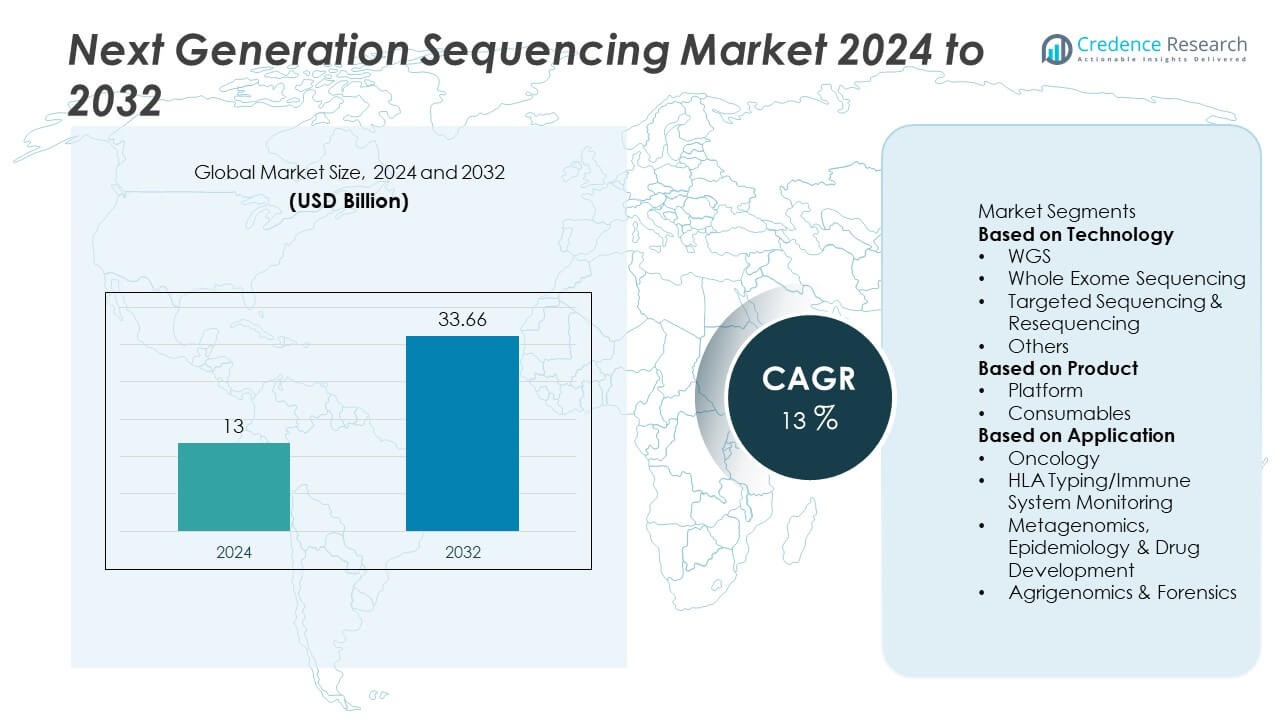
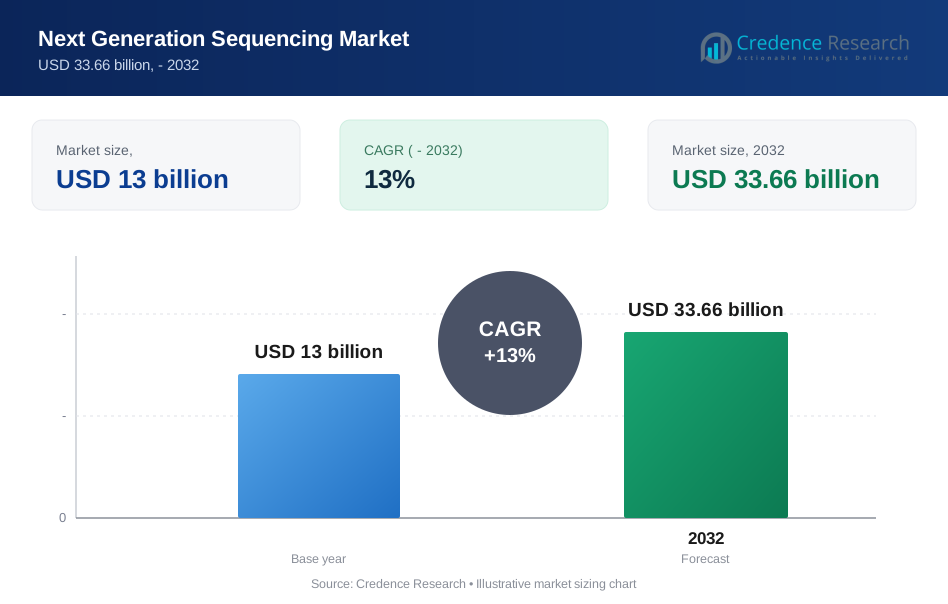
The Next Generation Sequencing market was valued at USD 13 billion in 2024 and is projected to reach USD 33.66 billion by 2032, growing at a compound annual growth rate (CAGR) of 13% during the forecast period.
| REPORT ATTRIBUTE | DETAILS |
|---|---|
| Historical Period | 2020-2023 |
| Base Year | 2024 |
| Forecast Period | 2025-2032 |
| Next Generation Sequencing Market Size 2024 | USD 13 Billion |
| Next Generation Sequencing Market, CAGR | 13% |
| Next Generation Sequencing Market Size 2032 | USD 33.66 Billion |
The Next Generation Sequencing (NGS) market is dominated by key players such as Illumina Inc., Thermo Fisher Scientific Inc., and F. Hoffmann-La Roche Ltd., which collectively drive the market with their broad product portfolios, global reach, and substantial investments in R&D. These companies, along with secondary competitors like QIAGEN N.V., Bio-Rad Laboratories, Inc., PacBio, and Oxford Nanopore Technologies, lead through innovation and strategic partnerships. In 2024, North America held the largest share at 44.7%, driven by strong research funding and widespread adoption of precision medicine. Europe and Asia Pacific follow, with significant growth observed in Asia due to rising healthcare investments and government genomics initiatives. North America's advanced infrastructure and research ecosystem continue to maintain its leadership, while Asia Pacific is expected to be the fastest-growing region, surpassing other markets in terms of growth trajectory.
Market Insights
- The global NGS market stood at USD 13 billion in 2024, and it is forecast to reach USD 33.66 billion by 2032, growing at a CAGR of 13%.
- Precision medicine and genomic diagnostics drive growth, especially in oncology where over 35% market share is observed.
- Key trends include expanding applications in agrigenomics, forensics, metagenomics and the integration of AI‑driven analytics and point‑of‑care sequencing systems.
- Restraints consist of the complexity of managing large sequencing data sets and regulatory and reimbursement delays across regions.
- Regionally, North America leads with 44.7% market share in 2024, while Asia Pacific is the fastest‑growing region; technology segments such as whole genome sequencing hold around 45% share and consumables over 60% in product category.
Market Segmentation Analysis:
By Technology
In the Next Generation Sequencing (NGS) market, Whole Genome Sequencing (WGS) is the dominant technology, holding the largest market share of approximately 45%. WGS is widely used for comprehensive genomic analysis and is pivotal in areas such as genetic disorder detection, personalized medicine, and cancer research. The increasing demand for accurate, high-throughput sequencing methods for a range of applications, including rare disease identification and genetic research, drives the adoption of WGS. Other technologies like Whole Exome Sequencing and Targeted Sequencing also contribute to the market, but WGS remains the leading segment due to its broad application and higher accuracy.
- For instance, Illumina's NovaSeq 6000 system, which supports WGS, has been used to sequence the genomes of more than 1 million individuals, helping advance cancer research and personalized treatments.
By Product
In the Next Generation Sequencing market, consumables hold the largest market share, accounting for over 60%. Consumables include reagents, kits, and other necessary components that facilitate the sequencing process. The growth of this segment is primarily driven by the increasing volume of sequencing studies in clinical diagnostics, research, and pharmaceutical applications. As the demand for NGS platforms grows, so does the need for consumables, ensuring their continued dominance. The platform segment, while significant, is smaller in comparison and focuses on providing the equipment and software needed for sequencing.
- For instance, QIAGEN's QIAseq technology is part of the growing market for consumables and its solutions are used by over 500,000 customers worldwide across various therapeutic areas, including infectious disease diagnostics and oncology.
By Application
Oncology is the leading application in the NGS market, capturing more than 35% of the market share. The rising prevalence of cancer and the need for targeted therapies that require detailed genomic data contribute to the segment's growth. NGS is extensively used for tumor profiling, identifying mutations, and assessing genetic predispositions in cancer patients. Additionally, applications in HLA typing and immune system monitoring, metagenomics, and agrigenomics are also significant, but oncology remains the dominant driver due to its high demand for precision medicine and targeted treatment strategies.
Key Growth
Rising Demand for Precision Medicine and Genomic Diagnostics
The growing demand for precision medicine is a key driver of the Next Generation Sequencing (NGS) market. Healthcare providers increasingly rely on genomic sequencing to detect genetic mutations, identify biomarkers, and personalize treatment plans. NGS allows for more accurate disease diagnosis and better-targeted therapies, especially in oncology, rare diseases, and genetic disorders. The ability to provide tailored treatments based on genetic profiles is a game-changer for improving patient outcomes. As precision medicine continues to gain traction, the need for robust sequencing technologies grows, making this a major growth driver. Additionally, the integration of NGS in clinical diagnostics is driving investments in healthcare infrastructure, contributing further to the market expansion.
- For instance, the Genomics England 100,000 Genomes Project used NGS to analyze the genomes of patients with rare diseases, enabling the identification of genetic variants, leading to a new diagnosis for 25% of participants with rare diseases.
Technological Advancements and Reduced Sequencing Costs
Technological advancements and the continuous reduction in sequencing costs are major factors propelling the Next Generation Sequencing market. The improvements in sequencing accuracy, throughput, and automation make NGS platforms more efficient and cost-effective. Over the past decade, the cost of sequencing has drastically decreased, making it accessible to a wider range of research and clinical applications. This cost reduction allows for broader adoption in clinical diagnostics, drug development, and population genomics. As sequencing costs continue to fall, the technology becomes more scalable and affordable for both large and small labs, driving increased demand across multiple industries, including healthcare, agriculture, and environmental science.
- For instance, PacBio’s Sequel II system improved sequencing accuracy and read length while also reducing costs, enabling large-scale genomic projects such as the Human Pangenome Project, which aims to map the diversity of human genomes across various populations.
Expanding Applications Across Multiple Industries
The expanding applications of Next Generation Sequencing across various industries is fueling its market growth. Beyond healthcare, NGS is increasingly used in fields like agrigenomics, forensic analysis, and metagenomics. In agriculture, it helps in crop improvement and livestock breeding through genomic analysis. In forensics, NGS is employed for DNA analysis, enabling faster and more accurate identification. The technology also plays a crucial role in epidemiology, drug development, and environmental studies. As the use cases for NGS continue to grow, demand increases in both research and practical applications, driving the market’s expansion across diverse sectors. The ability to integrate NGS into these fields is a significant growth factor.
Key Trend & Opportunity
AI-Driven Analytics and Predictive Genomics
One of the most significant trends in the Next Generation Sequencing market is the integration of Artificial Intelligence (AI) and machine learning with sequencing platforms. AI-driven analytics offer advanced capabilities, such as predictive genomics, which allow researchers and clinicians to forecast disease progression, identify potential genetic risk factors, and make more informed treatment decisions. By analyzing large datasets quickly and accurately, AI enhances the utility of NGS, improving diagnostic precision and therapeutic outcomes. This trend also enables the development of personalized medicine, where treatment plans are tailored to individual genetic profiles. As AI continues to advance, its integration with NGS technologies is expected to provide new insights and further drive adoption across the healthcare sector.
- For instance, IBM Watson for Genomics integrated AI with next-generation sequencing platforms to analyze large-scale genomic data. This system assisted in identifying potential biomarkers and providing treatment recommendations for cancer patients.
Point-of-Care and Portable Sequencing Systems
The development of portable and point-of-care sequencing platforms presents a significant opportunity for the Next Generation Sequencing market. These systems are designed to be more compact, cost-effective, and adaptable for use outside traditional laboratory settings, such as in hospitals, remote areas, and even fieldwork. Point-of-care sequencing allows for real-time results, enabling faster clinical decision-making, particularly in infectious disease monitoring and genetic diagnostics. As demand grows for decentralized healthcare solutions, portable NGS platforms offer a more accessible option for smaller clinics and healthcare providers. The convenience and flexibility of these systems are key drivers for their adoption in low-resource settings, offering a significant opportunity for market expansion.
- For instance, the Oxford Nanopore MinION, a portable sequencing device, has been used in over 50 countries for field-based research, including outbreak surveillance of Ebola and Zika viruses, due to its ability to perform rapid, real-time analysis of smaller genomes in a few hours outside a lab.
Key Challenge
Data Management and Analysis Complexity
A major challenge in the Next Generation Sequencing market is the complexity of managing and analyzing the vast amount of data generated. Sequencing technologies produce enormous volumes of genomic data, and effectively storing, processing, and interpreting this data is a significant hurdle. Researchers and clinicians need robust bioinformatics tools to analyze the data accurately, and the lack of skilled professionals in bioinformatics can limit the potential of NGS. Furthermore, issues with data integration, management, and scalability in healthcare environments can delay the adoption of NGS technologies. The ability to manage and derive meaningful insights from large genomic datasets remains a critical challenge.
Regulatory and Reimbursement Hurdles
Another challenge in the Next Generation Sequencing market is the regulatory uncertainty and slow reimbursement processes that hinder widespread adoption, particularly in clinical settings. Regulatory approval for NGS-based diagnostics varies by region and can be a lengthy and complex process, which delays market entry for new technologies. Additionally, many health insurance providers are slow to reimburse NGS-based tests, as they are still considered cutting-edge technology. These hurdles increase the cost and time required for clinical implementation, limiting the expansion of NGS solutions in some markets. Overcoming these regulatory and reimbursement challenges is essential for wider adoption of NGS technologies in healthcare.
Regional Analysis
North America
In 2024, North America held a dominant share of 44.7% in the next‑generation sequencing market. The region benefits from strong investment in genomic research, widespread use of precision medicine programs, and a large number of clinical laboratories offering sequencing services. Advanced healthcare infrastructure and significant funding from public and private sectors accelerate the adoption of NGS platforms. On‑going initiatives in cancer genomics and rare disease diagnostics further support regional growth. The established presence of major players and high utility in both research and clinical settings maintain North America’s lead position.
Europe
Europe accounted for a significant share of the next‑generation sequencing market in 2024, though exact percentage varies across sources. The region’s growth is supported by government programs for genomics, strong public‑private partnerships, and growing clinical adoption of NGS in oncology and infectious disease monitoring. Countries such as the UK, Germany and France are setting the pace with national genome projects and large‑scale research initiatives. The region’s regulatory frameworks, while complex, also bolster demand for high‑quality diagnostic sequencing. Europe’s mature research ecosystem and policy support ensure continued market expansion.
Asia‑Pacific
The Asia‑Pacific region stands out as the fastest‑growing market for next‑generation sequencing, with increasing enthusiasm from countries like China, India, Japan and Australia. Although precise market share figures vary, this region leverages rising healthcare expenditure, government initiatives in genomics, and growing awareness of precision medicine. Domestic biotech companies and collaborations drive adoption of sequencing platforms and services. Investments in infrastructure, expansion of clinical diagnostics and localization of technologies further accelerate growth. Asia‑Pacific’s growth trajectory is expected to outpace more mature regions as penetration deepens.
Latin America and Middle East & Africa
Together, Latin America and the Middle East & Africa regions represent a combined segment with emerging opportunity in the next‑generation sequencing market. These regions benefit from rising demand for modern healthcare infrastructure, increasing use of cloud‑based diagnostics and government‑backed genomics efforts. While current market share is smaller compared to North America or Europe, growth prospects are strong as sequencing technologies reach underserved areas. Focus on infectious disease monitoring, agrigenomics and regional research initiatives supports uptake. The evolving regulatory environment and improving access make these regions critical for vendors seeking new growth avenues.
Market Segmentations:
By Technology
- WGS
- Whole Exome Sequencing
- Targeted Sequencing & Resequencing
- Others
By Product
- Platform
- Consumables
By Application
- Oncology
- HLA Typing/Immune System Monitoring
- Metagenomics, Epidemiology & Drug Development
- Agrigenomics & Forensics
By Geography
- North America
- U.S.
- Canada
- Mexico
- Europe
- Germany
- France
- U.K.
- Italy
- Spain
- Rest of Europe
- Asia Pacific
- China
- Japan
- India
- South Korea
- South-east Asia
- Rest of Asia Pacific
- Latin America
- Brazil
- Argentina
- Rest of Latin America
- Middle East & Africa
- GCC Countries
- South Africa
- Rest of the Middle East and Africa
Competitive Landscape
The Competitive landscape analysis the global Next Generation Sequencing market features major players such as Illumina Inc., Thermo Fisher Scientific Inc., and F. Hoffmann‑La Roche Ltd., which lead through broad product portfolios, global reach and strong service capabilities. These companies invest heavily in R&D, strategic partnerships and geographic expansion to maintain leadership positions. Secondary competitors like QIAGEN N.V., Bio‑Rad Laboratories, Inc., PacBio (Bio Pacifica), Oxford Nanopore Technologies Plc., Revvity, Inc., Merck KGaA, and BGI Group focus on niche segments, innovative workflows and regional expansion. Firms differentiate through advanced analytics, lower‑cost workflows and automation, which raise competitive pressure on pricing and margins. Smaller entrants continue to challenge incumbents by offering specialised services and region‑specific offers, making product innovation and service excellence key success factors in the NGS market.
Key Player Analysis
- QIAGEN
- Hoffman-La Roche Ltd.
- Merck KGaA
- Thermo Fisher Scientific, Inc.
- Bio-Rad Laboratories, Inc.
- Illumina
- Oxford Nanopore Technologies
- BGI
- Revvity, Inc.
- PacBio
Recent Developments
- In July 2025, QIAGEN N.V. launched its “QIAseq xHYB Long Read Panels,” enabling long‑read enrichment workflows on platforms such as Pacific Biosciences (PacBio) for structural variant and HLA typing applications.
- In May 2025, Roche announced a strategic collaboration with Broad Clinical Labs to pilot applications using the SBX technology, targeting clinical genomics use‑cases in translational research.
- In February 2025, F. Hoffmann‑La Roche Ltd. unveiled its proprietary “Sequencing by Expansion (SBX)” technology, a new category of NGS combining novel chemistry and a CMOS sensor module for ultra‑rapid, scalable sequencing workflows.
Report Coverage
The research report offers an in-depth analysis based on Technology, Product, Application and Geography. It details leading market players, providing an overview of their business, product offerings, investments, revenue streams, and key applications. Additionally, the report includes insights into the competitive environment, SWOT analysis, current market trends, as well as the primary drivers and constraints. Furthermore, it discusses various factors that have driven market expansion in recent years. The report also explores market dynamics, regulatory scenarios, and technological advancements that are shaping the industry. It assesses the impact of external factors and global economic changes on market growth. Lastly, it provides strategic recommendations for new entrants and established companies to navigate the complexities of the market.
Future Outlook
- Market participants will further invest in AI‑augmented genomic analytics to improve disease prediction and treatment decisions.
- Portable and point‑of‑care sequencing systems will expand access in remote and low‑resource settings.
- Whole genome sequencing will gain share as its cost continues to fall and accuracy improves.
- Consumables (reagents, kits) will remain the largest product category as sequencing volume grows.
- Clinical adoption of sequencing for oncology, rare diseases, and infectious disease will accelerate globally.
- Bioinformatics and data management services will surge to handle increasing volumes of genomic data.
- Asia Pacific will register strong growth due to rising healthcare spend and national genomics initiatives.
- Regulatory harmonisation and reimbursement frameworks will improve, enabling broader clinical implementation.
- Sequencing technologies will extend into agriculture, forensics, and environmental genomics, opening new markets.
- Skilled workforce development and training in bioinformatics and genomics will become critical for market expansion.
Request a Free Sample
Fill in your details and we'll send you a free sample report.
- Sample data tables & charts
- Research methodology
Need a Custom Version of This Report?
Tailor the scope, geography, or segments to your exact requirements.
- Custom geography or segment scope
- Direct access to our analyst team
Frequently Asked Questions
What is the current market size for Next Generation Sequencing market, and what is its projected size in 2032?
At what Compound Annual Growth Rate is the Next Generation Sequencing market projected to grow between 2025 and 2032?
Which Next Generation Sequencing market segment held the largest share in 2024?
What are the primary factors fueling the growth of the Next Generation Sequencing market?
Who are the leading companies in the Next Generation Sequencing market?
Which region commanded the largest share of the Next Generation Sequencing market in 2024?
Table of Content
Chapter 1. Report Introduction
- 1.1 Report Description & Purpose
- 1.1.1 Report Title & Market Definition
- 1.1.2 Unique Selling Propositions (USP) & Key Differentiators
- 1.1.3 Value Proposition for Stakeholders
- 1.2 Research Objectives
- 1.2.1 Market Sizing Objectives (Volume & Revenue)
- 1.2.2 Segmentation Objectives
- 1.2.3 Competitive Intelligence Objectives
- 1.2.4 Forecast & Scenario Objectives
- 1.3 Report Scope
- 1.3.1 Next Generation Sequencing Scope – Types & Subtypes Covered
- 1.3.2 Geographic Scope – Regions & Countries Covered
- 1.3.3 Historical Period, Base Year & Forecast Period (the historical period; forecast to 2032)
- 1.3.4 Inclusions & Exclusions
- 1.4 HS Code & Classification Framework
- 1.5 Currency, Units & Pricing Basis
- 1.6 Target Stakeholders
- 1.7 Limitations & Assumptions
Chapter 2. Executive Summary
- 2.1 Global Next Generation Sequencing Market Snapshot
- 2.1.1 Market Size – Historical (the historical period) & Forecast (2032) (base year: USD 13 billion → 2032: USD 33.66 billion)
- 2.1.2 Volume & Revenue – Global Totals
- 2.1.3 Key Market Highlights – Top Five Facts
- 2.2 Next Generation Sequencing Market Segmentation Snapshot
- 2.2.1 Market Split by Region – vs. 2032
- 2.3 Competitive Snapshot
- 2.3.1 Top 10 Players by Revenue Share –
- 2.3.2 Top 10 Players by Volume Share –
- 2.3.3 Recent Strategic Developments (18-Month Summary)
- 2.4 Key Investment Highlights & Strategic Conclusions
Chapter 3. Next Generation Sequencing Market Dynamics & Industry Analysis
- 3.1 Market Overview & Context
- 3.1.1 Next Generation Sequencing Market Position in the Broader Automotive Value Chain
- 3.1.2 OEM vs. Replacement Market Dynamics
- 3.1.3 Market Maturity & Development Stage by Region
- 3.2 Next Generation Sequencing Market Drivers
- 3.3 Next Generation Sequencing Market Restraints & Challenges
- 3.4 Next Generation Sequencing Market Opportunities
- 3.5 Porter's Five Forces Analysis
- 3.5.1 Threat of New Entrants
- 3.5.2 Bargaining Power of Suppliers
- 3.5.3 Bargaining Power of Buyers
- 3.5.4 Threat of Substitutes
- 3.5.5 Competitive Rivalry – Intensity Assessment
- 3.6 Next Generation Sequencing Value Chain Analysis
- 3.6.1 Upstream – Raw Material/Input Suppliers
- 3.6.1.1 Raw Material/Input 1
- 3.6.1.2 Raw Material/Input 2
- 3.6.1.3 Raw Material/Input 3
- 3.6.2 Midstream – Production/Manufacturing/Service Delivery
- 3.6.2.1 Production/Process Overview
- 3.6.2.2 Key Facility Locations & Capacity by Manufacturer
- 3.6.3 Downstream – Distribution & End Consumer
- 3.6.3.1 Primary Channel – B2B/OEM
- 3.6.3.2 Secondary Channels – Dealer, Retail, Online, Direct
- 3.6.4 Value Chain Profitability Analysis
- 3.6.1 Upstream – Raw Material/Input Suppliers
- 3.7 PESTEL Analysis
- 3.7.1 Political Factors
- 3.7.2 Economic Factors
- 3.7.3 Social Factors
- 3.7.4 Technological Factors
- 3.7.5 Environmental Factors
- 3.7.6 Legal Factors
- 3.8 Next Generation Sequencing Supply Chain Analysis
- 3.8.1 Raw Material/Input Supply Risk Assessment
- 3.8.2 Manufacturing Concentration Risk (Geographic Exposure)
- 3.8.3 Trade Disruption Impact Analysis
- 3.9 Regulatory & Policy Landscape
Note: The regulatory and policy landscape section covers regulations based on their applicability to the market, Next Generation Sequencing category, geography, and scope of the study. Only regulatory frameworks with a material impact on operations, compliance, trade, sustainability, or market access are analyzed in detail.
Chapter 4. Key Investment Pockets & Opportunity Analysis
- 4.1 Next Generation Sequencing Market Attractiveness Analysis
- 4.1.1 By Region – Investment Attractiveness Matrix (Volume × CAGR)
- 4.2 Absolute Revenue Growth Opportunity
- 4.2.1 By Region – Absolute USD Growth Through 2032
- 4.3 Incremental Volume Opportunity
- 4.3.1 By Region – Incremental Volume Through 2032
- 4.3.2 Segment – Incremental Volume
- 4.4 Emerging Submarket Opportunity Deep Dive (Subject to Applicability)
- 4.5 Emerging Market Opportunity Scorecards
- 4.5.1 United States
- 4.5.2 Europe
- 4.5.3 Asia
- 4.5.4 Middle East & Africa
Note: Emerging Market Opportunity Scorecards will be included based on relevance and strategic importance. Regions listed are indicative and may vary depending on data availability and market dynamics.
Chapter 5. Next Generation Sequencing Import-Export Analysis & Trade Flows
- 5.1 Global Trade Overview
- 5.1.1 Global Export Value by Country (the historical period)
- 5.1.2 Global Export Volume by Country (the historical period)
- 5.1.3 Global Import Value by Country (the historical period)
- 5.1.4 Global Import Volume by Country (the historical period)
- 5.1.5 Net Trade Balance by Country (the historical period)
- 5.2 Export Analysis – Segment
- 5.2.1 Type 1 (HS Code)
- 5.2.2 Type 2 (HS Code)
- 5.2.3 Type 3 (HS Code)
- 5.2.4 Type 4 (HS Code)
- 5.2.5 Type 5 (HS Code)
- 5.3 Import Analysis – Segment
- 5.3.1 Type 1 (HS Code)
- 5.3.2 Type 2 (HS Code)
- 5.3.3 Type 3 (HS Code)
- 5.3.4 Type 4 (HS Code)
- 5.3.5 Type 5 (HS Code)
- 5.4 Average Unit Trade Prices
- 5.4.1 Average Export Price – Segment & Country
- 5.4.2 Average Import Price – Segment & Source Country
- 5.4.3 Price Trends (the historical period)
- 5.5 Key Trade Route Analysis
- 5.5.1 Trade Route 1
- 5.5.2 Trade Route 2
- 5.5.3 Trade Route 3
- 5.5.4 Trade Route 4
- 5.5.5 Trade Route 5
- 5.6 Trade Policy Impact Assessment
- 5.6.1 US Anti-Dumping & Section 301 Tariffs
- 5.6.2 EU Customs Union Impact
- 5.6.3 Major Free Trade Agreements
- 5.6.4 USMCA Rules of Origin
Note: Trade policy analysis will be included only where relevant to the Next Generation Sequencing market.
Chapter 6. Competitive Landscape & Company Benchmarking
- 6.1 Next Generation Sequencing Market Concentration & Structure
- 6.1.1 Herfindahl-Hirschman Index (HHI) – vs.
- 6.1.2 Tier 1, Tier 2 & Tier 3 Market Structure
- 6.1.3 Global, Regional & Local Player Dynamics
- 6.2 Next Generation Sequencing Market Share Analysis –
- 6.2.1 Global Revenue Share by Company
- 6.2.2 Global Volume Share by Company
- 6.2.3 Regional Revenue Share
- 6.2.4 Market Share Evolution ( vs. )
- 6.2.5 OEM Segment Share by Company
- 6.2.6 Replacement Segment Share by Company
- 6.3 Production/Delivery Capacity & Facility Analysis
- 6.3.1 Global Installed Capacity
- 6.3.2 Capacity Utilization Rates
- 6.3.3 Production/Output Volume
- 6.3.4 Facility Locations & Capacity Map
- 6.3.5 Planned Capacity Additions
- 6.4 Next Generation Sequencing Competitive Benchmarking Matrix
- 6.4.1 Revenue, Volume, CAGR & Profitability Comparison
- 6.4.2 Channel Revenue Mix
- 6.4.3 Geographic Revenue Exposure
- 6.4.4 R&D Intensity
- 6.4.5 Sustainability Maturity
- 6.5 Strategic Developments in Next Generation Sequencing (Last 24 Months)
- 6.5.1 Mergers, Acquisitions & Divestments
- 6.5.2 New Next Generation Sequencing Launches
- 6.5.3 Facility Expansions
- 6.5.4 Strategic Alliances, Joint Ventures & Partnerships
- 6.5.5 Distribution Expansion & Market Entry
- 6.5.6 Sustainability & ESG Initiatives
- 6.6 Competitive Strategy Mapping
- 6.6.1 Leader, Challenger, Follower & Niche Classification
- 6.6.2 Pricing Strategy Comparison
- 6.6.3 Channel Strategy Matrix
Note: Strategic developments are included based on their materiality and the availability of reliable information.
Chapter 7. Global Next Generation Sequencing Market – By Distribution Channel
- 7.1 Segment Overview
- 7.1.1 Volume & Revenue Split by Channel ( & 2032)
- 7.1.2 Channel Mix Evolution (2032)
Chapter 8. Regional Market Analysis – Global Overview
- 8.1 Global Regional Overview
- 8.1.1 Regional Volume Share
- 8.1.2 Regional Revenue Share
- 8.1.3 Regional Volume by Region
- 8.1.4 Regional Revenue by Region
- 8.1.5 Regional Forecast Through 2032
- 8.2 Cross-Regional Segment Analysis
- 8.2.1 By Distribution Channel
- 8.2.2 By Brand/Price Tier
Chapter 9. North America Next Generation Sequencing Market
- 9.1 United States
- 9.2 Canada
- 9.3 Mexico
Chapter 10. Europe Next Generation Sequencing Market
- 10.1 Germany
- 10.2 France
- 10.3 Italy
- 10.4 United Kingdom
- 10.5 Spain
- 10.6 Poland
- 10.7 Russia
- 10.8 Netherlands
- 10.9 Belgium
- 10.10 Sweden
- 10.11 Denmark
- 10.12 Norway
- 10.13 Rest of Europe
Chapter 11. Asia Pacific Next Generation Sequencing Market
- 11.1 China
- 11.2 India
- 11.3 Japan
- 11.4 South Korea
- 11.5 Thailand
- 11.6 Indonesia
- 11.7 Vietnam
- 11.8 Malaysia
- 11.9 Australia
- 11.10 Rest of Asia Pacific
Chapter 12. Latin America Next Generation Sequencing Market
- 12.1 Brazil
- 12.2 Argentina
- 12.3 Colombia
- 12.4 Chile
- 12.5 Rest of Latin America
Chapter 13. Middle East Next Generation Sequencing Market
- 13.1 Saudi Arabia
- 13.2 United Arab Emirates
- 13.3 Turkey
- 13.4 Israel
- 13.5 Iran
- 13.6 Rest of the Middle East
Chapter 14. Africa Next Generation Sequencing Market
- 14.1 South Africa
- 14.2 Egypt
- 14.3 Nigeria
- 14.4 Morocco
- 14.5 Rest of Africa
Chapter 15. Next Generation Sequencing Company Profiles
- 15.1 [Company 01]
- 15.1.1 Company Overview
- 15.1.2 Key Management Personnel
- 15.1.3 Products & Services Portfolio
- 15.1.4 Financial Performance
- 15.1.5 Key Market Focus & Geographic Presence
- 15.1.6 Recent Developments & Strategic Initiatives
Note: The company profile list is preliminary and may change based on research findings, market developments, data availability, and client requirements.
Chapter 16. Appendices
- Appendix A – List of Abbreviations & Acronyms
- Appendix B – Industry Classification Code Reference – Full Series
- Appendix C – Production & Capacity Data Tables
- Appendix D – End-Use & Demand Base Tables
- Appendix E – Consumption & Replacement Rate Assumptions
- Appendix F – ASP Reference Tables
- Appendix G – Manufacturing & Facility Database
- Appendix H – Import-Export Data Tables
- Appendix I – Regulatory Summary Tables
- Appendix J – Primary Research Participant List (Anonymized)
- Appendix K – Primary Research Questionnaire Framework
- Appendix L – Data Sources & Bibliography
- Appendix M – Market Size Divergence & Source Comparison
Chapter 17. Research Methodology
- 17.1 Research Framework & Philosophy
- 17.2 Secondary Research – Sources, Hierarchy & Data Extraction
- 17.3 Data Modeling – Bottom-Up & Top-Down Market Sizing
- 17.4 Primary Research – Stakeholder Framework, LOI & Sample Sizes
- 17.5 Forecast Methodology – Regression, Scenario & Sensitivity Analysis
- 17.6 Quality Control – Four-Layer Validation Framework
- 17.7 Limitations & Standard Assumptions
- 17.8 Disclaimer
