
Pharmaceutical Rapid Microbiology Testing Market Overview:
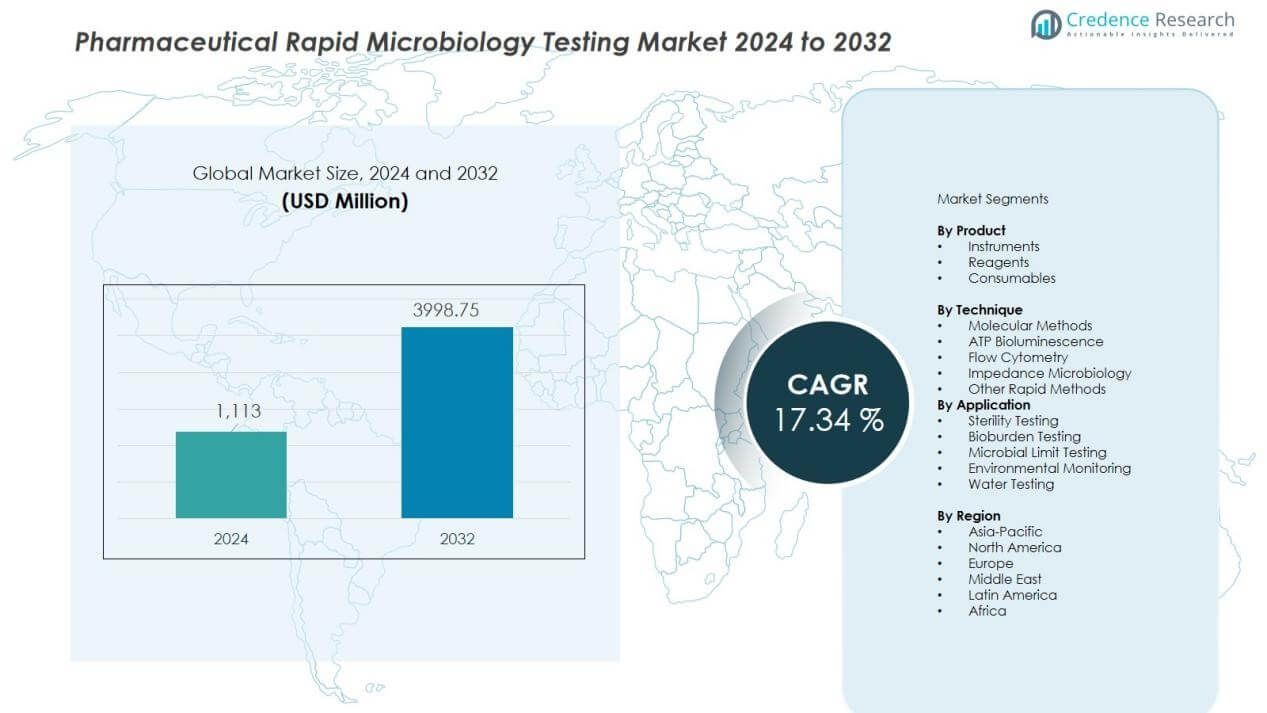
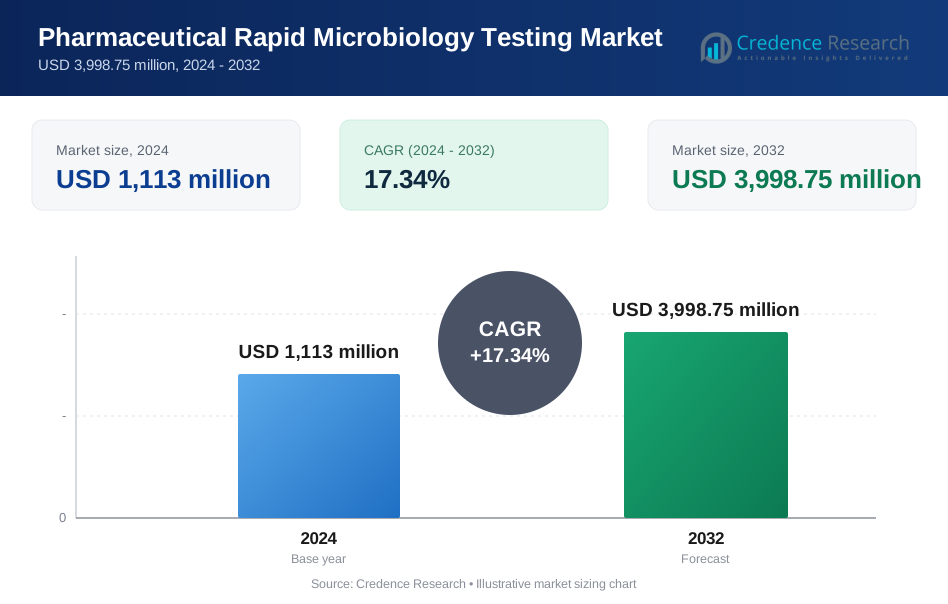
The Pharmaceutical Rapid Microbiology Testing Market size was valued at USD 1,113 million in 2024 and is anticipated to reach USD 3998.75 million by 2032, at a CAGR of 17.34% during the forecast period.
| REPORT ATTRIBUTE | DETAILS |
|---|---|
| Historical Period | 2020-2024 |
| Base Year | 2025 |
| Forecast Period | 2026-2032 |
| Pharmaceutical Rapid Microbiology Testing Market Size 2024 | USD 1,113 million |
| Pharmaceutical Rapid Microbiology Testing Market CAGR | 17.34% |
| Pharmaceutical Rapid Microbiology Testing Market Size 2032 | USD 3998.75 million |
Pharmaceutical Rapid Microbiology Testing Market Insights:
- Strict regulatory requirements for contamination control and product safety continue to push pharmaceutical manufacturers toward validated rapid microbiology testing solutions.
- Rising production of biologics, vaccines, and sterile injectables increases demand for sensitive, time-efficient microbial detection to reduce batch rejection risk.
- Adoption of rapid testing improves real-time decision-making, strengthens process control, and supports compliance with global regulatory standards.
- Technological advances in automation, molecular diagnostics, ATP bioluminescence, and flow cytometry enhance detection speed, accuracy, and reproducibility.
- High implementation costs, complex validation processes, and limited technical expertise remain key constraints, particularly for smaller manufacturers and emerging markets.
- North America leads with a 39% market share, followed by Europe at 29%, while Asia-Pacific at 24% represents the fastest-growing region due to expanding manufacturing capacity and regulatory alignment.
Pharmaceutical Rapid Microbiology Testing Market Drivers:
Stringent Regulatory Compliance and Quality Assurance Requirements
The Pharmaceutical Rapid Microbiology Testing Market benefits from strict global regulations that mandate faster and more reliable microbial detection. Regulatory authorities require robust contamination control to protect patient safety and product integrity. Rapid methods support earlier detection and corrective actions within validated manufacturing processes. It helps manufacturers meet audit expectations and maintain consistent compliance across sterile and non-sterile operations.
- For instance, Sartorius' Microsart qPCR kits detect mycoplasma, bacteria, and fungi in just 3 hours, complying with USP <71> and EP 2.6.1 standards for sterility testing.
Expansion of Biologics, Vaccines, and Sterile Drug Manufacturing
The Pharmaceutical Rapid Microbiology Testing Market gains momentum from rising production of biologics, cell therapies, vaccines, and sterile injectables. These products require sensitive and time-critical microbial monitoring to prevent batch loss. Rapid systems shorten release cycles while supporting high-value drug manufacturing. It enables manufacturers to manage complex formulations with greater process confidence.
- For instance, in March 2025, Nelson Labs expanded its rapid microbiological methods for sterility testing across U.S. and European labs, delivering results in 6 days versus 14 days for traditional incubation while complying with USP <71> and <1223>.
Operational Efficiency and Faster Product Release Timelines
The Pharmaceutical Rapid Microbiology Testing Market grows due to demand for reduced testing timelines and improved manufacturing efficiency. Conventional methods delay batch release and increase inventory costs. Rapid testing delivers earlier results that support quicker decision-making. It allows manufacturers to optimize workflows and improve facility throughput without compromising quality standards.
Technological Advancements and Automation in Microbial Detection
The Pharmaceutical Rapid Microbiology Testing Market advances through innovation in automation, molecular diagnostics, and digital data integration. Modern platforms offer higher sensitivity, standardized workflows, and improved reproducibility. Automation reduces manual intervention and minimizes human error. It strengthens data integrity and supports scalable quality control strategies across global production networks.
Pharmaceutical Rapid Microbiology Testing Market Trends:
Growing Integration of Rapid Methods within Quality Control and Release Testing Workflows
The Pharmaceutical Rapid Microbiology Testing Market shows a clear trend toward broader integration of rapid methods across quality control, environmental monitoring, and product release testing. Manufacturers replace traditional culture-based assays with rapid systems to shorten test cycles and support real-time manufacturing decisions. These methods align with quality by design principles and risk-based manufacturing strategies. Regulatory bodies recognize validated rapid technologies, which strengthens confidence in their routine use. It supports faster deviation management and improves contamination response timelines. Pharmaceutical companies also standardize rapid platforms across multiple sites to ensure consistent data quality. This trend reinforces the role of rapid microbiology as a core component of modern pharmaceutical quality systems.
- For instance, Rapid Infection Diagnostics Inc. launched the BSIDx system on January 16, 2025, providing pathogen identification and antibiotic sensitivity in under 5 hours—30 hours faster than traditional culture methods.
Rising Adoption of Automation, Digitalization, and Data Integrity Solutions
The Pharmaceutical Rapid Microbiology Testing Market continues to evolve through increased adoption of automated and digitally connected testing platforms. Automated systems reduce manual handling and support standardized workflows across high-throughput environments. Digital integration enables real-time data capture, audit trails, and compliance with data integrity requirements. It improves traceability and supports centralized quality oversight. Manufacturers also deploy analytics-enabled platforms to identify contamination patterns and process deviations early. Growing alignment with smart manufacturing initiatives strengthens the value of connected microbiology solutions. This trend supports scalable quality control models across global pharmaceutical production networks.
- For instance, bioMérieux's BACT/ALERT 3D automated platform provides early detection of many common microorganisms in mere hours (typically 11–24 hours), potentially cutting the traditional 14-day manual sterility testing cycle down to 7 days or less for a final validated result.
Pharmaceutical Rapid Microbiology Testing Market Challenges Analysis:
High Implementation Costs and Validation Complexity
The Pharmaceutical Rapid Microbiology Testing Market faces challenges related to high upfront investment and complex validation requirements. Advanced instruments, proprietary consumables, and software platforms increase capital expenditure. Regulatory validation demands extensive method equivalency studies and detailed documentation. It places pressure on smaller manufacturers with limited quality budgets. Integration with existing laboratory infrastructure also requires careful planning. Skilled personnel must manage system qualification and routine operation. These factors slow adoption despite clear performance advantages.
Regulatory Acceptance Gaps and Limited Technical Expertise
The Pharmaceutical Rapid Microbiology Testing Market encounters obstacles from uneven regulatory acceptance across regions. Some authorities require conservative testing approaches, which delays full replacement of traditional methods. It creates uncertainty during global product registration and multi-site manufacturing. Limited availability of trained microbiologists restricts effective system use. Knowledge gaps affect data interpretation and troubleshooting. Dependence on specialized vendors for support raises operational risk. These issues constrain wider deployment in emerging pharmaceutical markets.
Pharmaceutical Rapid Microbiology Testing Market Opportunities:
Expansion of Biopharmaceutical Manufacturing and Advanced Therapies
The Pharmaceutical Rapid Microbiology Testing Market presents strong opportunities through rapid growth in biologics, cell therapies, and gene-based medicines. These products require faster and more sensitive microbial control throughout development and commercial production. Manufacturers seek testing solutions that support shorter release cycles and higher batch value protection. It enables earlier contamination detection and reduces product loss risk. Contract development and manufacturing organizations also adopt rapid methods to strengthen service differentiation. Rising investment in vaccine production supports wider technology deployment. These factors create sustained demand across advanced therapy manufacturing ecosystems.
Digital Quality Systems and Emerging Market Adoption
The Pharmaceutical Rapid Microbiology Testing Market benefits from rising adoption of digital quality systems and smart manufacturing strategies. Integration with laboratory information systems improves data integrity and centralized oversight. It supports predictive quality management and trend analysis across multiple facilities. Emerging pharmaceutical hubs invest in modern quality infrastructure to meet export requirements. Technology providers gain opportunities through localized manufacturing expansion. Training programs and simplified platforms lower adoption barriers. This environment supports long-term market expansion across developing regions.
Pharmaceutical Rapid Microbiology Testing Market Segmentation Analysis:
By Product
The Pharmaceutical Rapid Microbiology Testing Market shows strong segmentation by product, including instruments, reagents, and consumables. Instruments account for a significant share due to rising adoption of automated testing platforms within quality control laboratories. Reagents and consumables maintain consistent demand due to routine testing frequency and recurring usage cycles. It supports stable revenue streams for suppliers through long-term consumable requirements. Manufacturers focus on improving system reliability and ease of integration with existing laboratory infrastructure.
- For Instance, Neogen Corporation’s Soleris Next Generation (NG) system utilizes optical technology and metabolic monitoring to deliver rapid microbial results, with many assays—such as Enterobacteriaceae and Coliforms—providing detection in as little as 14 to 18 hours.
By Technique
The Pharmaceutical Rapid Microbiology Testing Market segments by technique into molecular methods, ATP bioluminescence, flow cytometry, and other rapid detection approaches. Molecular methods gain traction due to high sensitivity and rapid pathogen identification. ATP bioluminescence supports fast contamination screening and environmental monitoring. Flow cytometry enables rapid enumeration and viability assessment of microorganisms. It allows manufacturers to select techniques aligned with product type and regulatory requirements.
- For instance, Roche Diagnostics' cobas® Liat System identifies pathogens like influenza in respiratory samples with 97% sensitivity within 20 minutes.
By Application
The Pharmaceutical Rapid Microbiology Testing Market segments by application across sterility testing, bioburden testing, microbial limit testing, and environmental monitoring. Sterility testing holds a dominant position due to stringent requirements for injectable and biologic products. Bioburden and microbial limit testing support in-process quality control. Environmental monitoring ensures controlled manufacturing conditions. It strengthens overall contamination control strategies across pharmaceutical production facilities.
Segmentations:
By Product
- Instruments
- Reagents
- Consumables
By Technique
- Molecular Methods
- ATP Bioluminescence
- Flow Cytometry
- Impedance Microbiology
- Other Rapid Methods
By Application
- Sterility Testing
- Bioburden Testing
- Microbial Limit Testing
- Environmental Monitoring
- Water Testing
By Region
- North America
- U.S.
- Canada
- Mexico
- Europe
- Germany
- France
- U.K.
- Italy
- Spain
- Rest of Europe
- Asia Pacific
- China
- Japan
- India
- South Korea
- South-east Asia
- Rest of Asia Pacific
- Latin America
- Brazil
- Argentina
- Rest of Latin America
- Middle East & Africa
- GCC Countries
- South Africa
- Rest of the Middle East and Africa
Regional Analysis:
North America Driven by Strong Regulatory Oversight and Technology Leadership
North America accounted for 39% of the global revenue share in 2024. The Pharmaceutical Rapid Microbiology Testing Market maintains leadership in this region due to strict regulatory oversight and advanced pharmaceutical manufacturing capabilities. Regulatory agencies enforce rigorous microbiological quality standards across sterile and non-sterile products. Pharmaceutical companies invest heavily in rapid testing platforms to support faster batch release and compliance assurance. It benefits from early adoption of automation and molecular diagnostic technologies. Strong presence of global pharmaceutical firms and biologics manufacturers supports sustained demand. Mature quality systems enable efficient integration of rapid methods.
Europe Supported by Harmonized Regulations and Biologics Production
Europe represented an exact market share of 29% in 2024. The Pharmaceutical Rapid Microbiology Testing Market demonstrates stable growth in this region supported by harmonized regulatory frameworks and strong pharmacopoeial compliance. European manufacturers emphasize contamination control and risk-based quality management. Rapid testing methods align well with stringent validation and documentation requirements. It supports efficiency improvements in vaccine, biosimilar, and sterile injectable production. Expansion of contract manufacturing strengthens regional adoption. Focus on data integrity and standardized quality systems sustains long-term demand.
Asia-Pacific Emerging Through Manufacturing Expansion and Regulatory Alignment
Asia-Pacific captured 24% of the global market share in 2024. The Pharmaceutical Rapid Microbiology Testing Market expands rapidly in this region due to rising pharmaceutical manufacturing capacity and export-driven production. Countries invest in modern quality control infrastructure to meet international regulatory expectations. Rapid microbiology supports competitive product release timelines across global supply chains. It benefits from strong growth in contract development and manufacturing organizations. Government initiatives encourage pharmaceutical innovation and biologics expansion. This region delivers the fastest growth trajectory worldwide.
Key Player Analysis:
- Thermo Fisher Scientific Inc.
- Merck KGaA
- BD
- bioMérieux
- Danaher
- Sartorius AG
- Abbott
- QuidelOrtho Corporation
- Charles River Laboratories
- Rapid Micro Biosystems, Inc.
Competitive Analysis:
The Pharmaceutical Rapid Microbiology Testing Market features a competitive landscape defined by strong technological capability, regulatory expertise, and global service reach. Leading companies focus on automated platforms, rapid detection accuracy, and validated compliance solutions to strengthen their market position. It rewards suppliers that offer integrated systems compatible with existing quality control workflows. Major players invest in research to enhance sensitivity, reduce time to result, and support diverse pharmaceutical applications. Strategic partnerships with drug manufacturers and contract development organizations expand customer access and long-term contracts. Companies also prioritize regulatory support services to simplify method validation and adoption. Product differentiation centers on digital integration, data integrity, and scalable platform design. Regional expansion strategies target high-growth pharmaceutical hubs with localized support infrastructure. Competitive intensity remains high due to continuous innovation cycles and strict performance expectations across global pharmaceutical manufacturing networks.
Recent Developments:
- In July 2025, Thermo Fisher Scientific expanded its strategic partnership with Sanofi by acquiring the Ridgefield, New Jersey steriles manufacturing site to boost U.S. drug production capacity.
- In September 2025, Thermo Fisher Scientific completed the acquisition of Solventum’s Purification and Filtration business, integrating it into the Life Sciences Solutions segment
Report Coverage:
The research report offers an in-depth analysis based on Product, Technique, Application and Region. It details leading Market players, providing an overview of their business, product offerings, investments, revenue streams, and key applications. Additionally, the report includes insights into the competitive environment, SWOT analysis, current Market trends, as well as the primary drivers and constraints. Furthermore, it discusses various factors that have driven Market expansion in recent years. The report also explores Market dynamics, regulatory scenarios, and technological advancements that are shaping the industry. It assesses the impact of external factors and global economic changes on Market growth. Lastly, it provides strategic recommendations for new entrants and established companies to navigate the complexities of the Market.
Future Outlook:
- The Pharmaceutical Rapid Microbiology Testing Market will continue to gain strategic importance as manufacturers prioritize faster quality release and stronger contamination control.
- Pharmaceutical companies will expand adoption of rapid testing methods across sterility, bioburden, and environmental monitoring workflows.
- Automation will play a central role in standardizing microbiological testing and reducing manual laboratory dependency.
- Integration with digital quality systems will support real-time data access, audit readiness, and improved traceability.
- Technology providers will focus on platforms that support multiple testing techniques within a single system architecture.
- Regulatory authorities will show broader acceptance of validated rapid methods within routine quality control frameworks.
- Contract development and manufacturing organizations will drive demand through service differentiation and efficiency targets.
- Emerging pharmaceutical markets will invest in modern microbiology infrastructure to support export-oriented production.
- Training programs and simplified platforms will address skill gaps and improve operational reliability.
- Continuous innovation will strengthen sensitivity, reproducibility, and system scalability across global pharmaceutical manufacturing networks
Request a Free Sample
Fill in your details and we'll send you a free sample report.
- Sample data tables & charts
- Research methodology
Need a Custom Version of This Report?
Tailor the scope, geography, or segments to your exact requirements.
- Custom geography or segment scope
- Direct access to our analyst team
Frequently Asked Questions
What is the current market size for the Pharmaceutical Rapid Microbiology Testing Market, and what is its projected size in 2032?
At what Compound Annual Growth Rate is the Pharmaceutical Rapid Microbiology Testing Market projected to grow between 2024 and 2032?
Which segment held the largest share in the Pharmaceutical Rapid Microbiology Testing Market in 2024?
What are the primary factors fueling growth in the Pharmaceutical Rapid Microbiology Testing Market?
Who are the leading companies operating in the Pharmaceutical Rapid Microbiology Testing Market?
Which region dominated the Pharmaceutical Rapid Microbiology Testing Market in 2024?
Table of Content
Chapter 1. Report Introduction
- 1.1 Report Description & Purpose
- 1.1.1 Report Title & Market Definition
- 1.1.2 Unique Selling Propositions (USP) & Key Differentiators
- 1.1.3 Value Proposition for Stakeholders
- 1.2 Research Objectives
- 1.2.1 Market Sizing Objectives (Volume & Revenue)
- 1.2.2 Segmentation Objectives
- 1.2.3 Competitive Intelligence Objectives
- 1.2.4 Forecast & Scenario Objectives
- 1.3 Report Scope
- 1.3.1 Pharmaceutical Rapid Microbiology Testing Scope – Types & Subtypes Covered
- 1.3.2 Geographic Scope – Regions & Countries Covered
- 1.3.3 Historical Period, Base Year & Forecast Period (2024; forecast to 2032)
- 1.3.4 Inclusions & Exclusions
- 1.4 HS Code & Classification Framework
- 1.5 Currency, Units & Pricing Basis
- 1.6 Target Stakeholders
- 1.7 Limitations & Assumptions
Chapter 2. Executive Summary
- 2.1 Global Pharmaceutical Rapid Microbiology Testing Market Snapshot
- 2.1.1 Market Size – Historical (2024) & Forecast (2024-2032) (2024: USD 1,113 million → 2032: USD 3,998.75 million)
- 2.1.2 Volume & Revenue – Global Totals
- 2.1.3 Key Market Highlights – Top Five Facts
- 2.2 Pharmaceutical Rapid Microbiology Testing Market Segmentation Snapshot
- 2.2.1 Market Split by Region – 2024 vs. 2032
- 2.3 Competitive Snapshot
- 2.3.1 Top 10 Players by Revenue Share – 2024
- 2.3.2 Top 10 Players by Volume Share – 2024
- 2.3.3 Recent Strategic Developments (18-Month Summary)
- 2.4 Key Investment Highlights & Strategic Conclusions
Chapter 3. Pharmaceutical Rapid Microbiology Testing Market Dynamics & Industry Analysis
- 3.1 Market Overview & Context
- 3.1.1 Pharmaceutical Rapid Microbiology Testing Market Position in the Broader Automotive Value Chain
- 3.1.2 OEM vs. Replacement Market Dynamics
- 3.1.3 Market Maturity & Development Stage by Region
- 3.2 Pharmaceutical Rapid Microbiology Testing Market Drivers
- 3.3 Pharmaceutical Rapid Microbiology Testing Market Restraints & Challenges
- 3.4 Pharmaceutical Rapid Microbiology Testing Market Opportunities
- 3.5 Porter's Five Forces Analysis
- 3.5.1 Threat of New Entrants
- 3.5.2 Bargaining Power of Suppliers
- 3.5.3 Bargaining Power of Buyers
- 3.5.4 Threat of Substitutes
- 3.5.5 Competitive Rivalry – Intensity Assessment
- 3.6 Pharmaceutical Rapid Microbiology Testing Value Chain Analysis
- 3.6.1 Upstream – Raw Material/Input Suppliers
- 3.6.1.1 Raw Material/Input 1
- 3.6.1.2 Raw Material/Input 2
- 3.6.1.3 Raw Material/Input 3
- 3.6.2 Midstream – Production/Manufacturing/Service Delivery
- 3.6.2.1 Production/Process Overview
- 3.6.2.2 Key Facility Locations & Capacity by Manufacturer
- 3.6.3 Downstream – Distribution & End Consumer
- 3.6.3.1 Primary Channel – B2B/OEM
- 3.6.3.2 Secondary Channels – Dealer, Retail, Online, Direct
- 3.6.4 Value Chain Profitability Analysis
- 3.6.1 Upstream – Raw Material/Input Suppliers
- 3.7 PESTEL Analysis
- 3.7.1 Political Factors
- 3.7.2 Economic Factors
- 3.7.3 Social Factors
- 3.7.4 Technological Factors
- 3.7.5 Environmental Factors
- 3.7.6 Legal Factors
- 3.8 Pharmaceutical Rapid Microbiology Testing Supply Chain Analysis
- 3.8.1 Raw Material/Input Supply Risk Assessment
- 3.8.2 Manufacturing Concentration Risk (Geographic Exposure)
- 3.8.3 Trade Disruption Impact Analysis
- 3.9 Regulatory & Policy Landscape
Note: The regulatory and policy landscape section covers regulations based on their applicability to the market, Pharmaceutical Rapid Microbiology Testing category, geography, and scope of the study. Only regulatory frameworks with a material impact on operations, compliance, trade, sustainability, or market access are analyzed in detail.
Chapter 4. Key Investment Pockets & Opportunity Analysis
- 4.1 Pharmaceutical Rapid Microbiology Testing Market Attractiveness Analysis
- 4.1.1 By Region – Investment Attractiveness Matrix (Volume × CAGR)
- 4.2 Absolute Revenue Growth Opportunity
- 4.2.1 By Region – Absolute USD Growth Through 2032
- 4.3 Incremental Volume Opportunity
- 4.3.1 By Region – Incremental Volume Through 2032
- 4.3.2 Segment – Incremental Volume
- 4.4 Emerging Submarket Opportunity Deep Dive (Subject to Applicability)
- 4.5 Emerging Market Opportunity Scorecards
- 4.5.1 United States
- 4.5.2 Europe
- 4.5.3 Asia
- 4.5.4 Middle East & Africa
Note: Emerging Market Opportunity Scorecards will be included based on relevance and strategic importance. Regions listed are indicative and may vary depending on data availability and market dynamics.
Chapter 5. Pharmaceutical Rapid Microbiology Testing Import-Export Analysis & Trade Flows
- 5.1 Global Trade Overview
- 5.1.1 Global Export Value by Country (2024)
- 5.1.2 Global Export Volume by Country (2024)
- 5.1.3 Global Import Value by Country (2024)
- 5.1.4 Global Import Volume by Country (2024)
- 5.1.5 Net Trade Balance by Country (2024)
- 5.2 Export Analysis – Segment
- 5.2.1 Type 1 (HS Code)
- 5.2.2 Type 2 (HS Code)
- 5.2.3 Type 3 (HS Code)
- 5.2.4 Type 4 (HS Code)
- 5.2.5 Type 5 (HS Code)
- 5.3 Import Analysis – Segment
- 5.3.1 Type 1 (HS Code)
- 5.3.2 Type 2 (HS Code)
- 5.3.3 Type 3 (HS Code)
- 5.3.4 Type 4 (HS Code)
- 5.3.5 Type 5 (HS Code)
- 5.4 Average Unit Trade Prices
- 5.4.1 Average Export Price – Segment & Country
- 5.4.2 Average Import Price – Segment & Source Country
- 5.4.3 Price Trends (2024)
- 5.5 Key Trade Route Analysis
- 5.5.1 Trade Route 1
- 5.5.2 Trade Route 2
- 5.5.3 Trade Route 3
- 5.5.4 Trade Route 4
- 5.5.5 Trade Route 5
- 5.6 Trade Policy Impact Assessment
- 5.6.1 US Anti-Dumping & Section 301 Tariffs
- 5.6.2 EU Customs Union Impact
- 5.6.3 Major Free Trade Agreements
- 5.6.4 USMCA Rules of Origin
Note: Trade policy analysis will be included only where relevant to the Pharmaceutical Rapid Microbiology Testing market.
Chapter 6. Competitive Landscape & Company Benchmarking
- 6.1 Pharmaceutical Rapid Microbiology Testing Market Concentration & Structure
- 6.1.1 Herfindahl-Hirschman Index (HHI) – vs. 2024
- 6.1.2 Tier 1, Tier 2 & Tier 3 Market Structure
- 6.1.3 Global, Regional & Local Player Dynamics
- 6.2 Pharmaceutical Rapid Microbiology Testing Market Share Analysis – 2024
- 6.2.1 Global Revenue Share by Company
- 6.2.2 Global Volume Share by Company
- 6.2.3 Regional Revenue Share
- 6.2.4 Market Share Evolution ( vs. 2024)
- 6.2.5 OEM Segment Share by Company
- 6.2.6 Replacement Segment Share by Company
- 6.3 Production/Delivery Capacity & Facility Analysis
- 6.3.1 Global Installed Capacity
- 6.3.2 Capacity Utilization Rates
- 6.3.3 Production/Output Volume
- 6.3.4 Facility Locations & Capacity Map
- 6.3.5 Planned Capacity Additions
- 6.4 Pharmaceutical Rapid Microbiology Testing Competitive Benchmarking Matrix
- 6.4.1 Revenue, Volume, CAGR & Profitability Comparison
- 6.4.2 Channel Revenue Mix
- 6.4.3 Geographic Revenue Exposure
- 6.4.4 R&D Intensity
- 6.4.5 Sustainability Maturity
- 6.5 Strategic Developments in Pharmaceutical Rapid Microbiology Testing (Last 24 Months)
- 6.5.1 Mergers, Acquisitions & Divestments
- 6.5.2 New Pharmaceutical Rapid Microbiology Testing Launches
- 6.5.3 Facility Expansions
- 6.5.4 Strategic Alliances, Joint Ventures & Partnerships
- 6.5.5 Distribution Expansion & Market Entry
- 6.5.6 Sustainability & ESG Initiatives
- 6.6 Competitive Strategy Mapping
- 6.6.1 Leader, Challenger, Follower & Niche Classification
- 6.6.2 Pricing Strategy Comparison
- 6.6.3 Channel Strategy Matrix
Note: Strategic developments are included based on their materiality and the availability of reliable information.
Chapter 7. Global Pharmaceutical Rapid Microbiology Testing Market – By Distribution Channel
- 7.1 Segment Overview
- 7.1.1 Volume & Revenue Split by Channel (2024 & 2032)
- 7.1.2 Channel Mix Evolution (2024-2032)
Chapter 8. Regional Market Analysis – Global Overview
- 8.1 Global Regional Overview
- 8.1.1 Regional Volume Share
- 8.1.2 Regional Revenue Share
- 8.1.3 Regional Volume by Region
- 8.1.4 Regional Revenue by Region
- 8.1.5 Regional Forecast Through 2032
- 8.2 Cross-Regional Segment Analysis
- 8.2.1 By Distribution Channel
- 8.2.2 By Brand/Price Tier
Chapter 9. North America Pharmaceutical Rapid Microbiology Testing Market
- 9.1 United States
- 9.2 Canada
- 9.3 Mexico
Chapter 10. Europe Pharmaceutical Rapid Microbiology Testing Market
- 10.1 Germany
- 10.2 France
- 10.3 Italy
- 10.4 United Kingdom
- 10.5 Spain
- 10.6 Poland
- 10.7 Russia
- 10.8 Netherlands
- 10.9 Belgium
- 10.10 Sweden
- 10.11 Denmark
- 10.12 Norway
- 10.13 Rest of Europe
Chapter 11. Asia Pacific Pharmaceutical Rapid Microbiology Testing Market
- 11.1 China
- 11.2 India
- 11.3 Japan
- 11.4 South Korea
- 11.5 Thailand
- 11.6 Indonesia
- 11.7 Vietnam
- 11.8 Malaysia
- 11.9 Australia
- 11.10 Rest of Asia Pacific
Chapter 12. Latin America Pharmaceutical Rapid Microbiology Testing Market
- 12.1 Brazil
- 12.2 Argentina
- 12.3 Colombia
- 12.4 Chile
- 12.5 Rest of Latin America
Chapter 13. Middle East Pharmaceutical Rapid Microbiology Testing Market
- 13.1 Saudi Arabia
- 13.2 United Arab Emirates
- 13.3 Turkey
- 13.4 Israel
- 13.5 Iran
- 13.6 Rest of the Middle East
Chapter 14. Africa Pharmaceutical Rapid Microbiology Testing Market
- 14.1 South Africa
- 14.2 Egypt
- 14.3 Nigeria
- 14.4 Morocco
- 14.5 Rest of Africa
Chapter 15. Pharmaceutical Rapid Microbiology Testing Company Profiles
- 15.1 [Company 01]
- 15.1.1 Company Overview
- 15.1.2 Key Management Personnel
- 15.1.3 Products & Services Portfolio
- 15.1.4 Financial Performance
- 15.1.5 Key Market Focus & Geographic Presence
- 15.1.6 Recent Developments & Strategic Initiatives
Note: The company profile list is preliminary and may change based on research findings, market developments, data availability, and client requirements.
Chapter 16. Appendices
- Appendix A – List of Abbreviations & Acronyms
- Appendix B – Industry Classification Code Reference – Full Series
- Appendix C – Production & Capacity Data Tables
- Appendix D – End-Use & Demand Base Tables
- Appendix E – Consumption & Replacement Rate Assumptions
- Appendix F – ASP Reference Tables
- Appendix G – Manufacturing & Facility Database
- Appendix H – Import-Export Data Tables
- Appendix I – Regulatory Summary Tables
- Appendix J – Primary Research Participant List (Anonymized)
- Appendix K – Primary Research Questionnaire Framework
- Appendix L – Data Sources & Bibliography
- Appendix M – Market Size Divergence & Source Comparison
Chapter 17. Research Methodology
- 17.1 Research Framework & Philosophy
- 17.2 Secondary Research – Sources, Hierarchy & Data Extraction
- 17.3 Data Modeling – Bottom-Up & Top-Down Market Sizing
- 17.4 Primary Research – Stakeholder Framework, LOI & Sample Sizes
- 17.5 Forecast Methodology – Regression, Scenario & Sensitivity Analysis
- 17.6 Quality Control – Four-Layer Validation Framework
- 17.7 Limitations & Standard Assumptions
- 17.8 Disclaimer
