Custom Antibody Market Overview:
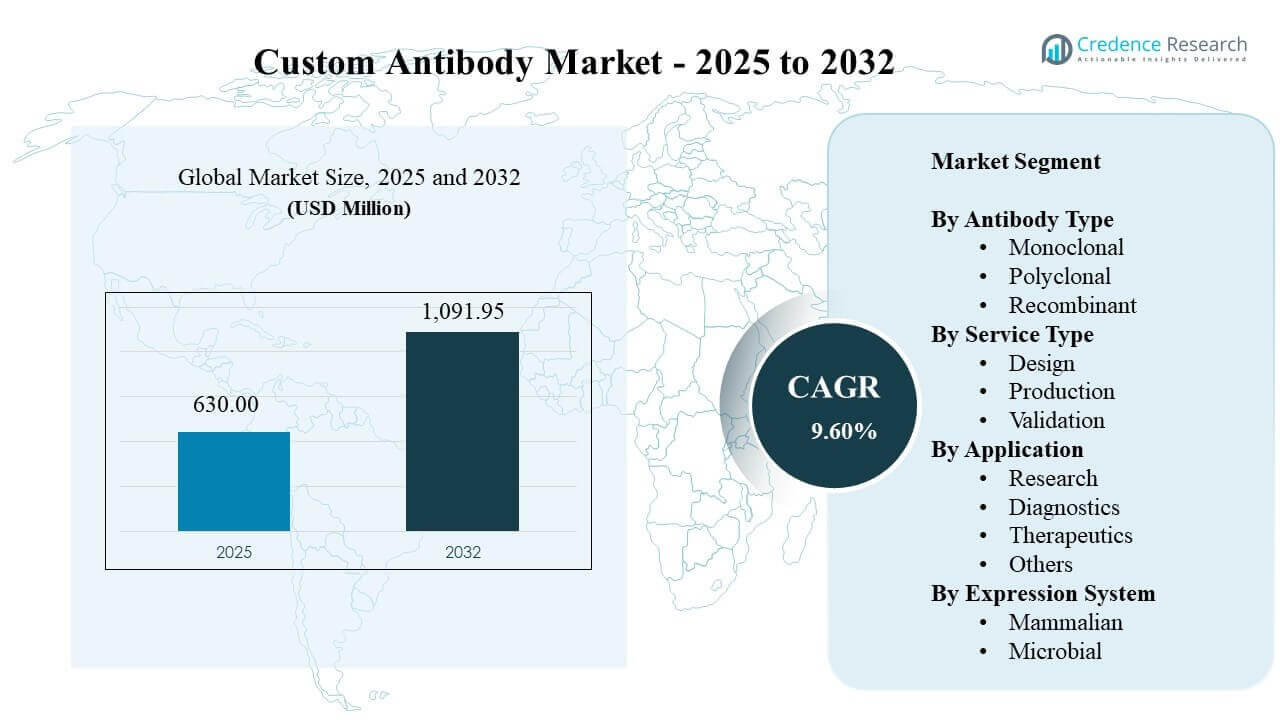
The global Custom Antibody Market size was estimated at USD 630.00 million in 2025 and is expected to reach USD 1,091.95 million by 2032, growing at a CAGR of 9.60% from 2025 to 2032. Demand is being propelled by faster target discovery cycles and larger biomarker programs across biopharma and academic research, which increases outsourcing for antibody generation, screening, and characterization. The Custom Antibody Market is also supported by broader adoption of engineered formats and higher reproducibility expectations for assay-grade reagents across research and diagnostics.
| REPORT ATTRIBUTE | DETAILS |
|---|---|
| Historical Period | 2020-2024 |
| Base Year | 2025 |
| Forecast Period | 2026-2032 |
| Custom Antibody Market Size 2025 | USD 630.00 million |
| Custom Antibody Market, CAGR | 9.60% |
| Custom Antibody Market Size 2032 | USD 1,091.95 million |
Key Market Trends & Insights
- The Custom Antibody Market is projected to expand at a 9.60% CAGR from 2025 to 2032, moving from USD 630.00 million in 2025 to USD 1,091.95 million by 2032.
- North America accounted for 38.6% share in 2025, reflecting strong outsourcing penetration across biopharma R&D and established CRO/CDMO ecosystems.
- Monoclonal antibodies held a 51.4% share in 2025, supported by consistent performance requirements in translational research and preclinical workflows.
- Mammalian expression systems captured 63.8% share in 2025, driven by quality requirements for complex proteins and human-like post-translational modifications.
- Production services represented 44.5% share in 2025 as clients prioritized end-to-end execution that reduces handoffs from design through purified material delivery.
Segment Analysis
The Custom Antibody Market is shaped by a shift toward higher-throughput discovery and tighter performance expectations for assay reagents. Large display libraries, automation, and faster screening enable broader target coverage and shorter cycles from antigen to validated binders. Scale-oriented suppliers also influence buying behavior, as repeat projects favor vendors that can deliver consistent lots, clear documentation, and application-specific validation.
Buyer priorities increasingly center on reproducibility and data quality across research, diagnostics, and early therapeutic exploration. Recombinant approaches support better sequence control and easier re-ordering, which aligns with efforts to reduce lot-to-lot variability. Bispecific and engineered constructs are also raising complexity, pushing more programs to outsource specialized design and screening rather than relying on internal ad hoc development.
By Antibody Type Insights
Monoclonal accounted for the largest share of 51.4% in 2025. The Custom Antibody Market benefits from monoclonal formats because monoclonal antibodies offer higher specificity and predictable performance across common assay formats. Many programs prefer monoclonal antibodies for target validation and pathway mapping because consistent binding reduces false signals and rework. Engineering flexibility also supports affinity maturation and format optimization, which aligns with rising use of engineered binders across advanced research and early therapeutic exploration.
By Service Type Insights
Production accounted for the largest share of 44.5% in 2025. The Custom Antibody Market sees production leadership because delivery of purified material is the most time- and resource-intensive stage for many clients. Outsourced production reduces internal bottlenecks in expression, purification, and QC documentation. Clients also prefer fewer handoffs between vendors, which supports integrated providers that can move from design to production and deliver multiple lots for iterative testing.
By Application Insights
Research accounted for the largest share of 47.2% in 2025. The Custom Antibody Market is anchored in research demand because expanding biomarker validation and multi-omics workflows require reliable antibodies across many targets. Academic and biopharma research groups also place higher value on reproducibility, which favors customized binders validated in the intended assay context. Faster research cycles encourage repeat ordering for follow-on targets, variant panels, and orthogonal validation experiments.
By Expression System Insights
Mammalian accounted for the largest share of 63.8% in 2025. The Custom Antibody Market relies on mammalian expression for many full-length antibodies where developability, stability, and functionality are closely tied to proper folding and post-translational modifications. Mammalian systems also align with workflows that require higher similarity to human biologics standards. Microbial expression remains important for speed and cost efficiency, especially for fragments and research-grade needs, but mammalian output remains preferred for complex formats and higher performance thresholds.
Custom Antibody Market Drivers
Expanding target discovery and biomarker validation workloads
The Custom Antibody Market is supported by growth in target discovery, pathway biology, and biomarker validation across biopharma and translational research. Larger panels of targets require scalable antibody development and consistent reagent supply. Custom antibody programs reduce internal lab burden and compress timelines for assay development. Higher expectations for reproducible data also increase demand for sequence-defined and well-characterized antibodies.
Rising complexity of antibody formats and engineered constructs
The Custom Antibody Market is benefiting from broader adoption of engineered formats, including sequence-defined recombinant antibodies and multispecific constructs. Engineered designs require specialized screening approaches and stronger developability assessment. Many organizations outsource these activities to access platforms, libraries, and expertise without building internal infrastructure. Format diversification increases iterative testing needs, which can raise recurring service demand across design, production, and validation.
- For instance, Twist Biopharma states that each library in its Library of Libraries contains up to 10^10 antibodies across Fab, scFv, and VHH scaffolds, and the company reported using this platform with high-throughput IgG production and SPR characterization to discover anti-4-1BB-Nectin-4 bispecific antibodies.
Greater emphasis on assay performance and reproducibility
The Custom Antibody Market is driven by tighter assay performance requirements across research and diagnostics. Laboratories increasingly prioritize validation in relevant applications, documented specificity, and reliable lot continuity. Custom programs allow fit-for-purpose testing and higher confidence in binding performance. Standardized documentation and QC also support regulated or near-regulated workflows tied to diagnostic development and clinical research.
Outsourcing to reduce cycle time and operational risk
The Custom Antibody Market is expanding as organizations push to reduce turnaround time and avoid capacity constraints in discovery and production. Outsourcing can limit delays from animal facilities, hybridoma operations, cloning, and purification queues. Integrated providers also reduce handoffs that create schedule risk and data inconsistency. The trend is reinforced by distributed R&D models and multi-site collaborations that require standardized reagents.
- For instance, GenScript states that its custom monoclonal antibody development service can deliver monoclonal antibodies three weeks faster than competitors, with a premium B cell cloning platform turnaround time of 15 weeks, while its high-throughput gene-to-antibody production service offers express delivery in 18 business days for standard packages.
Custom Antibody Market Challenges
The Custom Antibody Market faces performance and reproducibility risks when antibodies fail specificity thresholds or do not translate across assay formats. Off-target binding, epitope sensitivity, and matrix effects can trigger rework, re-screening, or redesign cycles. Program variability across antigens and targets makes outcomes less predictable, which adds cost and timeline uncertainty. Quality expectations also raise documentation and validation burdens for suppliers.
- For instance, Abcam says it has confirmed the specificity of more than 4,000 antibodies across over 2,000 protein targets using knockout validation and validates recombinant antibodies in up to 10 applications. Abcam also states that around 500 antibodies failed its specificity criteria in knockout models and were removed from its catalog, showing how strict validation thresholds can expand re-screening and compliance workloads.
The Custom Antibody Market also encounters supply-chain and capacity constraints, particularly for complex formats that require specialized expression and purification. Lead times can expand when providers face high project volumes or limited platform availability. Differences in validation standards across customers can increase scope creep and change requests. Pricing pressure can intensify competition and challenge suppliers that invest heavily in characterization depth.
Custom Antibody Market Trends and Opportunities
The Custom Antibody Market is seeing accelerating adoption of sequence-defined recombinant workflows that support repeatability and easier transfer across teams. Recombinant approaches also improve long-term reagent continuity because sequences can be reproduced without reliance on hybridoma stability. Expanded use of high-throughput screening and computational support is improving hit rates and speeding selection cycles. These trends create opportunities for providers offering integrated discovery plus validation packages.
- For instance, AbCellera reported in one antibody discovery campaign that it screened 4 million single cells, identified more than 1,900 target-specific antibodies, and advanced 428 unique antibody leads, while noting that a single immune repertoire sequencing run can generate approximately 800 million antibody sequences.
The Custom Antibody Market is also gaining opportunity from growth in advanced modalities that depend on high-quality binders, including antibody-drug conjugate development and multispecific research tools. Demand is increasing for developability screening, Fc engineering options, and application-specific validation. Partnerships between reagent suppliers and platform technology developers can expand addressable workflows. Providers that standardize QC and deliver consistent lots can capture repeat programs across research and diagnostics.
Regional Insights
North America
North America held a 38.6% share in 2025. The Custom Antibody Market in North America is supported by strong biopharma R&D activity, large academic research networks, and mature outsourcing ecosystems. High expectations for documentation, consistency, and assay validation reinforce demand for custom programs rather than off-the-shelf reagents. Concentration of discovery-stage pipelines also increases iterative ordering across targets and formats.
Europe
Europe captured a 26.2% share in 2025. The Custom Antibody Market in Europe is shaped by dense biomedical research clusters and steady growth in biologics-related research. Buyers often prioritize quality control, validation depth, and compliance-aligned documentation, which supports demand for well-characterized antibodies. Cross-border collaborations and large-scale consortia programs also increase the need for standardized, reproducible reagents.
Asia Pacific
Asia Pacific accounted for a 23.9% share in 2025. The Custom Antibody Market in Asia Pacific is supported by expanding biotech activity, rising research funding in key hubs, and growing demand for advanced research tools. Scale-up of biologics and conjugate programs increases interest in sequence-defined binders and stronger characterization. Provider competition is rising as regional players expand capabilities in discovery, expression, and validation services.
Latin America
Latin America represented a 6.4% share in 2025. The Custom Antibody Market in Latin America is driven by expanding research capacity in leading life science centers and growing interest in diagnostic development. Purchases often focus on fit-for-purpose validation and faster turnaround, especially for academic and hospital-linked research programs. Access to consistent supply and technical support remains a key differentiator for vendors serving the region.
Middle East & Africa
Middle East and Africa held a 4.9% share in 2025. The Custom Antibody Market in Middle East and Africa is supported by gradual expansion of research infrastructure and growing interest in specialized diagnostics and biomedical research. Demand typically concentrates in a limited number of hubs where funding and technical capacity are stronger. Suppliers with training support, documentation, and reliable delivery can improve adoption across emerging research centers.
Competitive Landscape
The Custom Antibody Market is moderately competitive, with differentiation centered on integrated discovery platforms, screening depth, turnaround time, and validation quality. Providers compete on library size, engineering options, and ability to deliver sequence-defined antibodies with consistent performance across batches. Service bundling across design, production, and validation is a common strategy to reduce customer handoffs and improve time-to-data. Long-term relationships are often reinforced through repeat programs, standardized QC packages, and application-specific expertise.
Abcam remains a prominent participant in the Custom Antibody Market through broad reagent capabilities and emphasis on quality and characterization for research use cases. Abcam’s positioning benefits from alignment with reproducibility priorities, including stronger documentation and validation expectations across research workflows. Participation in collaborative initiatives also supports demand for standardized reagents and consistent datasets. The Custom Antibody Market continues to reward companies that combine breadth of targets with consistent performance and reliable lot continuity.
The industry research and growth report includes detailed analyses of the competitive landscape of the market and information about key companies, including:
- Abcam
- Thermo Fisher
- Merck KGaA
- GenScript
- Bio-Rad
- Creative Biolabs
- Sino Biological
- Proteintech
- Rockland Immunochemicals
- Lonza
Qualitative and quantitative analysis of companies has been conducted to help clients understand the wider business environment as well as the strengths and weaknesses of key industry players. Data is qualitatively analyzed to categorize companies as pure play, category-focused, industry-focused, and diversified; it is quantitatively analyzed to categorize companies as dominant, leading, strong, tentative, and weak.
Recent Developments
- In March 2024, Sino Biological announced a services partnership with Rapid Novor to combine Rapid Novor’s proprietary REmAb monoclonal antibody sequencing service with Sino Biological’s custom monoclonal antibody development and production services. This partnership was aimed at creating a more integrated workflow for customers, covering antibody sequencing, development, and production across several Asian markets.
- In April 2024, Sino Biological finalized its acquisition of SignalChem Biotech, saying the deal would strengthen its global presence and expand its product portfolio. This update is relevant to the custom antibody market because Sino Biological is already active in antibodies and related contract research services, so the acquisition supports wider capability expansion.
- In September 2024, Leinco Technologies announced its acquisition of QED Biosciences, a provider of antibodies, kits, recombinant proteins, and antigens for the research and IVD communities. Leinco said the acquisition would expand its antibody capabilities and that QED would complement its antibody development services, making the move directly relevant to the custom antibody market.
- In November 2024, Antibody Solutions became an approved contract research organization for Leveragen’s Singularity Sapiens Mouse platform, a next-generation fully human single-domain antibody platform. The partnership allows Antibody Solutions to support client antibody discovery programs using the licensed platform and broadens access to advanced human antibody discovery tools.
Report Scope
| Report Attribute | Details |
| Market size value in 2025 | USD 630.00 million |
| Revenue forecast in 2032 | USD 1,091.95 million |
| Growth rate (CAGR) | 9.60% (2025–2032) |
| Base year | 2025 |
| Forecast period | 2026-2032 |
| Quantitative units | USD million |
| Segments covered | By Antibody Type Outlook: Monoclonal, Polyclonal, Recombinant; By Service Type Outlook: Design, Production, Validation; By Application Outlook: Research, Diagnostics, Therapeutics, Others; By Expression System Outlook: Mammalian, Microbial |
| Regional scope | North America, Europe, Asia Pacific, Latin America, Middle East & Africa |
| Key companies profiled | Abcam, Thermo Fisher, Merck KGaA, GenScript, Bio-Rad, Creative Biolabs, Sino Biological, Proteintech, Rockland Immunochemicals, Lonza |
| No. of Pages | 324 |
Segmentation
By Antibody Type
- Monoclonal
- Polyclonal
- Recombinant
By Service Type
- Design
- Production
- Validation
By Application
- Research
- Diagnostics
- Therapeutics
- Others
By Expression System
- Mammalian
- Microbial
By Region
- North America
- U.S.
- Canada
- Mexico
- Europe
- Germany
- France
- U.K.
- Italy
- Spain
- Rest of Europe
- Asia Pacific
- China
- Japan
- India
- South Korea
- South-east Asia
- Rest of Asia Pacific
- Latin America
- Brazil
- Argentina
- Rest of Latin America
- Middle East & Africa
- GCC Countries
- South Africa
- Rest of the Middle East and Africa

Request a Free Sample
Fill in your details and we'll send you a free sample report.
- Sample data tables & charts
- Research methodology
Need a Custom Version of This Report?
Tailor the scope, geography, or segments to your exact requirements.
- Custom geography or segment scope
- Direct access to our analyst team
Frequently Asked Questions
What is the current size and forecast of the Custom Antibody Market?
What is the growth rate for the Custom Antibody Market?
Which segment holds the largest share by antibody type in 2025?
What factors are driving growth in the Custom Antibody Market?
Who are the leading companies in the Custom Antibody Market?
Which region leads the Custom Antibody Market in 2025?
Table of Content
Chapter 1 Market Segmentation
- 1.1 Segmentation Framework
- 1.1.1 Product and Service Classification
- 1.1.2 Application and End-Use Classification
- 1.1.3 Technology and Solution Classification
- 1.1.4 Customer and Distribution Channel Classification
- 1.1.5 Geographic Segmentation
- 1.1.6 Market Segment Definitions and Boundaries
Chapter 2 Introduction
- 2.1 Report Objectives and Scope
- 2.2 Product Definition and Industry Terminology
- 2.3 Market Inclusions and Exclusions
- 2.4 Research Process
- 2.4.1 Primary Research and Expert Interviews
- 2.4.2 Secondary Research and Source Review
- 2.4.3 Top-Down and Bottom-Up Estimation
- 2.4.4 Data Triangulation and Verification
- 2.5 Market Size Measurement Basis
- 2.5.1 2025: USD 630.00 million → 2032: USD 1,091.95 million
- 2.6 Historical and Forecast Reference Periods
- 2.6.1 Base Year: 2025
- 2.6.2 Forecast Period: 2025-2032
- 2.7 Research Assumptions and Limitations
Chapter 3 Executive Summary
- 3.1 Market Snapshot and Key Findings
- 3.2 Base-Year Market Size, 2025
- 3.3 Forecast Market Size, 2032
- 3.4 Revenue and Volume Growth Outlook
- 3.5 Key Demand and Supply Indicators
- 3.6 Leading Market Segments
- 3.7 Fastest-Growing Market Opportunities
- 3.8 Regional Performance Highlights
- 3.9 Technology and Industry Transformation
- 3.10 Competitive Landscape Summary
- 3.11 Analyst View and Strategic Implications
Chapter 4 Global Custom Antibody Market Trends and Developments
- 4.1 Historical Industry Development
- 4.2 Recent Market Trends and Developments
- 4.3 Demand and Customer Behavior Trends
- 4.4 Technology and Product Innovation
- 4.5 Artificial Intelligence, Automation and Digitalization
- 4.6 Local Manufacturing and Supply Chain Realignment
- 4.7 Industry Partnerships, Mergers and Acquisitions
- 4.8 Sustainability and Circular Economy Developments
- 4.9 Government and Private Sector Investment Trends
- 4.10 Emerging Business Models and Commercialization
- 4.11 Industry Developments and Announcements
Chapter 5 Global Custom Antibody Market Production, Supply and Demand Analysis
- 5.1 Demand Trend and Consumption Analysis
- 5.2 Demand Forecast, 2025-2032
- 5.3 Production and Output Trend
- 5.4 Production and Output Forecast, 2025-2032
- 5.5 Installed Capacity and Capacity Utilization
- 5.6 Company-Wise Production Plants and Statistics
- 5.6.1 Installed Production Capacity
- 5.6.2 Actual Production
- 5.6.3 Planned Capacity and Expansion Targets
- 5.7 Supply Chain Structure and Procurement Trends
- 5.8 Supply-Demand Gap and Bottlenecks
- 5.9 Import Dependence and Sourcing Structure
- 5.10 Contract Manufacturing and Outsourcing
- 5.11 Regional Supply and Demand Concentration
Chapter 6 Global Custom Antibody Market Pricing Analysis
- 6.1 Pricing Structure and Measurement
- 6.2 Historical Pricing Trends
- 6.3 Pricing Outlook, 2025-2032
- 6.4 Average Selling Price and Unit Economics
- 6.5 Pricing by Product and Market Segment
- 6.6 Geographic Pricing Differences
- 6.7 Key Input, Energy, Labor and Logistics Costs
- 6.8 Contract Pricing and Purchasing Models
- 6.9 Pricing Sensitivity and Competitive Positioning
- 6.10 Price, Margin and Profitability Implications
Chapter 7 Global Custom Antibody Market Dynamics
- 7.1 Market Growth Drivers
- 7.1.1 Demand-Side Drivers
- 7.1.2 Technology and Innovation Drivers
- 7.1.3 Infrastructure and Investment Drivers
- 7.1.4 Regulatory and Policy Drivers
- 7.2 Market Restraints
- 7.2.1 Cost and Affordability Constraints
- 7.2.2 Technology and Adoption Barriers
- 7.2.3 Supply Chain and Operational Constraints
- 7.3 Market Challenges
- 7.3.1 Competitive Pressure and Margin Erosion
- 7.3.2 Skills, Infrastructure and Implementation Gaps
- 7.4 Emerging Market Opportunities
- 7.5 Market Dynamics Impact and Time-Horizon Assessment
Chapter 8 Global Custom Antibody Value Chain Analysis
- 8.1 Industry Value Chain Overview
- 8.2 Upstream Suppliers and Critical Inputs
- 8.3 Technology and Component Providers
- 8.4 Manufacturing or Service Delivery
- 8.5 Distribution, Channel Partners and Integrators
- 8.6 Downstream Applications and End Users
- 8.7 Value Addition and Profit Pools
- 8.8 Vertical Integration and Outsourcing
- 8.9 Supplier Concentration and Risk
- 8.10 Supply Chain Localization and Resilience
Chapter 9 Global Custom Antibody Market Regulations and Policies
- 9.1 Relevant Laws, Standards and Compliance Frameworks
- 9.2 Product, Service, Safety and Quality Requirements
- 9.3 Government Policies, Incentives and Subsidies
- 9.4 Imports, Exports and Trade Barriers
- 9.5 Public Procurement and Local Content Requirements
- 9.6 Environmental and Sustainability Compliance
- 9.7 Upcoming Policy Changes and Market Implications
Chapter 10 Global Custom Antibody Market Hotspots and Opportunities
- 10.1 Market Opportunity Mapping and Growth Hotspots
- 10.2 High-Growth Applications and Customer Groups
- 10.3 Underserved Markets and White-Space Opportunities
- 10.4 Emerging Technology and Product Opportunities
- 10.5 New Capacity and Investment Hotspots
- 10.6 Market Entry and Expansion Opportunities
- 10.7 Distribution and Partnership Opportunities
- 10.8 Near-Term and Long-Term Commercial Potential
- 10.9 Opportunity Attractiveness and Execution Risks
Chapter 11 Global Custom Antibody Market Outlook, 2025-2032
- 11.1 Market Size and Analysis
- 11.1.1 Revenue (Market Measurement: 2025: USD 630.00 million → 2032: USD 1,091.95 million)
- 11.1.2 Market Volume and Quantity Sold
- 11.1.3 Historical Market Size
- 11.1.4 Base-Year Market Size, 2025
- 11.2 Market Forecast, 2025-2032
- 11.2.1 Revenue Forecast to 2032
- 11.2.2 Volume Forecast to 2032
- 11.2.3 CAGR and Year-on-Year Growth
- 11.2.4 Incremental Revenue Opportunity
- 11.3 Forecast Assumptions and Scenario Analysis
- 11.3.1 Base-Case Forecast
- 11.3.2 Optimistic and Conservative Scenarios
- 11.3.3 Technology, Pricing and Policy Sensitivities
- 11.4 Market Attractiveness and Growth Outlook
Chapter 12 Global Custom Antibody Market Segmentation and Outlook
- 12.1 Segmentation Summary and Market Shares, 2025
- 12.2 Largest and Fastest-Growing Segments
- 12.3 Segment Growth Comparison
- 12.4 Segment Attractiveness and Priority Matrix
Chapter 13 Global Custom Antibody Geographic Market Outlook, 2025-2032
- 13.1 Regional Market Size and Share, 2025
- 13.2 Regional Market Forecast, 2025-2032
- 13.3 Regional Pricing, Production and Demand Differences
- 13.4 North America
- 13.4.1 United States
- 13.4.2 Canada
- 13.4.3 Mexico
- 13.5 Europe
- 13.5.1 Germany
- 13.5.2 France
- 13.5.3 Italy
- 13.5.4 United Kingdom
- 13.5.5 Spain
- 13.5.6 Poland
- 13.5.7 Russia
- 13.5.8 Netherlands
- 13.5.9 Belgium
- 13.5.10 Sweden
- 13.5.11 Denmark
- 13.5.12 Norway
- 13.5.13 Rest of Europe
- 13.6 Asia Pacific
- 13.6.1 China
- 13.6.2 India
- 13.6.3 Japan
- 13.6.4 South Korea
- 13.6.5 Thailand
- 13.6.6 Indonesia
- 13.6.7 Vietnam
- 13.6.8 Malaysia
- 13.6.9 Australia
- 13.6.10 Rest of Asia Pacific
- 13.7 Latin America
- 13.7.1 Brazil
- 13.7.2 Argentina
- 13.7.3 Colombia
- 13.7.4 Chile
- 13.7.5 Rest of Latin America
- 13.8 Middle East
- 13.8.1 Saudi Arabia
- 13.8.2 United Arab Emirates
- 13.8.3 Turkey
- 13.8.4 Israel
- 13.8.5 Iran
- 13.8.6 Rest of the Middle East
- 13.9 Africa
- 13.9.1 South Africa
- 13.9.2 Egypt
- 13.9.3 Nigeria
- 13.9.4 Morocco
- 13.9.5 Rest of Africa
- 13.10 Regional Investment, Policy and Supply Chain Differences
- 13.11 Regional Competitive Landscape
- 13.12 Geographic Growth Hotspots
Chapter 14 Global Custom Antibody Technology, Innovation and Sustainability Outlook
- 14.1 Technology Landscape and Maturity
- 14.2 Product, Process and Service Innovation
- 14.3 AI, Automation and Digital Tools in the Industry
- 14.4 Technology Adoption and Performance Benchmarking
- 14.5 Innovation Pipeline and R&D Investment
- 14.6 Patent and Intellectual Property Trends
- 14.7 Energy Efficiency and Resource Management
- 14.8 Sustainability, Recycling and Circularity
- 14.9 Technology Roadmap, 2025-2032
- 14.10 Risks of Obsolescence and Technology Substitution
Chapter 15 Global Custom Antibody Market Key Strategic Imperatives
- 15.1 Growth and Market Entry Priorities
- 15.2 High-Return Products and Segments
- 15.3 Pricing, Profitability and Cost Optimization
- 15.4 Technology Investment and Product Differentiation
- 15.5 Supply Chain Localization and Resilience
- 15.6 Distribution and Customer Acquisition
- 15.7 Partnership, Acquisition and Capacity Strategy
- 15.8 Regional Expansion Priorities
- 15.9 Short-, Medium- and Long-Term Actions
Chapter 16 Competition Outlook
- 16.1 Industry Competition Characteristics
- 16.2 Market Structure and Concentration
- 16.3 Market Share and Competitive Positioning, 2025
- 16.4 Company-Wise Revenue and Product Benchmarking
- 16.5 Production and Service Capacity Benchmarking
- 16.6 Technology, Pricing and Differentiation
- 16.7 Regional Footprint and Distribution Strength
- 16.8 Mergers, Acquisitions and Strategic Alliances
- 16.9 New Entrants and Competitive Threats
- 16.10 Porter's Five Forces and Industry Attractiveness
- 16.11 Competitive Outlook, 2025-2032
Chapter 17 Company Profiles
- 17.1 Company Coverage and Selection Criteria
- 17.2 Leading Market Participants – Standard Profile Structure
- 17.2.1 Business Description
- 17.2.2 Company Ownership and Geographic Presence
- 17.2.3 Product and Service Portfolio
- 17.2.4 Manufacturing and Operating Footprint
- 17.2.5 Production Capacity and Expansion Plans
- 17.2.6 Financial Performance and Investment
- 17.2.7 Market Share and Competitive Position
- 17.2.8 Technology and Innovation Capabilities
- 17.2.9 Strategic Alliances or Partnerships
- 17.2.10 Recent Developments
- 17.2.11 Growth Strategy and Outlook
- 17.3 Other Relevant Market Participants
Note: Every listed company is profiled on the structure shown under the first company. The company list is preliminary and may change based on research findings, market developments, data availability and client requirements.
Chapter 18 Disclaimer
- 18.1 Research and Forecast Disclaimer
- 18.2 Data Source and Estimation Limitations
Note: The depth of individual sections depends on data availability for this market. Volume, capacity, trade and other unit-based metrics are included where applicable.