
Essential Thrombocythemia Market Overview:
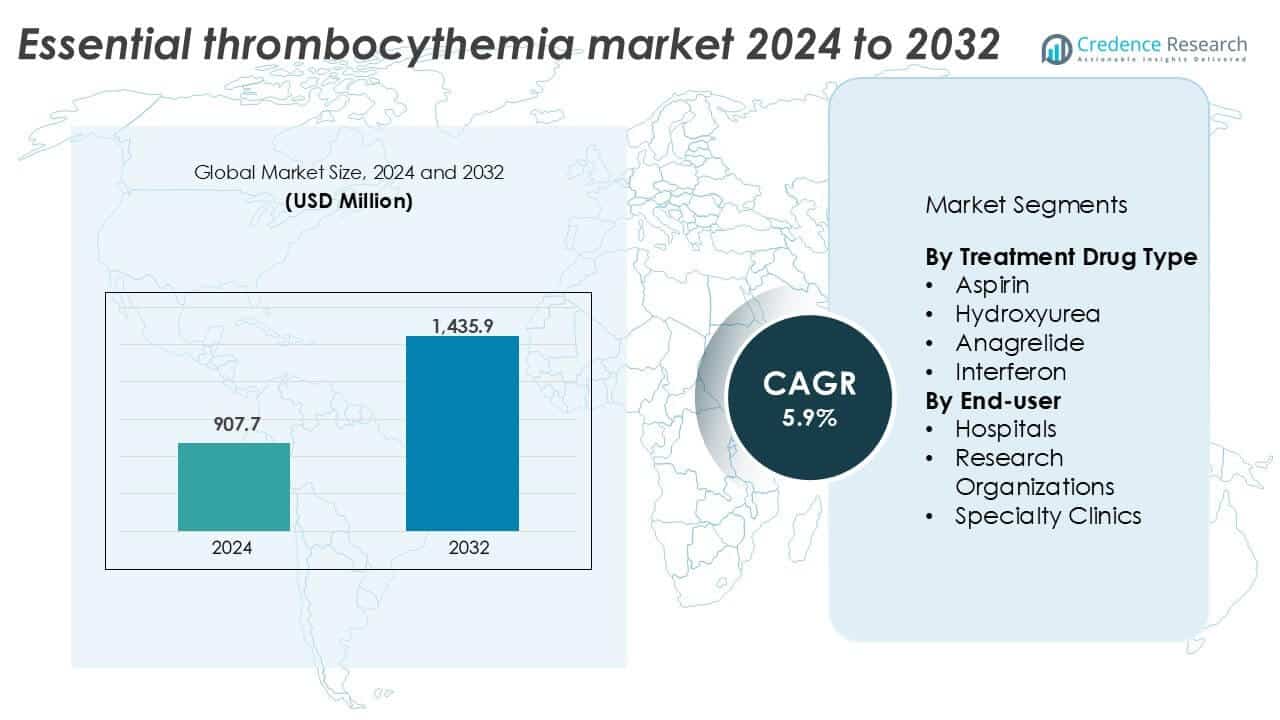
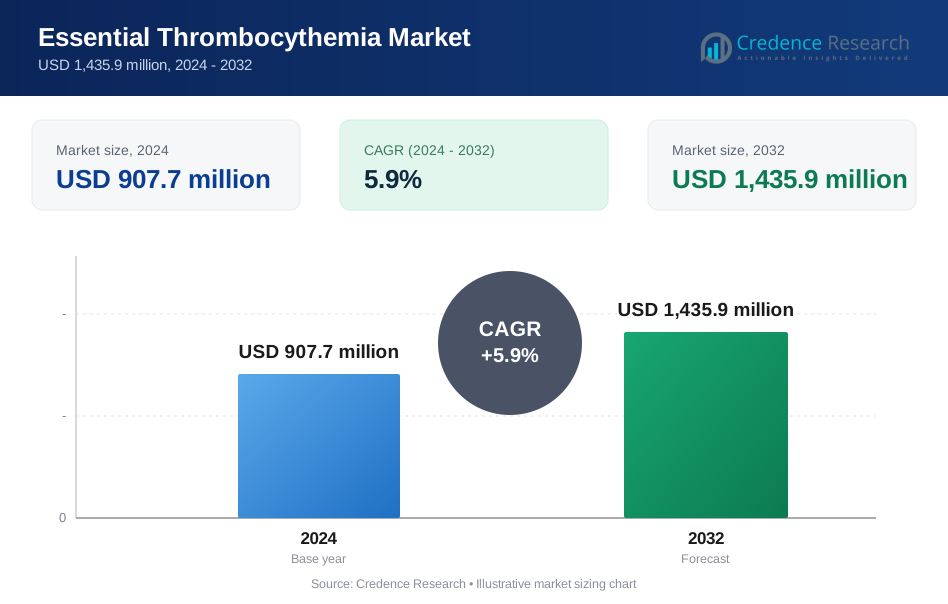
The Essential Thrombocythemia Market size was valued at USD 907.7 million in 2024 and is anticipated to reach USD 1,435.9 million by 2032, at a CAGR of 5.9% during the forecast period.
| REPORT ATTRIBUTE | DETAILS |
|---|---|
| Historical Period | 2020-2024 |
| Base Year | 2025 |
| Forecast Period | 2026-2032 |
| Essential Thrombocythemia Market Size 2024 | USD 907.7 million |
| Essential Thrombocythemia Market, CAGR | 5.9% |
| Essential Thrombocythemia Market Size 2032 | USD 1,435.9 million |
Essential Thrombocythemia Market Insights
- Rising incidence of myeloproliferative neoplasms and increased adoption of early genetic testing drive steady market demand.
- Key trends include growing use of interferon-based long-acting drugs and digital tools for remote patient monitoring.
- Bristol-Myers Squibb, Novartis AG, and Incyte Corporation dominate the competitive landscape, with combined market control exceeding 35%.
- North America leads with a 38% share due to superior healthcare access, followed by Europe at 29% and Asia Pacific at 21%; hydroxyurea remains the top treatment type, while hospitals account for over 55% of end-user share.
Essential Thrombocythemia Market Segmentation Analysis:
By Treatment Drug Type:
Hydroxyurea dominates the essential thrombocythemia market under the treatment drug type segment, accounting for over 40% of the market share in 2024. Its established efficacy in controlling platelet counts and reducing thrombotic risks drives its widespread adoption. Clinicians prefer hydroxyurea as a first-line therapy due to its cost-effectiveness, oral administration, and strong clinical backing. While aspirin holds a significant share for low-risk patients, it mainly supports symptom relief rather than disease control. Interferon and anagrelide cater to patients intolerant to hydroxyurea or younger demographics, but they occupy smaller shares due to cost, side effects, and dosage complexity.
- For instance, Bristol Myers Squibb’s Hydrea (hydroxyurea) remains widely prescribed and included in NCCN guidelines for cytoreductive therapy.
By End-user:
Hospitals lead the end-user segment with more than 55% share in 2024, owing to their access to hematologists and advanced diagnostic facilities. These settings support long-term monitoring and management of essential thrombocythemia patients, especially those receiving cytoreductive therapies. Hospitals often act as primary centers for initiating and adjusting treatment plans, including hydroxyurea and interferon therapies. Specialty clinics follow in share due to their focus on outpatient care and follow-up treatments. Research organizations hold a niche share, primarily engaged in clinical trials and biomarker studies, contributing to ongoing innovation in treatment protocols.
- For instance, Mayo Clinic and Cleveland Clinic report that over 70% of ET patients initiate treatment in hospital-based hematology departments.
Key Growth Drivers
Rising Prevalence of Myeloproliferative Disorders
The increasing incidence of myeloproliferative neoplasms (MPNs), particularly essential thrombocythemia, significantly drives market growth. A rise in diagnostic awareness and improved hematological testing supports early disease identification. According to global clinical data, essential thrombocythemia affects approximately 1 to 2 per 100,000 individuals annually, with a higher prevalence in adults over 60. The aging population amplifies the patient base, given the disorder’s strong correlation with advancing age. Growing life expectancy and rising chronic disease management efforts further contribute to increased demand for long-term therapies. Physicians now rely on regular complete blood count (CBC) tests to detect abnormal platelet counts, enhancing diagnosis rates. As early identification improves, the market benefits from a consistent inflow of newly diagnosed cases requiring sustained treatment across diverse healthcare settings, from primary hospitals to specialized hematology clinics.
- For instance, SEER data from the U.S. National Cancer Institute shows nearly 5,100 to 6,100 new ET cases diagnosed annually, with over 65% in patients above 60.
Advancements in Targeted and Interferon Therapies
Progress in targeted therapies and pegylated interferons significantly enhances treatment outcomes, making them key growth drivers in the essential thrombocythemia market. New-generation interferons, such as ropeginterferon alfa-2b, show improved tolerability and long-term disease control in younger patients and those intolerant to hydroxyurea. Several clinical studies support their role in molecular remission, offering an edge over conventional therapies. The market sees steady expansion of oral targeted therapies focused on JAK2 mutations, which are prevalent in over 50% of ET patients. Targeted approaches improve personalized treatment and reduce side effects, increasing patient compliance. As more biologics and small molecule drugs undergo clinical trials and receive regulatory approval, therapy choices are diversifying. These innovations support adoption in both high-risk and refractory patient groups, boosting the long-term revenue potential across pharmaceutical pipelines.
- For instance, in the PROUD/CONTI-PV trials, ropeginterferon achieved hematologic response rates of over 80% with lower discontinuation compared to standard therapy.
Strong Support from Healthcare Infrastructure and Government Initiatives
Expanding healthcare infrastructure and government-backed programs for rare disease management provide robust support for the essential thrombocythemia market. Developed countries have integrated essential thrombocythemia under hematology care pathways with full reimbursement for diagnostic and therapeutic procedures. National health insurance schemes in countries like the U.S., Canada, and select European regions ensure access to therapies such as hydroxyurea, anagrelide, and interferons. Government funding also aids in clinical research on chronic MPNs, supporting drug development and biomarker discovery. In emerging markets, increased investment in oncology and hematology facilities strengthens care delivery. Specialized centers now offer genetic testing to confirm JAK2, CALR, and MPL mutations, improving risk stratification and treatment precision. Public-private partnerships further improve drug accessibility and raise awareness about early detection and symptom management, fueling growth across multiple care tiers.
Key Trends & Opportunities
Shift Toward Personalized Medicine and Genetic Testing
The essential thrombocythemia market sees a marked shift toward personalized treatment based on genetic profiling. Mutation testing for JAK2, CALR, and MPL helps classify risk levels and select appropriate therapies. This trend supports targeted drug development and enables earlier treatment intervention. Healthcare providers increasingly rely on molecular diagnostics to determine response to interferons and identify resistance to certain therapies. Personalized care pathways improve outcomes and reduce treatment-related toxicity, especially in younger and intermediate-risk patients. Commercial diagnostic panels now offer rapid, cost-effective mutation screening, expanding access beyond tertiary hospitals. This trend opens opportunities for molecular diagnostic firms and supports pharma-biotech collaborations to develop targeted formulations. As genetic literacy among patients and clinicians grows, the adoption of mutation-guided treatment is expected to rise, shaping long-term treatment standards across global markets.
- For instance, over 50–60% of ET patients test positive for the JAK2V617F mutation, which directly influences drug selection, especially for JAK inhibitor trials such as those led by Incyte and CTI BioPharma.
Digital Health Integration and Remote Monitoring Potential
Digital health tools are emerging as valuable assets in managing chronic conditions like essential thrombocythemia. Remote monitoring platforms allow clinicians to track platelet counts, symptoms, and medication adherence in real time. Telehealth solutions enable patients to consult hematologists and receive ongoing support, reducing hospital visits. Digital diaries and mobile apps help patients log fatigue, bleeding episodes, or thrombotic events, enhancing communication and early intervention. These tools improve treatment personalization and reduce care costs, especially for elderly or rural patients. Healthcare systems now explore AI-powered platforms to predict disease progression using lab data and patient behavior. The growing interest in digital monitoring presents strong business opportunities for healthtech companies and pharma players to integrate support programs with drug delivery. As data-driven care becomes standard, digital tools will likely complement clinical decision-making and improve disease management outcomes.
Key Challenges
Limited Awareness and Delayed Diagnosis in Low-Income Regions
One of the core challenges in the essential thrombocythemia market is the limited awareness and late diagnosis in developing and under-resourced regions. General practitioners often overlook early signs such as headaches, dizziness, or fatigue, which are common across other conditions. Without routine CBC tests, elevated platelet counts remain undetected until serious events like thrombosis or stroke occur. Many healthcare systems lack specialist hematology units, restricting timely referrals and genetic testing for mutation confirmation. Delays in diagnosis reduce the chances of early intervention and long-term disease control. Educational gaps among healthcare providers further slow down treatment initiation. Pharmaceutical companies also face obstacles in market penetration due to poor diagnostic infrastructure. Addressing this challenge requires focused awareness campaigns, training for frontline providers, and wider availability of diagnostic tools across community health settings.
Side Effects and Limited Tolerance of Existing Therapies
Existing treatment options such as hydroxyurea, interferons, and anagrelide face limitations due to adverse effects and variable patient tolerance. Hydroxyurea, though effective, may cause myelosuppression or gastrointestinal disturbances, leading some patients to discontinue. Anagrelide often results in cardiovascular side effects, making it unsuitable for high-risk elderly patients. Interferons, while effective in younger populations, involve flu-like symptoms, injection-site reactions, and mental health impacts, reducing adherence. Long-term therapy requires careful monitoring and dose adjustments, increasing patient burden. These drawbacks limit treatment continuity and create demand for better-tolerated alternatives. Development pipelines remain slow due to high regulatory scrutiny and limited incentives for rare hematological diseases. Overcoming this challenge requires innovations in drug delivery, better side-effect profiles, and improved patient support programs to enhance compliance.
Regional Analysis
North America
North America holds the largest share in the essential thrombocythemia market, accounting for approximately 38% in 2024. Strong diagnostic infrastructure, high awareness, and widespread access to targeted therapies support regional dominance. The U.S. drives most of the market with advanced hematology centers and established reimbursement frameworks. Frequent use of genetic testing for JAK2, CALR, and MPL mutations enables early and accurate diagnosis. Clinical guidelines from bodies like the NCCN standardize treatment across hospitals and clinics. Ongoing research and FDA approvals for novel therapies further reinforce the region’s leadership in therapeutic adoption and disease management efficiency.
Europe
Europe follows with a 29% market share, driven by robust healthcare systems and increasing adoption of personalized therapies. Countries like Germany, the UK, and France lead the region due to strong clinical protocols and well-developed specialist networks. The European Hematology Association promotes early diagnosis and treatment standardization, which supports better patient outcomes. National reimbursement programs cover hydroxyurea and interferon therapies widely. The region also supports multiple clinical trials focused on advanced interferon variants and targeted drugs. Rising awareness and structured screening approaches for myeloproliferative disorders continue to fuel steady growth in treatment uptake across key EU markets.
Asia Pacific
Asia Pacific commands around 21% of the essential thrombocythemia market, with strong growth expected due to rising healthcare investments and improved diagnostics. Japan, China, and India lead the region, with Japan benefiting from strong clinical research infrastructure. Increased urbanization and growing access to blood testing expand early diagnosis capabilities. China shows rising demand due to a growing aging population and expanded insurance coverage for chronic conditions. However, awareness gaps and uneven access to hematology care persist across rural zones. Government efforts to improve rare disease management and drug accessibility are likely to accelerate market penetration in the near term.
Latin America
Latin America contributes roughly 7% to the global essential thrombocythemia market, led by Brazil, Mexico, and Argentina. The market benefits from gradual improvements in hematology services and availability of hydroxyurea as a low-cost first-line therapy. Government initiatives to include rare diseases in public health priorities are helping improve awareness and early diagnosis. Access to advanced therapies like interferons remains limited outside major urban hospitals. Patient advocacy groups are increasingly active in supporting treatment access and information dissemination. While the region lags in high-end diagnostics, growing investments in public healthcare are likely to support gradual market expansion.
Middle East & Africa
The Middle East & Africa hold the smallest market share at around 5%, with limited access to specialized hematology care posing a key barrier. Gulf Cooperation Council (GCC) countries, including Saudi Arabia and the UAE, show higher treatment adoption due to modern healthcare infrastructure and government-led disease screening programs. However, much of Sub-Saharan Africa lacks adequate diagnostic tools and clinical expertise. Essential thrombocythemia often remains underdiagnosed due to the absence of routine blood screening. Expansion of healthcare partnerships and investment in tertiary care centers are needed to bridge existing gaps and unlock the region’s growth potential.
Essential Thrombocythemia Market Segmentations:
By Treatment Drug Type
- Aspirin
- Hydroxyurea
- Anagrelide
- Interferon
By End-user
- Hospitals
- Research Organizations
- Specialty Clinics
By Geography
- North America
- U.S.
- Canada
- Mexico
- Europe
- Germany
- France
- U.K.
- Italy
- Spain
- Rest of Europe
- Asia Pacific
- China
- Japan
- India
- South Korea
- South-east Asia
- Rest of Asia Pacific
- Latin America
- Brazil
- Argentina
- Rest of Latin America
- Middle East & Africa
- GCC Countries
- South Africa
- Rest of the Middle East and Africa
Competitive Landscape
The essential thrombocythemia market features a moderately consolidated landscape, led by key players focusing on targeted therapies, interferon formulations, and clinical advancements. Bristol-Myers Squibb holds a leading 14–19% share, driven by strong investments in JAK inhibitor research and global clinical trial networks. Novartis AG follows closely, with a robust pipeline of interferon-based and immunotherapy products, commanding an 11–15% share. Incyte Corporation leverages its flagship JAK inhibitor, ruxolitinib, and ongoing indication expansion efforts to secure a 9–13% market position. PharmaEssentia Corporation stands out for its next-generation long-acting interferons, while Geron Corporation introduces telomerase inhibitors as an emerging therapeutic class. Other players, including Roche, AbbVie, Takeda, and AstraZeneca, contribute to innovation through hematologic drug portfolios and strategic partnerships. Companies increasingly focus on personalized treatment approaches, global access strategies, and regulatory acceleration to maintain competitiveness. M&A activities, geographic expansion, and strong R&D pipelines remain core tactics shaping the evolving competitive dynamics of this market.
Key Player Analysis
- Bristol-Myers Squibb
- Novartis AG
- Incyte Corporation
- PharmaEssentia Corporation
- Geron Corporation
- Roche Holding AG
- AbbVie Inc.
- Takeda Pharmaceutical Company Limited
- AstraZeneca
- Celgene Corporation
- Gilead Sciences, Inc.
- Sierra Oncology
- Hoffmann-La Roche Ltd.
Recent Developments
- In March 2025, multiple market‑analysis sources projected a strong upswing in the ET treatment market, driven by the recent approvals and the advancing pipeline of novel therapeutics (including interferons and other investigational agents), indicating growing commercial and clinical interest in ET.
- In January 2025, the Phase 3 Ropeginterferon alfa-2b (P1101 / BESREMi) previously approved for polycythemia vera was reported to have succeeded in the SURASS-ET trial for ET, achieving a significantly higher durable clinical response rate than Anagrelide (42.9% vs. 6.0%), along with a greater reduction in JAK2 V617F allele burden over 12 months.
- In August 2024, the European Commission (EC) granted marketing authorization for a “Type II variation” of Peginterferon alfa-2a (PEGASYS) allowing its use as a monotherapy for adults with ET representing a notable regulatory milestone since ET has had very few drugs specifically approved for it in Europe.
Report Coverage
The research report offers an in-depth analysis based on Treatment Drug Type, End-User and Geography. It details leading market players, providing an overview of their business, product offerings, investments, revenue streams, and key applications. Additionally, the report includes insights into the competitive environment, SWOT analysis, current market trends, as well as the primary drivers and constraints. Furthermore, it discusses various factors that have driven market expansion in recent years. The report also explores market dynamics, regulatory scenarios, and technological advancements that are shaping the industry. It assesses the impact of external factors and global economic changes on market growth. Lastly, it provides strategic recommendations for new entrants and established companies to navigate the complexities of the market.
Future Outlook
- The market will expand with rising awareness and early detection of myeloproliferative disorders.
- Demand for targeted therapies like JAK inhibitors will grow due to better patient outcomes.
- Long-acting interferon therapies will gain traction among younger and low-risk patients.
- Personalized treatment approaches based on genetic mutations will become standard practice.
- Digital health tools will improve treatment monitoring and patient adherence.
- North America will maintain leadership due to strong clinical infrastructure and access to therapies.
- Asia Pacific will show high growth with improved diagnostic capacity and healthcare spending.
- Research on telomerase and combination therapies will open new treatment avenues.
- Market competition will intensify as more players seek regulatory approvals for novel therapies.
- Partnerships and strategic alliances will expand access to therapies across emerging markets.
Request a Free Sample
Fill in your details and we'll send you a free sample report.
- Sample data tables & charts
- Research methodology
Need a Custom Version of This Report?
Tailor the scope, geography, or segments to your exact requirements.
- Custom geography or segment scope
- Direct access to our analyst team
Frequently Asked Questions
What is the current market size for the Essential thrombocythemia market, and what is its projected size in 2032?
At what Compound Annual Growth Rate is the Essential thrombocythemia market projected to grow between 2024 and 2032?
Which Essential thrombocythemia market segment held the largest share in 2024?
What are the primary factors fueling the growth of the Essential thrombocythemia market?
Who are the leading companies in the Essential thrombocythemia market?
Which region commanded the largest share of the Essential thrombocythemia market in 2024?
Table of Content
Chapter 1. Report Introduction
- 1.1 Report Description & Purpose
- 1.1.1 Report Title & Market Definition
- 1.1.2 Unique Selling Propositions (USP) & Key Differentiators
- 1.1.3 Value Proposition for Stakeholders
- 1.2 Research Objectives
- 1.2.1 Market Sizing Objectives (Volume & Revenue)
- 1.2.2 Segmentation Objectives
- 1.2.3 Competitive Intelligence Objectives
- 1.2.4 Forecast & Scenario Objectives
- 1.3 Report Scope
- 1.3.1 Essential Thrombocythemia Scope – Types & Subtypes Covered
- 1.3.2 Geographic Scope – Regions & Countries Covered
- 1.3.3 Historical Period, Base Year & Forecast Period (2024; forecast to 2032)
- 1.3.4 Inclusions & Exclusions
- 1.4 HS Code & Classification Framework
- 1.5 Currency, Units & Pricing Basis
- 1.6 Target Stakeholders
- 1.7 Limitations & Assumptions
Chapter 2. Executive Summary
- 2.1 Global Essential Thrombocythemia Market Snapshot
- 2.1.1 Market Size – Historical (2024) & Forecast (2024-2032) (2024: USD 907.7 million → 2032: USD 1,435.9 million)
- 2.1.2 Volume & Revenue – Global Totals
- 2.1.3 Key Market Highlights – Top Five Facts
- 2.2 Essential Thrombocythemia Market Segmentation Snapshot
- 2.2.1 Market Split by Region – 2024 vs. 2032
- 2.3 Competitive Snapshot
- 2.3.1 Top 10 Players by Revenue Share – 2024
- 2.3.2 Top 10 Players by Volume Share – 2024
- 2.3.3 Recent Strategic Developments (18-Month Summary)
- 2.4 Key Investment Highlights & Strategic Conclusions
Chapter 3. Essential Thrombocythemia Market Dynamics & Industry Analysis
- 3.1 Market Overview & Context
- 3.1.1 Essential Thrombocythemia Market Position in the Broader Automotive Value Chain
- 3.1.2 OEM vs. Replacement Market Dynamics
- 3.1.3 Market Maturity & Development Stage by Region
- 3.2 Essential Thrombocythemia Market Drivers
- 3.3 Essential Thrombocythemia Market Restraints & Challenges
- 3.4 Essential Thrombocythemia Market Opportunities
- 3.5 Porter's Five Forces Analysis
- 3.5.1 Threat of New Entrants
- 3.5.2 Bargaining Power of Suppliers
- 3.5.3 Bargaining Power of Buyers
- 3.5.4 Threat of Substitutes
- 3.5.5 Competitive Rivalry – Intensity Assessment
- 3.6 Essential Thrombocythemia Value Chain Analysis
- 3.6.1 Upstream – Raw Material/Input Suppliers
- 3.6.1.1 Raw Material/Input 1
- 3.6.1.2 Raw Material/Input 2
- 3.6.1.3 Raw Material/Input 3
- 3.6.2 Midstream – Production/Manufacturing/Service Delivery
- 3.6.2.1 Production/Process Overview
- 3.6.2.2 Key Facility Locations & Capacity by Manufacturer
- 3.6.3 Downstream – Distribution & End Consumer
- 3.6.3.1 Primary Channel – B2B/OEM
- 3.6.3.2 Secondary Channels – Dealer, Retail, Online, Direct
- 3.6.4 Value Chain Profitability Analysis
- 3.6.1 Upstream – Raw Material/Input Suppliers
- 3.7 PESTEL Analysis
- 3.7.1 Political Factors
- 3.7.2 Economic Factors
- 3.7.3 Social Factors
- 3.7.4 Technological Factors
- 3.7.5 Environmental Factors
- 3.7.6 Legal Factors
- 3.8 Essential Thrombocythemia Supply Chain Analysis
- 3.8.1 Raw Material/Input Supply Risk Assessment
- 3.8.2 Manufacturing Concentration Risk (Geographic Exposure)
- 3.8.3 Trade Disruption Impact Analysis
- 3.9 Regulatory & Policy Landscape
Note: The regulatory and policy landscape section covers regulations based on their applicability to the market, Essential Thrombocythemia category, geography, and scope of the study. Only regulatory frameworks with a material impact on operations, compliance, trade, sustainability, or market access are analyzed in detail.
Chapter 4. Key Investment Pockets & Opportunity Analysis
- 4.1 Essential Thrombocythemia Market Attractiveness Analysis
- 4.1.1 By Region – Investment Attractiveness Matrix (Volume × CAGR)
- 4.2 Absolute Revenue Growth Opportunity
- 4.2.1 By Region – Absolute USD Growth Through 2032
- 4.3 Incremental Volume Opportunity
- 4.3.1 By Region – Incremental Volume Through 2032
- 4.3.2 Segment – Incremental Volume
- 4.4 Emerging Submarket Opportunity Deep Dive (Subject to Applicability)
- 4.5 Emerging Market Opportunity Scorecards
- 4.5.1 United States
- 4.5.2 Europe
- 4.5.3 Asia
- 4.5.4 Middle East & Africa
Note: Emerging Market Opportunity Scorecards will be included based on relevance and strategic importance. Regions listed are indicative and may vary depending on data availability and market dynamics.
Chapter 5. Essential Thrombocythemia Import-Export Analysis & Trade Flows
- 5.1 Global Trade Overview
- 5.1.1 Global Export Value by Country (2024)
- 5.1.2 Global Export Volume by Country (2024)
- 5.1.3 Global Import Value by Country (2024)
- 5.1.4 Global Import Volume by Country (2024)
- 5.1.5 Net Trade Balance by Country (2024)
- 5.2 Export Analysis – Segment
- 5.2.1 Type 1 (HS Code)
- 5.2.2 Type 2 (HS Code)
- 5.2.3 Type 3 (HS Code)
- 5.2.4 Type 4 (HS Code)
- 5.2.5 Type 5 (HS Code)
- 5.3 Import Analysis – Segment
- 5.3.1 Type 1 (HS Code)
- 5.3.2 Type 2 (HS Code)
- 5.3.3 Type 3 (HS Code)
- 5.3.4 Type 4 (HS Code)
- 5.3.5 Type 5 (HS Code)
- 5.4 Average Unit Trade Prices
- 5.4.1 Average Export Price – Segment & Country
- 5.4.2 Average Import Price – Segment & Source Country
- 5.4.3 Price Trends (2024)
- 5.5 Key Trade Route Analysis
- 5.5.1 Trade Route 1
- 5.5.2 Trade Route 2
- 5.5.3 Trade Route 3
- 5.5.4 Trade Route 4
- 5.5.5 Trade Route 5
- 5.6 Trade Policy Impact Assessment
- 5.6.1 US Anti-Dumping & Section 301 Tariffs
- 5.6.2 EU Customs Union Impact
- 5.6.3 Major Free Trade Agreements
- 5.6.4 USMCA Rules of Origin
Note: Trade policy analysis will be included only where relevant to the Essential Thrombocythemia market.
Chapter 6. Competitive Landscape & Company Benchmarking
- 6.1 Essential Thrombocythemia Market Concentration & Structure
- 6.1.1 Herfindahl-Hirschman Index (HHI) – vs. 2024
- 6.1.2 Tier 1, Tier 2 & Tier 3 Market Structure
- 6.1.3 Global, Regional & Local Player Dynamics
- 6.2 Essential Thrombocythemia Market Share Analysis – 2024
- 6.2.1 Global Revenue Share by Company
- 6.2.2 Global Volume Share by Company
- 6.2.3 Regional Revenue Share
- 6.2.4 Market Share Evolution ( vs. 2024)
- 6.2.5 OEM Segment Share by Company
- 6.2.6 Replacement Segment Share by Company
- 6.3 Production/Delivery Capacity & Facility Analysis
- 6.3.1 Global Installed Capacity
- 6.3.2 Capacity Utilization Rates
- 6.3.3 Production/Output Volume
- 6.3.4 Facility Locations & Capacity Map
- 6.3.5 Planned Capacity Additions
- 6.4 Essential Thrombocythemia Competitive Benchmarking Matrix
- 6.4.1 Revenue, Volume, CAGR & Profitability Comparison
- 6.4.2 Channel Revenue Mix
- 6.4.3 Geographic Revenue Exposure
- 6.4.4 R&D Intensity
- 6.4.5 Sustainability Maturity
- 6.5 Strategic Developments in Essential Thrombocythemia (Last 24 Months)
- 6.5.1 Mergers, Acquisitions & Divestments
- 6.5.2 New Essential Thrombocythemia Launches
- 6.5.3 Facility Expansions
- 6.5.4 Strategic Alliances, Joint Ventures & Partnerships
- 6.5.5 Distribution Expansion & Market Entry
- 6.5.6 Sustainability & ESG Initiatives
- 6.6 Competitive Strategy Mapping
- 6.6.1 Leader, Challenger, Follower & Niche Classification
- 6.6.2 Pricing Strategy Comparison
- 6.6.3 Channel Strategy Matrix
Note: Strategic developments are included based on their materiality and the availability of reliable information.
Chapter 7. Global Essential Thrombocythemia Market – By Distribution Channel
- 7.1 Segment Overview
- 7.1.1 Volume & Revenue Split by Channel (2024 & 2032)
- 7.1.2 Channel Mix Evolution (2024-2032)
Chapter 8. Regional Market Analysis – Global Overview
- 8.1 Global Regional Overview
- 8.1.1 Regional Volume Share
- 8.1.2 Regional Revenue Share
- 8.1.3 Regional Volume by Region
- 8.1.4 Regional Revenue by Region
- 8.1.5 Regional Forecast Through 2032
- 8.2 Cross-Regional Segment Analysis
- 8.2.1 By Distribution Channel
- 8.2.2 By Brand/Price Tier
Chapter 9. North America Essential Thrombocythemia Market
- 9.1 United States
- 9.2 Canada
- 9.3 Mexico
Chapter 10. Europe Essential Thrombocythemia Market
- 10.1 Germany
- 10.2 France
- 10.3 Italy
- 10.4 United Kingdom
- 10.5 Spain
- 10.6 Poland
- 10.7 Russia
- 10.8 Netherlands
- 10.9 Belgium
- 10.10 Sweden
- 10.11 Denmark
- 10.12 Norway
- 10.13 Rest of Europe
Chapter 11. Asia Pacific Essential Thrombocythemia Market
- 11.1 China
- 11.2 India
- 11.3 Japan
- 11.4 South Korea
- 11.5 Thailand
- 11.6 Indonesia
- 11.7 Vietnam
- 11.8 Malaysia
- 11.9 Australia
- 11.10 Rest of Asia Pacific
Chapter 12. Latin America Essential Thrombocythemia Market
- 12.1 Brazil
- 12.2 Argentina
- 12.3 Colombia
- 12.4 Chile
- 12.5 Rest of Latin America
Chapter 13. Middle East Essential Thrombocythemia Market
- 13.1 Saudi Arabia
- 13.2 United Arab Emirates
- 13.3 Turkey
- 13.4 Israel
- 13.5 Iran
- 13.6 Rest of the Middle East
Chapter 14. Africa Essential Thrombocythemia Market
- 14.1 South Africa
- 14.2 Egypt
- 14.3 Nigeria
- 14.4 Morocco
- 14.5 Rest of Africa
Chapter 15. Essential Thrombocythemia Company Profiles
- 15.1 [Company 01]
- 15.1.1 Company Overview
- 15.1.2 Key Management Personnel
- 15.1.3 Products & Services Portfolio
- 15.1.4 Financial Performance
- 15.1.5 Key Market Focus & Geographic Presence
- 15.1.6 Recent Developments & Strategic Initiatives
Note: The company profile list is preliminary and may change based on research findings, market developments, data availability, and client requirements.
Chapter 16. Appendices
- Appendix A – List of Abbreviations & Acronyms
- Appendix B – Industry Classification Code Reference – Full Series
- Appendix C – Production & Capacity Data Tables
- Appendix D – End-Use & Demand Base Tables
- Appendix E – Consumption & Replacement Rate Assumptions
- Appendix F – ASP Reference Tables
- Appendix G – Manufacturing & Facility Database
- Appendix H – Import-Export Data Tables
- Appendix I – Regulatory Summary Tables
- Appendix J – Primary Research Participant List (Anonymized)
- Appendix K – Primary Research Questionnaire Framework
- Appendix L – Data Sources & Bibliography
- Appendix M – Market Size Divergence & Source Comparison
Chapter 17. Research Methodology
- 17.1 Research Framework & Philosophy
- 17.2 Secondary Research – Sources, Hierarchy & Data Extraction
- 17.3 Data Modeling – Bottom-Up & Top-Down Market Sizing
- 17.4 Primary Research – Stakeholder Framework, LOI & Sample Sizes
- 17.5 Forecast Methodology – Regression, Scenario & Sensitivity Analysis
- 17.6 Quality Control – Four-Layer Validation Framework
- 17.7 Limitations & Standard Assumptions
- 17.8 Disclaimer
