D Dimer Market Overview:
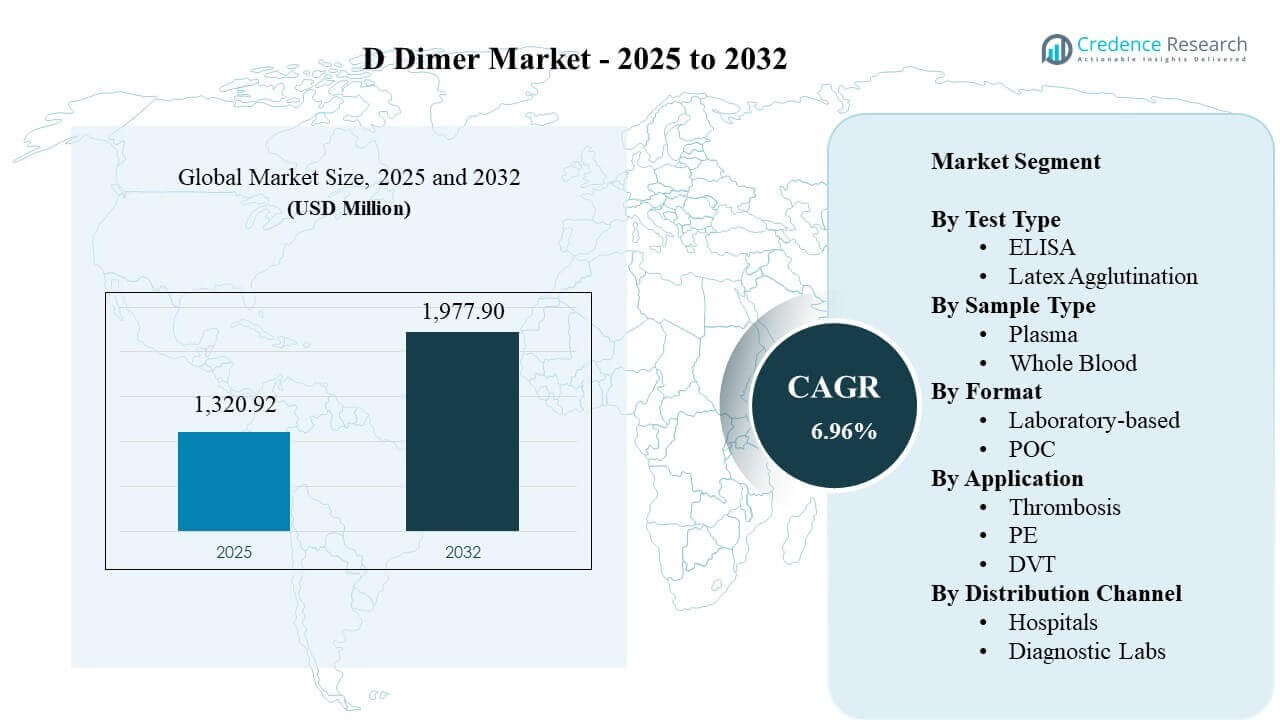
The global D Dimer Market size was estimated at USD 1,320.92 million in 2025 and is expected to reach USD 1,977.90 million by 2032, growing at a CAGR of 6.96% from 2025 to 2032. Growth momentum is driven by rising emergency and inpatient testing volumes tied to venous thromboembolism rule-out pathways, where rapid decision-making reduces unnecessary imaging and accelerates treatment selection. D Dimer Market expansion is reinforced by broader adoption of standardized clinical algorithms in hospitals and diagnostic networks, supported by improving assay automation, workflow integration, and expanding availability of near-patient testing in time-sensitive care settings.
| REPORT ATTRIBUTE | DETAILS |
|---|---|
| Historical Period | 2020-2024 |
| Base Year | 2025 |
| Forecast Period | 2026-2032 |
| D Dimer Market Size 2025 | USD 1,320.92 million |
| D Dimer Market, CAGR | 6.96% |
| D Dimer Market Size 2032 | USD 1,977.90 million |
Key Market Trends & Insights
- D Dimer Market expansion from USD 1,320.92 million (2025) to USD 1,977.90 million (2032) reflects a 6.96% CAGR during 2025–2032.
- North America accounted for the largest regional share at 35.2% in 2025, supported by high diagnostic intensity across emergency and inpatient settings.
- Laboratory-based testing remained the dominant format, with a 59.1% share in 2025, reflecting established core-lab workflows and high-throughput operations.
- ELISA accounted for the largest share of 43.2% in 2025, supported by sensitivity expectations and standardized assay performance.
- DVT represented the largest application with a 35.8% share in 2025, reflecting sustained utilization in suspected clotting-event pathways.
Segment Analysis
D Dimer Market demand is shaped by acute-care triage needs and the growing use of structured diagnostic pathways for suspected thrombotic events. Hospital workflows prioritize quick rule-out testing to reduce avoidable imaging utilization and to streamline patient routing in emergency departments and inpatient units. Diagnostic laboratories support both hospital networks and outpatient referrals, expanding test access through centralized processing and standardized quality systems. Format choices often reflect turnaround-time targets, staffing models, and connectivity requirements for results reporting and care coordination.
D Dimer Market segmentation dynamics also reflect technology and operational trade-offs across methods and care settings. Laboratory-based platforms continue to benefit from high throughput, automation compatibility, and predictable quality control practices. Point-of-care testing adoption is supported by faster time-to-result where clinical decisions must be made rapidly, especially in emergency and urgent care environments. Sample type selection is influenced by pre-analytical constraints, with plasma workflows aligning to established lab processes and whole-blood workflows aligning to decentralized testing environments.
By Test Type Insights
ELISA accounted for the largest share of 43.2% in 2025. ELISA leadership reflects strong analytical sensitivity that supports rule-out pathways in suspected thrombotic events. ELISA workflows align with standardized laboratory quality systems, supporting repeatable performance across high-volume testing environments. ELISA adoption also benefits from compatibility with automated processing and integration into broader immunoassay menus used for acute-care diagnostics.
By Sample Type Insights
Plasma and whole-blood sampling are both used across D Dimer Market workflows, with selection shaped by setting-specific operational needs. Plasma-based testing aligns with established laboratory processing and quality controls, supporting consistency in central laboratories. Whole-blood testing supports faster execution where centrifugation and sample preparation add time and complexity. Emergency and decentralized settings often prioritize sample simplicity and speed, which supports broader consideration of whole-blood workflows.
By Format Insights
Laboratory-based testing accounted for the largest share of 59.1% in 2025. Laboratory-based dominance reflects established core-lab infrastructure, high throughput requirements, and strong quality management practices that support routine hemostasis testing. Hospital laboratories often prioritize consolidated operations that can deliver consistent turnaround times while supporting large test volumes. Laboratory-based integration with LIS connectivity and standardized QC practices further supports operational reliability across multi-site health systems.
By Application Insights
DVT accounted for the largest share of 35.8% in 2025. DVT pathways use D-dimer results to support rapid triage and rule-out decisions, particularly for low-to-moderate risk patients. Routine utilization is reinforced by high patient presentation volumes in emergency care and inpatient settings where clotting risk must be assessed quickly. Clinical algorithm standardization and diagnostic stewardship initiatives support consistent ordering patterns tied to DVT evaluation workflows.
By Distribution Channel Insights
Hospitals accounted for the largest share of 38.6% in 2025. Hospital leadership reflects high testing frequency in emergency departments, inpatient units, and perioperative settings where thrombotic risk assessment is critical. Integrated laboratory services within hospitals support standardized ordering, rapid results reporting, and clinical decision support in acute pathways. Hospital procurement also favors platforms that combine automation, reliability, and menu breadth, reinforcing sustained utilization of D-dimer assays.
D Dimer Market Drivers
Rising venous thromboembolism triage volumes in acute care
D Dimer Market growth is supported by higher utilization in emergency and inpatient pathways where suspected thrombotic events require rapid evaluation. D-dimer testing supports rule-out decisions that can reduce unnecessary imaging for appropriate patient cohorts. Hospital protocols increasingly emphasize faster patient routing to manage crowding and reduce time-to-treatment. Standardized pathways support consistent ordering patterns and stable baseline volumes. Workflow maturity across hospital networks reinforces repeat utilization.
Expansion of standardized clinical algorithms and diagnostic stewardship
D Dimer Market expansion is driven by broader use of structured decision tools that link symptoms, risk scoring, and lab results into consistent diagnostic sequences. Clinical standardization reduces variability in ordering and strengthens test utilization where rule-out performance is clinically valued. Diagnostic stewardship efforts often aim to optimize imaging utilization and improve care efficiency. D-dimer testing benefits from being a well-established component of these pathways. Greater protocol adherence supports predictable demand.
Increasing laboratory automation and hemostasis workflow integration
D Dimer Market performance benefits from continued investments in core-lab automation, including improved analyzer throughput and connectivity. Automated workflows support consistent quality control, faster processing, and better staff productivity in high-volume laboratories. Integration of hemostasis parameters into consolidated platforms strengthens utilization as part of broader coagulation and thrombosis testing menus. Consolidation of laboratory networks supports centralized processing and standardization. These operational improvements help sustain market demand.
- For instance, Sysmex Corporation’s CN-7000 automated coagulation analyzer achieved processing rates of 300 tests per hour with auto-reflex protocols for D-dimer and fibrinogen, enabling centralized workflow integration across five European hospital networks for hemostasis testing standardization.
Growth of decentralized testing and near-patient decision-making
D Dimer Market growth is reinforced by care models that prioritize rapid clinical decisions in emergency departments, urgent care, and decentralized settings. Point-of-care testing supports faster time-to-result, improving speed of triage and reducing delays tied to specimen transport and batch processing. Connectivity improvements support results capture within clinical systems, enabling better documentation and follow-up. Near-patient testing also aligns with care settings that emphasize throughput and patient flow. These dynamics support additional test placements over time.
- For instance, Roche Diagnostics’ cobas h 232 point-of-care analyzer provides D-dimer results in under 8 minutes and integrates directly with electronic health records via Cobas infinity software, facilitating decision-making in over 500 decentralized outpatient and emergency care centers globally.
D Dimer Market Challenges
D Dimer Market faces operational challenges tied to pre-analytical variability, assay standardization differences, and result interpretation across patient populations. Sample handling, timing, and local workflow differences can affect results reliability and create variation across sites. Clinical utilization also requires alignment with validated protocols to avoid inappropriate testing that can increase false-positive rates in certain contexts. Health systems may respond with tighter ordering rules, which can constrain volume growth.
D Dimer Market adoption can be limited by reimbursement pressure, procurement constraints, and the need to demonstrate workflow value beyond analytical performance. Hospital laboratories often prioritize platforms that optimize total cost of ownership, which can increase competitive pressure on pricing and reagent contracts. Point-of-care expansion also requires training, quality oversight, and connectivity, adding operational burdens for decentralized deployments. These constraints can slow scale-up in resource-limited settings.
- For instance, Abbott Diagnostics expanded its i-STAT D-Dimer cartridge for point-of-care use, which achieved a turnaround time of less than 10 minutes per test and showed inter-lot CV under 6%, validated across >1,200 clinical samples. Despite high performance, the device requires network integration for LIS connectivity, which hospitals identify as a critical step for workflow compliance and quality monitoring.
D Dimer Market Trends and Opportunities
D Dimer Market opportunity is expanding through improved assay integration across automated laboratory systems and stronger interoperability with clinical information systems. Connectivity and analytics can support protocol adherence, reduce turnaround time variability, and improve diagnostic stewardship outcomes. Multi-site health systems increasingly standardize platforms to support consistent performance across networks. This trend supports broader placements for integrated hemostasis solutions and recurring reagent demand.
- For instance, Siemens Healthineers integrated its Atellica COAG 360 system with hospital laboratory networks, enabling automated D-Dimer assays with a throughput exceeding 450 tests per hour and data interoperability through HL7 connectivity. The platform’s bidirectional data exchange reportedly reduced result verification time by over 30% across multi-hospital networks.
D Dimer Market trends also include continued growth in near-patient testing placements where rapid triage and patient flow are critical. Emergency departments and urgent care settings increasingly value faster rule-out workflows that reduce time to disposition. Product strategies that emphasize ease of use, operator guidance, and quality controls support broader adoption in decentralized environments. These trends create room for expanded placements across community hospitals and outpatient urgent care networks.
Regional Insights
North America
North America led D Dimer Market demand with a 35.2% share in 2025, supported by high emergency department utilization and structured thrombotic event pathways. Hospital networks in the region emphasize rapid triage to reduce avoidable imaging and improve patient throughput. Large integrated delivery networks support standardized testing algorithms and consolidated laboratory operations. Strong platform penetration and broad access to diagnostics sustain steady demand across hospital and diagnostic laboratory settings.
Europe
Europe accounted for 24.7% of D Dimer Market revenue in 2025, supported by established clinical pathways and widespread hospital laboratory capabilities. Health systems across major European markets emphasize standardized diagnostic workups and appropriate imaging utilization, which supports rule-out testing demand. Consolidated laboratory services and strong quality frameworks support consistent utilization in hospital and referral lab networks. Cost controls can influence procurement decisions, reinforcing demand for reliable, efficient testing workflows.
Asia Pacific
Asia Pacific represented 27.1% of D Dimer Market revenue in 2025, supported by expanding diagnostic infrastructure and rising emergency-care utilization in large urban centers. Hospital capacity additions and improving laboratory automation support higher testing volumes across high-growth health systems. Growing awareness of thrombotic risks and broader adoption of structured clinical pathways reinforce routine ordering. Decentralized testing expansion in the region supports faster triage and new placement opportunities in urgent care settings.
Latin America
Latin America held 7.1% of D Dimer Market revenue in 2025, supported by growth in private diagnostics networks and improving access to acute-care testing in major cities. Demand is reinforced by expanding hospital capacity and the rising role of diagnostic laboratories serving referral volumes. Procurement constraints and uneven access to automation can create variability in testing availability across countries. Opportunities remain in network standardization and near-patient testing expansion where workflow speed improves clinical efficiency.
Middle East & Africa
Middle East and Africa accounted for 5.9% of D Dimer Market revenue in 2025, supported by growth in hospital infrastructure and expanding laboratory capabilities in higher-income markets. Acute-care modernization and the expansion of tertiary hospitals support higher utilization for thrombotic event triage. Access constraints and variable reimbursement can limit scale in lower-resource settings. Development of centralized laboratory hubs and improving clinician awareness can support steady adoption growth.
Competitive Landscape
D Dimer Market competition is shaped by assay performance, automation compatibility, reagent stability, and connectivity across laboratory and near-patient settings. Major diagnostic companies compete through instrument placements, menu breadth, and service coverage that supports uptime and predictable workflow performance. Differentiation often centers on turnaround time, integration into coagulation and immunoassay ecosystems, and total cost of ownership for laboratory networks. Commercial strategies frequently include long-term reagent agreements, bundled placements, and workflow optimization support.
Roche competition in D Dimer Market is supported by broad diagnostic portfolio depth and strong footprint in core laboratory and near-patient testing ecosystems. Roche positioning typically emphasizes workflow integration, standardized assay performance, and connectivity that supports clinical decision-making in acute care. Roche platform strategies can support cross-selling across immunoassay and coagulation-related workflows within hospital networks. Roche service coverage and installed base strength can reinforce recurring reagent utilization and support long-term customer retention.
The industry research and growth report includes detailed analyses of the competitive landscape of the market and information about key companies, including:
- Roche
- Abbott
- Siemens Healthineers
- Bio-Rad
- Thermo Fisher
- Sysmex
- Stago
- DiaSorin
- Ortho Clinical
- Randox
Qualitative and quantitative analysis of companies has been conducted to help clients understand the wider business environment as well as the strengths and weaknesses of key industry players. Data is qualitatively analyzed to categorize companies as pure play, category-focused, industry-focused, and diversified; it is quantitatively analyzed to categorize companies as dominant, leading, strong, tentative, and weak.
Recent Developments
- In January 2025, bioMérieux announced an agreement to acquire SpinChip Diagnostics ASA, and the acquired point-of-care immunoassay platform is being developed with an assay menu that includes D-dimer, making this a notable acquisition in the D-dimer testing space.
- In July 2024, Roche completed the acquisition of LumiraDx’s point-of-care technology, stating that the platform would strengthen Roche’s portfolio across clinical chemistry, immunochemistry, coagulation, and molecular testing, while LumiraDx’s platform already included a D-dimer assay for near-patient use.
Report Scope
| Report Attribute | Details |
| Market size value in 2025 | USD 1,320.92 million |
| Revenue forecast in 2032 | USD 1,977.90 million |
| Growth rate (CAGR) | 6.96% (2025–2032) |
| Base year | 2025 |
| Forecast period | 2026-2032 |
| Quantitative units | USD million |
| Segments covered | By Test Type, By Sample Type, By Format, By Application, By Distribution Channel |
| Regional scope | North America, Europe, Asia Pacific, Latin America, Middle East & Africa |
| Key companies profiled | Roche; Abbott; Siemens Healthineers; Bio-Rad; Thermo Fisher; Sysmex; Stago; DiaSorin; Ortho Clinical; Randox |
| No. of Pages | 334 |
Segmentation
By Test Type
- ELISA
- Latex Agglutination
By Sample Type
- Plasma
- Whole Blood
By Format
- Laboratory-based
- POC
By Application
- Thrombosis
- PE
- DVT
By Distribution Channel
- Hospitals
- Diagnostic Labs
By Region
- North America
- U.S.
- Canada
- Mexico
- Europe
- Germany
- France
- U.K.
- Italy
- Spain
- Rest of Europe
- Asia Pacific
- China
- Japan
- India
- South Korea
- South-east Asia
- Rest of Asia Pacific
- Latin America
- Brazil
- Argentina
- Rest of Latin America
- Middle East & Africa
- GCC Countries
- South Africa
- Rest of the Middle East and Africa

Request a Free Sample
Fill in your details and we'll send you a free sample report.
- Sample data tables & charts
- Research methodology
Need a Custom Version of This Report?
Tailor the scope, geography, or segments to your exact requirements.
- Custom geography or segment scope
- Direct access to our analyst team
Frequently Asked Questions
What is the current size and forecast value for D Dimer Market?
What is the growth rate for D Dimer Market during the forecast period?
Which segment holds the largest share in D Dimer Market?
What factors are driving growth in D Dimer Market?
Which companies are leading in D Dimer Market?
Which region leads D Dimer Market?
Table of Content
Chapter 1 Market Segmentation
- 1.1 Segmentation Framework
- 1.1.1 Product and Service Classification
- 1.1.2 Application and End-Use Classification
- 1.1.3 Technology and Solution Classification
- 1.1.4 Customer and Distribution Channel Classification
- 1.1.5 Geographic Segmentation
- 1.1.6 Market Segment Definitions and Boundaries
Chapter 2 Introduction
- 2.1 Report Objectives and Scope
- 2.2 Product Definition and Industry Terminology
- 2.3 Market Inclusions and Exclusions
- 2.4 Research Process
- 2.4.1 Primary Research and Expert Interviews
- 2.4.2 Secondary Research and Source Review
- 2.4.3 Top-Down and Bottom-Up Estimation
- 2.4.4 Data Triangulation and Verification
- 2.5 Market Size Measurement Basis
- 2.5.1 2025: USD 1,320.92 million → 2032: USD 1,977.90 million
- 2.6 Historical and Forecast Reference Periods
- 2.6.1 Base Year: 2025
- 2.6.2 Forecast Period: 2025-2032
- 2.7 Research Assumptions and Limitations
Chapter 3 Executive Summary
- 3.1 Market Snapshot and Key Findings
- 3.2 Base-Year Market Size, 2025
- 3.3 Forecast Market Size, 2032
- 3.4 Revenue and Volume Growth Outlook
- 3.5 Key Demand and Supply Indicators
- 3.6 Leading Market Segments
- 3.7 Fastest-Growing Market Opportunities
- 3.8 Regional Performance Highlights
- 3.9 Technology and Industry Transformation
- 3.10 Competitive Landscape Summary
- 3.11 Analyst View and Strategic Implications
Chapter 4 Global D Dimer Market Trends and Developments
- 4.1 Historical Industry Development
- 4.2 Recent Market Trends and Developments
- 4.3 Demand and Customer Behavior Trends
- 4.4 Technology and Product Innovation
- 4.5 Artificial Intelligence, Automation and Digitalization
- 4.6 Local Manufacturing and Supply Chain Realignment
- 4.7 Industry Partnerships, Mergers and Acquisitions
- 4.8 Sustainability and Circular Economy Developments
- 4.9 Government and Private Sector Investment Trends
- 4.10 Emerging Business Models and Commercialization
- 4.11 Industry Developments and Announcements
Chapter 5 Global D Dimer Market Production, Supply and Demand Analysis
- 5.1 Demand Trend and Consumption Analysis
- 5.2 Demand Forecast, 2025-2032
- 5.3 Production and Output Trend
- 5.4 Production and Output Forecast, 2025-2032
- 5.5 Installed Capacity and Capacity Utilization
- 5.6 Company-Wise Production Plants and Statistics
- 5.6.1 Installed Production Capacity
- 5.6.2 Actual Production
- 5.6.3 Planned Capacity and Expansion Targets
- 5.7 Supply Chain Structure and Procurement Trends
- 5.8 Supply-Demand Gap and Bottlenecks
- 5.9 Import Dependence and Sourcing Structure
- 5.10 Contract Manufacturing and Outsourcing
- 5.11 Regional Supply and Demand Concentration
Chapter 6 Global D Dimer Market Pricing Analysis
- 6.1 Pricing Structure and Measurement
- 6.2 Historical Pricing Trends
- 6.3 Pricing Outlook, 2025-2032
- 6.4 Average Selling Price and Unit Economics
- 6.5 Pricing by Product and Market Segment
- 6.6 Geographic Pricing Differences
- 6.7 Key Input, Energy, Labor and Logistics Costs
- 6.8 Contract Pricing and Purchasing Models
- 6.9 Pricing Sensitivity and Competitive Positioning
- 6.10 Price, Margin and Profitability Implications
Chapter 7 Global D Dimer Market Dynamics
- 7.1 Market Growth Drivers
- 7.1.1 Demand-Side Drivers
- 7.1.2 Technology and Innovation Drivers
- 7.1.3 Infrastructure and Investment Drivers
- 7.1.4 Regulatory and Policy Drivers
- 7.2 Market Restraints
- 7.2.1 Cost and Affordability Constraints
- 7.2.2 Technology and Adoption Barriers
- 7.2.3 Supply Chain and Operational Constraints
- 7.3 Market Challenges
- 7.3.1 Competitive Pressure and Margin Erosion
- 7.3.2 Skills, Infrastructure and Implementation Gaps
- 7.4 Emerging Market Opportunities
- 7.5 Market Dynamics Impact and Time-Horizon Assessment
Chapter 8 Global D Dimer Value Chain Analysis
- 8.1 Industry Value Chain Overview
- 8.2 Upstream Suppliers and Critical Inputs
- 8.3 Technology and Component Providers
- 8.4 Manufacturing or Service Delivery
- 8.5 Distribution, Channel Partners and Integrators
- 8.6 Downstream Applications and End Users
- 8.7 Value Addition and Profit Pools
- 8.8 Vertical Integration and Outsourcing
- 8.9 Supplier Concentration and Risk
- 8.10 Supply Chain Localization and Resilience
Chapter 9 Global D Dimer Market Regulations and Policies
- 9.1 Relevant Laws, Standards and Compliance Frameworks
- 9.2 Product, Service, Safety and Quality Requirements
- 9.3 Government Policies, Incentives and Subsidies
- 9.4 Imports, Exports and Trade Barriers
- 9.5 Public Procurement and Local Content Requirements
- 9.6 Environmental and Sustainability Compliance
- 9.7 Upcoming Policy Changes and Market Implications
Chapter 10 Global D Dimer Market Hotspots and Opportunities
- 10.1 Market Opportunity Mapping and Growth Hotspots
- 10.2 High-Growth Applications and Customer Groups
- 10.3 Underserved Markets and White-Space Opportunities
- 10.4 Emerging Technology and Product Opportunities
- 10.5 New Capacity and Investment Hotspots
- 10.6 Market Entry and Expansion Opportunities
- 10.7 Distribution and Partnership Opportunities
- 10.8 Near-Term and Long-Term Commercial Potential
- 10.9 Opportunity Attractiveness and Execution Risks
Chapter 11 Global D Dimer Market Outlook, 2025-2032
- 11.1 Market Size and Analysis
- 11.1.1 Revenue (Market Measurement: 2025: USD 1,320.92 million → 2032: USD 1,977.90 million)
- 11.1.2 Market Volume and Quantity Sold
- 11.1.3 Historical Market Size
- 11.1.4 Base-Year Market Size, 2025
- 11.2 Market Forecast, 2025-2032
- 11.2.1 Revenue Forecast to 2032
- 11.2.2 Volume Forecast to 2032
- 11.2.3 CAGR and Year-on-Year Growth
- 11.2.4 Incremental Revenue Opportunity
- 11.3 Forecast Assumptions and Scenario Analysis
- 11.3.1 Base-Case Forecast
- 11.3.2 Optimistic and Conservative Scenarios
- 11.3.3 Technology, Pricing and Policy Sensitivities
- 11.4 Market Attractiveness and Growth Outlook
Chapter 12 Global D Dimer Market Segmentation and Outlook
- 12.1 Segmentation Summary and Market Shares, 2025
- 12.2 Largest and Fastest-Growing Segments
- 12.3 Segment Growth Comparison
- 12.4 Segment Attractiveness and Priority Matrix
Chapter 13 Global D Dimer Geographic Market Outlook, 2025-2032
- 13.1 Regional Market Size and Share, 2025
- 13.2 Regional Market Forecast, 2025-2032
- 13.3 Regional Pricing, Production and Demand Differences
- 13.4 North America
- 13.4.1 United States
- 13.4.2 Canada
- 13.4.3 Mexico
- 13.5 Europe
- 13.5.1 Germany
- 13.5.2 France
- 13.5.3 Italy
- 13.5.4 United Kingdom
- 13.5.5 Spain
- 13.5.6 Poland
- 13.5.7 Russia
- 13.5.8 Netherlands
- 13.5.9 Belgium
- 13.5.10 Sweden
- 13.5.11 Denmark
- 13.5.12 Norway
- 13.5.13 Rest of Europe
- 13.6 Asia Pacific
- 13.6.1 China
- 13.6.2 India
- 13.6.3 Japan
- 13.6.4 South Korea
- 13.6.5 Thailand
- 13.6.6 Indonesia
- 13.6.7 Vietnam
- 13.6.8 Malaysia
- 13.6.9 Australia
- 13.6.10 Rest of Asia Pacific
- 13.7 Latin America
- 13.7.1 Brazil
- 13.7.2 Argentina
- 13.7.3 Colombia
- 13.7.4 Chile
- 13.7.5 Rest of Latin America
- 13.8 Middle East
- 13.8.1 Saudi Arabia
- 13.8.2 United Arab Emirates
- 13.8.3 Turkey
- 13.8.4 Israel
- 13.8.5 Iran
- 13.8.6 Rest of the Middle East
- 13.9 Africa
- 13.9.1 South Africa
- 13.9.2 Egypt
- 13.9.3 Nigeria
- 13.9.4 Morocco
- 13.9.5 Rest of Africa
- 13.10 Regional Investment, Policy and Supply Chain Differences
- 13.11 Regional Competitive Landscape
- 13.12 Geographic Growth Hotspots
Chapter 14 Global D Dimer Technology, Innovation and Sustainability Outlook
- 14.1 Technology Landscape and Maturity
- 14.2 Product, Process and Service Innovation
- 14.3 AI, Automation and Digital Tools in the Industry
- 14.4 Technology Adoption and Performance Benchmarking
- 14.5 Innovation Pipeline and R&D Investment
- 14.6 Patent and Intellectual Property Trends
- 14.7 Energy Efficiency and Resource Management
- 14.8 Sustainability, Recycling and Circularity
- 14.9 Technology Roadmap, 2025-2032
- 14.10 Risks of Obsolescence and Technology Substitution
Chapter 15 Global D Dimer Market Key Strategic Imperatives
- 15.1 Growth and Market Entry Priorities
- 15.2 High-Return Products and Segments
- 15.3 Pricing, Profitability and Cost Optimization
- 15.4 Technology Investment and Product Differentiation
- 15.5 Supply Chain Localization and Resilience
- 15.6 Distribution and Customer Acquisition
- 15.7 Partnership, Acquisition and Capacity Strategy
- 15.8 Regional Expansion Priorities
- 15.9 Short-, Medium- and Long-Term Actions
Chapter 16 Competition Outlook
- 16.1 Industry Competition Characteristics
- 16.2 Market Structure and Concentration
- 16.3 Market Share and Competitive Positioning, 2025
- 16.4 Company-Wise Revenue and Product Benchmarking
- 16.5 Production and Service Capacity Benchmarking
- 16.6 Technology, Pricing and Differentiation
- 16.7 Regional Footprint and Distribution Strength
- 16.8 Mergers, Acquisitions and Strategic Alliances
- 16.9 New Entrants and Competitive Threats
- 16.10 Porter's Five Forces and Industry Attractiveness
- 16.11 Competitive Outlook, 2025-2032
Chapter 17 Company Profiles
- 17.1 Company Coverage and Selection Criteria
- 17.2 Leading Market Participants – Standard Profile Structure
- 17.2.1 Business Description
- 17.2.2 Company Ownership and Geographic Presence
- 17.2.3 Product and Service Portfolio
- 17.2.4 Manufacturing and Operating Footprint
- 17.2.5 Production Capacity and Expansion Plans
- 17.2.6 Financial Performance and Investment
- 17.2.7 Market Share and Competitive Position
- 17.2.8 Technology and Innovation Capabilities
- 17.2.9 Strategic Alliances or Partnerships
- 17.2.10 Recent Developments
- 17.2.11 Growth Strategy and Outlook
- 17.3 Other Relevant Market Participants
Note: Every listed company is profiled on the structure shown under the first company. The company list is preliminary and may change based on research findings, market developments, data availability and client requirements.
Chapter 18 Disclaimer
- 18.1 Research and Forecast Disclaimer
- 18.2 Data Source and Estimation Limitations
Note: The depth of individual sections depends on data availability for this market. Volume, capacity, trade and other unit-based metrics are included where applicable.