
Market Overview:
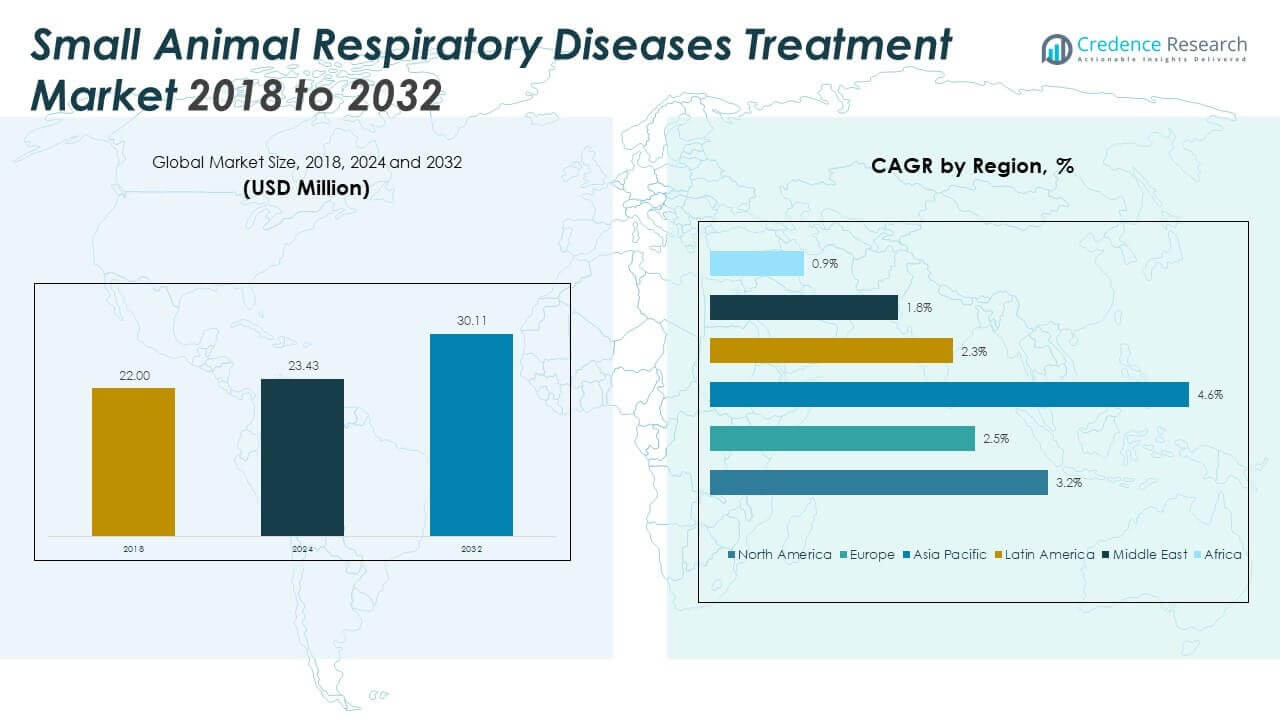
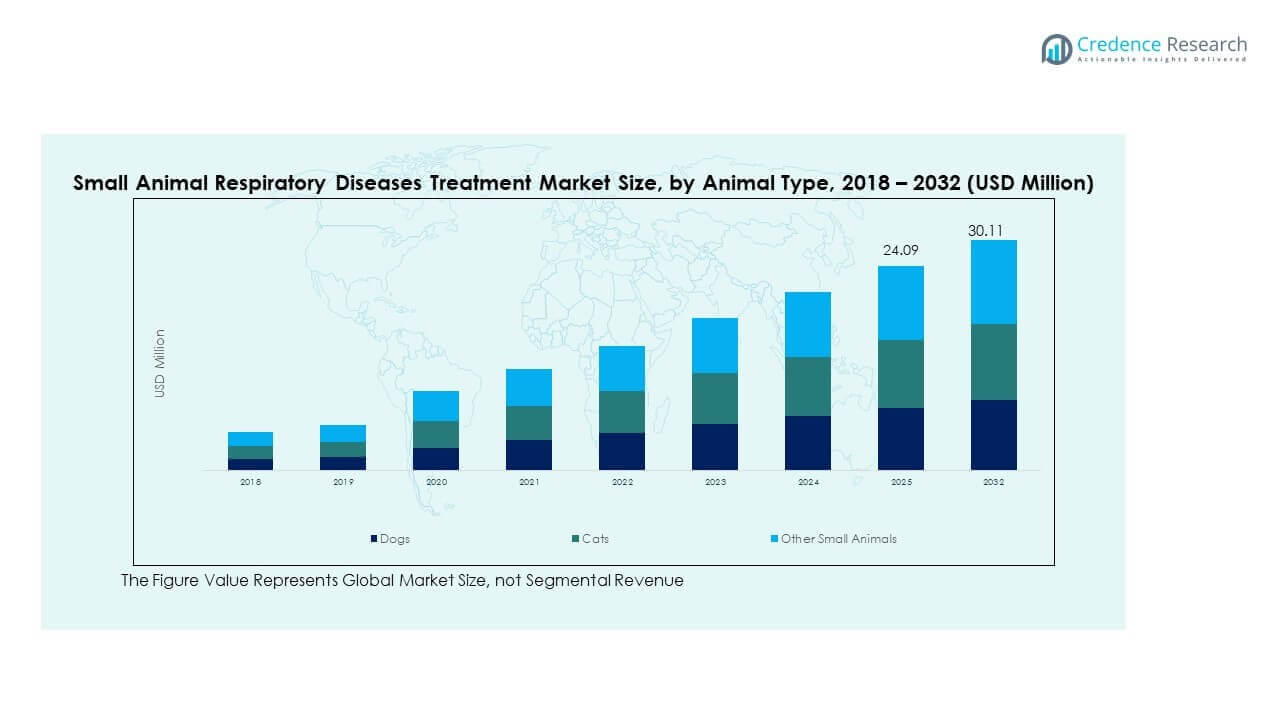
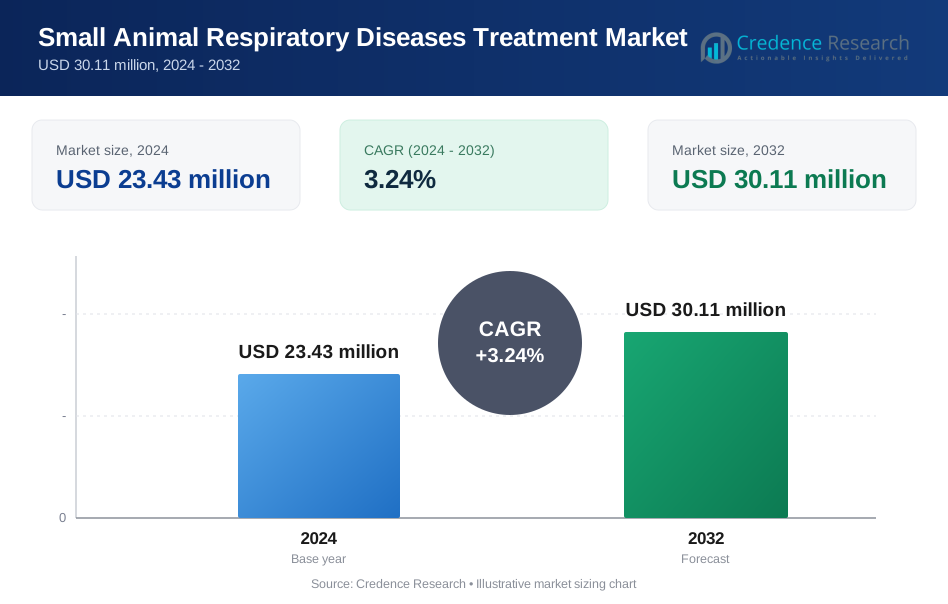
The Small Animal Respiratory Diseases Treatment Market size was valued at USD 22.00 million in 2018 to USD 23.43 million in 2024 and is anticipated to reach USD 30.11 million by 2032, at a CAGR of 3.24% during the forecast period.
| REPORT ATTRIBUTE | DETAILS |
|---|---|
| Historical Period | 2020-2023 |
| Base Year | 2024 |
| Forecast Period | 2025-2032 |
| Small Animal Respiratory Diseases Treatment Market Size 2024 | USD 23.43 Million |
| Small Animal Respiratory Diseases Treatment Market, CAGR | 3.24% |
| Small Animal Respiratory Diseases Treatment Market Size 2032 | USD 30.11 Million |
Market growth is driven by rising companion animal ownership worldwide. Pet owners seek timely diagnosis and effective respiratory care. Veterinary awareness of respiratory infections continues to improve. Clinics expand diagnostic and treatment capabilities for small animals. Preventive healthcare practices gain acceptance among pet parents. Chronic respiratory conditions require long-term treatment management. Improved access to prescription therapies supports demand. Pet humanization increases healthcare spending. These factors collectively sustain market growth.
North America leads due to strong veterinary infrastructure and high pet healthcare spending. The United States remains a key contributor with advanced clinical practices. Europe follows with strong preventive care adoption and strict animal health standards. Countries such as Germany, France, and the UK support stable demand. Asia Pacific emerges as a high-growth region driven by urban pet adoption. China, Japan, and India show expanding clinic networks. Latin America, the Middle East, and Africa register gradual growth with improving awareness.
Market Insights:
- The Small Animal Respiratory Diseases Treatment Market was valued at USD 22.00 million in 2018, reached USD 23.43 million in 2024, and is projected to hit USD 30.11 million by 2032, growing at a CAGR of 3.24%.
- North America led in 2024 with about 37.5% share due to strong veterinary infrastructure, followed by Europe at ~26.4% and Asia Pacific at ~23.6% supported by preventive care adoption and rising pet ownership.
- Asia Pacific is the fastest-growing region, holding nearly 23.6% share in 2024, driven by urbanization, expanding clinic networks, and rising companion animal adoption.
- Regional segmentation shows North America and Europe together accounted for nearly 64% share in 2024, reflecting mature markets with high treatment adherence.
- Asia Pacific, Latin America, the Middle East, and Africa together represented about 36% share in 2024, indicating strong long-term expansion potential across emerging regions.
Market Drivers
Rising Companion Animal Ownership And Higher Veterinary Care Utilization Rates
Pet ownership continues to rise across urban and suburban households. Owners seek timely treatment for respiratory conditions in pets. Veterinary visits increase due to better disease awareness. Clinics expand respiratory diagnostics and treatment services. Pet humanization strengthens spending on animal health. The Small Animal Respiratory Diseases Treatment Market benefits from this behavioral shift. It supports steady demand for prescription therapies. Companion animals receive care similar to human standards. This pattern sustains long-term treatment volumes.
- For instance, Zoetis’ Cytopoint (lokivetmab) showed clinically proven efficacy in canine atopic dermatitis, achieving treatment success in 69% of dogs by day 28 at a minimum 2 mg/kg dose, with statistically significant reductions in pruritus scores across a 49-day study period.
Growing Awareness Of Zoonotic And Communicable Animal Respiratory Infections
Public awareness of zoonotic diseases influences veterinary care decisions. Respiratory infections raise concern due to transmission risks. Veterinarians stress early diagnosis and treatment compliance. Educational campaigns support preventive veterinary visits. Pet owners follow vaccination and treatment schedules more closely. The Small Animal Respiratory Diseases Treatment Market gains from preventive care focus. It improves therapy adoption across clinics. Awareness reduces delayed treatment cases. This driver strengthens routine respiratory disease management.
- For instance, Elanco’s Credelio Quattro, approved in 2024, demonstrated about 98.7% efficacy against fleas and ticks in field studies involving over 400 dogs. The product supports preventive care by reducing parasite-borne infection risks in companion animals.
Expansion Of Veterinary Clinics And Specialty Animal Hospitals Worldwide
Veterinary infrastructure expands across developed and developing regions. Specialty animal hospitals increase respiratory care capacity. Clinics invest in diagnostic imaging and lab tools. Skilled veterinarians manage complex respiratory disorders. Referral networks improve access to advanced treatments. The Small Animal Respiratory Diseases Treatment Market benefits from facility growth. It supports wider therapy availability. Improved service reach raises treatment consistency. Infrastructure expansion ensures sustained market demand.
Rising Incidence Of Chronic And Age-Related Respiratory Conditions In Pets
Pet lifespans increase due to better nutrition and care. Older animals face higher respiratory disease risk. Chronic bronchitis and airway disorders require long-term treatment. Veterinarians recommend continuous therapy management. Owners accept prolonged treatment regimens. The Small Animal Respiratory Diseases Treatment Market supports chronic care demand. It benefits from repeat prescription cycles. Aging pets sustain steady therapy use. Long-term disease management drives market stability.
Market Trends
Shift Toward Advanced Diagnostic Tools In Veterinary Respiratory Care
Veterinary clinics adopt advanced diagnostic technologies. Imaging and molecular tests improve disease accuracy. Early detection supports targeted treatment decisions. Clinics reduce trial-based medication approaches. Precision diagnostics improve therapy outcomes. The Small Animal Respiratory Diseases Treatment Market aligns with this trend. It supports optimized drug selection. Diagnostic-driven care gains acceptance. This trend reshapes treatment protocols.
- For instance, IDEXX Laboratories developed RealPCR panels that rapidly detect canine respiratory pathogens, including H3N2 influenza virus, from nasal swabs. The assays supported outbreak control efforts following the 2015 Chicago H3N2 event by enabling faster diagnosis.
Increased Use Of Combination Therapies For Respiratory Disease Management
Veterinarians prefer combination drug approaches for complex cases. Antibiotics pair with anti-inflammatory therapies. Combination protocols improve recovery rates. Clinics standardize multi-drug treatment plans. This approach reduces relapse risk. The Small Animal Respiratory Diseases Treatment Market reflects this clinical shift. It supports broader product utilization. Treatment customization becomes common practice. Combination therapy adoption continues to rise.
- For instance, Zoetis’ Convenia (cefovecin) is a long-acting injectable antibiotic that provides up to 14-day antibacterial coverage in dogs and cats. Veterinarians use the therapy, often under extra-label guidance, to support treatment of bacterial respiratory infections alongside anti-inflammatory care.
Growth Of Preventive Treatment And Prophylactic Care Practices
Preventive veterinary care gains wider acceptance among pet owners. Clinics emphasize early intervention strategies. Prophylactic treatments reduce disease severity. Routine health plans include respiratory monitoring. Subscription-based care models support compliance. The Small Animal Respiratory Diseases Treatment Market adapts to preventive focus. It benefits from regular treatment cycles. Preventive care stabilizes demand patterns. This trend reshapes market dynamics.
Rising Adoption Of Digital Veterinary Platforms And Teleconsultation Services
Digital platforms support remote veterinary consultations. Telemedicine improves early symptom reporting. Veterinarians guide treatment without physical visits. Digital records improve treatment tracking. Pet owners value convenience and access. The Small Animal Respiratory Diseases Treatment Market aligns with digital care models. It supports timely prescription fulfillment. Technology improves treatment adherence. Digital adoption influences care delivery models.
Market Challenges Analysis
High Treatment Costs And Limited Affordability In Price-Sensitive Regions
Treatment costs remain a concern for many pet owners. Advanced diagnostics raise overall care expenses. Long-term respiratory therapies increase financial burden. Cost sensitivity limits treatment adherence. Some owners delay veterinary visits. The Small Animal Respiratory Diseases Treatment Market faces affordability constraints. It restricts therapy uptake in emerging markets. Cost barriers impact revenue consistency. Financial limitations remain a key challenge.
Limited Access To Skilled Veterinary Professionals In Rural Areas
Rural regions face shortages of trained veterinarians. Respiratory disease diagnosis requires specialized skills. Limited infrastructure restricts advanced care access. Travel distance discourages timely treatment. Referral systems remain underdeveloped. The Small Animal Respiratory Diseases Treatment Market encounters access gaps. It affects treatment penetration rates. Workforce limitations slow market expansion. Skill shortages constrain service quality.
Market Opportunities
Expansion Of Pet Insurance Coverage Supporting Advanced Respiratory Treatments
Pet insurance adoption increases across urban markets. Coverage reduces out-of-pocket treatment costs. Owners approve advanced respiratory therapies more easily. Insurance improves treatment compliance rates. Clinics recommend comprehensive care plans. The Small Animal Respiratory Diseases Treatment Market benefits from insurance growth. It supports higher-value treatment adoption. Financial protection expands addressable demand. Insurance penetration creates long-term opportunities.
Untapped Growth Potential In Emerging Veterinary Healthcare Markets
Emerging regions invest in veterinary healthcare infrastructure. Urbanization increases companion animal adoption. Clinics expand services beyond basic care. Awareness of respiratory diseases improves gradually. International players enter developing markets. The Small Animal Respiratory Diseases Treatment Market gains expansion scope. It benefits from early-stage market development. New clinics drive therapy demand. Emerging economies offer strong growth potential.
Market Segmentation Analysis:
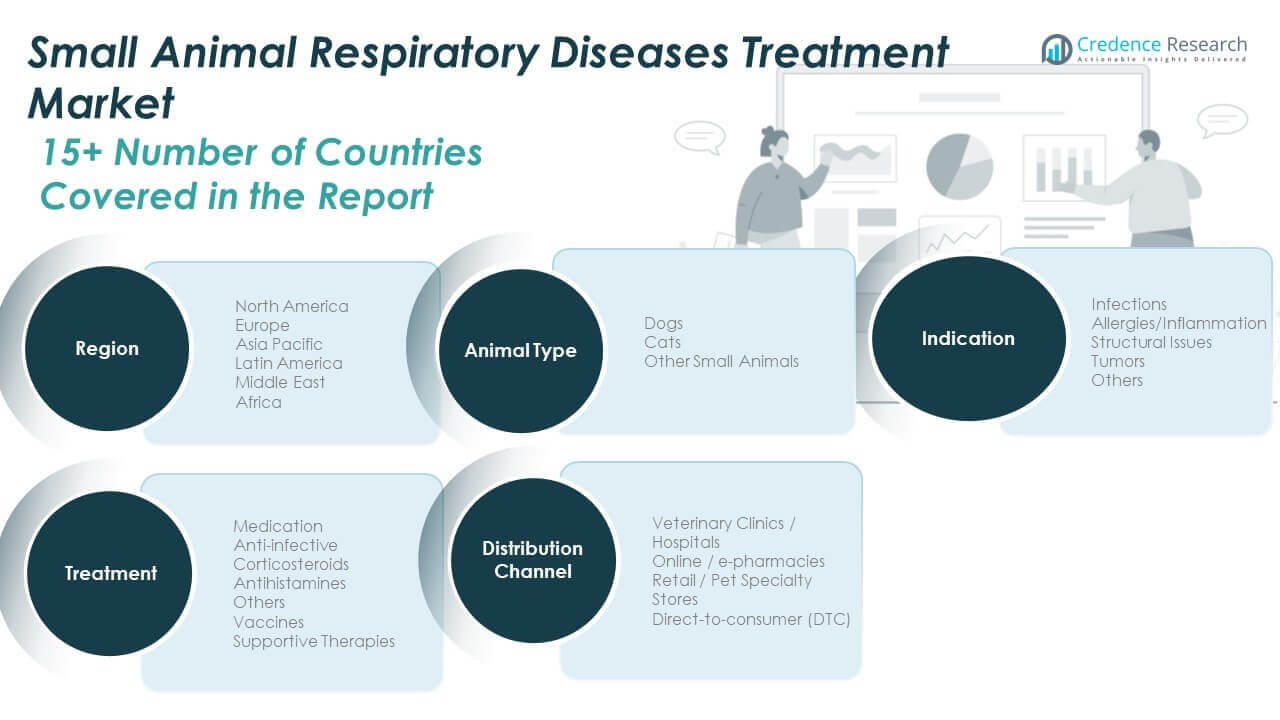
The Small Animal Respiratory Diseases Treatment Market shows clear segmentation patterns across animal type, indication, treatment, and distribution channel.
By animal type, dogs hold a dominant position due to higher diagnosis rates and frequent veterinary visits. Cats follow with rising indoor adoption and growing awareness of chronic respiratory conditions. Other small animals represent a niche segment, supported by specialty veterinary practices and targeted therapies.
By indication, infections account for the largest share, driven by bacterial and viral respiratory cases. Allergies and inflammation form a stable segment due to long-term management needs. Structural issues and tumours require specialized diagnostics and extended treatment plans. Other indications maintain limited but consistent demand within referral clinics.
- For instance, Merck Animal Health’s Nuflor (florfenicol) has shown strong clinical efficacy in treating bovine respiratory disease in large-scale field studies. This outcome highlights the company’s proven capabilities in developing anti-infective therapies for respiratory conditions.
By treatment, medication-based therapies lead overall usage. Anti-infective drugs remain essential for infection control. Corticosteroids and antihistamines support symptom management and chronic care. Vaccines gain traction through preventive healthcare programs. Supportive therapies play a complementary role in recovery protocols.
- For instance, Boehringer Ingelheim’s Metacam (meloxicam) has demonstrated significant pain reduction in dogs following orthopedic surgery in controlled clinical studies. Anti-infective drugs remain essential for infection control, while anti-inflammatory therapies support symptom relief in veterinary care.
By distribution channel, veterinary clinics and hospitals dominate due to direct diagnosis and prescription authority. Online and e-pharmacies expand through convenience and repeat purchases. Retail and pet specialty stores serve basic therapy needs. Direct-to-consumer channels grow slowly, supported by regulated product access and digital engagement.
Segmentation:
By Animal Type
- Dogs
- Cats
- Other Small Animals
By Indication
- Infections
- Allergies/Inflammation
- Structural Issues
- Tumours
- Others
By Treatment
- Medication
- Anti-infective
- Corticosteroids
- Antihistamines
- Others
- Vaccines
- Supportive Therapies
By Distribution Channel
- Veterinary Clinics / Hospitals
- Online / e-pharmacies
- Retail / Pet Specialty Stores
- Direct-to-consumer (DTC)
By Region
- North America
- The U.S.
- Canada
- Mexico
- Europe
- Germany
- France
- The U.K.
- Italy
- Spain
- Rest of Europe
- Asia Pacific
- China
- Japan
- India
- South Korea
- South-east Asia
- Rest of Asia Pacific
- Latin America
- Brazil
- Argentina
- Rest of Latin America
- Middle East & Africa
- GCC Countries
- South Africa
- Rest of the Middle East and Africa
Regional Analysis:
North America Regional Analysis
The North America Small Animal Respiratory Diseases Treatment Market size was valued at USD 8.34 million in 2018 to USD 8.78 million in 2024 and is anticipated to reach USD 11.26 million by 2032, at a CAGR of 3.2% during the forecast period. North America accounted for nearly 37.5% market share in 2024. High pet ownership rates support steady treatment demand. Veterinary infrastructure remains well developed across the region. Pet insurance coverage improves treatment affordability. Advanced diagnostics support early respiratory disease detection. Veterinarians follow standardized treatment protocols. Companion animal humanization drives premium care adoption. The United States leads due to strong clinical networks. Canada supports growth through preventive veterinary care.
Europe Regional Analysis
The Europe Small Animal Respiratory Diseases Treatment Market size was valued at USD 6.03 million in 2018 to USD 6.18 million in 2024 and is anticipated to reach USD 7.52 million by 2032, at a CAGR of 2.5% during the forecast period. Europe held around 26.4% market share in 2024. Strong regulatory frameworks support animal health standards. Preventive care practices remain widely adopted. Veterinary clinics focus on early intervention strategies. Companion animal adoption stays stable across urban centers. Germany, France, and the UK drive regional demand. Structured referral systems improve advanced care access. Treatment adherence rates remain high. Regional growth stays steady due to mature market conditions.
Asia Pacific Regional Analysis
The Asia Pacific Small Animal Respiratory Diseases Treatment Market size was valued at USD 4.94 million in 2018 to USD 5.52 million in 2024 and is anticipated to reach USD 7.89 million by 2032, at a CAGR of 4.6% during the forecast period. Asia Pacific captured nearly 23.6% market share in 2024. Rapid urbanization increases pet adoption rates. Rising income levels support veterinary spending. Awareness of companion animal health continues to improve. Veterinary clinic expansion strengthens treatment access. China and Japan lead regional demand. India shows strong growth through urban pet ownership. Preventive respiratory care gains traction. The region shows the fastest growth pace.
Latin America Regional Analysis
The Latin America Small Animal Respiratory Diseases Treatment Market size was valued at USD 1.45 million in 2018 to USD 1.53 million in 2024 and is anticipated to reach USD 1.83 million by 2032, at a CAGR of 2.3% during the forecast period. Latin America represented about 6.5% market share in 2024. Pet adoption trends support gradual demand growth. Veterinary infrastructure improves across urban areas. Cost sensitivity influences treatment decisions. Brazil and Argentina remain key contributors. Preventive care adoption remains moderate. Specialty veterinary services stay limited. Market growth depends on awareness programs. Regional demand remains stable.
Middle East Regional Analysis
The Middle East Small Animal Respiratory Diseases Treatment Market size was valued at USD 0.77 million in 2018 to USD 0.76 million in 2024 and is anticipated to reach USD 0.88 million by 2032, at a CAGR of 1.8% during the forecast period. The Middle East held nearly 3.2% market share in 2024. Pet ownership remains concentrated in urban zones. Veterinary clinics focus on basic respiratory care. Awareness of companion animal health rises gradually. GCC countries drive most regional demand. Advanced care access remains limited. Cost constraints affect treatment uptake. Market growth remains slow but steady. Infrastructure investments support gradual improvement.
Africa Regional Analysis
The Africa Small Animal Respiratory Diseases Treatment Market size was valued at USD 0.47 million in 2018 to USD 0.66 million in 2024 and is anticipated to reach USD 0.73 million by 2032, at a CAGR of 0.9% during the forecast period. Africa accounted for around 2.8% market share in 2024. Veterinary services remain limited in many areas. Urban pet adoption supports localized demand. Awareness of respiratory diseases stays low. South Africa leads regional treatment adoption. Cost barriers restrict advanced therapy use. Preventive care remains underdeveloped. Market expansion depends on infrastructure growth. Long-term potential remains untapped.
Key Player Analysis:
- Zoetis Inc.
- Boehringer Ingelheim
- Merck Animal Health
- Elanco Animal Health
- Virbac
- Ceva Santé Animale
- Vetoquinol S.A.
- PetIQ Inc.
- MediVet Biologics
- Kyoritsu Seiyaku Corporation
- Dechra Pharmaceuticals PLC
Competitive Analysis:
The Small Animal Respiratory Diseases Treatment Market features a competitive structure led by global animal health companies and supported by regional players. Leading firms focus on broad respiratory portfolios across infections, inflammation, and preventive care. These companies invest in product line depth to address both acute and chronic conditions. Strong veterinary relationships support prescription-led demand. Market leaders rely on established brands to maintain trust among clinicians. It benefits from consistent R&D activity aimed at improved efficacy and safety. Mid-sized players compete through niche therapies and targeted indications. Regional companies strengthen presence through pricing strategies and localized distribution. Strategic partnerships support market reach across clinics and hospitals. Competitive intensity remains moderate due to regulatory entry barriers. Brand loyalty influences purchasing decisions. Innovation pace shapes long-term positioning across treatment categories.
Recent Developments:
- In April 2025, Virbac licensed novel therapeutic antibodies from MabGenesis in Japan, securing rights to develop and commercialize monoclonal antibodies for canine therapeutic treatments, which could extend to respiratory disease management.
- In January 2024, Ceva acquired Scout Bio, a pioneer in gene therapies and monoclonal antibodies targeting chronic pet diseases, paving the way for innovations that may address small animal respiratory issues.
Report Coverage:
The research report offers an in-depth analysis based on animal type, indication, treatment, and distribution channel. It details leading market players, providing an overview of their business, product offerings, investments, revenue streams, and key applications. Additionally, the report includes insights into the competitive environment, SWOT analysis, current market trends, as well as the primary drivers and constraints. Furthermore, it discusses various factors that have driven market expansion in recent years. The report also explores market dynamics, regulatory scenarios, and technological advancements that are shaping the industry. It assesses the impact of external factors and global economic changes on market growth. Lastly, it provides strategic recommendations for new entrants and established companies to navigate the complexities of the market.
Future Outlook:
- The market will benefit from steady growth in companion animal ownership across urban households worldwide.
- Veterinary care standards will continue to improve, supporting earlier respiratory disease diagnosis.
- Preventive care practices will gain stronger acceptance among pet owners and clinics.
- Chronic respiratory disease management will expand due to longer pet lifespans.
- Product portfolios will evolve toward broader multi-indication respiratory solutions.
- Vaccination and prophylactic therapies will see wider clinical adoption.
- Digital veterinary platforms will support faster consultation and treatment access.
- Emerging regions will contribute incremental demand through expanding clinic networks.
- Regulatory clarity will support stable product approvals and market entry.
- The Small Animal Respiratory Diseases Treatment Market will maintain balanced competition between global and regional players.
Request a Free Sample
Fill in your details and we'll send you a free sample report.
- Sample data tables & charts
- Research methodology
Need a Custom Version of This Report?
Tailor the scope, geography, or segments to your exact requirements.
- Custom geography or segment scope
- Direct access to our analyst team
Frequently Asked Questions
What is the current market size for Small Animal Respiratory Diseases Treatment Market, and what is its projected size in 2032?
At what Compound Annual Growth Rate is the Small Animal Respiratory Diseases Treatment Market projected to grow between 2024 and 2032?
Which Small Animal Respiratory Diseases Treatment Market segment held the largest share in 2024?
What are the primary factors fueling the growth of the Small Animal Respiratory Diseases Treatment Market?
Who are the leading companies in the Small Animal Respiratory Diseases Treatment Market?
Which region commanded the largest share of the Small Animal Respiratory Diseases Treatment Market in 2024?
Table of Content
Chapter 1. Report Introduction
- 1.1 Report Description & Purpose
- 1.1.1 Report Title & Market Definition
- 1.1.2 Unique Selling Propositions (USP) & Key Differentiators
- 1.1.3 Value Proposition for Stakeholders
- 1.2 Research Objectives
- 1.2.1 Market Sizing Objectives (Volume & Revenue)
- 1.2.2 Segmentation Objectives
- 1.2.3 Competitive Intelligence Objectives
- 1.2.4 Forecast & Scenario Objectives
- 1.3 Report Scope
- 1.3.1 Small Animal Respiratory Diseases Treatment Scope – Types & Subtypes Covered
- 1.3.2 Geographic Scope – Regions & Countries Covered
- 1.3.3 Historical Period, Base Year & Forecast Period (2024; forecast to 2032)
- 1.3.4 Inclusions & Exclusions
- 1.4 HS Code & Classification Framework
- 1.5 Currency, Units & Pricing Basis
- 1.6 Target Stakeholders
- 1.7 Limitations & Assumptions
Chapter 2. Executive Summary
- 2.1 Global Small Animal Respiratory Diseases Treatment Market Snapshot
- 2.1.1 Market Size – Historical (2024) & Forecast (2024-2032) (2024: USD 23.43 million → 2032: USD 30.11 million)
- 2.1.2 Volume & Revenue – Global Totals
- 2.1.3 Key Market Highlights – Top Five Facts
- 2.2 Small Animal Respiratory Diseases Treatment Market Segmentation Snapshot
- 2.2.1 Market Split by Region – 2024 vs. 2032
- 2.3 Competitive Snapshot
- 2.3.1 Top 10 Players by Revenue Share – 2024
- 2.3.2 Top 10 Players by Volume Share – 2024
- 2.3.3 Recent Strategic Developments (18-Month Summary)
- 2.4 Key Investment Highlights & Strategic Conclusions
Chapter 3. Small Animal Respiratory Diseases Treatment Market Dynamics & Industry Analysis
- 3.1 Market Overview & Context
- 3.1.1 Small Animal Respiratory Diseases Treatment Market Position in the Broader Automotive Value Chain
- 3.1.2 OEM vs. Replacement Market Dynamics
- 3.1.3 Market Maturity & Development Stage by Region
- 3.2 Small Animal Respiratory Diseases Treatment Market Drivers
- 3.3 Small Animal Respiratory Diseases Treatment Market Restraints & Challenges
- 3.4 Small Animal Respiratory Diseases Treatment Market Opportunities
- 3.5 Porter's Five Forces Analysis
- 3.5.1 Threat of New Entrants
- 3.5.2 Bargaining Power of Suppliers
- 3.5.3 Bargaining Power of Buyers
- 3.5.4 Threat of Substitutes
- 3.5.5 Competitive Rivalry – Intensity Assessment
- 3.6 Small Animal Respiratory Diseases Treatment Value Chain Analysis
- 3.6.1 Upstream – Raw Material/Input Suppliers
- 3.6.1.1 Raw Material/Input 1
- 3.6.1.2 Raw Material/Input 2
- 3.6.1.3 Raw Material/Input 3
- 3.6.2 Midstream – Production/Manufacturing/Service Delivery
- 3.6.2.1 Production/Process Overview
- 3.6.2.2 Key Facility Locations & Capacity by Manufacturer
- 3.6.3 Downstream – Distribution & End Consumer
- 3.6.3.1 Primary Channel – B2B/OEM
- 3.6.3.2 Secondary Channels – Dealer, Retail, Online, Direct
- 3.6.4 Value Chain Profitability Analysis
- 3.6.1 Upstream – Raw Material/Input Suppliers
- 3.7 PESTEL Analysis
- 3.7.1 Political Factors
- 3.7.2 Economic Factors
- 3.7.3 Social Factors
- 3.7.4 Technological Factors
- 3.7.5 Environmental Factors
- 3.7.6 Legal Factors
- 3.8 Small Animal Respiratory Diseases Treatment Supply Chain Analysis
- 3.8.1 Raw Material/Input Supply Risk Assessment
- 3.8.2 Manufacturing Concentration Risk (Geographic Exposure)
- 3.8.3 Trade Disruption Impact Analysis
- 3.9 Regulatory & Policy Landscape
Note: The regulatory and policy landscape section covers regulations based on their applicability to the market, Small Animal Respiratory Diseases Treatment category, geography, and scope of the study. Only regulatory frameworks with a material impact on operations, compliance, trade, sustainability, or market access are analyzed in detail.
Chapter 4. Key Investment Pockets & Opportunity Analysis
- 4.1 Small Animal Respiratory Diseases Treatment Market Attractiveness Analysis
- 4.1.1 By Region – Investment Attractiveness Matrix (Volume × CAGR)
- 4.2 Absolute Revenue Growth Opportunity
- 4.2.1 By Region – Absolute USD Growth Through 2032
- 4.3 Incremental Volume Opportunity
- 4.3.1 By Region – Incremental Volume Through 2032
- 4.3.2 Segment – Incremental Volume
- 4.4 Emerging Submarket Opportunity Deep Dive (Subject to Applicability)
- 4.5 Emerging Market Opportunity Scorecards
- 4.5.1 United States
- 4.5.2 Europe
- 4.5.3 Asia
- 4.5.4 Middle East & Africa
Note: Emerging Market Opportunity Scorecards will be included based on relevance and strategic importance. Regions listed are indicative and may vary depending on data availability and market dynamics.
Chapter 5. Small Animal Respiratory Diseases Treatment Import-Export Analysis & Trade Flows
- 5.1 Global Trade Overview
- 5.1.1 Global Export Value by Country (2024)
- 5.1.2 Global Export Volume by Country (2024)
- 5.1.3 Global Import Value by Country (2024)
- 5.1.4 Global Import Volume by Country (2024)
- 5.1.5 Net Trade Balance by Country (2024)
- 5.2 Export Analysis – Segment
- 5.2.1 Type 1 (HS Code)
- 5.2.2 Type 2 (HS Code)
- 5.2.3 Type 3 (HS Code)
- 5.2.4 Type 4 (HS Code)
- 5.2.5 Type 5 (HS Code)
- 5.3 Import Analysis – Segment
- 5.3.1 Type 1 (HS Code)
- 5.3.2 Type 2 (HS Code)
- 5.3.3 Type 3 (HS Code)
- 5.3.4 Type 4 (HS Code)
- 5.3.5 Type 5 (HS Code)
- 5.4 Average Unit Trade Prices
- 5.4.1 Average Export Price – Segment & Country
- 5.4.2 Average Import Price – Segment & Source Country
- 5.4.3 Price Trends (2024)
- 5.5 Key Trade Route Analysis
- 5.5.1 Trade Route 1
- 5.5.2 Trade Route 2
- 5.5.3 Trade Route 3
- 5.5.4 Trade Route 4
- 5.5.5 Trade Route 5
- 5.6 Trade Policy Impact Assessment
- 5.6.1 US Anti-Dumping & Section 301 Tariffs
- 5.6.2 EU Customs Union Impact
- 5.6.3 Major Free Trade Agreements
- 5.6.4 USMCA Rules of Origin
Note: Trade policy analysis will be included only where relevant to the Small Animal Respiratory Diseases Treatment market.
Chapter 6. Competitive Landscape & Company Benchmarking
- 6.1 Small Animal Respiratory Diseases Treatment Market Concentration & Structure
- 6.1.1 Herfindahl-Hirschman Index (HHI) – vs. 2024
- 6.1.2 Tier 1, Tier 2 & Tier 3 Market Structure
- 6.1.3 Global, Regional & Local Player Dynamics
- 6.2 Small Animal Respiratory Diseases Treatment Market Share Analysis – 2024
- 6.2.1 Global Revenue Share by Company
- 6.2.2 Global Volume Share by Company
- 6.2.3 Regional Revenue Share
- 6.2.4 Market Share Evolution ( vs. 2024)
- 6.2.5 OEM Segment Share by Company
- 6.2.6 Replacement Segment Share by Company
- 6.3 Production/Delivery Capacity & Facility Analysis
- 6.3.1 Global Installed Capacity
- 6.3.2 Capacity Utilization Rates
- 6.3.3 Production/Output Volume
- 6.3.4 Facility Locations & Capacity Map
- 6.3.5 Planned Capacity Additions
- 6.4 Small Animal Respiratory Diseases Treatment Competitive Benchmarking Matrix
- 6.4.1 Revenue, Volume, CAGR & Profitability Comparison
- 6.4.2 Channel Revenue Mix
- 6.4.3 Geographic Revenue Exposure
- 6.4.4 R&D Intensity
- 6.4.5 Sustainability Maturity
- 6.5 Strategic Developments in Small Animal Respiratory Diseases Treatment (Last 24 Months)
- 6.5.1 Mergers, Acquisitions & Divestments
- 6.5.2 New Small Animal Respiratory Diseases Treatment Launches
- 6.5.3 Facility Expansions
- 6.5.4 Strategic Alliances, Joint Ventures & Partnerships
- 6.5.5 Distribution Expansion & Market Entry
- 6.5.6 Sustainability & ESG Initiatives
- 6.6 Competitive Strategy Mapping
- 6.6.1 Leader, Challenger, Follower & Niche Classification
- 6.6.2 Pricing Strategy Comparison
- 6.6.3 Channel Strategy Matrix
Note: Strategic developments are included based on their materiality and the availability of reliable information.
Chapter 7. Global Small Animal Respiratory Diseases Treatment Market – By Distribution Channel
- 7.1 Segment Overview
- 7.1.1 Volume & Revenue Split by Channel (2024 & 2032)
- 7.1.2 Channel Mix Evolution (2024-2032)
Chapter 8. Regional Market Analysis – Global Overview
- 8.1 Global Regional Overview
- 8.1.1 Regional Volume Share
- 8.1.2 Regional Revenue Share
- 8.1.3 Regional Volume by Region
- 8.1.4 Regional Revenue by Region
- 8.1.5 Regional Forecast Through 2032
- 8.2 Cross-Regional Segment Analysis
- 8.2.1 By Distribution Channel
- 8.2.2 By Brand/Price Tier
Chapter 9. North America Small Animal Respiratory Diseases Treatment Market
- 9.1 United States
- 9.2 Canada
- 9.3 Mexico
Chapter 10. Europe Small Animal Respiratory Diseases Treatment Market
- 10.1 Germany
- 10.2 France
- 10.3 Italy
- 10.4 United Kingdom
- 10.5 Spain
- 10.6 Poland
- 10.7 Russia
- 10.8 Netherlands
- 10.9 Belgium
- 10.10 Sweden
- 10.11 Denmark
- 10.12 Norway
- 10.13 Rest of Europe
Chapter 11. Asia Pacific Small Animal Respiratory Diseases Treatment Market
- 11.1 China
- 11.2 India
- 11.3 Japan
- 11.4 South Korea
- 11.5 Thailand
- 11.6 Indonesia
- 11.7 Vietnam
- 11.8 Malaysia
- 11.9 Australia
- 11.10 Rest of Asia Pacific
Chapter 12. Latin America Small Animal Respiratory Diseases Treatment Market
- 12.1 Brazil
- 12.2 Argentina
- 12.3 Colombia
- 12.4 Chile
- 12.5 Rest of Latin America
Chapter 13. Middle East Small Animal Respiratory Diseases Treatment Market
- 13.1 Saudi Arabia
- 13.2 United Arab Emirates
- 13.3 Turkey
- 13.4 Israel
- 13.5 Iran
- 13.6 Rest of the Middle East
Chapter 14. Africa Small Animal Respiratory Diseases Treatment Market
- 14.1 South Africa
- 14.2 Egypt
- 14.3 Nigeria
- 14.4 Morocco
- 14.5 Rest of Africa
Chapter 15. Small Animal Respiratory Diseases Treatment Company Profiles
- 15.1 [Company 01]
- 15.1.1 Company Overview
- 15.1.2 Key Management Personnel
- 15.1.3 Products & Services Portfolio
- 15.1.4 Financial Performance
- 15.1.5 Key Market Focus & Geographic Presence
- 15.1.6 Recent Developments & Strategic Initiatives
Note: The company profile list is preliminary and may change based on research findings, market developments, data availability, and client requirements.
Chapter 16. Appendices
- Appendix A – List of Abbreviations & Acronyms
- Appendix B – Industry Classification Code Reference – Full Series
- Appendix C – Production & Capacity Data Tables
- Appendix D – End-Use & Demand Base Tables
- Appendix E – Consumption & Replacement Rate Assumptions
- Appendix F – ASP Reference Tables
- Appendix G – Manufacturing & Facility Database
- Appendix H – Import-Export Data Tables
- Appendix I – Regulatory Summary Tables
- Appendix J – Primary Research Participant List (Anonymized)
- Appendix K – Primary Research Questionnaire Framework
- Appendix L – Data Sources & Bibliography
- Appendix M – Market Size Divergence & Source Comparison
Chapter 17. Research Methodology
- 17.1 Research Framework & Philosophy
- 17.2 Secondary Research – Sources, Hierarchy & Data Extraction
- 17.3 Data Modeling – Bottom-Up & Top-Down Market Sizing
- 17.4 Primary Research – Stakeholder Framework, LOI & Sample Sizes
- 17.5 Forecast Methodology – Regression, Scenario & Sensitivity Analysis
- 17.6 Quality Control – Four-Layer Validation Framework
- 17.7 Limitations & Standard Assumptions
- 17.8 Disclaimer
