Dental Anesthetics Market Overview:
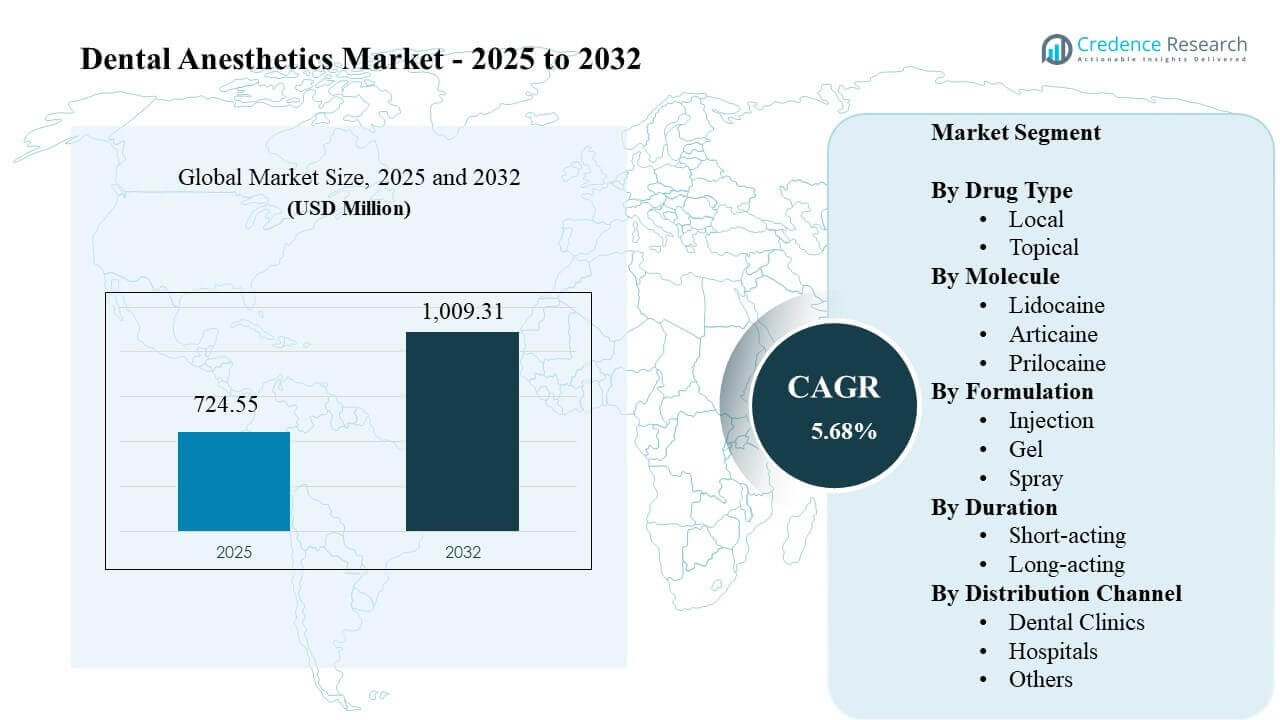
The global Dental Anesthetics Market size was estimated at USD 724.55 million in 2025 and is expected to reach USD 1,009.31 million by 2032, growing at a CAGR of 5.68% from 2025 to 2032. Demand is supported by rising procedure volumes in restorative dentistry and oral surgery, where reliable pain control is a prerequisite for patient acceptance and clinician efficiency. Broader adoption of minimally invasive, high-throughput workflows in dental clinics also increases repeat consumption of anesthetic formulations across routine visits.
| REPORT ATTRIBUTE | DETAILS |
|---|---|
| Historical Period | 2020-2024 |
| Base Year | 2025 |
| Forecast Period | 2026-2032 |
| Dental Anesthetics Market Size 2025 | USD 724.55 million |
| Dental Anesthetics Market, CAGR | 5.68% |
| Dental Anesthetics Market Size 2032 | USD 1,009.31 million |
Key Market Trends & Insights
- The Dental Anesthetics Market is projected to expand at a CAGR of 5.68% from 2025–2032.
- Asia Pacific accounted for an adjusted 36.4% share in 2025, reflecting expanding dental service capacity and higher patient throughput.
- Local anesthetics led by drug type with an adjusted 71.6% share in 2025, supported by routine use across restorative and surgical procedures.
- Injection formulations held an adjusted 62.4% share in 2025, reflecting broad clinical dependence for infiltration and nerve block use cases.
- Dental Clinics represented an adjusted 58.7% share in 2025, aligned with outpatient procedure concentration and standardized chairside protocols.
Segment Analysis
The Dental Anesthetics Market shows demand patterns that are closely tied to procedure type, workflow intensity, and the need for predictable onset and anesthetic depth. Chairside care models favor products that integrate smoothly into standardized clinical protocols, support consistent patient comfort, and minimize procedural disruptions. Form factors that enable rapid administration and reliable effect remain central to daily practice, especially for restorative procedures, endodontics, and minor oral surgery performed in outpatient settings.
Buyer preferences also reflect practice economics and patient experience priorities. Dental care settings typically prioritize products that reduce chairtime variability, support clear dosing control, and perform consistently across diverse patient profiles. Portfolio breadth and availability through established distribution networks influence purchasing decisions, particularly for multi-site clinic groups that emphasize procurement standardization and predictable replenishment cycles.
By Drug Type Insights
Local accounted for the largest share of 71.6% in 2025. Local anesthetics remain essential for procedures requiring deeper and longer pain control, including restorations, extractions, and endodontic care. Clinical preference favors predictable onset and depth of anesthesia to reduce intra-procedure interruptions and improve patient cooperation. Product familiarity and established dosing practices support repeat use across general dentistry and key specialties.
By Molecule Insights
Molecule selection depends on clinical needs related to onset speed, diffusion, and safety considerations across patient groups. Lidocaine maintains wide use due to broad familiarity, extensive clinical experience, and consistent performance in routine dentistry. Articaine use increases in settings where infiltration performance and procedural efficiency influence agent selection. Prilocaine use aligns with clinician preference and patient-specific factors, including tolerability and desired anesthetic characteristics.
By Formulation Insights
Injection accounted for the largest share of 62.4% in 2025. Injectable delivery remains the standard for infiltration and nerve block techniques required in most operative procedures. Established cartridge and delivery-device ecosystems reinforce standardized workflows and repeat purchasing patterns. Gel and spray formats are commonly used as supportive steps for surface anesthesia and patient comfort, but primary procedure anesthesia continues to rely on injections.
By Duration Insights
Duration preference follows procedure complexity, visit structure, and patient expectations for post-visit recovery. Short-acting options align with routine restorative care where rapid recovery and reduced residual numbness support satisfaction and daily functioning. Long-acting options fit surgical and complex procedures where extended anesthesia helps maintain comfort across longer chairtime and postoperative periods. Clinical decision-making also reflects contraindications and technique selection that influence effective duration.
By Distribution Channel Insights
Dental Clinics accounted for the largest share of 58.7% in 2025. Outpatient dental clinics represent the primary point of anesthetic administration across general dentistry and specialty care. Standardization of preferred brands and compatible delivery supplies supports recurring purchase cycles in clinic settings. Group practices and multi-site clinic networks also increase centralized buying behavior, which reinforces consistent anesthetic protocols across locations.
Dental Anesthetics Market Drivers
Rising volumes of restorative and surgical dentistry
Growing utilization of restorative dentistry, endodontics, and oral surgery increases recurring need for effective chairside anesthesia. Dental clinics typically require predictable onset and reliable anesthetic depth to maintain schedule discipline and patient comfort. Higher procedure volumes translate into steady demand for injectables used in infiltration and nerve blocks. Improving access to dental services and expanded clinic footprints support broader consumption across routine visits and specialty procedures.
- For instance, Septodont states that Septanest 1:100,000 delivers onset in 1.5–1.8 minutes for infiltration and 1.4–3.6 minutes for nerve block, with pulpal anesthesia lasting 60–75 minutes and soft tissue anesthesia lasting 180–360 minutes, supporting predictable use across restorative and surgical dental workflows.
Emphasis on patient comfort and chairside efficiency
Patient experience expectations influence clinician choice toward anesthetic solutions that reduce discomfort and improve procedural flow. Pain management quality supports treatment acceptance and repeat attendance, especially for anxiety-sensitive patients. Workflow-driven practices favor products that reduce variability in onset and maintain consistent anesthetic performance across case types. Dental care teams also prioritize products that align with established dosing routines and minimize procedural interruptions.
- For instance, Dentsply’s Oraqix reaches anesthetic effect in 30 seconds, lasts about 20 minutes with an observed range of 14–31 minutes, and in three randomized studies reduced median pain scores during scaling and root planing to 7 versus 17, 5 versus 13, and 11 versus 27 on a 100 mm visual analog scale compared with placebo.
Expansion of outpatient dental clinic capacity
Dental anesthetic consumption is concentrated in outpatient settings where the majority of procedures are performed. Growth in clinic networks supports standardized procurement, predictable replenishment, and repeat utilization across multiple locations. Higher chair utilization raises the importance of products that support fast preparation and consistent delivery. Wider coverage of dental specialties within clinic settings further broadens the range of procedures requiring reliable anesthesia.
Portfolio breadth and availability through distribution networks
Availability of multiple formulations and packaging options supports purchasing decisions across diverse practice types. Distributors and dental supply partners simplify ordering, inventory management, and bundled procurement of related consumables. Reliable supply improves clinical continuity, reducing the risk of product substitution that can disrupt protocols. Vendors with broad portfolios and channel reach can strengthen adoption through training, compatibility support, and practice-level standardization.
Dental Anesthetics Market Challenges
Supply continuity and regulatory compliance pressures can affect product availability, especially for formulations tied to specific packaging, cartridge formats, or controlled ingredients. Dental practices prioritize consistent products to avoid protocol changes that can increase chairtime and training burden. Pricing sensitivity remains relevant for clinics that manage high procedure volumes and fixed reimbursement dynamics. Operational disruptions in sourcing or distribution can create substitution risk and reduce clinician confidence.
- For instance, Septodont states that it produces around 500 million dental anesthetic injections annually, and the company also notes that its products are approved by 150 government health agencies, highlighting how manufacturing scale and broad regulatory compliance can support continuity for cartridge-based dental anesthetic supply.
Clinical variability and patient-specific constraints also shape utilization and create complexity in product selection. Differences in patient tolerance, contraindications, and procedure complexity can require alternate anesthetic strategies. Concern about postoperative numbness and patient satisfaction can reduce willingness to use longer-duration approaches in routine care. Managing these clinical trade-offs requires clinician training and careful protocol design, which can slow product switching.
Dental Anesthetics Market Trends and Opportunities
Product positioning increasingly emphasizes practice workflow benefits, including faster preparation, reduced injection discomfort, and consistent onset across common procedures. Dental organizations seek protocols that scale across multi-site networks, creating opportunities for standardized anesthetic systems aligned with training and procurement centralization. Innovations that improve delivery convenience and reduce procedural variability can strengthen adoption in high-throughput clinics. Patient experience-focused offerings also support differentiation for competitive dental service providers.
- For instance, Milestone Scientific’s STA-based delivery approach was used at a controlled low flow rate of 0.5 drops per second with a 30-gauge, 0.3 mm × 21 mm needle, and in a 130-patient retrospective study the STA group achieved a 95.38% excellent/good pain-relief rate, 93.85% compliance, and 100.00% excellent/good tolerance, while post-extraction dental anxiety was 9.23% versus 26.15% with traditional injection anesthesia.
Growth opportunities also emerge from broader access to dental care and expanding elective and cosmetic dentistry volumes. Higher utilization of implantology, orthodontic procedures with adjunct care, and complex restorative work increases demand for dependable anesthesia. Specialty clinics often require predictable pain control across longer visits, supporting demand for suitable duration profiles. Channel strategies that improve availability across clinics, hospitals, and alternative care settings can expand addressable demand.
Regional Insights
North America
North America held an adjusted 22.1% share in 2025, supported by high procedure volumes and a mature outpatient clinic ecosystem. Demand benefits from established clinical protocols that rely on injectable local anesthesia across routine and specialty dentistry. Consolidation of dental service organizations supports standardized purchasing and repeat utilization across multi-site networks. Product availability through strong distribution infrastructure sustains consistent supply to clinics and hospital dental units.
Europe
Europe accounted for an adjusted 28.9% share in 2025, reflecting steady utilization across general dentistry and specialist care. Clinical emphasis on consistent anesthetic performance supports recurring demand for established injectable and topical options. Structured procurement practices in many markets reinforce standardized product preferences within clinic systems. Ongoing investments in dental care delivery and patient experience initiatives support continued utilization across routine visits.
Asia Pacific
Asia Pacific led with an adjusted 36.4% share in 2025, driven by expanding dental infrastructure and rising patient volumes in large urban and secondary markets. Outpatient clinic growth supports higher utilization of local anesthesia for restorative care and oral surgery. Wider adoption of modern dental workflows increases demand for products that support predictable chairside performance. Expanding private clinic networks also supports broader distribution reach and replenishment frequency.
Latin America
Latin America reached an adjusted 8.1% share in 2025, supported by growing private dental clinic capacity and rising demand for restorative procedures. Purchasing decisions often prioritize consistent availability and cost-effective protocols that maintain chairside efficiency. Clinic-led care delivery concentrates consumption in outpatient settings with repeat procedure volumes. Expansion of dental supply distribution improves access to a wider range of anesthetic options across key countries.
Middle East & Africa
Middle East and Africa represented an adjusted 4.5% share in 2025, shaped by uneven access across countries and concentration of advanced dental services in major cities. Growth in private dental clinics and medical tourism hubs supports increasing use of local anesthesia in elective and restorative care. Procurement often centers on dependable supply channels and clinician familiarity with established products. Investments in healthcare infrastructure and dental service expansion support gradual market development.
Competitive Landscape
The Dental Anesthetics Market features competition centered on product reliability, formulation breadth, and channel coverage across dental clinics and institutional settings. Portfolio strategies emphasize compatibility with routine clinical workflows and consistent performance across common procedure types. Distribution reach and availability through dental supply partners influence share capture, especially for multi-site clinic networks. Differentiation also reflects ease of use, delivery convenience, and support for standardized practice protocols.
Septodont is positioned as a specialist player with a strong focus on dental anesthesia portfolios aligned to chairside needs and routine procedure requirements. Septodont typically benefits from clinician familiarity and established product use patterns that support repeat purchasing. Septodont also competes through channel partnerships that improve access and practice-level adoption. Septodont’s positioning aligns with high-frequency outpatient utilization where standardized protocols and consistent supply matter.
The industry research and growth report includes detailed analyses of the competitive landscape of the market and information about key companies, including:
- Septodont
- Dentsply Sirona
- 3M
- Henry Schein
- Pfizer
- Sanofi
- Kulzer
- Kerr
- Zhermack
- Septa
Qualitative and quantitative analysis of companies has been conducted to help clients understand the wider business environment as well as the strengths and weaknesses of key industry players. Data is qualitatively analyzed to categorize companies as pure play, category-focused, industry-focused, and diversified; it is quantitatively analyzed to categorize companies as dominant, leading, strong, tentative, and weak.
Recent Developments
- In January 2025, Septodont Inc. and Premier Dental launched BufferPro, an 8.4% sodium bicarbonate buffering solution for dental local anesthetics. The product was introduced as a one-step, single-use solution intended to simplify buffering and improve workflow for dental professionals, with commercial availability beginning in early February 2025.
- In September 2025, Dentalhitec Americas announced the U.S. launch of QuickSleeper5 following FDA clearance. The company described QuickSleeper5 as a computer-guided local anesthesia delivery system that enables true intraosseous anesthesia with immediate onset, aimed at improving precision, reducing prolonged soft-tissue numbness, and increasing treatment efficiency.
- In January 2026, Milestone Scientific launched The Wand Ambassador Program to expand awareness and adoption of its STA (Single Tooth Anesthesia) System in the dental market. The company said the program was designed as a peer-to-peer clinical engagement initiative to support broader use of its computerized dental anesthesia delivery platform.
Report Scope
| Report Attribute | Details |
| Market size value in 2025 | USD 724.55 million |
| Revenue forecast in 2032 | USD 1,009.31 million |
| Growth rate (CAGR) | 5.68% (2025–2032) |
| Base year | 2025 |
| Forecast period | 2026-2032 |
| Quantitative units | USD million |
| Segments covered | By Drug Type Outlook: Local, Topical; By Molecule Outlook: Lidocaine, Articaine, Prilocaine; By Formulation Outlook: Injection, Gel, Spray; By Duration Outlook: Short-acting, Long-acting; By Distribution Channel Outlook: Dental Clinics, Hospitals, Others |
| Regional scope | North America, Europe, Asia Pacific, Latin America, Middle East & Africa |
| Key companies profiled | Septodont, Dentsply Sirona, 3M, Henry Schein, Pfizer, Sanofi, Kulzer, Kerr, Zhermack, Septa |
| No.of Pages | 328 |
Segmentation
By Drug Type
- Local
- Topical
By Molecule
- Lidocaine
- Articaine
- Prilocaine
By Formulation
- Injection
- Gel
- Spray
By Duration
- Short-acting
- Long-acting
By Distribution Channel
- Dental Clinics
- Hospitals
- Others
By Region
- North America
- U.S.
- Canada
- Mexico
- Europe
- Germany
- France
- U.K.
- Italy
- Spain
- Rest of Europe
- Asia Pacific
- China
- Japan
- India
- South Korea
- South-east Asia
- Rest of Asia Pacific
- Latin America
- Brazil
- Argentina
- Rest of Latin America
- Middle East & Africa
- GCC Countries
- South Africa
- Rest of the Middle East and Africa

Request a Free Sample
Fill in your details and we'll send you a free sample report.
- Sample data tables & charts
- Research methodology
Need a Custom Version of This Report?
Tailor the scope, geography, or segments to your exact requirements.
- Custom geography or segment scope
- Direct access to our analyst team
Frequently Asked Questions
What is the current size and forecast value of the Dental Anesthetics Market?
What is the CAGR for the Dental Anesthetics Market?
Which segment is the largest in the Dental Anesthetics Market?
What factors are driving growth in the Dental Anesthetics Market?
Who are the leading companies in the Dental Anesthetics Market?
Which region leads the Dental Anesthetics Market?
Table of Content
Chapter 1 Market Segmentation
- 1.1 Segmentation Framework
- 1.1.1 Product and Service Classification
- 1.1.2 Application and End-Use Classification
- 1.1.3 Technology and Solution Classification
- 1.1.4 Customer and Distribution Channel Classification
- 1.1.5 Geographic Segmentation
- 1.1.6 Market Segment Definitions and Boundaries
Chapter 2 Introduction
- 2.1 Report Objectives and Scope
- 2.2 Product Definition and Industry Terminology
- 2.3 Market Inclusions and Exclusions
- 2.4 Research Process
- 2.4.1 Primary Research and Expert Interviews
- 2.4.2 Secondary Research and Source Review
- 2.4.3 Top-Down and Bottom-Up Estimation
- 2.4.4 Data Triangulation and Verification
- 2.5 Market Size Measurement Basis
- 2.5.1 2025: USD 724.55 million → 2032: USD 1,009.31 million
- 2.6 Historical and Forecast Reference Periods
- 2.6.1 Base Year: 2025
- 2.6.2 Forecast Period: 2025-2032
- 2.7 Research Assumptions and Limitations
Chapter 3 Executive Summary
- 3.1 Market Snapshot and Key Findings
- 3.2 Base-Year Market Size, 2025
- 3.3 Forecast Market Size, 2032
- 3.4 Revenue and Volume Growth Outlook
- 3.5 Key Demand and Supply Indicators
- 3.6 Leading Market Segments
- 3.7 Fastest-Growing Market Opportunities
- 3.8 Regional Performance Highlights
- 3.9 Technology and Industry Transformation
- 3.10 Competitive Landscape Summary
- 3.11 Analyst View and Strategic Implications
Chapter 4 Global Dental Anesthetics Market Trends and Developments
- 4.1 Historical Industry Development
- 4.2 Recent Market Trends and Developments
- 4.3 Demand and Customer Behavior Trends
- 4.4 Technology and Product Innovation
- 4.5 Artificial Intelligence, Automation and Digitalization
- 4.6 Local Manufacturing and Supply Chain Realignment
- 4.7 Industry Partnerships, Mergers and Acquisitions
- 4.8 Sustainability and Circular Economy Developments
- 4.9 Government and Private Sector Investment Trends
- 4.10 Emerging Business Models and Commercialization
- 4.11 Industry Developments and Announcements
Chapter 5 Global Dental Anesthetics Market Production, Supply and Demand Analysis
- 5.1 Demand Trend and Consumption Analysis
- 5.2 Demand Forecast, 2025-2032
- 5.3 Production and Output Trend
- 5.4 Production and Output Forecast, 2025-2032
- 5.5 Installed Capacity and Capacity Utilization
- 5.6 Company-Wise Production Plants and Statistics
- 5.6.1 Installed Production Capacity
- 5.6.2 Actual Production
- 5.6.3 Planned Capacity and Expansion Targets
- 5.7 Supply Chain Structure and Procurement Trends
- 5.8 Supply-Demand Gap and Bottlenecks
- 5.9 Import Dependence and Sourcing Structure
- 5.10 Contract Manufacturing and Outsourcing
- 5.11 Regional Supply and Demand Concentration
Chapter 6 Global Dental Anesthetics Market Pricing Analysis
- 6.1 Pricing Structure and Measurement
- 6.2 Historical Pricing Trends
- 6.3 Pricing Outlook, 2025-2032
- 6.4 Average Selling Price and Unit Economics
- 6.5 Pricing by Product and Market Segment
- 6.6 Geographic Pricing Differences
- 6.7 Key Input, Energy, Labor and Logistics Costs
- 6.8 Contract Pricing and Purchasing Models
- 6.9 Pricing Sensitivity and Competitive Positioning
- 6.10 Price, Margin and Profitability Implications
Chapter 7 Global Dental Anesthetics Market Dynamics
- 7.1 Market Growth Drivers
- 7.1.1 Demand-Side Drivers
- 7.1.2 Technology and Innovation Drivers
- 7.1.3 Infrastructure and Investment Drivers
- 7.1.4 Regulatory and Policy Drivers
- 7.2 Market Restraints
- 7.2.1 Cost and Affordability Constraints
- 7.2.2 Technology and Adoption Barriers
- 7.2.3 Supply Chain and Operational Constraints
- 7.3 Market Challenges
- 7.3.1 Competitive Pressure and Margin Erosion
- 7.3.2 Skills, Infrastructure and Implementation Gaps
- 7.4 Emerging Market Opportunities
- 7.5 Market Dynamics Impact and Time-Horizon Assessment
Chapter 8 Global Dental Anesthetics Value Chain Analysis
- 8.1 Industry Value Chain Overview
- 8.2 Upstream Suppliers and Critical Inputs
- 8.3 Technology and Component Providers
- 8.4 Manufacturing or Service Delivery
- 8.5 Distribution, Channel Partners and Integrators
- 8.6 Downstream Applications and End Users
- 8.7 Value Addition and Profit Pools
- 8.8 Vertical Integration and Outsourcing
- 8.9 Supplier Concentration and Risk
- 8.10 Supply Chain Localization and Resilience
Chapter 9 Global Dental Anesthetics Market Regulations and Policies
- 9.1 Relevant Laws, Standards and Compliance Frameworks
- 9.2 Product, Service, Safety and Quality Requirements
- 9.3 Government Policies, Incentives and Subsidies
- 9.4 Imports, Exports and Trade Barriers
- 9.5 Public Procurement and Local Content Requirements
- 9.6 Environmental and Sustainability Compliance
- 9.7 Upcoming Policy Changes and Market Implications
Chapter 10 Global Dental Anesthetics Market Hotspots and Opportunities
- 10.1 Market Opportunity Mapping and Growth Hotspots
- 10.2 High-Growth Applications and Customer Groups
- 10.3 Underserved Markets and White-Space Opportunities
- 10.4 Emerging Technology and Product Opportunities
- 10.5 New Capacity and Investment Hotspots
- 10.6 Market Entry and Expansion Opportunities
- 10.7 Distribution and Partnership Opportunities
- 10.8 Near-Term and Long-Term Commercial Potential
- 10.9 Opportunity Attractiveness and Execution Risks
Chapter 11 Global Dental Anesthetics Market Outlook, 2025-2032
- 11.1 Market Size and Analysis
- 11.1.1 Revenue (Market Measurement: 2025: USD 724.55 million → 2032: USD 1,009.31 million)
- 11.1.2 Market Volume and Quantity Sold
- 11.1.3 Historical Market Size
- 11.1.4 Base-Year Market Size, 2025
- 11.2 Market Forecast, 2025-2032
- 11.2.1 Revenue Forecast to 2032
- 11.2.2 Volume Forecast to 2032
- 11.2.3 CAGR and Year-on-Year Growth
- 11.2.4 Incremental Revenue Opportunity
- 11.3 Forecast Assumptions and Scenario Analysis
- 11.3.1 Base-Case Forecast
- 11.3.2 Optimistic and Conservative Scenarios
- 11.3.3 Technology, Pricing and Policy Sensitivities
- 11.4 Market Attractiveness and Growth Outlook
Chapter 12 Global Dental Anesthetics Market Segmentation and Outlook
- 12.1 Segmentation Summary and Market Shares, 2025
- 12.2 Largest and Fastest-Growing Segments
- 12.3 Segment Growth Comparison
- 12.4 Segment Attractiveness and Priority Matrix
Chapter 13 Global Dental Anesthetics Geographic Market Outlook, 2025-2032
- 13.1 Regional Market Size and Share, 2025
- 13.2 Regional Market Forecast, 2025-2032
- 13.3 Regional Pricing, Production and Demand Differences
- 13.4 North America
- 13.4.1 United States
- 13.4.2 Canada
- 13.4.3 Mexico
- 13.5 Europe
- 13.5.1 Germany
- 13.5.2 France
- 13.5.3 Italy
- 13.5.4 United Kingdom
- 13.5.5 Spain
- 13.5.6 Poland
- 13.5.7 Russia
- 13.5.8 Netherlands
- 13.5.9 Belgium
- 13.5.10 Sweden
- 13.5.11 Denmark
- 13.5.12 Norway
- 13.5.13 Rest of Europe
- 13.6 Asia Pacific
- 13.6.1 China
- 13.6.2 India
- 13.6.3 Japan
- 13.6.4 South Korea
- 13.6.5 Thailand
- 13.6.6 Indonesia
- 13.6.7 Vietnam
- 13.6.8 Malaysia
- 13.6.9 Australia
- 13.6.10 Rest of Asia Pacific
- 13.7 Latin America
- 13.7.1 Brazil
- 13.7.2 Argentina
- 13.7.3 Colombia
- 13.7.4 Chile
- 13.7.5 Rest of Latin America
- 13.8 Middle East
- 13.8.1 Saudi Arabia
- 13.8.2 United Arab Emirates
- 13.8.3 Turkey
- 13.8.4 Israel
- 13.8.5 Iran
- 13.8.6 Rest of the Middle East
- 13.9 Africa
- 13.9.1 South Africa
- 13.9.2 Egypt
- 13.9.3 Nigeria
- 13.9.4 Morocco
- 13.9.5 Rest of Africa
- 13.10 Regional Investment, Policy and Supply Chain Differences
- 13.11 Regional Competitive Landscape
- 13.12 Geographic Growth Hotspots
Chapter 14 Global Dental Anesthetics Technology, Innovation and Sustainability Outlook
- 14.1 Technology Landscape and Maturity
- 14.2 Product, Process and Service Innovation
- 14.3 AI, Automation and Digital Tools in the Industry
- 14.4 Technology Adoption and Performance Benchmarking
- 14.5 Innovation Pipeline and R&D Investment
- 14.6 Patent and Intellectual Property Trends
- 14.7 Energy Efficiency and Resource Management
- 14.8 Sustainability, Recycling and Circularity
- 14.9 Technology Roadmap, 2025-2032
- 14.10 Risks of Obsolescence and Technology Substitution
Chapter 15 Global Dental Anesthetics Market Key Strategic Imperatives
- 15.1 Growth and Market Entry Priorities
- 15.2 High-Return Products and Segments
- 15.3 Pricing, Profitability and Cost Optimization
- 15.4 Technology Investment and Product Differentiation
- 15.5 Supply Chain Localization and Resilience
- 15.6 Distribution and Customer Acquisition
- 15.7 Partnership, Acquisition and Capacity Strategy
- 15.8 Regional Expansion Priorities
- 15.9 Short-, Medium- and Long-Term Actions
Chapter 16 Competition Outlook
- 16.1 Industry Competition Characteristics
- 16.2 Market Structure and Concentration
- 16.3 Market Share and Competitive Positioning, 2025
- 16.4 Company-Wise Revenue and Product Benchmarking
- 16.5 Production and Service Capacity Benchmarking
- 16.6 Technology, Pricing and Differentiation
- 16.7 Regional Footprint and Distribution Strength
- 16.8 Mergers, Acquisitions and Strategic Alliances
- 16.9 New Entrants and Competitive Threats
- 16.10 Porter's Five Forces and Industry Attractiveness
- 16.11 Competitive Outlook, 2025-2032
Chapter 17 Company Profiles
- 17.1 Company Coverage and Selection Criteria
- 17.2 Leading Market Participants – Standard Profile Structure
- 17.2.1 Business Description
- 17.2.2 Company Ownership and Geographic Presence
- 17.2.3 Product and Service Portfolio
- 17.2.4 Manufacturing and Operating Footprint
- 17.2.5 Production Capacity and Expansion Plans
- 17.2.6 Financial Performance and Investment
- 17.2.7 Market Share and Competitive Position
- 17.2.8 Technology and Innovation Capabilities
- 17.2.9 Strategic Alliances or Partnerships
- 17.2.10 Recent Developments
- 17.2.11 Growth Strategy and Outlook
- 17.3 Other Relevant Market Participants
Note: Every listed company is profiled on the structure shown under the first company. The company list is preliminary and may change based on research findings, market developments, data availability and client requirements.
Chapter 18 Disclaimer
- 18.1 Research and Forecast Disclaimer
- 18.2 Data Source and Estimation Limitations
Note: The depth of individual sections depends on data availability for this market. Volume, capacity, trade and other unit-based metrics are included where applicable.