
Antheia Wins Conditional $80 Million Pentagon Strategic Capital Loan to Onshore Drug Ingredients
Antheia, a Menlo Park, California, biomanufacturing company that uses engineered biosynthesis to make pharmaceutical ingredients, said on Oct. 18, 2026, that it has received a conditional commitment for a direct, long-term loan of up to $80 million from the U.S. Department of War's Office of Strategic Capital. The company said the financing, paired with additional private capital, is meant to support a U.S. manufacturing strategy aimed at bringing production of critical drug ingredients back onshore.
Key developments
- The Office of Strategic Capital (OSC) issued a conditional commitment for a direct, long-term loan of up to $80 million to Antheia.
- Antheia said the loan, combined with additional private capital, will support its U.S. manufacturing strategy for key starting materials (KSMs) and active pharmaceutical ingredients (APIs).
- The commitment is not final. Antheia must meet further financial, legal, technical, investment and due diligence requirements before financial close.
- The company said it has previously secured $32 million in non-dilutive federal financing, along with equity from strategic government-affiliated investors.
- Antheia cited U.S. reliance on foreign countries for about 90 percent of its supply of KSMs and APIs as the supply chain risk it aims to address.
How the technology works
Most small-molecule drug ingredients are produced through multistep chemical synthesis or extracted from plants, and much of that capacity sits outside the United States. Antheia takes a different route. It describes itself as an advanced biosynthesis company that engineers microbial strains to produce high-value pharmaceutical ingredients through fermentation, a process the company says is faster than legacy methods and less exposed to agricultural and geopolitical supply shocks.
The company has already moved part of its pipeline into commercial supply. Antheia has reported its first commercial delivery of thebaine, a key ingredient used to produce the opioid overdose reversal drug Narcan. That milestone matters because thebaine has traditionally been derived from opium poppies, a crop concentrated in a handful of countries and subject to strict international controls.
Antheia has also built a record of federal project work. In March 2026, it announced an additional $9 million under an expanded project agreement with the Biopharmaceutical Manufacturing Preparedness Consortium (BioMaP-Consortium), bringing that project's total to $21 million. The agreement is funded by the Department of Health and Human Services through its Defense Production Act Title III program, under the Administration for Strategic Preparedness and Response, and covers production of two critical pharmaceutical ingredients at a significantly increased commercial scale.
Industry implications
The OSC commitment extends a defense-oriented lending tool into pharmaceutical manufacturing, a sector that federal agencies have increasingly framed as a national security concern. The office was created to bring private capital into technologies and supply chains the Pentagon considers critical, and a loan to an ingredient maker signals that drug supply resilience now sits alongside minerals, energy and electronics on that list.
For drugmakers, the practical question is whether domestically produced KSMs and APIs can compete on cost and qualification timelines with established overseas suppliers. Generic manufacturers in particular operate on thin margins and tend to change suppliers only when there is a clear regulatory, pricing or continuity advantage. Government-backed debt can lower the capital cost of building new plants, but buyers will still need validated processes, regulatory filings and consistent output before they shift volumes.
The financing structure is also notable. A loan, rather than a grant, implies an expectation of repayment from commercial revenue. That places pressure on Antheia to convert its pipeline into products with paying customers, not just government-funded demonstration projects.
Competitive and supply chain implications
Antheia is pursuing a hybrid manufacturing footprint. In November 2025, it partnered with TAPI, a global API and KSM manufacturer and contract development and manufacturing organization, to use TAPI's fermentation capabilities and European facilities to scale existing products and speed future launches. The OSC-backed plan adds a U.S. production leg to that network, which could give customers a choice between European and domestic supply for the same biosynthetic ingredients.
The move puts Antheia in a growing field of companies seeking federal support to localize pharmaceutical inputs, including established chemical API makers and other synthetic biology firms. Its differentiation rests on fermentation-based routes to molecules that are hard to make by conventional chemistry or that depend on plant extraction. If those routes scale reliably, they could reduce the number of steps, and the number of countries, involved in producing certain ingredients.
Capital is less of a constraint than it was a year ago. Antheia said in January 2026 that it had secured more than $175 million over the prior year, including Series C funding led in its second close by ATHOS KG and America's Frontier Fund, as well as non-dilutive government agreements. Jeff Karras, general partner at America's Frontier Fund and an Antheia board member, said the company is showing that "American-born technology can become American manufacturing capacity."
Regional implications
Antheia has not disclosed where its U.S. manufacturing operations will be located, and the announcement does not name a site, capacity or construction timeline. That leaves states and local economic development agencies with an open question about where the investment will land. Biomanufacturing plants typically gravitate toward regions with fermentation infrastructure, a trained bioprocess workforce and access to utilities and wastewater capacity.
Outside the United States, the plan carries implications for current ingredient suppliers. Much of the world's KSM and API capacity is concentrated in Asia, and U.S. policy has increasingly favored domestic and allied production. Antheia's existing tie-up with TAPI's European sites suggests the company sees a role for allied manufacturing alongside U.S. capacity rather than a purely domestic model.
Credence Research analysis
The OSC commitment is significant less for its size than for what it represents: federal defense financing being applied directly to the earliest links of the drug supply chain. Policy attention on drug shortages has often focused on finished dosage forms, while the upstream starting materials that feed those products have received less capital. Antheia's own framing, that the U.S. depends on foreign sources for about 90 percent of KSMs and APIs, points to where the bottleneck sits. A loan that helps build domestic capacity at that level addresses the dependency at its root rather than at the final packaging stage.
Execution risk remains high. The commitment is conditional, the company has not named a site or production volumes, and biosynthetic processes must still prove they can run at commercial scale with consistent quality and costs that generic buyers will accept. Chief Financial Officer Eric d'Esparbes said expanding the U.S. footprint is "central to our commercial strategy." The test will be whether Antheia can lock in offtake agreements with drug manufacturers that make the plant economically self-sustaining once federal support is in place.
What comes next
- Antheia must satisfy the financial, legal, technical, investment and due diligence conditions required to reach financial close on the OSC loan.
- The company is expected to identify the location, scale and timeline of its planned U.S. manufacturing operations.
- Additional private capital will need to be committed alongside the federal loan, per the company's stated financing plan.
- Work continues under the HHS-funded BioMaP-Consortium agreement covering two critical pharmaceutical ingredients.
- Commercial scale-up through the TAPI partnership in Europe is set to run in parallel with the U.S. build-out.
Sources
- Antheia: Antheia Secures $80 Million Conditional Funding Commitment from Department of War's Office of Strategic Capital (Oct. 18, 2026)
- Antheia: Additional $9 Million in Expanded BioMaP-Consortium Project Agreement (March 4, 2026)
- Antheia: Additional $24 Million to Complete Series C Financing (Jan. 27, 2026)
- Antheia and TAPI: Partnership on Global Commercialization of Critical Pharmaceutical Ingredients (Nov. 20, 2025)
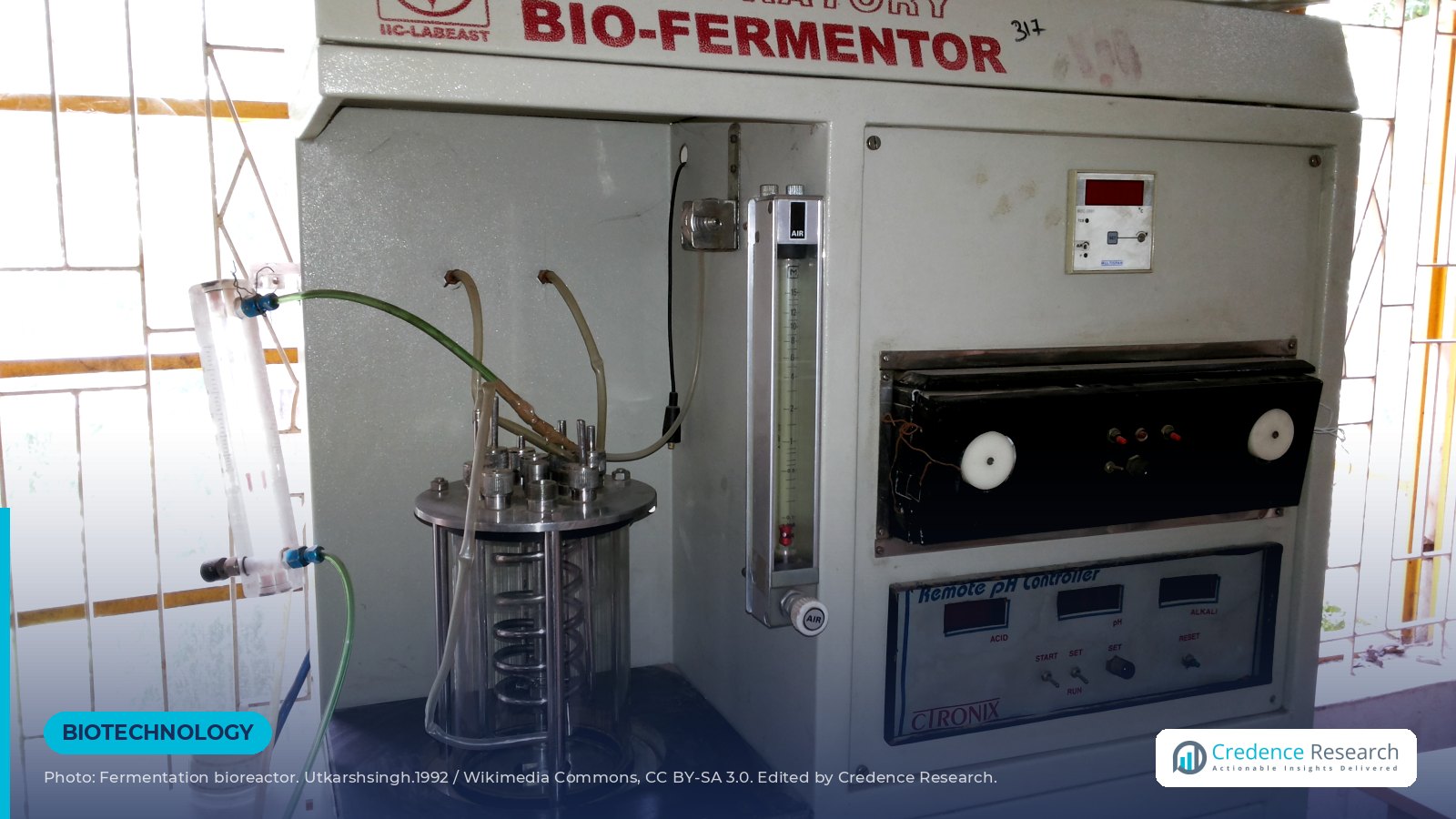
Image: Laboratory fermentation bioreactor, by Utkarshsingh.1992 via Wikimedia Commons, CC BY-SA 3.0. Cropped and edited by Credence Research.

About the Author

Senior News Editor at Credence Research Inc