
FDA approves Roche's Enspryng as first at-home injectable treatment for thyroid eye disease
The U.S. Food and Drug Administration has approved Roche's Enspryng (satralizumab) for adults with thyroid eye disease, making it the first treatment for the condition that patients can inject under the skin at home, the Basel, Switzerland-based drugmaker said Oct. 16, 2026. The decision gives Enspryng its second U.S. indication, six years after it was first cleared for neuromyelitis optica spectrum disorder, a rare autoimmune disease of the central nervous system.
Key developments
- Enspryng is given as a subcutaneous injection every four weeks during the maintenance phase. After training from a healthcare provider, a patient or caregiver can give the injection at home.
- The approval rests on SatraGO-1 and SatraGO-2, two identically designed Phase III trials that randomized 258 patients in 19 countries to Enspryng or placebo. SatraGO-2 met its primary endpoint. SatraGO-1 did not.
- In SatraGO-2, 52.9% of patients with active, moderate-to-severe disease on Enspryng achieved a reduction in eye bulging of at least 2 millimeters at Week 24, compared with 23.4% on placebo. Double vision improved in 60.7% of treated patients versus 25.8% on placebo.
- Roche reported no new safety signals in the trials and said the drug's profile matched what has been seen in its use for neuromyelitis optica.
Disease background
Thyroid eye disease, also called Graves' ophthalmopathy, is a rare, progressive autoimmune condition in which the muscles and fatty tissue around the eye become inflamed and swollen. The swelling pushes the eye forward, a sign known as proptosis, and can cause double vision, redness, eyelid retraction and pain. In severe cases, pressure on the optic nerve can threaten sight. Roche puts the prevalence at about 155 people per 100,000.
The disease most often occurs in people with an overactive thyroid, and roughly half of those patients develop at least mild eye symptoms, according to Roche. It can also appear in people with an underactive or normally functioning thyroid. For decades, treatment relied on steroids, orbital radiation and surgery to remove bone or tissue from the eye socket. Targeted biologic drugs reached the market only in 2020.
How the drug works
Satralizumab is a humanized monoclonal antibody that binds both the soluble and the membrane-bound forms of the interleukin-6 receptor, blocking a signaling pathway that drives inflammation. It was developed by Chugai Pharmaceutical, the Japanese drugmaker in which Roche holds a majority stake, using Chugai's antibody recycling technology. That design lets the antibody release its target inside cells and return to circulation, extending how long each dose works and allowing injections every four weeks.
Enspryng is already approved for neuromyelitis optica in about 90 countries, including the U.S. and the European Union, and Roche says its safety experience covers more than 16,000 patients. That record gives prescribers a longer safety history than a newly launched molecule would carry.
Industry implications
The approval introduces a second biological approach to a field built so far around one target. The two other FDA-approved therapies for the disease, Amgen's Tepezza (teprotumumab) and Viridian Therapeutics' Lumvoa (veligrotug), both block the insulin-like growth factor 1 receptor, and both are given by intravenous infusion. Viridian won approval for Lumvoa in June 2026 with a course of five infusions given every three weeks.
Infusions require clinic visits and chair time at infusion centers, which can be a burden for working-age patients and for those far from specialist care. A home-injected drug shifts administration out of the clinic. For manufacturers and distributors, that typically means dispensing through specialty pharmacies rather than physician offices, a change that affects how the drug is stocked, billed and reimbursed.
A different mechanism also matters for patients who cannot take or do not respond to the existing class. Tepezza's label carries warnings about hearing impairment, and physicians have sought options for patients at risk of that side effect. IL-6 is not a new target in this disease. Some specialists have used Roche's intravenous IL-6 receptor drug tocilizumab off-label for patients who do not respond to steroids, and Enspryng now gives them an approved option in the same pathway.
Competitive and supply chain implications
For Amgen and Viridian, Enspryng is a competitor on convenience rather than on head-to-head efficacy, since no trial has compared the drugs directly. The split trial result is the main point of debate. Regulators accepted one positive pivotal study alongside one that missed, and specialists will weigh that evidence against the infusion-based drugs when choosing treatment. Payers may use the same evidence to decide where Enspryng sits in coverage policies.
On the supply side, Enspryng is a biologic that Chugai already produces at commercial scale for neuromyelitis optica, where it is supplied in a prefilled syringe. Moving into a larger patient population will test that capacity, along with the cold-chain distribution and patient training programs that home injection requires.
Regional implications
The approval is U.S.-only for now. Roche's announcement does not mention filings for thyroid eye disease in the European Union or Japan, and the timing of any submissions there will decide when patients outside the U.S. gain access. Because Chugai developed the drug and markets Roche Group products in Japan, a Japanese filing would be a natural next step to watch. Europe is the other major market where the infusion-based IGF-1R class has set expectations for what a thyroid eye disease therapy must deliver.
Credence Research analysis
Roche is entering this market with a practical argument rather than a clear efficacy advantage. At-home dosing every four weeks addresses the most visible drawback of the infusion drugs, and a mechanism outside the IGF-1R class gives specialists an alternative when hearing risk or lack of response is a concern. Those are real advantages for patients with chronic disease who face months of treatment.
The evidence base is the weaker point. With one of two Phase III trials missing its primary endpoint, uptake will likely depend on how ophthalmologists and endocrinologists read the SatraGO-2 results and on early real-world experience. Pricing and payer decisions, which Roche has not disclosed, will shape the launch as much as the label. The approval also extends the commercial life of an established Roche-Chugai asset, a pattern of adding indications to existing antibodies that large drugmakers increasingly use to get more value from proven molecules.
What comes next
- U.S. launch timing and list price, neither of which Roche has announced.
- Coverage decisions by insurers and pharmacy benefit managers, including any step-therapy requirements.
- An FDA decision on Enspryng for MOG antibody-associated disease, under Priority Review with a decision expected in January 2027.
- Any regulatory filings for thyroid eye disease in Europe and Japan.
- Further analyses from the SatraGO program, including longer-term and chronic-disease data.
Sources
- Roche announcement of the FDA approval of Enspryng for thyroid eye disease
- Viridian Therapeutics release on the FDA approval of Lumvoa
- Healio report on the Enspryng approval
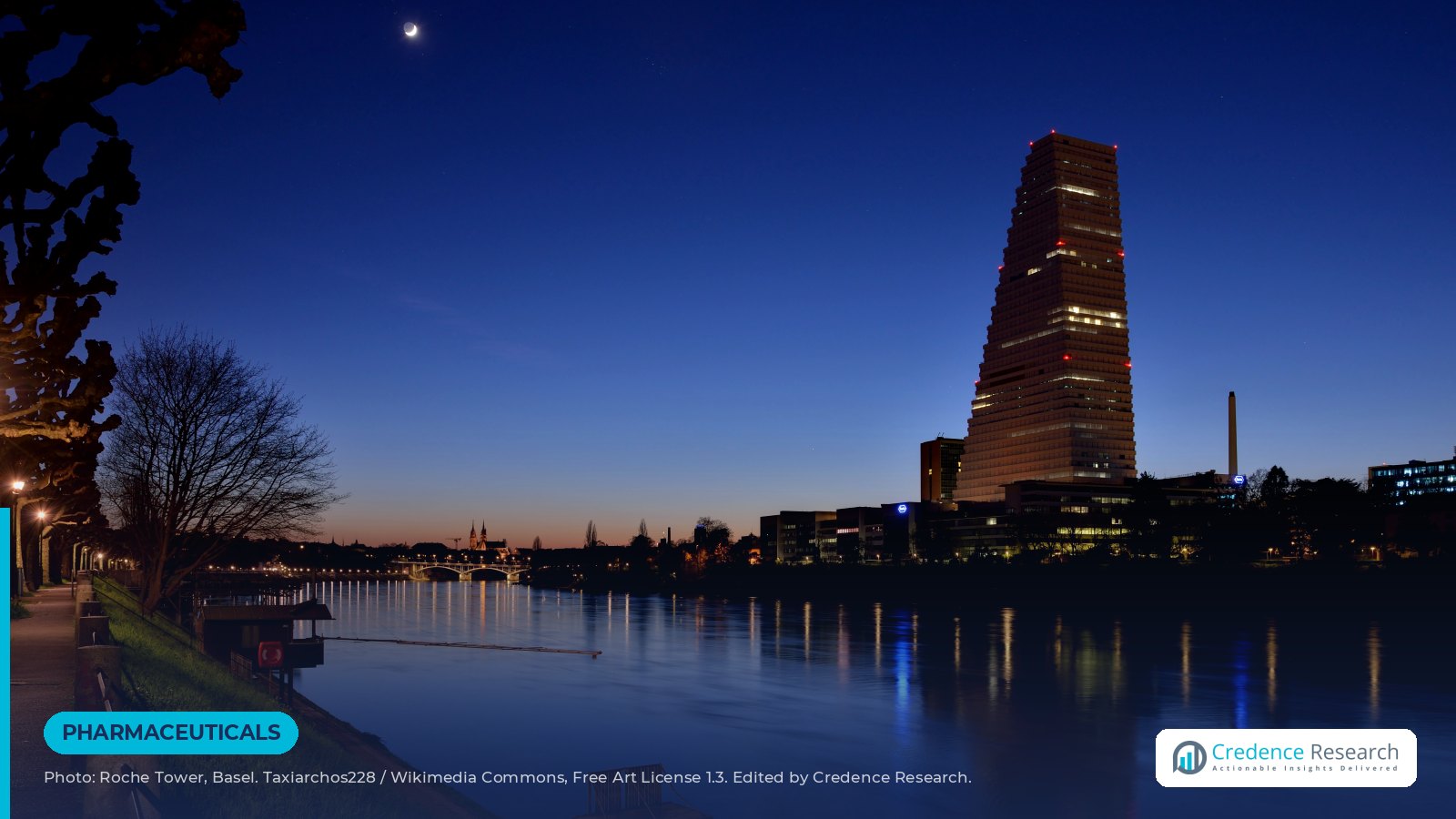
Image: Roche Tower, Basel, by Taxiarchos228 via Wikimedia Commons, Free Art License 1.3. Cropped and edited by Credence Research.

About the Author

Senior News Editor at Credence Research Inc