Market Overview:
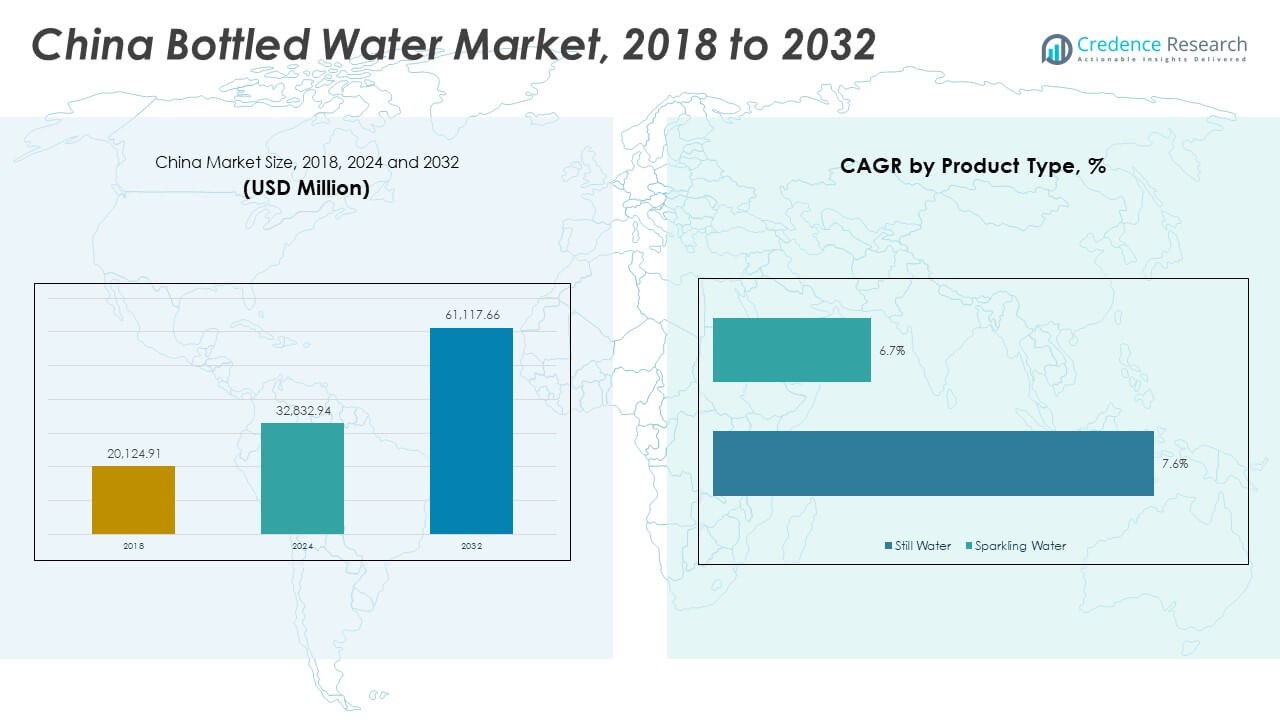
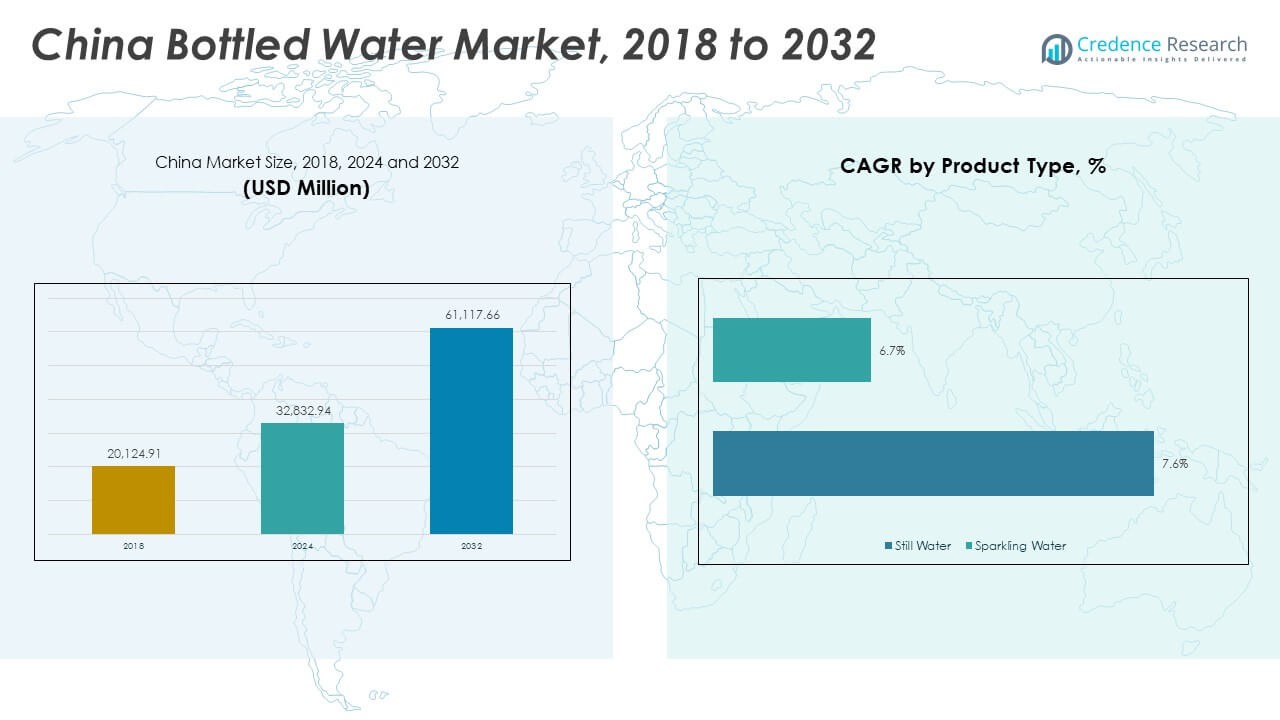
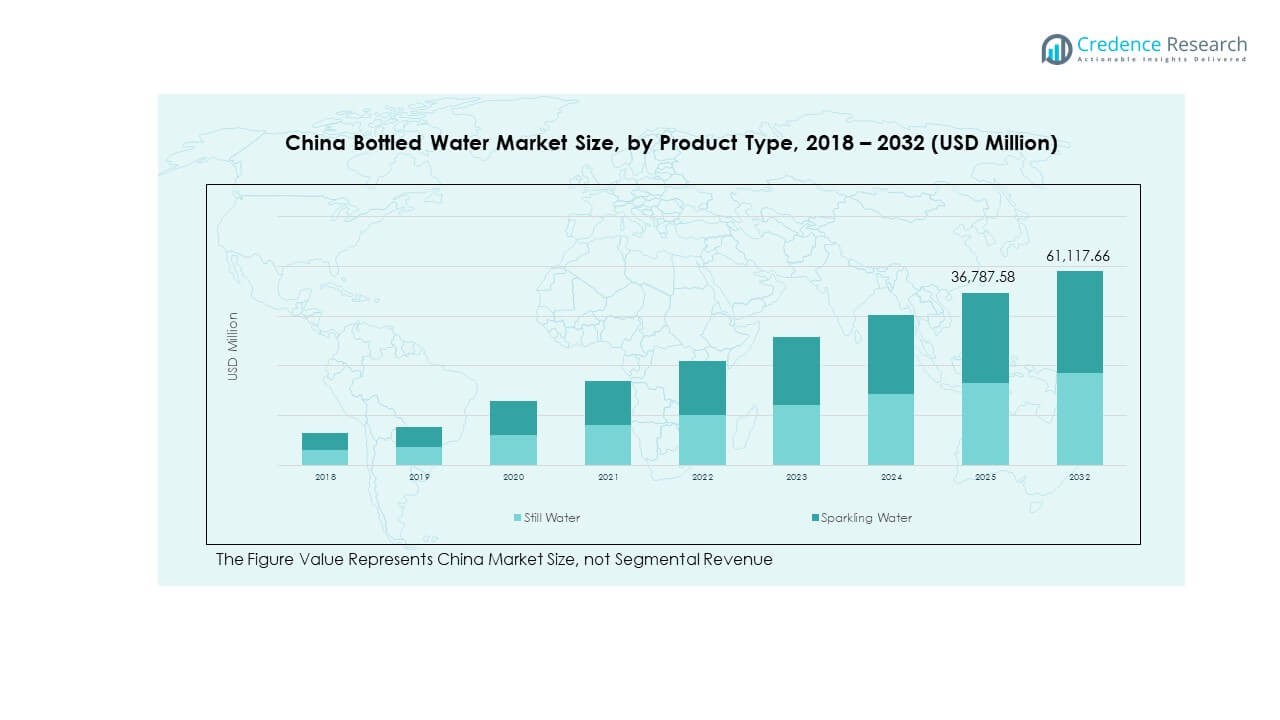
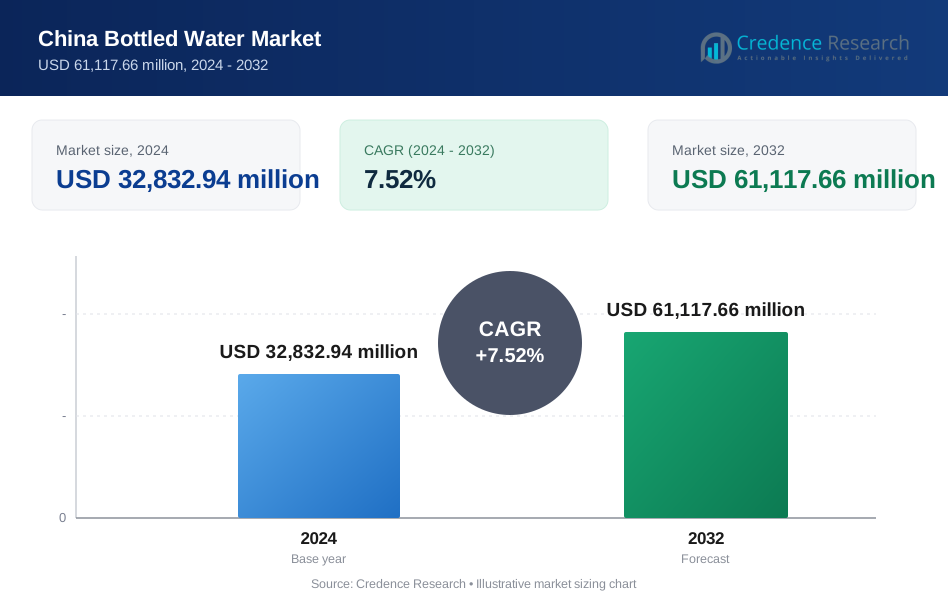
The China Bottled Water Market size was valued at USD 20,124.91 million in 2018 to USD 32,832.94 million in 2024 and is anticipated to reach USD 61,117.66 million by 2032, at a CAGR of 7.52% during the forecast period.
| REPORT ATTRIBUTE | DETAILS |
|---|---|
| Historical Period | 2020-2023 |
| Base Year | 2024 |
| Forecast Period | 2025-2032 |
| China Bottled Water Market Size 2024 | USD 32,832.94 Million |
| China Bottled Water Market , CAGR | 7.52% |
| China Bottled Water Market Size 2032 | USD 61,117.66 Million |
Growth is driven by rising health awareness, greater preference for safe packaged drinking water, and widespread concern over tap-water quality in major urban centres. Consumers shift toward still and mineral water for daily hydration, supported by strong brand visibility across retail formats. Expanding disposable income boosts spending on premium and functional water products. Product innovations, including flavoured and enriched variants, strengthen the market’s appeal. Modern retail and e-commerce continue to accelerate category penetration across all age groups.
Regionally, eastern provinces lead due to high urbanisation, dense retail networks and strong brand engagement. Southern provinces follow, supported by hospitality growth and evolving lifestyle preferences. Central and western regions emerge gradually as household adoption increases and retail infrastructure expands. Consumers in coastal cities show stronger demand for premium and functional water, while inland markets display rising interest in affordable formats. This geographic spread highlights a balanced growth pattern across the China Bottled Water Market.
Market Insights
- The China Bottled Water Market grew from USD 20,124.91 million in 2018 to USD 32,832.94 million in 2024 and is projected to reach USD 61,117.66 million by 2032, supported by a CAGR of 7.52%.
- Eastern China leads with about 40% share due to dense urbanisation and strong retail development, followed by Southern China at 30% supported by tourism and lifestyle demand, while Central & Western China hold 30% due to expanding household adoption.
- Central & Western China represent the fastest-growing region with a 30% share, driven by rising middle-class consumption and gradual improvement in retail access.
- Still water accounts for roughly 70% of the total category share in the chart, reflecting strong household and everyday hydration demand.
- Sparkling water holds about 30% share in the chart and shows steady growth supported by premium, lifestyle-focused consumer segments.
Key Market Drivers
Rising Health Awareness and Preference for Safe Drinking Water
China Bottled Water Market expansion is fueled by a rising health-conscious population preferring clean hydration. Consumers increasingly avoid sugary beverages and carbonated drinks, turning toward purified and mineral water options. Concerns over urban water contamination push bottled options as a safe daily choice. Marketing campaigns by leading brands emphasize purity and mineral benefits. Young and middle-income groups choose bottled water for everyday consumption. It benefits from the growing trend of healthy lifestyles across cities. Public trust in branded water quality enhances steady demand. Expanding awareness across smaller towns strengthens nationwide adoption.
- For instance, Nongfu Spring reported in its 2023 annual financial results that bottled water generated RMB 20.26 billion in revenue, recording 10.9% year-on-year growth. Bottled water contributed 47.5% of the company’s total revenue, according to figures disclosed in its official filings and widely reported by industry media.
Urbanization and Strong Distribution Networks Boosting Accessibility
Rapid urbanization drives bottled water penetration across convenience stores, supermarkets, and e-commerce platforms. Expanding retail chains and logistics networks make bottled water available in both cities and rural regions. It benefits from an organized supply chain ensuring steady delivery and product consistency. Busy urban lifestyles promote ready-to-drink packaging formats suitable for travel and office use. The rising middle class increases spending on convenience-oriented beverages. Retail partnerships with local delivery services widen product reach. E-commerce platforms enable direct brand-to-consumer access. Continuous expansion of modern retail infrastructure sustains strong national demand.
- For instance, China Resources C’Estbon reported a retail sales volume of around 13.5 million tons in 2023, according to data disclosed in its IPO filings and market reports. The company supplies bottled water through more than 300,000 retail outlets nationwide, supported by a combination of self-operated and partnered logistics hubs that ensure broad coverage across both urban and rural regions.
Innovation in Packaging and Brand Differentiation Enhancing Consumer Appeal
Packaging innovation remains a core driver shaping consumer preferences and loyalty. Companies invest in eco-friendly and lightweight bottles to attract environmentally aware buyers. Unique bottle designs and smart labels improve market visibility and brand recognition. The China Bottled Water Market benefits from premiumization trends emphasizing natural springs and imported origins. Product diversification, including alkaline and vitamin-enriched water, supports segment growth. Leading brands focus on recyclable packaging to align with sustainability goals. Technology integration in production ensures purity control. Continuous improvement in design and materials helps maintain brand competitiveness.
Rising Tourism and Hospitality Industry Driving Consumption Growth
The tourism and hospitality sectors contribute significantly to bottled water sales growth. Hotels, resorts, and restaurants rely heavily on packaged water for guest services. Increasing domestic tourism stimulates consistent on-the-go demand across major travel destinations. Event venues and transportation hubs maintain large-scale consumption. It benefits from government initiatives promoting local tourism and health safety standards. Rising international arrivals enhance the market for premium imported water. Seasonal travel peaks amplify sales volumes. The hospitality industry’s expansion continues to reinforce bottled water’s role in lifestyle consumption.
Key Market Trends
Shift Toward Premium and Functional Bottled Water Categories
The China Bottled Water Market is witnessing a clear shift toward premium and functional offerings. Consumers seek products with added health benefits, including mineral-rich, electrolyte-infused, and alkaline water. Brands position these as lifestyle choices reflecting wellness and sophistication. Imported natural spring water gains attention from urban professionals. Functional products targeting hydration efficiency are rapidly entering retail channels. Packaging innovations showcase product transparency and source authenticity. Celebrity endorsements further elevate brand image. Growing disposable incomes sustain the momentum for high-value bottled water options.
Expansion of Sustainable and Eco-Conscious Packaging Solutions
Sustainability becomes a key focus across the Chinese beverage industry. Manufacturers invest in biodegradable and recycled PET bottles to reduce environmental impact. The China Bottled Water Market sees government and corporate alignment on carbon reduction goals. Companies like Nongfu Spring and Wahaha experiment with plant-based materials. Bottle cap redesigns aim to minimize plastic waste. Consumers increasingly value packaging sustainability when choosing products. Awareness campaigns highlight environmental responsibility and brand integrity. The transition toward green packaging enhances reputation and long-term brand trust.
- For instance, Incom Resources (盈创汇智), a leading Chinese recycling company, expanded its food-grade rPET facility in 2023, increasing its waste beverage bottle processing capacity to 80,000 tons per year. The company produces food-grade rPET chips for beverage and bottled water brands in China, supported by EFSA and U.S. FDA certifications, according to verified company disclosures.
Integration of Smart Technology and Supply Chain Efficiency
Technology adoption reshapes production, distribution, and consumer engagement strategies. Smart bottling systems ensure precision in filtration and mineral balance. The China Bottled Water Market leverages IoT-based logistics to enhance supply chain transparency. QR-coded packaging allows consumers to trace product origin instantly. Digital platforms track shelf-life and stock movement efficiently. Online retail analytics provide data-driven insights into regional demand trends. Automation improves manufacturing accuracy and reduces wastage. Technology strengthens consumer trust by ensuring quality verification. Integration of AI-based systems ensures predictive inventory management across retail outlets.
Rising Influence of Online Retail and Direct-to-Consumer Sales Channels
E-commerce channels play a transformative role in the bottled water industry. Digital platforms like JD.com and Alibaba enhance brand visibility and access. Subscription-based bottled water delivery models gain popularity in urban areas. The China Bottled Water Market benefits from app-driven ordering convenience. Online promotions and flash sales influence younger demographics. Real-time tracking ensures timely home delivery. Cross-platform collaborations enable targeted marketing strategies. It allows brands to collect consumer feedback and personalize offers. Continuous growth in online grocery and quick-commerce sectors strengthens future sales potential.
- For instance, JD.com’s 2024 consumer insights highlight strong bottled water demand across its platform, with Nongfu Spring, C’Estbon, and Evian ranking among the top-selling brands. JD.com also reports rising adoption of home water delivery and subscription services, driven by growing urban convenience preferences and its extensive logistics network.
Market Challenges Analysis
Environmental Concerns and Plastic Waste Management Pressure
Plastic waste generation remains one of the toughest issues for bottled water producers. The rising consumption of single-use bottles amplifies ecological concerns. Government policies tightening plastic use standards create operational challenges. The China Bottled Water Market faces growing scrutiny from sustainability advocates. Companies must invest in recycling systems and eco-pack innovations. Consumer perception about plastic waste affects brand loyalty. Recyclable materials increase production costs, reducing price competitiveness. Balancing affordability with environmental responsibility becomes a key industry dilemma.
Intense Market Competition and Price Volatility Affecting Profit Margins
The Chinese bottled water sector experiences intense rivalry among domestic and global brands. Established players like Nongfu Spring, Wahaha, and Coca-Cola compete for brand dominance. It faces aggressive pricing strategies, making differentiation difficult. Premium brands struggle to sustain margins amid rising operational expenses. Frequent promotional campaigns reduce profitability for small manufacturers. Retail shelf space competition grows with increasing product varieties. Logistics and raw material fluctuations add pressure on pricing strategies. Companies must balance innovation and cost control to maintain stability in a highly fragmented market.
Market Opportunities
Rising Demand for Premium and Functional Products Among Urban Consumers
Premiumization offers strong growth prospects across major Chinese cities. Urban consumers prefer water enriched with minerals and natural electrolytes. The China Bottled Water Market can capitalize on this shift through value-added formulations. Expanding gym and fitness culture promotes bottled hydration solutions. Collaboration with wellness brands creates targeted marketing channels. Brands introducing imported or source-verified options enhance perceived quality. Growth in organized retail supports distribution of specialized bottled water. Expanding middle-class income strengthens the willingness to spend on premium categories.
Expansion in Lower-Tier Cities and Rural Distribution Networks
Emerging markets in lower-tier cities present untapped sales potential. Rural consumers increasingly adopt bottled water for daily use due to health awareness. It benefits from government initiatives improving regional water infrastructure. Local bottlers can leverage affordability-focused products to reach new demographics. Distribution through small retailers and mobile delivery enhances accessibility. Digital commerce platforms extend reach to less urbanized areas. Growing logistics efficiency enables large-scale delivery networks. Future expansion beyond metropolitan hubs will secure consistent long-term growth.
Market Segmentation Analysis
By Product Type
Still water dominates the China Bottled Water Market, supported by strong consumer preference for daily hydration and affordability. Unflavored variants maintain high demand for household and office use, while flavored still water appeals to younger consumers seeking taste diversity without sugar. Sparkling water grows rapidly, driven by lifestyle changes and premium positioning in urban centers. Flavored sparkling options attract health-conscious buyers looking for low-calorie alternatives. Unflavored sparkling water continues to perform well in hospitality and fine-dining establishments due to its perceived sophistication.
- For instance, Master Kong (Tingyi Holding Corp.) stated in its 2024 interim results that still water remained the core of its bottled water category performance in the first half of the year. The company also partnered with Meituan Flash Sale to promote full-case direct-to-home delivery of its bottled drinking water, supporting faster retail volume growth in major urban markets.
By Source
Mineral water leads the segment due to its natural mineral content and perceived health benefits. Consumers favor spring water sourced from reputed mountain regions for purity and freshness. Purified and distilled water remains popular in commercial and institutional use due to consistent quality control and low production costs. The China Bottled Water Market benefits from growing awareness about mineral composition and safety certification. Regional players expand sourcing partnerships to ensure supply stability across provinces.
- For instance, Tibet Water Resources Ltd. reported a 32.9% year-on-year increase in revenue from its packaged drinking water products in 2023, driven by stronger commercial and hospitality channel demand. The company disclosed this performance in its official financial results, showing solid momentum within its core bottled water category.
By Packaging
Bottled formats under 1 liter dominate on-the-go consumption in retail and travel sectors. Large bottles over 1 liter remain preferred for household and office use. Cans gain traction among younger demographics seeking trendy, recyclable alternatives. Bulk water through dispensers sustains steady demand from institutions and corporate offices. It leverages strong logistics networks and efficient refilling systems to maintain cost competitiveness and accessibility.
By End User
Household consumption holds the highest share due to increasing focus on safe drinking water at home. Commercial and institutional buyers, including offices and schools, ensure consistent purchase volumes. The travel and tourism sector drives seasonal demand spikes, especially during festivals and domestic travel peaks. It supports premium and small-format packaging designed for convenience and hygiene assurance.
By Sales Channel
Modern trade, including supermarkets and convenience stores, remains the primary sales channel. Traditional trade sustains rural distribution networks and small retailers. Online retail expands fast due to digital shopping adoption and doorstep delivery convenience. HORECA outlets rely on bulk and premium-packaged options for consistent service quality. It continues to strengthen its presence through partnerships with beverage suppliers and hospitality groups.
Segmentation
By Product Type
- Still Water
- Flavored
- Unflavored
- Sparkling Water
- Flavored
- Unflavored
By Source
- Mineral Water
- Spring Water
- Purified/Distilled Water
By Packaging
- Bottles (<500 ml, 500–1000 ml, >1L)
- Cans
- Bulk Water (Refill/Dispensers)
By End User
- Household Consumption
- Commercial / Institutional
- Travel & Tourism Sector
By Sales Channel
- Modern Trade
- Traditional Trade
- Online Retail
- HORECA (Hotels, Restaurants, Cafés, and Catering)
By Country
- China
Regional Analysis
Eastern China (Approx. 40% Share) The China Bottled Water Market records its largest concentration in Eastern China, capturing roughly 40 % of national volume. Economic centres such as Shanghai, Jiangsu and Zhejiang lead in premium bottled water consumption and modern retail penetration. Urban households show strong demand for mineral and spring-water offerings. Retail infrastructure, including supermarkets and e-commerce, functions at high density and strengthens product access. It benefits from elevated disposable incomes and widespread marketing of branded options. Brand loyalty among eastern consumers further bolsters regional dominance.
Southern China (Approx. 30% Share) Southern China holds an estimated 30 % share of the bottled-water market. Provinces such as Guangdong, Guangxi and Hainan drive demand through rising urbanisation and evolving lifestyle trends. The hospitality and tourism sectors support bottled water consumption for onsite services and premium segments. It supports regional manufacturers and international entrants targeting affluent coastal populations. Health awareness and shift toward functional water variants gain traction here. Distribution networks in southern cities facilitate rapid product roll-out and brand expansion.
Central & Western China (Remaining ~30% Share) The remaining market share resides in Central and Western China, accounting for roughly 30 % of the total bottled-water market. Inland provinces display growth potential due to expanding middle-class households and improving retail infrastructure. It faces logistical challenges and lower per-capita consumption relative to coastal zones. Emerging urban centres in these regions register faster growth rates than mature eastern or southern markets. Local bottlers leverage regional sourcing and lower‐cost formats to reach price-sensitive consumers. The region represents a key frontier for expansion, given untapped demand and improving access.
Key Player Analysis
- Nongfu Spring
- C’estbon
- Uni-President
- Master Kong
- Nestlé Water
Competitive Analysis
The China Bottled Water Market features strong competition among both domestic and international players vying for scale, distribution reach and brand differentiation. Domestic brands such as Nongfu Spring Co., Ltd. dominate shelf space, utilising extensive regional sourcing networks and deep retail penetration. Global entrants leverage premium positioning and imported water sources to appeal to affluent urban consumers. It faces margin pressure from escalating costs in raw materials, packaging and logistics, forcing firms to optimise operations and differentiate on value. Regional producers exploit fast-moving formats and smaller pack sizes to secure footprint in lower-tier cities. Strategic developments include line expansions, acquisitions and partnerships aimed at increasing market share and geographic reach. It demands continuous innovation in health-oriented and value-driven products to retain consumer interest.
Recent Developments
- In June 2025, Nongfu Spring strengthened its presence in the China Bottled Water Market by officially entering the Hong Kong market through its distributor Uni-China Group. The company showcased its full premium bottled beverage portfolio at a high-profile launch event, expanding brand visibility and widening regional access. This move reinforced its strategic focus on premium segments and cross-border market growth.
Report Coverage
The research report offers an in-depth analysis based on Product Type, Source, Packaging, End User and Sales Channel. It details leading market players, providing an overview of their business, product offerings, investments, revenue streams, and key applications. Additionally, the report includes insights into the competitive environment, SWOT analysis, current market trends, as well as the primary drivers and constraints. Furthermore, it discusses various factors that have driven market expansion in recent years. The report also explores market dynamics, regulatory scenarios, and technological advancements that are shaping the industry. It assesses the impact of external factors and global economic changes on market growth. Lastly, it provides strategic recommendations for new entrants and established companies to navigate the complexities of the market.
Future Outlook
- The market will continue expanding driven by growing urbanisation and changing hydration habits.
- Premium bottled water will gain wider traction as consumers prioritise natural minerals and purity.
- Functional and flavoured water products will strengthen their position in wellness-driven consumer groups.
- Sustainability will become a decisive factor, pushing brands toward recyclable and biodegradable packaging.
- Online retail will evolve as a core sales channel, supported by subscription and doorstep delivery models.
- Local manufacturers will focus on automation and logistics upgrades to manage large-scale distribution.
- International players will invest in niche and luxury categories targeting affluent city consumers.
- The hospitality and tourism sectors will create strong off-season demand for premium bottled options.
- Water source protection and certification standards will become key differentiators among brands.
- Consolidation through mergers and partnerships will reshape the competitive structure, improving efficiency.
Request a Free Sample
Fill in your details and we'll send you a free sample report.
- Sample data tables & charts
- Research methodology
Market Dynamics
Rising Health Awareness and Preference for Safe Drinking Water
Chinese consumers are increasingly health-conscious and concerned about tap water quality, leading to a strong preference for bottled water as a safe and reliable hydration option. Marketing campaigns emphasizing purity and mineral content further reinforce this trend.
Urbanization and Strong Distribution Networks
Rapid urbanization and the expansion of modern retail and e-commerce platforms have made bottled water widely accessible across both urban and rural areas, supporting consistent market growth and penetration.
Product Innovation and Premiumization
Brands are introducing premium, functional, and flavored bottled water variants, appealing to consumers seeking added health benefits and lifestyle-oriented products. This innovation drives higher value sales and attracts younger, affluent demographics.
Expansion of Hospitality and Tourism Sectors
Growth in domestic tourism, hospitality, and on-the-go consumption in hotels, restaurants, and travel hubs is boosting demand for bottled water, especially in premium and convenient packaging formats.
Sustainability and Eco-Friendly Packaging
Increasing consumer and regulatory focus on environmental responsibility is pushing brands to invest in recyclable and biodegradable packaging, which enhances brand reputation and appeals to eco-conscious buyers.
Need a Custom Version of This Report?
Tailor the scope, geography, or segments to your exact requirements.
- Custom geography or segment scope
- Direct access to our analyst team
Frequently Asked Questions
What is the current market size for China Bottled Water Market, and what is its projected size in 2032?
At what Compound Annual Growth Rate is the China Bottled Water Market projected to grow between 2024 and 2032?
Which China Bottled Water Market segment held the largest share in 2024?
What are the primary factors fueling the growth of the China Bottled Water Market?
Who are the leading companies in the China Bottled Water Market?
Which region commanded the largest share of the China Bottled Water Market in 2024?
Table of Content
Chapter 1 Market Segmentation
- 1.1 Segmentation Framework
- 1.1.1 Product and Service Classification
- 1.1.2 Application and End-Use Classification
- 1.1.3 Technology and Solution Classification
- 1.1.4 Customer and Distribution Channel Classification
- 1.1.5 Geographic Segmentation
- 1.1.6 Market Segment Definitions and Boundaries
- 1.2 By Source
- 1.2.1 Mineral Water
- 1.2.2 Spring Water
- 1.2.3 Purified/Distilled Water
- 1.3 By Packaging
- 1.3.1 Bottles (<500 ml)
- 1.3.2 Bottles (500–1000 ml)
- 1.3.3 Bottles (>1L)
- 1.3.4 Cans
- 1.3.5 Bulk Water (Refill/Dispensers)
- 1.4 By Product Type
- 1.4.1 Still Water (Flavored)
- 1.4.2 Still Water (Unflavored)
- 1.4.3 Sparkling Water (Flavored)
- 1.4.4 Sparkling Water (Unflavored)
- 1.5 By Sales Channel
- 1.5.1 Modern Trade
- 1.5.2 Traditional Trade
- 1.5.3 Online Retail
- 1.5.4 HORECA (Hotels, Restaurants, Cafés, and Catering)
Chapter 2 Introduction
- 2.1 Report Objectives and Scope
- 2.2 Product Definition and Industry Terminology
- 2.3 Market Inclusions and Exclusions
- 2.4 Research Process
- 2.4.1 Primary Research and Expert Interviews
- 2.4.2 Secondary Research and Source Review
- 2.4.3 Top-Down and Bottom-Up Estimation
- 2.4.4 Data Triangulation and Verification
- 2.5 Market Size Measurement Basis
- 2.5.1 2024: USD 32,832.94 million → 2032: USD 61,117.66 million
- 2.6 Historical and Forecast Reference Periods
- 2.6.1 Base Year: 2024
- 2.6.2 Forecast Period: 2024-2032
- 2.7 Research Assumptions and Limitations
Chapter 3 Executive Summary
- 3.1 Market Snapshot and Key Findings
- 3.2 Base-Year Market Size, 2024
- 3.3 Forecast Market Size, 2032
- 3.4 Revenue and Volume Growth Outlook
- 3.5 Key Demand and Supply Indicators
- 3.6 Leading Market Segments
- 3.7 Fastest-Growing Market Opportunities
- 3.8 Regional Performance Highlights
- 3.9 Technology and Industry Transformation
- 3.10 Competitive Landscape Summary
- 3.11 Analyst View and Strategic Implications
Chapter 4 China Bottled Water Market Trends and Developments
- 4.1 Historical Industry Development
- 4.2 Recent Market Trends and Developments
- 4.3 Demand and Customer Behavior Trends
- 4.4 Technology and Product Innovation
- 4.5 Artificial Intelligence, Automation and Digitalization
- 4.6 Local Manufacturing and Supply Chain Realignment
- 4.7 Industry Partnerships, Mergers and Acquisitions
- 4.8 Sustainability and Circular Economy Developments
- 4.9 Government and Private Sector Investment Trends
- 4.10 Emerging Business Models and Commercialization
- 4.11 Industry Developments and Announcements
Chapter 5 China Bottled Water Market Production, Supply and Demand Analysis
- 5.1 Demand Trend and Consumption Analysis
- 5.2 Demand Forecast, 2024-2032
- 5.3 Production and Output Trend
- 5.4 Production and Output Forecast, 2024-2032
- 5.5 Installed Capacity and Capacity Utilization
- 5.6 Company-Wise Production Plants and Statistics
- 5.6.1 Installed Production Capacity
- 5.6.2 Actual Production
- 5.6.3 Planned Capacity and Expansion Targets
- 5.7 Supply Chain Structure and Procurement Trends
- 5.8 Supply-Demand Gap and Bottlenecks
- 5.9 Import Dependence and Sourcing Structure
- 5.10 Contract Manufacturing and Outsourcing
- 5.11 Regional Supply and Demand Concentration
Chapter 6 China Bottled Water Market Pricing Analysis
- 6.1 Pricing Structure and Measurement
- 6.2 Historical Pricing Trends
- 6.3 Pricing Outlook, 2024-2032
- 6.4 Average Selling Price and Unit Economics
- 6.5 Pricing by Product and Market Segment
- 6.6 Geographic Pricing Differences
- 6.7 Key Input, Energy, Labor and Logistics Costs
- 6.8 Contract Pricing and Purchasing Models
- 6.9 Pricing Sensitivity and Competitive Positioning
- 6.10 Price, Margin and Profitability Implications
Chapter 7 China Bottled Water Market Dynamics
- 7.1 Market Growth Drivers
- 7.1.1 Demand-Side Drivers
- 7.1.2 Technology and Innovation Drivers
- 7.1.3 Infrastructure and Investment Drivers
- 7.1.4 Regulatory and Policy Drivers
- 7.2 Market Restraints
- 7.2.1 Cost and Affordability Constraints
- 7.2.2 Technology and Adoption Barriers
- 7.2.3 Supply Chain and Operational Constraints
- 7.3 Market Challenges
- 7.3.1 Competitive Pressure and Margin Erosion
- 7.3.2 Skills, Infrastructure and Implementation Gaps
- 7.4 Emerging Market Opportunities
- 7.5 Market Dynamics Impact and Time-Horizon Assessment
Chapter 8 China Bottled Water Value Chain Analysis
- 8.1 Industry Value Chain Overview
- 8.2 Upstream Suppliers and Critical Inputs
- 8.3 Technology and Component Providers
- 8.4 Manufacturing or Service Delivery
- 8.5 Distribution, Channel Partners and Integrators
- 8.6 Downstream Applications and End Users
- 8.7 Value Addition and Profit Pools
- 8.8 Vertical Integration and Outsourcing
- 8.9 Supplier Concentration and Risk
- 8.10 Supply Chain Localization and Resilience
Chapter 9 China Bottled Water Market Regulations and Policies
- 9.1 Relevant Laws, Standards and Compliance Frameworks
- 9.2 Product, Service, Safety and Quality Requirements
- 9.3 Government Policies, Incentives and Subsidies
- 9.4 Imports, Exports and Trade Barriers
- 9.5 Public Procurement and Local Content Requirements
- 9.6 Environmental and Sustainability Compliance
- 9.7 Upcoming Policy Changes and Market Implications
Chapter 10 China Bottled Water Market Hotspots and Opportunities
- 10.1 Market Opportunity Mapping and Growth Hotspots
- 10.2 High-Growth Applications and Customer Groups
- 10.3 Underserved Markets and White-Space Opportunities
- 10.4 Emerging Technology and Product Opportunities
- 10.5 New Capacity and Investment Hotspots
- 10.6 Market Entry and Expansion Opportunities
- 10.7 Distribution and Partnership Opportunities
- 10.8 Near-Term and Long-Term Commercial Potential
- 10.9 Opportunity Attractiveness and Execution Risks
Chapter 11 China Bottled Water Market Outlook, 2024-2032
- 11.1 Market Size and Analysis
- 11.1.1 Revenue (Market Measurement: 2024: USD 32,832.94 million → 2032: USD 61,117.66 million)
- 11.1.2 Market Volume and Quantity Sold
- 11.1.3 Historical Market Size
- 11.1.4 Base-Year Market Size, 2024
- 11.2 Market Forecast, 2024-2032
- 11.2.1 Revenue Forecast to 2032
- 11.2.2 Volume Forecast to 2032
- 11.2.3 CAGR and Year-on-Year Growth
- 11.2.4 Incremental Revenue Opportunity
- 11.3 Forecast Assumptions and Scenario Analysis
- 11.3.1 Base-Case Forecast
- 11.3.2 Optimistic and Conservative Scenarios
- 11.3.3 Technology, Pricing and Policy Sensitivities
- 11.4 Market Attractiveness and Growth Outlook
Chapter 12 China Bottled Water Market Segmentation and Outlook
- 12.1 Segmentation Summary and Market Shares, 2024
- 12.2 Largest and Fastest-Growing Segments
- 12.3 By Source - Market Size and Forecast, 2024-2032
- 12.3.1 Segment Definition and Scope
- 12.3.2 Historical Market Size
- 12.3.3 Revenue Forecast, 2024-2032
- 12.3.4 Volume Forecast, 2024-2032
- 12.3.5 Base-Year Market Share, 2024
- 12.3.6 Segment CAGR and Growth Drivers
- 12.3.7 Subsegment Market Size and Forecast
- 12.3.7.1 Mineral Water
- 12.3.7.2 Spring Water
- 12.3.7.3 Purified/Distilled Water
- 12.3.8 Subsegment Pricing and Adoption Trends
- 12.3.9 Leading Suppliers and Competition
- 12.3.10 Regional Demand and Opportunities
- 12.4 By Packaging - Market Size and Forecast, 2024-2032
- 12.4.1 Segment Definition and Scope
- 12.4.2 Historical Market Size
- 12.4.3 Revenue Forecast, 2024-2032
- 12.4.4 Volume Forecast, 2024-2032
- 12.4.5 Base-Year Market Share, 2024
- 12.4.6 Segment CAGR and Growth Drivers
- 12.4.7 Subsegment Market Size and Forecast
- 12.4.7.1 Bottles (<500 ml)
- 12.4.7.2 Bottles (500–1000 ml)
- 12.4.7.3 Bottles (>1L)
- 12.4.7.4 Cans
- 12.4.7.5 Bulk Water (Refill/Dispensers)
- 12.4.8 Subsegment Pricing and Adoption Trends
- 12.4.9 Leading Suppliers and Competition
- 12.4.10 Regional Demand and Opportunities
- 12.5 By Product Type - Market Size and Forecast, 2024-2032
- 12.5.1 Segment Definition and Scope
- 12.5.2 Historical Market Size
- 12.5.3 Revenue Forecast, 2024-2032
- 12.5.4 Volume Forecast, 2024-2032
- 12.5.5 Base-Year Market Share, 2024
- 12.5.6 Segment CAGR and Growth Drivers
- 12.5.7 Subsegment Market Size and Forecast
- 12.5.7.1 Still Water (Flavored)
- 12.5.7.2 Still Water (Unflavored)
- 12.5.7.3 Sparkling Water (Flavored)
- 12.5.7.4 Sparkling Water (Unflavored)
- 12.5.8 Subsegment Pricing and Adoption Trends
- 12.5.9 Leading Suppliers and Competition
- 12.5.10 Regional Demand and Opportunities
- 12.6 By Sales Channel - Market Size and Forecast, 2024-2032
- 12.6.1 Segment Definition and Scope
- 12.6.2 Historical Market Size
- 12.6.3 Revenue Forecast, 2024-2032
- 12.6.4 Volume Forecast, 2024-2032
- 12.6.5 Base-Year Market Share, 2024
- 12.6.6 Segment CAGR and Growth Drivers
- 12.6.7 Subsegment Market Size and Forecast
- 12.6.7.1 Modern Trade
- 12.6.7.2 Traditional Trade
- 12.6.7.3 Online Retail
- 12.6.7.4 HORECA (Hotels, Restaurants, Cafés, and Catering)
- 12.6.8 Subsegment Pricing and Adoption Trends
- 12.6.9 Leading Suppliers and Competition
- 12.6.10 Regional Demand and Opportunities
- 12.7 Segment Growth Comparison
- 12.8 Segment Attractiveness and Priority Matrix
Chapter 13 China Bottled Water Geographic Market Outlook, 2024-2032
- 13.1 Domestic Market Distribution and Demand Clusters
- 13.2 State- or Province-Wise Market Size and Forecast, 2024-2032
- 13.3 City and Metropolitan Market Outlook
- 13.4 Industrial, Manufacturing and Commercial Clusters
- 13.5 Geographic Concentration of Key End Users
- 13.6 Local Pricing and Purchasing Differences
- 13.7 Domestic Production Facilities and Capacity Map
- 13.8 Local Infrastructure and Project Pipeline
- 13.9 State-Level Policy and Incentive Differences
- 13.10 Subnational Investment Hotspots and Opportunities
- 13.11 Distribution and Logistics Networks
- 13.12 Domestic Competitive Footprint
Chapter 14 China Bottled Water Technology, Innovation and Sustainability Outlook
- 14.1 Technology Landscape and Maturity
- 14.2 Product, Process and Service Innovation
- 14.3 AI, Automation and Digital Tools in the Industry
- 14.4 Technology Adoption and Performance Benchmarking
- 14.5 Innovation Pipeline and R&D Investment
- 14.6 Patent and Intellectual Property Trends
- 14.7 Energy Efficiency and Resource Management
- 14.8 Sustainability, Recycling and Circularity
- 14.9 Technology Roadmap, 2024-2032
- 14.10 Risks of Obsolescence and Technology Substitution
Chapter 15 China Bottled Water Market Key Strategic Imperatives
- 15.1 Growth and Market Entry Priorities
- 15.2 High-Return Products and Segments
- 15.3 Pricing, Profitability and Cost Optimization
- 15.4 Technology Investment and Product Differentiation
- 15.5 Supply Chain Localization and Resilience
- 15.6 Distribution and Customer Acquisition
- 15.7 Partnership, Acquisition and Capacity Strategy
- 15.8 Regional Expansion Priorities
- 15.9 Short-, Medium- and Long-Term Actions
Chapter 16 Competition Outlook
- 16.1 Industry Competition Characteristics
- 16.2 Market Structure and Concentration
- 16.3 Market Share and Competitive Positioning, 2024
- 16.4 Company-Wise Revenue and Product Benchmarking
- 16.5 Production and Service Capacity Benchmarking
- 16.6 Technology, Pricing and Differentiation
- 16.7 Regional Footprint and Distribution Strength
- 16.8 Mergers, Acquisitions and Strategic Alliances
- 16.9 New Entrants and Competitive Threats
- 16.10 Porter's Five Forces and Industry Attractiveness
- 16.11 Competitive Outlook, 2024-2032
Chapter 17 Company Profiles
- 17.1 Company Coverage and Selection Criteria
- 17.2 Nongfu Spring
- 17.2.1 Business Description
- 17.2.2 Company Ownership and Geographic Presence
- 17.2.3 Product and Service Portfolio
- 17.2.4 Manufacturing and Operating Footprint
- 17.2.5 Production Capacity and Expansion Plans
- 17.2.6 Financial Performance and Investment
- 17.2.7 Market Share and Competitive Position
- 17.2.8 Technology and Innovation Capabilities
- 17.2.9 Strategic Alliances or Partnerships
- 17.2.10 Recent Developments
- 17.2.11 Growth Strategy and Outlook
- 17.3 C’estbon (China Resources)
- 17.4 Uni-President
- 17.5 Master Kong (Tingyi Holding Corp.)
- 17.6 Nestlé Water
- 17.7 Wahaha
- 17.8 Evian (Danone)
- 17.9 Tibet Water Resources Ltd.
- 17.10 Coca-Cola (Ice Dew)
- 17.11 PepsiCo (Aquafina)
- 17.12 Other Relevant Market Participants
Note: Every listed company is profiled on the structure shown under the first company. The company list is preliminary and may change based on research findings, market developments, data availability and client requirements.
Chapter 18 Disclaimer
- 18.1 Research and Forecast Disclaimer
- 18.2 Data Source and Estimation Limitations
Note: The depth of individual sections depends on data availability for this market. Volume, capacity, trade and other unit-based metrics are included where applicable.