Acute Ischemic Stroke Diagnosis Market Overview:
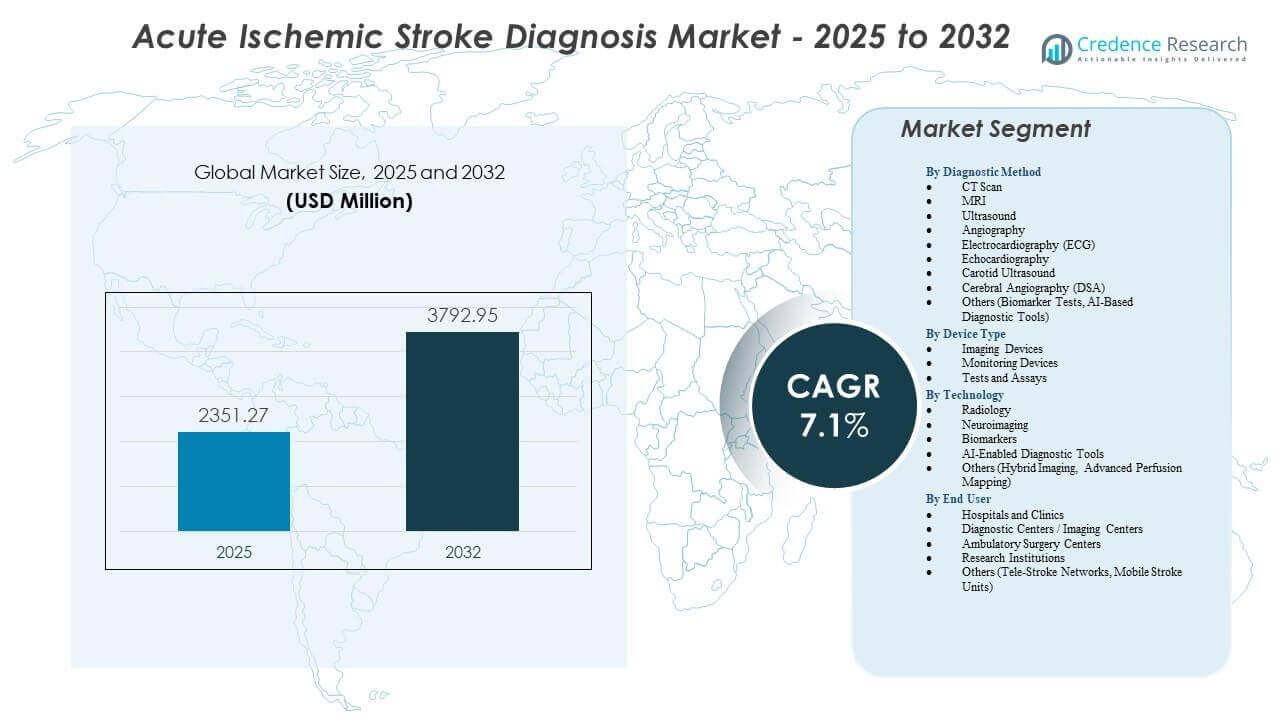
The Acute Ischemic Stroke Diagnosis Market is projected to grow from USD 2,351.27 million in 2025 to an estimated USD 3,792.95 million by 2032, with a compound annual growth rate (CAGR) of 7.1% from 2025 to 2032.
| RT ATTRIBUTE |
DETAILS |
| Historical Period |
2020-2023 |
| Base Year |
2024 |
| Forecast Period |
2025-2032 |
| Acute Ischemic Stroke Diagnosis Market Size 2025 |
USD 2,351.27 million |
| Acute Ischemic Stroke Diagnosis Market, CAGR |
7.1% |
| Acute Ischemic Stroke Diagnosis Market Size 2032 |
USD 3,792.95 million |
Acute Ischemic Stroke Diagnosis Market Insights:
- Rising demand for rapid diagnostic tools, advanced neuroimaging, and AI-enabled platforms strengthens clinical accuracy and supports faster stroke intervention.
- Limited access to high-end imaging systems, workforce shortages, and high operational costs restrain broader adoption across low-resource healthcare settings.
- North America leads the market due to strong infrastructure and early technology uptake, while Europe maintains growth through expanded stroke units and digital diagnostic integration.
- Asia-Pacific emerges as the fastest-growing region due to increasing stroke incidence, expanding hospital capacity, and improved access to CT and MRI technologies.
Acute Ischemic Stroke Diagnosis Market Drivers
Growing Burden of Stroke and Rising Need for Rapid Diagnostic Pathways
The Acute Ischemic Stroke Diagnosis Market expands due to a rising global stroke burden that heightens demand for faster evaluation methods. Healthcare systems invest in advanced tools that shorten the critical treatment window for better outcomes. Clinicians rely on imaging techniques that support accurate assessments during emergencies. Rapid diagnostic support improves patient triage and supports thrombolytic decision workflows. Hospitals seek solutions that reduce diagnostic delays in high-volume centers. Vendors introduce optimized systems that enhance detection of vessel blockages. Governments push stroke awareness programs that raise early reporting rates among at-risk populations. The Acute Ischemic Stroke Diagnosis Market gains stronger adoption through improved emergency response networks.
- For instance, GE HealthCare’s Revolution CT scanners utilize a 160mm coverage capability to perform a whole-brain perfusion scan in just 1 second, providing clinicians with the high-resolution hemodynamics needed to identify salvageable brain tissue during the first hour of onset.
Access crucial information at unmatched prices!
Request your sample report today & start making informed decisions powered by Credence Research Inc.!
Download Sample
Growing Adoption of AI-Enabled Stroke Imaging Platforms
Artificial intelligence strengthens acute stroke care by improving detection accuracy across CT and MRI modalities. It supports automated interpretation that reduces human error during peak demand hours. AI tools identify subtle perfusion deficits and guide clinicians toward better treatment selection. Hospitals adopt AI platforms to lower diagnostic variance among radiologists. Faster processing supports time-sensitive intervention decisions for high-risk patients. Vendors partner with technology firms to integrate deep-learning modules into existing PACS systems. Emergency units value AI tools that improve stroke alerts and reduce workflow bottlenecks. The Acute Ischemic Stroke Diagnosis Market benefits from higher confidence in image-based decision support systems.
- For instance, Viz.ai’s Viz LVO platform employs deep-learning algorithms that automatically detect large vessel occlusions and notify a specialist in an average of 2 minutes, a significant reduction from the typical manual notification time of 60 minutes.
Expansion of Tele-Stroke Networks and Remote Diagnostic Integration
Tele-stroke programs improve access to skilled neurologists across underserved regions. Remote evaluation platforms support faster review of CT scans sent from rural hospitals. Clinicians depend on telehealth tools that guide frontline teams toward correct diagnosis. It improves stroke management by reducing treatment delays linked to specialist shortages. Network partnerships support coordinated care models across multisite hospitals. Cloud-based infrastructure helps upload and analyze imaging files quickly. Vendors design encrypted systems that protect patient data during remote transfers. The Acute Ischemic Stroke Diagnosis Market advances through scalable tele-consultation frameworks.
Rising Investments in Portable and Point-of-Care Stroke Diagnostic Devices
Point-of-care tools gain traction due to rising demand for mobile diagnostics outside major hospitals. Portable imaging systems support ambulance teams during field assessments. Handheld ultrasound devices help identify vascular issues in pre-hospital settings. Emergency crews adopt compact scanners that reduce time lost during transport. It empowers first responders with decision support that guides facility selection. Technology firms invest in lightweight platforms suitable for remote clinics. Faster access to preliminary screening improves early clinical actions. The Acute Ischemic Stroke Diagnosis Market adopts mobile systems that improve real-time patient evaluation.
Market Trends
Shift Toward Multimodal Imaging for Improved Diagnostic Accuracy
Clinicians move toward combined imaging protocols that improve diagnostic precision. CT, MRI, angiography, and perfusion studies deliver complementary insights for complex stroke cases. Hospitals incorporate multimodal workflows that support targeted interventions. It helps reduce misclassification risks for mild and severe ischemic events. Vendors update imaging suites that integrate synchronized reporting capabilities. Radiology teams use advanced software for layered reconstruction views. Emergency departments push for wider availability of hybrid systems. The Acute Ischemic Stroke Diagnosis Market shifts toward integrated imaging environments.
- For instance, Canon Medical Systems’ Aquilion ONE PRISM Edition utilizes Deep Learning Spectral Imaging to provide 160mm whole-brain coverage in a single 0.275-second rotation, allowing for the simultaneous acquisition of anatomical, functional, and vascular data.
Growth of Biomarker-Based Stroke Diagnostic Research
Biomarker studies expand with new molecules linked to neural injury detection. Research institutions test proteins that indicate early ischemic changes in blood samples. Faster screening aims to support primary care teams during first-contact evaluations. It strengthens understanding of stroke onset timing and severity patterns. Companies explore panels that combine inflammatory and neuronal markers. Clinical trials examine accuracy improvements in real-world settings. Hospitals show interest in rapid blood-based tests that guide imaging decisions. The Acute Ischemic Stroke Diagnosis Market tracks heavy investment in neuro-biomarker innovation.
Higher Adoption of Cloud-Based Stroke Analytics Platforms
Cloud systems streamline data sharing among radiologists and neurologists. Imaging files move across networks at speeds that support rapid stroke alerts. Hospitals rely on cloud platforms that enable real-time collaboration. It reduces delays caused by physical file management during emergencies. Vendors improve cybersecurity features that secure diagnostic images. Tele-stroke teams gain smoother access to remote scan reviews. Multi-institution research benefits from shared anonymized data pools. The Acute Ischemic Stroke Diagnosis Market grows with improved digital infrastructure.
- For instance, the RapidAI cloud-based platform is currently deployed in over 2,200 hospitals globally, delivering automated CT perfusion and CT angiography results to an entire stroke team’s mobile devices in under 90 seconds.
Increasing Integration of Mobile Apps for Stroke Recognition and Pre-Hospital Triage
Mobile apps support early stroke symptom recognition among the public. These tools guide caregivers through simple checks that trigger emergency calls. Paramedics use triage apps that help identify probable stroke patients. It assists emergency teams in selecting facilities with available stroke units. Digital platforms include geolocation features for faster routing. Developers update algorithms that refine pre-hospital risk scoring. Awareness campaigns promote mobile tools that educate families and caregivers. The Acute Ischemic Stroke Diagnosis Market benefits from stronger patient engagement pathways.
Acute Ischemic Stroke Diagnosis Market Challenges Analysis
Limited Access to Advanced Imaging and Skilled Specialists Across Low-Resource Settings
The Acute Ischemic Stroke Diagnosis Market faces hurdles due to uneven access to CT and MRI facilities in rural and low-income regions. Many hospitals operate with outdated imaging systems that slow diagnosis. Workforce shortages reduce availability of skilled radiologists during critical hours. It creates delays that impact patient outcomes in high-incidence regions. Infrastructure gaps hinder real-time data transfer and consult responses. Emergency teams struggle with limited onsite neurologists. Financial constraints reduce procurement of upgraded scanning equipment. Care providers push governments to fill these diagnostic capacity gaps.
Operational Delays, Workflow Inefficiencies, and High Cost of Advanced Diagnostic Tools
Advanced imaging platforms require high capital investment that strains small facilities. Maintenance and software upgrades push operational budgets higher. Slow workflows in crowded emergency departments reduce diagnostic speed. It limits throughput for stroke patients who need urgent care. Staff require extensive training that increases transition time during adoption. Reimbursement gaps affect hospitals planning to expand stroke imaging programs. Vendors must balance cost innovation with quality standards. These constraints create adoption barriers within resource-pressed environments.
Acute Ischemic Stroke Diagnosis Market Opportunities
Advancements in AI, Portable Imaging, and Blood-Based Diagnostic Technologies
The Acute Ischemic Stroke Diagnosis Market sees strong opportunity from rapid innovation across AI systems and portable diagnostic tools. AI drives higher accuracy during acute evaluations and supports faster triage. Portable imaging devices expand diagnostic reach in ambulances and rural units. It encourages early interventions that improve survival and recovery metrics. Blood-based biomarker technologies open pathways for quick screening in primary care. Companies invest in hybrid platforms that combine imaging and molecular insights. Clinical teams welcome tools that shorten the treatment decision timeline. These advancements support broader market adoption.
Expansion of Tele-Stroke Networks and Government Programs Supporting Early Stroke Detection
Tele-stroke adoption rises as health systems strengthen emergency connectivity. Remote neurologists support frontline staff with faster diagnostic reviews. It expands access to expert guidance in regions without stroke specialists. Governments invest in stroke awareness and early detection campaigns that raise public responsiveness. Funding programs strengthen rural emergency care infrastructure. Hospitals join integrated stroke networks that improve care coordination. Vendors gain opportunity to deploy cloud tools and remote imaging platforms. These initiatives position the market for sustained long-term growth.
Market Segmentation Analysis:
By Diagnostic Method
The Acute Ischemic Stroke Diagnosis Market grows through strong demand for rapid imaging and cardiac evaluation tools that support accurate stroke triage. CT scan holds the leading share because emergency departments rely on non-contrast CT for immediate assessment of intracranial bleeding risk. MRI expands in tertiary care centers where diffusion-weighted imaging improves early ischemic detection. Ultrasound supports carotid artery evaluation in suspected large-vessel occlusion cases. Angiography and DSA guide interventional teams during mechanical thrombectomy planning. ECG and echocardiography remain essential for identifying cardioembolic triggers that increase stroke risks. Biomarker tests and AI tools gain attention for faster pre-imaging screening and decision support in time-critical environments. It strengthens diagnostic precision across diverse clinical settings.
By Device Type
The Acute Ischemic Stroke Diagnosis Market builds momentum through rising adoption of advanced imaging devices, monitoring tools, and assay-based diagnostics. CT and MRI systems lead device demand due to their central role in acute evaluations. Ultrasound and angiography systems support vascular assessment and intervention planning. Monitoring devices track vital parameters during emergency care and guide early risk stratification. Tests and assays, including biomarker panels and blood-based stroke tests, support rapid screening in pre-hospital or low-resource settings. Point-of-care diagnostic tools allow early evaluation in ambulances, clinics, and remote care units. It supports faster decision pathways that reduce treatment delays across stroke networks.
By Technology
The Acute Ischemic Stroke Diagnosis Market advances through rapid innovation across radiology, neuroimaging, biomarker science, and AI-based platforms. Radiology tools such as NCCT, CTA, and CTP remain essential for identifying vessel blockages and assessing perfusion deficits. Neuroimaging techniques such as DWI, SWI, and MRI perfusion improve early ischemic detection and reduce diagnostic uncertainty. Biomarker research pushes forward blood-based and protein-based indicators that may support earlier stroke identification outside traditional imaging environments. AI-enabled diagnostic tools increase accuracy by automating image interpretation and reducing human error during peak workloads. Hybrid imaging and advanced perfusion mapping support comprehensive visualization for complex cases. It reinforces technology-driven improvements across emergency and specialty care.
- For instance, Brainomix e-ASPECTS technology uses AI to automate the Alberta Stroke Program Early CT Score (ASPECTS), which has been clinically validated to maintain a 90% correlation with expert neuroradiologist assessments while reducing the evaluation time from several minutes to under 60 seconds.
By End User
The Acute Ischemic Stroke Diagnosis Market serves hospitals, diagnostic centers, ambulatory surgery centers, and research institutions with rising demand for high-performance diagnostic infrastructure. Hospitals and clinics dominate due to their role in emergency stroke management and access to advanced imaging systems. Diagnostic centers and imaging facilities support outpatient evaluations and follow-up assessments. Ambulatory surgery centers use selective diagnostic tools for pre-operative risk checks among high-risk patients. Research institutions drive innovation in neuroimaging, biomarkers, and AI tools that enhance future clinical practices. Tele-stroke networks and mobile stroke units create new adoption channels that expand access in remote regions. It strengthens diagnostic reach across varied healthcare ecosystems.
- For instance, the Frazer Mobile Stroke Unit (MSU), utilized by major health systems like Memorial Hermann, contains a specialized onboard CT scanner that facilitates a 40-minute reduction in “door-to-needle” time for thrombolytic administration compared to traditional hospital-based arrival.
Segmentation:
By Diagnostic Method
- CT Scan
- MRI
- Ultrasound
- Angiography
- Electrocardiography (ECG)
- Echocardiography
- Carotid Ultrasound
- Cerebral Angiography (DSA)
- Others (Biomarker Tests, AI-Based Diagnostic Tools)
By Device Type
- Imaging Devices
- CT Systems
- MRI Systems
- Ultrasound Devices
- Angiography Systems
- Monitoring Devices
- Tests and Assays
- Biomarker Panels
- Blood-Based Stroke Tests
- Point-of-Care Diagnostics
By Technology
- Radiology
- Non-contrast CT (NCCT)
- CT Angiography (CTA)
- CT Perfusion (CTP)
- Neuroimaging
- Diffusion-Weighted Imaging (DWI)
- Susceptibility-Weighted Imaging (SWI)
- MRI Perfusion
- Biomarkers
- Blood Biomarkers
- Genetic/Protein Markers
- AI-Enabled Diagnostic Tools
- Others (Hybrid Imaging, Advanced Perfusion Mapping)
By End User
- Hospitals and Clinics
- Diagnostic Centers / Imaging Centers
- Ambulatory Surgery Centers
- Research Institutions
- Others (Tele-Stroke Networks, Mobile Stroke Units)
By Region
- North America
- Europe
- Germany
- France
- U.K.
- Italy
- Spain
- Rest of Europe
- Asia Pacific
- China
- Japan
- India
- South Korea
- South-east Asia
- Rest of Asia Pacific
- Latin America
- Brazil
- Argentina
- Rest of Latin America
- Middle East & Africa
- GCC Countries
- South Africa
- Rest of the Middle East and Africa
Regional Analysis:
North America leads the Acute Ischemic Stroke Diagnosis Market with an estimated 38–40% share, supported by strong healthcare infrastructure and broad access to advanced imaging systems. Hospitals in the United States adopt CT, MRI, and AI-supported platforms that reduce diagnostic delays. The region benefits from high stroke awareness and strong investment in tele-stroke networks. Vendors expand collaborations with hospitals to deploy cloud-based diagnostic tools. It gains traction through consistent regulatory approvals for imaging and biomarker technologies. Research institutions contribute to innovation that strengthens clinical adoption across emergency care settings.
Europe holds an estimated 27–29% share, driven by widespread use of multimodal imaging technologies and strong national stroke programs. Countries such as Germany, France, and the UK expand stroke units with upgraded CT perfusion and MRI capabilities. Healthcare providers invest in digital workflow systems that reduce bottlenecks in emergency diagnostics. It benefits from government-led frameworks supporting early stroke recognition. Diagnostic centers integrate AI-enabled tools that improve interpretation accuracy. Growing demand for biomarker-based testing supports wider technology adoption.
Asia-Pacific grows rapidly and secures an estimated 22–24% share, driven by rising stroke incidence and expanding hospital infrastructure across China, India, and Japan. Governments invest in emergency care modernization and promote early diagnosis initiatives. Hospitals expand imaging capacity to match rising patient loads in urban centers. It gains momentum through rising procurement of portable diagnostic devices and mobile stroke units. Diagnostic labs adopt biomarker testing technologies that support early triage. The region benefits from increasing private sector investment in imaging centers. Latin America and the Middle East & Africa hold a combined 8–10% share, with growth driven by improving access to CT and MRI platforms.
Shape Your Report to Specific Countries or Regions & Enjoy 30% Off!
Key Player Analysis:
- Abbott Laboratories
- Cardinal Health Inc.
- GE Healthcare Technologies Inc.
- Koninklijke Philips N.V.
- Medtronic plc
- Merck & Co. Inc.
- Siemens Healthineers AG
- Stryker Corporation
- Johnson & Johnson Services Inc.
- Bayer AG
- Boston Scientific Corporation
- Canon Medical Systems Corporation
- Fujifilm Holdings Corporation
- Genentech Inc.
- Hitachi High-Tech Corporation
- Neusoft Medical Systems Co. Ltd.
Competitive Analysis:
The Acute Ischemic Stroke Diagnosis Market features strong competition among imaging leaders, diagnostic developers, and AI technology providers. Companies such as Siemens Healthineers, GE Healthcare, Philips, and Canon Medical strengthen their presence through upgraded CT and MRI systems engineered for faster acquisition and higher clarity. It gains competitive depth from firms expanding AI-enabled platforms that improve diagnostic precision during emergency care. Biomarker innovators such as Abbott and Merck advance research that supports early detection. Stryker, Bayer, and Boston Scientific focus on technologies linked to stroke intervention workflows. Vendors compete through product integration, partnerships with stroke centers, and digital platforms that support remote diagnostics. Strong emphasis on workflow automation, multimodal imaging, and portable devices shapes market differentiation across global regions.
Recent Developments:
- In June 2025, Brainomix partnered with 3DR Labs to advance stroke care in the US by integrating the FDA-cleared Brainomix 360 Stroke AI imaging solution with 3DR Labs’ medical imaging post-processing services, aiming to optimize acute stroke diagnosis and patient outcomes through seamless technology delivery.
- In March 2025, Perfuze received FDA 510(k) clearance for its Zipline Access Catheters, enhancing neurovascular access for acute ischemic stroke diagnosis and treatment procedures, while also securing €22 million in follow-on funding to expand its innovative device portfolio.
- In February 2025, Vena Medical’s MicroAngioscope earned FDA Breakthrough Device designation, introducing advanced micro-scale visualization capabilities to improve real-time diagnosis of acute ischemic stroke by enabling precise intravascular imaging during interventions.
Report Coverage:
The research report offers an in-depth analysis based on Diagnostic Method, Device Type, Technology, End User and Region. It details leading market players, providing an overview of their business, product offerings, investments, revenue streams, and key applications. Additionally, the report includes insights into the competitive environment, SWOT analysis, current market trends, as well as the primary drivers and constraints. Furthermore, it discusses various factors that have driven market expansion in recent years. The report also explores market dynamics, regulatory scenarios, and technological advancements that are shaping the industry. It assesses the impact of external factors and global economic changes on market growth. Lastly, it provides strategic recommendations for new entrants and established companies to navigate the complexities of the market.
Future Outlook:
- The Acute Ischemic Stroke Diagnosis Market will expand through wider adoption of multimodal imaging systems that support faster decision pathways in emergency care.
- AI-enabled diagnostic platforms will strengthen clinical accuracy and reduce interpretation delays across high-volume stroke centers.
- Biomarker-based screening tools will gain momentum as research institutions validate their value in early detection workflows.
- Portable and point-of-care devices will support pre-hospital stroke evaluation and improve outcomes in remote regions.
- Tele-stroke networks will scale further, enabling real-time specialist support for hospitals with limited neurological expertise.
- Cloud-integrated imaging platforms will streamline sharing of diagnostic data across multisite healthcare systems.
- Investments in hybrid imaging and perfusion mapping will enhance precision during complex stroke assessments.
- Emerging markets will see accelerated adoption due to rising stroke prevalence and expanding diagnostic infrastructure.
- Strategic partnerships between imaging manufacturers and AI developers will drive product innovation and competitive strength.
- Regulatory support for advanced diagnostic technologies will help the market maintain consistent long-term growth.



