AI in Endoscopy Market Overview:
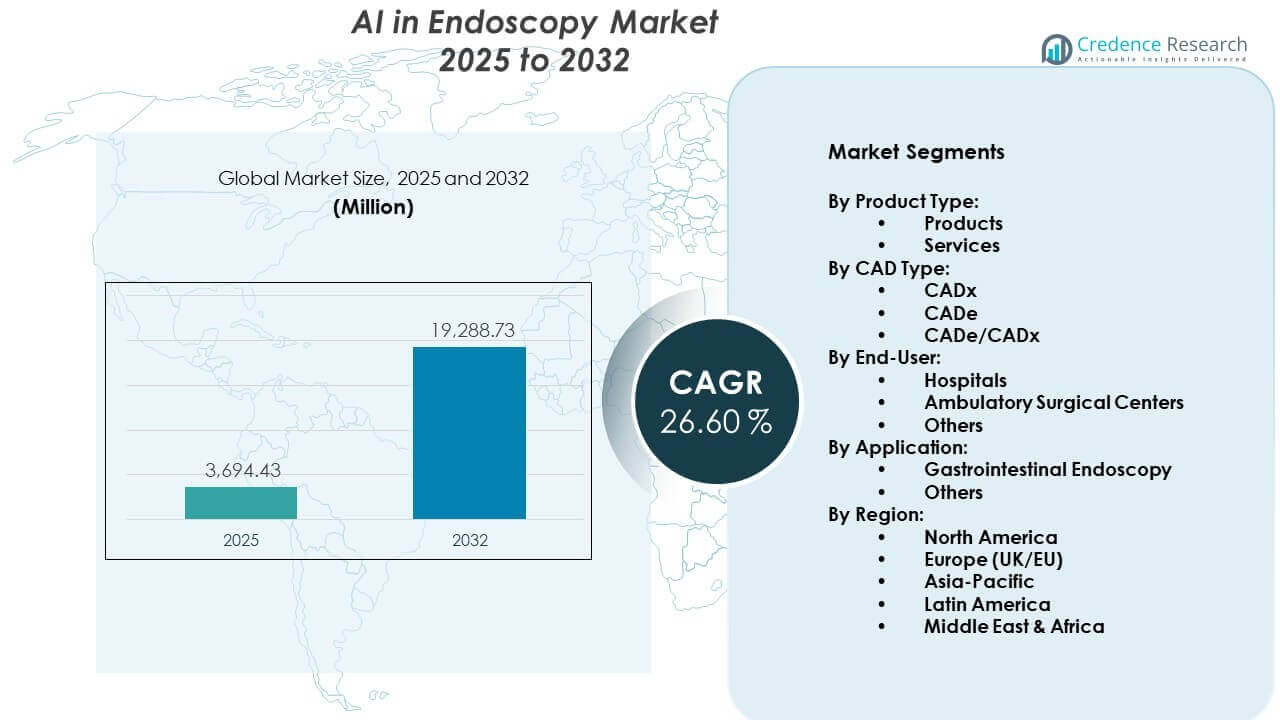
The AI in Endoscopy Market is projected to grow from USD 3,694.43 million in 2025 to an estimated USD 19,288.73 million by 2032, with a compound annual growth rate (CAGR) of 26.60% from 2025 to 2032.
| RT ATTRIBUTE |
DETAILS |
| Historical Period |
2020-2023 |
| Base Year |
2024 |
| Forecast Period |
2025-2032 |
| AI in Endoscopy Market Size 2025 |
USD 3,694.43 million |
| AI in Endoscopy Market, CAGR |
26.60% |
| AI in Endoscopy Market Size 2032 |
USD 19,288.73 million |
AI in Endoscopy Market Insights:
- North America leads with 38% market share, driven by early adoption, strong infrastructure, and high procedure volumes; Europe follows with 29%, supported by public health initiatives and regulatory approvals; Asia-Pacific holds 20%, reflecting growing investments and rising cancer burden.
- Asia-Pacific is the fastest-growing region due to expanding screening programs, increasing procedure volume, and growing adoption in emerging economies like China, Japan, and India.
- Gastrointestinal endoscopy accounts for over 65% of the market by application, owing to widespread colorectal cancer screening and strong adoption of CADe tools.
- Hospitals dominate the end-user segment with over 70% share, supported by high patient throughput and infrastructure readiness for AI integration.
AI in Endoscopy Market Drivers:
Rising Global Burden of Gastrointestinal and Colorectal Disorders
The increasing incidence of GI and colorectal diseases creates strong demand for early and accurate diagnosis. Healthcare systems across regions are under pressure to reduce cancer-related mortality through regular screening. AI in endoscopy helps detect polyps and tumors with greater sensitivity than traditional techniques. The need for early-stage identification pushes facilities to adopt AI-powered image recognition tools. Governments and private bodies support awareness programs that encourage preventive endoscopy use. It leads to a larger base of patients benefiting from automated, real-time diagnostics. With aging populations and poor dietary habits, chronic GI conditions are also becoming more prevalent. The AI in Endoscopy Market gains steady momentum due to this disease burden.
- For instance, Medtronic reported that its GI Genius™ intelligent endoscopy module demonstrated a 14% absolute increase in Adenoma Detection Rate (ADR) compared to standard colonoscopy in a large-scale clinical trial.
Access crucial information at unmatched prices!
Request your sample report today & start making informed decisions powered by Credence Research Inc.!
Download Sample
Growing Need for Workflow Optimization and Clinician Support
Hospitals face challenges related to time constraints, staffing gaps, and rising procedure volumes. AI tools reduce endoscopic interpretation time, helping clinicians work faster and more efficiently. It allows for real-time flagging of abnormalities, reducing the chance of human error. By supporting clinical decisions, AI improves diagnostic confidence, especially in smaller facilities. Larger centers use AI to optimize resource use and manage patient load. Training new endoscopists becomes easier with assistive AI platforms guiding decision-making. Surgeons and gastroenterologists can delegate repetitive tasks to automation. The AI in Endoscopy Market benefits from the need to improve productivity across healthcare systems.
- For instance, Olympus Corporation launched its ENDO-AID platform, which utilizes the EVIS X1 endoscopy system to achieve a sensitivity of 94.8% in detecting colonic lesions. According to Olympus Global, this AI-powered system provides real-time visual alerts to help endoscopists identify polyps that might otherwise be missed, effectively reducing the cognitive load and eye fatigue associated with intensive screening sessions.
Supportive Regulatory Frameworks and AI Integration Policies
Medical regulatory agencies are becoming more open to AI adoption in clinical settings. The FDA, EMA, and others have released guidelines supporting safe AI use in diagnostics. Governments also fund research programs that develop AI-based endoscopy tools for public hospitals. It improves clinical access and pushes industry players to innovate rapidly. Health insurers are starting to recognize AI-assisted procedures for reimbursement. National cancer screening policies increasingly recommend advanced imaging systems for mass diagnostics. Early product approvals help start-ups and med-tech giants enter markets faster. The AI in Endoscopy Market thrives in environments where policy and innovation align.
Technological Advancements in Deep Learning and Image Processing
Ongoing advancements in deep learning enable AI models to analyze complex visual patterns in endoscopic images. New algorithms improve diagnostic accuracy across multiple lesion types. Edge AI and embedded hardware reduce latency and improve real-time video processing. Integration of AI with HD and 4K endoscopy systems enhances visibility and detection. It allows hospitals to use advanced systems without replacing entire infrastructure. Cloud-based platforms also offer post-procedure analysis and risk stratification tools. Vendors continue to build AI software compatible with major endoscope brands. The AI in Endoscopy Market expands as these technologies mature and scale.
AI in Endoscopy Market Trends:
Emergence of Real-Time AI-Assisted Polyp Detection Tools
Companies now offer AI-powered tools capable of detecting polyps and lesions during live colonoscopy. These systems use real-time video input to highlight areas of concern on-screen. Physicians can make instant decisions, improving procedural efficiency and patient outcomes. This trend moves AI beyond post-procedure analysis into live intervention support. Products like GI Genius and CAD EYE are already deployed in hospitals globally. It signals a major shift in how diagnostics integrate with procedure flow. Clinicians prefer systems that require minimal setup or workflow disruption. The AI in Endoscopy Market sees increasing demand for real-time capabilities.
- For instance, Fujifilm developed the CAD EYE system, which can identify polyps at a processing speed of 60 frames per second, ensuring zero latency between the video feed and the AI-generated visual alerts.
Integration of AI With Cloud-Based Post-Procedure Analytics Platforms
AI-based endoscopy tools are now linking with cloud platforms for storing, analyzing, and retrieving procedure data. These platforms help track polyp recurrence, patient outcomes, and lesion characteristics over time. It improves follow-up care and supports personalized treatment planning. Hospitals use cloud-based analytics to benchmark performance across facilities. Such platforms also support remote training and case sharing among professionals. AI models improve through continuous learning on these large datasets. Vendors gain insights to refine algorithms and expand applications. The AI in Endoscopy Market gains traction from this integration of clinical and analytical platforms.
- For instance, Iterative Health (formerly Iterative Scopes) uses a cloud-based AI platform to standardize assessments for Inflammatory Bowel Disease (IBD). While recent research involving AI for Ulcerative Colitis often uses smaller, high-quality datasets for training, such as approximately 40,000 images, the company has utilized its algorithms to identify and exclude up to 31% of patients who did not meet strict disease severity criteria in clinical trials.
Expansion of AI-Enabled Capsule Endoscopy Applications
Capsule endoscopy, already popular for non-invasive GI imaging, is being enhanced by AI for image triage and abnormality detection. AI shortens the time needed to review thousands of images per patient. It automatically flags bleeding, inflammation, or tumors for review. Physicians use AI to focus on clinically relevant frames, saving time. Remote clinics benefit from automated reports generated by the AI model. Patients prefer capsule procedures due to comfort and convenience. This trend supports adoption in rural and home-care settings. The AI in Endoscopy Market diversifies through these capsule-based solutions.
Growing Adoption of AI for Pediatric and Geriatric Endoscopy Support
Pediatric and geriatric patients often present unique challenges in diagnosis due to atypical symptoms and higher risk of complications. AI tools provide enhanced support by improving precision and reducing need for repeat procedures. Doctors rely on automated insights to assist in rare and subtle cases. Specially trained AI models are being developed for these vulnerable groups. Hospitals build dedicated pathways using AI tools to minimize invasive interventions. Geriatric facilities use AI to aid endoscopies in patients with cognitive or physical limitations. Pediatric centers apply AI for early detection of gastrointestinal developmental disorders. The AI in Endoscopy Market responds to this trend with specialized solutions.
AI in Endoscopy Market Challenges Analysis:
Data Privacy, Clinical Validation, and Ethical Use Limit Widespread Adoption
AI in endoscopy relies on access to large datasets of clinical images, which raises privacy and consent issues. Hospitals must ensure all data used for training complies with local regulations. Some institutions hesitate to adopt AI tools due to unclear liability in case of diagnostic errors. Clinicians demand high levels of validation before trusting AI in live procedures. There is also concern about algorithmic bias and lack of transparency in decision-making. Vendors face long and expensive approval processes for each regional market. It slows innovation and limits the number of products reaching hospitals. The AI in Endoscopy Market must address trust and safety to expand further.
Integration Barriers With Legacy Equipment and Staff Resistance
Many hospitals operate with older endoscopy systems that lack AI compatibility. Upgrading infrastructure requires significant capital investment and technical support. Smaller clinics especially struggle to afford or integrate new AI software. There is also resistance from clinicians who fear losing control or mistrust algorithm outputs. Training programs are still limited in many regions, causing underuse of available tools. Real-time AI assistance may disrupt traditional diagnostic workflows if not managed properly. IT departments face compatibility issues between vendor systems and hospital networks. The AI in Endoscopy Market continues to face slow uptake in resource-constrained settings.
AI in Endoscopy Market Opportunities:
Rising Investment in AI Start-ups and MedTech Collaborations
Venture capital firms are funding AI endoscopy start-ups focused on smart diagnostics and workflow automation. Large medtech firms partner with these start-ups to co-develop FDA-cleared tools. Hospitals increasingly pilot AI systems in gastroenterology departments. Cloud-based AI delivery models lower the cost of entry for many facilities. The AI in Endoscopy Market benefits from this expanding innovation ecosystem. It opens space for niche applications across disease types and patient segments. These partnerships accelerate global product availability and performance improvement.
Growing Potential in Emerging Markets With High Disease Burden
Emerging countries report rising cases of digestive cancers and gastrointestinal infections. Governments push for affordable diagnostic access across rural and urban areas. AI tools offer scalable solutions for screening large populations with fewer specialists. Mobile endoscopy units integrated with AI software can reach remote zones. It helps detect early signs of cancer where trained experts are lacking. The AI in Endoscopy Market finds strong future demand in countries with high screening gaps. Growth will rely on public-private partnerships and digital infrastructure expansion.
Market Segmentation Analysis:
By Product Type
The AI in Endoscopy Market segments product type into products and services. Products include AI-powered endoscopic equipment and integrated software modules that support real-time image analysis. Hospitals prefer device-based solutions that embed AI directly into endoscopy systems for seamless workflow use. Vendors focus on compatibility with existing scopes and imaging units. Services cover software updates, cloud analytics, maintenance, and training programs. Many facilities adopt subscription-based AI platforms to reduce upfront investment. Service models also support performance monitoring and algorithm refinement over time. Both segments play a vital role in expanding clinical adoption.
- For instance, Pentax Medical introduced the DISCOVERY™ AI system, which is housed in a compact hardware unit that integrates with existing endoscopy towers via a simple HDMI connection, requiring less than 5 minutes for full system calibration.
By CAD Type
The market divides CAD type into CADx, CADe, and hybrid CADe/CADx systems. CADe tools focus on detecting abnormalities such as polyps and lesions during procedures. CADx systems assist physicians in characterizing detected findings and assessing malignancy risk. Hybrid CADe/CADx solutions combine detection and diagnosis in one platform. Healthcare providers favor integrated systems that enhance decision support and reduce interpretation errors. Technology developers refine algorithms to improve accuracy across lesion types. Each CAD category supports distinct clinical needs while advancing diagnostic confidence.
- For instance, NEC Corporation developed a CADx software that analyzes approximately 80 different features of a polyp to differentiate between neoplastic and non-neoplastic lesions with an accuracy rate exceeding 90% in less than 0.5 seconds.
By End-User
Hospitals represent the largest end-user group due to high procedure volumes and advanced infrastructure. Large tertiary centers deploy AI tools to standardize quality across departments. Ambulatory Surgical Centers adopt compact AI solutions to improve efficiency in outpatient settings. Smaller clinics and specialty centers fall under the others category. These facilities seek cost-effective AI tools that integrate with limited resources. End-user demand varies based on procedure complexity and patient load. Broader adoption depends on training and reimbursement support.
By Application
Gastrointestinal endoscopy holds the dominant application share due to widespread colorectal cancer screening. AI systems assist in detecting early-stage GI lesions and improving adenoma detection rates. Other applications include pulmonology, urology, gynecology, orthopedic, and oncology procedures. Physicians use AI to enhance visualization and reduce oversight in these specialties. Cross-specialty adoption expands the technology footprint within endoscopic practice. Application diversity strengthens long-term market growth potential.
Segmentation:
By Product Type:
By CAD Type:
By End-User:
- Hospitals
- Ambulatory Surgical Centers
- Others
By Application:
- Gastrointestinal Endoscopy
- Others
By Region:
- North America
- Europe
- Germany
- France
- U.K.
- Italy
- Spain
- Rest of Europe
- Asia Pacific
- China
- Japan
- India
- South Korea
- South-east Asia
- Rest of Asia Pacific
- Latin America
- Brazil
- Argentina
- Rest of Latin America
- Middle East & Africa
- GCC Countries
- South Africa
- Rest of the Middle East and Africa
Regional Analysis:
North America
North America leads the AI in Endoscopy Market with a market share of over 38% in 2025. The region benefits from early adoption of AI-powered healthcare tools, well-established endoscopy infrastructure, and strong reimbursement frameworks. Major players like Medtronic and Olympus operate extensive research facilities and deployment networks across the U.S. and Canada. Hospitals in the region invest heavily in real-time CADe/CADx systems for colorectal cancer screening. Academic institutions also contribute by validating AI models through clinical trials. Demand continues to rise due to the region’s focus on value-based care and diagnostic accuracy. North America remains at the forefront of innovation and product launches.
Europe
Europe holds the second-largest share in the AI in Endoscopy Market, accounting for nearly 29% of the global revenue in 2025. Countries like Germany, the UK, and France deploy advanced AI tools under structured healthcare guidelines. Regulatory bodies such as the EMA support fast-track approvals for AI-assisted diagnostic devices. Public health initiatives emphasize early cancer detection, driving investment in GI endoscopy solutions. Hospitals adopt AI-integrated systems that reduce diagnostic errors and standardize procedure outcomes. Regional startups collaborate with OEMs to localize AI tools for EU clinical workflows. Europe maintains strong growth through policy support and growing clinician trust in automation.
Asia-Pacific
Asia-Pacific is the fastest-growing region in the AI in Endoscopy Market, with a market share of around 20% in 2025. Japan, China, South Korea, and India are driving adoption due to rising cancer burden, growing healthcare digitization, and increasing procedure volumes. Governments support AI-based screening programs in public hospitals, especially for colorectal and gastric cancers. Local players emerge with cost-effective AI solutions adapted to regional needs. Rising endoscopy center expansions and medical tourism growth further support technology penetration. Asia-Pacific’s large population base and unmet diagnostic demand position it for rapid market acceleration. Investment inflows from global medtech firms continue to expand access across tier 2 and tier 3 cities.
Shape Your Report to Specific Countries or Regions & Enjoy 30% Off!
Key Player Analysis:
Competitive Analysis:
The AI in Endoscopy Market features strong competition among global medtech leaders and specialized AI startups. Companies such as Medtronic, Olympus Corporation, FUJIFILM Corporation, and PENTAX Medical focus on integrated AI-enabled imaging platforms. These firms leverage established distribution networks and hospital partnerships to expand adoption. Startups like MAGENTIQ EYE compete through niche innovation in polyp detection and real-time analytics. Market players prioritize regulatory approvals, clinical validation, and software compatibility with existing endoscopy systems. Strategic collaborations with hospitals and research centers strengthen product credibility. Continuous upgrades in CADe and CADx capabilities shape competitive positioning. Pricing models, service contracts, and cloud integration further differentiate offerings across regions.
Recent Developments:
- In February 2026, PENTAX Medical established a strategic research and development presence at The Pearl innovation district in Charlotte, NC, focusing on advancing endoscopic technologies through its new engineering lab. Additionally, the company solidified a partnership in May 2024 to distribute the MAGENTIQ-COLO AI-assisted lesion detection device in the U.S., which officially began on October 1, 2024.
- In November 2025, Olympus unveiled a comprehensive global corporate strategy centered on transforming from a hardware provider to a leader in intelligent, integrated care powered by AI and cloud-connected digital ecosystems. Earlier, in September 2025, the company launched OLYSENSE CAD/AI, a suite of cloud-based applications (CADDIE, CADU, and SMARTIBD) designed to assist in detecting lesions and assessing conditions like Barrett’s Esophagus and ulcerative colitis across the US and Europe.
- In November 2025, Fujifilm India reached a milestone with the state’s first installation of the CAD EYE AI-powered endoscopy system at Fortis Hospital in Jaipur to improve early detection of gastric and colon cancers. This expansion followed the August 2025 launch of ENDOVEDA, a digital endoscopy reporting platform developed in India to streamline clinical documentation and integrate high-definition image capture with hospital systems.
Report Coverage:
The research report offers an in-depth analysis based on Product Type, CAD Type, End-User, Application, and Region. It details leading market players, providing an overview of their business, product offerings, investments, revenue streams, and key applications. Additionally, the report includes insights into the competitive environment, SWOT analysis, current market trends, as well as the primary drivers and constraints. Furthermore, it discusses various factors that have driven market expansion in recent years. The report also explores market dynamics, regulatory scenarios, and technological advancements that are shaping the industry. It assesses the impact of external factors and global economic changes on market growth. Lastly, it provides strategic recommendations for new entrants and established companies to navigate the complexities of the market.
Future Outlook:
- AI in endoscopy will become a routine component of gastrointestinal diagnostics across primary, secondary, and tertiary healthcare institutions.
- Hospitals will integrate AI with cloud and edge platforms to enable real-time image enhancement, automated reporting, and longitudinal patient monitoring.
- AI-enabled systems will expand beyond GI to support bronchoscopic, cystoscopic, and gynecological procedures, diversifying the application base.
- Start-ups and medtech giants will intensify partnerships to co-develop CADx/CADe tools tailored for specific procedural needs and patient populations.
- Governments will increase funding for AI-powered cancer screening, accelerating adoption in underserved regions and boosting public healthcare capabilities.
- Integration of AI with robotic endoscopy systems will support minimally invasive surgeries and precision-guided biopsies in complex anatomy.
- Training programs for endoscopists will embed AI modules to standardize interpretation skills and reduce learning curves for new clinicians.
- AI in endoscopy will evolve toward personalized diagnostics by linking imaging with patient history, genetic data, and clinical outcomes.
- Regulatory frameworks will mature, leading to faster AI approvals and broader insurance coverage for AI-assisted procedures globally.
- The AI in Endoscopy Market will experience a shift toward subscription-based and AI-as-a-service models, making solutions more scalable and accessible.



