AI in Patient Engagement Market Overview:
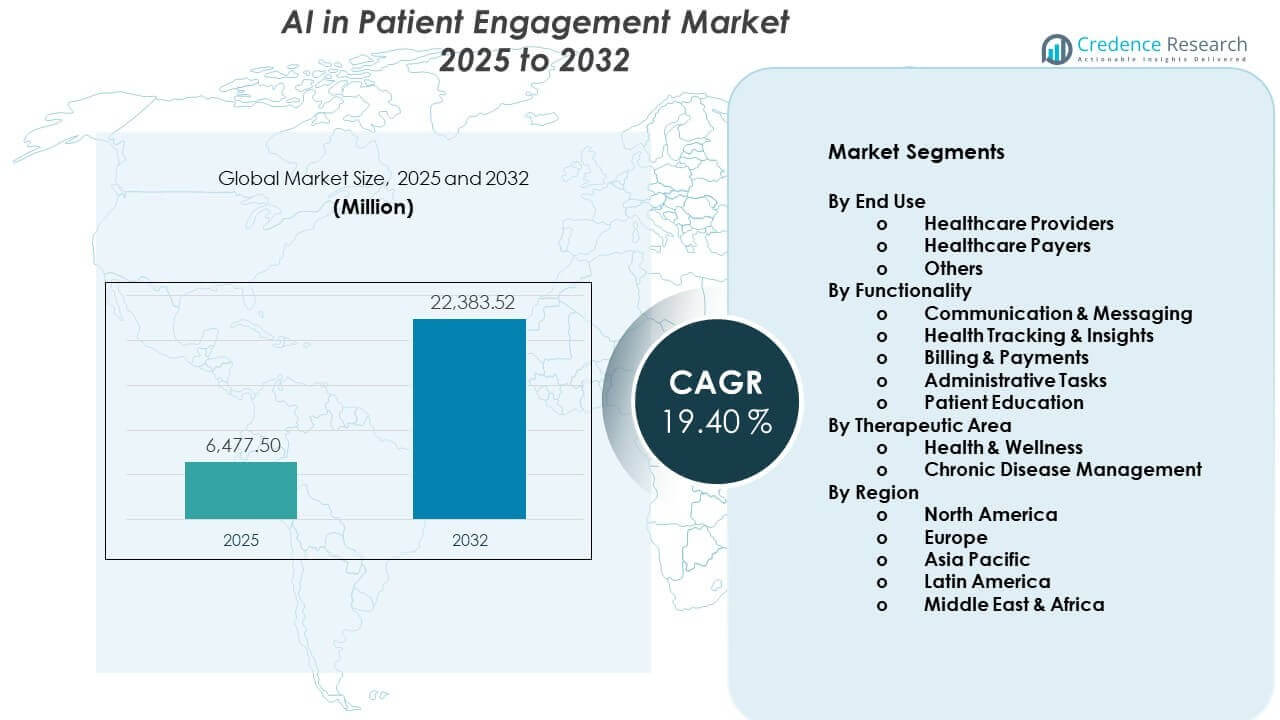
The AI in Patient Engagement Market is projected to grow from USD 6,477.5 million in 2025 to an estimated USD 22,383.52 million by 2032, with a compound annual growth rate (CAGR) of 19.40% from 2025 to 2032.
| RT ATTRIBUTE |
DETAILS |
| Historical Period |
2020-2023 |
| Base Year |
2024 |
| Forecast Period |
2025-2032 |
| AI in Patient Engagement Market Size 2025 |
USD 6,477.5 million |
| AI in Patient Engagement Market, CAGR |
19.40% |
| AI in Patient Engagement Market Size 2032 |
USD 22,383.52 million |
AI in Patient Engagement Market Insights:
- North America (42%), Europe (27%), and Asia-Pacific (21%) collectively account for the majority share of the market; North America leads due to advanced digital health infrastructure and high healthcare IT spending, Europe benefits from strong regulatory support and digital transformation initiatives, while Asia-Pacific is supported by expanding healthcare access and rapid AI integration.
- Asia-Pacific, holding 21% market share, is the fastest-growing region, fueled by large patient populations, increasing smartphone penetration, government-backed digital health programs, and growing investments in AI-enabled healthcare platforms.
- By end use, Healthcare Providers dominate with 58% share, followed by Healthcare Payers at 28%, reflecting strong demand for AI tools that enhance patient communication, automate workflows, and improve care coordination across provider networks.
- By functionality, Communication & Messaging accounts for 34% of total revenue, followed by Health Tracking & Insights at 26%, underscoring the emphasis on real-time patient interaction, remote monitoring, predictive analytics, and personalized engagement strategies.
AI in Patient Engagement Market Drivers:
Rising Demand For Personalized Digital Communication Across Complex Care Pathways
Healthcare providers seek tailored communication that improves patient trust and adherence. AI tools analyze patient data to deliver targeted reminders and follow-up alerts. Hospitals deploy chatbots to answer queries and reduce call center pressure. Payers use predictive models to identify high-risk members for outreach. These solutions enhance satisfaction and strengthen long-term engagement. The AI in Patient Engagement Market benefits from this structural shift in care delivery. It supports proactive communication across chronic and preventive care programs. Strong executive focus on patient-centric models sustains investment momentum.
- For instance, Humana utilized AI-driven predictive modeling to identify members at risk of social isolation, achieving a 29% reduction in loneliness scores for engaged seniors through targeted digital and telephonic outreach.
Access crucial information at unmatched prices!
Request your sample report today & start making informed decisions powered by Credence Research Inc.!
Download Sample
Expansion Of Value-Based Care Models And Outcome-Focused Reimbursement Systems
Healthcare systems link reimbursement to quality metrics and patient outcomes. Providers adopt AI platforms to track adherence and close care gaps. Automated alerts prompt timely screenings and medication compliance. Data-driven insights help clinicians intervene before complications escalate. Health systems aim to lower avoidable admissions and emergency visits. AI tools enable structured engagement across the full treatment cycle. Financial incentives align with digital transformation initiatives. This alignment accelerates enterprise-wide adoption of intelligent engagement systems.
- For instance, Oak Street Health leverages its proprietary Canopy software to drive value-based outcomes, resulting in a 51% reduction in hospital admissions compared to traditional Medicare benchmarks.
Rapid Growth In Remote Care Infrastructure And Virtual Health Services
Telehealth adoption reshapes patient-provider interaction across many specialties. Remote monitoring devices generate continuous health data streams. AI engines interpret these inputs and trigger timely communication. Clinicians rely on automated triage to prioritize critical cases. Patients receive digital coaching that supports long-term disease control. Health networks expand hybrid care models that combine virtual and in-person visits. Digital access improves continuity of care beyond hospital walls. This infrastructure expansion strengthens demand for scalable AI engagement platforms.
Increasing Smartphone Penetration And Digital Literacy Among Patient Populations
Smartphone access expands across developed and emerging economies. Patients expect seamless digital experiences similar to other industries. Mobile apps integrate AI to guide appointment booking and health education. Secure messaging tools improve transparency and trust. Younger demographics show high comfort with digital health tools. Older populations adopt user-friendly platforms with voice support features. Healthcare brands compete on digital experience quality. Broader connectivity fuels sustained growth in AI-enabled engagement solutions.
AI in Patient Engagement Market Trends:
Integration Of Generative AI For Conversational Support And Dynamic Content Creation
Healthcare organizations explore generative AI to enhance patient interaction. Virtual agents provide context-aware responses across multiple languages. These systems draft personalized care summaries after consultations. Providers automate routine educational content with structured oversight. Clinical teams review outputs to ensure accuracy and compliance. The AI in Patient Engagement Market reflects strong interest in conversational interfaces. It supports more natural dialogue between patients and digital systems. Vendors refine guardrails to manage clinical risk and data sensitivity.
- For instance, Epic Systems integrated generative AI via Microsoft Azure OpenAI to draft patient portal responses, where pilot studies at organizations like Mayo Clinic showed that clinicians saved approximately 30 to 33 seconds per message.
Adoption Of Multichannel Engagement Platforms With Unified Patient View
Health systems deploy integrated dashboards that consolidate communication channels. Email, SMS, app notifications, and portal messages sync within one platform. Unified data views help staff track engagement history in real time. Analytics measure response rates and care plan adherence. Organizations prioritize seamless transitions between digital touchpoints. Vendors design interoperable systems that connect with EHR platforms. Patients receive consistent messaging across every interaction stage. This coordinated approach defines next-generation engagement architecture.
- For instance, Providence Health implemented a unified digital platform featuring the AI-powered chatbot Grace, which intercepts patient messages and handles tasks such as scheduling and intake. This system contributed to a 30% reduction in manual administrative message volume for care teams.
Shift Toward Predictive Behavioral Analytics And Risk Stratification Models
AI models assess behavioral patterns that influence health decisions. Algorithms predict likelihood of missed appointments or medication non-compliance. Care teams target outreach based on data-driven insights. Health plans tailor wellness programs for specific demographic groups. Predictive tools refine segmentation beyond traditional clinical variables. Digital nudges encourage preventive screenings and lifestyle change. Continuous model training improves accuracy over time. Data maturity strengthens strategic planning within engagement initiatives.
Focus On Ethical AI Frameworks And Transparent Algorithm Governance
Healthcare leaders prioritize ethical oversight in AI deployment. Governance committees review model fairness and bias mitigation measures. Transparent documentation builds trust among patients and regulators. Vendors provide explainable outputs to support clinical validation. Data privacy safeguards align with national compliance standards. Organizations conduct audits to assess performance and equity impact. Clear accountability structures reduce operational risk. Ethical design becomes a competitive differentiator in vendor selection.
AI in Patient Engagement Market Challenges Analysis:
Data Privacy Risks And Complex Regulatory Compliance Across Jurisdictions
Healthcare data remains highly sensitive and tightly regulated. Organizations must comply with regional and national privacy laws. AI platforms require secure storage and controlled data access. Breaches can damage brand reputation and patient trust. Cross-border data transfer creates legal complexity. The AI in Patient Engagement Market faces scrutiny from regulators and advocacy groups. It must align product design with strict compliance frameworks. Implementation costs rise due to legal and cybersecurity requirements.
Integration Barriers With Legacy Health IT Systems And Workflow Constraints
Many hospitals operate outdated infrastructure with limited interoperability. AI platforms require seamless integration with EHR and billing systems. Technical incompatibility slows deployment timelines. Staff resistance may emerge due to workflow disruption. Training programs demand time and financial resources. Smaller providers face budget constraints that limit adoption. Vendor fragmentation complicates standardization efforts. Operational complexity restricts rapid enterprise-scale rollout.
AI in Patient Engagement Market Opportunities:
Expansion Into Emerging Economies With Growing Digital Health Investment
Emerging markets invest in digital infrastructure to expand healthcare access. Governments promote telehealth and smart hospital initiatives. The AI in Patient Engagement Market can address unmet demand in rural areas. Mobile-first strategies suit regions with limited physical infrastructure. Vendors can partner with public health agencies for scalable programs. Population growth supports long-term demand expansion. Cost-effective cloud deployment models increase accessibility. Strategic localization enhances market penetration.
Development Of AI-Powered Preventive Care And Population Health Programs
Healthcare systems emphasize early intervention and wellness management. AI tools identify at-risk populations before disease progression. Personalized reminders support vaccination and screening campaigns. Employers adopt digital engagement tools within corporate health plans. Insurers reward preventive participation through incentive models. Scalable analytics platforms improve population-level insights. Vendors can tailor solutions for chronic disease cohorts. Preventive focus creates strong long-term growth avenues.
AI in Patient Engagement Market Segmentation Analysis:
By End Use
Healthcare providers represent the primary adopters, using AI tools to automate outreach, monitor adherence, and personalize interventions at scale. Hospitals and clinics integrate engagement platforms with EHR systems to reduce no-show rates and streamline follow-up care. Healthcare payers deploy AI to guide members toward preventive services and lower-cost care settings. They rely on risk scoring to prioritize outreach for high-cost and high-risk populations. Others, including pharmaceutical companies and pharmacies, use AI to support therapy onboarding and refill reminders. The AI in Patient Engagement Market benefits from cross-stakeholder usage that reinforces continuous interaction across the care journey.
- For instance, Emirates Health Services (EHS) implemented an AI-powered no-show prediction model across its primary healthcare centers that achieved an 86% accuracy rate in predicting absences, resulting in a 50.7% reduction in no-show rates and saving approximately 6,456.6 hours of clinical time over three months.
By Functionality
Communication and messaging hold a central role, with chatbots, virtual assistants, and automated reminders delivering timely and context-aware interactions. Health tracking and insights tools interpret data from wearables and remote monitoring devices to drive proactive engagement. Billing and payments features improve transparency and reduce friction for patients managing medical expenses. Administrative task automation supports scheduling, intake, and documentation. Patient education modules provide tailored content that addresses literacy, language, and cultural needs. It aligns functional capabilities to both clinical and non-clinical workflows, improving efficiency and patient experience.
- For instance, Providence Health deployed the AI chatbot Grace, which currently serves over 150,000 active monthly users and achieves a 59% goal completion rate per conversation, effectively deflecting 30% of administrative manual messages for care teams.
By Therapeutic Area
Health and wellness applications span lifestyle coaching, preventive screenings, and mental well-being programs. AI-driven nudges encourage users to adopt healthier habits and maintain regular check-ups. Chronic disease management solutions target conditions such as diabetes, cardiovascular disease, and respiratory disorders. These platforms coordinate medication adherence, symptom tracking, and remote consultations. Clinicians gain consolidated views of patient status between visits. The AI in Patient Engagement Market uses therapeutic stratification to design pathways that match risk profiles and care complexity.
Segmentation:
By End Use
- Healthcare Providers
- Healthcare Payers
- Others
By Functionality
- Communication & Messaging
- Health Tracking & Insights
- Billing & Payments
- Administrative Tasks
- Patient Education
By Therapeutic Area
- Health & Wellness
- Chronic Disease Management
By Region
- North America
- Europe
- Germany
- France
- U.K.
- Italy
- Spain
- Rest of Europe
- Asia Pacific
- China
- Japan
- India
- South Korea
- South-east Asia
- Rest of Asia Pacific
- Latin America
- Brazil
- Argentina
- Rest of Latin America
- Middle East & Africa
- GCC Countries
- South Africa
- Rest of the Middle East and Africa
Regional Analysis:
North America And Europe Lead In Early Adoption And Spend
North America holds the largest share of the AI in Patient Engagement Market, accounting for about 38% of global revenue. Strong healthcare IT infrastructure and high EHR penetration support rapid integration of AI engagement tools. U.S. providers and payers invest in AI to manage chronic diseases and reduce readmissions. Europe follows with an estimated 27% share, driven by digital health strategies in countries such as Germany, the United Kingdom, and the Nordics. Regulatory focus on patient rights and data protection shapes careful but steady adoption. It benefits from mature reimbursement frameworks and structured national e-health programs.
Asia Pacific Emerges As A High-Growth Hub With Digital Health Scale-Up
Asia Pacific accounts for roughly 24% of the market and represents the fastest-growing region. China, India, Japan, and South Korea expand telehealth, super-app ecosystems, and remote monitoring services. Governments promote digital health to address access gaps and urban–rural disparities. Health systems adopt AI tools to manage large patient volumes and support multilingual communication. Rising middle-class expectations push hospitals to improve digital experience and convenience. The AI in Patient Engagement Market gains strong momentum in this region through mobile-first strategies and cloud-based deployments.
Latin America And Middle East & Africa Present Growing Upside Potential
Latin America contributes around 6% of global share, led by Brazil and Mexico, where private hospital networks pilot AI-driven engagement platforms. Economic constraints and fragmented infrastructure slow broad deployment, yet telemedicine expansion creates new use cases. Middle East & Africa together hold about 5% share, with growth centered in Gulf Cooperation Council countries and South Africa. Flagship smart hospital projects and national e-health visions introduce AI into patient portals and remote care programs. Public–private partnerships help offset budget limitations in several markets. It shows significant long-term opportunity as digital infrastructure and regulatory clarity improve across both regions.
Shape Your Report to Specific Countries or Regions & Enjoy 30% Off!
Key Player Analysis:
- IBM
- Oracle Health
- Microsoft
- Innovaccer, Inc.
- Health Catalyst
- Ada Health GmbH
- Huma
- mPulse Mobile
- AllazoHealth
Competitive Analysis:
The competitive landscape in the AI in Patient Engagement Market includes global cloud providers, EHR vendors, and specialized engagement platforms. Leading players such as Microsoft, Oracle Health, IBM, Innovaccer, mPulse Mobile, Huma, Ada Health, and others compete on interoperability, AI capabilities, and healthcare-grade security. Health systems favor vendors that integrate deeply with core EHRs and payer systems while supporting omnichannel communication. Companies extend reach through open APIs, marketplaces, and partnerships with CRM, telehealth, and population health tools. Demonstrated impact on adherence, readmission reduction, and satisfaction scores has become a key differentiator. Regional specialists focus on language, local regulation, and cultural fit. It remains a fragmented space, yet ongoing acquisitions and portfolio expansions signal steady consolidation around full-stack engagement platforms.
Recent Developments:
- In January 2026, Innovaccer announced that its Gravity healthcare intelligence platform now operates on Snowflake’s AI Data Cloud. This partnership allows healthcare organizations to rapidly deploy trusted AI workflows across patient engagement, revenue cycle, and care delivery, effectively moving beyond fragmented data toward AI-powered health outcomes.
- In January 2026, in a push for “agentic AI” at scale, IBM launched the Enterprise Advantage Service. This asset-based consulting service is designed to help businesses, including those in healthcare, quickly build and govern their own tailored internal AI platforms using reusable AI assets and proven tools like watsonx.
- In September 2025, Oracle announced it would integrate OpenAI-powered capabilities into its Patient Portal. This update, planned for general availability in 2026, aims to simplify complex medical terms for patients and prepare them for follow-up conversations with their care teams through AI-generated, cited text.
Report Coverage:
The research report offers an in-depth analysis based on end use, functionality therapeutic area, and regional coverage. It details leading market players, providing an overview of their business, product offerings, investments, revenue streams, and key applications. Additionally, the report includes insights into the competitive environment, SWOT analysis, current market trends, as well as the primary drivers and constraints. Furthermore, it discusses various factors that have driven market expansion in recent years. The report also explores market dynamics, regulatory scenarios, and technological advancements that are shaping the industry. It assesses the impact of external factors and global economic changes on market growth. Lastly, it provides strategic recommendations for new entrants and established companies to navigate the complexities of the market.
Future Outlook:
- AI-powered omnichannel engagement platforms will become standard for large health systems and payers that seek consistent patient journeys across touchpoints.
- Virtual assistants and chatbots will move beyond FAQs to support triage, shared decision making, and tailored self-management plans.
- Predictive analytics will guide proactive outreach to high-risk patients and help organizations prioritize resources across complex populations.
- Deeper EHR, CRM, and telehealth integration will reduce workflow friction and shorten deployment cycles for new engagement tools.
- Ethical AI frameworks and explainability requirements will shape procurement criteria and vendor reporting obligations.
- Cloud-native architectures will support rapid scaling and lower entry barriers for mid-size providers and regional networks.
- Personalization engines will use behavioral data to fine-tune messaging tone, timing, and content preferences.
- Voice and ambient AI will increasingly support both clinical encounters and patient-facing education experiences.
- Life sciences firms will expand AI-based engagement in support programs that span initiation, adherence, and persistence.
- Partnerships between payers, providers, and tech vendors will anchor large-scale programs that link engagement metrics to value-based outcomes.



